ISSN (e): 2250-3021, ISSN (p): 2278-8719
Vol. 09, Issue 3 (March. 2019), ||S (I) || PP 67-74
SOA Cloud Computing: Modernized the Supply Chain
Management Applications
Mr Sujit Kr Singh
1, Prof. (Dr) S.Srinivasan
2, Deepinder Kaur
31Ph.D. Research Scholar Mewar University Chittorgarh,Rajasthan 2Professor & Head C.S.A P.D.M College of Engineering
3
Student, M.Tech (I.S) AIACTR, Delhi Corresponding Author: Mr Sujit Kr Singh
Abstract
:
Due to the growth of web and internet technologies in last few decades rapid changed has been seen in most of the Manufacturing industry which revolutionized the manufacturing industry from local to global competitive industry. There are increased in customer demand for customized and high quality product with lower cost and shorter life cycle. In this agile environment, manufacturing industry need to be competitive, innovative, inter operative and collaborative to meet the changing demands of customer while maintaining productivity. Traditional manufacturing execution systems, supply chain management (SCM) and enterprise resource planning (ERP) are built upon rigid architecture that can‘t respond fully in dynamic environment. In these circumstances, the challenge is to develop an integrated solution that is intelligent, agile and robust and have the potential to meet environmental and customer demands. [1]In the modern world companies are investigating ways to optimize both cost and operational efficiency of each phase of their supply chain, such as planning and forecasting, sourcing and procurement, logistics and service and spare parts management. Cloud computing emerges as a useful technology that contributes to this optimization by providing infrastructure, platform and software solutions for the whole supply chain via internet. The utilization of cloud-based services in supply chain management leads to both financial and operational benefits. Lower cost in contrast to on-premises infrastructure cost, supply chain visibility, platform scalability and flexibility through supply chain partners‘ collaboration are some notable examples.
In this paper, the use of cloud computing is presented in supply chain management and more specifically in the case of third-party logistics service providers. At a first level, the paper demonstrates what cloud technology is, how it can be used in supply chain management as well as its benefits compared with other systems. Furthermore, the paper outlines the implementation of cloud computing in the case of third-party logistics companies, especially from the perspectives of cost effectiveness and real-time visibility of shipment and inventory between companies and their customers.
Keywords
:
Multi-Agent System (MAS), SOA Cloud Computing Technology (CCT), Cloud based Supply Chain Management, Software-as-a-Service (SaaS).--- --- Date of Submission: 21-02-2019 Date of acceptance:08-03-2019
---I.
INTRODUCTION
1.1 SOA Cloud computing Definition
Cloud computing is a model used for enabling convenient and usage-based network access to configurable computing resources (e.g. networks, servers etc.) that can be provided and used rapidly.
It provides a chance to business users to implement services with usage-based billing that is changed according to their requirements without need of consulting with IT department.
It provides an abstraction layer between computing resources and its technical implementation details and sequentially enables computational resources to be used while avoiding efforts in infrastructure management [2].
1.2 Concepts in Cloud Computing
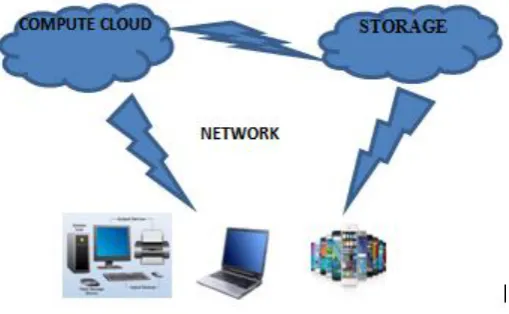
The below figure shows the SOA cloud computing along with the models:
Figure1 1: SOA Cloud Computing
Below are the models that are differentiated on the horizontal scaling basis in cloud computing
Infrastructure-as-a-Service (IaaS): It provides a hardware platform as a service.
Platform-as-a-Service (PaaS): It provides end-users an application development environment delivered over the internet.
Software-as-a-Service (SaaS): It provides end-users a standardized, network-delivered IT application. The distinctions are made according to availability and the location of installation in the deployment models. Private clouds are internal company services whereas public clouds are the services that are available to the public on internet.
In the large companies where IT plays an important role, internal company cloud solutions are often built in their own data canters. Small and medium companies often use public cloud services. Cloud Computing provides a very flexible and scalable platform through processing external services and also has the ability to connect with customers, suppliers etc.
1.3 Classification of SOA Cloud computing
Cloud computing can be classified in general into four types: public, private, hybrid and community cloud.
Public cloud infrastructure is designed for open use by general public. It may be managed and operated by a company and its multiple partners and it exists externally on the premises of the cloud provider (Mell & Grance, 2011). The comparative advantage of public cloud against in-house systems is that companies do not have to concern about the systems‘ construction or maintenance (Pires & Carmago, 2010). Using public cloud, the end-user can achieve an inexpensive set-up, as the application costs are covered by the thirdparty provider. Moreover, the cost of using such a service is being kept at the lowest as the users pay for what they use (Zhou et al., 2012).
In contrast, private cloud is an on-premises cloud infrastructure accessed by users of different business units within a company (Pires & Camargo, 2010). Since the main motivation for employing cloud services is independence from having to operate internal computing resources, the term of private cloud is an oxymoron (Kim et al., 2009). However, the need for lower risk and high security levels makes private cloud an intriguing concept. As shown in Table 1, the choice between private and public cloud depicts a tradeoff between security and flexibility respectively (Schramm et al., 2010).
Another type of cloud computing is the hybrid cloud, which is a combination of private and public cloud. In this type, ―two or more distinct cloud infrastructures, while remaining unique entities, are bound together by standardized or proprietary technology that enables data and application portability‖ (Mell & Grance, 2011, p. 3). In a hybrid cloud, a company can maintain its private cloud and then scale out to a public when local capacity is exhausted (Sujay, 2011). In other words, when in-house systems are not able to support workload peaks, the external system becomes available for the users (Pires & Camargo, 2010). Hybrid clouds balance the benefits and risks between private and public clouds, as well as the operating cost of the in-house infrastructure and the usage-based cost of the cloud provider services.
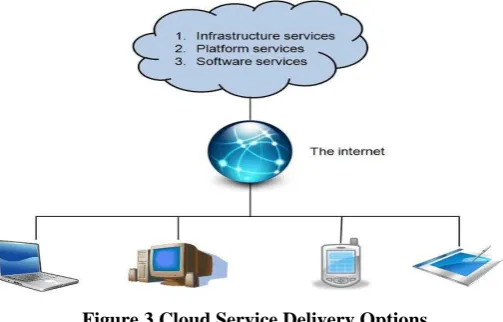
Figure 2Cloud Service Delivery Options
1.4Cloud Services or Service Model
A number of options are available to consumers as they embark on their journey to the cloud, and the rest of this section summarizes the key decisions they face. The first major decision for a consumer is the level of IT outsourcing (Figure 1). Cloud computing consists of three different service models namely Infrastructure-as-a-Service, Platform-as-a-Service and Software-Infrastructure-as-a-Service, each one of them serving different requirements of cloud users.
1.4.1 Infrastructure-as-a-Service (IaaS)
IaaS model is a platform through which businesses can avail equipment in the form of hardware, servers, storage space and others, at pay-per-use service. In this service model, cloud providers offer from physical or virtual machines to raw storage, firewalls, load balancers and networks (Mell & Grance, 2011). More specifically, the user buys these resources as a fully outsourced service instead of buying servers, software and network equipment (Conway, 2011). A remarkable example of IaaS is Amazon Cloud Services, a web-based platform that offers online services via its webpage, amazon.com. Two popular services are Amazon EC2 and Amazon S3, each of them covering specific areas of interest.
1.4.2 Platform-as-a-Service (PaaS).
PaaS model offers a higher level of abstraction compared with IaaS model that focuses on providing raw access on virtual or physical infrastructure (Garg & Buyya, 2012). In PaaS, cloud providers host a computing environment typically including operating system, data base and programming language execution environment, where users develop and deploy applications (Sujay, 2011). Users can rent virtualized servers for running existing applications or developing new ones without the cost and complexity of buying and managing the related hardware and software (Conway, 2011). In some cases, the underlying compute and storage resources scale automatically to catch application demand so that cloud user does not have to allocate resources manually. Some examples of PaaS are Google Apps and Windows Azure. Windows Azure is a service provided by Microsoft, where someone can build, deploy and manage all the applications across a network of data centres based on a Microsoft environment.
1.4.3 Software-as-a-Service (SaaS)
Figure 3 Cloud Service Delivery Options
II.
CLOUD-BASED SUPPLY CHAIN MANAGEMENT
The application of cloud computing concept in the context of supply chain management is an innovative practice that generates a new field of study.
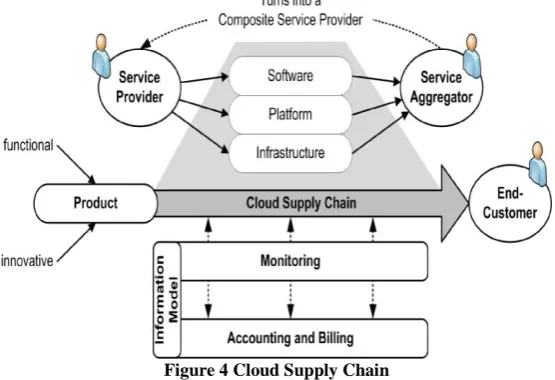
A cloud supply chain is two or more parties linked by the provision of cloud services, related information and funds (Lindner et al., 2010, p. 3).[4]
However, before shifting from a traditional supply chain to a cloud supply chain, companies should first identify the technical requirements for migrating supply chain activities to the cloud. This transformation process can be executed by using the cloud lifecycle, which is an improvement lifecycle with multiple steps that allows the process of transformation to be evaluated and improved
Cloud computing has clearly become a driving force in the information technology world. Over 90% of global enterprises report using cloud as part of their business 1.
2.1 CLOUD COMPUTING WITH SCM ACTIVITIES
In cloud computing, the applications of supply chain are innovative and generate a new field of research. Two or more parties linked by cloud services in cloud supply chain to provision of cloud services, related information and funds.
A. Forecasting and planning Cloud-based platforms are going to help companies improve their service levels by collaborating the chain‘s partners (retailers, suppliers and distributors) that are playing a major role in demand forecasting. These clouds based platforms get the data from internet and perform basic operation like analytics and perform more accurate demand forecast for all supply chain partners. This will help to the chain partners to aware of real demand volatile they have to handle with.
B. Source and procurement Sourcing includes acquisition, receipt and inspection of incoming materials as well as procurement process. Cloud based platform operate on database contains multiple data from different suppliers which provide efficient and different benefit for companies that handle thousands of them. On the other hand companies are able to select between supplier that which of them are able to provide appropriate martial as their specification and within time. Cloud based tools also enable companies and suppliers to mutually develop contracts and enhance contract management.
C. Inventory Management Using Wireless Devices Inventory management enhanced by many organizations using bar coding technologies and wireless services. RFID system integrates with the cloud based centralized data management sys-tem to deliver the global identification and tracking of any items or goods across the global supply chain management lifecycle [5].
D. Collaborative Design and Product Development Along with the development of information technology, internet network transmission technology is mature gradually, its security, stability, compatibility is constantly improved, and all application range is expanding continually, become a kind of the making universal of transmission [6]. Collaborative product development includes the use of product design and development techniques across multiple branches of same organization or between different organizations. All the developments process shared over secure network between different organizations. These processes include specific information, marketing firm, test result and design changes as well as customer feedback.
1) On demand self-service: Consumers parallel request and use computing capabilities without any human interaction with their service provider. Here internet access allows users to consume computing capabilities by means of client‘s platforms like mobile phones, note books or PCs.
2) Resource Pooling: In order to fulfill the consumers demand from multiple consumers, the cloud computing service providers pooled their resources. The provider dynamically assigns or reassigns physical or virtual resources to consumers. Consumers on the other hand have no knowledge about the resource location which is assigned to consumers.
3) Elasticity: In cloud computing it is the ability of providers to quickly add and release the resources as soon as possible to match changes in consumers demand. This should be done in efficient manner. 4) Scalability: Kopparberg et al. (2011) analyze the characteristics of elasticity and scalability in more detail and explicitly distinguish between scalability and elasticity. Scalability means that a system ―maintains its performance goals/SLAs even when its workload increases (up to a certain workload bound).‖ Whereas an elastic system dynamically adds or release more resources when service demand increase or decreases respectively. So elasticity adds dynamic component to scalability.
Figure 4 Cloud Supply Chain
III.
CLOUD COMPUTING CONTRIBUTIONS IN SCM APPLICATIONS
Recent reports by P&S Research have projected the value of cloud-based SCM solutions to surpass $11B, by 2023.
Most supply chain strategies originate from earlier times when the business environment was more stable. Now, as every business becomes a digital business, digitization has the potential to transform the supply chain by making services more valuable, accessible and affordable. Vendors and big business, alike, are racing to integrate the best technologies possible in order to stay ahead of competition. In the recent years, there has been an influx of cloud-based SCM solutions hitting the market or receiving massive funding for development.
For digital technologies to create new supply chain opportunities, a new perspective is needed. Organizations should reimagine the supply chain as a digital supply network that unites not just physical flows of products and services, but also talent, information and finance. In an abstract sense, people and data—as well as materials, products and supplies—must travel together across the extended enterprise. It is the Cloud Computing which can have a transformational impact on the business and the supply chain operating model by enabling data and analytics, mobility and social media functions.
Cloud computing helps organizations to realize major benefits from key marketplace trends that are redefining traditional supply chain networks:
1. Volatility is the new normal although unstable conditions are familiar terrain to supply chain professionals; few supply chains can accommodate the relentless speed and amplitude of volatility today. Cloud computing facilitates enhanced responsiveness to supply chain disruptions.
3. Digital technologies are industrial grade the flow of goods can now be managed with digital tools that leverage high volumes of data from multiple sources; connect resources (machines and humans) in real-time, and embrace social media to collaborate beyond organization boundaries. By moving to the cloud, organizations can operate with increased flexibility and mass-customize their products and services.
4. Agility-
The sharing and streamlined computing that is possible when utilizing cloud-based supply chain solutions makes for enhanced business agility.
A supplier audit is required and is completed in China, and the results are needed in Berlin — within the hour — to be able to make a deadline decision about continuing the supplier collaboration. The agility of this data compilation and sharing is crucial considering the supplier being audited was named in a child labor scandal, and the facts have yet to be confirmed. With a SCM solution, living in the cloud, this wouldn‘t even be a pain point. There are solutions on the market that would compile the data from an audit — within a cloud-based solution — and automatically share the auditor‘s results with HQ. Taking data from the floor to the head office in the blink of an eye (Kodiak Rating 2017).
5. Integration
Cloud computing is a wonderfully integral method of computing which holds strong potential for streamlined sharing, input and output of data sets amongst teams, individuals or cross-organizational. Moreover, cloud-computing solutions typically have capabilities to be ‗plugged in‘. ‗Plugging in‘ is simply the sourcing of data from one cloud to another.
This gives supply chain management professionals the opportunity to work from more robust platforms with a wider range of capabilities.
―The use of cloud technology enables multiple platforms to work with one another through a series of standardized protocols. Therefore, the previously existing digital boundaries between rapid communication and order fulfillment become nonexistent‖ (cerasis 2015).
Subsequently, cloud platforms resonate with higher trust and transparency amongst the parties utilizing a shared cloud.
6. Planning
Cloud technology provides capabilities such as real time inventory. Don‘t worry about making a promise you can‘t keep to a hopeful customer. Data sets of inventory can be managed at the palm of your hands, to ensure you‘re never losing track of your inventory levels.
As far as WMS or TMS problems…
―The cloud‘s ability to coordinate information with a specific solution can prevent any delays that might be caused by miscommunication or missed savings that might come from obfuscated data‖ (supplychain247.com 2013).
7. Scalability
While operating within a shared cloud, the accessibility of data sets is a lot more scalable. Especially when businesses are operating globally, but need to keep lines of communication and/or are in collaboration. Keeping multiple networks of individuals, or companies. under one cloud defies geographical boundaries; considering storage, sharing and communicating just require a WiFi connection.
This kind of scalability is crucial in operational procurement and sourcing teams.
―Within minutes, a supply chain management provider can extend the terms, or services, with the respective cloud host to account for the instant growth in capability. Furthermore, the use of cloud-based analytics allows businesses to isolate key inefficiencies within the order fulfillment process, which will further grow the respective business‖ (cerasis 2015).
That is business agility, at scale.
8. Competitiveness
You saw the trends. If your supply chain isn‘t on its way towards cloud-integration, you can bet your bottom dollar that your competitors‘ supply chains are on the way there.
The capability of cloud-solutions has created competitiveness between organizations that couldn‘t exist without such technology. Small and mid-sized organizations are able to function with the same agility and transparency that enterprise organizations are capable of.
within a reasonable price range — can give the underdog a fighting chance, without spending exorbitant amounts of time or money.
In enterprise competition, cloud-based solutions can help fight competitors by enhancing internal collaboration. In a 2012 study by SCM World, comprising a community of the senior supply chain professionals from over 150 of some of the world‘s largest companies, it was found that:
―46% of respondents report that greater supply chain collaboration leads to problems being solved twice as fast‖ (Columbus 2014). And this was back in 2012….
Figure 3Cloud Service Delivery Options
4. Necessary for adopting cloud computing in SCM Taking a strategic approach:-
A strategic approach to implementation is essential. This should recognize that not all supply chain processes are suitable candidates for migration to the cloud. Two categories of process in particular may prove to be unsuited to cloud computing. First, complex and/or unique processes that require a heavy degree of customized processing are less likely to be delivered as cloud computing based services, at least in the near future. And second, processes that require heavy integration with either a physical flow or with other information systems— particularly those requiring ultrafast response times— are currently not well-suited to cloud.
So which capabilities should be considered for deployment in the cloud—and how best to get underway? Companies are flocking in ever-increasing numbers to cloud‘s ―everything-as-a-service‖ promise. But it is important to recognize that a reliance on traditional, in-house IT systems and applications still exists. What has emerged is a more complex hybrid-technology landscape—one in which multiple emerging technologies must be assimilated with legacy systems. To transition effectively and manage in this hybrid world, organizations need deep knowledge, experience and insights into both cloud and legacy technologies. Moreover, they need the know-how, solutions, assets and implementation firepower to take optimal advantage of the unique opportunities that a hybrid model provides.
As the SCM application market expands, we are seeing different rates of adoption across the four core elements of the supply chain:
SaaS for Supply Chain Planning Although levels of adoption in this segment are low, especially in large enterprises, the supply chain planning (SCP) market is expected to grow rapidly as current concerns—such as data security and ERP/cloud integration—are overcome.
SaaS for Sourcing and Procurement There are high levels of adoption in this segment, largely because of the rapid implementation, low cost and innovation provided by SaaS solutions.
SaaS for Manufacturing On-premise is the dominant software delivery model for manufacturing management. However, there are alternative delivery models for software supporting environmental, health and safety activities, quality management, and business intelligence.
International organization of Scientific Research
74 | Page
REFERENCES
[1]. Design of multi-agent based cloud integrated manufacturing system (CIMS) for new product development, The Business and Management Review, Volume 6 Number 4, August 2015.
[2]. https://www.tutorialspoint.com/soa/soa_cloud_computing.htm
[3]. Public vs Private vs Hybrid vs Community - Cloud Computing: A Critical Review, I.J. Computer Network and Information Security, 2014, 3, 20-29 Published Online February 2014 in MECS (http://www.mecs-press.org/) DOI: 10.5815/ijcnis.2014.03.03.
[4]. The Cloud Supply Chain:A Framework for Information, Monitoring,Accounting and Billing, Maik Lindner , Ferm´ın Gal´an, Clovis Chapman , Stuart Clayman , Daniel Henriksson January 2011
[5]. B.Andal Supriya, Ilango Djearamane , RFID based Cloud Supply Chain Management, International Journal of Scientific & Engineering Research, Volume 4, Issue 5, May-2013, 2157, ISSN 2229-5518 [6]. CHEN JUN, MA YAN WEI, The Research of Supply Chain Information Collaboration Based on Cloud
Computing, 2011 3rd International Conference on Environmental Science and Information Application Technology (ESIAT 2011), Procedia Environmental Sciences 10 (2011), 875 – 880.