Research on E-mail Filtering Based On Improved
Bayesian
Liu Pei-yu
˄Shandong Normal University, Shandong Ji’Nan 250014, China˅ E-mail: [email protected]
Zhang Li-wei
˄Shandong Normal University, Shandong Ji’Nan 250014, China˅ E-mail: [email protected]
Zhu Zhen-fang
˄Shandong Normal University, Shandong Ji’Nan 250014, China˅ E-mail: [email protected]
Abstract
—
Naïve Bayesian has been widely used in spam filter because it simply and it also could classify texts more correctly and quickly. However, in the process of classifying and filtering, the traditional method doesn't consider the different features between the spam mail and the legitimate mail, and it also doesn't take into account the loss of misclassifying legitimate mail as spam, so there are many limitations of e-mail filtering. An improved algorithm based on Naïve Bayesian and Boosting method is proposed in this paper. The experiment result shows that the improved algorithm has better performance.Index terms—Spam; E-mail Filtering; Bayesian Algorithm; Boosting method
I. INTRODUCTION
The popularity of the Internet added a new information channel of communication to people's
1
work, study and life. At the same time, the influence that it brought is more and more widespread. The emergence of large number of spam has become a social hazard. In order to enable Internet environment clean and beautiful, and make Internet users especially young students stay away from the harassment of non-friendly information, network information filtering technology has now become a hot research>@
.
With the rapid development of Internet, e-mail has become one of the most popular communicating modes for users for its convenience, speediness and cheapness. But spam (also referred to as “junk mail”) is emerged with the convenience of e-mails, and bring harms to users. It is very late to begin researching on spam filtering in China; the spam in our country is quite serious. Nowadays, China has been the third most serious country in the world about the spam. So study of spam filtering is of great significance.
Fund to support: Fund for Nature of Shandong Province (Y2006G20)
II. AN INTRODUCTION TO E-MAIL FILTERING At present, E-mail filtering technology is the most used against the spam. E-mail filtering can be sub-divided into: Mail Transport Agent (MTA) filtering, Mail Delivery Agent (MDA) filters, Mail User Agent (MUA) form the filter architecture [3]. The main methods of anti-spam include based on E-mail address filtering technology, reversely verify domain names technology, based on rules (key words) filtering technology, and based on the statistical study of the E-mail filtering technology. Based on the statistical study of the E-mail filtering technology is the mainstream currently. In fact, based on the statistical study of the E-mail filtering technology is a binary classification. All kinds of text classification methods can be used for anti-spam, such as KNN Algorithm, SVM, Decision Tree and Bayesian Algorithm.
A. KNN Algorithm
KNN was proposed by Cover and Hart in 1968 at first, and theoretically it is a mutual approach. The thinking of the method is very simple and intuitive. We find k-nearest neighbors of a text (vector) in feature space. If most of them belong to a certain category, then this text (vector) belongs to the category, too. The advantages of this method are simple and accurate. When it comes to E-mail filtering, E-mails are divided into two types (legitimate E-mail and spam) in KNN Algorithm. We can find K nearest neighbors in the feature space. If majority of the K neighbors are belong to spam, the E-mail is classified as spam. The method is very simple, but its calculation is even larger, and can’t adapt to the changing E-mails.
B. Support Vector Machine
error) and has a minimum weight of vector. After using vector space model to express the characteristics of the document, the user’s needs information can be seen as a document. That is to say, it can be expressed as a vector. The degree of similarity between documents and user’s interests can be signified by the cosine similarity of the documents and user’s interests.
SVM has the following features:
a. They have a minimum distance of the training sample from hyper-plane in all kinds of categories. b. Though it has little vectors, it contains all the
information which we used to classifying.
c. Most training samples are not support vector, so the removal or reduction of these samples has no impact on the classifier.
When the sample space can be non-linear sharing, the sample space can be mapped onto a high-dimensional space by using kernel function. Operational point plot can be computed in the new space. In order to facilitate calculation, we usually choose three kernel functions as mapping functions: polynomial kernel function, RBF and Sigmoid function. SVM is a structure based on risk minimization of the pattern recognition method.
When it is used to filtering E-mails, the method aims to find a hyper plane. This plane can clarify E-mails into legitimate E-mails and spam as rightly as possible, and the two types of the data are farthest form the plane. SVM can achieve good results of classification with a small training set. However, SVM can’t adapt changing E-mails, too. Filtering effect is bad, when filtering new spam.
C. Decision Tree
In mathematics, the performances of the above methods are to build judgment surfaces. In fact, this surface is hard to build, because we will encounter various difficulties. Decision Tree is one of the most commonly method, because it has the following advantages:
a. As Decision Tree is divided into a few steps to carry out, the accuracy of the judgment is higher.
b. Judgment rules can be chosen some simple ones at each step.
c. we needn’t to use all the features at each step. A few effective ones are enough. It will reduce the workload of each step.
d. classify faster.
The disadvantage of the method is that it will cost much time to build classifier. It has another question: the stability of the tree’s structure. In addition, the use of the features and classification methods for different levels is a difficult job.
D. Bayesian Algorithm
“Bayesian” named after Thomas Bayes who was a famous mathematics, he developed a new possibility of inference theory which can predict the future by the past.
Bayesian classification model is a typical method of classification based on statistical models. Bayesian theorem is the most import formula in Bayesian theory, and it is the foundation to learning Bayesian. It combines the priori probability with the posterior probability wonderfully, and it predicts the posterior probability by using the prior probability and the sample data. Anti-spam model based on Bayesian Classifier deals with study of E-mails. It can be used to training E-mails sample set, identifying the division, refining the characters of the spam (training results). We can achieve Bayesian Classifier based on this model, use it to detect E-mail, and filter E-mail, if it is classified as spam. Bayesian filters are based on "self-learning" smart technology, and it can be adapt itself to the new tricks. Bayesian filters provider the legitimate E-mails with protection. Bayesian filtering technology has been applied to more and more anti-spam products, and it is one of the most effective anti-spam technologies. In spam filters, the naïve Bayesian has good effect, and it is very simple. An E-mail
e
i can be expressedby
x
e(
x
1,
x
2,
,
x
n)
i
o
, and the probability of
e
ibelonging to
C
k (generally, E-mails can be dividedinto two types, legitimate E-mail
C
legal , andspam
C
rubbish) is:¦
o o
) , (
)
|
(
)
(
)
|
(
)
(
)
|
(
rubbish legal k
k e k n
l
k l k
e k
C
x
P
C
P
C
x
P
C
P
x
C
P
i
i (1).
In the above formula, we suppose that one feature is independent of the others, that is to say that the incidence of one word occurring in the E-mail is independent of the incidence of the other word occurring.
E. The Reason To Use Bayesian
Spam filtering and the generally classifications have many differences, as follows:
a. Both the mail severs and user client, the real-time requirements of the spam filtering is higher. We must choose the text classification which is simpler and faster as far as possible.
b. The relation of the general classification technology and text provider is either no matter or cooperative relations. But the relation of the spam manufacturers and filter developers is antagonistic relation. One side wants to filter spam as soon as possible. But the other wants to manufacture much spam and bypass the filters by all means.
Compared with the above filtering algorithms, Bayesian filtering algorithm has the following advantages: (1) through the study of new spam and normal samples of spam, Bayesian will be able to combat the latest spam, and has better effect on various font. (2) Bayesian Algorithm is difficult to deceive. (3) In efficiency, Bayesian Algorithm is superior to the other algorithms. (4) Bayesian Algorithm can update with the constantly receiving E-mails. Therefore, Bayesian Algorithm is the most common method which is used to filtering spam, in the form of Naive Bayesian classifier.
III. IMPROVED NAIVE BAYESIAN ALGORITHM
We know that Naïve Bayesian algorithm is based on “Bayesian assumptions” which assume that each of the characteristics is independent by analyzing the theory. In fact, this assumption is difficult to exist. Experimental data also show that Bayesian algorithm makes important information lost, and leads to misjudging spam and legitimate mail. So, in this paper, we introduce Boosting method to the e-mail filtering field, and propose an improved filtering algorithm combined the Naïve Bayesian algorithm with Boosting method ü the improved Naïve Bayesian algorithm based on Boosting method. This method’s aim is to reduce the rate of the misjudgment, and to improve the accuracy of classification.
A. An Introduction To Boosting
Boosting method was proposed in the 1990s. Boosting is a general method which can boost the precision of the algorithm by many rounds learning and obtain much more accurate prediction rule by majority. This method can effectively transform the weak learning algorithm into strong learning algorithm. Boosting is a universal learning algorithm which can improve any given algorithm performance. Boosting has its roots in a theoretical framework for studying machine learning called the “PAC” learning model, due to Valiant >@; see Kearns and Varian>@
for a good introduction to this model. Kearns and Valiant>ˈ@were the first to pose the question of whether a “weak” learning algorithm which performs just slightly better than random guessing in the PAC model can be “boosted” into an arbitrarily accurate “strong” learning algorithm. Sharpie>@ came up with the first provable polynomial-time boosting algorithm in 1989. A year later, Freund>@ developed a much more efficient boosting algorithm which, although optimal in a certain sense, nevertheless suffered from certain practical drawbacks. The first experiments with these early boosting algorithms were carried out by Drucker, Schapire and Simard>@ on an OCR task. Nowadays, Boosting has been simply and effectively used for modeling, image segmentation, intrusion detection, data mining and so on>@.
The basic idea of Boosting method is >@
: The algorithm takes as input a training set
) , ( , , , ,
, 1 2 2
1 y x y xN yN
x ˅˄ ˅
˄ where each
x
ibelongs to somedomain or instance space
X
, and each labely
iis insome label set
Y
. The algorithm calls a given weak or base learning algorithm repeatedly in a series of roundst
1
,
,
T
. The weight of this distribution ontraining example
i
on roundt
is denotedD
ti
. Initially, all weights are set equally, but on each round, the weights of incorrectly classified examples are increased so that the weak learner is forced to focus on the hard examples in the training set.The weak learner’s job is to find a weak hypothesis
h
t . Then the algorithm chooses aparameter E˄t EtC˅ which directly measures the
importance of
h
t. AfterT
cycles, we can achieve thefinal assumption
H
by weighted voting. An individual weak learner has low rate of accuracy, but after we use boosting, the accuracy of the final outcome will be enhanced.B. Improved Naïve Bayesian Algorithm Based On Boosting Method
We take the Naïve Bayesian algorithm as “weak” learning algorithm to be boosted. (In order to facilitate the narrative, we recorded the Naïve Bayesian as a filter function
h
(
x
)
. There into,x
stands for the e-mails to be classified. ) According to the training example sequence ˄xi,yi˅and the weight of distributionD
t, weget a filter function
h
˄
tx
˅
. At the same time, we update of each example’s weight (give the larger weight to the incorrectly classified example). After T rounds of suchtraining, we get a filter function
sequence
h
1ˈ
h
2ˈ
ˈ
h
T . Finally, we get a boostedfiltering function
H
(
x
)
by the way of using a weighted majority vote.The improved Naïve Bayesian algorithm based on Boosting method describes as follows:
Step 1ˊInput: sequence of N examples
) , ( , , , , , 1 2 2
1 y x y xN yN x ˅˄ ˅
˄ with
x
i
X
( X standsfor training examples space ) ˈ
y
i
C
{
c
1,
c
2}
( c1stands for the class of legitimate mail, c2standsfor the class of spam)
Initialize˖
)
,
,
1
(
,
1
N
i
N
i
D
t (2)Step 2ˊDo for
t
1
,
,
T
˖˄2˅Calculate the error
E
t˄E
t is the sum of theweights of incorrectly classified examples˅˖
¦
z
T
t
i i t t
t
D
i
h
x
y
E
1]
)[
(
˄
˅
(3),Choose:
t t t
E E
1 ln 2 1
E
(4)˄3˅Update:
t i t i t t
t
Z
x
h
y
i
D
i
D
1exp(
(
))
E
(5)
ˈwhere
Z
tis
a normalization factor (chosen so that Dt1 will be a distribution).Step 3ˊOutput˖
¦
Tt t th x
H
1
) ( )
x
(
E
(6)C. Evaluation Of The Algorithm
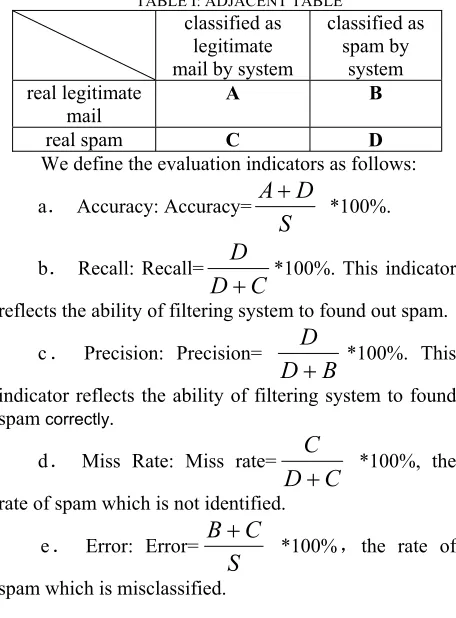
In the spam filter, we need to define some indicators to evaluate the spam filter effects in addition to the public corpus. These indicators are generally form text classification and information retrieval>@. We assume that there are S(S=A+B+C+D) e-mails in the test set. To facilitate the narrative, we define some variables in Table I.
TABLE I: ADJACENT TABLE
classified as
legitimate mail by system
classified as spam by
system real legitimate
A B
real spam C D
We define the evaluation indicators as follows:
aˊ Accuracy: Accuracy=
S
D
A
*100%.
bˊ Recall: Recall=
C
D
D
*100%. This indicatorreflects the ability of filtering system to found out spam.
cˊ Precision: Precision=
B
D
D
*100%. Thisindicator reflects the ability of filtering system to found spam correctly.
dˊ Miss Rate: Miss rate=
C
D
C
*100%, therate of spam which is not identified.
eˊ Error: Error=
S
C
B
*100%ˈthe rate of
spam which is misclassified.
IV. EXPERIMENTAL RESULTS
We randomly selected 2000 e-mails from Chinese e-mail corpus of CCERT>@ and CASA>@training examples to be classified, andrandomly selected 400 e-mails as test set, including 100 legitimate mails and 300 spam. In order to prevent the chanciness of the experimental results, we have calculated the average of the results.
TABLE II: EXPERIMENTAL RESULT OF NAÏVE BAYESIAN ALGORITHM
classified as legitimate
mail by system
classified as spam by
system
total
real legitimate
e -mail
89.25 10.75 100
real spam 12.25 287.75 300
total 101.5 298.5 400
The experimental result of the improved Naïve Bayesian algorithm based on Boosting method is shown in table III.
TABLE III: EXPERIMENTAL RESULT OF IMPROVED FILTERING ALGORITHM
classified as legitimate
mail by system
classified as spam by
system
total
real legitimate
96.5 3.5 100
real spam 6.33 293.67 300
total 99.83 300.17 400
Actually, there are 400 e-mails classified, including 100 legitimate mails and 300 spam. When the Naïve Bayesian algorithm is used, the system has classified 101.5 legitimate mails and 298.5 spam. The system has mistaken 10.75 legitimate mails as spam and has mistaken 12.25 spam as legitimate mail. And when we use the Improved Naïve Bayesian algorithm based on Boosting method, the system has classified 99.83 legitimate mails and 300.17 spam. The system has mistaken 3.5 legitimate mails as spam and has mistaken 6.33 spam as legitimate mail.
TABLE IV: COMPARISON OF EXPERIMENTAL RESULTS OF THE TWO FILTERING ALGORITHMS
Naïve Bayesian
Improved filtering algorithm
Accuracy 94.25% 96.79%
Recall 95.92% 97.89%
Precision 96.4% 97.83%
Miss rate 4.08% 2.11%
From Table IV, we know that the Improved Naïve Bayesian algorithm based on Boosting method has better performance than the traditional Naïve Bayesian algorithm in terms of Accuracy, Recall, Precision and so on. The improved filtering algorithm can not only improve the accuracy of spam filter, but also reduce the loss of the information and the error rate of misclassifying mail.
V. CONCLUSION AND FURTHER WORK
This article combined Bayesian algorithm with Boosting, presented a new spam filtering algorithm. Bayesian algorithm ignores the import information. The experiment shows that the algorithm can solve it. The algorithm is feasible. Our next step work begins with the following two aspects:
(1) In this paper, the feature vector we used is information gain. We will try other feature selected method, such as mutual information, TFIDF.
(2) Further study of the other advanced algorithms.
REFERENCES
[1] F. Crimmins, A. Smeaton, T. Dkaki, et al. Information discovery on the Internet. Intelligent Systems and Their Applications, IEEE. 1999: 55-62.
[2] Levitt, Mark Comiskey, Mike. Bright Light Focuses on Eliminating Spam. IDC Corporation. July 1998.
[3] Yong-jie Hu, Hong-xie Bo. Research on spam filtering technology. Journal of Hebei Normal University (Natural Science), 2006: 158-160.
[4] L. G. Valiant. A theory of the learnable. Communications of the ACM, 27(11):1134–1142, November 1984.
[5] Michael J. Kearns and Umesh V. Vazirani. AnIntroduction
to Computational Learning Theory. MIT Press, 1994. [6] Michael Kearns and Leslie G. Valiant. Learning Boolean
formulae or finite automata is as hard as factoring. Technical Report TR-14-88, Harvard University Aiken Computation Laboratory, August 1988
[7] Michael Kearns and Leslie G. Valiant. Cryptographic limitations on learning Boolean formulae and finite automata. Journal of the Association for Computing Machinery, 41(1):67–95, January 1994
[8] Robert E. Schapire. The strength of weak learnability. Machine Learning, 5(2):197–227, 1990.
[9] Yoav Freund. Boosting a weak learning algorithm
bymajority. Information and Computation, 121(2):256–285, 1995.
[10] Harris Drucker, Robert Schapire, and Patrice Simard. Boosting performance in neural networks. International Journal of Pattern Recognition and Artificial Intelligence, 7(4):705–719, 1993.
[11] FREUND Y, LYER R, SCHAPIRE R E, et al. An efficient boosting algorithm for combining preferences in machine learning. Proceedings of the Fifteenth International Conference. 1998:1-9.
[12] Schapire R E. A Brief Introduction to Boosting//
Procedings of the 16th International Joint Conference on
Artificial Intelligence, 1999.
[13] Zeng Chun, Xing Chunxiao, Zhou Lizhu. A Personalized Search Algorithm by Using Content-Based Filtering. Journal of Software[J]. 2003,14(5):999-1004.
[14] China Education and Research Network Computer
Emergency Response Team. http://www.ccert.edu.cn/index.htm
[15] China Anti-Spam Alliance. http://www.antispam.org.cn/
Prof. Pei-yu Liu˖Male, Broth in 1960, Doctoral tutor. Main research directions are computer network and information security, network system planning, network information resources development and software development technology.
Li-wei Zhang: Male, Broth in 1982, Postgraduate. Main
research direction is information filtering.
Zhen-fang ZHU: Male, Broth in 1981, Postgraduate. Main