Synchronization of Super Chaotic System with
Uncertain Functions and Input Nonlinearity
Junwei LeiA
A Department of Control Engineering, Naval Aeronautical and Astronautical University, Yantai, China Email: [email protected]
Jinyong YuB
A Department of Control Engineering, Naval Aeronautical and Astronautical University, Yantai, China Email:[email protected]
Lingling Wang C and Yuqiang Jin D
B C Department of Control Engineering, Naval Aeronautical and Astronautical University, Yantai, China D Department of Trainning, Naval Aeronautical and Astronautical University, Yantai, China
Email: {[email protected], jinyuqiang1024D@126.com}
Abstract—The double integral sliding mode synchronization
method is studied for a class of super chaotic systems. Both the unknown parameters and uncertain nonlinear functions are considered for the driven and response chaotic systems. It is worthy pointing out that a kind of input nonlinearity is taken into consideration when the synchronization controller is designed. The uncertainties are very complex in this situation and the steady state error can be compensated by the introducing of integrator in the sliding mode design. Also, the double integral sliding mode method has both the advantages of PI controller and sliding mode controller. So it is a new kind of integral sliding mode construction method and the numerical simulation proves the rightness of the proposed method.
Index Terms—Double integral; Sliding mode; Chaos;
Synchronization; Input nonlinearity; Uncertainty
I. INTRODUCTION
Chaos systems [1-3] have complex dynamical behaviors that possess some special features such as being extremely sensitive to tiny variations of initial conditions, and having bounded trajectories with a positive leading Lyapunov exponent and so on. Chaos control [4, 5]and chaos synchronization are two main problems of chaotic system research. In recent years, chaos synchronization has been attracted increasingly attentions due to their potential applications in the fields of secure communications.
The uncertainty [6, 7] is the main difficulty of chaotic system synchronization and synchronization of chaos systems with unknown parameters [8,9] is investigated widely by researchers from various fields. In fact, input uncertainties usually exist in actual control systems, but the situations of chaos systems with input uncertainties are neglected in most papers.
There are adaptive method[10,11], neural network method[12-15], robust method[16-21], output
feedback[22,23,24], linear feedback[25,26], PI control[27] and sliding mode method[28,29] to solve uncertainties of nonlinear system in control theory. For chaotic systems, researches are mainly focused on uncertain function [30], unknown parameters [31] and unknown control directions [32-35].
It is well known that, it is more difficult to estimate the unknown parameters exactly than to achieve synchronization. The estimation of unknown parameters often couldn’t converge to its real value in many simulations. It is a difficult problem that is often neglected by many researchers unconsciously or on purpose, and some researchers intended to find the answer for this question. But obviously the problem hasn’t been solved successfully until now. In this paper, since we consider a chaotic system with uncertain functions and input nonlinearity, so we do not consider the parameter estimation problem, because it is impossible to estimate all these unknown parameters with all above uncertainties. It can make a conclude that the unknown parameters can’t be estimated in some situation according to some researchers’ paper. So we just discuss how to improve the synchronization accuracy under all above uncertain conditions.
Robust control and adaptive control of nonlinear systems with linear input uncertainties has been researched widely and many good results are achieved. But those methods can not be used for systems with nonlinear input uncertainty even with some transformation and improvements.
Her-Terng Yau [2] proposed a PI sliding mode synchronization theorem for three kinds of chaotic systems(Lorenz-Chen, Chen-Liu and Liu-Lorenz)
with input nonlinearities based on Lyapunov stability theorem. But only the ideal chaotic system without uncertainties is synchronized and other situations such as parameters uncertainties or unknown nonlinear functions are not considered.
Tsung-Ying [3] designed an adaptive sliding mode controller for unit chaotic system with dead zoom. The Lyapunov stability theorem and PI type sliding mode are introduced in the design so both advantages of the two methods are integrated. The existence of nonlinear function is studied and the bound of uncertainties are assumed to be linear. A PI type sliding mode is constructed and the stability is analyzed. Based on that, a type of double integral sliding mode is proposed in this paper and choose of Hurwitz parameters guaranteed the stability of the sliding mode. The dead zoom nonlinearity considered in [1] is a special nonlinearity. In this paper, a more general nonlinear situation of input nonlinearity is considered.
The paper is organized as followed. In Section 2, the system model of our research is proposed. In Section 3, main assumptions are given. In section 4, a double integral synchronization controller is designed for the chaos systems and synchronization is achieved. In section 5, the numerical simulation is done to verify the conclusions of this paper. In section 6, the conclusions are given and the future work is pointed out.
II. PROBLEM DESCRIPTION
Consider the below driven system and response system, where both the driven system and response system contains unknown parameters and uncertain nonlinear function. The structure of driven system is different from response system.
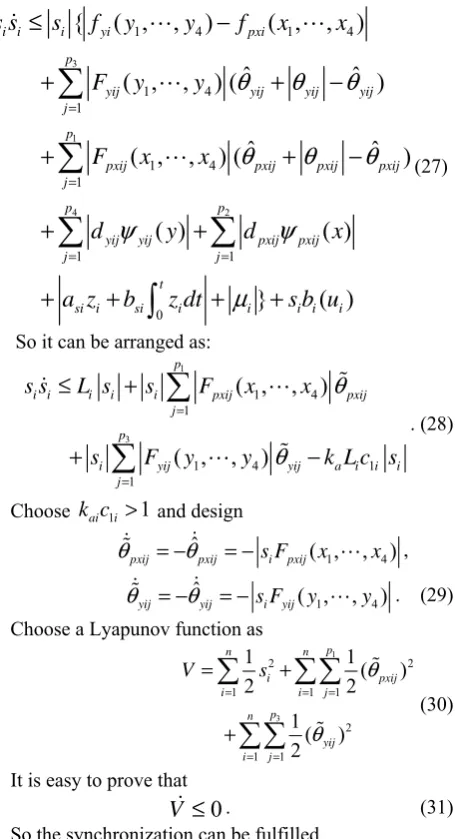
Without loss of generality, assume the dimension of driven system is higher than its response system and assume the dimension of response system is N and the dimension of driven system is N+R, so it can be written as follows:
For driven system, it holds
p p x( ) p x( ) p x p x( , )
x = f x + F x θ + Δ x t . (1)
For the else R dimension system, it has
r r x( ) r x( ) r x r x( , )
x = f x + F x
θ
+ Δ x t . (2)For the response system
( ) ( ) ( , ) ( ) ( )
y y y y
y= f y +F yθ + Δ y t +b u +d t . (3)
Where
θ
is unknown parameter,Δ
is uncertain nonlinear functions and b u( ) is uncertain nonlinear input function, ( )d t is outer disturbance. Take a three orderresponse system and four-order driven system as an example; it can be expanded as follows:
For the driven system, it has
1 2
1 1 1 2 3 1
1 1 2 3 1 1
1 1 1 ( , , , ) ( , , , ) ( , )
p px p p p r
p
px j p p p r px j
j p
px j j
x f x x x x F x x x x
x t
θ
= = = + + Δ∑
∑
. (4)
1 2
2 2 1 2 3 1
2 1 2 3 1 2
1
1
( , , , )
( , , , )
( , )
p px p p p r
p
px j p p p r px j
j p
pxij j
x f x x x x F x x x x
x t θ = = = + + Δ
∑
∑
. (5)
1 2
3 3 1 2 3 1
3 1 2 3 1 3
1 2 1 ( , , , ) ( , , , ) ( , )
p px p p p r
p
px j p p p r px j
j p
px j j
x f x x x x F x x x x
x t θ = = = + + Δ
∑
∑
. (6)
For the else R dimension system it has:
1 2
1 1 1 2 3 1
1 1 2 3 1 1 1
1 1
( , , , )
( , , , ) ( , )
r rx p p p r
p p
rx j p p p r rx j rx j
j j
x f x x x x
F x x x x θ x t
= =
=
+
∑
+∑
Δ
. (7)
For the response system, it has
3 4
1 1 1 4 1 1 4 1
1
1 1 1 1
1
( , , ) ( , , )
( , ) ( ) ( )
p
y y j y j
j p
y j j
y f y y F y y
y t b u d t
θ = = = + + Δ + +
∑
∑
" ". (8)
3 4
2 2 1 4 2 1 4 2
1
2 2 2 2
1
( , , ) ( , , )
( , ) ( ) ( )
p
y y j y j
j p
y j j
y f y y F y y
y t b u d t
θ = = = + + Δ + +
∑
∑
" ". (9)
3 4
3 3 1 4 3 1 4 1
1
3 3 3 3
1
( , , ) ( , , )
( , ) ( ) ( )
p
y y j y j
j p
y j j
y f y y F y y
y t b u d t
θ = = = + + Δ + +
∑
∑
" ". (10)
Now the unknown parameters arebi,θx andθy.
The control objective is to design a control ˆ
ˆ ˆ ˆ ˆ
( , , ,px px, , , )y y i
u=u x yθ q θ q b , θˆpx=f x y( , ,θˆpx)
,
ˆpx ( , ,ˆpx)
q = f x y q , θˆy= f x y( , , )θˆy
, ˆ ( , , )ˆ
y y
q = f x y q ,
ˆ ( , , )ˆ
i i
b =f x y b such that the synchronization of chaotic
systems with input nonlinearities and unknown parameters can be fulfilled, it means y→xp.
III. ASSUMPTION
Assumption 1: The Nonlinear input function ( )b ui i is
bounded compared withui . In other words, there exist positive constantc1i,c2isuch that:
1i i( ) /i i 2i
c ≤b u u ≤c . (11)
Assumption 2: The outer disturbance is bounded, then there exists positive constant
μ
i such that:( )
i i
d t ≤μ. (12)
With assumption 1, it is easy to prove that
2 2
1i i i i( )i 2i i
c u ≤u b u ≤c u . (13)
Then it holds:
2 2
1 2
1 1 ( ) 1
n n n
i i i i i i i
i i i
c u u b u c u
= = =
≤ ≤
∑
∑
∑
. (14)Choose c1=max( , , , )c11 c12 " c1n and
2 max( , , , )21 22 2n
c = c c " c , then it holds:
2 2
1 2
1 1 1
( )
n n n
i i i i i
i i i
c u u b u c u
= = =
≤ ≤
∑
∑
∑
. (15)IV. DOUBLE INTEGRAL SLIDING MODE ROBUST
SYNCHRONIZATION DESIGN
Design a new variablezi= −yi xpi, the error system of the above driven-response system can be written as:
3 4
1 2
1 4 1 4
1 4 1 1 1 4 1 1
( , , )
( , , )
( , , )
( , )
( , , )
( , )
( )
( )
i yi pxi
p p
yij yij yij
j j
p p
pxij pxij pxij
j j
i i i
z
f
y
y
f
x
x
F
y
y
y t
F
x
x
x t
b u
d t
θ
θ
= = = ==
−
+
+ Δ
−
− Δ
+
+
∑
∑
∑
∑
"
"
"
"
. (16)Define the sliding mode surface as:
0 0 0
t t t
i i si i si i
s
= +
z
a
∫
z dt
+
b
∫ ∫
z dtdt
. (17) Solve the derivative of the sliding mode, it holds:3 4
1 2
1 4 1 4
1 4 1 1 1 4 1 1 0
( , , )
( , , )
( , , )
( , )
( , , )
( , )
( )
( )
i yi pxi
p p
yij yij yij
j j
p p
pxij pxij pxij
j j
t
i i si i si i i
s
f
y
y
f
x
x
F
y
y
y t
F
x
x
x t
b u
a z
b
z dt d t
θ
θ
= = = ==
−
+
+ Δ
−
− Δ
+
+
+
+
∑
∑
∑
∑
∫
"
"
"
"
. (18)It can be arranged as:
3
1
1 4 1 4
1 4 1 1 4 1 { ( , , ) ( , , ) ( , , ) ( , , ) }
i i i yi pxi
p yij yij j p pxij pxij j
s s s f y y f x x F y y
F x x G
θ
θ
= = ≤ − + + +∑
∑
" " " ". (19)
Where G is defined as:
0
{ t } ( )
i si i si i i i i i
G= s a z +b
∫
z dt+μ
+s b u . (20)Define L as:
4 2
3
1
1 4 1 4
1 1 0 1 4 1 1 4 1
( , , )
( , , )
( )
( )
ˆ
( , , )
ˆ
( , , )
i yi pxi
p p
yij yij pxij pxij
j j
t
si i si i i
p yij yij j p pxij pxij j
L
f y
y
f
x
x
d
y
d
x
a z b
z dt
F y
y
F
x
x
ψ
ψ
μ
θ
θ
= = = ==
−
+
+
+
+
+
+
+
∑
∑
∫
∑
∑
"
"
"
"
. (21)
Design
( )
i ai i i
u = −k L sgn s . (22)
Then it holds:
( ) ( )
( )
( ) i
i i i i i i
ai i i
i
i i i ai i
s
s b u u b u
k L sgn s
s
u b u k L = − = − . (23) Consider that: 2 1 ( )
i i i i i
u b u ≥c u . (24)
Then it holds:
2
1 1
( ) i
i i i i i ai i i i ai i
s
s b u c u k L c s
k L
≤ − = − . (25)
Also it can be written as:
3
1
4 2
1 4 1 4
1 4 1 1 4 1 1 1 0
{ ( , , )
( , , )
( , , )
( , , )
( )
( )
}
( )
i i i yi pxi
p yij yij j p pxij pxij j p p
yij yij pxij pxij
j j
t
si i si i i i i i
s s
s
f
y
y
f
x
x
F
y
y
F
x
x
d
y
d
x
a z
b
z dt
s b u
θ
θ
ψ
ψ
μ
= = = =≤
−
+
+
+
+
+
+
+
+
∑
∑
∑
∑
∫
"
"
"
"
. (26)3
1
4 2
1 4 1 4
1 4 1 1 4 1 1 1 0
{ ( , , )
( , , )
ˆ
ˆ
( , , ) (
)
ˆ
ˆ
( , , ) (
)
( )
( )
}
( )
i i i yi pxi
p
yij yij yij yij
j
p
pxij pxij pxij pxij
j
p p
yij yij pxij pxij
j j
t
si i si i i i i i
s s
s
f
y
y
f
x
x
F
y
y
F
x
x
d
y
d
x
a z
b
z dt
s b u
θ
θ
θ
θ
θ
θ
ψ
ψ
μ
= = = =≤
−
+
+
−
+
+
−
+
+
+
+
+
+
∑
∑
∑
∑
∫
"
"
"
"
(27)So it can be arranged as: 1
3
1 4
1
1 4 1
1
( , , )
( , , )
p
i i i i i pxij pxij
j p
i yij yij a i i i
j
s s
L s
s
F
x
x
s
F
y
y
k L c s
θ
θ
= =≤
+
+
−
∑
∑
"
"
. (28)Choose k cai 1i>1 and design
1 4
ˆ ( , , )
pxij pxij s Fi pxij x x
θ
= −θ
= − " ,1 4
ˆ ( , , )
yij yij s Fi yij y y
θ
= −θ
= − " . (29) Choose a Lyapunov function as1 3
2 2
1 1 1
2
1 1
1 1 ( )
2 2
1 ( ) 2
p
n n
i pxij
i i j
p n
yij i j
V s θ
θ = = = = = = + +
∑
∑∑
∑∑
(30)It is easy to prove that
0
V
≤
. (31) So the synchronization can be fulfilled.V. NUMERICAL SIMULATION
Take a four dimension chaotic system as a driven system as follows:
1 ( 2 1) lb 4cos 2
x =a x −x +k x x ,
2 1 1 3 lb(1 sin( 2 3)) 2
x =bx −kx x +k + x x x ,
2
3 3 1 lb 2 cos( 1 2 3 4)) 1
x = −cx +hx +k ( − x x x x x , (32)
4 1 lb 3
(3 sin(
1 3))
x
= −
dx
+
k x
+
x x
.Where , , ,a b c d are unknown parameters. Take a
famous Lorenz system as a response system as bellows:
1 2 1 1 2 3 2
1 1
(
)
(1 sin(
))
( ) 0.01sin
y b
y
a
y
y
k
y y
y
b u
t
=
−
+
+
+
+
,
2 1 1 3 2 1 3 2
2 2 1 2
cos
( ) 0.02sin( )sin( )
y b
y
b y
y y
y
k y
y
b u
ty
ty
=
−
−
+
+
+
,. (33)
3 3 1 2 1 1 1 2
3 3 3 2
(3 sin(
))
( ) 0.03sin(
)
y b
y
c y
y y
k y
y y
b u
ty y
= −
+
+
+
+
+
,
The unknown parameters can be chosen as ( , , ) (10, 28,8 / 3)a b cy y y = , the initial states of the
driven system can be set as( , , , ) (0.5, 1,2, 2)x x x x1 2 3 4 = − − , the initial states of response system can be set as
1 2 3
( , , ) ( 3,3, 5)y y y = − − and the input parameters can be
set as( , , ) (2,0.5,5)b b b1 2 3 = , the input nonlinearity can be set as:
( ) ( 0.5cos )
i i i i
b u = +i u u . (34)
The synchronization law can be designed as: ( )
i ai i i
u = −k L sgn s ,k cai 1i>1. (35)
Where
4 2
4
2
1 4 1 4
1 1 0 1 4 1 1 4 1
( , , )
( , , )
( )
( )
ˆ
( , , )
ˆ
( , , )
i yi pxi
p p
yij yij pxij pxij
j j
t
si i si i i
p yij yij j p pxij pxij j
L
f
y
y
f
x
x
d
y
d
x
a z
b
z dt
F
y
y
F
x
x
ψ
ψ
μ
θ
θ
= = = ==
−
+
+
+
+
+
+
+
∑
∑
∫
∑
∑
"
"
"
"
(36)Simulation results can see below figure 1 to figure 12. Figure 1and Figure 2 and Figure 3 are the three dimensions of uncontrolled driven chaotic system. Figure 4 shows the tracking effect of state x1 and y1 without control. X1 is the state of driven system; y1 is the state of response system. So the synchronization cannot be realized without control.
-30 -20 -10 0 10 20 -50 0 50 100 0 50 100 150 x1 x2 x3
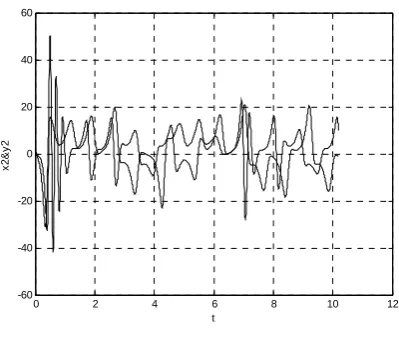
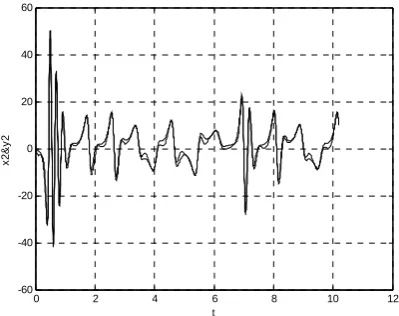
Figure 5 shows the tracking effect of state x2 and y2 without control. X2 is the state of driven system; y2 is the state of response system. X2 can not track with y2 without control.
Figure 6 shows the tracking effect of state x3 and y3 without control. x3 is the state of driven system, y3 is the state of response system. x3 can not track with y3 without control.
-50 0
50
100
0 50 100 150 -150 -100 -50 0 50
x2 x3
x4
Figure 2. Trajectory of driven system x2, x3, x4
-30 -20
-10 0
10 20
-40 -20 0 20 40 -20 0 20 40 60
y1 y2
y3
Figure 3. Trajectory of driven system x3, x4, x1
0 2 4 6 8 10 12
-25 -20 -15 -10 -5 0 5 10 15 20
t
x1
&
y1
Figure 7. Tracking curve of x1 with control
0 2 4 6 8 10 12
-20 0 20 40 60 80 100 120 140 160
t
x3
&
y3
Figure 6. Tracking curve of state x3
0 2 4 6 8 10 12
-60 -40 -20 0 20 40 60
t
x2
&
y2
Figure 5. Tracking curve of state x2
0 2 4 6 8 10 12
-25 -20 -15 -10 -5 0 5 10 15 20
t
x1
&
y1
Figure 7 shows the synchronization of x1 and y1. With the control law, the state y1 can follow the change of x1, the synchronization error is small.
Figure 8 shows the synchronization of state x2 and y2. With the synchronization law, the response system state can follow the driven system state.
Figure9 shows the synchronization of x3 and y3, and there exists chattering problem, but the synchronization error is very small. Below figure 10 to figure 12 shows the synchronization error e1, e2 and e3.
VI. CONCLUSIONS
Above all, the conclusion can be made as follows: with the proposed method of this paper, the synchronization of driven system and response system with unknown parameters and input nonlinearities can be fulfilled successfully. And the quickness of synchronization is satisfactory. But there exists synchronization errors with
0 2 4 6 8 10 12
-8 -7 -6 -5 -4 -3 -2 -1 0 1 2
t
e3
Figure 12. Synchronization error.e3
0 2 4 6 8 10 12
-1 0 1 2 3 4 5
t
e2
Figure 11. Synchronization error.e2
0 2 4 6 8 10 12
-3.5 -3 -2.5 -2 -1.5 -1 -0.5 0 0.5 1
t
e1
Figure 10. Synchronization error.e1
0 2 4 6 8 10 12
-20 0 20 40 60 80 100 120 140 160
t
x3
&
y3
Figure 9. Synchronization of x3 with control
0 2 4 6 8 10 12
-60 -40 -20 0 20 40 60
t
x2
&
y2
the double integral sliding mode method. So how to reduce the static state error and improve the synchronization accuracy is our future research target.
ACKNOWLEDGMENT
The author wish to thank his friend Heidi in Angels (a town of Canada) for her help , and thank his classmate Amado in for his many helpful suggestions. This paper is supported by Youth Foundation of Naval Aeronautical and Astronautical University of China, National Nature Science Foundation of Shandong Province of China ZR2012FQ010, National Nature Science Foundations of China 61174031, 61004002, 61102167, Aviation Science Foundation of China 20110184 and China Postdoctoral Foundation 20110490266.
REFERENCES
[1] Kuo-Ming Chang. Adaptive control for a class of chaotic systems with nonlinear inputs and disturbances. Chaos, Solitons and Fractals. 2008, 36: 460-468
[2] Her-Terng Yau, Jun-Juh Yan. Chaos synchronization of different chaotic systems subjected to input nonlinearity. Applied Mathematics and Computation. 2008, 197: 775-788.
[3] Tsung-Ying Chiang, Jui-Sheng Lin, Teh-Lu Liao et al. Antisynchronization of uncertain unified chaotic systems with dead-zone nonlinearity [J]. Nonlinear Analysis: 2008, 68: 2629-2637.
[4] Hsieh JY, Hwang CC, Wang AP, Li WJ. Controlling hyperchaos of the Rossler system. Int J Control. 1999, 72: 882-886.
[5] C. C. Fuh and P. C. Tung, “Controlling Chaos Using Differential Geometric Approach,” Physical Review Letters, vol. 75, no. 16, pp. 2952-2955, 1995.
[6] Yongguang Yu, Suochun Zhang. Adaptive backstepping synchronization of uncertain chaotic system. Chaos, Solitons and Fractals. 2004, 21: 643-649.
[7] M.T. Yassen. Adaptive chaos control and synchronization for uncertain new chaotic dynamical system. Physics Letters A. 2006, 350: 36-43.
[8] Awad El-Gohary, Rizk Yassen. Adaptive control and synchronization of a coupled dynamo system with uncertain parameters [J]. Chaos, Solitons and Fractals. 2006, 29: 1085-1094.
[9] Qiang Jia. Adaptive control and synchronization of a new hyperchaotic system with unknown parameters [J]. Physics Letters A. 2007, 362: 424-429.
[10]Rongwei Guo. A simple Adaptive Controller for chaos and hyperchaos synchronization. Physics Letters A. 2009, 360: 38-53.
[11]Charalampos P. Bechlioulis, George A. Rovithakis, adaptive control with guaranteed transient and steady state tracking error bounds for strict feedback systems , Automatica 45(2009)532-538
[12]Ge, S. S., Hong, F., & Lee, T. H. (2004). Adaptive neural control of nonlinear time-delay system with unknown virtual control coefficients. IEEE Transactions on Systems, Man, and Cybernetics-PartB: Cybernetics, 34(1), 499–
516.
[13]T.P.Zhang , S.S.Ge Adaptive neural control of MIMO nonlinear state time-varying delay systems with unknown dead-zones and gain signs, Automatica 43(2007) 1021-1033
[14]Jagannathan S, He P. Neural-network-based state-feedback control of a nonlinear discrete-time system in nonstrict feedback form. IEEE Transactions on Neural Networks 2008; 19(12):2073-87.
[15]Weisheng Chen, Adaptive NN control for discrete-time pure-feedback systems with unknown control direction under amplitude and rate actuator constraints, ISA Transactions 48 (2009) 304-311
[16] Ge, S. S., & Wang, J. (2003). Robust adaptive tracking for time-varying uncertain nonlinear systems with unknown control coefficients. IEEE Transactions on Automatic Control, 48(8), 1463-1469.
[17] Hull, R.A., & Z. Qu, 1995. Design and evaluation of robust nonlinear missile autopilot from a performance perspective. Proceedings of the ACC, 189-193
[18]KE Hai-sen, YE Xu-dong, Robust adaptive controller design for a class of nonlinear systems with unknown high frequency gains, Univ SCIENCE A 2006 7(3):315-320 [19] Liu Yunguang, Output-feedback Adaptive Control for a
Class of Nonlinear Systems with Unknown Control Directions, ACTA AUTOMATICA SINICA, Vol. 33, No. 12, 1306-1312
[20]Polycarpou, M. M., Ioannou, P. A. A robust adaptive nonlinear control design. Automatica, Vol. 32. No. 3 (1996) 423-427
[21]Seung-Hwan Kim, Yoon-Sik Kim, Chanho Song, A robust adaptive nonlinear control approach to missile autopilot design, Control engineering practice, 12(2004) pp. 149-154 [22]Qian, C., & Lin, W. (2002). Output feedback control of a class of nonlinear systems: A nonseparation principle paradigm. IEEE Transactions on Automatic Control, 47, 1710-1715
[23]Yang C, Ge SS, Xiang C, Chai TY, Lee TH. Output feedback NN control for two classes of discrete-time systems with unknown control directions in a unified approach. IEEE Transactions on Neural Networks 2008; 19(11):1873-86.
[24]Junwei Lei, Yidong Wang, Research on two kinds of universal output feedback adaptive controller, Journal of the Franklin Institute [J], 2013, available online 28 February 2013.
[25]Tsinias, J. (1991). A theorem on global stabilization of nonlinear systems by linear feedback. System and Control Letters, 17, 357-362
[26]M. Krstic, J. Sun, and P. V. Kokotovic, “Control of Feedback Linearizable Systems with Input Unmodeled Dynamics,” Proc. of the 33rd Conference on Decision and Control, Lake Buena Vista, FL, pp. 1633-1638, 1994 [27]Jingjing Du, Chunyue Song, Multi-PI control for
block-structured nonlinear systems[J], Journal of Computers,2012:7(12),3052-3059
[28]Xu H J and Mirmirani M.Robust adaptive sliding control for a class of MIMO nonlinear systems [A].In: AIAA Guidance,Navigation,and Control Conference and Exhibit[C].Montreal, Canada, AIAA 2001-4168.
[29]Guoqiang Liang, Junwei Lei, Yong Liang, Research on the robustness of PISS integral sliding mode control of supersonic missiles[J], Journal of Computers, 2012:7(8),1943-1950
[30]Yuqiang Jin, Junwei Lei,Yong Liang, Tracking of super chaotic system with static uncertain functions and unknown parameters[J], Journal of Computers, 2012:7 (12),2853-2860
[32]Xuedong Ye, Global adaptive control of nonlinear systems with unknown control directions nonoverparameterization design, Journal of China Jiliang University,Jan, 2005
Vol.14,No,1
[33]Yan Li, When is a Mittag-Leffler function a Nussbaum function? Automatica 45 (2009) 1957-1959
[34]Ye, X. D., & Jiang, J. P. (1998). Adaptive nonlinear design without a priori-knowledge of control directions. IEEE Transactions on Automatic Control, 43(11), 1617-1621. [35]Junwei Lei, Yinhua Lei, A Nussbaum gain adaptive
synchronization of a new hyperchaotic system with input uncertainties and unknown parameters, Communications in Nonlinear Science and Numerical Simulation, Volume 14, Issue 8, August2009, Pages 3439-3448.
Junwei Lei (1981-) was born in Chibi of Hubei province of China and received his Doctor degree in Guidance, Navigation and Control in 2010 from Naval Aeronautical and Astronautical University, Yantai of China. Her present interests are control theory, chaotic system control, aircraft control and adaptive control.
He was promoted to be a lecture of NAAU in 2010. His typical book named Nussbaum gain control technology of supersonic missiles was published in 2013 in China.
Jinyong Yu (1977-) was born in Haiyang
city of Shandong province of China and received his Doctor degree in Guidance, Navigation and Control in 2006 from Naval Aeronautical and Astronautical University, Yantai of China.
He became a vice professor of this school in 2008 and now he is the director of drone teaching team of control engineering department. Now his current interest is aircraft control and navigation.
Lingling Wang (1984- ) was born in
Tongling of Anhui province of China and received her master degree in control theory and control engineering in Hehai University in 2009, Nanjing of China. Now she works at Naval Aeronautical and Astronautical University, and became a lecturer in 2011. Her interest is in automatic testing.