Sudeesh Chouhan
Assistant Professor
Department of Computer Science & Engineering School of Engineering SSSUTMS, Sehore (M.P.)
Abstract
The cloud computing paradigm has brought the benefits of utility computing to a global scale. It has gained paramount attention in recent years. Companies are seriously considering to adopt this new paradigm and expecting to receive significant benefits. In fact, the concept of cloud computing is not a revolution in terms of technology; it has been established based on the solid ground of virtualization, distributed system, and web services. To comprehend cloud computing, its foundations and technological landscape need to be adequately understood. This paper provides a comprehensive review on the building blocks of cloud computing and relevant technological aspects. It focuses on four key areas including architecture, virtualization, data management, and security issues. Cloud computing is the emerging service provider used to manage computing resources like networks, storage, servers, applications and services which requires optimum effort of management [1]. Virtualization in cloud computing is gaining more importance today due to lack of proper utilization of resources, improper load balancing of processing nodes, lesser isolation of applications, extent of tolerating the faults in virtual machines, to increase the portability of nodes and to rise the efficiency of cost of the physical server. So, migration is one of the most important features of virtual machines technology [2]. Virtual machine migration is the migration of virtual machine from one physical host to another [1]. It is mainly done via two approaches per copy migration and post copy migration. Pre copy migration first transfers the memory and then transfers the execution while post copy migration first transfers the execution and then transfers the memory [7].The main motive of this paper is to provide the better understanding of post copy virtual machine migration technique research challenges by comparing existing general & network aware virtual machine migration techniques in cloud computing.
Keywords: Cloud computing, virtual machine migration, pre copy, post copy, hypervisor
________________________________________________________________________________________________________
I. INTRODUCTION
In recent years, the demand for Cloud computing is on the rise and it has become a focus in information technology arena. Cloud computing has been widely employed by the industry community, government bodies, business and also among academy and research community. Cloud computing is not a new concept in the era of IT, it provides the following facilities:
Virtualization
Virtualization methodology divides the computer resources into multiple executable virtual machines through hardware and software portioning [2]. It allows multiple virtual machines to run on a single physical machine. It permits less high powered servers to create more low powered servers, thus reduces overall cost in power, space and other infrastructure [7].
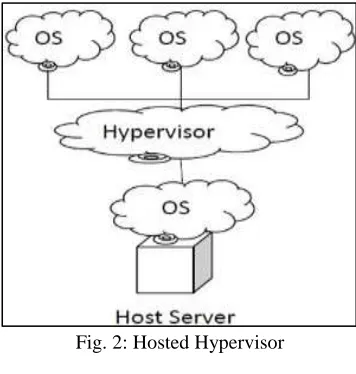
Hypervisor or virtual machine manager or virtual machine monitor is a program which enables multiple operating systems to be shared on a single host. Each operating system has a processor host and resources; hypervisor allocates needed resources to each operating system and ensures that guest operating system (also called virtual machine) cannot interrupt each other. Hypervisor is of two types [8]:
Bare Metal Hypervisor
Fig. 1: Bare Metal Hypervisor
Hosted Hypervisor
Hosted hypervisor is a hypervisor that is installed in the operating system of a server and that operating system has a control over it. Example: VMware Player, Virtual Box, Xen
Fig. 2: Hosted Hypervisor
II. VIRTUAL MACHINE MIGRATION
Virtual machine migration is the migration of virtual machine from one physical host to another without disrupting the users [1]. It is categorized as:
1) [8]Non-live or Off-line Virtual Machine Migration: In it, Virtual machine at the source host is paused and then transfer all states of source host to the target or destination host and then finally resume the working of virtual machine at the target host. The major drawback of it is that it results in larger down time.
2) [8]Live Virtual Machine Migration: In it, Virtual machine is transferred from one host to another with minimum possible disruption of services. It has following performance metrics [3][4][6][10]:
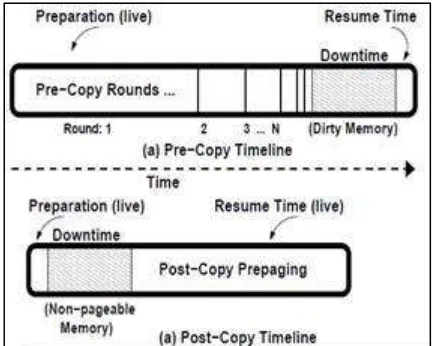
1) Preparation Time: Time between the migration process start and virtual machine’s processor state is sent to the destination node, during which the virtual machine run continuously and creates page faults is called preparation time.
2) Resume Time: Time between the resuming of the virtual machine’s running and migration end is called resume time. Note that, all dependencies are removed on the source host.
3) Pages transferred: The total amount of pages transferred including the copies of pages.
4) Down Time: Time during which the running of virtual machine is stopped. It contains sending of state of the processor. 5) Total Migration Time: Time taken by the migration process; from the initiating of the migration process until end of the migration process. This time is important as it affects the resource releasing on both the source node and the destination node.
[13]Fig. 3: Pre copy migration
Post Copy Memory Migration
[13]Fig. 5: Timeline of Pre copy vs. Post copy migration
Hybrid Virtual machine migration [9]
It is the combination of both pre copy and post copy virtual machine migration. It is based on five phases: 1) Preparation Phase: System resources required at the target host are reserved.
2) Bounded pre copy rounds Phase: Identify the delimited pre copy rounds and working set of virtual machine is transferred to the receiver server.
3) Virtual Machine state transfer Phase: The minimum state of virtual machine is captured and sent to the receiver server to resume the virtual machine at the target host.
4) Virtual machine resume Phase: At the receiver server, it launches the transferred state. 5) On Demand paging Phase: On the basis of application, requests of read/write.
Fig. 6: Hybrid Virtual Machine Migration
Post Copy variations [10] [11]
Post Copy through demand paging:
In it, the pages are transferred only once and it will result in page faults when requesting the referenced page from the source node over the network. As a result, it will slow down the processing of the virtual machine as it increases the length of the resume time and creates the dependencies in the form of an unfetched pages residing for unpredictable time periods.
Post Copy through Active Pushing:
Energy management:
The underutilized virtual machine servers are switched off to save the energy or efficiently use the power.
Resource Sharing:
On starvation of resources, the resource hungry virtual machine is relocated to the resource rich virtual machine.
Fault tolerance:
Before the fault occurs in the virtual machine, a fault tolerant system triggers virtual machine migration.
Mobile computing:
Virtual machine migration migrates the application running on system along with the operating system state from the desktop server to the mobile phones and vice-versa.
III. LITERATURE REVIEW
Qi Zhang and others [14] gives the explanation to topics related to computing. He provides a better understanding on the topic of cloud computing, its layered architecture, its business model, types of cloud and the terms related to cloud computing like virtualization, virtual machine migration, server consolidation, energy management, etc. and gives the direction towards the research challenges in cloud computing.
[2] says that VMM facilitates system administrator to migrate an OS instance of one physical node to another without the disturbance of services of host on the OS being migrating. VMM uses the resources of both the machines; the machine from which virtual machine is migrating and the machine to which it is being migrated. He reduces the size of data image on source host before migration according to the probability factor and threshold values.
Virtual machine migration was first proposed by Clark et al [13]. Virtual machine manager or hypervisor is a middleware between two physical nodes which facilitates abstraction from physical resources of one node to the other node. Through software emulation methods and virtualization of hardware systems, virtual machines are created. Virtual machines are acting as physical computers which have their own virtual RAM, Central Processing Unit, Network Interface Card and hard disk [12].
[10] says that Virtualization is a technique to run several operating systems simultaneously on one physical server, has become the core concepts in modern data centers. Virtual machine migration (VMM) is a useful tool for administrator of data center and clusters. It allows clean separation between hardware and software.
[4] categorized the techniques which are used to minimize the downtime and consider the bandwidth which provides the better performance of virtual machine.
[3] gives the design, implementation and evaluation of Pre copy, Pre copy vs. Post copy, Full Post copy and Hybrid Post copy techniques that results in minimum page faults incurred.
[5] Hines explains the post copy via pre paging strategy through Bubbling with single pivot and multiple pivots.
[6] Michael gives the design and implementation of post copy approach through Dynamic Self Ballooning on Xen and Linux based platforms.
[7] explain various Network aware virtual machine migration techniques.
[8] gives the comparative analysis of various live virtual machine migration techniques. [9] gives a detailed analysis, taxonomy, and research issues of virtual machine migration.
IV. COMPARISON OF COMMON VIRTUAL MACHINE MIGRATION TECHNIQUES [8]
Table - 1.1
Comparative analysis of various virtual machine migration techniques Virtual Machine
Migration Technique
Method 1. Stop the source virtual machine.
Improved Pre Copy approach Memory Compression Technique Delta Compression
It is implemented as a Modified KVM hypervisor Frequently
updated memory pages
Page Bitmap
*Judge the iteration process.
*Put the frequently updated pages into page bitmap *Transfer those pages in the last iteration round
Post copy approach First transfer the execution and then the memory Table - 1.2
Comparative analysis of various virtual machine migration techniques
Virtual Machine Migration Technique Advantages Disadvantages
Non-live migration Simple Concept and easy to implement Down time is more
Pre Copy approach
1. Down time < 1 sec. 2. On aborting migration, System do not crash as virtual Machine is still running on source host
Overhead of duplicate page transmission
Improved Pre Copy approach
1. Less Down time.
2. Migration throughput is increased Overhead of Compression technique 1. 34% total data transfer is reduced.
2. 32.5% total migration time is reduced
Not applicable to wide area live virtual machine migration Post copy
approach
1. Memory page is transferred at most once. 2. Total migration time is achieved as baseline
More Down time as compared to pre copy
V. COMPARISON OF NETWORK AWARE VIRTUAL MIGRATION TECHNIQUES [7]
Type Why virtual machine migration required? Performance Metrics
Network aware VM Placement & Migration approach
Due to unstable network, data transfer time crosses the threshold value
Time related Service Level Agreement(SLA) between cloud facility provider and cloud user is used to determine the threshold value Traffic-aware VM
Placement Problem (TVMPP)
Virtual Machines onhost become greater than the decided number of hosts
Traffic pattern and network topology analysis in data centers
Optimization of data center deployment & VM
assignment
Network latency between clients and data centers changes drastically
Scale solutions based on time(short/long) are provided
A Model-Based Algorithm for Optimizing I/O Intensive Applications in Clouds using VM-Based
Migration
To minimize the expected value of time required to access the file for
data intensive application
DAG shortest path search problem
Network-aware migration control and scheduling of
differentiated virtual machine workloads
To predict virtual machine migration, VM workload classifier is used
Network-Aware Coordination of Virtual
Machine Migrations in Enterprise Data Centers and Clouds
Workload increased in application due to
achievement of load balancing and fault tolerance Link sharing and software simulator is used.
VI. RESEARCH CHALLENGES IN NETWORK BASED LIVE VIRTUAL MACHINE MIGRATION [4]
1) Low Bandwidth over WAN: Due to large image size, it is impossible to trans-locate the live virtual machine across high latency low bandwidth WAN.
2) Network fault: In post copy, when Virtual machine at the target host tries to fetch the pages that have not yet transferred, it redirect towards the source host thus creates network faults as virtual machine at source host is suspended.
3) Memory intensive applications: to reduce the overhead of post copy technique than the overhead of memory reusing technique. 4) Memory state between clusters: live migration to have a control over transfer of CPU and memory state between cluster of
hosts which serves as a single Virtual Distributed Shared Memory system.
Current Challenges in Post copy Live Virtual Machine Migration Technique:-
1) Firstly, there is challenge to reduce the overhead of Post copy technique than memory reusing technique. So that post copy technique can be optimized
of network aware migration technique available in virtual machine migration techniques of cloud environment.
REFERENCES
[1] Rabiatul Addawiyah Mat Razali, Ruhani Ab Rahman, Norliza Zaini, Mustafa Samad, “Virtual Machine Migration Implementation in Load Balancing for
Cloud Computing”, in IEEE Conference, 2016
[2] Gursharan Singh, Sunny Behal, Monal Taneja, “Advanced Memory Reusing Mechanism for Virtual Machines in Cloud Computing”, 3rd International
Conference on Recent Trends in Computing 2015 published by ELSEVIER, pp 91-103, July 2015
[3] Aidan Shribman, Benoit Hudzia, “Pre-Copy and Post-Copy VM Live Migration for Memory Intensive Applications”, Springer, pp 539-547, 2013
[4] Divya Kapil, Emmanuel S.Pilli, Ramesh C.Joshi, “Live Virtual Machine Migration Techniques_Survey and Research Challenges”, in IEEE, 2012
[5] Michael R.Hines, Umesh Deshpande, Kartik Gopalan, “Post-Copy Live Migration of Virtual Machines”,
availableat“httposnet.cs.binghamton.edupublicationshines0 9postcopy_osr.pdf”, 2009
[6] Michael R.Hines, Kartik Gopalan, “Post-Copy Based Live Virtual Machine Migration Using Adaptive Pre-Paging and Dynamic Self-Ballooning”, 2013
[7] Rinal M.Chawda, Ompriya Kale, “Virtual_Machine_Migration_Techniques_in Cloud Environment_ A Survey”, IJSRD, 2013
[8] Gulshan Soni, Mala Kalra, “Comparative Study of Live Virtual Machine Migration Techniques in Cloud”, IJCA, vol 84, no. 14, December 2013
[9] Raja Wasim Ahmad, Abdullah Gani, Siti Hafizah Ab. Hamid, Muhammad Shiraz, Feng Xia, Sajjad A. Madani, “virtual machine migraton in cloud data
centers_a review, taxonomy and open research issues”, SPRINGER, 2473-2515, 2015
[10] Pradip D Patel, Miren Karamta, M.D.Bhavsar, M.B.Potdar, “Live Virtual Machine Migration Techniques in Cloud Computing A Survey”, IJCA, vol 86, no.
16, Jan 2014
[11] Soumya Ray, Ajanta De Sarkar, “Execution Analysis Of Load Balancing Algorithms In Cloud Computing Environment ”, IJCCSA, vol 2, no. 5, Oct 2012
[12] Jaspreet Kaur, Manpreet Kaur, Sahil Vashist, “Virtual Machine Migration in Cloud Datacenters”, IJARCSSE,vol 4, no. 8, pp 190-193,2014
[13] Raja Wasim Ahmad, Abdullah Gani, Siti Hafiza Ab. Hmid, Muhammad Shiraz, Abdullah Yousafzai, Feng Xia, “Journal of Network and Computer
Applications”, ELSEVIER, pp 11-25, 2015