WWJMRD 2018; 4(7): 43-49 www.wwjmrd.com
International Journal Peer Reviewed Journal Refereed Journal Indexed Journal
Impact Factor MJIF: 4.25
E-ISSN: 2454-6615
Jaafar A. Kadhem
Energy and Renewable Energies Technology Centre, University of Technology, Baghdad, Iraq
Correspondence:
Jaafar A. Kadhem
Energy and Renewable Energies Technology Centre, University of Technology, Baghdad, Iraq
A practical comparison of the differences between the
simple single slope solar distiller and wick distiller
Jaafar A. Kadhem
Abstract
Drinking water is a top priority for all governments in the world. A large part of the world's spent fuel is consumed on portable water production. The shift to renewable energies in water distillation, such as solar energy, reduces the consumption and burning of fossil fuels. Solar distillation systems, which have been used for thousands of years, are a solution that is available, possible, and easy because of the availability of solar energy in most parts of the world. The current study aims to experiment improvements added to the solar distillation to increase the production of distilled water. Two different distillers were built: the first distiller is a simple solar distillation, and the practical experiments proved its ability to produce up to 3L/m2/d of pure water. The second distiller was type wick type distiller with productivity up to 7L/ m2/d.
Keywords: Solar distillation, brackish water, insulation, productivity
Introduction
The huge burning of fossil fuels over the past two centuries has caused serious environmental problems such as climate change and global warming. The transition to clean renewable energy and environment-friendly energies has become necessary and there is no other choice
[1]
.
Iraq is one of the rich countries of oil and natural gas, but it is also rich in solar energy as it has a good solar radiation intensity and long brightness during the year. The use of this energy as an alternative is a suitable solution for the production of electric power or to benefit from water distillation [2]. The increase in population growth rates is associated with high levels of pollution in the air, water, and soil, which are caused by the overlap of human activities with the environment safety. These circumstances caused depletion of available fresh water resources [3].
People have used solar distillation centuries ago to desalinate water, and in the world's museums there are old models of these distillers, which usually consist of a bowl with a black floor and a transparent cover [4]. What distinguishes solar distillation is that there is no need to boil water to get distilled water. In the case of solar distillation, sunlight is used with heat energy transferred energy through the space free of charge and no pollutants are remained. The disadvantage of solar systems is the need for more space to collect solar energy [5]. What distinguishes the solar distillers is that they are available in different sizes. This system can be large, medium or small. It is designed to serve one family with a capacity of 3 to 15 liters of drinking water per day, or the system is designed to produce much more potable water for the use of small town or village [6]. The adoption of solar distillates on solar radiation causes a decrease in their productivity when this radiation is reduced by shade, clouds, or dust [7, 8].
Solar distillers are not expensive and have a simple technique and are used to distill brackish or dirty water such as swamp water and ponds. Water produced by solar distillers is clean and non-polluting. However, solar distillates are low in productivity and need a large area. The researchers have submitted many studies that try to increase the production of solar distillate and by many means. Ref. [9] used the heat stored in a solar saline pond to heat the brackish water in a simple solar distillation base. The study results have shown a significant
~ 44 ~
increase in distillate productivity due to the continued heat needed to evaporate the water throughout the day, especially during the night after the absence of the sun. The distillate production has been improved at night due to low atmospheric temperature and the consequent decrease in the temperature of distillation (condensate) [10].
Ref. [11] investigated practically the effect of adding a vacuum tube to a solar collector on solar distillation. Practical tests have shown that this process has increased the distillation yield by up to 56%. While Ref. [12] added a layer of paraffin wax mixed with aluminum powder (to increase the thermal conductivity of wax) to a simple solar distillation base. This process increased the productivity of the solar distiller and extended the production period after the sunset. Ref. [13] designed and manufactured a single-edged solar distiller by adding carbon nanotubes in the copper basin to increase its thermal conductivity. The results of the study concluded that this innovative method resulted in increasing the distillate production used up to 50%.
Ref. [14] has increased the temperature of the brackish water entering the distiller using a solar concentrator. They also added the use of paraffin wax inside the solar distillator to increase thermal storage. The results showed a significant increase in distillate production when compared to a simple distiller. Ref. [15] used a more sophisticated system by adding a tank to the system with a phase change material (PCM) to increase the thermal storage of the system as a whole. The presence of wax in the reservoir and the solar concentrator in addition to the distiller base caused a large increase in thermal storage and maximize productivity by forcing the distiller to work long hours after sunset. Ref. [16] used an inclined simple solar distiller with a wick and an external reflector to increase the falling light on the flat plate diaphragm distiller. The results of the study indicate that the distillate production increased with the presence of the solar reflector by 15% to 27%.
Ref. [17] conducted a practical research to eliminate the lack in distillation during the afternoon in the hot summer days. For this purpose, the paraffin wax was used as a PCM to store heat at day hours and used it at night hours while the glass cover was cooled to reach acceptable productivity. Ref. [18] designed and practically investigated the performance of an innovative type of solar distillers for desalination. This system consists of a cylindrical metallic parabolic reflector. The concentrator was designed to focus the falling solar radiation on a black outer surface of a tray located on the concentrator's focal line. The distiller contained a shaded wick, to increase evaporation surface. The researchers found that the possibility of increasing the productivity of diaphragm distillates using this technique, which was increased from 25% to 35% compared to the simple solar distiller. Ref. [19] tried to improve the productivity of a simple solar distiller by improving the thermal conductivity of the paraffin wax to increase heat transfer during the charging and discharging periods. The process focused on the mixing of nano-aluminum oxide (Al2O3) with paraffin. This method has increased the distiller productivity significantly and shortened the thermal charging and discharging periods with a higher temperature of wax than the case of non-use of nanoparticles.
Ref. [20] studied experimentally the effect of the addition of nano-titanium dioxide (TiO2) to a basin on the change in
water temperature, steam temperature, the glass inside and outside temperature. The practical results showed that the use of nanoparticles resulted in increased distillate production of up to 40%. Ref. [21] tested adding aluminum oxide (Al2O3) to distilled water on the production and note that this additive caused an increase in productivity up to 76%. Ref. [22] practically investigated the benefit of adding nano-copper oxide (CuO) to the side walls of the distiller that were painted in white. The use of nano-CuO improved the distillate yield by 22.4% compared to the simple one. Ref. [23] designed and built three solar distillers: single simple inclined distiller, wick distiller, and graduated one. The researcher studied the difference in productivity among the three distillates and noted that distiller No. 3 gave the best yield, flowed by No. 2 and finally distiller No. 1. The aim of this practical study is to improve the productivity of solar distillers adopting some added modification. The studied distiller performance will be compared under outdoor Iraqi climates utilization.
Experimental Setup
The steam generated by the distilled solar cells must be prevented from leaking out, so this type of distiller is completely closed. Distiller performance depends entirely on the availability of solar energy. As is known, Iraq is located near the solar belt, so the rate of solar radiation of this country is close to the maximum. Solar distillation can be effective and suitable solution to meet the citizen's need for fresh water [24]. With regard to the possibilities of the average citizen, he can save an area of about 3 square meters to build his own distillation unit. The provision of such space is not problematic for the Iraqi citizen as it can be installed distilled on the roof of the building or in the garden provided that it has enough solar radiation. If we take a medium-sized family, we find that it consumes about 20 liters of drinking water per day; if a citizen uses a distillery of good quality in the sense of productivity not less than 7L/m2/d, this means the need of distiller with an area of 3.5 m2 to equip the family with drinking water [25]. The solar distiller produces pure water evaporated from its basin and condenses on the glass cover. Particulate pollutants in water are left in the aquarium. Fresh water contains soluble salts such as sodium chloride in small quantities because the source of this water is rain, rivers, streams, and lakes [26]. The seawater waters are naturally salty and contain high salt content and limit up to 35 parts of salt per 1,000 parts of water. High concentrations of salts in water of more than 1000 mg/L have bad health effects on human health in the long term [27]. Contaminants may be presented in the distillation area due to errors in the construction and preparation of distillers. These pollutants are reduced by several ways, including re-distillating of the produced water or adding sodium bicarbonate at the base of the pond and keeping it under the sun for several days to avoid most volatiles. The manufacture of distilled parts of noble materials prevents their interaction with water at high distillation temperatures. Therefore, it is preferable to use plastic pipes of PVC instead of copper pipes. It is also preferable to use heat resistant glass containers [28].
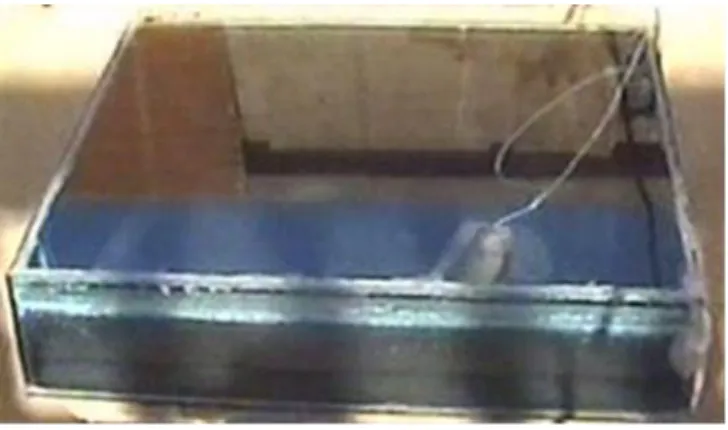
ambient temperatures not exceeding 30°C in the afternoon. The first distiller is a simple inclined distiller consisting of a rectangular glass box and a transparent top surface tilted at an angle of 12 degrees from the horizon. The base of the basin was painted in non-shiny black color to increase the
amount of absorbed solar radiation. Figure 1 shows a photograph of the simple inclined distiller used in the study. Table 1 lists the dimensions and measurements of distiller and its technical specifications.
Fig. 1: Simple single slope solar distiller photograph
Table 1: The simple single slope solar distiller dimension and technical details of the basin
Basin cross section area 1 m2
Basin length 1200 mm
Basin width 834 mm
Front height 100 mm
Rear height 200 mm
Salty water capacity 70 liter Angle of glass collector 12° Salty water maximum depth 70 mm Constricted material all from glasses
Fig. 2 shows the second distiller used in the study, which is the wick type still. This distiller consists of a base covered with a cotton wick and the water is sprayed from a small pump operated by a photoelectric panel installed at the top of the distillator and directed towards the sun. The basin area was chosen to be 1 m2. Reflectors on both sides of the distillate were added to increase the concentration of the
sun and improve the distillation process. The top of the distilled glass is used as a condenser to condense the steam, and the produced pure water is fused into a channel and connected to the outlet pipe. This disttiller was desingened to have the ability to change its direction, so it can track the sun. Table 2 shows the technical specifications of this distillator and the designed dininsions.
~ 46 ~
Table 2: Dimension and technical details of this type
Collector length 1200
Collector width 834
Collector thickness 100
Add a solar radiation reflector from aluminum foil Collector bed covered by charcoal
Collector supplied with water washing cycle Solar cell supplied the System by 36W 12V
Water pump 12V, 1.5A
Drinking water tank 20 liters Salty water tank 80 liters
Tests Procedure
Experiments were carried out in bright and clear days to avoid overlapping any effects such as clouds or dust with measurements. The yield of each distillator was collected every hour, in order to compare between the two distillers. Different temperature readings of the two distillers were observed and recorded. Work starts daily from 8:00 AM until sunset. After the dusk, both distillers are opened and the pelvic base is cleaned of dirt and it will be prepared for a new working day. In the early morning and before taking measurements, the glass cover of both distillers is cleaned to ensure full permeability of the solar radiation.
Result and Discussion
The practical tests were conducted above the roof of the Energy and Renewable Energies Technology Center,
University of Technology, Baghdad-IRAQ. These tests were conducted in Spring-2018 starting from sunshine till the sunset to evaluate the systems performance. The distiller production rate each hour was taken as an indicator to the distiller performance.
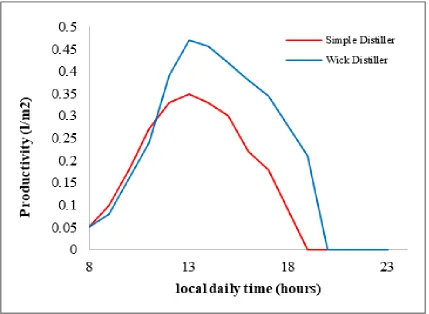
Figure 3 shows the production of the studied distillers during the day. The yield of the distillates increases from zero (l/m2) to their highest values at 2 PM and then drops to zero again at sunset. The simple distiller productivity is somewhat more than the output of the wick distiller from 7 to 12 AM; after that time the output of the wick distiller increased more because of the heat gained by the wick and the base. The comparison between the two distillates showed that the daily distillation yield was 2.31 for the simple distiller and was 3.708 L/m2 for the wick one.
Fig.3: The productivity of the studied distillers with daytime
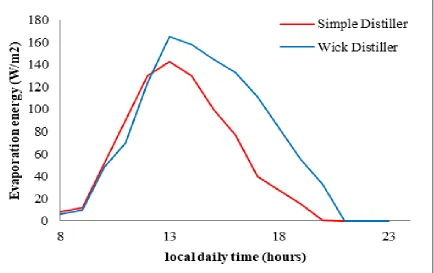
Figure 4 shows that the evaporation energy increased as evaporation increased due to increasing water temperature in the basin and evaporation capacities resulted from the increase in absorbed sunlight as well as increasing the intensity of solar radiation over time. The curves of this figure are similar to those of the previous one, which means
Fig. 4: evaporation energy variation with time for the studied distillers
Figure 5 shows an increase in condensation capacity over time from the first morning due to increased heat transfer capacity from the basin to the glass envelope (which remained at relatively low temperatures). The high temperature of the distiller water causes an increase in
convection and we note that it is increased in the wick distilled more than the simple distiller because of the same explanation mentioned above. The internal parts temperature of the wick distiller was higher than that of the simple distiller.
Fig. 5: convection energy variation with time for the studied distillers
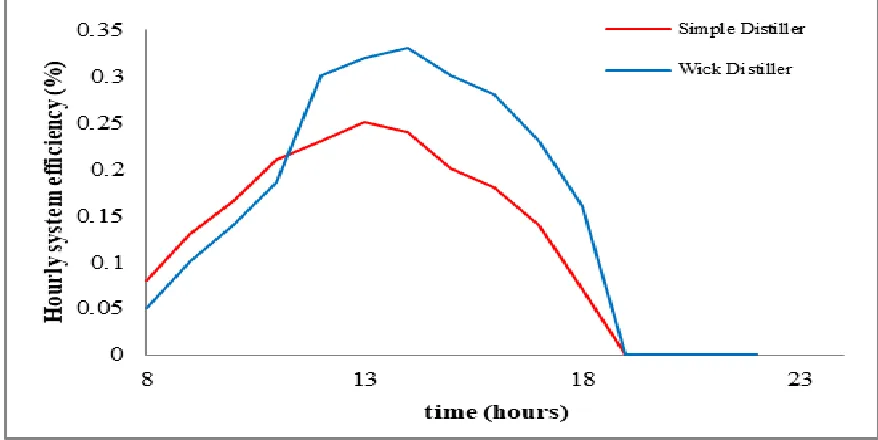
Figure 6 shows the distillation efficiency measured over time. The efficiency of the two solar distillers is closely linked to the intensity of solar radiation, which peaks around 1:00 PM. After this hour, the efficiency of the distillers decreased, but the decrement of the simple
~ 48 ~
Fig. 6: the hourly system variation with time for the studied distillers
Conclusion
In this study, the possibility of using two types of distillates: a simple single slope solar distiller and wick distiller to provide Iraqi families with drinking water. Iraq is a country with a high density of solar radiation, making it possible to use any of the studied distillates. The simple distiller is characterized by its cheap costs and the easy establishment of the body, there is no need for skilled technicians to build. Also, it does not require complicated and expensive maintenance works, but its main disadvantage is the low productivity of drinking water. The results of the study showed that the average maximum distilled water produced by this type did not exceed 2.31L/ m2/d. Although this quantity is low, it is not considered a small quantity, since two or three distillers of this type are sufficient to provide the necessary water for a small family for drinking and cooking purposes. The second distillate (Wick distiller) can be considered more complicated than the simple distiller. This type needs specialized technicians who know the type of fixed wick required and should have the experience required to build and maintain it. This distillation produces a higher yield than the simple distiller up to 3.7L/m2/d.
References
1. Chaichan M T, Kazem H A, Abid T A, Traffic and outdoor air pollution levels near highways in Baghdad, Iraq, Environment, Development and Sustainability, vol. 20, No. 2, pp. 589-603, 2018. DOI: 10.1007/s10668-016-9900-x.
2. Kadhem J A, Reza K S, Ahmed W K, Alternative fuel use in Iraq: A way to reduce air pollution, European Journal of Engineering Research and Science, vol. 2, No. 5, pp. 20-30, 2017. http://dx.doi.org/10.24018/ejers.2017.2.5.322
3. Popkin R, Desalination: Water for the World’s Future, Frederick A. Praeger Publishers, New York, 1968. 4. Malik M A, Tiwari G N, Kumar A, Sodha M S, Solar
distillation, a practical study of a wide range of stills and their optimum design, construction and performance, Pergamon Press, 1982.
5. Chaichan M T, Kazem H A, Abass K I, Al-Waeli A A,
Homemade solar desalination system for Omani families, International Journal of Scientific &
Engineering Research, vol. 7, No. 5, pp.1499-1504, 2016.
6. Chaibi M T, Validation of a simulation model for water desalination in a greenhouse roof through laboratory experiments, Desalination, vol. 142, pp. 65-78, 2002.
7. Kazem H A and Chaichan M T, The impact of using solar colored filters to cover the PV panel on its outcomes, Bulletin Journal, vol. 2, No. 7, pp. 464-469, 2016. DOI: 10.21276/sb.2016.2.7.5.
8. Kazem H A, Chaichan M T, Al-Waeli A H A, Mani K, Effect of shadows on the performance of solar photovoltaic, Mediterranean Green Buildings & Renewable Energy, pp.379-385, 2017. DOI: 10.1007/978-3-319-30746-6_27
9. Chaichan M T & Abass K I, Productivity amelioration of solar water distillator linked with salt gradient pond, Tikrit Journal of Engineering Sciences, vol. 19, No. 4, pp. 24-34, 2012.
10. Chaichan M T, Kazem H A & Abass K I, Improving productivity of solar water distillator linked with salt gradient pond in Iraqi weather, World Congress on Engineering 2012, London, UK, 4-6 July, 2012. 11. Panchal H N, Enhancement of distillate output of
double basin solar still with vacuum tubes, J. King Saud Univ. Eng. Sci., 2013. http://dx.doi.org/10.1016/j.jksues. 2013.06.007. 12. Chaichan M T & Kazem H A, Using aluminum
powder with PCM (paraffin wax) to enhance single slope solar water distillator productivity in Baghdad-Iraq winter weathers, International Journal of Renewable Energy Research, vol. 1, No. 5, pp. 151-159, 2015.
13. Koilraj G M, Senthil K P, Jemilda G, Sherin J S, Effect of nanofluids in a modified vacuum single basin solar still, International Journal of Scientific & Engineering Research, vol. 3, No. 1, pp. 1-7, 2012.
15. Chaichan M T, Abass K I, Kazem H A, Design and assessment of solar concentrator distillating system using phase change materials (PCM) suitable for desertec weathers, Desalination and water treatment, vol. 57, No. 32, pp. 14897-14907, 2016.DOI: 10.1080/19443994.2015.1069221
16. Tanaka H, Nakatake Y, Increase in distillate productivity by inclining the flat plate external reflector of a tilted-wick solar still in winter, Solar Energy, vol. 83, pp.785–789, 2009.
17. Chaichan M T, Enhancing productivity of concentrating solar distillating system accompanied with PCM at hot climate, Wulevina, vol. 23, No. 5, pp. 1-18, 2016.
18. Singh H N & Tiwari G N, Monthly performance of passive and active Solar Stills for different Indian climatic conditions, Desalination, vol. 168, pp. 145-150, 2004.
19. Chaichan M T, Kazem H A, Single slope solar distillator productivity improvement using phase change material and Al2O3 nanoparticle, Solar Energy, vol. 164, pp. 370-381, 2018. https://doi.org/10.1016/j.solener.2018.02.049
20. Bhramara P, Vijaya K, Sri S, Swathi L, Ajay P, Solar distillation using nano-material, International Journal of Scientific Engineering and Technology, vol. 3, No. 5, pp.583-87, 2014.
21. Kabeel A E, Omara Z M, Essa F A, Enhancement of modified solar still integrated with external condenser using nano-fluids: An experimental approach, Energy Conversion and Management, vol. 78, pp. 493-498, 2014.
22. Gupta B, Shankara P, Sharma R, Baredar P, Performance enhancement using nano particles in modified passive solar still, Procedia Technology, vol. 25, pp.1209-1216, 2016.
23. Kadhum J A, Hamed J M, Abdul-Munaim A H, Sheat E A, Design and construction of water solar distillation, work by steam circulation technique, International Journal of Computation and Applied Sciences IJOCAAS, vol. 3, No. 2, pp. 239-245, 2017. 24. Hongfei Z, Xiaoyan Z, Jing Z & Yuyuan W, A group
of improved heat and mass transfer correlations in Solar Stills, Energy Conversion and Management, vol. 43, pp. 2469-2478, 2002.
25. Omri A, Orfi J& Nasrallah S B, Natural convection effects in Solar Stills, Desalination, vol. 183, pp. 173-178, 2005.
26. Al-Karaghouli A A, Alnaser W E, Performances of single and double basin solar stills, Applied Energy, vol. 78, pp. 347-354, 2004.
27. Radhi A A and Borghei M, Effect of aeration then granular activated carbon on removal efficiency of TOC, COD and Coliform, Fecal coliform for “Sorkheh Hesar Canal" water, International Journal of Computation and Applied Sciences IJOCAAS, vol. 3, No. 2, pp. 201-206, 2017.