Design Method of Product Agile Customization
Based on Artificial Neural Network and Its
Application
Changfeng Yuan
Transportation Management College, Dalian Maritime University, Dalian, China Email: [email protected]
Wanlei Wang
Electromechanical & Information Engineering College, Dalian Nationalities University, Dalian, China Email: [email protected]
Yan Lin and Yan Chen
Transportation Management College, Dalian Maritime University, Dalian, China Email: [email protected], [email protected]
Abstract—Product agile customization design is an effective
technological measure to win the customers and improve development efficiency. In this paper, on the basis of analyzing the characteristics of product design process and integrating the advantages of artificial neural network (ANN), a novel design method of product agile customization based on ANN is put forward. In the method, ANN models between design demands of different design stages and corresponding product structures are established so as to determine product structural styles quickly by applying artificial neural network. Finally, this method is successfully applied to the general schematic design process of a roll plate machine’s customization, and its effectivity is verified.
Index Terms—agile customization design, artificial neural
network, roll plate machine
I. INTRODUCTION
With the development of global economy, the competition among enterprise has focused on the time and customers. In order to win the competition and possess the market, the enterprise has to develop product development technology to realize product agile customization design. Product agile customization design is an effective technology to respond customer requirements rapidly and improve design efficiency largely for the modern enterprise. It needs designer to determine product structure quickly according to customer’s customized requirements. However, this process is actually a designer’s design thinking process. Mathematization of design thinking process is an effective path to realize agile customization design by adopting some mathematics methods, and also has become a hot spot problem in design field. Many researchers have carried out a lot of work and many modern mathematics tools have been applied to product
design process. Among which, artificial neural network (ANN) approach is a fascinating mathematical tool, which shows obvious advantages in solving the problem of data combination, data infection of nonlinear problem and simulation of human thought [1-3]. ANN can be used to simulate a wide variety of complex scientific and engineering problems, especially, in the fields of mechanical design.
…
… …
… …
… …
…
Product Structure
…
…
…
Function Modular Structure
Submodular Structure
Structures of Parts and Accessories General
Schematic Design
Preliminary Design
Structural Design
Desi
g
n
er
’s
Th
ink
in
g
Pr
o
cess
Main Design Process of Product
Classes of Parts and Accessories Objects of Parts and Accessories
Figure 1. The relation between every design stage and corresponding structural style. to reliability optimization design of bolted joint [10], the
selection of rolling bearing’s types [11], robust optimal design of the swing movable teeth reducer [12], the optimal combination of product color design [13] and fitting of the cam’s shape line [10] etc.
In these applications, ANN is concentrated on a certain design stage in which input data could be obtained from experiment or theory. In the paper, by analyzing the characteristics of product design process and integrating the advantages of ANN, a novel design method of product agile customization based on ANN is put forward and is applied to the whole customization design process. In this method, ANN models between design demands of different design stages and corresponding product structures are established so as to determine product structural styles quickly, so that agile customization development is realized.
II. CHARACTERISTICS OF DESIGN PROCESS FOR PRODUCT AGILE CUSTOMIZATION
The process of product agile customization design is an intelligent process utilizing synthetically a lot of knowledge, in which, designer must provide the satisfactory individuated product according to customer’s customized requirements. Providing the individuated product means determining product structural style exactly. It is the process of designer’s complicated reasoning and knowledge’s use. In this process, designer
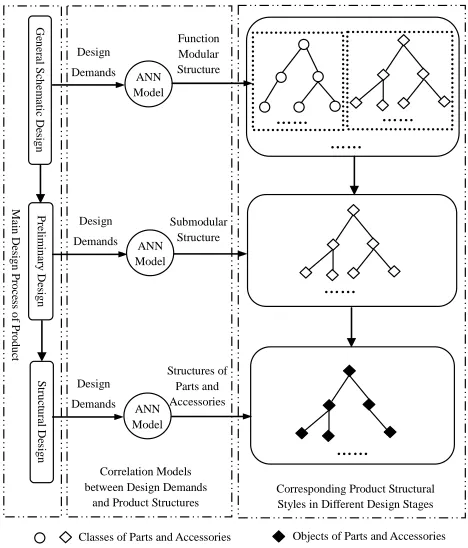
firstly should translate customer requirements into design demands, and then determine the product structure by using theses design demands, all kinds of design knowledge and design experience. The process of product design is a refining process step by step of product structure, including the selection of product family, determination of functional module, composition of structural module and instantiation of structural module. The expressive form of product structure determined by design demands of every stage is different. In the stage of general schematic design, designer needs to determine the type of product family, the composition of functional module and functional model according to design demands with some knowledge such as product function, performance and design experience and so on. In the stage of preliminary design, designer needs to refine those functional modules, which have been determined in the stage of general design, and determine the submodular structure by utilizing the related knowledge on functional module. The stage of structural design is the process of instantiation for parts and accessories’ structures, and it is the final design stage for determining material size and shape of product structure. In this stage, designer needs to determine the specific structures of parts and accessories, so that the whole product structure could be determined finally. The relation between every design stage and corresponding product structural style is shown in Fig. 1.
It shows from the Fig. 1 that the determining process of the whole product structure is truly a designer’s complicated thinking process based on design demands. For product agile customization design, it needs to respond customer requirements quickly and shorten
…
… … … … …
X1
X2
Xn
O1
O2
Om
Input Layer Hidden Layer Output Layer
Figure 2. Multilayer perception.
O
jk
i
w
ijFigure 3. Signal flow graph of the jth nerve cell. intelligentizing designer’s thinking process by using
some modern data analytic methods to establish and solve mathematic models. In numerous modern data analytic methods, artificial neural network is a simplest and applied simulation for human brain. ANN has preferable nolinear ability, and could perform the complicated logical operation and nonlinear relational mapping. So, a novel design approach of product agile customization is proposed based on ANN in the paper. In this approach, designer’s complicated thinking process is simulated by using ANN method, and product structural style could be determined quickly by establishing ANN model between design demands and product structure.
III. ALGORITHM OF ANN MODEL
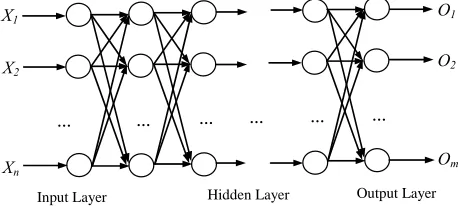
Artificial neural network is a method of artificial intelligence and has the stronger nonlinear mapping ability [14]. A topology structure of ANN is described in Fig. 2, and it belongs to multilayer perception including an input layer, an output layer and several hidden layers. In working process of network, input information passes nerve cells of input layer and then propagates ahead to nerve cells of hidden layer, and after calculating of neuronal activation function, the calculating results propagate to nerve cells of output layer and obtain the final output results. In ANN model, back propagation (BP) is the most popular and broad algorithm. It could realize analysis, induction and description of complex nonlinear problem, and give appropriate treatment for them [15], at the same time, it has better self-learning ability. As a result, BP network is suitable for solving those problems that have more complex internal mechanism, such as design process. In the paper, BP algorithm is applied to the customized design of a roll plate machine, in which, the existing design instances are training samples of network. Moreover, every design demand is the nerve cell of input layer and every structural style is the nerve cell of output layer. By establishing ANN model between design demands and product structure, designer’s thinking process is
simulated effectively.
BP algorithm is composed of forward propagation and back propagation. In the process of forward propagation, input information of input layer is treated by the nerve cells of hidden layer and propagated to output layer. The nerve cell’s state of every network layer only influences that of next network layer. If the expected outputs are not obtained from output layer of network, the output
information will switch to back propagation, that is, error signal will backtrack along path of connection and be minimized by modifying nerve cells’ connective weights of every layer. Output function must be differentiable because gradient optimal method is usually adopted to modify weights in BP algorithm, so sigmoid function is often used as output function. Supposing, the signal flow graph of the jth nerve cell of a certain network layer is
described in Fig. 3.
In Fig. 3, subscript i, subscript k, Oj and wij respectively represents the ith nerve cell of prior layer, the kth nerve cell of next layer, output of current layer and weight from previous layer to current layer. As a result, computing steps of BP algorithm could be generalized as follows [16].
① Weight coefficients are initialized with small random numbers.
② Ojof every layer is calculated by inputting a sample and described as
=
∑
i i ij j
w
O
net
(1)
j net j
e
O
−−
=
1
1
(2)
③ Local gradsδj of output layer is calculated and
described as
δ
j=
(
y
j−
O
j)
O
j(
1
−
O
j)
(3) where yj is ideal output value.④ Local gradsδj of every hidden layer is calculated from the back to front and described as
=
−
∑
k jk k j
j
j
O
O
w
δ
δ
(
1
)
(4)⑤ Modificatory value of every weight is calculated and saved as
∆
w
ij(
n
)
=
−
ηδ
jO
i+
α
∆
w
ij(
n
−
1
)
(5) where η is learning step length and 0<α<1, and the first item of (5) is the modificatory value of BP algorithm and the second item of (5) is momentum value.⑥ Weights are modified as
w
ij(
n
+
1
)
=
w
ij(
n
)
+
∆
w
ij(
n
)
(6) ⑦ Another sample is input into this network and then returns step ②.…… …… …… …… Mai n D es ign P roce ss of P rod uc t Ge ner al S chem at ic D es ig n Pre lim in ar y D es ign St ru ctu ra l D es ig n ANN Model Design Demands Structures of Parts and Accessories …… Function Modular Structure Submodular Structure
Corresponding Product Structural Styles in Different Design Stages
Classes of Parts and Accessories Objects of Parts and Accessories Design
Demands
Design Demands
Correlation Models between Design Demands
and Product Structures ANN Model
ANN Model
Figure 4. The associated relation between design demands and product structures.
ANN-A ANN-B ANN-C
Output Results of General Design Stage General Design Preliminary Design Structural Design
Output Results of Preliminary Design Stage
Output Results of Structural Design
Stage
Output Results of the Preceding Stage Partial Input Information of the Present Stage
Figure 5. Combined structure of ANN model in design process. IV. DESIGN METHOD OF PRODUCT AGILE
CUSTOMIZATION BASED ON ANN
A. Establishing Matching Relation between Design Demands and Product Structures by Using ANN
Product design is a complicated multitask and multistage process. Every stage has different design characteristics and design demands, so product structural styles determined by design demands of every design stage are also different. For example, in the stage of general design, design demands determined by customer requirements are mainly some functional demands, and designer needs determine function modular structure according these design demands. However, in the stage of structural design, design demands will be translated into some material characteristic parameters or performance indexs, and thus designer needs to determine structures of parts and accessories according these specific design demands.
As a result, design demands of different design stages could determine the corresponding structural styles by establishing associated model between them, but the relation of them is not just a simple one-to-one correspondence. Because design process is a chain work of multiphase, module combining forms of product structure maybe have many types. The process of design demands determining product structure is essentially the multiple combinations of these modular styles and selection from them. Especially, when product structure is rather complex, there are many alternative plans in different design stages and every module has many structural styles, the possible module combining forms of product structure, that is, possible scheme combining
amounts will very huge. In this process, designer needs to suffer the complicated logical reasoning and imaginal thinking for determining the final product structure. However, ANN has unique advantage in dealing with decision problem of design scheme, and could effectively simulate designer’s thought process so as to realize the synthesis at higher level. So, the designer’s complicated thinking process could be well simulated by making use of ANN method. The relation between design demands of different design stages and corresponding product structures could be established quickly by constructing ANN models, and realization path is shown in Fig. 4. Thought this path, the product structural styles could be determined rapidly so as to realize agile customization development.
B. Combined Structure of ANN Model between Design Demands and Product Structures
Product design process is a multistage transmission of knowledge process. Every stage has different characteristics and design demands, and the latter stage needs to use design result of the front stage. So, the combined structure of ANN model between design process and product structure is made up of several interconnecting subnetworks. According to the partition of design process, the combined structure of ANN model mainly includes subnetwork of general design stage, subnetwork of preliminary design stage and that of structural design stage. The combined structure of ANN model is shown in Fig. 5.
… Transmission
Mode
Bearing
Type
Pressing
Equipment
Driving
Type
Type of Taking
Plate
Adjustability of
the Roll Speed
Volume of
the Machine
Thickness of
the Plate
Material of
the Plate
Line Speed
of the Plate Cost of the
Machine Width of
the Plate
Output Layer
Input Layer Hidden Layer
Figure 6. Topological structure of BP network. Figure 8. Training times and the calculating error. relation between design process and product structure.
Furthermore the design results could be forecasted by applying the ANN models trained well for the new design task.
V. EXAMPLE OF APPLICATION
In this paper, a roll plate machine is taken as the example to discuss the application on the proposed method of product agile customization based on ANN in the general schematic design stage.
A. Constructing ANN Model to Establish Matching Relation between Design Demands and Product Structures
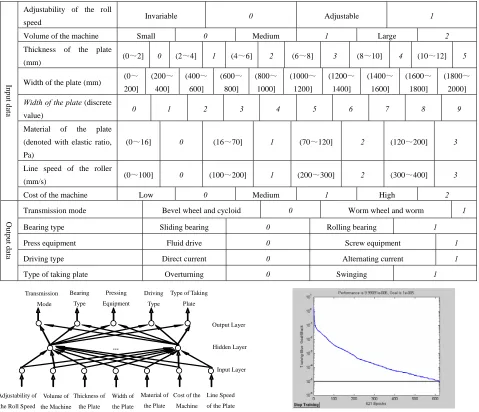
The design demands of a roll plate machine in the general schematic design stage include the adjustability of the roll speed, volume of the machine, thickness of the plate, width of the plate, material of the plate, line speed of the roller and the cost of the machine. In this stage, designer needs utilizing the effective knowledge to
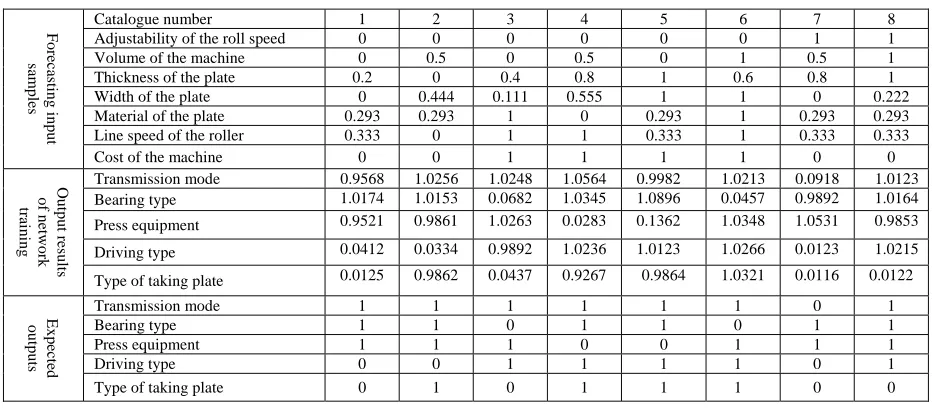
determine product structural style including transmission mode, bearing type, press equipment, driving type and type of taking plat. The samplings of design demands and that of product structural styles are shown in TABLE I, where the value of material of the plate is expressed with its elastic ratio. ANN model adopts BP network. BP network configuration is 7-12-5. The topological structure of this network is shown in Fig. 6. Model structure of BP network is shown in Fig. 7. ANN model is trained with MATLAB [17]. In the training process, training function adopts BFGS quasi-Newton method, and transfer function is logsig. Learning function is learngdm, and goal error of network training sets 1e-005. 60 groups of design demands are selected as the training samples. Sample data, expected outputs and output results of network training are shown in TABLE II. The values of input samples and expected output values have been normalized. The relationship between training times and the calculating error is shown in Fig. 8.
TABLE I.
VALUES OF INPUT DATA AND OUTPUT DATA OF ANN MODEL
Input data
Adjustability of the roll
speed Invariable 0 Adjustable 1
Volume of the machine Small 0 Medium 1 Large 2
Thickness of the plate
(mm) (0~2] 0 (2~4] 1 (4~6] 2 (6~8] 3 (8~10] 4 (10~12] 5
Width of the plate (mm) (0~ 200]
(200~
400]
(400~
600]
(600~
800]
(800~
1000]
(1000~
1200]
(1200~
1400]
(1400~
1600]
(1600~
1800]
(1800~
2000] Width of the plate (discrete
value) 0 1 2 3 4 5 6 7 8 9
Material of the plate
(denoted with elastic ratio,
Pa)
(0~16] 0 (16~70] 1 (70~120] 2 (120~200] 3
Line speed of the roller
(mm/s) (0~100] 0 (100~200] 1 (200~300] 2 (300~400] 3
Cost of the machine Low 0 Medium 1 High 2
Output data
Transmission mode Bevel wheel and cycloid 0 Worm wheel and worm 1
Bearing type Sliding bearing 0 Rolling bearing 1
Press equipment Fluid drive 0 Screw equipment 1
Driving type Direct current 0 Alternating current 1
Figure 7. Model structure of BP network.
TABLE II.
FORECASTING INPUT SAMPLES, OUTPUT RESULTS OF NETWORK TRAINING AND EXPECTED OUTPUTS
Forecasting input
sam
p
les
Catalogue number 1 2 3 4 5 6 7 8
Adjustability of the roll speed 0 0 0 0 0 0 1 1
Volume of the machine 0 0.5 0 0.5 0 1 0.5 1
Thickness of the plate 0.2 0 0.4 0.8 1 0.6 0.8 1
Width of the plate 0 0.444 0.111 0.555 1 1 0 0.222
Material of the plate 0.293 0.293 1 0 0.293 1 0.293 0.293 Line speed of the roller 0.333 0 1 1 0.333 1 0.333 0.333
Cost of the machine 0 0 1 1 1 1 0 0
Output results
of
networ
k
tr
aining
Transmission mode 0.9568 1.0256 1.0248 1.0564 0.9982 1.0213 0.0918 1.0123 Bearing type 1.0174 1.0153 0.0682 1.0345 1.0896 0.0457 0.9892 1.0164
Press equipment 0.9521 0.9861 1.0263 0.0283 0.1362 1.0348 1.0531 0.9853
Driving type 0.0412 0.0334 0.9892 1.0236 1.0123 1.0266 0.0123 1.0215
Type of taking plate 0.0125 0.9862 0.0437 0.9267 0.9864 1.0321 0.0116 0.0122
Expected
outputs Transmission Bearing type mode 1 1 1 1 1 1 0 1 1 1 0 1 1 0 1 1
Press equipment 1 1 1 0 0 1 1 1
Driving type 0 0 1 1 1 1 0 1
Type of taking plate 0 1 0 1 1 1 0 0
By comparing the output results of network training and expected outputs in TABLE II, it shows that the relation between design demands and corresponding product structure could be established by adopting ANN method, and the product structural style of general schematic design stage could be determined quickly and accurately.
B. Forecasting New Design Task by Using ANN Model Trained Well
The more important significance for establishing the relationship between design process and product structure lies in forecasting new design task. So, in order to verify the generalization ability of network, new 8 groups samples are retrained with this network configuration and their values are shown in TABLE III. Calculation results indicate that network also could give the correct response for new input, that is, ANN model could forecast commendably the new design task so as to realize product agile customization.
TABLE III.
PARTIAL SAMPLES DATA, EXPECTED OUTPUTS AND OUTPUT RESULTS OF NETWORK TRAINING
Input sam
p
les
Catalogue number 1 2 3 4 5 … 56 57 58 59 60
Adjustability of the roll
speed 0 0 0 0 0
…
1 1 1 1 1
Volume of the machine 0 1 0 0 1 1 0 1 0 1
Thickness of the plate 0 0.4 0.4 0.8 1 0.8 0.4 1 1 0.8
Width of the plate 0 0.555 0.111 0.222 0.444 0.444 0.222 1 0.333 1
Material of the plate 0.293 0.293 1 1 0 1 0.293 1 0.293 0
Line speed of the roller 0 0.333 1 0.333 1 0.333 0.333 1 0 0
Cost of the machine 0 1 0 1 1 1 0 0 1 0
E
xpected outputs Transmission mode 1 1 1 1 1 1 1 0 1 0
Bearing type 1 1 1 1 1 0 1 0 1 1
Press equipment 0 1 1 1 1 0 1 0 1 1
Driving type 1 1 0 1 1 0 1 0 1 0
Type of taking plate 0 1 0 1 1 1 0 1 1 1
Output r
esults of
networ
k tr
aining
Transmission mode 1.0206 1.0498 1.0781 1.0225 1.0213 1.0127 1.0212 0.0884 0.9765 0.0761
Bearing type 1.0321 1.0164 1.1026 1.0721 1.052 0.0552 1.0135 0.0236 1.0227 1.0236
Press equipment 0.0185 0.9816 1.0342 1.1053 0.9258 0.0672 1.0172 0.0692 1.0679 1.0258
Driving type 0.9906 1.0221 0.128 0.9863 1.0237 0.0381 0.9836 0.0769 0.9821 0.0562
VI. CONCLUSIONS AND FUTURE WORK
The paper discusses the characteristics of design process for product agile customization and the advantages of ANN algorithm, based on that, a novel design method of product agile customization based on ANN is put forward. Moreover this method is successfully applied to the custom design of a roll plate machine. Some conclusions are:
1) For design demands quickly determining product structural style, it is an effective path to establish the associated relation between design process and product structure.
2) The associated relation between design process and product structure could be established by constructing ANN model so as to determine quickly product structural style.
3) The proposed method could effectively simulate designer’s abstract logical thinking and imaginal intuition thinking, and it provides a new resolvent for product agile customization.
In addition, in order to improve the ANN performance to further advance design efficiency, ANN algorithm may connect with other some computational methods such as rough set (RS), genetic algorithm (GA), fuzzy theory and so on. For example, ANN algorithm integrates rough set, which extracts the effective design demands to predigest network configuration. Connecting ANN algorithm with GA can optimize output results of network. So, these researches are the future work on design method of product agile customization.
ACKNOWLEDGMENT
This work is supported by the National Natural Science Foundation of China (Grant No. 71072124), the Funds for the Association of Social Sciences of Liaoning Province in China (Grant No. 2010lslktxxjc-01), and the Fundamental Research Funds for the Central Universities in China (Grant No. 2009JC17).
REFERENCES
[1] W. L Chan and M. W. Fu, “An integrated FEM and ANN methodology for metal-formed product design,” Engineering Application of Artificial Intelligence, vol. 21, No. 8, pp. 1170–1181, 2008.
[2] W. W. Chen, Q. Zhang, X. P. Wei, T. T. Zhao, and X. Y. Zhao, “Product conceptual design schemes evaluation based on RBF neural network,” Computer Engineering and Design, vol. 30, No. 8, pp. 4290–4292, 2009.
[3] L. Yu, L. Y. Wang, and J. B. Yu, “Identification of product definition patterns in mass customization using a learning-based hybrid approach,” International Journal of
Advanced Manufacturing Technology, vol. 38, No. 11/12,
pp. 1061–1074, 2008.
[4] D. Su, M. Wakelam, and K. Jambunathan, “Integration of a knowledge-based system, artificial neural networks and multimedia for gear design,” Journal of Materials Processing Technology, vol. 107, pp. 53-59, 2000.
[5] Nalinaksh S. Vyas and D. Satishkumar, “Artificial neural network design for fault identification in a rotor-bearing system,” Mechanism and Machine Theory, No. 26, pp. 157–175, 2001.
[6] Hamdi Taplak, Ibrahim Uzmay, and Sahin Yildirim, “An artificial neural network application to fault detection of a rotor bearing system,” Industrial Lubrication and Tribology, vol. 58, No. 1, pp. 32–44, 2006.
[7] K. Liu and L. Yu, “Structure and Appl ication of Neural Networkfor Intelligent CAD System of V Belt Translation,” Journal of Sichuan Institute of Light Industry and Chemical Technology, vol. 12, No. 3, pp. 21–24, 1999. [8] Y. C. Lin, C. H. Yeh, and C. C. Wang, “Applying Neural Networks to Consumer-Oriented Product Design,” 2009 International Conference on Artificial Intelligence and
Computational Intelligence (AICI’09), November 7-8,
2009, Shanghai, China.
[9] J. N. Su and F. Q. Li, “Research of Product Styling Design Method Based On Neural Network,” Third International
Conference on Natural Computation (ICNC 2007), August
24-27, 2007, Hainan, China.
[10]Q. S. Xie, J. Yin, and Y. H. Luo, “Method of artificial neural networks in mechanical engineering,” Beijing: China machine press, 2003.
[11]F. H. Yin, “The Selection of Rolling Bearing’s Types Based on Artificial Neural Network,” Journal of Changzhou Institute of Technology, vol. 16, No. 4, pp. 35– 38, 2003.
[12]B. Tan, “Multiple Target Fuzzy Robust Optimal Design of the Swing Movable Teeth Reducer Based on ANN,” Master's Thesis: Central South University, 2008.
[13]Y. C. Lin, C. H. Yeh, and C. H. Hung, “A Neural Network Approach to the Optimal Combination of Product Color Design,” Fourth International Conference on Networked Computing and Advanced Information Management (NCM '08), September 2-4, 2008, Gyeongju, South Korea. [14]Y. P. Ju and C. H. Zhang, “Optimal Design Method for
Wind Turbine Airfoil Based on Artificial Neural Network Model and Genetic Algorithm,” Proceedings of the CSEE, vol. 29, No. 20, pp. 106–111, 2009.
[15]http://www.eda121.com/arm/jcarm/200709/693.html, 2007-9-19.
[16]J. P. Wu and D. S. Sun, “Modern Data Analysis,” Beijing: China Machine Press, 2006.
[17]S. Cong, “Technology and Application of Artificial Neural Network Faced to MATLAB Toolbox (Second Edition),” Hefei: University of Science and Technology of China Press, 2003.
Changfeng Yuan was born Shanxi, China in 1975. She received her Ph.D. degree in mechanical manufacturing and automation from Dalian University of Technology, Dalian, China in 2006. She is currently a lecturer in Transportation Management College, Dalian Maritime University. Her research interests include artificial intelligence, decision support and information management.
Yan Lin was born Shandong, China in 1972. He received his Ph.D. degree in Management Science and Engineering from Tsinghua University, Beijing, China in 2008. He is currently a lecturer in Transportation Management College, Dalian Maritime University. His research interests include knowledge management and management decision.