R E V I E W
Open Access
Understanding nurses
’
dual practice: a
scoping review of what we know and what
we still need to ask on nurses holding
multiple jobs
Giuliano Russo
1*, Inês Fronteira
2, Tiago Silva Jesus
2and James Buchan
2,3Abstract
Background:Mounting evidence suggests that holding multiple concurrent jobs in public and private (dual practice) is common among health workers in low- as well as high-income countries. Nurses are world’s largest health
professional workforce and a critical resource for achieving Universal Health Coverage. Nonetheless, little is known about nurses’engagement with dual practice.
Methods:We conducted a scoping review of the literature on nurses’dual practice with the objective of generating hypotheses on its nature and consequences, and define a research agenda on the phenomenon. The Arksey and O’Malley’s methodological steps were followed to develop the research questions, identify relevant studies, include/ exclude studies, extract the data, and report the findings. PRISMA guidelines were additionally used to conduct the review and report on results.
Results:Of the initial 194 records identified, a total of 35 met the inclusion criteria for nurses’dual practice; the vast majority (65%) were peer-reviewed publications, followed by nursing magazine publications (19%), reports, and doctoral dissertations. Twenty publications focused on high-income countries, 16 on low- or middle-income ones, and two had a multi country perspective.
Although holding multiple jobs not always amounted to dual practice, several ways were found for public-sector nurses to engage concomitantly in public and private employments, in regulated as well as in informal, casual fashions. Some of these forms were reported as particularly prevalent, from over 50% in Australia, Canada, and the UK, to 28% in South Africa. The opportunity to increase a meagre salary, but also a dissatisfaction with the main job and the flexibility offered by multiple job-holding arrangements, were among the reported reasons for engaging in these practices.
Discussion and conclusions:Limited and mostly circumstantial evidence exists on nurses’dual practice, with the few existing studies suggesting that the phenomenon is likely to be very common and carry implications for health systems and nurses’welfare worldwide. We offer an agenda for future research to consolidate the existing evidence and to further explore nurses’motivation; without a better understanding of nurse dual practice, this will continue to be a largely‘hidden’element in nursing workforce policy and practice, with an unclear impact on the delivery of care.
Keywords:Nurses dual practice, Multiple job-holding, Moonlighting, Human resources for health, Private health sector, Nurses, Casualization of work
* Correspondence:[email protected]
1Centre for Primary Care and Public Health, Queen Mary University of
London, Yvonne Carter Building, 58 Turner Street, London E1 2AB, United Kingdom
Full list of author information is available at the end of the article
health domain [1]. There is a concern among policy-makers and patients alike that simultaneous engagement with public and private sector activities jeopardise the availability of professionals and the quality of services in the public sector and divert patients towards costlier pri-vate care, therefore putting at risk the attainment of Universal Health Coverage (UHC) goals [2,3].
‘Dual practice’in the health sector has been defined as health workers’concomitant engagement in public and private sector clinical activities, with the public sector job representing the ‘primary’ one to which the largest proportion of working hours are allocated [4]. Although very common worldwide, the practice has been trad-itionally treated with suspicion by the public health and health system research literature, amid fears that it may compromise the supply of public services [5] and en-courage absenteeism in public institutions [6], as well as the selection and diversion of patients towards private services [7]. Scholars have highlighted the possible po-tential benefits of the practice, such as the opportunity it offers to provide a wider range of health services to the population and to retain underpaid workers in the public sector [8]. Others have paid attention to the regulatory aspects [9], with some focusing on the systems’ govern-ance and institutions [10] and others on the incentives to be offered to achieve the desired level of service provision [11,12].
Substantial literature exists on physicians’dual practice [13,14], most recently building up evidence on its preva-lence, forms, and drivers worldwide [15–17], as well as on modelling possible regulatory frameworks [12, 18]. How-ever, nurses’ engagement in multiple job-holding is, in comparison, less explored, despite preliminary evidence of its high prevalence in high-income [19] as well as in low-income settings [20], and amid concerns of its impact on the nurses’wellbeing [21].
Nurses and midwives are the world's largest group of health professionals, representing 48% of the global health workforce, and their role is widely considered critical for the delivery of UHC goals in high- as well as low-income countries [22]. However, the profession has recently come under pressure because of growth of the demand for health services and concomitant scarcity of funds, and the global shifts in the world’s health labour market [23]. As the nursing workforce is predominately female, policy op-tions to address nurses’participation in the public and pri-vate labour market will need to take gender into account [24,25].
This scoping review sets out to fill this knowledge gap by systematically searching and reviewing the studies conducted on nurses’ simultaneous engagement in
across geographies, publication types (e.g. peer-reviewed, grey), and specific topics addressed; (2) summarise the evidence, perspectives, and specific contents addressed; and (3) propose an agenda to advance research and de-velopment activities to first identify and then mitigate any pervasive effects of nurses’ dual practices to UHC, based on the scoping review results.
Methods
A scoping review was conducted to determine the extent and key themes within the literature on nurses’ dual practice, as well as to identify areas for future research on the topic. Such knowledge synthesis method is com-monly used to address exploratory research questions, to map the existing literature on a field or to preliminarily identify gaps in that literature [26–28]. We used the five Arksey and O’Malley’s methodological steps to develop the research questions, identify relevant studies, include/ exclude articles, extract the data, and report the findings [28]. As the methodological guidance for the report of scoping review is still under development, we used the PRISMA guidelines where appropriate [29].
In March 2017, we searched MEDLINE (through PubMed), the ISI Web of Knowledge, Scopus, and the CINHAL Plus with full texts (through EBSCO). We used a set of keywords for the searches and, where appropriate, Medical Subject Headings for nurses combined with key-words and indexed terms related to dual practice (using the Bolean operator‘AND’). Additional file1provides full details for the initial search strategy for each of the data-bases searched. The grey literature also was searched by visiting websites dedicated to nursing and/or health work-force issues. To widen the scope of the review, the searches on databases and grey literature were not filtered for publication date, language, or publication type. Human resources for health experts (named in the Additional file
To be included, studies needed to address explicitly both nurses and dual practice issues. The working defin-ition for the ‘nurses’ category contained explicit refer-ence in the text to the professional label, with midwives included too. The working definition of dual practice, in turn, referred to concomitant practice in two (or more) distinct clinical services, either in the same or in differ-ent healthcare institutions. Public employmdiffer-ent was considered the primary job, whereas the secondary (or subsequent) job(s) was considered the one(s) where fewer working hours were spent, periodically or regu-larly. Alternative labels for dual practice included‘ moon-lighting’,‘public-private work’,‘multiple profit-generating activities’, ‘dual/multiple job-holding’, and ‘second jobs’. ‘Casualization of work’, defined as the process of re-placing full-time and regular part-time staff with con-tract staff employed on an ad hoc basis, is another phenomenon related in many ways to dual practice [30]. As such, papers addressing this form of employment in relation to dual practice were also included.
Documents in English, French, Portuguese, Italian, and Spanish were included. With the exception of jour-nal commentaries, editorials, and letters to the editor, we did not exclude references because of the type of art-icle (such as opinion pieces), study output (e.g. final or preliminary results), countries or world regions, publica-tion status (i.e. both peer-reviewed and grey literature), or publication date. Titles and abstracts were first screened by one of the authors (TJ) and then reviewed in duplicate by the first author (GR), who finally deter-mined the suitability for the full-text review. Full-text re-view was carried out by one of three authors, all with a research track record in nurse workforce and/or dual practice issues (GR, IF, JB). Any of the authors were able to directly include or exclude papers on the basis of the eligibility criteria; agreement between two or more re-viewers was sought for doubtful cases.
Based on the overarching aim of the paper, the prelim-inary knowledge of the literature, and a priori consult-ation with health professionals [13], we developed the following set of questions to guide the data extraction for the review:
What are the forms in which nurses engage in
multiple profit-generating activities?
What are the different features of nurses’multiple
job-holding?
What is the prevalence of this phenomenon in
nursing?
Why do nurses engage in dual practice?
What are the enablers and barriers for nurses’dual
practice?
What are the personal/ professional drivers and
consequences?
What are the consequences for health systems,
specifically for the delivery of quality and safe nursing/health care?
What are the consequences for nurses’welfare?
What are the consequences for patients?
What are health workers’, managers’, and patients’
perceptions around this practice?
Data extraction tables were then purposively built by the research team to collect data on the specific ques-tions above, either using textual data or synthesis of the articles’ findings/conclusions. Consistent with the scop-ing review methodology, the data extraction did not involve quality appraisal or grading of the evidence from the studies.
A conventional form of qualitative content analysis, with coding categories derived directly from the text data, was used to analyse data retrieved for each topic [31]. The first author performed a first synthesis of the extracted material, that was then iteratively edited by two of the other authors (IF, JB) following the themes from the data extraction table.
Findings from the literature review on nurses’ dual practice
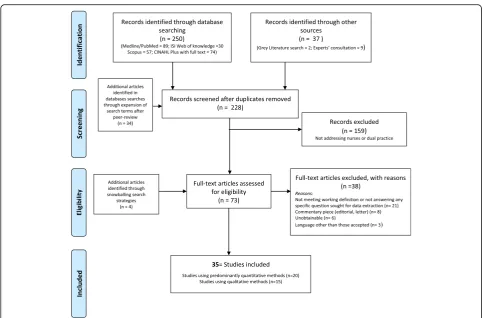
From 228 records retrieved, 159 (70%) were excluded after reviewing their titles and abstracts (Fig.1). An add-itional four articles were identified through snowballing search strategies, resulting in a total of 73 full texts assessed for eligibility. Of all these, a total of 35 (48%) articles finally met the inclusion criteria for addressing dual practices of nurses: 20 using predominantly quanti-tative methods and 15 using mostly qualiquanti-tative designs. The vast majority of the studies were in English, with only four published in Portuguese and one in Spanish. Additional file2 provides spreadsheets for the (a) list of included articles organised by study-type, (b) the data extraction table, and (c) list of articles excluded with the respective reasons.
associated with nurses’ multiple-job holding. Below we present the literature retrieved, organised in sec-tions reflecting the emerging themes.
Forms of nurses’multiple job-holding
From the documents retrieved, it emerged that nurses’ engagement in dual practice can take different forms and shapes, with often blurred boundaries. Some authors mention ‘secondary jobs’ and ‘moonlighting’ practices, where public sector nurses engage with the private sec-tor either individually or through an organised nursing services agency [32–34]. Ribera Silva et al. (2009) as well as Gupta et al. (2006) refer generally to‘nurses taking up public or private secondary jobs’ in Brazil, Chad, Côte d’Ivoire, Zimbabwe, and Mozambique. A similar operational definition is adopted by Serra et al. to de-scribe nurses’ practicing simultaneously in the national healthcare system and for NGOs or private clinics. Publications from HICs at times use the expression ‘casualization of work’to describe job insecurity through a lack of a stable contract of employment, but also the practice of working flexibly for public and private health facilities, often through agencies and banks for outsourced nursing services [35–38].
However, a distinction is drawn in the literature between holding multiple jobs concurrently, and dual practice, where the nurse’s primary job is in the public sector, and that may be affected in many forms by the simultaneous engagement with other clinical, profit-generating activities [13]. Three common forms of nurses’ dual practice are mentioned, and often used interchangeably, in the literature;
Primary public sector employment with additional
nursing work in the public sector—typically nightly
extra shifts in different departments of the same hospital/facility, or other public facilities in the same
geographical area [39,40];
Primary public sector employment with additional
nursing work in the formal or informal private
sector—long-hours shifts, or side jobs during spare
time/vacation from main employment [34,41,42];
Fixed part-time employment in the public, coupled
with multiple flexible contract assignments in public and private sector, often though nurse agencies
(referred to as‘casualization’) [21,43,44].
Some authors report that boundaries between public and private sector employment are often blurred,
particularly in low-income settings, and that ad hoc classi-fications of multiple-job holding may be required to cap-ture the essence of the practice for specific countries [2].
Magnitude of the phenomenon
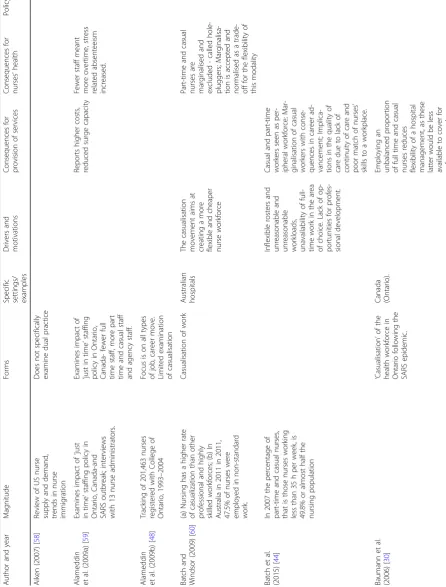
Although using different definitions of the practice, a number of studies attempted measuring the prevalence of nurses’ engagement in multiple job-holding in high-income as well as low- and middle-high-income countries (see Table 1 below). These are mainly cross-sectional surveys that do not provide data on trends for the phenomenon.
For Australia, Creegan et al. [36] show that 51.7% of nurses worked part-time in 1997, while in 2011 Batch and Windsor found that the nursing profession had a higher rate of casualization than other professional and highly skilled workforces, and that 47.5% of nurses were employed in non-standard work [44].
For the UK, Tailby reports that 80% (of 185 000) nurses registered with NHS nurse banks had another nursing job, and 60% worked occasionally or regularly additional shifts paid at bank or agency rates [43]. In a survey among nurs-ing magazines’ readers in 2013 [45], 54% declared taking up extra nursing work, and 10% another full time job out-side nursing; 5 years later, 47% of the 900 nurses partici-pating in another online magazine readers survey declared engaging in bank and/or agency shifts [37].
A report from the US Bureau of Labor Statistics [46] shows that multiple job-holding has grown stead-ily over the last decades, that 6.3% of nurses had multiple jobs in 2014, and that such prevalence was higher for a small sample of male nurses (9.5%). A 2017 article from Canada [35] provides evidence that 15.8% of all rural nurses are in casual jobs and that casualization is particularly common among registered nurses and licenced practical nurses (16.5%), and more common among those nurses living in the north of the country (20.0%).
Evidence on the phenomenon from LMICs is substan-tial too; Gupta et al. report from a multi-country study that nurses dual practice would be more limited than physicians’—the former calculated to be 11% in Chad; 7% in Cote d’Ivoire; 26% in Jamaica; 1% in Mozambique; 0% in Sri Lanka; and 7% in Zimbabwe [41]. In a World Bank study in Ethiopia [34], a similar proportion of a co-hort of public sector nurses (5%) were found to have secondary jobs 5 years after their initial appointment. Several studies by Rispel and colleagues from South Africa showed the prevalence of different forms of mul-tiple employment to be common (around 28%) and on the rise among South African nurses [21, 33]. And in Brazil, Portela et al. showed 41.5% of nurses in two pub-lic hospitals to be moonlighters [39].
Drivers and motivation
A few individual and institutional drivers for the practice are recurrent in the literature. At a personal level, the need to increase overall earnings by supplementing in-come from main salary is by far the most common, such as in Northern Ireland and elsewhere in the UK—where holding multiple jobs is seen by many nurses as an es-sential way to increase income [38, 45]. However, also for a low-income country like Ethiopia where a nurse’s salary is typically higher than the country’s average Gross Domestic Product (GDP) per capita, Serra et al. report that half of the nurses followed in their study took up a second job to support their families [34].
Flexibility of additional part-time employment seems to be another key factor for Australian and UK nurses, since nursing is a typically female profession, and some female workers have a strong preference for part-time, flexible jobs in comparison to their male peers [36, 43]. In the surveys in South Africa [21, 33], the opportunity for learning new nursing skills, the need to introduce di-versity in professional routines, a more stimulating working environment, the quality of supervision, and the ability to select their own working hours were the key reported motivating factors for South African nurses.
At a more institutional level, also in South Africa, the growing demand for nursing services from the private sector is pointed to as the key driver of the phenomenon of casualization of nursing employment. Taking a broader organisational perspective, Batch and Windsor (2014) argue that the ‘casualization movement’ is really aimed at creating a more flexible, cheaper, and easier to manage the nursing workforce.
Consequences of nurses’multiple job-holding
Table 1 Documents retrieved, by key themes Author and year Magnitude Forms
Specific settings/ examples
Drivers and motivations Consequences for provision of services Consequences for nurses ’ health Policy options Aiken (2007) [ 58 ] Review of US nurse supply and demand, trends in nurse immigration Does not specifically examine dual practice Alameddin et al. (2009a) [ 59 ] Examines impact of ‘ just in time ’ staffing policy in Ontario, Canada-and SARS out break ; intervi ews with 13 nurs e administrat ors. Examines impact of ‘ just in time ’ staffing policy in Ontario, Canada-fewer full time staff, more part time and casual staff and agency staff. Reports higher costs, reduced surge capacity Fewer staff meant more overtime, stress related absenteeism increased. Alameddin et al. (2009b) [ 48 ] Tracking of 201,463 nurses registered with College of Ontario, 1993 – 2004 Focus is on all types of job, career move. Limited examination of casualisation Batch and Windsor (2009) [ 60 ] (a) Nursing has a higher rate of casualization than other professional and highly skilled workforces; (b) In Australia in 2011 in 2011, 47.5% of nurses were employed in non-standard work. Casualisation of work Australian hospitals The casualisation movement aims at creating a more flexible and cheaper nurse workforce Part-time and casual nurses are marginalised and excluded -called hole-pluggers; Marginalisa-tion is accepted and normalised as a trade-off for the flexibility of this modality Batch et al. (2015) [ 44 ] In 2007 the percentage of part-time and casual nurses, that is those nurses working less than 35 h per week, is 49.8% or almost half the nursing population Inflexible rosters and unreasonable and
unreasonable workloads, unavailability
Table 1 Documents retrieved, by key themes (Continued) Author and year Magnitude Forms
Specific settings/ examples
Table 1 Documents retrieved, by key themes (Continued) Author and year Magnitude Forms
Specific settings/ examples
Drivers and motivations Consequences for provision of services Consequences for nurses ’ health Policy options Farzianpour et al. (2015) [ 61 ] 31% of nurses in private sector had a secondary job Iran (Tehran private hospitals) Feysia et al. (2012) [ 62 ] Repeating findings from Serra et al. (2010) Repeating findings from Serra et al. (2010) Gillen (2013) [ 45 ] 1200 nursing magazine readers. 54% took up extra nursing work, and 10% another on outside nursing UK, among
Nursing Standard readers
To complement insufficient public sector salary 46% was thinking of leaving nursing profession 45.8% declared considering leaving nursing because poor salary Gupta and Dal Poz (2009) [ 41 ] (a) 11% Chad; (b) 7% Cote d ’ Ivoire; (c)26% Jamaica; (d) 1% Mozambique; (e) 0% Sri Lanka; (f) 7% Zimbabwe Work at another location (health facility or other) in the previous month In some cases it was reported that nurses did not have the right of private practice Hipple (2010) [ 46 ] (a) Report on data from US Labor stats; (b) 6.3% of nurses had multiple jobs-higher for male nurses (9.5%, but small sample) Second jobs were in or out of health sector Discusses possible impact of nurses working 12 h shifts-meaning they would have more free days for second jobs Knauth (2007) [ 32 ] 64% of nurses on 12 h nightshift and 45% of those on dayshift had a secondary job Extended periods of work across different professions (Moonlighting and secondary jobs) Nurses in 12 h night and day shifts In cr ea se d sl eepi n es s, diffi cult y of comm unicat ing w it h managers ,i n creased risk of acc idents d riving ho me, incr eased absenteei sm, red u ced al ertness Lane et al. (2009) [ 50 ] A broad based global review of nursing labour market, health systems and macroeconomic policy Has a brief section on dual practice as a ‘ coping mechanism ’ ‘
Dual practices range
from
legitimate private practice
Table 1 Documents retrieved, by key themes (Continued) Author and year Magnitude Forms
Specific settings/ examples
Drivers and motivations Consequences for provision of services Consequences for nurses ’ health Policy options MacLeod et al. (2017) [ 35 ] 1.1% of all nurses were in a job-share arrangement (a) 15.8% of all nurses were in casual jobs; (b) Casualization is particularly common among Licenced Practical Nurses (16.5%); (c) Casualization is more common for rural States (20%)
Canada, Registered and
Licenced nurse population in rural areas and in the north of Canada Casualisation of nursing in rural areas/ communities is seen as a concern that should be addressed by Govt policies McPake et al. (2014) [ 17 ] Reports examples and prevalence of NDP for several countries from secondary sources Unspecified multiple job-holding Low-and
middle- income countries
Depending on its prevalence and regulation, dual practice can hamper attainment of UHC Different regulatory option depending on country GDP, regulatory capacity, and definition of boundaries between public and private sectors Monteiro et al. (2012) [ 40 ] 26% (out of 570 nursing workers) Second job in the same branch (a) Public hospitals and health centers in Brazil; (b)
Nurses, nursing assistants
Table 1 Documents retrieved, by key themes (Continued) Author and year Magnitude Forms
Specific settings/ examples
Drivers and motivations Consequences for provision of services Consequences for nurses ’ health Policy options Portela et al. (2004) [ 39 ] 41.5% of public hospital nurses were moonlighters MJH was more common among nurses during 12 h night or day shifts Public hospitals in Brazil Long (12 h) night shifts found to have a less taxing effect on nurses health than day ones. Ribeiro-Silva et al.(2006) [ 51 ] 33% Second job in another hospital or clinic (a) Public hospitals Brazil; (b) Registered nurses and nursing assistants ( N = 144) Those who had two jobs devoted more time to sleep/rest on the job (a) The less time devoted to leisure and personal needs among those who work more associated with quality of daily life; (b) Sleep on the job related to working on a second job. Those with two jobs had longer sleep episodes on the jobs (compared with those with a single job) Rispel and Blaauw (2015) [ 21 ] 40.7% reported agency or moonlighting in previous year Agency/ moonlighting 80 hospitals in 4 provinces in SA. All nurses surveyed 11.9% of moonlighters had taken vacation to do agency work or moonlight; 9.8% reported conflicting schedules between primary and secondary jobs Strong nurse
leadership, management consultation line
nurses counteract negative impacts agency-moonlighting Rispel et al. (2011) [ 64 ] (a) 28.0% IC95 [24.2; 32.1] moonlighting last 12 months; (b) 42.2% moonlighting ever; (c) 37.8% IC95 [32.4;43.6] agency nursing; (d) 69.2% IC95 [64.1;73.8] had done overtime, moonlighting or agency nursing in the preceding year; (e) 18.5% reported all activities Additional paid work (nursing or not nursing nature) in private health facility, another government health facility, insurance company private health laboratory or same health care facility excluding overtime (a) Taking care of patients, opportunity to learn new nursing skills, relationship with co-workers, agency ’ s weekly pay, choice of unit/ward, job variety, do it for the money, stimulating work, qual-ity of supervision, modern equipment/in-frastructure, selection of working hours, money owed to rev-enue service; (b) Pre-dictors: -having children province, sec-tor (higher among pri-vate sector)
-Management moonlighting considered important
Table 1 Documents retrieved, by key themes (Continued) Author and year Magnitude Forms
Specific settings/ examples
Table
1
Documents
retrieved,
by
key
themes
(Continued)
Author
and
year
Magnitude
Forms
Specific settings/ examples
Drivers
and
motivations
Consequences
for
provision
of
services
Consequences
for
nurses
’
health
Policy
options
Stephenson (2017)
[
37
]
Of
900
nurses
completing
an
online
survey
in
the
UK,
47%
declared
engaging
in
bank
and/or
agency
shifts
Ban
on
agency
shifts
is
introduced
for
nurses
with
a
substantial
NHS
contract
as
a
cost-containment
strategy
for
public
sector
The
UK
Agency
and
bank
shifts
as
a
way
to
balance
the
cap
on
increasing
public
sector
salaries
Tailby
(2
005
)
[
43
]
(a)
80%
(of
185,000)
nurses
registered
with
NHS
nurse
banks
had
another
nursing
job;
(b)
60%
worked
occasionally
or
regularly
additional
shifts
paid
at
bank
rates
or
agency
rates
––
(a)
Need
for
additional
income;
(b)
Need
to
refresh/update
skills;
(c)
Attain
a
preferred
pattern
of
working
hours
––
–
Taylor
et
al.
(2004)
[
52
]
Casualisation
of
work
Mental
health
nurses
in
New
South
Wales,
Australia
Casualisation
of
work
was
reported
to
be
a
major
source
of
career
fatigue
and
burnout
Wynton
and
A.
Kleebauer
(2016)
[
38
]
Agency
nursing,
other
country
(England,
Scotland)
Economic-higher
rate
for
single
day
fees
than
in
home
country
of
N
the public sector and/or migrate have been found to be more frequent among them than in their single-job peers [33].
Baumann et al. argue that employing an unbalanced proportion of full-time and casual nurses reduces flexi-bility of a hospital management, as these latter would be less available to cover for unforeseen needs [30]. In the case of Ontario, Canada’s experience with the Severe Acute Respiratory Syndrome (SARS) epidemic, such fac-tors, together with the increased dependence of many hospitals in high-income countries on agency nurses, have been suggested could compromise the system’s ‘surge capacity’, that is, its ability to rapidly scale-up services and response in the face of epidemics [48]. In a qualitative study in rural community hospitals in Canada about the changing nature of nursing work, Montour et al. argue that employment in multiple organisations con-tributes to scheduling issues because casual nurses are unavailable to fill vacant shifts [49]. And finally, accord-ing to some studies, some types of health workers’ dual practice can critically undermine health service provision and public trust, as it often entails conflict of interest, idleness, and absenteeism [50].
At a more personal level, Portela et al. show that taking extra shifts can seriously affect nurses’ general health and exhaustion levels, with night shifts reported to be less disruptive than day ones [39]. Such findings on sleeping patterns are also echoed by Ribeiro-Silva et al. [51] for hospital nurses in Rio de Janeiro, Brazil, and by Knauth for workers outside the clinical profession [32]. Casualization of work was also identified as a major source of career fatigue and burnout in qualitative inter-views with nurses in Australia [52]. Marginalisation and exclusion of part-timers by their peers was also reported to be a major source of dissatisfaction and frustration in an ethnographic study on Australian nurses [44].
As a positive individual consequence, nurses were re-ported to value highly the opportunity dual work offers to complement meagre public salaries in high-income countries [45] and to support extended families in low-income ones [34]; in the USA in 1999, nurses earned more in their secondary job than in their primary em-ployment [47]. Flexible working hours is another charac-teristics that nurses would find particularly attractive in secondary, casual jobs in the UK [43]. In this respect, Creegan et al. suggest that flexible working arrange-ments would be particularly suited for the predomin-antly female nursing workforce [36].
Policy options
Only a minority of the studies retrieved in this review (eight) present and discuss possible policy options for managing, regulating, or controlling the practice. McPake et al. [2] link the choice of policy measures to
the prevalence of the practice and to the country’s regu-latory capacity. Rispel et al. [21] highlight managing moonlighters as a key human resource for health strat-egy in South Africa; consultation with frontline nurses to counteract the practice’s negative impact is suggested as a possible policy option.
Electronic time recording, cessation of unpaid over-time, and controls over the number of shifts are put forward as alternative measures by other authors [53], while developing clinical guidelines for hospitals to en-sure safety of services ‘in the hands of strangers’ has been called for as a possible institutional measure. Other scholars have argued for the need for a better under-standing of dual practice patterns, in recognition of the fact that more effective planning and management of a flexible workforce could represent a more suitable solution than prohibition [36].
Discussion
Our review revealed that nurses engage in multiple job-holding activities, with varying forms and prevalence in high-income as well as in low-income countries. The practice appears to be driven by multiple, complex, and varying factors beyond the obvious economic motif, and to have non-trivial consequences, particularly for nurses’ welfare, organisation of health services, and health labour market. Despite its prevalence and relevance, a surprising paucity of studies was found on nurses’dual practice, and very few policy options have been outlined in the literature to address the phenomenon.
Although in the nursing profession holding simultan-eously multiple jobs cannot be necessarily considered as dual practice, the two areas often overlap, in shapes of poorly demarcated contours. Consistently with what is observed for other professions, more than one way seems to exist for nurses to engage with dual practice, both in regulated and informal, casual fashions. This may at least in part explain why the practice has been under-reported and little regulated through the years, with some of its forms driven underground or even con-sidered illegal in some countries [34], and other for-ms—such as the‘casualization’of nursing services—only recently having come to the fore in the context of rap-idly evolving health labour markets [33]. This absence of usable datasets would call for primary research to be conducted to, first, explore through qualitative research the specificities of the phenomenon and, second, to measure them quantitatively.
understanding nurses’burnout [55,56], surprisingly little attention has been given to the tendency to take on add-itional work in presence of an already heavy workload.
In contrast to the comparatively better understood physician dual practice, the limited evidence reviewed suggests that nurses’ dual practice is more likely to be bounded by the very nature of their jobs than it is for physicians, as typically nurses have limited autonomy and tend to work as part of a team, rather than as indi-vidual providers. On this basis, a hypothesis could be made that, while nurses are more likely to be part of an established team in their main (public sector) job, sec-ond jobs are often taken up as individuals, as agency nurses for one shift, or private home care visits.
Nurses’ personal characteristics also appear to shape forms and extent of the practice in any one country. Since taking up additional work in the private sector may be financially rewarding, but will also add to overall workload and may not necessarily increase career prospects, younger and comparatively lower paid nurses seem to be the ones likely to engage more in the practice [35, 39]. As a compounding factor, as nurses are pre-dominantly female and often perform a disproportionate share of child-rearing and care for elderly or disabled relatives’ duties, we may speculate that having depen-dents will likely decrease their ability to take up additional hours, unless the additional income generated can compensate for any additional child care costs.
The evidence available suggests that the consequences of this phenomenon are not negligible, particularly for the health of those nurses ending up working longer hours and hospital shifts because of their multiple com-mitments [39,51], but also for the organisation of public and private health services facing a more ‘casual’ and less-committed kind of workforce [21]. Interestingly, the most recent literature on nursing and midwifery enter-prises [24,25] recognises this limitation and may lay the grounds for a different type of engagement of nursing staff with private sector activities. We also did not find any evidence regarding the importance of economic con-siderations of nurses’ dual practice, or of any difference between higher and lower income countries; as we sus-pect the implications of such practice may have substan-tial repercussions on the health labour market, this could represent an area of future research.
This paper is based on a scoping exercise and so has limitations. The limited and often incomplete evidence made it difficult to be certain if dual practice is a factor of relevance in all health systems worldwide, if it is a major issue for nurse labour market participation, and its overall impact on the provision of care. With respect to
regulation.
All of the above call for a deeper understanding of the phenomenon, with the objective of better harnessing the changing nurses’ workforce worldwide. Following our review, the core elements of the required research agenda on nurse dual practice appear to be three-fold. First, further research is needed to systematically explore the nature, extent, and impact of nurse dual practice in different systems and countries; this can be achieved through the analysis of employment and professional register/association data sets where these exist, or by ad-hoc surveys of nurses and/ or workplaces. Analysis of specific data sets in some countries (e.g. such as the Current Population Census [57] and the Integrated Public Use Microdata Series the United Sates; Labour Force Surveys; and professional registries) may provide more evidence on prevalence of dual practice and some of its main forms.
Secondly, there is a need for developing a more in-formed picture of the reasons why nurses take on dual practice, their experiences and preferences of dual prac-tice, and the impact on their broader work/life balance. This can be achieved through a qualitative approach, ex-ploring multiple contexts in high- and low-income set-tings, and different nursing profiles.
Finally, there is a gap of research that establish the im-pact of dual practice at the policy level—what is its impact on participation rates, overall nursing hours available in different systems, what are the trends in incidence, what is the impact on nurses, and on the quality of care that is being delivered. Measures could be needed to mitigate the effects of nurses’dual practice to protect the provision of free-of-charge public sector for vulnerable populations. This latter area for policy research is the most complex and challenging to interrogate, but also of potentially great significance. Without a better understanding of nurse dual practice, it will continue to be a largely ‘ hid-den’ element in nursing workforce policy and practice, with an unknown level of significance, and an unclear im-pact on the delivery of care.
Additional files
Additional file 1:Search terms—database searches. (DOCX 19 kb)
Additional file 2:Spreadsheet of papers reviewed. (XLSX 32 kb)
Abbreviations
Acknowledgements N/A.
Funding
No funding was received for this research.
Availability of data and materials
All the data and information included in this review can be found in the annexes.
Authors’contributions
GR elaborated the original idea for the study. GR, IF, and JB designed the study. TSJ designed the methodology for the review. GR drafted the manuscript. All authors revised, read, and approved the final manuscript.
Ethics approval and consent to participate N/A.
Consent for publication N/A.
Competing interests
The authors declare that they have no competing interests.
Publisher’s Note
Springer Nature remains neutral with regard to jurisdictional claims in published maps and institutional affiliations.
Author details
1Centre for Primary Care and Public Health, Queen Mary University of
London, Yvonne Carter Building, 58 Turner Street, London E1 2AB, United Kingdom.2GHTM, Instituto de Higiene e Medicina Tropical, Nova University of Lisbon, Rua da Junqueira 100, Lisbon, Portugal.3School of Health Sciences, Queen Margaret University, Edinburgh EH21 6UU, United Kingdom.
Received: 4 October 2017 Accepted: 9 February 2018
References
1. Ranson MK, Chopra M, Atkins S, Dal Poz MR, Bennett S. Priorities for
research into human resources for health in low- and middle-income
countries. Bull World Health Organ. 2010;88:435–43.
2. McPake B, Russo G, Hipgrave D, Hort K, Campbell J. Implications of dual
practice for universal health coverage. Bull World Health Organ. 2016;94:142–6.
https://doi.org/10.2471/BLT.14.151894.
3. Sousa A, Scheffler RM, Nyoni J, Boerma T. A comprehensive health labour
market framework for universal health coverage. Bull World Health Organ.
2013;91:892–4.
4. Berman P, Cuizon D. Multiple public-private jobholding of health care
providers in developing countries: an exploration of theory and evidence.
Issues paper—private sector. London: DfID Health systems resource centre;
2004.http://www.heart-resources.org/wp-content/uploads/2012/10/
Multiple-public-private-jobholding-ofhealthcare-providers.pdf. Accessed 16 July 2013
5. Brekke KR, Sørgard L. Public versus private health care in a national health
service. Health Econ. 2007;16:579–601.
6. Eggleston K, Bir A. Physician dual practice. Health Policy Amst Neth. 2006;78:
157–66.
7. Barros PP, Olivella P. Waiting lists and patient selection. J Econ Manag
Strategy. 2005;14:623–46.
8. Jan S, Bian Y, Jumpa M, Meng Q, Nyazema N, Prakongsai P, et al. Dual job
holding by public sector health professionals in highly resource-constrained
settings: problem or solution? Bull World Health Organ. 2005;83:771–6.
9. Kiwanuka SN, Rutebemberwa E, Nalwadda C, Okui O, Ssengooba F,
Kinengyere AA, Pariyo GW. Interventions to manage dual practice among
health workers. Cochrane Database Syst Rev. 2011;7:CD008405.https://doi.
org/10.1002/14651858.CD008405.pub2.
10. García-Prado A, González P. Policy and regulatory responses to dual practice
in the health sector. Health Policy Amst Neth. 2007;84:142–52.
11. González P. Should physicians’dual practice be limited? An incentive
approach. Health Econ. 2004;13:505–24.
12. González P, Macho-Stadler I. A theoretical approach to dual practice
regulations in the health sector. J Health Econ. 2013;32:66–87.
13. Ferrinho P, Van Lerberghe W, Fronteira I, Hipólito F, Biscaia A. Dual practice
in the health sector: review of the evidence. Hum Resour Health. 2004;2:14.
14. Socha KZ, Bech M. Physician dual practice: a review of literature. Health
Policy. 2011;102:1–7.
15. Russo G, McPake B, Fronteira I, Ferrinho P. Negotiating markets for health:
an exploration of physicians’engagement in dual practice in three African
capital cities. Health Policy Plan. 2014;29:774–83.
16. Johannessen K-A, Hagen TP. Physicians’engagement in dual practices and
the effects on labor supply in public hospitals: results from a register-based study. BMC Health Serv Res. 2014;14:299.
17. McPake B, Russo G, Tseng F-M. How do dual practitioners divide their time?
The cases of three African capital cities. Soc Sci Med. 2014;122:113–21.
18. García-Prado A, González P. Whom do physicians work for? An
analysis of dual practice in the health sector. J Health Polit Policy
Law. 2011;36:265–94.
19. Bhengu BR. Exploring the critical care nurses’experiences regarding
moonlighting. Curationis. 2001;24:48–53.
20. Gupta N, Alfano M. Access to non-pecuniary benefits: does gender matter?
Evidence from six low- and middle-income countries. Hum Resour Health. 2011;9:25.
21. Rispel LC, Blaauw D. The health system consequences of agency nursing
and moonlighting in South Africa. Glob Health Action. 2015;8:26683.
22. WHO. Global Strategy on Human Resources for Health: Workforce 2030.
WHO. 2015.http://www.who.int/hrh/resources/globstrathrh-2030/en/.
Accessed 1 Mar 2016.
23. McPake B, Scott A, Edoka I. Analyzing markets for health workers: insights
from labor and health economics. World Bank Publications; 2014.http://
documents.worldbank.org/curated/en/787041468155118598/Analyzing-markets-for-health-workersinsights-from-labor-and-health-economics.
24. Pittman P, Salmon ME. Advancing nursing enterprises: a cross-country
comparison. Nurs Outlook. 2016;64:24–32.
25. Salmon ME, Maeda A. Investing in nursing and midwifery enterprise to
empower women and strengthen health services and systems: an
emerging global body of work. Nurs Outlook. 2016;64:7–16.https://doi.org/
10.1016/j.outlook.2015.11.010.
26. Colquhoun HL, Levac D, O’Brien KK, Straus S, Tricco AC, Perrier L, et al.
Scoping reviews: time for clarity in definition, methods, and reporting. J Clin
Epidemiol. 2014;67:1291–4.
27. Anderson S, Allen P, Peckham S, Goodwin N. Asking the right questions:
scoping studies in the commissioning of research on the organisation and delivery of health services. Health Res Policy Syst. 2008;6:7.
28. Arksey H, O’Malley L. Scooping studies: towards a methodological
framework. Int J Soc Res Methodol. 2005;8:19–32.
29. Moher D, Liberati A, Tetzlaff J, Altman DG and PRISMA Group. Preferred
Reporting Items for Systematic Reviews and Meta-Analyses: The PRISMA
Statement. PLOS Medicine. 6(7) 2009: e1000097.https://doi.org/10.1371/
journal.pmed.1000097.
30. Baumann AO, Blythe JM, Underwood JM. Surge capacity and casualization:
human resource issues in the post-SARS health system. Can J Public Health
Rev Can Sante Publique. 2006;97:230–2.
31 Hsieh H-F, Shannon SE. Three approaches to qualitative content analysis.
Qual Health Res. 2005;15:1277–88.
32 Knauth P. Extended work periods. Ind Health. 2007;45:125–36.
33 Rispel LC, Blaauw D, Chirwa T, de Wet K. Factors influencing agency nursing
and moonlighting among nurses in South Africa. Glob Health Action. 2014;7
https://doi.org/10.3402/gha.v7.23585.
34 Serra D, Serneels P, Lindelow M. Discovering the real world. Health workers’
career choices and early work experience in Ethiopia. The World Bank:
Washington; 2010.
http://elibrary.worldbank.org/doi/abs/10.1596/978-0-8213-8356-8. Accessed 1 Mar 2016
35 MacLeod MLP, Stewart NJ, Kulig JC, Anguish P, Andrews ME, Banner D, et al.
Nurses who work in rural and remote communities in Canada: a national survey. Hum Resour Health. 2017;15:34.
36 Creegan R, Duffield CM, Forrester K. Casualisation of the nursing workforce
in Australia: driving forces and implications. 2003.https://opus.lib.uts.edu.au/
handle/10453/4660. Accessed 6 July 2017.
37 Stephenson J. Exclusive: Survey Reveals Anger and Concern over Agency
Rule. Nursing Times. 2017.https://www.nursingtimes.net/news/workforce/
shifts. Chronobiol Int. 2004;21:859–70.
40 Monteiro I, Chillida M de SP, Moreno LC. Work ability among nursing
personnel in public hospitals and health centers in Campinas—Brazil. Work
Read Mass. 2012;41(Suppl 1):316–9.
41 Gupta N, Dal Poz MR. Assessment of human resources for health using
cross-national comparison of facility surveys in six countries. Hum Resour Health. 2009;7:22.
42 McMenamim P. QuikStats—Moonlighting Nurses - ANA Community.http://
www.ananursespace.org/browse/blogs/blogviewer?BlogKey=668883d2-c992-4cd5-89d7-68beba531ed0&ssopc=1. Accessed 16 Feb 2018
43 Tailby S. Agency and bank nursing in the UK National Health Service. Work
Employ Soc. 2005;19:369–89.
44 Batch M, Windsor C. Nursing casualization and communication: a critical
ethnography. J Adv Nurs. 2015;71:870–80.https://doi.org/10.1111/jan.12557.
45 Gillen S. Nurses make ends meet through extra shifts and payday loans.
Nurs Stand. 2013;28:7–7.https://doi.org/10.7748/ns2013.11.28.11.7.s2.
46 Hipple SH. Multiple jobholding over the past two decades : monthly labor
review: U.S. Bureau of Labor Statistics. Mon Labor Rev. 2010:21–32.
47 Brown T. Three essays on the labor market for nonphysician clinicians.
Berkeley: University of California; 1999.
48 Alameddine M, Baumann A, Laporte A, O’Brien-Pallas L, Levinton C, Onate K,
et al. Career trajectories of nurses leaving the hospital sector in Ontario,
Canada (1993-2004). J Adv Nurs. 2009;65:1044–53.
49 Montour A, Baumann A, Blythe J, Hunsberger M. The changing nature of
nursing work in rural and small community hospitals. Rural Remote Health. 2009;9:1089.
50 Lane C, Fernandes Antunes A, Kingma M. The nursing community,
macroeconomic and public finance policies: towards a better
understanding. Geneva: The World Health Organization; 2009.http://www.
who.int/health_financing/documents/cov-dp_e_09_02-nursing_ macroeconomics/en/. Accessed 7 July 2017
51 Ribeiro-Silva F, Rotenberg L, Soares RE, Pessanha J, Ferreira FL, Oliveira P, et
al. Sleep on the job partially compensates for sleep loss in night-shift
nurses. Chronobiol Int. 2006;23:1389–99.https://doi.org/10.1080/
07420520601091931
52 Taylor B, Barling J. Identifying sources and effects of carer fatigue and
burnout for mental health nurses: a qualitative approach. Int J Ment Health
Nurs. 2004;13:117–25.
53 Erasmus N. Slaves of the state—medical internship and community service in
South Africa. South Afr Med J Suid-Afr Tydskr Vir Geneeskd. 2012;102:655–8.
54 Hanson K, Jack W. Health worker preferences for job attributes in Ethiopia:
results from a discrete choice experiment. The World Bank; 2008.http://
documents.worldbank.org/curated/en/2008/04/11830852/health-worker-preferences-job-attributes-ethiopia-results-discrete-choice-experiment. Accessed 1 Mar 2016.
55 McHugh MD, Kutney-Lee A, Cimiotti JP, Sloane DM, Aiken LH. Nurses’
widespread job dissatisfaction, burnout, and frustration with health benefits
signal problems for patient care. Health Aff Proj Hope. 2011;30:202–10.
56 Ribeiro VF, Filho CF, Valenti VE, Ferreira M, de Abreu LC, de Carvalho TD, et
al. Prevalence of burnout syndrome in clinical nurses at a hospital of excellence. Int Arch Med. 2014;7:22.
57 US Census Bureau. Current Population Survey (CPS). 2017.http://www.
census.gov/programs-surveys/cps.html. Accessed 4 Jan 2017.
58. Aiken LH. U.S. Nurse Labor Market Dynamics Are Key to Global Nurse
Sufficiency. Health Serv Res 42, no. Pt 2. 2007;3:1299–1320.https://doi.org/
10.1111/j.1475-6773.2007.00714.x.
59. Alameddine M, Dainty KN, Deber R, Sibbald WJ (Bill). The Intensive Care Unit
Work Environment: Current Challenges and Recommendations for the Future.
J Crit Care. 2009;24(2):243–48.https://doi.org/10.1016/j.jcrc.2008.03.038.
60. Batch Mary, Barnard A, Windsor C. Who’s Talking? Communication and the
Casual/Part-Time Nurse: A Literature Review. Contemporary Nurse. August
2009;33(2):20–29.
61. Farzianpour F, Saeadeh Ansari Nosrati, Abbas Rahimi Foroushani, Fateme
Hasanpour, Zahra Khakdel Jelodar, Meysam Safi Keykale, Mohammad Bakhtiari, and Niusha Shahidi Sadeghi. Relationship Between Shift Work and Personality Traits of Nurses and Their Coping Strategies. Global Journal of
Health Science. 2015;8(5):166–74.https://doi.org/10.5539/gjhs.v8n5p166.
Kampala, Uganda. Health Research Policy and Systems / BioMed Central.
2014;12(41).https://doi.org/10.1186/1478-4505-12-41.
64. Rispel LC, Armstrong S, Blaauw D, Chirwa T. The Nature and Health System
Consequences of Casualisation, Agency Nursing and Moonlighting in South Africa. Technical report. Atlantic Philanthropies. Johannesbourgh, South Africa: Centre for Health Policy School of Public Health University of the Witwatersrand, Johannesburg, 2011.
65. Seleghim MR, Mombelli MA, de Oliveira MLF, Waidman MAP, Marcon SS.
Stress Symptoms in Female Nurses Working in Emergency Rooms. Revista
Gaúcha de Enfermagem. 2012;33(3):165–73.
https://doi.org/10.1590/S1983-14472012000300022.
• We accept pre-submission inquiries
• Our selector tool helps you to find the most relevant journal
• We provide round the clock customer support
• Convenient online submission
• Thorough peer review
• Inclusion in PubMed and all major indexing services
• Maximum visibility for your research Submit your manuscript at
www.biomedcentral.com/submit