University of Pennsylvania
ScholarlyCommons
Publicly Accessible Penn Dissertations
2017
Efficient Methods For Large-Scale Empirical Risk
Minimization
Aryan Mokhtari
University of Pennsylvania, [email protected]
Follow this and additional works at:
https://repository.upenn.edu/edissertations
Part of the
Electrical and Electronics Commons
Recommended Citation
Mokhtari, Aryan, "Efficient Methods For Large-Scale Empirical Risk Minimization" (2017).Publicly Accessible Penn Dissertations. 2978.
Efficient Methods For Large-Scale Empirical Risk Minimization
Abstract
Empirical risk minimization (ERM) problems express optimal classifiers as solutions of optimization problems in which the objective is the sum of a very large number of sample costs. An evident obstacle in using traditional descent algorithms for solving this class of problems is their prohibitive computational complexity when the number of component functions in the ERM problem is large. The main goal of this thesis is to study different approaches to solve these large-scale ERM problems.
We begin by focusing on incremental and stochastic methods which split the training samples into smaller sets across time to lower the computation burden of traditional descent algorithms. We develop and analyze convergent stochastic variants of quasi-Newton methods which do not require computation of the objective Hessian and approximate the curvature using only gradient information. We show that the curvature approximation in stochastic quasi-Newton methods leads to faster convergence relative to first-order stochastic methods when the problem is ill-conditioned. We culminate with the introduction of an
incremental method that exploits memory to achieve a superlinear convergence rate. This is the best known convergence rate for an incremental method.
An alternative strategy for lowering the prohibitive cost of solving large-scale ERM problems is decentralized optimization whereby samples are separated not across time but across multiple nodes of a network. In this regime, the main contribution of this thesis is in incorporating second-order information of the aggregate risk corresponding to samples of all nodes in the network in a way that can be implemented in a distributed fashion. We also explore the separation of samples across both, time and space, to reduce the computational and communication cost for solving large-scale ERM problems. We study this path by introducing a
decentralized stochastic method which incorporates the idea of stochastic averaging gradient leading to a low computational complexity method with a fast linear convergence rate.
We then introduce a rethinking of ERM in which we consider not a partition of the training set as in the case of stochastic and distributed optimization, but a nested collection of subsets that we grow geometrically. The key insight is that the optimal argument associated with a training subset of a certain size is not that far from the optimal argument associated with a larger training subset. Based on this insight, we present adaptive sample size schemes which start with a small number of samples and solve the corresponding ERM problem to its statistical accuracy. The sample size is then grown geometrically and use the solution of the previous ERM as a warm start for the new ERM. Theoretical analyses show that the use of adaptive sample size methods reduces the overall computational cost of achieving the statistical accuracy of the whole dataset for a broad range of deterministic and stochastic first-order methods. We further show that if we couple the adaptive sample size scheme with Newton's method, it is possible to consider subsequent doubling of the training set and perform a single Newton iteration in between. This is possible because of the interplay between the statistical accuracy and the quadratic convergence region of these problems and yields a method that is guaranteed to solve an ERM problem by performing just two passes over the dataset.
Degree Type
Dissertation
Degree Name
Graduate Group
Electrical & Systems Engineering
First Advisor
Alejandro Ribeiro
Keywords
Adaptive sample size algorithms, Decentralized methods, Empirical risk minimization, Optimization, Stochastic methods
Subject Categories
EFFICIENT METHODS FOR LARGE-SCALE EMPIRICAL RISK MINIMIZATION
Aryan Mokhtari
A DISSERTATION
in
Electrical and Systems Engineering
Presented to the Faculties of the University of Pennsylvania
in Partial Fulfillment of the Requirements for the Degree of Doctor of Philosophy
2017
Supervisor of Dissertation
Alejandro Ribeiro, Rosenbluth Associate Professor of Electrical and Systems Engineering
Graduate Group Chairperson
Alejandro Ribeiro, Rosenbluth Associate Professor of Electrical and Systems Engineering
Dissertation Committee
Ali Jadbabaie, JR East Professor of Engineering, Massachusetts Institute of Technology Asu Ozdaglar, Professor of Electrical Engineering and Computer Science, Massachusetts
Institute of Technology
EFFICIENT METHODS FOR LARGE-SCALE EMPIRICAL RISK MINIMIZATION
COPYRIGHT
2017
Acknowledgments
The years that I spent at UPenn as a Ph.D. student were an enjoyable experience, mainly because of my advisor, collaborators, and friends. I am extremely grateful to be able to
appreciate and acknowledge their crucial influence on writing this thesis.
First and foremost, I would like to express my sincere gratitude to my advisor Prof. Ale-jandro Ribeiro. This thesis without AleAle-jandro’s comments, suggestions, and support would
not have been possible. I want to thank him for his significant impact in shaping my career
and more importantly my personality. It has been my great pleasure to have the privilege of being his student. I believe that the ultimate goal of a teacher or advisor is to touch the
lives of her/his students, and Alejandro was successful in positively influencing my life at a stage that I will always regard fondly.
I would like to thank my committee members Prof. Ali Jadbabaie, Prof. Asu Ozdaglar,
and Prof. Gesualdo Scutari for their insightful comments, valuable criticism, and constant encouragement.
Indeed, writing this thesis would not have been possible without the joint effort of my
collaborators. I would like to thank Prof. Qing Ling, Prof. Thomas Hofmann, Dr. Wei Shi, Dr. Aurelien Lucchi, Hadi Daneshmand, and Mark Eisen for their contributions to
various elements of this thesis. Also, I would like to thank Prof. Geert Leus, Prof. Ali
Jadbabaie, Prof. Gesualdo Scutari, Prof. Mert Gurbuzbalaban, Dr. Alec Koppel, Dr. Shahin Shahrampour, Dr. Andrea Simonetto, Santiago Paternain, and Tianyi Chen for giving me
the opportunity to collaborate with them during my graduate study. Although none of the
technical content in this thesis emerged from these collaborations, their positive impact on my research experience which led to writing this thesis is invaluable.
I would like to thank my friends both here and back home in Iran. I am especially
grateful to my lab-mates who made this arduous journey an enjoyable experience. Special thanks to my parents, Shahnaz and Reza. Thank you is an insufficient phrase for your
consistent support, limitless sacrifices, and indescribable love. To my brother, Ali, who is
an extraordinary friend and role model for me. To my aunt, Fatemeh (Nasrin) Mohseni-Mofidi, thanks for your constant encouragement and support. Last but not least, to the
importantly for believing in me more than myself. This thesis would not have been written
without your unconditional love and support. Dedicating this thesis to you is the least I could do to acknowledge your role in writing this thesis and appreciate your kindness and
love.
ABSTRACT
EFFICIENT METHODS FOR LARGE-SCALE EMPIRICAL RISK MINIMIZATION
Aryan Mokhtari Alejandro Ribeiro
Empirical risk minimization (ERM) problems express optimal classifiers as solutions of
optimization problems in which the objective is the sum of a very large number of sample costs. An evident obstacle in using traditional descent algorithms for solving this class
of problems is their prohibitive computational complexity when the number of component
functions in the ERM problem is large. The main goal of this thesis is to study different approaches to solve these large-scale ERM problems.
We begin by focusing on incremental and stochastic methods which split the training
samples into smaller sets across time to lower the computation burden of traditional de-scent algorithms. We develop and analyze convergent stochastic variants of quasi-Newton
methods which do not require computation of the objective Hessian and approximate the curvature using only gradient information. We show that the curvature approximation in
stochastic quasi-Newton methods leads to faster convergence relative to first-order
stochas-tic methods when the problem is ill-conditioned. We culminate with the introduction of an incremental method that exploits memory to achieve a superlinear convergence rate. This
is the best known convergence rate for an incremental method.
An alternative strategy for lowering the prohibitive cost of solving large-scale ERM problems is decentralized optimization whereby samples are separated not across time but
across multiple nodes of a network. In this regime, the main contribution of this thesis is
in incorporating second-order information of the aggregate risk corresponding to samples of all nodes in the network in a way that can be implemented in a distributed fashion. We also
explore the separation of samples across both, time and space, to reduce the computational
and communication cost for solving large-scale ERM problems. We study this path by introducing a decentralized stochastic method which incorporates the idea of stochastic
averaging gradient leading to a low computational complexity method with a fast linear
convergence rate.
We then introduce a rethinking of ERM in which we consider not a partition of the
training set as in the case of stochastic and distributed optimization, but a nested
collec-tion of subsets that we grow geometrically. The key insight is that the optimal argument associated with a training subset of a certain size is not that far from the optimal argument
associated with a larger training subset. Based on this insight, we present adaptive sample
problem to its statistical accuracy. The sample size is then grown geometrically and use
the solution of the previous ERM as a warm start for the new ERM. Theoretical analyses show that the use of adaptive sample size methods reduces the overall computational cost
of achieving the statistical accuracy of the whole dataset for a broad range of deterministic
and stochastic first-order methods. We further show that if we couple the adaptive sample size scheme with Newton’s method, it is possible to consider subsequent doubling of the
training set and perform a single Newton iteration in between. This is possible because of
the interplay between the statistical accuracy and the quadratic convergence region of these problems and yields a method that is guaranteed to solve an ERM problem by performing
Contents
Acknowledgments iv
Abstract vi
Contents viii
List of Tables xii
List of Figures xiii
1 Introduction 1
1.1 Context and background . . . 2
1.1.1 Stochastic methods . . . 3
1.1.2 Decentralized methods . . . 5
1.1.3 Adaptive sample size algorithms . . . 8
1.2 Thesis outline and contributions . . . 9
I Stochastic (Incremental) Quasi-Newton Methods 18 2 Regularized stochastic BFGS algorithm 19 2.1 Context and background . . . 19
2.2 Algorithm definition . . . 22
2.2.1 Regularized BFGS . . . 23
2.2.2 RES: Regularized stochastic BFGS . . . 28
2.3 Convergence analysis of RES . . . 30
2.3.1 Rate of convergence . . . 36
2.4 Numerical analysis . . . 38
2.4.1 Effect of problem’s condition number . . . 39
2.4.2 Central processing unit runtime comparisons . . . 41
2.4.4 Effect of problem’s dimension . . . 45
2.5 Support vector machines . . . 46
2.5.1 RES vs stochastic gradient descent for suport vector machines . . . 48
2.5.2 RES and stochastic BFGS . . . 50
3 Online limited memory BFGS method 52 3.1 Context and background . . . 52
3.2 Algorithm definition . . . 55
3.2.1 LBFGS: Limited memory BFGS . . . 57
3.2.2 Online (Stochastic) limited memory BFGS . . . 58
3.3 Convergence analysis . . . 65
3.4 Support vector machines . . . 81
3.4.1 Convergence versus number of feature vectors processed . . . 82
3.4.2 Convergence versus processing time . . . 85
3.5 Search engine advertising . . . 88
3.5.1 Feature vectors . . . 88
3.5.2 Logistic regression of click-through rate . . . 90
3.5.3 Numerical results . . . 92
4 Superlinearly convergent incremental quasi-Newton method 97 4.1 Context and background . . . 97
4.1.1 Related work . . . 100
4.1.2 Outline . . . 101
4.2 BFGS quasi-Newton method . . . 101
4.3 IQN: Incremental aggregated BFGS . . . 103
4.3.1 Efficient implementation of IQN . . . 106
4.4 Convergence analysis . . . 108
4.5 Numerical results . . . 124
4.5.1 Logistic regression . . . 125
II Decentralized Methods 127 5 Network Newton methods 128 5.1 Context and background . . . 128
5.2 Distributed gradient descent . . . 131
5.2.1 Penalty method interpretation . . . 132
5.3 Network Newton . . . 134
5.4 Convergence analysis . . . 138
5.4.1 Analysis of network Newton as a Newton-like method . . . 146
5.5 Implementation details . . . 153
5.6 Numerical analysis . . . 155
5.6.1 Comparison with existing methods . . . 155
5.6.2 Effect of objective function condition number . . . 157
5.6.3 Effect of network topology . . . 158
5.6.4 Tightness of the bounds . . . 160
5.6.5 Adaptive network Newton . . . 161
5.6.6 Logistic regression . . . 162
6 Second-order primal-dual method for distributed optimization 165 6.1 Context and background . . . 165
6.2 Proximal method of multipliers . . . 167
6.3 ESOM: Exact second-order method . . . 170
6.3.1 Decentralized implementation of ESOM . . . 172
6.4 Convergence analysis . . . 176
6.4.1 Convergence of proximal method of multipliers . . . 177
6.4.2 Convergence of ESOM . . . 182
6.4.3 Convergence rates comparison . . . 191
6.5 Numerical experiments . . . 192
6.5.1 Decentralized linear least squares . . . 192
6.5.2 Decentralized logistic regression . . . 194
7 Decentralized stochastic optimization via gradient averaging 197 7.1 Context and background . . . 197
7.2 Decentralized double stochastic averaging gradient . . . 200
7.2.1 Limit points of DGD and EXTRA . . . 205
7.2.2 Stochastic saddle point method interpretation of DSA . . . 207
7.3 Convergence analysis . . . 208
7.3.1 Preliminaries . . . 209
7.3.2 Convergence . . . 213
7.3.3 Linear convergence constant . . . 225
7.4 Numerical experiments . . . 226
7.4.1 Comparison with decentralized methods . . . 227
7.4.2 Effect of graph condition numberκg . . . 230
7.4.3 Effect of number of functions (samples) at each nodeq . . . 232
7.4.5 Large-scale classification application . . . 236
III Adaptive Sample Size Methods 238 8 First-order adaptive sample size methods 239 8.1 Context and background . . . 239
8.2 Problem formulation . . . 241
8.3 Adaptive sample size methods . . . 243
8.4 Complexity analysis . . . 245
8.4.1 Adaptive sample size accelerated gradient (Ada AGD) . . . 247
8.4.2 Adaptive sample size SVRG (Ada SVRG) . . . 250
8.5 Experiments . . . 252
8.6 Discussions . . . 255
9 Second-order adaptive sample size method 257 9.1 Context and background . . . 257
9.2 Ada Newton . . . 259
9.3 Convergence analysis . . . 263
9.4 Experiments . . . 269
9.5 Discussions . . . 273
10 Conclusions 276 A Appendix 281 A.1 Proof of Lemma 3 . . . 282
B Appendix 284 B.1 Proof of Theorem 7 . . . 285
C Appendix 290 C.1 Proof of Proposition 9 . . . 291
List of Tables
2.1 Runtimes of RES, SGD, SAA, SAG, and S2GD for solving an SVM problem 49
3.1 Features for prediction of advertisements click-through rates . . . 90
List of Figures
2.1 Convergence paths of SGD and RES for a quadratic programming . . . 39
2.2 Convergence of SGD and RES for well-conditioned problems . . . 40
2.3 Convergence of SGD and RES for ill-conditioned problems . . . 41
2.4 CPU runtimes of SGD and RES for well-conditioned problems . . . 42
2.5 CPU runtimes of SGD and RES for ill-conditioned problems . . . 42
2.6 Convergence of SGD and RES in terms of number of computed gradients for a very large dimensional problem with small condition number . . . 43
2.7 Convergence of SGD and RES in terms of runtime for a very large dimensional problem with small condition number . . . 43
2.8 Effect of mini-batch size . . . 44
2.9 Histogram of the number of data points that SGD and RES needs to converge 45 2.10 Comparison of RES, SGD, the SGD accelerations SAA, SAG, and S2GD for a problem of dimension p= 40 and training set with N = 103 feature vectors 49 2.11 Comparison of RES, SGD, the SGD accelerations SAA, SAG, and S2GD for a problem of dimensionp= 400 and training set with N = 104 feature vectors 50 2.12 Comparison of SGD, regularized stochastic BFGS (RES), and (non regular-ized) stochastic BFGS . . . 51
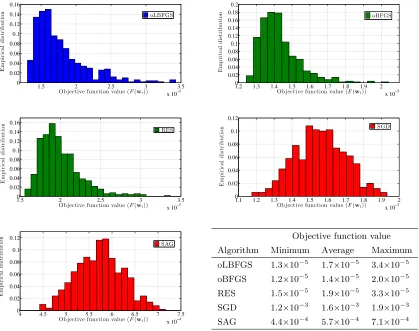
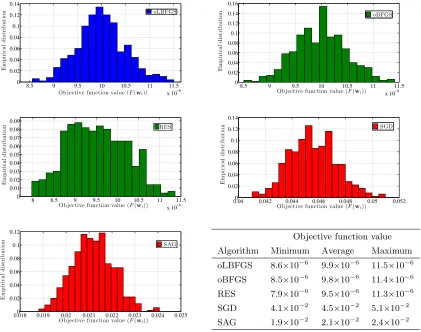
3.1 Comparing convergence paths of SGD, SAG, oBFGS, RES, and oLBFGS . 83 3.2 Histograms of objective function value for a problem with dimension p= 102 84 3.3 Histograms of objective function value for a problem with dimension p= 103 85 3.4 Histograms of CPU runtime for a problem with dimension p= 102 . . . 86
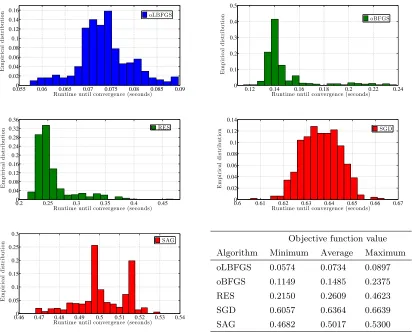
3.5 Histograms of CPU runtime for a problem with dimension p= 103 . . . 87
3.6 Illustration of Negative log-likelihood value for oLBFGS and SGD . . . 92
3.7 Performance of classifier after processing feature vectors with SGD and oLBFGS for the cost in (3.107) . . . 94
4.1 The scheme for updating variables, gradients, and Hessian approximation
matrices in IQN . . . 104 4.2 Convergence of IQN, SAG, SAGA, and IAG for a quadratic programming . 125
4.3 Convergence of IQN, SAG, SAGA, and IAG for a logistic regression problem 126
5.1 Comparison of DGD, Acc. DGD, DADMM, EXTRA, and NN-K in terms of number of iterations . . . 156
5.2 Comparison of DGD, Acc. DGD, DADMM, EXTRA, and NN-K in terms of
rounds of communications . . . 156 5.3 Comparison of DGD, Acc. DGD, and NN-K in a well-conditioned problem 157
5.4 Comparison of DGD, Acc. DGD, and NN-K in an ill-conditioned problem . 158
5.5 Convergence of NN-2 vs num. of iterations in different network topologies . 159 5.6 Convergence of NN-2 vs num. of communications in different network
topolo-gies . . . 159
5.7 Comparing theoretical bounds of NN with its performance in practice . . . 160 5.8 Adaptive variants of DGD and NN with a small initial penalty factor . . . . 161
5.9 Adaptive variants of DGD and NN with a large initial penalty factor . . . . 162 5.10 Convergence of DGD and NN in a linearly separable logistic regression problem163
5.11 Convergence of DGD and NN in a non-linearly separable logistic regression
problem . . . 164
6.1 Convergence paths of EXTRA, ESOM-K, NN-K, and PMM in terms of
number of iterations . . . 193
6.2 Convergence paths of EXTRA, ESOM-K, NN-K, and PMM in terms of rounds of communications . . . 194
6.3 Relative error of EXTRA, ESOM-K, and DQM versus number of iterations
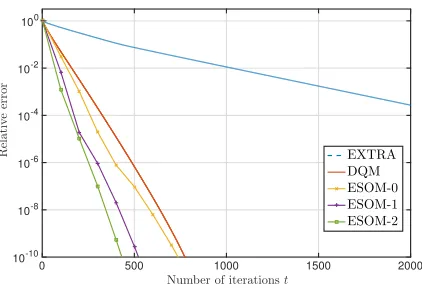
for a logistic regression problem . . . 195 6.4 Relative error of EXTRA, ESOM-K, and DQM versus rounds of
communi-cations for a logistic regression problem . . . 195
7.1 Stochastic averaging gradient table at each node . . . 201 7.2 Comparison of DSA, EXTRA, DGD, Stochastic EXTRA, and Decentralized
SAGA for a logistic regression problem . . . 228 7.3 Effect of graph condition number on the convergence of DSA . . . 230
7.4 Effect of graph condition number on the relative performance EXTRA of DSA231
7.5 Effect of number of functions when the number of nodes is fixed . . . 232 7.6 Effect of number of functions on the relative performance of DSA and
7.7 Convergence paths of DSA for different number of nodes when the total
number of sample points is fixed . . . 234 7.8 Effect of number of nodes on the relative performance of DSA and EXTRA
when the total number of sample points is fixed . . . 235
7.9 Comparison of DSA and EXTRA for the protein homology classification problem . . . 236
8.1 Improvement in terms of suboptimality for the RCV1 dataset using adaptive
sample scheme with regularization of the orderO(1/√n) . . . 253 8.2 Improvement in terms of test error for the RCV1 dataset using adaptive
sample scheme with regularization of the orderO(1/√n) . . . 253 8.3 Improvement in terms of suboptimality for the MNIST dataset using adaptive
sample scheme with regularization of the orderO(1/√n) . . . 254 8.4 Improvement in terms of test error for the MNIST dataset using adaptive
sample scheme with regularization of the orderO(1/√n) . . . 254 8.5 Improvement in terms of suboptimality for the MNIST dataset using adaptive
sample scheme with regularization of the orderO(1/n) . . . 255 8.6 Improvement in terms of test error for the MNIST dataset using adaptive
sample scheme with regularization of the orderO(1/n) . . . 255 9.1 Comparison of SGD, SAGA, Newton, and Ada Newton for the protein
ho-mology dataset. . . 270
9.2 Comparison of the sub-optimality of SAGA, Newton, and Ada Newton in
terms of number of effective passes over dataset for four real datasets . . . . 272 9.3 Comparison of the sub-optimality of SAGA, Newton, and Ada Newton in
terms of run time for four real datasets . . . 273
Chapter 1
Introduction
A large fraction of machine learning methods requires the solution of an empirical risk min-imization problem (ERM) which is expressed as the minmin-imization of a sum of individual
costs associated with individual elements of a training set. For example, support vector
machines intend to determine a hyperplane that separates samples with different labels by minimizing the average hinge loss associated with a given training set. In logistic regression,
we aim to find a linear classifier that minimizes an average negative log likelihood
proba-bility computed based on a set of training samples. Dictionary learning aims at finding a dictionary in which some training data admits a sparse representation by solving a finite
sum optimization problem. A feature common to modern versions of this class of problems
is the very large size of the respective training sets.
As the objective function in the ERM problem is convex, any descent method can be
utilized to solve this problem. However, an evident obstacle in using traditional descent
algorithms for solving this class of problems is their prohibitive computation complexity which is proportional to the number of component functions in the ERM problem, i.e., the
number of available samples in the given dataset. The main goal of this thesis is to study
different approaches to solve large-scale ERM problems.
We first explore the idea of separating the training set into smaller subsets across time.
In this scheme at each iteration, only a subset of samples – chosen either randomly or
cyclically – is used to update the estimate for the minimizer of the empirical risk. When training examples are processed sequentially over time, we are in the realm of stochastic
optimization methods. In this regime, the main contribution of this thesis is studying the
application of quasi-Newton methods to accelerate the state-of-the-art first order methods by approximating the curvature information of the empirical risk.
The second direction considered in this thesis for training massive training sets is dis-tributing samples to distinct nodes of a network, which we can interpret as separating
the second-order information of the aggregate risk associated with samples of all nodes in
the network in a way that can be implemented in a distributed fashion, i.e., each node only exchanges information with its neighboring nodes to update its estimate of the global
minimizer. Indeed, the idea of separating samples both across time and space can be
exe-cuted to enhance the required computational and communication cost for solving large-scale empirical risk minimization problems. This path, which is also referred to as decentralized
stochastic optimization, is studied in this thesis.
The third and last path considered in this thesis is a rethinking of ERM in which we consider not a partition of the training set as in the case of distributed and stochastic
optimization, but a nested collection of subsets that grows geometrically. The key insight is
that the optimal argument associated with a training subset of a certain size is not that far from the optimal argument corresponding to a larger training subset since the samples are
drawn from a common (unknown) distribution. This means that solutions for an element
of the geometric sequence can be used as warm starts for the solution of the subsequent element.
1.1
Context and background
To formally introduce the problem formulation used in this thesis, consider a decision vector
w∈Rp, a random variableΘ∈
Rd with realizations θ and a convex loss functionf(w,θ).
We aim to find the optimal argument that minimizes the optimization problem
w∗ := argmin
w∈Rp F(w) = argminw∈
Rp
EΘ[f(w,Θ)] = argmin
w∈Rp
Z
Θ
f(w,Θ)P(dθ), (1.1)
where F(w) := EΘ[f(w,Θ)] is defined as the expected loss, and P is the probability
distribution of the random variableΘ. The optimization problem in (1.1) cannot be solved
since the distribution P is unknown. However, we have access to a training set T =
{θ1, . . . ,θN} containing N independent samplesθ1, . . . ,θN drawn from P, and, therefore,
we attempt to minimize the empirical loss associated with the training setT ={θ1, . . . ,θN}, which is equivalent to minimizing the problem
w†N := argmin
w∈Rp
1
N
N
X
i=1
f(w,θi), (1.2)
We refer to the loss (1/N)PN
i=1f(w,θi) in (1.2) as the empirical loss associated to the training setT. One may also interpret the ERM problem in (1.2), which typically appears in machine leaning applications [14, 15, 26, 108], as a finite sum minimization problem ofN
fori= 1, . . . , N asfi(w) = f(w,θi) and the global objective function f as the average of the component functionsfi, the optimization problem in (1.2) can be written as
w∗ := argmin
w∈Rp
f(w) := argmin
w∈Rp
1
N
N
X
i=1
fi(w). (1.3)
Indeed, the problem formulation in (1.3), which is referred to as finite sum minimization,
is more general, and ERM in (1.2) is a special case of the optimization problem in (1.3).
This class of problems arises in many application domains such as control [22, 25, 56] and wireless communications [96, 97, 103].
In the first two parts of the thesis, we introduce a set of algorithms that can be executed
to solve the more general setting in (1.3), and, of course, these approaches can be used to solve the ERM problem in (1.2). In the third part of the thesis, however, we study a novel
approach for training large-scale ERM problems which is specifically designed for the setting
in (1.2), and the results in this part of the thesis cannot be generalized to the finite sum minimization problem in (1.3).
In the following sections, we overview the state-of-the-art methods for solving large-scale
ERM problems and overview the algorithms that are presented in this thesis to achieve faster convergence rates.
1.1.1 Stochastic methods
Classic deterministic optimization algorithms such as gradient descent, Newton’s method, and quasi-Newton methods are built on the assumption that the gradient of the cost
func-tion is empirically computable. In the particular case of Newton’s method, evaluafunc-tion of
the Hessian and its inverse should be feasible as well. However, the computational complex-ity of the gradient and Hessian evaluations, which are required to implement conventional
descent methods, increase linearly by the size of the training set. Stochastic approximation
methods are constructed on the idea of replacing gradients by their stochastic gradient ap-proximations, arise as a natural alternative to overcome the high computational complexity
of deterministic algorithms [15, 49, 82, 104, 107, 130]. However, the slow convergence time of
SGD has limited its practical appeal and fostered the search for alternatives. In this regard, it has to be noted that SGD is slow because of both, the use of gradients as descent
direc-tions which is problematic in funcdirec-tions with large condition numbers, and the replacement
of gradients by random estimates with potentially large variances. Alternatives to deal with both of these problems have been aggressively developed over the last decade.
Alternatives to reduce randomness in SGD have been proposed to render the convergence
developments have focused on hybrid approaches that use both, gradients and stochastic
gradients, or update descent directions so that they become progressively closer to gradients [47, 104, 129]. Inasmuch as they succeed in reducing randomness, these algorithms end up
exhibiting the asymptotic convergence rate of gradient descent which is faster than the
asymptotic convergence rate of SGD. Although they improve asymptotic convergence rates, the latter methods are still often slow in practice. This is not unexpected. Reducing
randomness is of no use when the functionF(w) has a challenging curvature profile. In these
ill conditioned functions SGD is limited by the slow convergence times of (deterministic) gradient descent.
A parallel line of research has attempted to accelerate the convergence of SGD by
cor-recting its curvature estimate. The natural solution to deal with these ill-conditioned func-tions is Newton’s method, which makes use of the Hessian of the objective. However,
stochastic estimates of Newton steps are not computationally cheap to compute. This
issue motivated the use of stochastic quasi-Newton methods. In deterministic settings, quasi-Newton methods, which do not require computation of the objective Hessian and
ap-proximate the curvature using only gradient information, have been successful in achieving
a super-linear convergence rate which outperforms the linear convergence rate of gradi-ent descgradi-ent [24, 32, 87, 89]. This success has resulted in the developmgradi-ent of the stochastic
quasi-Newton methods. An important observation here is that in trying to adapt to the changing curvature of the objective, stochastic quasi-Newton methods may end up
exacer-bating the problem. Indeed, since Hessian estimates are stochastic, it is possible to end up
with almost singular Hessian estimates. The corresponding small eigenvalues then result in a catastrophic amplification of the noise which nullifies progress made towards
conver-gence. This is not a minor problem. In oBFGS this possibility precludes convergence
analyses [12, 105] and may result in erratic numerical behavior; see, e.g., Figure 2.12. As a matter of fact, the main motivation for the introduction of RES, presented in Chapter 2,
is to avoid this catastrophic noise amplification so as to retain smaller convergence times
while ensuring that optimal arguments are found almost surely [70]. However valuable, the convergence guarantees of RES are tainted by an iteration cost of order O(p3) which
precludes its use in problems wherepis very large. In deterministic settings this problem is
addressed by limited memory (L)BFGS [55] which can be easily generalized to develop the oLBFGS algorithm [105]. Numerical tests of oLBFGS are promising but theoretical
con-vergence characterizations are still lacking. The main contribution of Chapter 3 is to show
that the sequence of iterates generated by oLBFGS converges with probability 1 to optimal arguments across realizations of the random variables, while its computational complexity
is of order O(p) [72].
application of quasi-Newton methods to stochastic settings and enhance the convergence
time of SGD in ill-conditioned problems, the best-proven convergence rate for them is a sublinear rate. This slow asymptotic performance is inherited from the stochastic
approxi-mation of gradient which does not vanish even near the optimal solution without randomness
reduction techniques.
Considering these two research trusts which handle the issues of randomness and
curva-ture estimation in the update of SGD, it seems natural to combine the idea of randomness
reduction and quasi-Newton methods to design a low computation cost method that recov-ers the superlinear convergence rate of deterministic quasi-Newton methods. The stochastic
quasi-Newton methods in [58, 78] attempt to achieve this goal by using the variance
reduc-tion technique proposed in [45]; however, they can not achieve better than a linear conver-gence rate. In Chapter 4, the presented incremental quasi-Newton method (IQN) succeeds
to achieve a superlinear convergence rate by incorporating the averages of variables,
gra-dients, and Hessian approximations in conjunction with a corrected Taylor expansion for approximating the individual component functions [60, 61]. The IQN method is the first
incremental quasi-Newton method to achieve a superlinear convergence rate.
1.1.2 Decentralized methods
Decentralized (Distributed) optimization algorithms are used to solve the problem of
mini-mizing a global cost function over a set of nodes in situations where the objective function
is defined as a sum of local functions. This class of algorithms can be used to solve the problem in (1.3) if the objective functions at nodes are the risk associated with a subset of
samples. Specifically, consider a connected network of size V where each nodev has access
to a local objective function fv :Rp → R. The local objective function fv(w) is defined as the average risk of qv functions (samples){fv,i(w)}qi=1v that can be individually evaluated at node v. Agents cooperate to solve the global optimization problem
˜
w∗:= argmin
w
V
X
v=1
fv(w) = argmin
w
V
X
v=1 qv
X
i=1
fv,i(w). (1.4)
The formulation in (1.4) models a training set with a total ofN =PV
v=1qv training samples that are distributed among the V agents for parallel processing conducive to the
determi-nation of the optimal classifier ˜w∗ [6, 26, 118].
In all distributed methods the first step is replicating the decision variable w at each
node. In other words, we consider the case that each node v has access to a local variable
can be written as
{wv∗}Vv=1 := argmin
{wv}Vv=1 V
X
v=1
fv(wv),
s.t.wv =wu, for all v, u∈ Nv. (1.5) Since the network is connected, the constraints wv =wu for all v and u∈ Nv imply that (1.4) and (1.5) are equivalent and we have wv∗= ˜w∗ for all v.
There are different algorithms to solve (1.5) in a distributed manner. The most popular choice is decentralized gradient descent (DGD) [80,126] and accelerated distributed gradient
descent method [44, 90] which can be abstracted as combinations of local descent steps followed by variable exchanges and averaging of information among neighbors. Although the
implementation of DGD is simple, its convergence could be arbitrary slow in ill-conditioned
problems since as in other first-order methods it operates on gradient information only. This is not surprising because gradient descent methods in centralized settings where the
aggregate function gradient is available at a single server (node) have the same difficulties
in problems with skewed curvature.
This issue is addressed in centralized optimization by Newton’s method that uses
sec-ond order information to determine a descent direction adapted to the objective’s curvature.
However, second order methods are not practical in distributed settings since they require access to global information. In Chapter 5, an approximate Newton’s method is presented
to solve the problem in (1.5) in a distributed manner. It is done by introducing Network
Newton (NN), a method that relies on distributed approximations of Newton steps for the global cost function PV
v=1fv(w) to accelerate the convergence of DGD. The presented NN method approximates the Newton step of a penalized version of (1.5) by truncating the
Taylor series of the exact Newton step. Convergence analysis of the NN method guarantees a global linear convergence method, while the rate of convergence is quadratic in a
neighbor-hood of the optimal argument. This convergence property makes NN the first distributed
algorithm that solves problem (1.5) faster than a linear rate when the functions are strongly convex and smooth.
The NN method is successful in improving the convergence rate of DGD; however, both
of these methods solve a penalized version of (1.5) where the accuracy of the optimal solution depends on the penalty factor; see Chapter 5. This issue can be resolved by solving problem
(1.5) in the dual domain. Dual domain methods build on the fact that the dual function of (1.5) has a gradient with separable structure. The use of plain dual gradient descent
is possible but generally slow to converge [8, 95, 102]. In centralized optimization, better
term to keep iterates close. In either case, the quadratic term that is added to construct the
augmented Lagrangian makes distributed computation of primal gradients impossible. This issue is most often overcome with the use of decentralized (D) versions of the alternating
direction method of multipliers (ADMM) [19, 103, 112]. Besides the ADMM, other methods
that use different alternatives to approximate the gradients of the dual function have also been proposed [28,43,79,100,115,117,122]. The convergence rates of these methods have not
been studied except for the DADMM and its variants that are known to converge linearly
to the optimal argument when the local functions are strongly convex and their gradients are Lipschitz continuous [54, 77, 112]. An important observation here is that while all of
these methods try to approximate the MM or the PMM, the performance penalty entailed
by the approximation has not been studied.
In Chapter 6 an exact second order method (ESOM) is presented which uses quadratic
approximations of the augmented Lagrangians of the problem in (1.5) and leads to a set of
separable subproblems. As in the primal domain, computation of the dual function Hessian requires global communication and is impractical. ESOM overcomes this issue by using the
Hessian inverse approximation technique introduced in the design of NN. The convergence
analysis of ESOM as an approximation of the PMM shows that it converges at the same rate as PMM and the gap between the convergence guarantees of these methods decreases
as the iterates approach the optimal argument. This indicates that the convergence paths of ESOM and PMM are very close, while PMM can not be implemented in a distributed
fashion and ESOM is a distributed algorithm.
Although in decentralized optimization training samples are divided among different processors (nodes) to reduce the required computational capacity for each processor, there
still could be cases that the number of assigned samples to each processor is beyond its
com-putational capacity. To be more precise, all of the mentioned distributed algorithms require the computationally costly evaluation of the local gradients ∇fv(w) = Pvqv=1∇fv,i(w). In the case that the number of assigned samplesN/V to each processor is still large, the
com-putation of local gradients might be beyond the comcom-putational capacity of each processor. In this regime, which is not seldom inlarge-scale optimization, we can reduce the
computa-tion cost by the use of stochastic decentralized algorithms that substitute the local gradients
with their stochastic approximations. In other words, the stochastic decentralized methods separate samples across both time and space by training a subset of available samples at
each processor.
The use of distributed stochastic methods reduces the computational cost per iteration of deterministic distributed algorithms but results in sublinear convergences rates of order
O(1/t) even if the corresponding deterministic algorithm exhibits linear convergence [9, 48,
linear convergence rates in expectation are established by decreasing the variance of the
stochastic gradient approximation [31, 45, 47, 49, 104, 109]. In Chapter 7, the decentralized double stochastic averaging gradient (DSA) method is presented which incorporates the idea
of stochastic gradient averaging in [31] to approximate local gradients by a low computation
cost gradient averaging [71,73]. This modification leads to a linear convergence rate for DSA which is the first decentralized stochastic method that achieves linear convergence rate.
1.1.3 Adaptive sample size algorithms
Perhaps most of the methods designed for solving large-scale ERM problems can be applied to solve finite sum minimization (FSM) problems, including the mentioned stochastic and
decentralized methods. However, by focusing on designing methods for solving the general
FSM problem we end up ignoring some fundamental properties of ERM which can be leveraged to solve ERM problems more efficiently. ERM problems have two specific qualities
that come from the fact that ERM is a proxy for statistical loss minimization. The first
property is that since the empirical risk and the statistical loss have different minimizers, there is no reason to solve ERM beyond the expected difference between the two objectives.
This so-calledstatistical accuracy VN is a constant of orderO(1/Nα) where αis a constant from the interval [0.5,1] depending on the regularity of the loss function. The second important property of ERM is that the component functions are drawn from a common
distribution. This implies that if we consider subsets of the training set, the respective
empirical risk functions are not that different from each other and, indeed, their differences are related to the statistical accuracy of the subset.
The relationship of ERM to statistical loss minimization suggests that ERM problems
have more structure than FSM problems. This is not exploited by most existing methods which, albeit used for ERM, are in fact designed for FSM. The goal of adaptive sample
size methods is to exploit the relationship between ERM and statistical loss minimization
to achieve lower overall computational complexity for a broad class of first-order methods applied to ERM. The main idea of adaptive sample size methods is to start with a small
subset of samples and solve the problem to within its statistical accuracy. Then, increase
the size of training samples and use the current approximate optimal solution as a warm start for the new training set.
The technique presented in Chapters 8 and 9 uses subsamples of the training set
con-taining n ≤ N component functions that we grow geometrically. In particular, we start by a small number of samples and minimize the corresponding empirical risk added by a
regularization term of order Vn up to its statistical accuracy. Note that, based on the first property of ERM, the added adaptive regularization term does not modify the required
number. After solving the subproblem, we double the size of the training set and use the
solution of the problem with nsamples as a warm start for the problem with 2n samples. This is a reasonable initialization since based on the second property of ERM the functions
are drawn from a joint distribution, and, therefore, the optimal values of the ERM problems
with n and 2n functions are not that different from each other. The proposed approach succeeds in exploiting the two properties of ERM problems to improve complexity bounds
of first-order methods and second-order methods.
1.2
Thesis outline and contributions
The first approach studied in this thesis in dealing with massive ERM problems is splitting
samples across time. In Part I of the thesis, we explore this direction by studying the use of stochastic quasi-Newton methods for improving convergence rate of stochastic gradient
de-scent. In this part, the challenges in designing convergent stochastic quasi-Newton methods
have studied, as well as, the techniques to reduce the computational complexity of these methods. Finally, we close this part of the thesis by explaining the difficulties in designing
a superlinearly convergent quasi-Newton method in the stochastic domain.
In Part II of the thesis, we explore the use of decentralized methods for solving large-scale ERM problems which can be also interpreted as splitting samples across space. In this
part, we recap the state-of-the-art methods for solving distributed optimization problems
and presents methods that approximate Newton step, both in primal and dual domains, to accelerate the convergence of first-order distributed methods. We further examine the idea
of separating samples both in space and time to reduce the computational burden required
at each node when we deal with massive datasets.
In Part III of the thesis, we introduce adaptive sample size methods for solving ERM
problems which is constructed on the idea of starting with a small subset of samples and
increasing the size of training set geometrically. We study the use of adaptive sample size scheme for both first-order and second-order methods and show that it leads to reduction
in overall computational cost to achieve the statistical accuracy of the full dataset.
Chapter 2 opens the first part of the thesis on stochastic methods. In this chapter we introduce RES [68, 70] a stochastic regularized version of the
Broyden-Fletcher-Goldfarb-Shanno (BFGS) quasi-Newton method, to solve problems with the generic structure in (1.2).
The proposed regularization avoids the near-singularity problems of more straightforward extensions and yields an algorithm with provable convergence guarantees when the functions
are strongly convex. The fundamental idea of BFGS is to continuously satisfy a secant
approximation matrix stay above a given threshold. This regularized version is leveraged
to introduce the regularized stochastic BFGS algorithm. Regularized stochastic BFGS differs from standard BFGS in the use of a regularization to make a bound on the largest
eigenvalue of the Hessian inverse approximation matrix and in the use of stochastic gradients
in lieu of deterministic gradients for both, the determination of descent directions and the approximation of the objective function’s curvature.
By proving lower and upper bounds on the approximate Hessians of the component
func-tions it can be guaranteed that the sequence of iterates wt genearaed by RES converges to the optimal argumentw∗ with probability 1 over realizations of the sample functions. This
result indicates that RES is a globally convergent stochastic quasi-Newton method. We
complement this result with a characterization of the convergence rate which is shown to be at least of orderO(1/t) in expectation. Advantages of RES relative to SGD are significant,
as we establish in numerical results for the minimization of a family of quadratic
objec-tive functions of varying dimensionality and condition number. As we vary the condition number we observe that for well conditioned objectives RES and SGD exhibit comparable
performance, whereas for ill conditioned functions RES outperforms SGD by an order of
magnitude. As we vary problem dimension we observe that SGD becomes unworkable for large dimensional problems. RES however, exhibits manageable degradation as the number
of iterations required for convergence doubles when the problem dimension increases by a factor of ten. We also study the performance of RES on an important example of ERM
problems which are support vector machines (SVMs) [13, 15, 120]. We adapt RES for SVM
problems and show the improvement relative to SGD in convergence time and stability through numerical analysis [69].
Chapter 3 studies the convergence properties and numerical behavior of the online Limited memory BFGS method proposed in [105], which can be considered as a practical
variant of RES in Chapter 2. However valuable, the convergence guarantees of RES are
tainted by an iteration cost of orderO(p3) which precludes its use in problems wherepis very large. In deterministic settings this problem is addressed by limited memory (L)BFGS [55]
which can be easily generalized to develop the oLBFGS algorithm [105]. The fundamental idea in BFGS and oLBFGS is to continuously satisfy a secant condition while staying
close to previous curvature estimates. They differ in that BFGS uses all past gradients to
estimate curvature while oLBFGS uses a fixed moving window of past gradients. The use of this window reduces memory and computational cost. The difference between LBGS and
oLBFGS is the use of stochastic gradients in lieu of their deterministic counterparts.
In this chapter we present the oLBFGS algorithm and show that it converges with probability 1 to optimal arguments across realizations of the random variables [72]. This
oLBFGS per iteration is of orderO(p). Convergence guarantees for oLBFGS do not require
such measures. To do so, we first show that under the assumption that the component functions are strongly convex and Lipschitz continuous the trace and determinant of the
Hessian approximations computed by oLBFGS are upper and lower bounded, respectively.
These bounds are then used to limit the range of variation of the ratio between the Hessian approximations’ largest and smallest eigenvalues. In turn, this condition number limit is
shown to be sufficient to prove convergence to the optimal argument w∗ with probability
1 over realizations of the sample functions. We complement this almost sure convergence result with a characterization of the convergence rate which is shown to be at least sublinear
of orderO(1/t) in expectation.
To show the advantage of using oLBFGS as an adaptive reconditioning strategy we de-velop its application to the training of SVMs and perform a comparative numerical analysis
with synthetic data. The conclusions of this numerical analysis are that oLBFGS performs
as well as oBFGS and RES while outperforming SGD when convergence is measured with respect to the number of feature vectors processed. In terms of computation time, oLBFGS
outperforms all three methods, SGD, and RES. The advantages of oLBFGS grow with the
dimension of the feature vector and can be made arbitrarily large. To further substantiate numerical claims we use oLBFGS to train a logistic regressor to predict the click through
rate in a search engine advertising problem. The logistic regression uses a heterogeneous feature vector with 174,026 binary entries that describe the user, the search, and the
ad-vertisement. Being a large scale problem with heterogeneous data, the condition number of
the logistic log likelihood objective is large and we expect to see significant advantages of oLBFGS relative to SGD. This expectation is fulfilled. The oLBFGS algorithm trains the
regressor using less than 1% of the data required by SGD to obtain similar classification
accuracy.
Chapter 4presents the incremental quasi-Newton (IQN) method which has the unique
properties of low computational complexity and superlinear convergence rate. Note that the issue of proving convergence of stochastic quasi-Newton methods is tackled by RES
and oLBFGS in Chapters 2 and 3, respectively. Although these methods are successful in expanding the application of quasi-Newton methods to stochastic settings, their convergence
rate is sublinear. This is not better than the convergence rate of SGD and, as is also the case
in SGD, is a consequence of the stochastic approximation noise which necessitates the use of diminishing stepsizes. The stochastic quasi-Newton methods in [58, 78] resolve this issue by
using the variance reduction technique proposed in [45]. The fundamental idea of the work
in [45] is to reduce the noise of the stochastic gradient approximation by computing the exact gradient in an outer loop to use it in an inner loop for gradient approximation. The
the update of quasi-Newton methods, are successful in achieving a linear convergence rate.
Note that the use of variance reduction in stochastic quasi-Newton methods led to linear convergence and did not recover a superlinear rate. Hence, a fundamental question remains
unanswered: Is it possible to design an incremental quasi-Newton method that recovers the
superlinear convergence rate of deterministic quasi-Newton algorithms? In Chapter 4, we show that the answer to this open problem is positive by proposing an incremental
quasi-Newton method (IQN) with a local superlinear convergence rate [60, 61]. This is the first
quasi-Newton method to achieve superlinear convergence while having a per iteration cost independent of the number of functionsN – the cost per iteration is of orderO(p2).
There are three major differences between the IQN method and state-of-the-art
incre-mental (stochastic) quasi-Newton methods that lead to the former’s superlinear convergence rate. First, the proposed IQN method uses the aggregated information of variables,
gra-dients, and Hessian approximation matrices to reduce the noise of approximation for both
gradients and Hessian approximation matrices. This is different to the variance-reduced stochastic quasi-Newton methods in [58, 78] that attempt to reduce only the noise of
gra-dient approximations. Second, in IQN the index of the updated function is chosen in a
cyclic fashion, rather than the random selection scheme used in the incremental methods in [23, 70, 72, 105]. The cyclic routine in IQN allows to bound the error at each iteration as
a function of the errors of the last N iterates, something that is not possible when using a random scheme. To explain the third and most important difference we point out that
the form of quasi-Newton updates is the solution of a local second order Taylor
approxi-mation of the objective. It is possible to understand stochastic quasi-Newton methods as an analogous approximation of individual sample functions. However, it turns out that
the state-of-the-art stochastic quasi-methods evaluate the linear and quadratic terms of
the Taylor’s expansion at different points yielding and inconsistent approximation (Remark 4.7). The IQN method utilizes a consistent Taylor series which yields a more involved
up-date which we nonetheless show can be implemented with the same computational cost.
These three properties together lead to an incremental quasi-Newton method with a local superlinear convergence rate.
Chapter 5 launches the second part of the thesis on the use of decentralized
(dis-tributed) optimization methods for solving large-scale ERM problems on a network
us-ing multiple processors (nodes). There are different algorithms to solve (1.4) in a dis-tributed manner. The most popular choices are decentralized gradient descent (DGD)
[44, 80, 111, 126], distributed implementations of the alternating direction method of
mul-tipliers [19, 27, 77, 103, 112], and decentralized dual averaging [33, 119]. Although there are substantial differences between them, these methods can be generically abstracted as
among neighbors. A feature common to all of these algorithms is the slow convergence rate
in ill-conditioned problems since they operate on first order information only. This is not surprising because gradient descent methods in centralized settings where the aggregate
function gradient is available at a single server have the same difficulties in problems with
skewed curvature.
The goal of Chapter 5 is to accelerate the convergence rate of DGD in solving (1.4) by
incorporating the second information of the objective objective function. In achieving this
goal, the first step is to reinterpret DGD as an algorithm that utilizes gradient descent to solve a penalized version of (1.5) which is a distributed representation of the problem in
(1.4). This reinterpretation explains linear convergence of DGD to a neighborhood of the
optimal argument w∗. The volume of this neighborhood is given by the relative weight of the penalty function and the original objective which is controlled by a penalty coefficient.
If DGD uses gradient descent to solve the penalized objective function, it seems natural
to use Newton’s method to achieves faster convergence. Alas, distributed computation of Newton steps for the penalized problem requires global communication between all nodes in
the network and is therefore impractical (Section 5.3). To resolve this issue, the presented
Network Newton (NN) method approximates the Newton step of the penalized objective function by truncating the Taylor series of the exact Newton step [66]. This approximation
results in a family of methods indexed by the number of terms of the Taylor expansion that are kept in the approximation. The method that results from keeping K of these terms
is termed NN-K. A fundamental observation here is that the Hessian of the penalized
function has a sparsity structure that is the same sparsity pattern of the graph. Thus, when computing terms in the Hessian inverse expansion, the first order term is as sparse as
the graph, the second term is as sparse as the two hop neighborhood, and, in general, the
k-th term is as sparse as thek-hop neighborhood of the graph. Thus, implementation of the NN-K method requires aggregating information from K hops away. Increasing K makes
NN-K arbitrarily close to Newton’s method at the cost of increasing the communication
overhead of each iteration.
In the convergence analysis of NN, it is shown that a measure of the error between
the Hessian inverse approximation utilized by NN-K and the actual inverse Hessian decays
exponentially with the method index K. This exponential decrease hints that using a small value of K should suffice in practice. Convergence analysis of NN shows that its
convergence rate is at least linear. It follows from this convergence analysis that larger
penalty coefficients result in faster convergence that comes at the cost of increasing the distance between the optimal solutions of the original and penalized objectives. Further,
it is shown that for all iterations except the first few, a weighted gradient norm associated
Newton iterates. The only difference between these residual paths is that the NN-K path
contains a term that captures the error of the Hessian inverse approximation. Leveraging this similarity, it is possible to show that the rate of convergence is quadratic in a specific
interval whose length depends on the order K of the selected network Newton method
(Theorem 8). Existence of this quadratic convergence phase explains why NN-K methods converge faster than DGD. It is also worth remarking that the error in the Hessian inverse
approximation can be made arbitrarily small by increasing the method’s orderK and, as a
consequence, the quadratic phase can be made arbitrarily large.
Chapter 6 continues development of distributed method for solving ERM problems by extending the idea of using second-order information into primal-dual methods which
have exact convergence. This extension is necessary since the NN method in Chapter 5
solves a penalized version of (1.5) where the accuracy of the optimal solution depends on the penalty factor. Among the methods that solve problem (1.5) in the dual domain the
method of multipliers (MM) that adds a quadratic augmentation term to the Lagrangian of
the problem [7, 40], or the proximal (P)MM that adds an additional term to keep iterates close have the best performance. However, in either case, the quadratic term that is added
to construct the augmented Lagrangian makes distributed computation of primal
gradi-ents impossible. This chapter studies the exact second order method (ESOM) which uses quadratic approximations of the augmented Lagrangians of (1.5) to approximate the PMM
which leads to a set of separable subproblems [74,76]. The ESOM algorithm is second-order
since it uses a quadratic approximation of the augmented Lagrangian in the primal update. It is exact since, as the PMM, it solves the augmented Lagrangian and converges to the
exact solution of (1.5). And it is distributed since the update of ESOM can be implemented
locally and without the need for global communication.
ESOM can also be interpreted as a variation of PMM that substitutes the proximal
aug-mented Lagrangian with its quadratic approximation. Implementation of ESOM requires
computing the inverse of the Hessian of the proximal augmented Lagrangian. Since this inversion cannot be computed using local and neighboring information, ESOM-K
approx-imates the Hessian inverse with the K-order truncation of the Taylor’s series expansion of the Hessian inverse, as explained in the derivation of NN in Chapter 5. This expansion can
be carried out using an inner loop of local operations.
A remarkable property of all ESOM-K methods is that they can be shown to pay a performance penalty relative to (centralized) PMM that vanishes with increasing iterations.
To be more specific, in this chapter we establish linear convergence of (centralized) PMM
and use its linear convergence factor as a benchmark for methods that can be implemented in a distributed manner. We then prove linear convergence of ESOM and to show that
approach the optimal solution. This indicates that the convergence paths of (distributed)
ESOM-K and (centralized) PMM are very close.
Chapter 7 closes the second part of the thesis by presenting a novel stochastic
dis-tributed method for solving large-scale optimization problems. Decentralized optimization method lead to reducing the computational complexity required by processors to train
mas-sive ERM problems through distributing samples over multiple processors and diving the computational cost among them. However, the possibility of facing scenarios that operating
on assigned samples to each processor is beyond its computational capacity is not rare in
big-data problems. This is a valid claim since distributed optimization methods rely on the computation of local gradients∇fv(w) =Pqi=1v ∇fv,i(w) at nodes. As in centralized case, a natural solution would be splitting samples over time and using stochastic gradients in lieu
of local gradients. The use of stochastic decentralized methods reduces the computational cost per iteration but results in sublinear convergences rates of order O(1/t) even if the
corresponding deterministic algorithm exhibits linear convergence. Our interest here is in
solving (1.4) with a method that is decentralized, stochastic, and has a linear convergence rate.
In this chapter, we achieve this goal by presenting the decentralized double stochastic
averaging gradient (DSA) method [71, 73]. The method exploits a new interpretation of EXTRA as a saddle point method and uses stochastic averaging gradients in lieu of
gradi-ents. DSA isdecentralized because it is implementable in a network setting where nodes can
communicate only with their neighbors. It is double because iterations utilize the informa-tion of two consecutive iterates. It isstochastic because the gradient of only one randomly
selected function is evaluated at each iteration and it is an averaging method because it
uses an average of stochastic gradients to approximate the local gradients. DSA is proven to converge linearly to the optimal argument ˜x∗ in expectation when the local instantaneous
functions fv,i are strongly convex, with Lipschitz continuous gradients. This is in contrast to all other decentralized stochastic methods that converge at sublinear rates.
Chapter 8 launches the third part of the thesis which introduces the idea of adaptive sample size methods for solving large-scale ERM problems. In particular, in this chapter
we explain that most (if not all) iterative stochastic and decentralized methods aim to
solve general finite sum minimization (FSM) problems by either sampling over time or space. This approach leads to ignoring some critical properties of ERM as a particular
case of FSM. The first property is that since the empirical risk and the statistical loss
have different minimizers, there is no reason to solve ERM beyond the expected difference between the two objectives. This so-called statistical accuracy takes the place of in the
complexity orders of the previous paragraph and is a constant of order O(1/Nα) where
The second important property of ERM is that the component functions are drawn from
a common distribution. This implies that if we consider subsets of the training set, the respective empirical risk functions are not that different from each other and, indeed, their
differences are related to the statistical accuracy of the subset.
The relationship of ERM to statistical loss minimization suggests that ERM problems have more structure than FSM problems. This is not exploited by most existing methods
which, albeit used for ERM, are in fact designed for FSM. The goal of this part of the thesis
is to exploit the relationship between ERM and statistical loss minimization to achieve lower overall computational complexity for a broad class of first-order methods applied to
ERM. The technique we propose uses subsamples of the training set containing n ≤ N
component functions that we grow geometrically. In particular, we start by a small number of samples and minimize the corresponding empirical risk added by a regularization term of
order Vn up to its statistical accuracy. Note that, based on the first property of ERM, the added adaptive regularization term does not modify the required accuracy while it makes the problem strongly convex and improves the problem condition number. After solving
the subproblem, we double the size of the training set and use the solution of the problem
with n samples as a warm start for the problem with 2n samples. This is a reasonable initialization since based on the second property of ERM the functions are drawn from
a joint distribution, and, therefore, the optimal values of the ERM problems with n and 2n functions are not that different from each other. The proposed approach succeeds in
exploiting the two properties of ERM problems to improve complexity bounds of first-order
methods. In particular, we show that to reach the statistical accuracy of the full training set the adaptive sample size scheme reduces the overall computational complexity of a broad
range of first-order methods by a factor of log(Nα). For instance, the overall computational complexity of adaptive sample size AGD to reach the statistical accuracy of the full training set is of orderO(N√κ) which is lower thanO((N√κ) log(Nα)) complexity of AGD.
Chapter 9extends the idea of adaptive sample size methods into second-order Newton’s method [59]. In this chapter we attempt to circumvent the challenges in the implementation
of Newton’s method for ERM with the Ada Newton algorithm that combines the use of Newton iterations with adaptive sample sizes. Say the total number of available samples
is N, consider subsets of n≤N samples, and suppose the statistical accuracy of the ERM associated with nsamples isVn. In Ada Newton we add a quadratic regularization term of order Vn to the empirical risk – so that the regularized risk also has statistical accuracyVn – and assume that for a certain initial sample size m0, the problem has been solved to its
statistical accuracy Vm0. The sample size is then increased by a factorα >1 to n=αm0. We proceed to perform a single Newton iteration with unit stepsize and prove that the
permits a second increase of the sample size by a factor α and a second Newton iteration
that is likewise guaranteed to solve the problem to its statistical accuracy. Overall, this permits minimizing the empirical risk in α/(α−1) passes over the dataset and inverting logαN Hessians. Our theoretical results provide a characterization of the values of α that are admissible with respect to different problem parameters. In particular, we show that asymptotically on the number of samplesnand with proper parameter selection we can set
α = 2. In such case we can optimize to within statistical accuracy in about 2 passes over
the dataset and after inversion of about 3.32 log10N Hessians. Our numerical experiments verify thatα= 2 is a valid factor for increasing the size of the training set at each iteration
while performing a single Newton iteration for each value of the sample size.
Part I
Stochastic (Incremental)
Chapter 2
Regularized stochastic BFGS
algorithm
2.1
Context and background
Stochastic optimization algorithms are used to solve the problem of optimizing an objective
function over a set of feasible values in situations where the objective function is defined as an expectation over a set of random functions. To be precise, consider an optimization
variablew∈Rp and a random variableθ ∈Θ⊆
Rdthat determines the choice of a function f(w,θ) :Rp×d→ R. The stochastic optimization problems considered in this paper entail
determination of the argumentw∗ that minimizes the expected valueF(w) :=Eθ[f(w,θ)],
w∗ := argmin
w Eθ
[f(w,θ)] := argmin
w
F(w). (2.1)
We refer tof(w,θ) as the random or instantaneous functions and to F(w) :=Eθ[f(w,θ)]
as the average function. We assume that the instantaneous functionsf(w,θ) are strongly
convex for allθfrom where it follows that the average functionF(w) is also strongly convex.
Problems having the form in (2.1) are common in machine learning [14, 15, 108] as well as in optimal resource allocation in wireless systems [67, 96, 97].
Note that the the empirical risk minimization (ERM) problem in (1.2) can be considered
as a specific case of the problem formulation in (2.1). In order to clarify this connection assume that the distribution of the random variable θ is uniform over the training set
{θi}Ni=1. Therefore, the optimization problem in (2.1) reduces to
w∗ := argmin
w
1
N
N
X
i=1