University of Pennsylvania
ScholarlyCommons
Publicly Accessible Penn Dissertations
1-1-2014
The Impact of Conditional Cash Transfer Programs
Under Risk-Sharing Arrangements: Schooling and
Consumption Smoothing in Rural Mexico
Eun-young Shim
University of Pennsylvania, [email protected]
Follow this and additional works at:http://repository.upenn.edu/edissertations
Part of theLabor Economics Commons
Recommended Citation
Shim, Eun-young, "The Impact of Conditional Cash Transfer Programs Under Risk-Sharing Arrangements: Schooling and Consumption Smoothing in Rural Mexico" (2014).Publicly Accessible Penn Dissertations. 1440.
The Impact of Conditional Cash Transfer Programs Under Risk-Sharing
Arrangements: Schooling and Consumption Smoothing in Rural Mexico
Abstract
This paper develops and estimates a model of informal risk sharing with limited commitment that
incorporates children's school attendance choices. The model is estimated using Mexican rural villages data from the PROGRESA experiment and is used to analyze how the presence of informal risk sharing influences schooling and child labor choices, as well as the effectiveness of conditional cash transfer (CCT) programs. In particular, I compare the outcomes (schooling, child labor, and consumption) generated under the informal risk-sharing model with those that would be obtained, forcing households to make choices under autarky. I evaluate the effect of alternative program designs that were also considered in other papers which did not incorporate inter-household transfers. I find that the number of years of schooling completed at age 18 is 0.5 years lower under autarky than with risk sharing. Also, the effect of CCT on schooling outcomes and welfare of households is larger under autarky than under risk sharing, and CCT increases consumption volatility under risk sharing, especially among households with young children who are subject to the future program benefit.
Degree Type
Dissertation
Degree Name
Doctor of Philosophy (PhD)
Graduate Group
Economics
First Advisor
Kenneth I. Wolpin
Keywords
CCT, Conditional cash transfer, Informal risk sharing, limited commitment, PROGRESA
Subject Categories
THE IMPACT OF CONDITIONAL CASH TRANSFER PROGRAMS
UNDER RISK-SHARING ARRANGEMENTS: SCHOOLING AND
CONSUMPTION SMOOTHING IN RURAL MEXICO
Eun-young Shim
A DISSERTATION
in
Economics
Presented to the Faculties of the University of Pennsylvania
in
Partial Fulfillment of the Requirements for the
Degree of Doctor of Philosophy
2014
Supervisor of Dissertation
Kenneth I. Wolpin
Walter H. and Leonore C. Annenberg Professor in the Social Sciences
Graduate Group Chairperson
Goerge J. Mailath
Walter H. Annenberg Professor in the Social Sciences and Professor of Economics
Dissertation Committee
Flavio Cunha, Assistant Professor of Economics Hanming Fang, Professor of Economics
THE IMPACT OF CONDITIONAL CASH TRANSFER PROGRAMS UNDER
RISK-SHARING ARRANGEMENTS: SCHOOLING AND CONSUMPTION
SMOOTHING IN RURAL MEXICO
COPYRIGHT
2014
Eun-young Shim
This work is licensed under the
Creative Commons
Attribution-NonCommercial-ShareAlike 3.0
License
To view a copy of this license, visit
DEDICATION
I dedicate my dissertation to my family. This work would not have been possible
ACKNOWLEDGMENT
I am greatly indebted to Kenneth Wolpin, Flavio Cunha, Hanming Fang, and Dirk
Krueger for their invaluable guidance and support. I have greatly benefited from
discus-sion with Jere Behrman, Andrew Clausen, Harold Cole, Susumu Imai, Robert Jensen,
Yena Park, Petra Todd, and Shing-Yi Wang. I thank the Federal Reserve Bank of St.
Louis for its hospitality and support during my visit. I also thank seminar participants
at Penn empirical micro workshop and empirical micro lunch, Federal Reserve Bank of
St. Louis, and SWUFE International Workshop on Applied Microeconomics in 2012 for
helpful comments and suggestions. This research was supported in part by the National
Science Foundation through XSEDE resources provided by the XSEDE Science
ABSTRACT
THE IMPACT OF CONDITIONAL CASH TRANSFER PROGRAMS UNDER
RISK-SHARING ARRANGEMENTS: SCHOOLING AND CONSUMPTION
SMOOTHING IN RURAL MEXICO
Eun-young Shim
Kenneth I. Wolpin
This paper develops and estimates a model of informal risk sharing with limited
com-mitment that incorporates children’s school attendance choices. The model is estimated
using Mexican rural villages data from the PROGRESA experiment and is used to analyze
how the presence of informal risk sharing influences schooling and child labor choices,
as well as the effectiveness of conditional cash transfer (CCT) programs. In particular, I
compare the outcomes (schooling, child labor, and consumption) generated under the
in-formal risk-sharing model with those that would be obtained, forcing households to make
choices under autarky. I evaluate the effect of alternative program designs that were also
considered in other papers which did not incorporate inter-household transfers. I find that
the number of years of schooling completed at age 18 is 0.5 years lower under autarky
than with risk sharing. Also, the effect of CCT on schooling outcomes and welfare of
households is larger under autarky than under risk sharing, and CCT increases
consump-tion volatility under risk sharing, especially among households with young children who
Contents
1 Introduction 1
2 Model 7
2.1 Set-up . . . 8
2.1.1 Village and Household Demographics . . . 8
2.1.2 School Grade Completion and Activity Choices of Children . . . 9
2.1.3 Type Probability . . . 10
2.1.4 Income Process . . . 10
2.1.5 Preference . . . 11
2.2 Risk Sharing Problem . . . 13
2.2.1 State Space . . . 13
2.2.2 Autarky . . . 13
2.2.3 Risk Sharing with Limited Commitment . . . 14
2.2.4 The agent’s Problem . . . 16
3 Data 19 4 Estimation 28 4.1 Parameter estimates . . . 31
4.1.1 Income, wage, and type process parameters . . . 32
4.1.2 Preference Parameters . . . 34
4.2 Model fit . . . 36
5 Counterfactual Analysis 40 5.1 Risk Sharing and Autarky . . . 41
6 Conclusion 50
A Autarky Problem 53
B Solution Algorithm for the Agent’s Problem 55
C Household Consumption and Income Variables 62
C.1 Consumption . . . 62
List of Tables
1 PROGRESA monthly education grant schedule in 1998 . . . 20
2 Proportion of children making transitions into or out of school . . . 21
3 Reasons for not attending school . . . 22
4 Percentage of households having experienced various shocks . . . 24
5 Informal financial activities in PROGRESA villages . . . 25
6 Summary statistics . . . 27
7 Parameter estimates: income process . . . 32
8 Parameter estimates: child wage process . . . 33
9 Parameter estimates: type process . . . 34
10 Parameter estimates: preference . . . 35
11 Actual and Predicted Mean Parental and Household Income . . . 37
12 Actual and predicted log parental and household income variance . . . 38
13 Actual and predicted parental income by mother’s completed school grade . . . 38
14 Actual and predicted moments by age . . . 39
15 Actual and predicted consumption, proportion attending school and stay-ing home, mean wage by income quartile . . . 40
16 Actual and predicted correlation between household income and con-sumption . . . 40
17 Outcomes under risk sharing and autarky . . . 42
21 The effect of CCT on income, consumption, and welfare outcome under
risk sharing . . . 46
22 The effect of CCT on schooling outcome under autarky . . . 47
23 The effect of CCT on income, consumption, and welfare outcome under
autarky . . . 48
24 (a) Fraction of children attending school and (b) mean household
con-sumption under autarky by cross-sectional parental-income states . . . 49
25 Effect of CCT with completed grade at age 12 fixed at 2nd grade,
benefi-ciary households only . . . 49
26 Income by source (in 1998 pesos) . . . 64
List of Figures
1 School enrollment rate and completed school grade by age . . . 21
2 Child labor in PROGRESA villages . . . 23
3 Estimated distribution over discretized income states . . . 41
1
Introduction
Over recent decades, many developing countries have adopted conditional cash transfer
(CCT) programs as a new approach to reducing poverty and increasing the human capital
of the next generation. These programs give cash grants to poor households conditional
on children’s school attendance. In 1997, the Mexican government initiated one of the
first programs, which is called the Programa de Educación, Salud y Alimentación, or
PROGRESA (the current program is named Oportunidades), and similar programs were
adopted throughout Central and Latin America and, more recently, in South East Asia and
Africa (Fiszbein and Schady, 2009). The randomized implementation of PROGRESA
and its collection of extensive data offered researchers unique opportunities to evaluate
the program’s effectiveness and to study alternative program subsidy designs (Attanasio,
Meghir, and Santiago, 2012; Behrman, Sengupta, and Todd, 2005; Schultz, 2004, Todd
and Wolpin, 2006, among others).
Most of the existing studies of the effects of CCT programs on child schooling have
modeled the behavior of households without regard to transfers between households and
have focused on short-term program effects. An important reality of the lives of poor
families in developing countries is that, in the absence of formal lending opportunities,
they manage income risk through transfers among relatives and neighbors, often referred
to as “informal risk sharing” (see Fafchamps, 2008, for the survey). There is evidence that
public transfers that are targeted to specific groups, such as old age pension programs or
conditional cash transfers, are shared by others through informal risk sharing and crowd
out existing informal transfers (Albarran and Attanasio, 2003; Angelucci and Di Giorgi,
2009; Dercon and Krishnan, 2003; Jensen, 2004). The treatment effects estimated with
experimental treatment and control groups, such as those obtained under the PROGRESA
stud-ies that develop structural models to evaluate the effects of alternative program designs,
and which assume that households face only household-level income constraints, may not
fully capture program effects.1 Moreover, most of the CCT literature focuses on
short-term program effects, as the data are usually only available for a few years. The
longer-term effects may be different from observed short-longer-term effects, as households adjust their
risk-sharing behavior in response to both the transfers and to additional changes in the
level and variability of income arising from children’s increased schooling.2 At the
sub-sistence level, managing income risk is crucial for the ability of households to meet their
daily basic needs, and thus, understanding the change in informal risk sharing behavior is
important in evaluating the welfare effect of the CCT programs. Also, financial constraint
is an important determinant of a child schooling and labor choice, and these outcomes
may respond to the change in the availability of informal transfers (Jacoby, 1994; Jacoby
and Skoufias, 1997).
This paper develops and estimates a model of informal risk sharing with limited
com-mitment that incorporates children’s school attendance choices. My model builds on and
extends the earlier informal village risk-sharing models introduced in Townsend (1994),
on the limited commitment framework developed in Ligon, Thomas, and Worrall (2000,
2002), Laczó (2011), and on the large economy model of Krueger and Perri (2011). The
model is estimated using data from the PROGRESA experiment and is used to analyze
how the presence of informal risk sharing influences the effectiveness of CCT programs.
In particular, I compare the treatment outcomes (schooling, consumption, and income)
generated under the informal risk sharing model with those that would be obtained
forc-ing households to make choices under autarky. I quantify the effect of informal risk
1The notable exceptions are Angelucci, Di Giorgi, Rangel, and Rasul (2010), and Angelucci, Di Giorgi,
and Rasul (2012).
2Attanasio and Rios-Rull (2000) and Krueger and Perry (2006, 2011) show that lower income variability
sharing and study the mechanisms through which risk sharing promotes schooling
attain-ment. I evaluate the effect of alternative program designs which were also considered in
other papers that did not incorporate inter household transfers (Attanasio, Meghir, and
Santiago, 2012; Todd and Wolpin, 2006).
In the model, I consider a closed village economy, populated by a continuum of
over-lapping generations of households who make a collective decisions about (1) the size of
the transfers given to or received by each household, and (2) which households send their
child to school. The arrangement is based on the households’ voluntary incentive to share
their income with others, and hence, the arrangement is made in such a way that the
fu-ture gain from staying in the arrangement relative to autarky is sufficient to compensate
for the amount households have to share in the current period. Incorporating this so-called
limited-commitment constraint, the arrangement endogenously responds to the expected
and the actual changes in the autarky value driven by government transfers.3
Households begin their lifecycle as a married couple, and, with some probability,
a child birth occurs. Children are eligible to attend school between ages of 6 and 18,
during which time they can either choose to stay home, attend school, or work for a
child labor wage. There is a utility cost of returning to school after an interruption of
school attendance. Parents’ income and child wage offers are exogenous and stochastic,
and household income is pooled. Children aged 19 and over are assumed to work, and
household income depends on child schooling attainment. Household income may also
differ across households according to permanent unobserved types of parents and children
which are incorporated into the model.
Households have an incentive to participate in risk sharing mainly for two reasons.
First, households are risk averse and want to smooth their consumption against future
3Albarran and Attanasio (2003) find evidence that the limited-commitment constraint is present in these
shocks. Second, schooling interruptions are costly, so parents have an incentive to keep
their child in school even in periods where they receive negative income shocks.
Directly solving for the allocation for all households for all possible states is not
fea-sible. However, a solution can be found by solving a contract between a household and an
infinitely-lived, risk-neutral agent (see Atkeson and Lucas, 1992, 1995; and Krueger and
Perri, 2011). The advantage of this algorithm is that it reduces the original problem to a
recursive cost minimization problem of the risk-neutral agent, who is committed to deliver
a certain level of lifetime utility (which is promised in the contract) to a given household
without having to track the distribution of the allocations received by all households. This
approach requires assuming that the village economy is stationary.
In 1997, the Mexican government launched a large-scale cash transfer program
tar-geting the rural poor. The program, which was called PROGRESA, paid a cash grant
to mothers upon the school attendance of their children, and detailed panel data were
collected to evaluate the program. The data includes 25,000 households in 506 villages,
and all households in selected villages were surveyed. Thus, I observe the information of
all households that would participate in the risk-sharing arrangement. The data contain
detailed information about household income and consumption and also about the age,
completed school grade, main activity, and wage income earned by each household
mem-ber. Among the 506 villages, 186 were selected as control villages, and the CCT program
for them was delayed until the end of 1999. In estimation, I use the 11 largest control
vil-lages, which have more than 100 households each.4 The model parameters are estimated
by the simulated method of moments, matching the observed income, consumption, and
child activity choices predicted by the model to those in the PROGRESA data.
4I restrict the sample to large control villages for two reasons. First, the model assumes a continuum
Based on the estimated model, I find that informal risk sharing promotes more
reg-ular school attendance for children and helps households smooth consumption against
income shocks. When households engage in risk sharing, school attendance and child
labor choices are not responsive to parental income fluctuations, whereas in autarky, they
are significantly affected by them. A temporary decrease in parental income leads to a
school enrollment rate that is 12 percentage points lower under autarky than with risk
sharing. Due to high estimated adjustment costs, only a small fraction of children return
to school once schooling is interrupted. Under autarky, the impact of a low income shock
in one year is persistent. I find that the amount of schooling completed by children by the
age of 19 is 0.47 years less under autarky than with risk sharing.
I also introduce a CCT program that is similar to PROGRESA to the estimated model
with and without risk sharing and find that the effect of the CCT program on schooling
outcomes and household welfare is larger under autarky than under risk sharing.
Com-pared to when there is no CCT program, the amount of schooling completed by children
by the age of 19 increases by 1.12 years under autarky and by 0.85 years under risk
shar-ing. School enrollment rate increases by 23 percentage points under autarky and by 19
percentage points under risk sharing. One of the benefits of CCT is that it mitigates the
effect of negative income shocks on household consumption and school attendance. This
effect, however, is negligible under risk sharing because the allocations under risk
shar-ing were close to efficient allocations even without the CCT. Moreover, the correlation
between household income and consumption under risk sharing increases by 13 percent
compared to when there is no CCT. This is because beneficiary households can rely on
the CCT benefit if inter-household transfer becomes unavailable, and this weakens their
voluntary participation incentive to remain in the risk-sharing arrangement. This offsets
some of the welfare gains from the CCT under risk sharing.
program, especially to Attanasio, Meghir, and Santiago (2012) and Todd and Wolpin
(2006), both of which use a structural modeling approach to model schooling decisions.
Both papers evaluate the effects of alternative policies that involve reallocating program
benefits among households. My modeling framework is much different in that it is an
equilibrium model that allows for transfers among households. I examine how policy
effects differ in an environment where households make or receive transfers and jointly
make schooling decisions relative to an autarky environment.
Other closely related papers are Angelucci, Di Giorgi, Rangel, and Rasul (2010) and
Angelucci, Di Giorgi, and Rasul (2013). These papers find that the PROGRESA program
was effective in increasing child schooling only for the households which have extended
family network ties within the same village, suggesting that informal risk sharing plays
an important role. This paper takes an alternative approach by developing and estimating
a model that allows the amount of risk sharing within each village to be endogenously
determined. This approach is more flexible when it comes to an evaluation of alternative
policies by allowing risk sharing outcomes to vary depending on the nature of each policy.
Several papers structurally estimate dynamic risk-sharing models with limited
com-mitment using village-level data. Ligon, Thomas, and Worrall (2002) find that estimated
model explains the consumption dynamics in rural Indian villages better than alternative
models, including autarky and a static risk-sharing model. Laczó (2011) formally
ap-plies statistical tests to different risk sharing regimes using the same Indian villages data
and finds that limited commitment with heterogenous preference outperforms alternative
models. She also studies the effect of a counterfactual public cash transfer policy on the
risk-sharing arrangement. Their analysis is confined to consumption risk sharing and does
not incorporate schooling or any other investment decision.
Ligon, Thomas, and Worrall (2000) consider a limited-commitment risk-sharing model
show that the existence of savings helps to smooth aggregate shocks, but it may decrease
welfare by making the outside option more attractive. My model does not incorporate
savings (very few households in the data have savings), but I instead incorporate the
schooling decision as a form of investment. Schooling differs from savings or other
phys-ical capital because schooling investments have to be made continuously during a specific
interval of the lifecycle, and households receive direct utility from schooling. An
impli-cation of my model is that households which want to invest in schooling demand more
risk sharing.
This paper is also related to a large literature on informal risk sharing in rural village
economies that originated with Townsend (1994), who studied risk sharing among
vil-lagers in rural India. Since then, numerous papers have documented similar behaviors
in many different countries (Dercon and Krishnan, 2003; Fafchamps and Lund, 2003;
Kinnan, 2011; Mazzocco and Saini, 2009; and Morduch, 1995, among others). Cox and
Fafchamps (2007) and Fafchamps (2008) provide extensive reviews of the literature on
informal risk sharing and evidence of crowding out of public transfers found in the
liter-ature.
The rest of the paper is organized as follows. The model is presented in section 2.
Sec-tion 3 provides a descripSec-tion of the data. SecSec-tion 4 introduces estimaSec-tion procedure and
results. Section 5 presents the description and the analysis of counterfactual experiments,
and section 6 concludes.
2
Model
In the following subsections I first set up the model environment, including the village and
household demographics and the choices and risks which these households face. Then I
an efficient allocation under risk sharing, I introduce an agent who mediates interaction
among households. The agent’s problem is presented at the end of this section.
2.1
Set-up
2.1.1 Village and Household Demographics
I consider a closed village economy, populated by a continuum of overlapping generations
of households. The life of a household begins without a child. A household is endowed
with some level of lifetime utilityω0 and unobserved type ptype. Fertility shocks arrive
once a year, and a childbirth occurs with probabilityπb. Once a child is born, the fertility
process ends. Children between the ages of 6 and 18 are eligible to attend school. After a
child reaches age 19, he or she is no longer eligible to attend school, and instead always
works and contributes to household income. Children in this stage also may permanently
leave their households and stop contributing to household income with probability πm.
This event is called a “migration” in the remaining of the paper. Households in this stage
(i.e., a household whose grown-up child is no longer present), whose grown-up child is
no longer present, stochastically dissolve with probability πd, after which they do not
consume nor obtain any utility. Dissolved households are replaced by new households so
as to keep the village demography stationary. At any given time period, each village is
populated by households in different stages in their life cycle.
A period in the model equals one school semester (six months), and there are two
periods within one year (fall and spring semester). All demographic transitions including
birth, migration, dissolution, and the evolution of a child’s age occur once a year, in the
beginning of the fall period.5
5The model assumes that each household has at most one child. This is restrictive because households
2.1.2 School Grade Completion and Activity Choices of Children
Children between ages 6 and 11 always attend school. Between ages 12 and 18, they either
stay home, attend school, or work for a wage. These activity choices are mutually
exclu-sive. I definedtj=1 if alternative jis chosen in periodt where j∈ {home, school, work}.
If alternative j is not chosen,dtj=0. dt denotes a vector{dthome,dtschool,dtwork}. School
enrollment choices for a child are made twice a year, at the beginning of the fall and the
spring semesters.
Although children under age 12 always attend school, they may fail their school grade
and need to repeat the year. Rather than modeling that each child completes or fails a
grade every year, the model determines each child’s completed grade at the time the child
turns 12. Define Xtc to be the completed grade of a child at the beginning of t. The
probability thatXtc=X forX =0, ...,6 is denoted byπgr12(X,ptype):
Pr(X12c =X) = πgr12(X,ptype)
and the probability sums up to 1,∑6X=0πgr12(X,ptype) =1.
Between ages 12 and 18, school grade completion is determined at the end of
ev-ery spring semester. The probability that a grade is completed by a child is a
func-tion of school attendance choices in that year, dtschool−1 and dtschool, and is denoted by
πgr(dtschool,dtschool−1 ).
2.1.3 Type Probability
The probability that a parent or a grown-up child whose completed grade is X is
high-income type is given by:
Pr(type=high|X) = exp(Xγ)
1+exp(Xγ),
where
Xγ ≡γo+γXX+γ61{X ≥6}+γ91{X≥9}+γ121{X ≥12}.
2.1.4 Income Process
Households face a stochastic income process. This is a major source of risk in the model.
Before a child becomes 12 years of age, his or her parents are the household’s only income
earners. The parental income process is given by the following:
log
yip,v,t
=βvp+µptypep i+εip,v,t , εip,v,t∼N 0,σp2,v,
where βvp is a village fixed effect, µptypep i denotes an unobserved parental component
type ptypei, andεip,v,t is an idiosyncratic shock that is independent over time and across
households. Letadenote the age of a child. The child’s wage process between ages 12
and 18 is given by the following:
log(wi,v,t(a)) =βaw+εiw,v,t,εiw,v,t∼N(0,σw2),
where βaw is an age specific mean and εiw,v,t is an idiosyncratic shock. When a child is
between ages 12 and 18, household income,yhi,v,t, is the sum of the parental income and
yhi,v,t=yip,v,t+wi,v,t1{dtwork=1},
εip,v,t andεiw,v,t are independent of each other. As a child reaches age 19, both the parents
and child jointly generate household income:
logyhi,v,t=βvh+µptypep i+µctypec i+εih,v,t , εih,v,t∼N 0,σh2,v,
whereµctypec i denotes an unobserved type component of a child of typectypei. As parents
and grown-up child start to jointly generate household income, both the parental and the
child type enter the process. If there is no child or a child is below age 12,yhi,v,t=yip,v,t.
2.1.5 Preference
The period utility of household is derived from household consumption, completed school
grade and activity choices of a child:
ui,t =uχ(χi,t) +uX(Xic,t) +uschool(dischool,t−1 ,dischool,t ,ai,t,Xic,t) +uwork(dworki,t ,ai,t), (1)
where
uC(χi,t) =
χi1−,t η−1
1−η ,
andχi,t is a composite good of household consumption and utility derived from the child
leisure given by
χi,t=ci,t+ (κhome,a+ξ)1{dihome,t =1},
with household consumption ci,t, utility from the child’s leisure, κhome,a and ξ, where
logξ ∼N(0,σ2
ξ). Note thatκhome,a is age-specific. The utility from leisure can be
Households are risk averse overχi,t, and their period utility is represented by the constant
relative risk aversion utility function with risk aversion parameterη. uX(Xic,t)denotes the
utility from the completed school grade,Xic,t:
uX(Xic,t) =κ61{Xic,t≥6}+κ91{Xic,t≥9}+κ121{Xic,t≥12}.
uschool(di,t−1,di,t,ai,t,Xic,t)denotes the utility cost of attending school:
uschool(di,t−1,di,t,ai,t,Xic,t) = κgap11{dischool,t =1,ai,t−6−Xic,t >0} + κgap61{dischool,t =1,ai,t−6−Xic,t ≥6}
+ κgap91{dischool,t =1,ai,t−6−Xic,t ≥9} (2) + κprev1{dischool,t−1 =0,dischool,t =1}
The top three terms on the right hand side of the equation (2) capture the utility cost
of attending school when a child is behind the standard school grade for his or her age
(ai,t−6) by at least 1 year, more than 6 years, and more than 9 years, respectively. The
fourth term captures the cost of attending school when a child did not attend the school in
the previous period.
The last term of (1) captures the age-specific cost of working for a wage:
uwork(diwork,t ,ai,t=a) =κwork,a1{diwork,t =1}
2.2
Risk Sharing Problem
In this subsection, I formally define efficient allocations under risk sharing with limited
commitment and present the agent’s problem in a recursive formulation. Recall that the
outside option of households is to live under autarky. Therefore, to characterize the
vol-untary participation constraint, I first introduce the autarky problem.
2.2.1 State Space
Let us denote a vector of shocks received by householdiin periodt bysi,t. si,t includes
stochastic events affecting demographic transition (birth, migration, and dissolution),
parental income, child wage, leisure preference, grade completion. A history of si,t up
to periodτ is denoted bysτi. DefineΩi,τ to be a state that householdiarrived in at the
be-ginning of periodτ, consisting ofsτi and demographic characteristics including the initial
ex-ante lifetime utilityω0and the type of parents and a child,ptypeandctype:
Ωi,τ ={ω0,ptypei,ctypei,sτi,ai,τ,di,τ−1,Xic,τ}.
Also, denote the set of allΩi,τ that can be reached with a positive probability in periodτ
asΩτ.
2.2.2 Autarky
Under autarky, households make an optimal choice given their household budget
con-straint,ci,t =yhi,t. The only choice involved under autarky is a child activity choice. The
discounted present lifetime utility of householdiwhich arrivedΩi,tin periodt is denoted
2.2.3 Risk Sharing with Limited Commitment
Households have an incentive to participate in risk sharing for two reasons. First,
house-holds are risk averse and want to smooth their consumption against future shocks.
Sec-ond, schooling interruptions are costly, so parents have an incentive to keep their child in
school even in periods where they receive negative income shocks. To manage income
risk, households participate in a risk-sharing arrangement where households pool their
income and make a collective decisions about (1) the size of the inter-household
trans-fers given to or received by each household, and (2) which households send their child to
school.
Households opt out to autarky unless they obtain at least as much utility as they
would without any risk sharing. Also, there is no means by which to enforce this
in-formal contract among the households. The decision whether to remain in or leave the
arrangement is made by each household in the beginning of each period after si,t is
re-alized. The only exception is for the households whose child is between ages 12 and
18. For these households, elements insi,t are realized sequentially. At the beginning of
each period, εp is realized first, and then{ξ,εw} follows. The decision whether to
re-main in the arrangement is made after the realization of εp but before that of{ξ,εw}.
Thus, they remain in the arrangement if and only if the utility from staying in the
ar-rangement is at least as much as the utility obtained under autarky in expectation over
possible{ξ,εw}realizations.6 For all households, the decision to remain in the
arrange-ment, once made, binds until the next periodεpis realized. It is assumed that the entire
arrangement breaks down if at least one household chooses to leave the arrangement, and
6If the participation constraint must be satisfied after{ξ,
εw}is realized, the dimension of the problem
substantially increases, which makes the computation too costly. This is because the state-contingent utility
promise has to be made for all possible combinations of{ξ,εw}, whereas with the current assumption, there
hence, the allocation is constrained to keep every household within the arrangement in
every state in every period. An allocation under the risk sharing arrangement is denoted
by(c,d)≡ {{ci,t(Ωi,t),di,t(Ωi,t)}Ωi,t∈Ωt} ∞ t=0.
Defineu(Ωi,τ,c,d)to be the period utility of householdiin periodτ under allocation (c,d). The constraint to keep households in the arrangement, which will hereafter be called a voluntary participation constraint (V P), are given by the following:7
u(Ωi,t,c,d) + ∞
∑
τ=t+1
δτ−tEΩi,
τ|Ωi,t,di,t(Ωi,t)[u(Ωi,τ,c,d)]≥U Aut(
Ωi,t).
There is no village-level aggregate saving or borrowing technology. Thus, in every
period, the sum of the consumption of all households should not exceed the sum of income
of the households in the village. The village resource constraint(RC)is given by,
ˆ
Ωi,t∈Ωt
ci,t(Ωi,t)dΦt(Ωi,t)≤ ˆ
Ωi,t∈Ωt
yhi,t(Ωi,t)dΦt(Ωi,t)∀t,Ωt,
whereΦt(Ωi,t)is a cumulative distribution function ofΩi,t over the supportΩt in period
t. Subject to(V P)and(RC), households in a village in periodtjointly maximize the sum
of their discounted present value of lifetime utility:
max
c,d
∞
∑
τ=t
δτ−tEsτ|st
(ˆ
Ωi,τ∈Ωτ
u(Ωi,τ,c,d)dΦτ(Ωi,τ)
)
.
An allocation(c,d)is efficient with respect toΦt if the allocation solves the problem
with(RC)holds at equality. As shown in Atkeson and Lucas (1992, 1995) and Krueger
7For the periods when a child is between age 12 and 18,(V P)is given by the following:
Est|εp (
u(Ωi,t,c,d) + ∞
∑
τ=t+1
δτ−tEΩi,τ|Ωi,t,di,t(Ωi,t)[u(Ωi,τ,c,d)]
) ≥Est|εp
and Perri (2011), solving for efficient allocations reduces to a standard dynamic
pro-gramming problem. In order to use recursive techniques, however, allocations under a
risk-sharing arrangement have to be restricted to stationary allocations. An allocation is
stationary ifΦt =Φfor allt. Extending Krueger and Perri (2011), which considered an
endowment economy, the solution can be found by solving a dynamic contract between a
household and an infinitely-lived, risk-neutral agent as described in the next subsection.
2.2.4 The agent’s Problem
The constrained efficient allocation of risk-sharing arrangement is found by solving a
dynamic contract between a household and an infinitely-lived, risk-neutral agent who is
responsible for allocating resources to a given household. It is assumed that the agent has
an access to an outside financial market where he or she can borrow or save at a risk-free
interest rateR. A household is promised a certain level of lifetime utility in the contract.
The agent determines how much of the promised lifetime utility should be delivered as a
form of current consumption and how much should be postponed into the next period as
a utility promise. In this subsection, I set up the agent’s problem in a recursive form.
In the contract a household is promised a certain level of lifetime utility, ωt, which
will be called the “promised utility” throughout the remainder of the paper. The objective
of the agent is to find an allocation that minimizes the discounted sum of the cost of
delivering ωt. The agent chooses the current period utility, h, and the state-contingent
promise to be made in the next period,ωt+1(Ωt+1), along with a child’s activity choicedt
when it is relevant. DefineC(·)to be the inverse utility function that gives the amount of
consumption necessary to deliverht.
The agent’s problem for households whose child is above age 18 is equivalent to
(2011). For these households the agent’s problem is given by:
TV(ωt,Ωt) = min ht,{ωt+1(Ωt+1)}∀st+1
C(ht) + 1
REΩt+1|Ωt[V(ωt+1(Ωt+1),Ωt+1)]
, (3)
subject to
ωt =ht+δEΩt+1|Ωt[ωt+1(Ωt+1)], (4)
ωt+1(Ωt+1)≥UAut(Ωt+1)∀Ωt+1. (5)
When a child is of ageaand the child’s activity choices are involved:8
Va(ωt,Ωt) =min dt
n
Va(ωt,Ωt|dthome=1),Va(ωt,Ωt|dtschool=1),Va(ωt,Ωt|dtwork =1)
o
where
Va(ωt,Ωt|dt) = min h,{ωt+1(Ωt+1)}∀st+1
C(ht,dt)−wtdtwork
+R1EΩt+1|Ωt,dt[Va+1(ωt+1(Ωt+1),Ωt+1)]
, subject to
ωt =ht+δEΩt+1|Ωt,dt[ωt+1(Ωt+1)]∀Ωt+1
ωt+1(Ωt+1)≥EΩt+1|Ωt,dt
h
UtAut+1(Ωt+1)
i
∀Ωt+1.
The interest rateRis endogenously determined at the level where the agent neither
bor-8The agent’s problem presented in this subsection is simplified. For example, I did not distinguish the
rows nor saves, and thus,(RC)holds at equality.
The extension of Krueger and Perri (2011) to this setting is not trivial. It is commonly
known that introducing an investment choice to a limited-commitment model makes the
constraint set non-convex. This is because the investment choice affects the outside option
value (under the assumption that returns from investment are still accrued under autarky),
and the convex combinations of the choices of promised utility and the level of investment
jointly may not be contained in the constraint set. The agent’s problem considered here,
however, solves the minimization problem given a discrete activity choice. Thus, given an
activity choice, such a non-convexity issue does not arise, and the minimization problem
with respect to the future promised utilities is well-defined.
Major challenges in computation arise due to the presence in the problem of both
discrete child activity choices and continuous choice variables {ωt+1(Ωt+1)}Ωt+1. The
presence of the dynamic discrete choices makes value functions nondifferentiable and
nonconvex with respect to promised utility ωt in the neighborhood where the optimal
child activity choice changes from one to another. As the differentiable and
non-convex value functions in period t+1 enter the optimization problem in periodt, the
first order condition is not well defined. Unlike in a standard dynamic discrete choice
model where introducing many shocks convexifies the objective function, there is one
continuous choice variable that needs to be solved for each possible realization of shocks.
Grid searches are robust to the nonconvexity of the objective function; however, the
trade-off between the accuracy of the solution and the computation speed is large. The
ac-curacy of the solution is important to obtain a value forRthat satisfies the village resource
constraint. In numerical simulations, a coarse grid ofωt+1leads to failure to finding such
a value forR. With a grid ofωt+1that is refined enough to find an equilibriumR, the
com-putation takes an infeasible amount of time. Because of the non-differentiability of the
be applied.
Fortunately, Clausen and Strub (2013) provide an envelope theorem that is applicable
in this setting. According to their envelope theorem, regardless of the presence of
non-differentiable parts in an objective function, optimal solutions are always found in
dif-ferentiable parts of the objective function. Based on that envelope theorem, Fella (2013)
proposes an algorithm that combines an endogenous grid method, which is based on the
first order condition, and a grid search. By adopting this algorithm, I achieve both
ac-curacy and speed. A detailed explanation of the computational procedure is provided in
Appendix B.
3
Data
In 1997 the Mexican government launched a large-scale cash transfer program to promote
school attendance of children in poor rural areas in the country. As of 1998, a total of
35,688 villages in 28 states that had a high “marginalization index” were selected for
participation. Among households in each village, the program further identified the poor
households that became beneficiaries of the program (For more details, see Skoufias,
Davis, and Behrman, 1999). Beneficiary households whose children were enrolled in
grades 3 to 9 were eligible for educational grants conditional on the attendance of their
children at school for more than 85 percent of the applicable school days. The educational
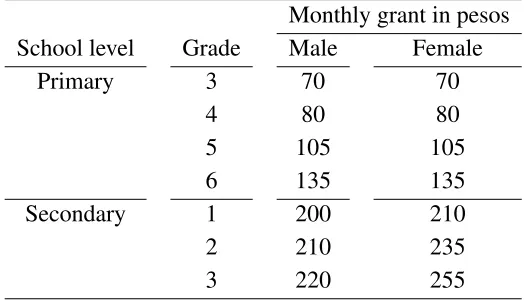
grant schedule is provided in Table 1.9
9The program also provided cash transfer and nutritional supplements for infants and small children that
Table 1: PROGRESA monthly education grant schedule in 1998 Monthly grant in pesos School level Grade Male Female
Primary 3 70 70
4 80 80
5 105 105
6 135 135
Secondary 1 200 210
2 210 235
3 220 255
Source: Schultz (2004)
For the evaluation of the program, village- and household-level survey data was
col-lected in 506 randomly secol-lected villages. Moreover, a randomization of treatment villages
and control villages was performed. The beneficiary households in 324 treatment villages
started receiving the program transfers in 1998 and those in 182 control villages did at the
end of 1999. The survey data was collected in both treatment and control villages before
and after the implementation of the program. The baseline surveys were done in October
1997 and March 1998, and the three follow-up surveys were conducted in October 1998,
May 1999, and November 1999, all before the control villages started receiving the
pro-gram transfers. Every household in selected villages was surveyed; in the baseline surveys
there were 24,077 households (9,221 in the control villages and 14,856 in the treatment
villages). The household-level survey contains information about household members,
including their age, most recently completed school grade, school attendance,
employ-ment, and information about individual members’ wage income, household income from
other sources, household food consumption, and household expenditure on both food and
non-food items.
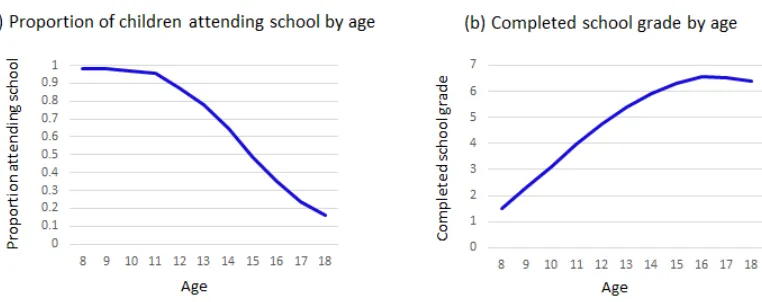
Figure 1: School enrollment rate and completed school grade by age
Source: PROGRESA data October 1998, May 1999, and November 1999. The sample is restricted to all control villages.
Table 2: Proportion of children making transitions into or out of school All Age≤12 Age>12 No transition into or out of school 0.72 0.80 0.43
One transition 0.18 0.12 0.38
Two transitions or more 0.11 0.08 0.20 Number of observations 16,981
Source: De Janvry et al. (2006). PROGRESA data over 7 semesters from November 1997-November 2000.
school for the entire semester. School enrollment is almost universal before age 12 and
starts to drop sharply around age 14. In control villages, the school enrollment rate
be-tween ages 16 and 18 during the data periods is around 30 percent, and the completed
grade of children at age 18 is less than 7th grade (Figure 1). School attendance is not only
low but also irregular. As shown in Table 2, 20 percent of children of the age of 12 and
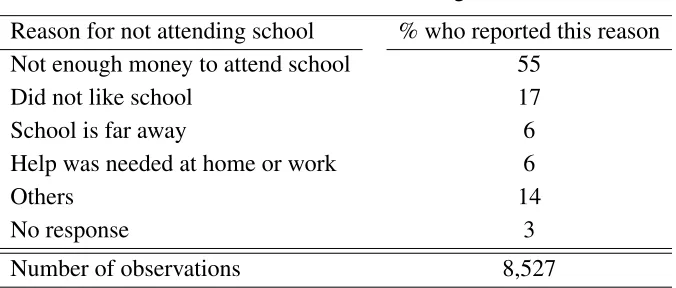
above make at least two transitions into and out of school. Table 3 shows that the most
frequently cited reason for absence is “not enough money”, which suggests that financial
constraint is important determinant of observed schooling outcomes in these villages.
Child labor is prevalent and a significant source of income in these villages. Child
Table 3: Reasons for not attending school
Reason for not attending school % who reported this reason Not enough money to attend school 55
Did not like school 17
School is far away 6
Help was needed at home or work 6
Others 14
No response 3
Number of observations 8,527
Source: PROGRESA data October 1998, May 1999, and November 1999. The sample is restricted to all control villages and children between the ages of 12 and 18.
wage reaches 35 percent by the age of 18 (Figure 2(a)). The contribution of children
(including zero wage) to household income increases with the age of the oldest child,
reaching 30 percent of total household income at the age of 18 (Figure 2(b)). In families
where a child works for a wage, the proportion of their contribution to household income
is 40 percent (Figure 2(c)).
In the data, only 1.2 percent of children between the ages of 12 and 18 were both
attending school and working. The assumption that the activity choices are mutually
exclusive does not seem to be very restrictive.10 Also, only 0.4 percent of the children
below age 12 worked.
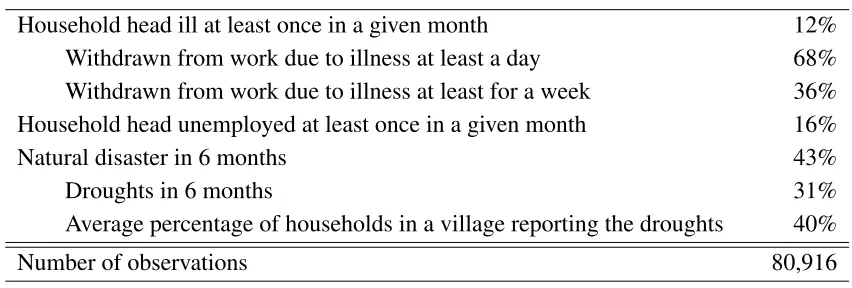
Table 4 shows the prevalence of shocks faced by households in PROGRESA villages.
In the data, 12 percent of households reported that their head had fallen ill at least once
within a given month, and almost 70 percent of them had to withdraw from work for one
or more days due to the illness. Also, 16 percent of households reported that their head
was unemployed at a certain point in a given month. Natural disasters such as droughts are
also common. 40 percent of households reported that they had experienced a drought at
10When children are both attending school and working, I treat them as attending school regardless of
Figure 2: Child labor in PROGRESA villages
Table 4: Percentage of households having experienced various shocks
Household head ill at least once in a given month 12% Withdrawn from work due to illness at least a day 68% Withdrawn from work due to illness at least for a week 36% Household head unemployed at least once in a given month 16%
Natural disaster in 6 months 43%
Droughts in 6 months 31%
Average percentage of households in a village reporting the droughts 40%
Number of observations 80,916
Source: PROGRESA data October 1998, May 1999, and November 1999. All villages.
least once within the past 6 months. Droughts are regarded as a community-wide shock;
however, not all households in a village reported the experience of the same shock. In
a given village, on average, 4 out of 10 households report that they had experienced a
drought whereas 6 out of 10 households reported that they had not experienced any during
the same periods. Reported damage also varied across households in each given village,
suggesting that there is a room for risk sharing among households in a village even in
times of natural disaster.
There is evidence that households exchange informal transfers and rely on informal
sources to borrow money in PROGRESA villages. As shown in Table 5, 10 percent of
households reported some form of support received from or given to other households
within a single month.11 The average amount of support was 475 pesos, which is a
sub-stantial amount considering that the average monthly household expenditure is 1,071
pe-sos in these villages. Also, more than 60 percent of reported credit (in frequency, not
in the amount of money) was from informal sources such as relatives, neighbors, and
1110 percent is arguably not large enough to support a model assumption that every household participates
Table 5: Informal financial activities in PROGRESA villages Giving or receiving support from other households
Percentage of households reported the activity 10% Average amount of the support 475 pesos Borrowing or credit
Percentage of households reported the activity 2% Percentage of credit from relatives/neighbors/friends 62%
Number of observations 26,972
Source: PROGRESA data October 1998, May 1999, and November 1999. Average amount of the support is reported in nominal Mexican peso.
friends.
In addition, the data on income from other sources such as sales of a household
mem-ber’s service, crop production, livestock sales, government program transfers other than
PROGRESA (such as pensions), rent, and any interest from savings were also available.
Household income variable was constructed as the sum of all members’ wage income and
income from other sources. Parental income is obtained by subtracting the sum of the
wage income of children from household income.
The survey also contains detailed information about the quantity and the value of
household food consumption, non-food expenditures, and income from various sources.
The consumption variables are available in the October 1998, May 1999, and November
1999 waves, but not in the baseline surveys; thus, in my analysis, only the later three
waves are used. I convert the household income and consumption to the adult-equivalent
per-capita level adjusted by the economies of scale. The adult equivalent weights are
based on the calculation of Di Maro (2004).12 See Appendix C for details about how the
income and consumption and variables are constructed.
12Di Maro (2004) assigns 1 on adult members above age 18 and 0.73 on members of age 18 and below.
Then I further adjust the adult equivalent size of the households for the economies of scale by taking a square root. For example, in a household that has two adults who are age 40 and three children who are age 10,
In the estimation, I use the 11 largest control villages, which have more than 100
households each. I restrict the sample to large control villages for two reasons. First, I
use large villages because the model assumes a continuum of households, which is better
approximated by large villages. Second, I use control villages because the model solution
algorithm requires stationarity of the economy. In treatment villages, the village economy
may be on a transition path to a different steady state than in the control villages, due to
the introduction of the cash transfer program. There are 1,433 households in the selected
sample. Also, when I map the model to the data, I only track the information about
the oldest child of each household. For example, the model outcomes such as school
attendance and the accepted wage of a 12-year-old-child are compared to the observed
outcomes of the households whose oldest child is 12 years of age in the data.13 Table 6
provides the summary statistics of the selected sample. The school enrollment rate and
the fraction of children working for a wage by age is based on the oldest child. When
constructing moments in the estimation, income is deflated so that the aggregate income
level is the same as the aggregate consumption level.14
13In PROGRESA villages, the birth order does not seem to affect the school attendance decision much
as the coefficient of the birth order variable in the probit regression of the school enrollment was close to zero and not significant at conventional level. The sample used in the analysis was comprised of all children between ages 6 and 18 in both the treatment and control villages (about 48,000 children in total). Other controls were age, gender, parental education, completed grade, and village-fixed effect. The most important determinant was the age of a child.
14The aggregate consumption-to-income ratios in each village are 0.58, 0.68, 0.96, 0.56, 0.66, 0.67, 0.77,
Table 6: Summary statistics
mean (s.d.) Completed school grade
mothers 3.18 (2.69)
fathers 3.81 (2.56)
children at age 18 7.42 (2.37) School enrollment rate
6≤age≤11 .98 (.13)
12≤age≤15 .77 (.42)
16≤age≤18 .36 (.48)
Fraction of children working for wage
12≤age≤15 .06 (.24)
16≤age≤18 .31 (.46)
Children’s wage income 1,179.24 (1,232.13) Household income 2,478.75 (2,978.39)
Number of observations 4,152
4
Estimation
I use the method of simulated moments to estimate the model parameters.15 This
estima-tion method finds a set of parameter values that minimizes the weighted distance between
the aggregate moments constructed with the data and that of the simulated outcomes of the
model. The weights are given by the inverse of estimated variances of the data moments
following Lee and Wolpin (2010).
The simulated moments are generated from the computed stationary distribution for
a given set of parameters. I use the observed completed school grade of mothers and
the estimated type-probability process to determine the type of parents of each
house-hold. Given the parental type, the age and completed school grade of each child is drawn
from the stationary distribution. I assume that the state of the economy when the
par-ents’ schooling investment was made is different from the current steady state and that
the parental schooling distribution and the parental type distribution are exogenous to
the model. I also assume that the new households entering the economy have the same
schooling distribution as the mothers in the sample. Thus, the parental schooling
distribu-tion and the resulting parental type distribudistribu-tion are constant over time. Given the parental
15Parameters in the model are identified by the combination of functional forms, distributional
assump-tions, and exclusion restrictions.µpin the parental and household income processes for high-income type
are normalized to be zero. Although the parameters in the parental and household income processes are identified outside the model, estimating the income process jointly with other model parameters makes the estimation more efficient. This is because the parameters in the income process determine the return from schooling, and thus they affect other parameters that govern child activity choices. I fix the subjective
dis-count factorδ at a conventional level of 0.95 because with a constant relative risk aversion (CRRA) utility
function it is not obvious how to separately identify the risk aversion and time discounting parameters.
Grade-completion probability for grades 7-12,πgr(dtschool,dtschool−1 )are not estimated but imputed based on
the fraction of children completing one school grade given their observed enrollment status. The computed
grade-completion probability for grades 7-12 is given byπgr(1,1) =0.8,πgr(1,0) =πgr(0,1) =0.25, and
πgr(0,0) =0.1. Grade-completion probability for children below age 12 (or between grades 1-6),πgr12(X,k),
for each(X,k)are estimated whereXis a school grade in which a child is enrolled andkis a parental type.
Althoughπgr(dtschool,dtschool−1 )is independent of parental type, the proportion of children who complete a
school grade each year can differ across different parental types becausedschool
t is a choice and is affected
by parental type. Demographic transition probabilitiesπb,πm, andπdare also imputed based on the
type, the age and the completed school grade of a child, and a set of shocks, an efficient
allocation is computed by solving the agent’s problem. Then, the simulated moments are
constructed as an average over the outcomes which are associated with many different
sets of shocks.
Target moments used in the estimation are listed below. A “grown-up child” refers to
a child whose age is above 18.
1. Income process
(a) Mean parental income by village, excluding households with a grown-up child
(b) Mean household income by village (households with a grown-up child only)
(c) Standard deviation of mean-differenced log parental income by village,
ex-cluding households with a grown-up child
(d) Standard deviation of mean-differenced log household income by village
(house-holds with a grown-up child only)
(e) Mean parental income by the completed grade of mothers, excluding
house-holds with a grown-up child
(f) Mean parental income by the completed grade of mothers (households with a
grown-up child only)
(g) Mean household income by the completed grade of children (households with
a grown-up child only)
(h) Standard deviation of log parental income by the completed grade of mothers,
excluding households with a grown-up child only
(i) Standard deviation of log household income by the completed grade of
2. Child wage process
(a) Mean accepted wage by age, from ages 12 to 18
(b) Mean accepted wage by parental income quartile
(c) Mean accepted wage by the completed grade of mothers.
3. Child activity choice
(a) Proportion of children attending school and working by age, from age 12 to
age 18
(b) Proportion of children staying home, attending school, and working between
ages 12 and 16 by parental income quartile
(c) Proportion of children attending in each of the 5th, 6th, 8th, and 9th grades
(d) Proportion of children attending school in the spring but who were not
en-rolled in the previous fall
(e) Proportion of children attending school in the fall but were not enrolled in the
previous spring
(f) Proportion of children attending school by years behind the standard grade
level at each age
(g) Mean parental income of households with a child attending middle school
(grades 7 to 9)
(h) Mean parental income of households whose child is eligible to attend middle
school but stays home
(i) Mean parental income of households whose child attends high school (grades
(j) Mean parental income of households whose child is eligible for high school
but stays home.
4. School grade completion16
(a) Proportion of 12-year-old children who completed no grade, 1st grade, 2nd
grade, ..., 6th grade by the completed school grade of their mothers.
5. Consumption
(a) Mean consumption by the completed grade of mothers
(b) Mean consumption by the completed grade of child (households with a
grown-up child only)
(c) Mean consumption by parental income quartile
(d) Correlation of mean-differenced household income and consumption over time.
4.1
Parameter estimates
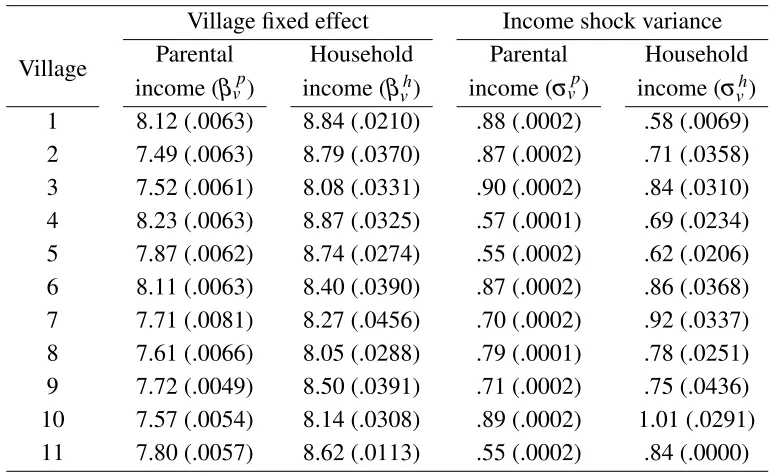
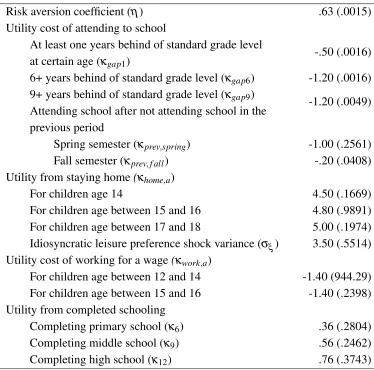
The estimated parameters are shown in Table 7-Table 10.17 I discuss the parameter
Table 7: Parameter estimates: income process
Village fixed effect Income shock variance
Village Parental Household Parental Household income (βvp) income (βvh) income (σ
p
v) income (σvh)
1 8.12 (.0063) 8.84 (.0210) .88 (.0002) .58 (.0069) 2 7.49 (.0063) 8.79 (.0370) .87 (.0002) .71 (.0358) 3 7.52 (.0061) 8.08 (.0331) .90 (.0002) .84 (.0310) 4 8.23 (.0063) 8.87 (.0325) .57 (.0001) .69 (.0234) 5 7.87 (.0062) 8.74 (.0274) .55 (.0002) .62 (.0206) 6 8.11 (.0063) 8.40 (.0390) .87 (.0002) .86 (.0368) 7 7.71 (.0081) 8.27 (.0456) .70 (.0002) .92 (.0337) 8 7.61 (.0066) 8.05 (.0288) .79 (.0001) .78 (.0251) 9 7.72 (.0049) 8.50 (.0391) .71 (.0002) .75 (.0436) 10 7.57 (.0054) 8.14 (.0308) .89 (.0002) 1.01 (.0291) 11 7.80 (.0057) 8.62 (.0113) .55 (.0002) .84 (.0000)
Notes: Standard errors are in parentheses.
4.1.1 Income, wage, and type process parameters
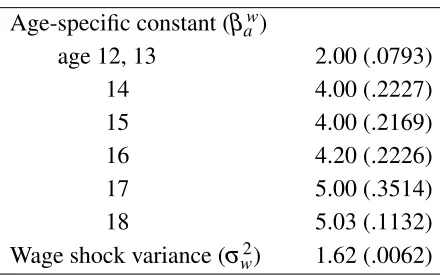
Table 7-Table 9 provide parameter estimates for parental income, child wage, household
income, and type process parameters. As shown in Table 7, the mean and the variance of
parental and household income vary significantly across villages. In all villages,
house-hold income with a grown-up child is larger than that of other househouse-holds. Table 8
pro-vides parameter estimates for the child wage process. Mean wage offers for children
substantially increase with the child’s age, implying a higher opportunity cost of
attend-ing school for older children. Table 9 provides type process parameter estimates. The
16The current estimation on which the results reported in the paper are based does not incorporate the
moments related to school grade completion. School grade completion probabilitiesπgr12(X,ptype) for
X=0, ...,6 andptype=low,highare calibrated. The results of the full estimation are forthcoming. The
calibrated values are given by the following. The numbers may not sum up to 1 because they are rounded:
ptype\X 0 1 2 3 4 5 6
low 0.03 0.01 0.05 0.12 0.27 0.28 0.13 high 0.08 0.01 0.01 0.05 0.08 0.31 0.47
Table 8: Parameter estimates: child wage process Age-specific constant (βaw)
age 12, 13 2.00 (.0793)
14 4.00 (.2227)
15 4.00 (.2169)
16 4.20 (.2226)
17 5.00 (.3514)
18 5.03 (.1132)
Wage shock variance (σw2) 1.62 (.0062)
Notes: Standard errors are in parentheses.
estimated type component in income process, µp, is -0.9 for the low-income type,
trans-lating to a mean income that is 41 percent of high-income-type ones.18 This is compatible
with the observed difference in mean incomes of poor (CCT beneficiaries) and non-poor
households in the data.19 The estimated parameters in the type probability process predict
that the probability of being a high-income-type child when no grade is completed is 0.25
and that completing the 6th, 9th, and 12th grades increases this probability to 0.48, 0.56,
and 0.66 respectively. Combined with the estimated µp, the estimated type probability
process predicts that, compared to those who did not finish any school grade, the expected
mean household income is 24, 33, and 43 percent higher when a child completes 6th, 9th,
and 12th grades.20 The type components of parents and children enter multiplicatively in
18This calculation is done by:
Realized income of low-income type
Realized income of high-income type =
eβv+µp+εp
eβv+εp ==exp(−0.9)'0.41
19In the sample used in the estimation, the observed mean of per adult-equivalent household income of
the beneficiary households for 6 months is 1835.68 pesos and that of the non-beneficiary households is 3022.26 pesos.
20The relative size of income is obtained by the following calculations:
(A) Mean income of those who did not complete any school grade = 0.75eβv−µp+0.5σvp+0.25eβv+0.5σvp
(B) Mean income of those who completed 6th grade =0.52eβv−µp+0.5σvp+0.48eβv+0.5σvp
Table 9: Parameter estimates: type process Unobserved type component in income process
Constant term for low-income type (µ) -.90 (.0058)
Type probability process (probability of being high-income type) When completed grade is observed
Constant (γ0) -1.00 (.0021)
Coefficient of completed school grade
For grade between 1 and 6 (γX,primary) .10 (.0143)
For grade above 6 (γX,secondary) .08 (.0183)
Coefficient of completing primary school (γ6) .30 (.0595)
Coefficient of completing middle school (γ9) .12 (.0132)
Coefficient of completing high school (γ12) .17 (.0123)
When completed grade is not observed
Constant (γX0) .80 (.0130)
Notes: Standard errors are in parentheses.
the household income process, and households with high-income type parents have larger
return from schooling.
4.1.2 Preference Parameters
Preference parameter estimates are provided in Table 10. The estimated risk aversion
coefficient is 0.63. This is within the range of the values which were found in other
studies that structurally estimate limited-commitment risk-sharing models using
village-level data in developing countries.21
The estimated parameters for utilities from completing primary, middle, and high
school are 0.30, 0.50, and 0.75 respectively. To provide an idea of how large these
num-21Other papers that structurally estimate a limited-commitment risk-sharing model by using data from
Table 10: Parameter estimates: preference
Risk aversion coefficient (η) .63 (.0015)
Utility cost of attending to school
At least one years behind of standard grade level
-.50 (.0016) at certain age (κgap1)
6+ years behind of standard grade level (κgap6) -1.20 (.0016)
9+ years behind of standard grade level (κgap9)
-1.20 (.0049) Attending school after not attending school in the
previous period
Spring semester (κprev,spring) -1.00 (.2561)
Fall semester (κprev,f all) -.20 (.0408)
Utility from staying home(κhome,a)
For children age 14 4.50 (.1669)
For children age between 15 and 16 4.80 (.9891) For children age between 17 and 18 5.00 (.1974) Idiosyncratic leisure preference shock variance (σξ) 3.50 (.5514)
Utility cost of working for a wage(κwork,a)
For children age between 12 and 14 -1.40 (944.29) For children age between 15 and 16 -1.40 (.2398) Utility from completed schooling
Completing primary school (κ6) .36 (.2804)
Completing middle school (κ9) .56 (.2462)
Completing high school (κ12) .76 (.3743)
Notes: Standard errors are in parentheses.
bers are I convert them into consumption-equivalent terms given a reference consumption
level of 2,634.46 pesos, which is the estimated mean consumption level in the economy.
The utilities from completing schools are translated into 183.42, 210.57, and 259.24
addi-tional pesos of consumption respectively, compared to the households of which the child
did not finish primary school.22
The estimated parameters for the leisure value of a child are translated into 100.34
22The consumption-equivalent values were obtained by the following way. Suppose that a household has
household consumption of 2,634.46 pesos (which is the average amount of consumption in the villages) and