An Insight into a Software Architect’s Role in
Project Development
Ayushi Agarwal1, Devyani Jivani2 and Akash Vijay Pillai3
I.INTRODUCTION
Software architecture is gaining increasingly attention in the software development community due to its significantly important role in overall development cycle. The software architecture provides us with the structure of the software, its components; properties of these components and their relationship with each other.The major role of a software architectis to create the software architecture. The software architect has to decide on a particular architecture by experimenting with different architectural approaches. He has to create different models and interface specification documents and validate the selected architecture against the requirements of the software. The software architect’s role is also to lead and coordinate technical activities, check the development of the project. He has to communicate with the organizational management, his peers and the customer.
1School of Computer Science and Engineering VIT University, Vellore, Tamilnadu, India 2School of Computer Science and Engineering VIT University, Vellore, Tamilnadu, India 3School of Computer Science and Engineering VIT University, Vellore, Tamilnadu, India
International Journal of Latest Trends in Engineering and Technology Vol.(7)Issue(3), pp. 180‐185 DOI: http://dx.doi.org/10.21172/1.73.525 e‐ISSN:2278‐621X
Abstract- Software architect plays an important role in developing the software as software architecture plays a crucial role in the positive and negative result of the software project with regard to quality and cost. People have different individual tendencies, and how they understand, design and implement any allocated task is influenced by it. These individual tendencies are identified by soft skills. Generally development of software is a team effort which implies various people performing distinct tasks. The positive and negative result stories of software projects disclosed the human factor as one of the critical importance. In this handwork we are presenting an analytic study about the practical experiences and industrial case studies on how the architect’s role has facilitated or hindered success. This paper describes the results of an online survey, with the contribution of 20 software architects, targeted at defining the features of the software architect's role. The results expose that software architects conduct different activities such as duties, knowledge, skills, management and many more. Besides, in the context of leadership, software architects attempt to do far more than they can at present do. The output of this survey will help in understanding various aspects and requirements for the post of software architect and gives the present-day status of their use in job advertisements. Software architects develops software which is the fundamental part of software architecture; however, its combination in the development procedure has become more challenging with the conversion from traditional to agile development methods, and with the architects becoming more technological experts responsible for high-level design.
An Insight into a Software Architect’s Role in Project Development
181
II.RESEARCH MOTIVATION
Software engineering is a set of activities comprising of phases such as system analysis, design, coding, testing, and maintenance. To achieve this, a collection of different tasks have to be performed. To perform these activities, we need people with skills to perform specific activities, like a software designer to design, a testing head to test the software, since all these activities are very different from each other. Software architecture is still a young field and is still on its developing stage. The principles of the architectures are still not properly defined but it is clear that human creativity is a major requirement in software architecture. Software architecture is exploratory in nature, the architect has to look for different components and had to try out a variety of schemes so as to properly find an appropriate solution which is validated against the software requirements.
From a outsider’s view, the job of a software architect looks easy, but in implementing large scale projects, its difficult to find the key components, relationships between them and then to find the appropriate architecture such that these requirements are fulfilled. There are sometimes repetitions since it takes a number of iterations to choose a good architecture. The number of iterations reduces with experience.
This is an area of interest and is still in the developing stage. This gave us motivation to do some research and make an inference on what exactly is the role of a software architect.
II.APPLYING K-MEANS ALGORITHM
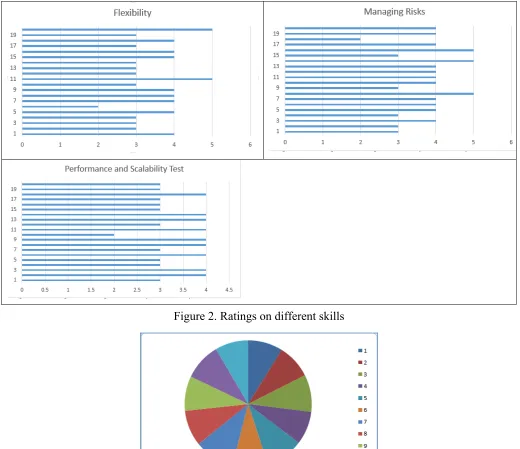
The survey that has been carried out explains us that a software architect is responsible for generating or choosing the most suitable architecture for a system , such that it satisfies the business needs, requirements of the user, and attains the expected outputs under given limitations. We have considered 11 aspects namely managing risks, performance and scalability test, management skills, technical skills, knowledge, leadership qualities, ability to take risk, architecture evaluation, flexibility, interpersonal communication, to determine the views of software architects and from the survey we have concluded that the role of software architect has not hindered but facilitated success.
We have used K-means Clustering algorithm to find the similarities in the judgment of 20 software architects which serve as our attributes. We considered 11 clusters and then implemented the k-means Clustering algorithm. We implemented this using the WEKA tool.
The Lloyd's algorithm, mostly known as k-means algorithm, is used to solve the k-means clustering problem and works as follows. First, decide the number of clusters k.(Here 11) then:
1) Initialize the center of the clusters
μi= some value ,i=1,...,k
2) Attribute the closest cluster to each data point(the data collected from 20 software architects) ci={j:d(xj,μi)≤d(xj,μl),l≠i,j=1,...,n}
3) Set the position of each cluster to the mean of all data points belonging to that cluster μi=1|ci|∑j∈ cixj,∀ i
4) Repeat steps 2-3 until convergence Notation
Ayushi Agarwal, Devyani Jivani and Akash Vijay Pillai 182
Figure1. Data collected represented in an excel sheet
A software architect scans an organization’s universal business and initiates the working of the software, estimates new software applications to verify whether they are apt for an organization and if the present hardware will support them. A brief information regarding advantages and costs of software is given by software architect to make sure that it will provide the user over long run. He does this by abstracting the problem of a system into a controllable model that defines the nature of a system by revealing key details and remarkable constraints. Maintaining control on the architecture process along with the project’s software development process is also a key task.
The architect needs to have a good contact with management at different levels, stakeholder groups, , business analysts or marketing, and developers. The architect needs to balance active contribution with the necessity to generate conceptual integrity and keep the architecture decision procedure from stalling. Knowledge about compilers and different language translators can identify the costs for changing computer programs from one language to other, so the software architect selects the language and the environment.
Leading a team of programmers is a major role of software architect. Negotiating outsource contracts for creating new software, building various prototypes of the software and testing them, transferring previous data from existing software to new software, testing and reviewing the new software and solving the problems are also some of his roles. Training manuals are developed by software architect and they also run training sessions to give the users details about the use of the software
II.THE COMPARATIVE
Ayushi Agarwal, Devyani Jivani and Akash Vijay Pillai 184
Figure 2. Ratings on different skills
Figure 3. Pie Chart representation of the required skills
An Insight into a Software Architect’s Role in Project Development
185
REFERENCES
[1] Rick Kazman, Paul Clements, Mark Klein, “The Duties, Skills, and Knowledge of Software Architects”.
[2] Karl Ulrich, “The role of product architecture in the manufacturing firm”.