Greenway
Use and
Users:
An
Examination
Of
Raleigh
and
Charlotte
Greenways
Owen
J.Furuseth
Robert
E.
Altman
As
withany
public
facility,the
planning
and
development
of greenways should be
reflectiveof
the
needs of
potential
usersand
typesof
usage.Because
of
theirrelativeshort
history,however,
almost
no
efforthas been
made
tofollow
up
the
expected use
of greenways
with
empirical
evidence
concerning
theiractual
usage.Intuitively,
greenway
planners
and
designers
may
have
some
notion
of
likelypatronage,
how
the
facility willbe
used,and
where
patrons
willbe
coming
from, but
theseperceptions
may
be
inappropriate.
Without
actual
information
on greenway
visitorsand
use,the
planning
process
isguided by
conjecture.If
greenway
development
trends of the 1980s areex-tended, thedecade ofthe1990swillseethe proliferationof
new
and expanded greenways throughouttheUnitedStates.The
challenges facinggreenway
plannersand
managers
arevaried,butthe importance ofcollecting
and
usingpatrondataintheplanningprocesscannot bediscounted. Inorder
to create viable, user-accessible facilities, better
under-standing
ofwho
patronsare,theirpatterns ofuse,and
theirproblems
and
concernsmust
be addressed.These
arecritical ingredients for not onlyenhancing facility usage, butalsobuildingbroader
community
supportforthegreen-way
concept.Asa
resultofaninitialrequestfrom
theNorth
CarolinaGreenways Conference
OrganizingCommittee,
theDe-partment of
Geography and
EarthSciencesoftheUniver-sityof
North
CarolinaatCharlottehasbeen
involvedin sev-eralcase studiesofgreenway
patronage designedtoaddressthese questions.
Our
research has usedtwo
ofNorth
Carolina's oldestand
largestgreenways, the CapitalArea
Greenway
System
inRaleighand
theMcAlpine
Greenway
inCharlotte,asstudysites. Inour
work
we
havecollected data ofgreenway
users, their activity patterns,and
theirevaluationsofthesefacilities.
The
researchcarriedouton
Charlotteand
Raleighgreen-ways found several
common
elementsbetween
thetwo
communities and
theirdissimilargreenways.While
these findings relate specifically to theMcAlpine
and
CapitalArea
greenways,theymay
haverelevanceor,atleast, pro-videsome
insights forotherNorth
Carolinacommunities.A
Recent
History
Greenways were
rediscoveredinthe 1980s. Inthefaceofincreasing publicconcern overthelossof
open
spaceand
the protection oflocalqualityoflife,greenwaysemerged
as ahighlytoutedplanningstrategy (Little, 1987).A
green-way
may
be definedasanarrow
linear stripofundeveloped
land often located alonga stream,flood plain,powerlinecorridoror
unused
railroad line.Because
theyrepresentfingers of open, public space in a larger urban setting,
greenways
may
providea varietyofpublicbenefits. Special-izedrecreational opportunities,suchasbikepaths,joggingtrails,orparcourses,fitwell into the
greenway
concept.At
the
same
time,environmentaland
aestheticgoalsmay
beenhanced
bythemaintenance
ofstream corridors, floodplains,
and
naturallyvegetated areas (Kuslerand
South-worth, 1988).Nature
study, fishingand
picnicking are potentially importantactivities along greenways.Green-ways
may
also be integrated into a local transportation system.Where
greenwayslinkneighborhoods
and
commu-nityfacilities,theyrepresent
an
alternative transportationmode
to theroadway
(Rotolo, 1981).Greenways
areuniquelymultifaceted facilities; theysupply recreational,
environmentalquality,
and
transport servicesforaminimal
public investmentand occupy
onlyasmallportion ofthecommunity.
Inthe past tenyears,thegreenways concepthasspread
Owen
J.Furusethisprofessorofgeographyatthe Universityof North Carolina at Charlotte.He
is a graduate of EastCarolina University
and Oregon
State University. Priortojoining thefaculty at
UNCC,
hewas
a planner with theJacksonville
Area
PlanningBoard
in Jacksonville, Florida.Hisprofessional
and
researchinterestsarein landuseplan-ning.
RobertE.
Altman
receivedamaster'sdegreefrom
theDepart-ment
ofGeography
and
Earth Sciencesatthe Universityof North CarolinaatCharlottein 1990.He
iscurrentlya Ph.D.studentinthegeography
program
atOregon
StateUniversity,Greenway Programs
inNorth Carolina
ExistingGreenwayor TrailSystem
GreenwayUnder DevelopmentorPlanned
GreenwayProgram UnderConsideration
Source: GreenwaysIncorporated,CurrentStatusGreenwavsProgramsinNorth Carolina,February 1989.
from
a fewprogressive communities, like Denver,Colo-radoandPortland,Oregon,toover200jurisdictions. (Knack andSearns, 1990).
The
highlyregarded President'sCom-mission
on
America'sOutdoors recommended,
in their1987report,the
development
ofa locallybased,nationwide system ofgreenwaysas amechanism
forproviding public accesstoopen
space.In
North
Carolina, there areelevenoperating greenwaysor
greenway
systems,withanadditionaltwenty-eightcom-munitieseitherinthe process ofdeveloping greenwaysor considering
them
(seemap
above).Although most
ofthegreenwayactivity inthestateisconcentrated in the
more
urban Piedmont, especially the Research Triangle area,greenwaysarefound throughoutthestate in
communities
of varyingsizes.The
Capital
Area
and
McAlpine Greenways
While
Raleighand
Charlotte'sgreenway
planningpro-grams havereceivedwidespreadrecognition, theseefforts
have
produced
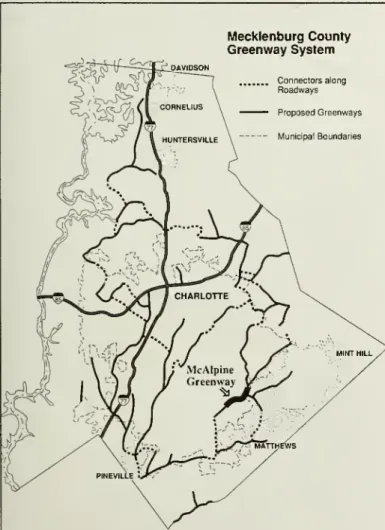
verydifferent products. In 1981,Meck-lenburg
County
adopted a countywide mastergreenway
plancalling for a65-mile "green necklace" oflinearopen
spacelinking
communities and
neighborhoods.The
largestcomponent
ofthegreenway
would
besituatedinlowlyingfloodplains.
These
water-orientedcorridorswould,inturn,bejoined together usingconnectingtrailsalong roadways
(see illustration
on
page39).Presently, the only operating
greenway
section is the 360- acreMcAlpine
facility,extendingalongtheMcAlpine
Creek. It is locatedina middle- toupper-classsuburban
areaineast Charlotte.
Opened
in 1979,greenway
facilitiesinclude three milesof
paved
bikeways, a three-milecross-country runningtrail,
and
athree-acrelake. Itadjoins thecounty-operated
McAlpine
District Park.The
greenway
abuts severalneighborhoods
and
there arecommunity
entrances as well as the
main
entrance, with a shared parkingarea.The
greenway,which
hasan estimated5,000visitors per week, is
open
daily without admission fee.Because it is a single-segment greenway, the
McAlpine
facilitymight beconsidered aneighborhood-oriented green-way.
The
CapitalArea Greenway, begun
in1972,isthe oldestgreenway
inNorth
Carolinaand
ranksamong
thelargestmunicipal greenwaysystemsintheUnitedStates(Flourney,
Jr., 1989).
The
system serves the city of Raleighand
adjacent portionsofWake
County, with 12trailsegments extending over 27linearmilesand
covering800
acres(see illustrationon
page41).As
thegreenway
winds throughthe city, it connects
neighborhoods
and communities
ofvaryingsocial
and
demographic
characteristics.Unlikethe
McAlpine
greenway,the CapitalArea
green-way
is acomprehensive
system oftrails, presenting easy opportunitiesforcitizensthroughoutthecityto use,due
toitssize
and
accessibilitytomany
differentneighborhoods.Data
Collection
The
research datawere
collectedatboth greenways, overa
one-month
period,usinganintercept survey.Greenway
usersatleastsixteenyearsof age
were randomly
surveyedat differenttimesofday. InCharlotte,the interviewerswere
positionedat themain and neighborhood
entrances. Infourtrailsat
main and
variousneighborhood
entrances.The
four trails surveyed in Raleighwere
the Shelley Lake,Johnson
Lake,Buckeye,andLittleRock
trails.These
trails
were chosen
becausetheyrepresentacross-sectionofthe various types of
greenway
trailsand neighborhood
settings fortheCapital
Area
system.Upper
middle-income
neighborhoods surroundthe
Johnson
Lake
Trailin south-west Raleigh.Upper
middle-income
and
affluentneigh-borhoods
surround the ShelleyLake
Greenway
Trail innortheast Raleigh.
The
Buckeye and
LittleRock
trailsare smaller green-ways.The
LittleRock Greenway
insoutheast Raleighissituated in a predominantly
low-income
neighborhood.The
Buckeye
Trailrunsthrough lower middle-tomiddle-income
blue collarsections ofeast Raleigh withlow-in-come
housingdevelopments
situatednearit.The
survey questionnairewas
composed
of multiple choice questions. Itqueriedtherespondentsaboutgreen-way
usage,visitors'concerns or problems,aswellas collect-ingsocioeconomic,demographic and
locationalinforma-tion.
Two
hundredsixty-one adultscompletedtheMcAlpine
questionnaire, while320
personsanswered
the CapitalMecklenburgCounty
Greenway System
Connectorsalong
Roadways ProposedGreenways
MunicipalBoundaries
Source Adapted byauthors from theMecklenburgCountyGreenwayMasterPlanMap.June1987.
Area
Greenway
survey.The
surveywas
designedtomini-mize
interview time.The number
of personsrefusing toparticipateinthesurvey
was
extremelylow,lessthan sevenpercent, inbothcases.
Greenway
Patrons
Given
the locationaland
size differencesbetween
the CapitalArea and
McAlpine
greenways,we
began
ourre-searchanticipating that there
would be
significantdiffer-ences
between greenway
patronage inRaleighand
Char-lotte. Surprisingly,
we
found
that both the "comprehen-sive"and "neighborhood"
greenways tendedtodraw
a very similaruserpopulationand had
thesame
serviceradius.Tables 1
and
2 presenta profileofgreenway
visitors inCharlotte
and
Raleigh.The
majority ofadult visitors inboth
communities
areyoung
to middle-aged,white,and
resideinhouseholds withoutchildren. Socioeconomically, patrons are better educatedand
live in households with higherincomes
than the average non-patron.When
theMcAlpine
background
variables arecompared
with thecharacteristics ofthe surrounding census tracts,
and
the CapitalArea greenway background
dataarecompared
withcitywide
socioeconomic
and demographic
data,greenway
usersarefound
tobesignificantlyyounger,bettereducated,more
affluent,and
includefewer non-whites.Table 1. Capital
Area
Greenway
User
Characteristics16-24 25-34 35-44 45-54 55-84
Age
21%
Female
33%
Male
23%
13%
10%Gender
53%
Non-Wliite
47%
Wliite
Race
15%
85%
High School Some College Graduate Educational Graduate College Graduate Studies
Attainment
15%
24%
40%
21%
$10,001- $25,001-
$50,001-Household <$10,000 $25,000 $50,000 $100,000 >$100,000
Income 7.6% 22.1% 42.2% 23.2% 4.8%
Children<18 Yes
No
InHousehold
30%
70%
One
areawhere
the Raleighand
Charlotte findingsdifferisgender.
The
majority ofMcAlpine
visitorswere
men, whereas
thelargestnumber
of respondentsalongthe CapitalArea
Greenway
were
women.
This variance might be accounted for by gender-related mobility differences.Transportation studies have
shown
thatwomen
tend tohavelesstravelflexibilitythan
men
(Hanson and Hanson,
1981;Pas,1984). Consequently,thelarger,more
accessible CapitalArea greenway
may
provide greateropportunityTable2.
McAlpine
Greenway
User
Characteristics 18-24 25-34 35-44 45-54 55-64 >65Age 15%
Female
31%
Male
25%
18%
7%
4%
Gender
48%
Non-White
52%
Wltite
Race
5%
95%
NotH.S. H.S. Some College Graduate Educnlion.il Graduate Graduate College Graduate Studies
Attainment
3%
13%
25%
45%
13%Household
Children<18
InHousehold
<$10,000
6%
Yes
36%
$10,000-$25,000
24%
No
64%
$25,001-
$50,001-$50,000 $100,000 >$100,000
42%
22%
5%
Although
theimage
ofa"yuppie"-typegreenway
patron emergesfrom
theuserprofile,thisimpressionistempered
by frequency ofuse.
While younger
visitorspredominate,they arenot the
most
intensive users ofthesegreenways.The
heaviestgreenway
usageisbya smallerpool ofolderresidents.
When
respondentswere
askedhow
often theyused the greenway, the
most
active userswere
seniors,persons over 55years. InCharlotte
and
Raleigh, amajorityoftheseniorsinterviewedvisitedthe
greenway
daily.For
most
senior patrons,greenway
activities havebecome
an importantpartoftheirlifestyle.The
overwhelming
majorityofgreenway
visitors inboth Raleighand
Charlotte live nearthe facility (seeTables 3and4).
The
primaryservice areaofthe four CapitalArea
greenway segments
and
theMcAlpine
greenway
was
afive-mile radius. Well over one-half
(58%)
of the Raleighpatronslive lessthanfivemiles
from
thegreenway,and
90percent residelessthan ten miles
from
the trailon which
they
were
surveyed. Similarly,52 percentof theMcAlpine
visitorslivewithin a five-mile radius
and
91 percentlivein a ten-mile radius.Table3. Capital
Area
Greenway
Distance
From
User'sResidenceessthan.99miles ...
16.0%
1 to1.99miles . ..
10.7%
2to4.99 miles ...
32.0%
5to10.99 miles ...
31.7%
Over
11miles ...9.6%
Table4.
McAlpine
Greenway
Distance
From
User'sResidence Less than1 mile18%
1 to5miles
52%
6to10miles
21%
Over
10miles9%
The
close correlation in travel distancesbetween
theMcAlpine
and
CapitalArea
greenwayswas
completely unexpected.Because
the CapitalArea
Greenway
offerstheconvenience of proximity to
more
neighborhoods, itwas
conversely anticipated that the
McAlpine
greenway would
attract visitors
from
amuch
largerarea.The
locational characteristics of patrons inbothcom-munitiessuggests thatgreenwaysplayan importantrolein
neighborhood
recreationoractivitypatterns,butthattheyhave
much
less importance in a regional context.The
absence oflargenumbers
of users livingmore
than fivemiles
from
thegreenwayssuggests thatcompeting
oppor-tunities
from
otherpublicfacilitiesaremeeting
theneeds ofthese potentialvisitors. Inconclusion,personsarenotwilling toforego nearbyrecreational facilitiesin orderto
visit
more
distantgreenways.Patterns of
Use
Greenways
offera varietyofpotentialusesrangingfrom
passivetoactiverecreation,aswell as transportation. Thismulti-facetedaspectof greenwaysisoftencitedby
propo-nentsas
one
oftheirmost
importantsellingpoints;how-ever,
when
we
queried Charlotteand
Raleighpatronsabouthow
theyused thegreenway, the respondentsindicated a specialized patternof use(seeTables5and
6).Table5. Capital
Area
Greenway
PatternOf
Use
Atleast Atleast Atleast oncea once a oncea
Everyday week month year Never
Activity (%) (%) (%) (%) (%)
BikeRiding 5.6 12.6 11.6 4.3 65.8
Walking 27.2 33.2 16.3 11.0 12.3
Jogging 8.3 17.3 10.0 3.7 60.8
Transportation 1.3 2.3 2.0 2.0 92.4
BirdWatching 4.7 6.6 8.0 3.0 77.7
Picnicking 0.0 3.7 15.3 16.6 64.5
Fishing 0.0 2.0 5.0 6.3 86.7
Boating 0.0 1.3 4.7 14.3 79.7
Table6.
McAlpine
Greenway
Pattern ofUse
Very
Frequently Frequently Seldom Never
Activity (%) (%) (%) (%)
Walking 40 32 16 12
Jogging/Runn ng 28 16 10 46
Bikeriding 8 16 16 60
Birdwatching 3 8 17 72
Picnicking 1 11 25 63
Transportation 2 4 8 86
Fishing 1 6 93
Based
on
oursurveys,itwould
appearthatthegreenway
is
most
usedforwalking,joggingor running,and
bicycling.Allotheruses
seem
ancillary. Picnicking, bird watching,and
fishingwere
regulargreenway
activitiesforarelativelyactivities bird watching
was
themost
popular, butonlyone
in fiveCapitalArea
patronsand
one
in ten
McAlpine
patronsreportedregularly vis-itingthegreenway
tobirdwatch.The
heavyuseofthegreenway
forpedestrian-and bicycle-oriented recreation is perhaps not suprising. Their linear shape
and
separation from vehicular trafficmake
them
an attractivealternative to streets or roadways.
Very
few urban land usescan provide thesesame
condi-tions,
which
are so valued by pedestrian-and
bike-orientedrecreationists. Informationaboutgood
places to recreate is often sharedamong
runners,bicyclists
and
walkers, increasingusageby thesegroups.
Additionally,
greenway
plannersand
manag-ers tend to
promote
these facilities for these typesofactivities. Indesigninggreenways, plan-nersand
landscapearchitects are keenly sensi-tive topedestrian-related uses. Similarly,park and recreationmanagers
have a tendency tomarketand operatethesefacilitieswith
empha-sis
on
walking, running, and biking.The
lower usagerates forothertypesofrecreationmay
bea reflection ofa lack of awareness concerning
otherpotential recreationalactivities inthe green-ways.
Among
the lowest use categorieson
both greenwayswas
transportation.Very
fewrespon-dents, less than seven percent, stated that they regularly used the
greenway
for transportation purposes. Thisusagerateseems
suprisingly low,inlightofearliernational reports
which
empha-sizedthepotentialuseof greenwaysfor intra-city
travel. This resultunderscoresthefactthatneither
green-way was
specificallyplanned for transportation purposes.The McAlpine
greenway
is onlythree miles long,and
itspresent
end
points aretwo
highway bridges.The
CapitalArea greenway
isextensive,butitalsowas
not plannedtoconnectactivitypoints(e.g.,
employment
centers,shopping
areas,
community
facilities). Lackingaccessibility tocity-wide traveldestinations, extensive useofeither
greenway
fortransportisunrealistic.
A
second considerationmay
bethe survey population,which
was
limitedtoadults.Because
both greenways pro-vide linkagesbetween neighborhoods
theirgreatesttrans-portation useis likely tobe inter-neighborhood or
neigh-borhood-to-park.
Much
ofthistypeoflocal travelwould
bebyyouthsvisitingfriendsinnearby
neighborhoods
orgoingto the park.
Had we
surveyed allgreenway
patrons, the youthfulvisitorsmight haveincreased thetravelelement.Patron
Satisfaction
and
Concerns
One
areawhere
usersurveysprovideinsightsthatcannot becollectedthrough any othermechanism
isvisitorsatis-Capital
Area
Greenway System
-<z>
GreenwayPaths Creek and Lakes GreenwayStudy Areas RaleighCityBoundary
Source: Adaptedby Authors fromthe CapitalAreaGreenway Map.inCapitalAreaGreenway.AReportTo
TheCityCouncilOnTheBenefit Potential,AndMethodologyOfEstablishingAGreenway System
InRaleigh.1982.
faction.
Without
thesedataitisimpossibletoknow
how
effectively a facility or specific design ismeeting
publicneeds
and
expectations.Moreover,
one
isable toidentifyuser
problems and measure
theseriousnessofthesecon-cerns. This type of information can be used to modify
existing
greenway
structuresor operationstorespondbet-tertopublic needs,aswellastoplan
and
designmore
"user friendly"greenways inthefuture.Our
surveyfound
thatbothCapitalArea and
McAlpine
greenway
visitorswere
extremelysatisfied. Admittedly,we
expectedgreenway
visitors tobe supportive of greenways, ortheyprobablywould
not usethefacility; however,theirenthusiasm for local greenways
and greenway
expansionwas
more
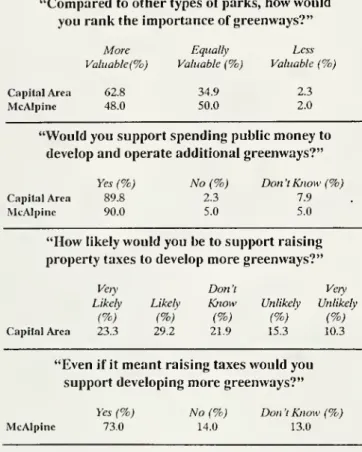
intensethananticipated.When
respondentswere
asked toranktheimportance of greenwaysagainstothertypesofparks,greenwayswere
perceivedmore
valuablebyamajorityofthe Raleigh pa-tronsand
slightly less than a majority of the Charlotte patrons(seeTable7). Clearly,greenway
usersfindthesefacilitiesbetter suited totheirrecreationalneeds than
Table7. Patrons' Attitudes
Toward
LocalGreenways
"Compared
toothertypes of parks,how
would
you
rank
theimportanceofgreenways?"CapitalArea
McAlpinc
More
Valuable(%)
62.8 48.0
Equally Valuable{%)
34.9 50.0
Less Valuable(%)
2.3 2.0
"Would
you
supportspendingpublicmoney
todevelop
and
operateadditionalgreenways?"
CapitalArea
McAlpine
Yes(%)
89.8 90.0
>{%) Don'tKnow(%)
2.3 7.9
5.0 5.0
"How
likelywould you
betosupportraisingpropertytaxestodevelop
more
greenways?"
Very Don't Very
Likely Likely Know Unlikely Unlikely
(%) (%) (%) (%) (%)
CapitalArea 23.3 29.2 21.9 15.3 10.3
"Even
ifitmeant
raisingtaxeswould you
support developing
more
greenways?"
McAlpine
Yes(%) 73.0
No
(%)14.0
Don'tKnow(%)
13.0
A
willingness to spend public funds, or even increasetaxes to
expand
greenways,would
indicate adeeper supportnot
measured
bythefirstgeneral question.When
queried aboutincreased public spending,roughly90 percentof the patronsrespondedaffirmatively.But
ifincreasedgreenway
spending
were
translated into higher taxes, the surveyshowed
thattheamount
ofsupportwould
drop.Never-theless, a majorityofthe users, 73 percent in Charlotte
and
52.5percent inRaleigh, indicatedsupportforgreen-way
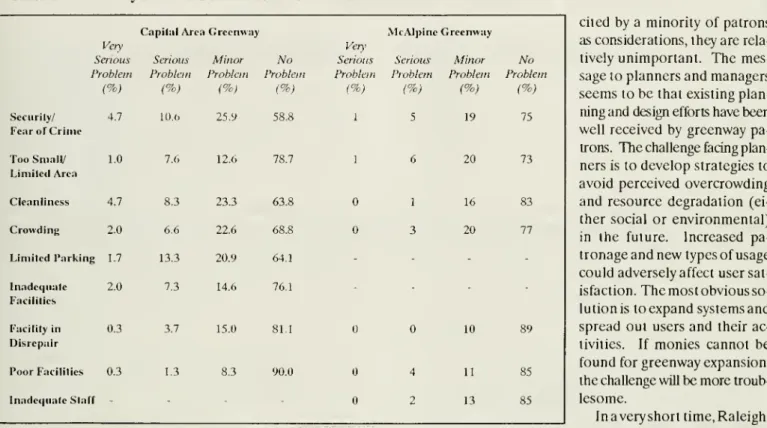
expansioneven withhighertaxes.Patron support
and
satisfactionwith their greenways was also evidentwhen
respondentswere
asked about greenway problems(seeTable8).The
surveylisted sev-eralpotentialproblems
and
asked respondents toindi-cate
whether
eachproblem was
"very serious," "serious,""minor"
or"no
problem."The
set of problemswas
compiledinconjunction withthe
North
CarolinaGreen-ways Conference Organizing
Committee
tocoverawide range ofuserconcerns.A
reviewofthesesurveyresultsshowsthatmost Raleigh and Charlottegreenway
users indicated very few prob-lems withtheirfacilities.No
more
thanseven percentof theMcAlpine
users orfifteenpercent ofthe CapitalArea
usersclassified anyproblem
as"serious"and
"veryseri-ous."
On
everyissueamajority of therespondentsindi-cated
"no
problem." This perceptionwas
completely unexpected.Based
on
ourdiscussionswithgreenway
planners,we
had
expectedtofindthat"securityorfearofcrime"would
beawidespreaduserconcern, butitprovedtobe
much
lessof a
problem
thananticipated.Among
CapitalArea
Green-way
users,58.8percent describeditas"no
problem," while 75 percent ofMcAlpine
users described securityas"no
problem."
Moreover,
among
thosesurveyedwho
didindi-cate aconcernabout crime orsecurity,
most
consideredittobea
minor
issue.Greenway
cleanliness,parking limitations,and
crowd-ing
were
somewhat
problematicamong
Raleighpatrons,while arealimitationscausing overuse
and
crowdingwere
issues
among
Charlotteans. Inbothcommunities
itseems
that
greenway
usershavesome
anxietyabout approachinggreenway
carryingcapacity.Some
ofthisconcernmay
havebeen
reflected inthe earlierdiscussions about providingpublic
money
toexpand
thegreenways.The
qualityof greenwaysand
theirconditionwere minor
issues toour respondents. In linewithearlierfindings,
poor
facilities,
maintenance problems
and
insufficient staffingwere
rarelyconsideredproblems
tothesurveyparticipants.Conclusions
The
surveyresults indicate that Raleighand
Charlottegreenway
usersare heavilydrawn from
surroundingneigh-borhoods
or communities.There
isa cleardistance-decay function associatedwithvisitation,withthelargestnumber
ofvisitors living close to thegreenway where
theywere
surveyed
and
thenumber
ofvisitorsdecliningashome-to-greenway
distance increased.The
service radius inbothcities
was
approximatelyfivemiles.The
notionthatindi-vidualgreenways or
greenway
segmentsact asTable8.
Greenway
Patrons'Problems
And
Concerns
Very Serious Problem
(%)
CapitalArea
Serious Problem
(%)
Greenway
Minor
Problem
(%)
No
Problem
(%)
Ver)>
Serious Problem
<%)
McAlpine
Serious Problem
(%)
Greenway
Minor
Problem
(%)
No
Problem
(%)
Security/ FearofCrime
4.7 io.o 25.9 58.8 1 5 19 75
TooSmall/ LimitedArea
1.0 7.6 12.6 78.7 1 6 20 73
Cleanliness 4.7 8.3 23.3 63.8 1 16 83
Crowding 2.0 6.6 22.6 68.8 3 20 77
LimitedParking 1.7 13.3 20.9 64.1 - - -
-Inadequate Facilities
2.0 7.3 14.6 76.1 - - -
-Facility in Disrepair
0.3 3.7 15.0 81.1 10 89
PoorFacilities 0.3 1.3 8.3 90.0 4 11 85
InadequateSlaIT - - - 2 13 85
widerecreational resources isnotsupported by ourdata. Similarly,thestudysites
were
patronized byaparticularsubpopulationof the local area.
These
visitors used thefacility intensively for selected types of activities.
The
profileof theaveragegreenway
userwas
ayoung
tomiddle-aged,white
upper
middleclass person. Seniors,however, usedthegreenwaysmost
frequently.While
both greenways offered a variety of potential recreationand
transportation opportunities,most
of those surveyedlimitedthemselvestowalkingand
biking.For
ourrespondents, greenways providea recreational niche de-signedfortheseforms ofexercise.
One
lessonforplanners andmanagers
may
be toeitheraccept the currentpercep-tions
and
designand
operatetheirgreenwaysaccordingly,or, alternatively, to
market
thegreenway
as a broaderpublic resource.
The
latter optionwould
require greaterefforts tostructure
new
programs and
activitieswhich
are not pedestrian- or bike-related,to attractotheruserpopu-lations.
The
use ofgreenwaysasviable transportationmodes
for intra-cityadulttravelhas also notdevelopedinRaleigh. Itisimportanttorecognizethatifgreenwaysaretofunction
astransportationelements, thengreaterattentionneedsto
begiventointegrating
them
intotransportation planning programs.Finally,oursurveys indicated that theexisting
greenway
user isaverycontented patron,withstrongpolitical sup-portforgreenwaysand greenway
expansion.For
patronsthereis
no
single issuewhichrepresents asignificantprob-lem.
Although
crimeand
carrying capacity questions arecited bya minority of patrons
asconsiderations,they are rela-tivelyunimportant.
The
mes-sagetoplannersand managers
seems
tobe thatexisting plan-ninganddesigneffortshavebeenwell received by
greenway
pa-trons.
The
challengefacingplan-nersistodevelopstrategies to
avoid perceived overcrowding
and
resource degradation(ei-ther social orenvironmental)
in the future. Increased
pa-tronage
and
new
typesofusage couldadverselyaffectuser sat-isfaction.The
most
obviousso-lutionisto
expand
systemsand
spread out users
and
their ac-tivities. Ifmonies
cannot be foundforgreenway
expansion,thechallengewillbe
more
troub-lesome.
In avery short time, Raleigh, Charlotte,
and
othercommu-nitieshave
made enormous
progress reviving thegreenway
concept
and implementing community-wide greenway
sys-tems.Their accomplishments,asindicatedby ourresearch,
have
been
impressive.As more
communities
acrossNorth
Carolinainitiate
new
greenway
programs,theycanlearna great dealfrom
the experiences ofthe CapitalArea and
McAlpine
Greenways. oReferences
Flournoy,Jr.W.L. 1982."Capital CityGreenway:
A
Reporttothe City Councilonthe Benefits,Potential,andMethodologyof Establishing aGreenwaySysteminRaleigh,"RaleighCityCouncil, Raleigh,NC.Flournoy, Jr., W.L. 1989. "ANonlinearApproach toOpen Space," Carolina Planning, Vol.15,No.1: 50-54.
Hanson, S.andP. Hanson. 1981. "The Impactof Married Woman's
EmploymentonHouseholdTravel Patterns:
A
Swedish Example," Transportation,Vol.10: 165-183.Knack,R.andR. Searns. 1990."ThePathsLessTraveled," Planning, Vol. 56: 6-10.
Kusler,J.andA.Southworth. 1988. "Greenways: An Introduction," National WetlandsNewsletter,Vol.10: 2-3.
Little,C.E. 1987. "LinkingCountrysideandCity: TheUsesof Green-ways,"JournalofSoilandWaterConservation,Vol.42: 167-169. Mecklenburg County Parks and Recreation Department, 1987.
Meck-lenburgCountyGreenwayMasterPlan, Charlotte,NC.
Pas, E.I. 1984. "TheEffectsof SelectedSociodemographic
Characteris-ticsonDaily Travel-Activity Behavior," EnvironmentandPlanning A, Vol.16: 571-581.
Rotolo, B. 1981. 22-25.