IJIRT 143228 INTERNATIONAL JOURNAL OF INNOVATIVE RESEARCH IN TECHNOLOGY 796
Performance Analysis of a Robust Blind Digital Image
Watermarking Using DWT and Twin Encoding
Methodology
ShubhangiPande1, Santosh Varshney2, Dr. M. K. Ravat3 1
M.Tech Student, Lakshmi Narain College of Technology, Indore
2
Professor, Lakshmi Narain College of Technology, Indore
3
Head of Department, Lakshmi Narain College of Technology, Indore
Abstract- Digital watermarking is the process of hiding information which is used to hide proprietary information in digital media like image, video, audio. In digital watermarking the wavelet based transformation scheme is an effective in image analyzing and processing. Digital watermarking emerged as a solution for protecting the multimedia data. In the previous paper [1], on the one side, consider a watermarking technique by Joint DWT-DCT methodology. These 2 combined frequency domain method eliminate the downside of each one and in the opposite of this, a blind digital image watermarking based on DWT and twin encoding methodology. In Proposed paper, we will improve the value of PSNR as compare to the previous paper.
Index Terms- Digital Image Watermarking, DWT, DCT, Arnold Transformation, Chaos Transformation, etc.
I. INTRODUCTION
Digital image watermarking technique can be divided into two main subsystems but complimentary to each other system: embedding subsystem and extracting subsystem. The embedding subsystem, the watermark is hidden in the original image to obtain watermarked, and to measure imperceptibility. In extracting subsystem, the output of embedding subsystems act as an input image, and the watermark is the extracted, and to measure robustness. Researchers in the field of digital watermarking image search on effective techniques provide two properties: imperceptibility (watermark not noticeable by viewer), and robustness against. The watermark algorithm can be divided into two types according to whether the original image is
required to extract the watermark technique: blind and non-blind. Blind algorithm does not need the original image in extraction. The watermark is a signal embedded into the host media to be protected, such as an image or video and audio, etc.
It contains useful certifiable information for the owner of the host media, such as producer's name, company logo, and other, the watermark can be detected or extracted later to make an assertion about the host media. For this aim, digital watermarking schemes are developing and their number is growing, the searching all for the equilibrium between three criteria of technique: data hiding capacity, imperceptibility, and robustness, depending on the image domain representation. The choice of a domain lies mainly on robustness criteria required relating to specific data manipulations or malicious attacks. For these domains, the spatial presentation is robust against geometrical attacks. On the other hand, its restrictions dissuades its use since of the poor capacity of data embedding with respect to the imperceptibility condition. In order to further performance improvements in discrete wavelet transform (DWT) based digital image watermarking algorithms could be obtained by jointing DWT with Discrete wavelet transform.
II. DIGITAL WATERMARKING TECHNIQUES
The Digital watermarking techniques are categorized into two different domains: pixel domain or spatial domain and transform domain or frequency domain.
IJIRT 143228 INTERNATIONAL JOURNAL OF INNOVATIVE RESEARCH IN TECHNOLOGY 797
image/video. The foremost advantages of pixel based scheme are that they are conceptually simple having very low computational intricacies. These methods are, therefore, it is commonly used in video watermarking process where the prime concern is real-time performance. The resulting watermark may or may not be perceptible, depending upon the intensity value. For example picture cropping, commonly used by image editors, can be used to remove the watermark. Some methods of watermarking in spatial domains are: Correlation based techniques: In this schemes, the watermark data W(x, y) is added to the original content O(x, y) according to the equation (1).
(1)
In equation (1), k is a gain factor and Ow is the watermarked content. As we increase the value k, will expense the quality of watermarked contents.
Least Significant Bit Modification
Least Significant Bit modification is the simplest technique of this domain. In this method, the watermark process is just embedded process into the least significant bits of the original video or flips the LSB. Though it is the most popular technique due to its simplicity, then but has some limitations like incompetence in dealing with a range of attacks, poor quality of the produced video and least robustness and lack of imperceptibility.
Watermark characteristics
Robustness technique: The embedded watermarks should not be removed or eliminated by unauthorized distributors using common processing techniques including; the compression, filtering, cropping, quantization and others.
Imperceptibility: The watermark scheme must not degrade the image or multimedia file but also retains in the file so that it must be invisible, until and unless required to be visible.
Security: The watermarking method should be in such a way that it uses some private key or encryption with keys.
Adjustability: The algorithm should be tunable to various degrees of robustness, quality, or embedding capacities to be suitable for diverse applications.
Real-time processing: Watermarks should be rapidly embedded into the host signals without much delay.
Watermark embedding process:
Spatial Domain: The spatial-domain watermark insertion manipulates image pixels. The spatial-domain watermark insertion is simple and easy to implement, it is weak against various attacks and noise.
Transform domain: Transform-domain watermark insertion is based on the transform coefficients of cover image. It is more robust against attacks. In Discrete Cosine Transform (DCT), Discrete Wavelet Transform (DWT), and Discrete Fourier Transform are three popular methods in transform domain.
III. WAVELET TRANSFORM
IJIRT 143228 INTERNATIONAL JOURNAL OF INNOVATIVE RESEARCH IN TECHNOLOGY 798 Fig. 1 Wavelet decomposition sequence (a) Original
Image (b) Wavelet transform and decimation in column (c) Wavelet transform and decimation in
row
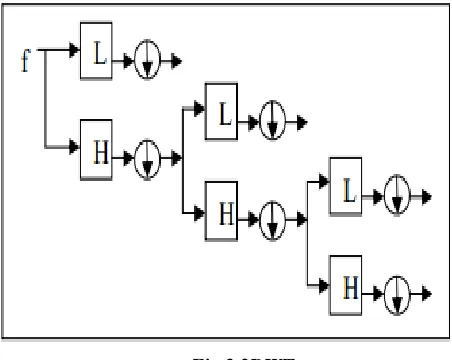
The LL will called as approximation of image and it contrail the low frequency image information. Due to our limited resolution ability for high frequency image and data this will contain almost information about the image. This high frequency contain HH, LH, and HL are used to de-noised the image
The wavelet transform is based on signal processing and developed from the Fourier transform. The wavelet transform is expressed as a series of functions which are related with every other through translation and simple scaling. The original WT function is called mother wavelet and is employed for generating all basis functions. A set of functions is constructed by scaling and shifting the mother wavelet transform .
(2)
The original signal can be reconstructed by an appropriate integration; this is performed after projecting the given signal on a continuous family of frequency band. The continuous wavelet transform of a signal x(t) is given by:
(3)
Where the superscript * is the complex conjugate and ∗a,b represents in a translated and
scaled complex conjugated mother wavelet. The mother wavelet transform is invertible when it verifies the condition of admissibility which is stated as:
(4)
Many wavelets are used for computing the wavelet transform and Morlet is one of them. It is expressed as following:
(5)
Where fb and fc are respectively a bandwidth parameter and a wavelet center frequency.
Fig.2 2DWT
IV. ARNOLD’S TRANSFORM
Arnold's Cat Map is a transformation that can be applied to an image. Pixels of the image appear to be randomly rearranged, however when the transformation is repeated enough times, the original image will reappear. Digital square image, the discrete Arnold mapping can be achieve by using following equation.
IJIRT 143228 INTERNATIONAL JOURNAL OF INNOVATIVE RESEARCH IN TECHNOLOGY 799
V. CHAOS TRANSFORM
Chaos-based image encryption techniques are very useful for protecting the contents of digital videos and image. The complex structure of the traditional block ciphers makes them unsuitable for real-time encryption of digital images and videos. Real-time applications require fast algorithms with acceptable security strengths. The chaos-based image encryption system based on logistic map, in the framework of stream cipher architecture, is proposed. In this provides an efficient and secure way for image encryption and transmission. The chaotic functions are like noise signals but they are completely certain, that is if we have the primary quantities and the drawn function, the exact amount will be reproduced. The advantages of these signals will be as follows:
1) The sensitivity to the primary conditions. 2) The Deterministic work.
3) The apparently accidental feature. The equation (6) shows one of the most famous signals which has chaotic features and is known as the logistic map signal.
(6)
In which the Cn will get the number between [0, 1]. The signals shows three different features in three different range based on the division of the r parameter of which the signal features will be as well by considering the C0=0.3
VI. ATTACKS ON DIGITAL WATERMARKING
There are various possible malicious intentional or unintentional attacks that a watermarked matter. In the accessibility of wide range of image processing soft ware’s made it possible to achieve attacks on the robustness of the watermarking technique. The aim of these attacks is foil the watermark from performing its intended purpose scheme. A brief introduction to various types of watermarking attacks is follows.
Removal Attack
In this attacks mean to remove the watermark data from the watermarked object.
Geometric attack
All manipulations that distress the geometry of the image such as flipping, cropping, rotation, etc. should be detectable.
Protocol Attack
In this attacks do neither mean at destroying the embedded information nor at disabling the detection of the embedded information.
Cryptographic attacks
It is deal with the brilliant of the security.
VII. PSNR AND MSE
To measure the quality of reconstruction of lossy compression, PSNR is frequently used. It is the ratio of the maximum possible power of a host image to the power of corrupting noise in that affects the fidelity of its representation. It can define by the following equation:
(7)
Where MAX represents the maximum possible pixel value in the host image and MSE is shows the mean square error in embedded image.
Means square error (MSE) is measured from the host image and noisy approximation of it. MSE can be defined by the equation (8)
(8)
Where, is host image and is watermarked/embedded image. Smaller the MSE reveals better quality of image.
IJIRT 143228 INTERNATIONAL JOURNAL OF INNOVATIVE RESEARCH IN TECHNOLOGY 800
VIII. RESULTS AND DISCUSSION
Proposed Technique
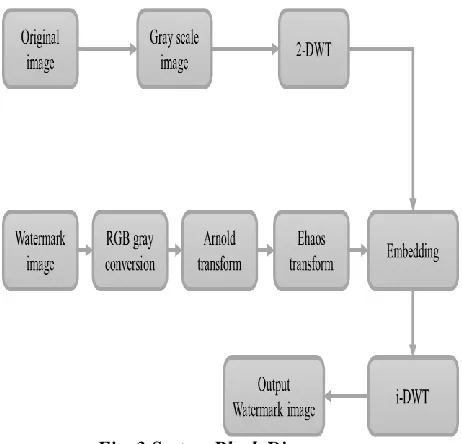
1. In proposed work we start by selecting two kinds of image one is for cover image and another is for watermark image.
2. The RGB to gray converter.
3. Here we apply 2 level DWT only on cover image. And on the watermark image, applying Arnold transform and chaos transform.
4. Now apply embedding algorithm. Embedding is performed on HL and HH coefficients of DWT. 5. Combined watermark and cover image then,
Apply Inverse level DWT.
6. Calculate PSNR & MSE value for Embedding Process.
7. The output results of watermark image.
Fig. 3 System Block Diagram
Watermarking technique with wavelet transform
Fig: 4 Cover Image
Fig:5 Watermark image
IJIRT 143228 INTERNATIONAL JOURNAL OF INNOVATIVE RESEARCH IN TECHNOLOGY 801 Fig: 6 Performance of watermark image using
Arnold transform (HL)
Fig: 7 Performance of chaos transform (HL)
Fig: 8 Watermark image after inverse DWT
Fig: 9 Performance of watermark image using Arnold transform (HH)
Fig: 10 Performance of chaos transforms (HH)
IJIRT 143228 INTERNATIONAL JOURNAL OF INNOVATIVE RESEARCH IN TECHNOLOGY 802
IMAGES
PREVIOUS
ALGORTHM
PROPOSED
ALGORITH
M
PSNR(dB)
MAE PSNR(d B)
MA E LENA
42.7157 0.0019 53
53.3235 0
CAMERM AN
42.3476 0.0019 52
53.3235 0
MANDRIL L
43.5883 0.0019 54
53.3235 0
Table: 1 Comparison of Previous and Proposed Algorithm.
IX. CONCLUSION
Digital image watermarking focuses on utilizing Discrete Wavelet Transform due to its excellent spatial-frequency localization and multi-resolution properties. Discrete Wavelet Transform (DWT) has been applied efficiently and successfully in many digital image watermarking systems. In this paper, we introduce a new efficient algorithm of digital image watermarking based on combination between Arnold and chaos transform. Watermarking was done by embedding the watermark in the two level-DWT of original image. The combination improves the system performance. The improve PSNR and, robustness since it produced better robust against Gaussian noise attack.
REFERENCES
[1] Poonam H. Mahajan, Pramod B. Bhalerao, “A Blind Digital Image Watermarking using Joint DCT-DWT and Twin Encoding Methodology”, International Journal of Innovative Technology and Exploring Engineering (IJITEE), Volume-4 Issue-6, November 2014.
[2] Nidal F. Shilbayeh, BelalAbuHaija, "Combined DWT-CT Blind Digital Image Watermarking Algorithm", International Scholarly and Scientific Research & Innovation 7(6) 2013. [3] Surya Pratap Singh, “A Robust Watermarking
Approach using DCT-DWT”, International Journal of Emerging Technology and Advanced Engineering, Volume 2, Issue 8, August 2012. [4] Gursharanjeet Singh Kalra, Dr. Rajneesh Talwar,
Robust Blind Digital Image Watermarking Using DWT and Dual Encryption Technique, Third International Conference on Computational Intelligence, 2011,
[5] Saeed K. Amirgholipour , Ahmad R. Naghsh-Nilchi, Robust Digital Image Watermarking Based on Joint DWT-DCT, Computer Engineering Dept, Isfahan University, IRAN, 2009,