VOLUME 9 | ISSUE 1 | 2014 | 1
Resistance exercise load reduction and
exercise-induced micro-damage
JAQUELINE S SILVA 1, ALEXANDER J KOCH 2, JOSEANE C MEDEIROS 1, MICHELE LAIA DA SILVA 1,
MARCO MACHADO1,3
1 Laboratory of Physiology and Bioknetics, Universidade Iguaçu Campus V, Itaperuna, RJ, Brazil 2 Exercise Physiology Laboratory, Lenoir-Rhyne University, Hickory, NC, USA
3 Laboratory of Human Movement Studies, Universitary Foundation of Itaperuna (FUNITA), Itaperuna, RJ, Brazil
ABSTRACT
Silva, J.S., Koch, A.J., Medeiros, J.C., Da Silva M.L., & Machado, M. (2014). Resistance exercise load reduction and exercise-induced micro-damage. J. Hum. Sport Exerc., 9(1), pp.1-6. High volumes of resistance exercise increase muscle hypertrophy, independent of the extent of muscle damage. We compared volume load and markers of muscle damage after resistance exercise using two load reduction strategies versus a constant intensity. Methods: Twenty-seven trained men (age = 23.4±3.5 years, body mass = 74.5±10.7 Kg, height = 174±8 cm, 10 RM = 211±40 Kg) completed one weekly bout of 4 sets of leg press exercise under three loading schemes in a randomized, counterbalanced order over a three-week period. The loading schemes were (a) constant load for all sets (CON), (b) 5% load reduction after each set (LR5), and (c) 10% load reduction after each set (LR10). Volume load, muscle soreness (SOR), and range of motion (ROM) at the knee were assessed after each bout. Results: Volume load was significantly different amongst all conditions (CON = 6799±1583 Kg; LR5 = 8753±1789 Kg; 10896±2262 Kg; F= 31,731; p<0.001). ROM and SOR were significantly different among conditions, with LR5 and LR10 producing greater preservations of ROM (p =<0.001) and less SOR (p < 0.001). These data may support the use of load reductions when training for hypertrophy. Key words: RESISTANCE TRAINING, EXERCISE-INDUCED MUSCLE-DAMAGE, RANGE OF MOTION, PAIN
1Corresponding author. Laboratory of Human Movement Studies. Universitary Foundation of Itaperuna (FUNITA)
R Luis Carlos Ferreira Tirado, 148. Itaperuna, Rio de Janeiro. CEP 28.300-000. Phone number: +55 22 3824-4040
Email: [email protected] Submitted for publication December 2012 Accepted for publication December 2013
JOURNAL OF HUMAN SPORT & EXERCISE ISSN 1988-5202 © Faculty of Education. University of Alicante
2 | 2014 | ISSUE 1 | VOLUME 9 © 2014 University of Alicante INTRODUCTION
Resistance exercise consisting of multiple sets with maximum repetitions (to voluntary exhaustion) combined with short rest intervals between sets (60 to 120 seconds) has been used by body builders in an attempt to optimize skeletal muscle hypertrophy (Hackett et al., 2012). This strategy is very stressful, and if a constant intensity is maintained throughout successive sets, inevitably leads volume load (sets*repetition*load) reduction in the face of accumulated fatigue.
Willardson et al. (2010, 2012) proposed employing progressive load reductions to maintain maximum repetitions of 10 (10RM) for maintenance high total volume. Briefly, he found that decreasing intensity by 15% on each successive set allowed for the maintenance of ~10RM effort in untrained men (Willardson et al., 2010), while load reductions of 10% maintained ~10RM performances in trained women (Willardson et al., 2012). In both studies, maintaining a constant intensity resulted in a decreased volume load. A higher volume load completed has been related to greater gains in skeletal muscle hypertrophy (Rhea et al., 2003; Schoenfeld, 2012). In contrast, indirect markers of muscle damage have not been related to gains in hypertrophy (Brentano & Kruel, 2011; Schoenfeld, 2012).
Thus, we hypothesize that a load reduction scheme that leads to higher volume with lower exercise-induced muscle damage (EIMD) markers alterations would be most advantageous to muscle hypertrophy. The aim of this work is to compare volume load, range of motion and perceived muscle pain and soreness after resistance exercise with and without load reduction.
METHODS
Subjects
Twenty seven men (age = 23.4±3.5 years, body mass = 74.5±10.7 Kg, height = 174±8 cm, 10 RM = 211±40 Kg) with least two years of recreational resistance training experience participated in the current study. Subjects’ training history included: a minimum frequency of 3 d•wk-1; 60min•session-1; 3-5 sets•exercise-1; 6-15 repetitions• set-1; experience with performing leg presses, training to failure; and resting 60-120s between sets. Subjects did not use drugs or nutritional supplements that could affect repetitions performance least six months; b) were free of bone, joint or muscular problems that could limit the effective execution of leg press exercise; c) did not perform any extraneous exercise during the study. All participants read and signed an informed consent to the testing procedures; the experimental procedures were approved by local ethics committee.
Procedures
Subjects completed one exercise bout per week for four weeks at a consistent day and time. A supervisor monitored each session to ensure proper technique, provide spotting and verbal encouragement. Week 1 was the preparatory period, during which 10RM loads were established for the Leg Press according to previously published procedures (Kraemer & Fry, 1995). The 10RM was assessed 2 times with 72 hours between tests (ICC = 0.988). Before the 10RM tests, each subject completed 5 minutes of low-intensity jogging/walking. Two warm-up sets preceded testing of each exercise at 50% of the perceived 10RM load for 10 repetitions each.
VOLUME 9 | ISSUE 1 | 2014 | 3 (CON), (b) 5% load reduction after each set (LR5), and (c) 10% load reduction after each set (LR10). The conditions were randomized and counter-balanced to control for order effects.
Each session began with 5 minutes of low-intensity jogging/walking followed by two sets of 15 leg presses to 50% off the predetermined 10 RM. Three minutes after the warm-up sets, 4 consecutive sets were performed to the point of voluntary exhaustion (i.e., full repetition maximums). Subjects were allowed 60s of rest between sets. Rest intervals were controlled with a handheld stopwatch.
Before, immediately after and 24-96 hours after each exercise session subjects were measured for right knee range of motion (ROM) and quadriceps perceived muscle soreness (SOR). Right knee ROM and quadriceps SOR were assessed according to previously published procedures (Cook et al, 1997).
Statistical analysis
Sample size was calculated using previously reported differences in ROM and SOR (Machado et al 2012). We calculated that 27 subjects were needed to detect associations with 2-tailed α = 0.05 and 1-β = 0.90. Repetitions per set were assessed with a two-way mixed model analysis of variance (4 sets x 3 load conditions) with repeated measures. Total volume was assessed with a one-way analysis of variance. ROM and SOR were assessed with a two-way mixed model analysis of variance (6 measures x 3 load conditions) with repeated measures. Multiple comparisons were made according to Bonferroni’s method with a significance level of p < 0.05. Statistical analysis was completed using SPSS® 17.0 for Windows (LEAD Technologies).
RESULTS
We found differences in repetitions among three conditions (F2,52 = 277.678; p<0.001; 1-β = 1.000) and between four sets (F3,78 = 63.810; p<0.001; 1-β = 1.000). Interactions between conditions and sets display significant differences (F6,156 = 229.906; p<0.001; 1-β = 1.000). Repetitions per set were significantly reduced under CON (10±1; 8±1; 7±1; 6±1 repetitions, p < 0.001). LR5 (10±1; 9±1; 11±1; 12±0 repetitions) and LR10 (10±1; 12±1; 13±1±15±1 repetitions) led to increased performance of repetitions per set. Total volume load was significantly different among conditions (CON = 6799±1583 Kg; LR5 = 8753±1789 Kg; 10896±2262 Kg; F= 31,731; p<0.001). Bonferroni´s post hoc test display significant differences between all conditions (p<0.05).
4 | 2014 | ISSUE 1 | VOLUME 9 © 2014 University of Alicante
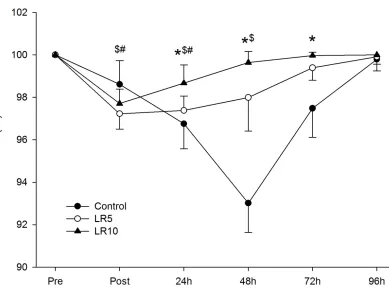
Figure 1. Normalized changes in range of motion (means ±SD) from the baseline (Pre) and for 4 days
following the Leg Press exercise session for each condition. Control (without load reduction), LR5 (with 5% load reduction for each set), and LR10 (with 10% load reduction for each set)
(*) Difference from PRE in Control (p<0,01); ($) Difference from PRE in LR5 (p<0,01); (#) Difference from PRE in LR10 (p<0,01)
VOLUME 9 | ISSUE 1 | 2014 | 5
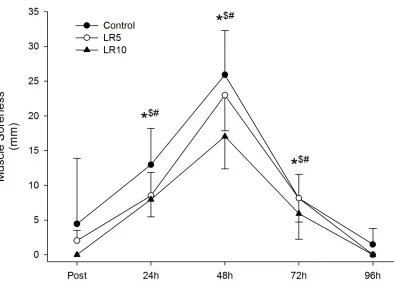
Figure 2. Changes in muscle soreness (means ±SD) from post and for 4 days following the Leg Press
exercise session for each condition. Control (without load reduction), LR5 (with 5% load reduction for each set), and LR10 (with 10% load reduction for each set)
(*) Difference from PRE in Control (p<0,01); ($) Difference from PRE in LR5 (p<0,01); (#) Difference from PRE in LR10 (p<0,01)
DISCUSSION
LR5 and LR10 schemes produced a greater total volume than CON. These results were consistent with prior studies that examined exercises with a constant load versus load reduction (Willardson et al. 2010; 2012). In addition, despite a higher volume load, indirect muscle damage markers were significantly lower in both LR schemes than control.
Schoenfeld (2012) and Brentano & Kruel (2011) reviewed the relationship between muscle damage and skeletal muscle hypertrophy. Briefly, Schoenfeld (2012) concludes that “moderate” levels of exercise-induced muscle damage (EIMD) would be most appropriate for maximizing hypertrophy, while excessive damage would merely impair the individual’s ability to train. Brentano & Kruel (2011) concluded that EIMD is not a prerequisite for inducing hypertrophy. Thus, we speculate that higher volume with lowest EIMD discomfort following load reduction may be a better prescription scheme for inducing skeletal muscle hypertrophy.
6 | 2014 | ISSUE 1 | VOLUME 9 © 2014 University of Alicante REFERENCES
1. Brentano, M.A., & Kruel, L.F.M. (2011). A review on strength exercise-induced muscle damage: applications, adaptation mechanisms and limitations. J Sports Med Phys Fitness, 51, pp.1-10. 2. Chen, T.C., Nosaka, K., & Sacco P. (2007). Intensity of eccentric exercise, shift of optimum angle,
and the magnitude of repeated-bout effect. J Appl Physiol, 102, pp.992-999.
3. Cook, D.B., O’Connor, P.J., Eubanks, S.A., Smith, J.C., & Lee, M. (1997). Naturally occurring muscle pain during exercise: assessment and experimental evidence. Med Sci Sports Exerc, 29, pp.999-1012.
4. Hackett, D.A., Johnson, N.A., & Chow, C.M. (2012). Training Practices and Ergogenic Aids used by Male Bodybuilders. J Strength Cond Res, Publish Ahead of Print.
5. Kraemer, W.J., & Fry, A.C. (1995). Strength Testing: Development and evaluation of methodology. In P. Maud & C. Foster (Eds.), Physiological Assessment of Human Fitness (pp.115-138). Champaign, IL: Human Kinetics.
6. Machado, M., Pereira, R., & Willardson, J.M. (2012). Short intervals between sets and individuality of muscle damage response. J Strength Cond Res, 26, pp.2946-2952.
7. Rhea, M.R., Alvar, B.A., Burkett, L.N., & Ball, S.D. (2003). A Meta-Analysis to Determine the Dose Response for Strength Development. Med Sci Sports Exerc, 35, pp.456-464.
8. Schoenfeld, B. (2012). Does exercise-induced muscle damage play a role in skeletal muscle hypertrophy? J Strength Cond Res, 26, pp.1441-1453.
9. Willardson, J.M., Simão, R., & Fontana, F.E. (2012). The effect of load reductions on repetition performance for commonly performed multi-joint resistance exercises. J Strength Cond Res, 26, pp.2939-2945.