ISSN (Online) 2249-6084 (Print) 2250-1029
International Journal of Pharmaceutical and
Phytopharmacological Research (eIJPPR)
[Impact Factor – 0.852]
Journal Homepage: www.eijppr.com
Research Article
Comparative Evaluation of Viability of Encapsulated
Lactobacillus casei
Using
Two Different Methods of Microencapsulation
Tanja Petreska Ivanovska
1*, Katarina Smilkov
2, Zoran Zhivikj
1, Lidija Petrushevska – Tozi
1, Kristina Mladenovska
1 1 Ss. Cyril and Methodius University of Skopje, Faculty of Pharmacy, Mother Theresa 47, 1000 Skopje, Republic of Macedonia.2 University Goce Delcev Faculty of Medical Sciences, Krste Misirkov bb, 2000 Stip, Republic of Macedonia.
Article info
Article History: Received 11 March 2014 Accepted 04 July 2014
Keywords:
Lactobacillus casei, Microencapsulation, Spray- drying, Emulsion, Synbiotic microparticles, Probiotic microparticles.
Abstract
Microencapsulation using two different methods, spray-drying and emulsion technique were applied to preserve the viability of the probiotic Lactobacillus casei during manufacture and refrigerated storage. As coating materials to encapsulate the probiotic by spray-drying method, compatible biopolymers alginate and chitosan were utilized, while as a cross-linking agent, CaCl2 was used. In addition to the probiotic, oligofructose enriched inulin (Synergy 1®) as prebiotic was added to the medium intended for spray-drying. For microencapsulation of the probiotic by emulsion method, alginate and whey proteins were applied. Further, protective effects of four potential cryoprotectants (oligofructose enriched inulin, sorbitol, sucrose, lactose) were investigated when added to the whey proteins-Ca-alginate microparticles before freeze-drying. Experiments showed that chitosan- Ca-alginate microparticles and whey protein-Ca-alginate microparticles with high viability of L. casei were obtained using spray-drying and emulsion method, respectively. Lactobacillus casei encapsulated by emulsion method survived better during 6-months storage at refrigerated conditions than L. casei encapsulated by spray- drying. Cryoprotectants have no additional effect on the cells survival during freeze-drying, while sorbitol has shown negative impact on the probiotic viability encapsulated in whey protein-alginate and subsequently freeze-dried. No significant differences in viability of L. casei during storage at refrigerated conditions were observed, both in whey proteins-Ca-alginate microparticles as control and formulations containing cryoprotective agent.
1. INTRODUCTION
Beneficial health properties of probiotics, prebiotics and other functional compounds strengthened the production, the offer and requirement of functional food products and/or pharmaceuticals worldwide. The efficacy of the administered functional products containing probiotic bacteria largely depends on the viability of the cells and their release in the lower intestine in sufficient number. Different techniques of microencapsulation have been used as a potential tool to enhance the viability of probiotics and to control release of these cells across the intestinal tract1,8
. It is important the encapsulation method applied does not reduce viability of the cells and does not inhibit their activity which includes resistance of the cells to gastrointestinal environment and their ability to adhere to intestinal mucosa.
Spray-drying is a method of microencapsulation where an aqueous solution containing the sensitive active core material and solution of wall material are atomized into hot air. The production of stable microparticles with low diameters and homogenous size distribution can be considered as advantage of the spray-drying method in comparison to extrusion or emulsion methods3,4,10-17
. The main disadvantage of spray-drying technique is viability loss resulting from simultaneous dehydration and thermal inactivation of probiotic cells during the process5,18-25
. Emulsion technique does not involve severe conditions, both in terms of temperature and solvents used, while has the benefit of producing very small (< 100 µm) microparticles6,7,26-31
. Examples of biomaterials often applied to encapsulate bacterial cells include alginate, gelatin, chitosan, carrageenan, whey proteins, cellulose acetate phthalate, acacia
*Corresponding Author:
Tanja Petreska Ivanovska,
Ss. Cyril and Methodius University of Skopje, Faculty of Pharmacy, Mother Theresa 47, 1000 Skopje, Republic of Macedonia
Email: [email protected]
gum, gellan and xanthan gum and starches1,2, 32-35
. Alginate beads are sensitive to the acidic environment, while cellulose acetate phthalate and mixture of gellan-xanthan are not soluble at acidic pH and enable high resistance towards acid conditions. Amphoteric nature of gelatin and whey protein allows favorable interaction with anionic polysaccharides when the pH is adjusted below the isoelectric point of the protein component thus the net charge of the protein becomes positive8,36-40
. The behavior of the proteins below their isoelectric point encourages cooperation between proteins and polysaccharides in terms of higher survival rate of probiotics during processing and after consumption. Due to certain advantages and disadvantages of an applied method of encapsulation and coating agents, it is important to compare different biomaterials and encapsulation methods using the same probiotic strain.
Lactobacillus casei is an acid sensitive, rod-shaped, facultative
heterofermentative lactic acid bacterium that can be isolated from a variety of environments including raw and fermented milk and meat or plant products, as well as the oral, intestinal, and reproductive tracts of humans and animals. It is a beneficial microorganism that helps to promote other beneficial bacteria and prevents the overgrowth of pathogenic bacteria in the human body. It has been reported that it can improve and intensify digestion, control diarrhea, reduce inflammations of the gut, reduce lactose intolerance and alleviate the symptoms of constipation, all leading to better function of the immune system9,10,41-44. Recently, there has been intensive usage of this probiotic in functional food products. However, many reports indicate poor survival of the probiotic in these products and also the survival in the human gastrointestinal system is questionable11,45-57
. In our preliminary studies, 3-hour exposure to simulated gastric acid at 37°
C using a horizontal shaking water bath with 75 strikes/min (0.08 M HCl; 2 g/L NaCl; 3 g/L pepsin; pH 1.5) resulted in poor survival of L.
casei, 2.68±0.28 log cfu/g vs. 10.51+0.58 log cfu/g as initial cell
10 g/L bile salts), the viability of the probiotic decreased to 4.18±0.13 log cfu/g12,58-62
. Considering that, providing L. casei
with a physical barrier against adverse environmental conditions could significantly improve its stability thus ensuring its health effects.
The aim of this study was to evaluate the effects of coating materials and applied methods of encapsulation on the viability of probiotic strain Lactobacillus casei - 01 during preparation and storage of chitosan-Ca-alginate and whey protein-Ca-alginate microparticles. The probiotic whey protein-Ca-alginate microparticles were obtained using an emulsion method, while probiotic/synbiotic chitosan-Ca-alginate microparticles were prepared by spray-drying method. As the spray-drying method is associated with aggressive conditions of encapsulation, it is worthwhile to add prebiotic or other protective agent in the medium before drying. Thus, to improve the viability of probiotic L. casei
during preparation and storage of the chitosan-Ca-alginate microparticles, the medium for spray-drying was supplemented with oligofructose enriched inulin (Synergy 1®
) as prebiotic. Further, the viability of L. casei using different cryoprotective agents was determined and compared with L. casei loaded in whey protein-Ca- alginate microparticles as control.
2. MATERIALS AND METHODS
2.1 Microencapsulation by spray-drying
Probiotic/synbiotic chitosan-Ca-alginate microparticles were prepared by modified method of spray-drying13
that was previously successfully applied for microencapsulation of sensitive drug 5- aminosalicylic acid14,15, 63-65
. The feed suspension was prepared of carrier agent sodium alginate (4% w/w) (Protanal LF 10/60 LS, fG 35-45%, FMC BioPolymer, IMCD, Ayrshire, UK) and oligofructose enriched inulin (1.5% w/w) (Orafti® Synergy 1, Orafti-Rue L. Maréchal, Tienen, Belgium) which is the mixture of oligofructose (DP 2-8) and long-chain inulin fraction (DP 10-60). Then, overnight inoculated culture of Lactobacillus casei - 01 (Chr. Hansen, Hoersholm, Denmark) into MRS broth at 37 °C was added to alginate-prebiotic mixture. Alginate suspension enriched by prebiotic and probiotic L. casei with a cell load ca. 12 log cfu/g was infused into a spray-dryer (Büchi Mini Spray Dryer B-290, Flawil, Switzerland) at a constant air inlet temperature of 120 °C and outlet temperature at 58±3 °C. The flow rate of the spray-drying process was 6 ml/min, nozzle diameter 0.7 mm, aspirator pressure 90% and atomizer pressure 600 Nlh-1
. The dried powder samples were collected in sterile containers and then slowly added into previously prepared solution of 5% (w/w) CaCl2 (Merck, KGaA, Darmstadt, Germany) and 0.5% (w/w) chitosan (France Chitine, Marseille, France) in 1% (v/v) acetic acid under continuous stirring using a magnetic stirrer for at least 3 h at room temperature. The hardened microparticles were separated by centrifugation at 1500 x g for 10 min, washed with sterile saline solution and frozen at -20 °C. Afterwards, the microparticles were freeze-dried at 0.070 mbar and -50 °C for 24 h (FreeZone Freeze Dry System, Labconco, Kansas City, USA).
2.2 Microencapsulation by emulsion method
For the preparation of probiotic whey protein-Ca-alginate microparticles, emulsion technique adapted from Mandal et al.16 combined with subsequent coating according to the method proposed by Gbassi et al.17 was used12. Namely, aqueous suspension of sodium alginate (2.5% w/w) and L. casei (cell load
ca. 12 log cfu/g) was emulsified in olive oil (Sigma-Aldrich, St. Louis, USA) with 0.2% Tween 80 (Merck, KGaA, Darmstadt, Germany) while stirring magnetically. The emulsion droplets were hardened by quickly added CaCl2 and the mixture was allowed to stir for additional 15 min. The particles were removed from the aqueous phase by centrifuging at 1000 x g for 5 min and subsequently rinsed with sterile water until complete removal of the oil phase. Additional coating of the alginate particles was performed into 3% w/w native whey protein solution (100% Hydrolyzed whey protein isolate – ISO 100, Dymatize Nutrition, Farmers Branch, USA) by stirring at initial speed of 900 rpm to disperse the particles. After 60 min, the coated particles were separated by centrifugation at 1000 x g for 5 min, rinsed twice with sterile water, frozen at -20 °C and freeze-dried at conditions given in the previous section. Further, the cryoprotective effects of oligofructose enriched inulin, sorbitol, sucrose and lactose during freeze-drying of L. casei loaded whey protein-Ca-alginate microparticles were investigated. Thus, 1
ml of 10% (w/v) solution of tested cryoprotectants in phosphate buffered saline was mixed with 5 g of prepared microparticles before freeze-drying and cell viability determined after freeze-drying and 8-week of cold storage.
2.3 Enumeration of encapsulated L. casei
For quantitative determination of cell viability, it was necessary to release the encapsulated L. casei from the particles. Thus, one gram of particles was suspended in 9 ml phosphate buffer solution (pH 6.9) at room temperature until complete release of the probiotic cells. Measurements of viable cells in the suspensions were determined using plate-count method on selective MRS agar with incubation at 37 °C under aerobic conditions for 72 h. The average of the results obtained in triplicates was expressed as colony- forming units per gram or ml of sample (cfu/g or cfu/ml) using following equation18
:
a
=
a
n×
C
nV
Where, a is the number of colonies expressed as cfu/ml, an is the
number of colonies determined at dilution n, V is the volume of the sample in ml and Cn is reciprocic value of the dilution n. Afterwards,
results calculated in cfu/g were transformed to log cfu/g to make the reading of the paper more friendly.
RESULTS AND DISCUSSION
3.1 Viability of L. casei encapsulated by spray-drying versus emulsification
Probiotic/synbiotic chitosan-Ca-alginate microparticles using a spray-drying method and probiotic whey protein-Ca-alginate microparticles using an emulsion method with high cell rate were produced. The encapsulation efficiency of the emulsion method applied was higher (95.8±0.7%) compared with the spray-drying method, 89.5±1.2. The increased efficiency of microencapsulation of the probiotic cells using an emulsion technique is probably due to the mild conditions of the procedure applied. Herewith, the reduction of the survival rate of encapsulated probiotic cells in whey protein-Ca-alginate microparticles was lower than it was in probiotic/synbiotic loaded chitosan-Ca-alginate microparticles before freeze-drying (Table 1), although, the medium intended for spray-drying was supplemented by prebiotics as inulin and oligofructose, which may be useful for enhancing probiotic viability during spray-drying and storage19
.
Table 1: Viability of L. casei during microencapsulation; (A) using spray-drying technique, biopolymers, alginate (4% w/w) and chitosan (0.5% w/w), CaCl2 (5% w/w) as cross-linking agent and oligofructose enriched inulin as prebiotic (1.5% w/w), and (B) using emulsification, encapsulating materials, alginate (2.5% w/w) and whey protein (3% w/w), and CaCl2 (3% w/w).
Sample
Viability of L. casei in initial alginate
suspension (log cfu/g)
Viability of L. casei
before coating by chitosan/whey proteins (log cfu/g)
Viability of L. casei
after freeze-drying (log cfu/g)
A B
12.52±0.15 11.26±0.27
11.84±0.11 10.91±0.19
11.28±0.26 10.55±0.21
Spray-drying process is advantageous in view of rapidity and relatively low cost20
as well high reproducibility and suitability for industrial applications1
. However, high temperature and rapid evaporation of water during atomization of a suspension of probiotics and encapsulating agents in a drying chamber may destroy the integrity of the cell membrane provoking significant inactivation of the cells despite short residence time in the hot air drying chamber. Thus, the initial viability of L. casei in alginate suspension prepared for spray-drying was significantly higher in respect to the alginate bacterial suspension prepared to emulsifying. The concentration of sodium alginate as encapsulating agent applied in both methods used to encapsulate the probiotic L.
casei is also different in accordance with our previous
microencapsulation and in simulated gastrointestinal conditions) can be obtained when alginate at respective concentration of 4%
w/w13
and 2.5% w/w12
was applied.
3.2 Effects of protective polymers on viability of encapsulated
L. casei
Sodium alginate is often applied for encapsulation of probiotic cells due to its low cost, biocompatibility and suitability to form gels easily by selective binding of divalent ions, while properly resolve in the intestine and release entrapped cells. Alginate microparticles improved survival of L. casei NCDC-298 in simulated GI conditions and exposure to heat16
and had no negative effect on adhesion of probiotic cells to HT-29 cell line of the human epithelium21
. However, alginate particles are sensitive to acid medium and they can be easily disintegrated in the presence of monovalent ions or salts as phosphates, lactates and citrates which bond calcium ions. Additional disadvantage of alginate particles is their porous surface22
. On the other hand, the polyelectrolyte nature of alginate enables improving its properties as encapsulating agent by creating of electrostatic interaction with other polymers or by using additives to cause structural modifications of alginate23
. Physical and chemical stability of negatively charged alginate particles may be improved when they are coated with chitosan due to the structure obtained by cross-linking of opposite charged polymers where disorientation of the calcium ions is not possible, even the particles are subjected to monovalent ions or antigelling agents. Chitosan- alginate particles have more strength and possess increased resistance to environmental conditions24
. There are studies indicating that high molecular chitosan creates particles with better mucoadhesive properties25
and improves the survival of probiotic cells under gastrointestinal conditions26,27
.
The protective properties of alginate may be enhanced through combination of proteins due to various functional groups and significant number of potential interactions. Electrostatic interactions between polysaccharides and proteins produce complex structures that can be resolved or precipitated depending on the polymer properties (cationic, anionic), pH, ionic strength and ratio polysaccharide/protein8
. Physicochemical properties of the obtained microparticles (elasticity, swelling, resistance) using a combination of polysaccharide and protein mainly depend of the conditions of manufacture, thus convenient encapsulating matrix may be designed by optimizing the conditions. Whey proteins as biocompatible and biodegradable components are potential candidates to improve protective effects of alginate, especially synergizing the surface properties of whey proteins with stabilization properties of polysaccharides in water-oil-water and oil- water-oil double emulsions28
. Other studies have already shown whey protein as effective protectant of probiotic survival during exposure to simulated gastrointestinal fluids and characterize whey protein as suitable carrier of viable and active probiotic cells17,29-31
. In our study, the loss of viable cell number of encapsulated L. casei
was 0.36 log after freeze-drying of whey protein-alginate microparticles, while for chitosan-Ca-alginate microparticles it was 0.56 log. The increased survival of L. casei during freeze-drying in presence of whey protein is probably due to increased stability of proteins compared to sugars at temperature of transition of ice to liquid form32
.
3.3 Cryoprotective effects of sugars during freeze-drying of encapsulated L. casei
The study of Desmond et al.33
has showed better survival of L.
paracasei during drying when mixture of reconstituted skim milk
tested cryoprotective agents (oligofructose enriched inulin, lactose, and sucrose). Sorbitol showed lowest protection of encapsulated cells from drying injuries, although its penetrating effect as polyalcohol should be more efficient than the effect of non- penetrating substances as oligosaccharides. During storage at 4°C, there was no significant difference observed either among the tested protective agents, or in comparison to the control. The addition of protective compounds as sucrose and trehalose and prebiotics as Raftilose® (fructooligosaccharides), Hi-maize®, and Raftiline® (inulin) maintains the viability of probiotics during dehydration and storage of freeze-dried yoghurt, although the viability was not significantly lower in the samples without added protectants34
. These indicate that the tested prebiotics have no additional cryoprotective function, thus the use of prebiotics as cryoprotective agents should be further established.
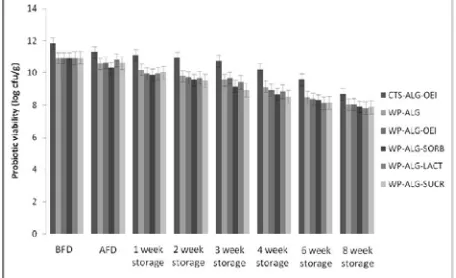
Figure 1: Viability of encapsulated L. casei during freeze-drying (BFD - before freeze-drying and AFD - after freeze-drying) and subsequent cold storage for 2 months of microparticles obtained by spray-drying method (CTS-ALG-OEI) and emulsification (WP-ALG) and whey protein-Ca-alginate particles using protective agents, oligofructose enriched inulin (WP-ALG-OEI), sorbitol (WP-ALG- SORB), lactose (WP-ALG-LACT), and sucrose (WP-ALG-SUCR). Values are presented as averages (n=3)±standard error.
3.4 Comparative viability of encapsulated L. casei during storage
In our study, to preserve the viability of L. casei using a spray- drying technique, polyelectrolyte complexation between alginate and chitosan was used, while using an emulsion technique, an electrostatic interaction between alginate and whey protein was applied. During 8-week of cold storage, the reduction of viable cell number encapsulated in synbiotic chitosan-Ca-alginate microparticles and probiotic whey protein-alginate microparticles was similar. After 3 months of storage at 4°C, the viability of L.
casei encapsulated by emulsifying method was significantly higher
(for approximately 0.8 log) with respect to the viability of L. casei
encapsulated by spray-drying, although the second method includes prebiotic during drying. This may be due to the more stressful conditions of the spray-drying process, but also owing to different properties of the encapsulating materials applied. Conjugates obtained between amino groups in proteins and the reducing-end carbonyl residues in saccharides, generally have superior surface stabilization properties, compare to their 28
components before conjugation . The high protective potential of (10%) as protein matrix and acacia gum (10%) as sugar compound
was applied. Thus, to investigate whether adding of sugars or polyhydric alcohol to proteins may increase survival of encapsulated L. casei, probiotic whey protein-alginate microparticles were supplemented by oligofructose enriched inulin, lactose, sucrose and sorbitol before freeze-drying. The experimental results of the viability of encapsulated L. casei during freeze-drying and subsequent storage at 4°C using oligofructose enriched inulin (OEI), sorbitol (SORB), lactose (LACT) and sucrose (SUCR) as protective agents, are shown in Fig. 1, with respect to the whey protein-alginate microparticles (WP-ALG) as control and chitosan-Ca-alginate microparticles loaded with L. casei and oligofructose enriched inulin (CTS-ALG-OEI). Survival of encapsulated L. casei during the freeze-drying process was similar for whey protein-alginate microparticles and for the three of the
whey proteins in a view of probiotic viability is probably due to their buffering capacity which provided good shielding for encapsulated
L. casei against harsh conditions during drying and exposure to
simulated gastrointestinal fluids.
The synbiotic microparticles manufactured using a spray-drying method and probiotic whey protein-Ca-alginate microparticles produced using an emulsion method were able to preserve the therapeutic level of viable cells within 4 months (6.9±0.24 log cfu/g) and 6 months (6.95±0.18 log cfu/g) of refrigerated storage, respectively. The polyelectrolyte complex between alginate and chitosan cross-linked with calcium ions is relatively porous, while whey proteins create strength anchorage for the cells that are embedded into the protein milieu30
processing and storage conditions presented in this study are very valuable, considering that previously published work never considered comparison of methods, using a same probiotic strain and literature is relatively poor with these type of data.
In conclusion, synbiotic chitosan-Ca-alginate microparticles and L.
casei loaded whey protein-alginate microparticles showed potential
for further implementation as functional ingredients to manufacture probiotic and/or synbiotic products with prolonged expiry date considering the proposed level of viable cells in the commercial product at the end of the shelf-life to be at least 106
cfu/g or ml in order probiotics to achieve positive effects35, 66, 68.
4. CONCLUSION
The effective preservation of the probiotic cells applying spray- drying and emulsion techniques as encapsulation methods and appropriate selection of coating materials provided the survival rate of microencapsulated L. casei in chitosan-Ca-alginate microparticles and whey protein-Ca-alginate microparticles to be above the therapeutic level within 4 and 6 months of cold storage, respectively. No further improvement in survival of encapsulated cells coated by whey protein was observed when cryoprotective agents were added to the formulation before freeze-drying.
Nevertheless, both microparticulate formulations, the synbiotic chitosan-Ca-alginate microparticles and whey protein-Ca-alginate microparticles, are potential candidates to be further used as functional ingredients in pharmaceutical and food industry.
5. ACKNOWLEDGMENTS
This research was financially supported by the Ministry of Education and Science of the Republic of Macedonia (Project No. 13-3583/1). The authors would like to express gratitude to Orafti Beneo Group and to IMCD (UK) for the donation of Orafti® Synergy 1 (L. Maréchal, Tienen, Belgium), and sodium alginate (Protanal 10/60 LS, FMC BioPolymer, USA), respectively.
REFERENCES
1. Burgain J, Gaiani C, et al “Encapsulation of probiotic living cells: From laboratory scale to industrial applications” J
Food Eng, 2011, 104: 467-483.
2. Cook MT, Tzortzis G, et al “Microencapsulation of probiotics for gastrointestinal delivery” J Control Release, 2012, 162: 56-67.
3. Picot A, Lacroix C “Encapsulation of bifidobacteria in whey protein-based microcapsules and survival in simulated gastrointestinal conditions and in yoghurt” Int Dairy J, 2004, 14: 505-515.
4. Petrovic T, Nedovic V, et al “Protection of probiotic microorganisms by microencapsulation” Chem Ind Chem
Eng Quart, 2007, 13: 169-174.
5. Anal AK, Singh H “Recent advances in microencapsulation of probiotics for industrial applications and targeted delivery” Trends Food Sci Technol, 2007, 18: 240-251. 6. Heidebach T, Forst P, et al “Microencapsulation of probiotic
cells by means of rennet-gelation of milk proteins” Food
Hydrocol, 2009, 23: 1670-1677.
7. Mokarram RR, Mortazavi SA, et al “The influence of multi stage alginate coating on survivability of potential probiotic bacteria in simulated gastric and intestinal juice” Food Res Int, 2009, 42: 1040-1045.
8. Harnsilawat T, Pongsawatmanit R, et al “Characterization of β-lactoglobulin-sodium alginate interactions in aqueous solutions: a calorimetry, light scattering, electrophoretic mobility and solubility study” Food Hydrocol, 2006, 20: 577- 585.
9. Marteau P, Seksik P, et al “Probiotics and intestinal health effects: a clinical perspective” Br J Nutr, (Suppl. S1), 2002. 88: S51-S57.
10. Gill H, Prasad J “Probiotics, immunomodulation, and health benefits” Adv Exp Med Biol, 2008, 606: 423-454.
11. Vidhyalakshmi R, Bhakyaraj R, et al “Encapsulation “the future of probiotics”- a review” Adv Biol Res, 2009, 3: 96- 103.
12. Smilkov K, Petreska Ivanovska T, et al “Optimization of the formulation for the preparing of Lactobacillus casei loaded whey-protein-Ca-alginate microparticles using full-factorial design” J Microencapsul, 2013, 1-10.
13. Petreska Ivanovska T, Petrusevska–Tozi L, et al “From optimization of synbiotic microparticles prepared by spray- drying to development of new functional carrot juice” Chem
Ind Chem Eng Quart, 2013, (in press),
DOI:10.2298/CICEQ130218036P.
14. Mladenovska K, Raicki RS, et al “Colon-specific delivery of 5-aminosalicylic acid from chitosan-Ca-alginate microparticles” Int J Pharm, 2007a, 342(1-2): 124-136. 15. Mladenovska K, Cruaud O, et al “5-ASA loaded chitosan-
Ca-alginate microparticles: Preparation and physicochemical characterization” Int J Pharm, 2007b, 345: 59-69.
16. Mandal S, Puniya AK, et al “Effect of alginate concentrations on survival of microencapsulated
Lactobacillus casei NCDC-298” Int Dairy J, 2006, 16: 1190-
1195.
17. Gbassi GK, Vandamme T, et al “Microencapsulation of
Lactobacillus plantarum spp. in an alginate matrix coated
with whey proteins” Int J Food Microbiol, 2009, 129: 103- 105.
18. Duraković S, Primijenjena mikrobiologija. Prehrambeno-
tehnološki inženjering, Zagreb 1996.
19. Corcoran BM, Ross RP, et al “Comparative survival of probiotic lactobacilli spray-dried in the presence of prebiotic substances” J Appl Microbiol, 2004, 96: 1024-1039. 20. Fritzen-Freire CB, Prudêncio ES, et al “Effect of
microencapsulation on survival of Bifidobacterium BB-12 exposed to simulated gastrointestinal conditions and heat treatments” LWT-Food Sci Technol, 2013, 50: 39-44. 21. Kim SJ, Cho SY, et al “Effect of microencapsulation on
viability and other characteristics in Lactobacillus
acidophilus ATCC 43121” LWT-Food Sci Technol, 2008,
41: 493-500.
22. Gouin S, “Microencapsulation-industrial appraisal of existing technologies and trends” Trends Food Sci Technol, 2004, 15: 330-347.
23. Krasaekoopt W, Bhandari B, et al ”Evaluation of encapsulation techniques of probiotics for yoghurt” Int
Dairy J, 2003, 13: 3-13.
24. Anal AK, Stevens WF “Chitosan-alginate multilayer beads for controlled release of ampicillin” Int J Pharm, 2005, 290: 45-54.
25. Honary S, Maleki M, et al “The effect of chitosan molecular weight on the properties of alginat/chitosan microparticles contening prednisolone” Trop J Pharm Res, 2009, 8(1): 53- 61.
26. Liserre AM, Re MI, et al “Microencapsulation of
Bifidobacterium animalis subsp. lactis in modified alginate-
chitosan beads and evaluation of survival in simulated gastrointestinal conditions” Food Biotechnol, 2007, 21: 1- 16.
27. Chávarri M, Marañón A, et al “Microencapsulation of a probiotic and prebiotic in alginate-chitosan capsules improves survival in simulated gastro-intestinal conditions”
Int J Food Microbiol, 2010, 142: 185-189.
28. Livney YD “Milk proteins as vehicles for bioactives” Curr
Opin Colloid Interface Sci, 2010, 15: 73-83.
29. Pimentel-Gonzalez DJ, Campos-Montiel RG, et al “Encapsulation of Lactobacillus rhamnosus in double emulsions formulated with sweet whey as emulsifier and survival in simulated gastrointestinal conditions” Food Res Int, 2009, 42: 292-297.
30. Doherty SB, Gee VL, et al “Efficacy of whey protein gel networks as potential viability-enhancing scaffolds for cell immobilization of Lactobacillus rhamnosus GG” J Microbiol
Methods, 2010, 80: 231-241.
31. De Castro-Cislaghi FP, Silva CDRE, et al “Bifidobacterium
Bb-12 microencapsulated by spray-drying with whey: Survival under simulated gastrointestinal conditions, tolerance to NaCl, and viability during storage” J Food Eng, 2012, 113: 186-193.
32. Buitink J, van den Dries IJ, et al “High critical temperature above Tg may contribute to the stability of biological systems” Biophys J, 2000, 79(2): 1119-1128.
34. containing gum acacia” J Appl Microbiol, 2002, 93: 1003-1011.
35. Capela P, Hay TKC, et al “Effect of cryoprotectants, prebiotics and microencapsulation on survival of probiotic microorganisms in yoghurt and freeze-dried yoghurt” Food Res Int, 2006, 39: 203-211.
36. Chaikham P, Apichartsrangkoon A, et al “Influence of encapsulated probiotics combined with pressurized longan juice on colon microflora and their metabolic activities on the exposure to simulated dynamic gastrointestinal tract” Food Res Int, 2012, 49: 133-142.
37. Hosseinlou A, Alinejad V, Alinejad M, Aghakhani N. The effects of fish oil capsules and vitamin B1 tablets on duration and severity of dysmenorrhea in students of high school in Urmia-Iran. Global journal of health science. 2014. Global journal of health science. 6(7), pp. 124-129
38. Sobouti B, Fallah S, Ghavami Y, Moradi M. Serum immunoglobulin levels in pediatric burn patients. Burns. 2013 May;39(3):473-6. doi: 10.1016/j.burns.2012.08.010. Epub 2012 Sep 20.
39. Mansouri E, Abedi HA, Damshenas MH, Jahromi HK. Antioxidant effects of hydro-alcoholic extract of Pomegranate (Punica granatum L.) on some of tissues. Biosciences Biotechnology Research Asia. Volume 11, Issue 2, 1 August 2014, Pages 441-447.
40. Heidari Gorji MA, Davanloo A, Heidarigorji AM. The efficacy of relaxation training on stress, anxiety, and pain perception in hemodialysis patients. 2014. ndian Journal of Nephrology. 24(6), pp. 356-361.
41. Abbasalizadeh S, Pharabar ZN, Abbasalizadeh F, Ghojazadeh M, Goldust M. Efficacy of betamethasone on the fetal motion and biophysical profile and amniotic fluid index in preterm fetuses. Pak J Biol Sci. 2013 Nov 15;16(22):1569-73.
42. Samadian M, Vahidi S, Khormaee F, Ashraf H. Isolated, Primary Spinal Epidural Hodgkin's Disease in a Child. Pediatric Neurology.2009, 40(6), pp. 480-482
43. Rahimi-Movaghar V, Saadat S, Vaccaro AR, Ghodsi SM, Samadian M, Sheykhmozaffari A, Safdari SM, Keshmirian B. The efficacy of surgical decompression before 24 hours versus 24 to 72 hours in patients with spinal cord injury from T1 to L1 - With specific consideration on ethics: A randomized controlled trial. Trials. 2009 Aug 24;10:77. doi: 10.1186/1745-6215-10-77.
44. Afkar A, Mehrabian F, Shams M, Najafi L. Assessment of the preparedness level of administrators and State Hospitals of Guilan against Earthquake. Life Science Journal.2013. 10(SUPPL.2), pp. 60-66
45. Pashapour N, Macooei AA, Golmobammadlou S.
Alternating ibuprofen and acetaminophen in the treatment of febrile hospitalized children aged 9-24 months. Iranian Journal of Pediatrics. 2009. 19(2), pp. 164-168
46. Payandeh M, Raeisi D, Sohrabi N, Zare ME, Kansestani AN, Keshavarz N, Gholami S, Hashemian AH. Poor platelet count response to helicobacter pylori eradication in patients with severe idiopathic thrombocytopenic purpura. International Journal of Hematology-Oncology and Stem Cell Research. 2013. 7(3), pp. 9-13. Pourmeidani H, Habibi M. Hierarchical defect tolerance technique for NRAM repairing with range matching CAM. 2013 21st Iranian Conference on Electrical Engineering, ICEE 2013.
47. Habibi M, Pourmeidani H. A hierarchical defect repair approach for hybrid nano/CMOS memory reliability enhancement. 2014. Microelectronics Reliability. 54(2), pp. 475-484.
48. Niafar M, Bahrami A, Aliasgharzadeh A,
Aghamohammadzadeh N, Najafipour F, Mobasseri M. Vitamin D status in healthy postmenopausal Iranian women. 2009. Journal of Research in Medical Sciences. 14(3), pp. 171-177
49. Abolghasemi J, Eshraghian MR, Toosi MN, Mahmoodi M, Foroushani AR. Introducing an optimal liver allocation system for liver cirrhosis patients. Hepatitis Monthly.2013. 13(8)
50. Adib S, Tiraihi T, Darvishi ., Taheri T, Kazemi H. Cholinergic differentiation of neural stem cells generated from cell aggregates-derived from Human Bone marrow stromal cells. Tissue Engineering and Regenerative Medicine, 2014. 12(1), pp. 43-52
A, Asadi M. Otoacoustic emissions and auditory brainstem responses in patiens with sudden sensorineural hearing loss. Do otoacoustic emissions have prognostic value?. 2006. Journal of Research in Medical Sciences
52. Mousavimughaddam SR. Healthy man and its role in the spiritual health and mental health from the viewpoints of rene descartes and allamah tabatabaei based on the interpretative attitude of almizan. 2014, Journal of Zanjan University of Medical Sciences and Health Services. 22(90), pp. 33-44 53. Pakiman K, Ashoori T, Najafi M, Tabesh A, Abediniangerabi
B. Micro tunneling in Tehran metropolis. International No-Dig Madrid 2014. International No-Dig Madrid 2014. IFEMA Convention CentreMadrid; Spain; 13 October 2014 through 15 October 2014; Code 110896.
54. Rezaee O, Sharifi G, Samadian M, Haddadian K, Ali-Asgari A, Yazdani M. Endoscopic third ventriculostomy for treatment of obstructive hydrocephalus. 2007. Archives of Iranian Medicine. 10(4), pp. 498-503
55. Shushizadeh MR, Kiany M. Solvent-free alkylation of dimethyl malonate using benzyl alcohols catalyzed by FeCl3/SiO2. 2009. Chinese Chemical Letters. 20(9), pp. 1068-1072. 56. Rastegarian ., Abedi HA, Sepidkar A, Kheyrkhah N, Jahrom
HK, Farzam M. The use of laryngeal mask airway in pilonidal cyst excision after muscle relaxant (Atracurium) injection in prone position. 2014. Biosciences Biotechnology Research Asia. 11(2), pp. 875-878.
57. Rastegarian A, Abedi HA, Sepidkar A, Kheyrkhah N, Jahrom HK, Farzam M. The use of laryngeal mask airway in pilonidal cyst excision after muscle relaxant (Atracurium) injection in prone position. Biosciences Biotechnology Research Asia. 2014, 11(2), pp. 875-878
58. Khayati G, Anvari M, Kazemi S. Peanut pod-an inexpensive
substrate for β-galactosidase production by Bacillus sp. in
solid-state fermentation: Process evaluation and optimization by Taguchi design of experimental (DOE) methodology. Minerva Biotecnologica.2014. 26(4), pp. 301-307
59. Mobasseri M, Bahrami A, Zargami N, Aliasgarzadeh A, RhmatiB M, Delazar, A, Agamohmmadzadeh N. Effect of total extract of Urtica dioica on insulin and C-peptide secretion from rat (RIN5F) pancreatic β cells and glucose utilization by human muscle cells. 2010. Iranian Journal of Endocrinology and Metabolism. 11(6), pp. 721-727+743.
60. Ansarin K, Niroomand B, Najafipour F.,
Aghamohammadzadeh N, Niafar M, Sharifi A, Shoja MM. End-tidal CO2 levels lower in subclinical and overt hypothyroidism than healthy controls; no relationship to thyroid function tests. 2011. International Journal of General Medicine. 4, pp. 29-33.
61. arassoli A, Shushizadeh MR. Synthesis and characterization of tris[2,3-di(o-oxyphenylene)quinoxalin] cyclotriphosphazene - A novel spiroheterocyclophosphazene. 2003. Phosphorus, Sulfur and Silicon and the Related Elements. 178(4), pp. 803-809.
62. Sharifi V, Bakhshaie J, Hatmi, Z, Faghih-Nasiri L, Sadeghianmehr Z, Mirkia S, Mirsharifa SM. Self-reported psychotic symptoms in the general population: Correlates in an Iranian Urban area. 2012. Psychopathology. 45(6), pp. 374-380.
63. Ashrafi MR, Salehi S, Malamiri RA, Heidari M, Hosseini SA, Samiei M, Tavasoli AR, Togha M. Efficacy and safety of cinnarizine in the prophylaxis of migraine in children: A double-blind placebo-controlled randomized trial. 2014. Pediatric Neurology. 51(4), pp. 503-508
64. Shushizadeh MR, Dalband N. SiO 2/H 2SO 4: An efficient catalytic system for solvent-free 1, 5-benzodiazepines synthesis. 2012. Jundishapur Journal of Natural Pharmaceutical Products. 7(2), pp. 61-64.
65. Moradian M. Diagnostic errors in echocardiography: Review of five interesting pediatric cases. 2012. Journal of Tehran University Heart Center. 7(1), pp. 33-36.
66. Moradian M, Nokhostin-Davari P, Merajie M, Pouraliakbar HR. Aortic runoff as a sign of intracranial arteriovenous malformation: Report of two cases. 2013. Iranian Journal of Pediatrics. 23(2), pp. 229-232.
67. Moradian M, Fard MZ, Mozaffari K. Atrial rhabdomyoma: A case report. Iranian Heart Journal. . 2014 15(2), pp. 39-42 68. Moradian M. Fetal circulation. Comprehensive Approach to