1
International Journal of Research in Social Sciences http://www.ijmra.us, Email: [email protected] BRITISH UNDERSTANDING OF SIKHISM: A CRITICAL APPRAISAL OFCAPTAIN J.D. CUNNINGHAM
Dr. Anita Rathi, Associate Professor Dept. of History, R.G. P.G. College, Meerut
J. D. Cunningham is regarded as the most intelligent, shrewd and far-sighted historian of the Sikhs. To some, his work is admitted as the "best history of the Sikhs by an English man". Cunningham may be called a bridge, a connecting link among the British Historians on the Sikhs since later 18th century till the beginning of the 20th century. He knitted along with its matching shades, the scattered threads of the British travellers and historians like Brown, Foster, Malcolm, Macgregor, Eiphinstone, Murry Gordon, Bingley and Payne.
Joseph Davey Cunningham 'Historian of the Sikhs', was born in Lambeth on June 9, 1812. He was educated at different private schools in London, and showed such aptitude for mathematics that his father was strongly advised by his friends to send his son to Cambridge. But the boy wished Lo be a soldier; and, on his father's request, sir Walter Scott perceived him a cadetship in the East India Company's Army. Cunningham sailed for India in February, 1834, with strong letters of introduction to many Scotsmen then filling high jobs in India. On reaching here he was appointed to the staff of general Macleod, the then Chief Engineer in the Bengal Presidency, and in 1837 he was selected, entirely without solicitation from himself, by Lord Thickland to join colonel Claude Wade, who was then the Political agent on the Sikh frontier, as assistant, with the special duty of fortifying Firozepur, the agent‘s headquarters.
Numerous appointments made him thoroughly conversant with Sikh character. His appointment as the Political agent on the Sikh Frontier had brought Cunningham into close associations and deep concern with the Sikhs, and as he spent the next eight years of his life in political employments in the Punjab he was able to obtain that through knowledge of their manners and customs which made his History of Sikhs one of the most valuable books ever published on Indian History.
J.D. Cunningham was a great scholar and possessed a great knowledge of History, Geography, Literature, Philosophy, Religion and Science. This is proved by the quotations, foot-notes, references, and appendixes which are given by Cunningham to his book. His study of the works of the great historians helped him developed a philosophy of history in which religion played a dominant role in making a nation of people.
2
International Journal of Research in Social Sciences http://www.ijmra.us, Email: [email protected] Cunningham completed his 'History of the Sikh when the second Anglo-Sikh War was going on in its full furry. But the exciting contemporary situation did not sweep Cunningham off his feet. He did not convert his work into a commentary on the campaigns of the war. He discussed all phases of the history of the Sikhs with a perfect sense if proportion which was sadly missing in almost all the earlier works.J. D. Cunningham's 'A History of the Sikhs' from the origin of the Nation to the Battles of the Sutlej, is a book of 392 pages consisting of Nine Chapters and 41 Appendixes. Nine Chapters expands from page 1 to 290 pages and last 102 pages have 41 appendixes which show his great labour to accumulate his knowledge about Sikh traditions, values, cultures, ceremonies and principles etc. The author itself has given the objectives of writing this book in the preface to the second edition as Firstly, "to give Sikhism its place in the general history of humanity, by showing its connection with different creeds of India, by exhibiting it as a natural and important result of the Mohammedan conquest, and by impressing upon the people of England, the great necessity of attending to the mental changes now in progression amongst their subject millions in the East, who are erroneously thought to be sunk in superstitions, apathy, or to be held spell-bound in ignorance by a dark and designing priesthood". Secondly he was to give "some account of the connection of the English with the Sikhs, and in part with the Afghans, from the time they began to take a direct interest in the affairs of these races, and to improve them in the web of their policy for opening the navigation of the Indus, and for bringing Turkistan and Khurasan within their commercial influence."
The first chapter of the book, 'The Country and People which runs from page 1 to l6 pages, gives us the information regarding the geographical condition of Punjab at that time, its climate, vegetation, industries, rains and mineraIs. The author's valuable information of this chapter is 'Racial- Composition of Punjabi People', though this again is in need of supplemenunion in the light of modern researches. lt seems hardly necessary to guide the modem leader in this direction when so many excellent gazetteers are now available, but for a very lucid summary of the hill states of the Punjab and their peoples, a subject in which the author is a little difficult of follow. He links the connection of Upper Indian people with Darius and Alexander to Babur and Nadir Shah when he says, "it is sufficient to observe that the vigorous Hindu civilization of the first ages of Christianity soon absorbed its barbarous invaders and that in the lapse of centuries, the Jats became "essentially Brahmanical in language and belief." Cunningham's second chapter deals with the emergence and revolution of the various Indian sects and creeds and particularly attached with the boundaries of the Punjab, like Buddhism, Brahmanism and Mohammedanism and their reformative actions and reactions.
He finds some sort of resemblances in the old civilization of India, Babylon and Egypt. He appreciates the peculiar dominating and assimilating role of the ancient Brahmins; however, he finds that they could not resist the Turkmen hordes and the character of the Hindu mind had been permanently altered by the genius of the Arabic prophet.
3
International Journal of Research in Social Sciences http://www.ijmra.us, Email: [email protected] Indian theory of Karma, which consequently, according to him, preaches the dogma of inequality among men and with the institution of body of hereditary guardians of religion.Further he describes the main cause for the 'origin and growth of Bhakti Movement‘, which was due to the influence of Muslim invaders upon the Hindus and the Bhakti Movement appeared as a synthesis of the two opposing cultures viz. Hinduism and Islam.
Cunningham does not agree with Sikh chronicler's view contained in the Janamsakhis that the source of Nanak's wisdom was only the 'Divine Initiation'. On the contrary he says that Nanak attained wisdom, "by penitent meditation, by study and by an enlarged intercourse with mankind". In Cunningham's view Nanak accepted the 'Excellencies of preceding reformers but he avoided the errors of them'. In the last Cunningham concluded his second chapter by showing the main contribution of Nanak to marking that 'his mission was applicable to all times and places. yet he declared himself to be but the slave, the humble messenger of the Almighty making use of universal truth as his role instrument.
The third chapter mainly deals with the lives and teachings of the Sikh Gurus. To him, the repressive policy of the Mughals made the radical changes in the structure of the Sikh religion. He narrates the causes of the creation of the Khalsa and rise of the first Sikh kingdom under Banda Bahadur. He also describes the causes which were responsible for the decline of Banda's power. Fourth chapter deals with the further development of Sikhism upto the rise of the first Sikh Misls. This chapter describes the circumstances which were responsible for the rise of the Sikh Misls. Thus, the first four chapters of J.D. Cunningham's book were truly written 'in great sympathy with the Sikhs‘ but next five chapters of this book are 'more anti-British' than 'pro- sikhs'.
The remaining five chapters expand from page 101 to 290 deals with Maharaja Ranjit Singh, his conquest and his relations with contemporary history and some secrets of British policy regarding the Sikhs. He describes the Civil and Military Administration of Ranjit Singh in the Sixth Chapter. Seventh Chapter deals with relations of Ranjit Singh with British and also discusses the disputes which arose and created doubt and suspicion amongst the Sikhs and the English. The Iast two chapters eighth and ninth deal with the contemporary history of the Sikhs especially the decline of sikh kingdom under the successors of Ranjit Singh. He also discusses the 1st Anglo-Sikh War in the last chapter of the book. He describes all events to the battles fought at Ferozpur, Aliwal, and Sabraon without any reflection of favour and prejudice. Cunningham was criticized at that time not merely for being 'the apologist of the Sikhs' in their war with the English but also for treating their religion with sympathy and appreciation. He was almost a follower of Govind, said Kaye; 'almost is the Granth hid gospel'. Henry Lawrence too thought of Cunningham's treatment of Sikhism as reprehensible. The editor of the Calcutta Review lamemted that Cunningham's abilities had been wasted for a contemptible purpose, since he had preferred 'the Sikh cause and the Sikh religion to his own.'
4
International Journal of Research in Social Sciences http://www.ijmra.us, Email: [email protected] Besides J.D. Cunningham's interpretation, his work is comprehensible onc. yet it is full of sweeping generalization, superficial remarks, fallacies and the factual in accuracies. Some of the interpretations have become out of date on the basis of modern researches and sources. For example, his views regarding the oldest inhabitants of India, their language and religion are not acceptable. Similarly, his views regarding the immigration of the Jats have no basis. His comments like 'Buddhism is old‘ than Brahmanism, 'the character of the Hindu mind has been permanently altered by the genius of the Arabian prophet, are too sweeping generalizations. Being a true believer in Christianity he misinterprets the philosophical concept of the theory of Karma.Cunningham's work is not free from the factual inaccuracies. For instance, at the death of Teg Bahadur, Govind was only ten years old not 15 years; Govind Singh was not the last of the 'prophets‘, but the last Sikh Guru, and he had only one wife, not more than one. Banda Bahadur was not a native of South of India, but he belonged to Kashmir; he was not an ascetic of the Bairagi order. Even the meaning of 'Banda' does not so signify the meaning as 'slave'.
5
International Journal of Research in Social Sciences http://www.ijmra.us, Email: [email protected] REFERENCES1. Cunningham, A History of Sikhs, published by low price publications, D.K. Fine Art Press (P) Ltd, Delhi, (First ed. 1849 revised 1915 spt. 1990, 96,97.
2. Cunningham, J.D., A History of the Sikhs from the Origin of the Nation to te Battle of the Sutlej, (First ed., 1849) ed. Bu H.L.O Garret Reprint, Delhi, 1972.
3. Cunningham, Joseph Davy, A History of the Sikhs from the origin of the Nation to the Battles of the Sutlej, John Murray London, 1849, 1851, 1853 Oausa Akhbar, Lahore, 1897, Oxford University Press, 1918.
4. Fauja Singh, After Ranjit Singh, New Delhi, Master Publishes, 1982.
5. Fauja Singh, Dr. Ed; Historians and Historiography of the Sikhs, Calcutta, 1962.
6. Ganda Singh, ed; Early European accounts of the Sikhs Calcutta 1962.
6
International Journal of Research in Social Sciences http://www.ijmra.us, Email: [email protected] BUDDHIST NOTION OF JUSTICEDr. Anita Rathi, Associate Professor Dept. of History,R.G. P.G. College, Meerut
Buddhism is primarily a contemplative religion. Buddhism approach of justice begins with individual behaviour. Justice is the most important instrument needed to create peaceful life for individuals and peaceful state for them to live happily. In Buddhism the theory of natural justice is considered in the concept of Karma. The doctrines of transmigration and Nirvana for instance, had been taught by Brahmanism, even long before the Buddha appeared in the world. It is the same with this doctrine of Karma.
The Buddhist approach to justice begins with individual behaviour. The moral law of karma, in which good actions generate positive consequences and bad actions negative ones, is at its core. Buddhism has proved historically compatible with any number of different political forms. Because it has traditionally been centred on the monastery, Buddhism has limited itself to general social prescriptions- the five precepts of good conduct (not to kill, steal, lie, commit sexual wrong, or partake of intoxicants)- and tended to acknowledge the existing political regime. Rulers, in turn, have often patronized the sangha, providing a mixture of protection and resources, in return for the blessing of the monks-and the wider political legitimacy it afforded them.
According to Pali literature all good and bad action constitutes Karma. Karma means all moral and immoral volition. Involuntary, unintentional or unconscious action, through technically deeds, do not constitute Karma, is absent. Good and bad deeds each include ten sorts of actions, speaking falsely, slandering, abuse and foolish talking are four evil deeds belonging to speech and covetousness, malice and being sceptical are there evil deeds belonging to the mind.
The Buddhist term of justice is Dharma and its adjectival form, Dhammika is used to refer to whatever deed that is just. The concept of law and moral could not give rise to a standard of justice where positive law has to conform to the immutable and unwritten laws of heaven. One should follow the principles of nature and accord with what is right. This is based on the notion of Dharma. A truly noble and righteousness ruler would live on accord with Dharma, ruling without violence of coercion.
The term Dharma is a central term in Buddhism. The etymological meaning of Dharma is according to the nature. Dharma is the universal law of nature or the teachings of Buddha which lead to enlightment. Buddha‘s teaching revolves round the Dharma and Dharma is also considered as the key teachings of Buddha. Whereas Dharma is usually known as a medium that open a path to enlightenment for those who truly want to follow the path of Buddha.
7
International Journal of Research in Social Sciences http://www.ijmra.us, Email: [email protected] According to the Buddha the best form of Vinaya was to discipline the mind, words and action. The early disciples of the Buddha were highly developed spiritually and they had little need for a set of rules to be imposed upon them. Buddhagosha defines the Vinaya as the discipline which by various means controls the body and speed and prevents them from erring. The Buddha prescribed all the necessary guidance to maintain the holy order in every aspect of life.Vinaya is known as a compilation of rules, which clearly state what, is wrong and what is right, what is offence and what is non-offence together with the principle of restraint. The Dharma deals with the purity of mind, and with the logical problems and moral doctrines. Buddhaghosha, in the SamnataPasadika, call theVinaya the very life of the teaching of the Buddha and adds that all Buddhist doctrines and precepts are an outcome of the Vinaya alone. TheVinaya approach is very practical in another way too, in its realistic attitude towards human weakness. The extent of crime can be reduced by improving social and economic conditions, but no human society will ever be able to eradicate crime completely. According to Buddhism, the issue is not punishment but correction, and the best antidote to crime is to help people realize the full consequences of their actions. The Vanaya supports the notion that our preoccupation with guilt is based on an erroneous understanding of human nature. The main concern of the Vanaya is not ruling on guilt but deterring the intention, because one‘s intention decides the nature of the offence. The laws of the Vanaya are distinct from any of the contemporary law-codes. The Buddha preached the Dharma, he simply explained the truth and the course of action to follow in order to lead a happy and useful life. Buddhist views for justice are based on the vision of the welfare of all living beings and happiness. For the Buddha, morals are not meant to be enforced on the people against their will.
Laws are meant to regulate society with the welfare of the people as the basic motivation, so there is need to restrain errant ones. The Buddha‘s description of a universal monarch brings to the forefront his conception of justice. The king should place human welfare as the goal of sovereignty. According to the Buddha, birth in a royal family does not by itself qualify a person to be a king. The duty of king is to provide moral world and protection all his subjects. The origin of kingship is described in the Dighanikaya, when it was that the theft had appeared in the society, the people assembled together, and agreed to choose as king who would punish those deserving blame, banish theose deserving banishment. Another important aspect of the Buddha‘s conception of monarchy is that it is not governance by a single individual. Nor is the king mere titular head or a puppet. According to the legal theory the king could not be sovereign, yet in actual practice his judgement as to validity of legal sources always prevailed. In Mahavastuthe Buddha is represented as recounting to the assembled monks the story of the origin of kinship.
8
International Journal of Research in Social Sciences http://www.ijmra.us, Email: [email protected] from the religious perspectives. For the vast majority of humankind, crime and punishment are still inextricably bound up with religious views about sin, judgement and forgiveness.The Buddhist concept of crime is not Pdifferent from that of Hinduism. Buddha was a religious teacher. The ultimate aim of his Dharma was to achieve Nirvana. The Vyavaharika law means the king‘s law. The worst offences are knowns as Parajika offences, and the punishment of the Parajika offences is the expulsion of the delinquent monk from the Sangha. The serious offence are lack of continence, theft, murder or abetment of murder and exaggeration of one‘s power to perform miracles etc.
The Buddhist way of punishment is not only a way of purification, but it is mode of punishing the wrongdoer, for a monk in some cases. It was possible to avoid secular punishment, but it was impossible to avoid the religious sanction. When the rules of propriety or justice are violated, or when a man fails in fidelity or filial piety, then they cut his nose or his ears off, or his hands and feet, or expel him from the country or drive him out into the desert wilds. For other faults, expect these, a small payment of money will redeem the punishment. The offences arise mainly from the relationship between monks and women, construction of hermitage, false accusations etc. The crime rate is very high in Buddhist societies. In questioning an accused person, if he replies with frankness the punishment id proportioned accordingly.
The next comparatively less serious offences are called Aniyata.ForAniyata offences, circumstantial evidence is necessary to ascertain the facts. In the Buddhist law, the idea of divine trial is unknown. The purpose of the divine trial is unknown. The purpose of the divine trila was to get the real proof of the incident, pointing out the good and bad effect of the ordeals. In Buddha age four kinds of ordeal are used by water by force, by weighing, by poison. The ordeal by the balance was intended for women, children, old men, blind and lame persons, the Brahmanas and the diseased.
9
International Journal of Research in Social Sciences http://www.ijmra.us, Email: [email protected] REFERENCEAgarwala, VS - Harscharita (in Hindi), Patna, 1953
Altekar, AS - History of village Communities in Western
India, Bombay, 1926.
Birendra, Nath - Judicial Administration in Ancient India, 1979.
Devahuti, D - Harsha A Political Study, Oxford, 1970.
Kane, PV - Hindu Customs and Modern Law, Bombay, 1950.
Law NN - Studies in Ancient Hindu Polity, Calcutta, 1914.
Senugupta NC - Evolution of Ancient Indian Law, Calcutta, 1953.
Sternbach, L - Juridical Studies in Ancient Indian Law.
Stokes W - Hindu Law, 1836.
Journals Etc.
Archaeological Survey of India, Reports.
Indian Antiquary, Bombay.
Indian Historical Quarterly, Calcutta.
Journals of Oriental Research, Madras.
Journal of the American Oriented Society,
Journal of the Bombay Historical Society.
Journal of the Royal Asiatic Society, London
Journal of the Ganganath Jha Research Institute, Allahabad
Journal of the Bihar Research Society, Patna.
10
International Journal of Research in Social Sciences http://www.ijmra.us, Email: [email protected]‖ ‖
‖ ‖
‖ ‖
‖
‖ ‖
‖ ‖ ‖ ‖
‖
‖
17
International Journal of Research in Social Sciences http://www.ijmra.us, Email: [email protected] IMPACT OF SOCIAL FACTORS ON THE QUALITY OF LIFE OF WORKINGWOMEN – WITH REFERENCE TO THE IT SECTOR
Santhosh Naik.R, 1Research Scholar,
DoS & R in Sociology, Gulbarga University, Kalaburagi,
Prof. S.L.Hiremath2Professor,
Research Guide, DoS & R in Sociology, Gulbarga University, Kalaburagi
Abstract
Till date many research and studies have been done on ‗work-life balance of women‘, however, the present study focuses on the quality of life and situations of the women working in IT sectors and the impact of social factors on them. Our study is purely restricted to working women in the IT sector in four metro cities. The data has taken by dividing into five factors that influence the work life. It is clear that at present in all sectors women have become a visible part of the workplace. Especially in Information Technology related organizations, they have a major role in developing the sectors. So the study aims to find out the social factors which are influencing and affecting the personal lives of women working in Information Technology companies. However, on the other hand, the present 21st-century women are more career-oriented and trying to achieve the heights which were denied for them for centuries, are now facing difficulties to give much time for their personal life and spending more and more time at the workplace.
Keywords: Work life balance, professional life, personal life, sociological factors, and women in the IT sector.
Introduction
18
International Journal of Research in Social Sciences http://www.ijmra.us, Email: [email protected] women will be under more pressure to maintain the self according to the societies or families views. When we try to measure Quality of life, which is also a most researched topic in social sciences, there are many objective indicators like education, economic conditions, human development index, etc. But there are many methods to evaluate subjective indicators like satisfaction well-being happiness etc also to find out one‘s overall satisfaction about life.Now even the government is encouraging women to participate in all the fields by introducing many policies on equality basis. The advantage is to observe that exposure to the educational and job opportunities for women is sustainably higher when compared to decades ago. Since IT Companies providing a huge number of job opportunities the number of women aspirants to join this sector is also increasing. But tragically, in overall India‘s job market female job participation is decreasing. According to the World Bank Report of 2017, in over two decades preceding 2013, in India the female labour force participation has come down from 34.8% to 27% due to various reasons. Still, for working women, it‘s been difficult to manage their roles as homemaker, employee, mother, wife, etc. In this paper, the study analyzes how the impacts of social factors affect the women life working in IT sector.
The objectives of the study are
1) To find out the impact of social factors on the Quality of life of working women 2) The family management, and health issues due to their dual roles
3) Economic factors and job satisfaction.
The researcher prepared the questionnaire by factors that are connected to the objectives and circulated to around 50 IT companies to collect the data. So, the present study is to show that the life management of women has a significant difference in the variables.
Literature Review
Vijayakumar Bharathi.s et al. (2015) analyzed both professional and personal life balancing and challenges for balancing work and life amongst working women in IT sectors through a survey of total 186 number of employed women in India. The researcher found that the working hours of women is the main challenge in professional life. The distance of workplace and time ontraveling to the office and home will consume more time. The working women do not get sufficient time to take care of self, elders at home, children, etc. This will be the guiltiest and sad part to them. Using social media platforms, applications to do interfacing with others was found to be stress relievers for many of the working women. Most women would prefer timing according to their flexibility and management, and supportive life partner to them, colleagues and friends, a lively environment work at the workplace. The paper explained the relationship between the professional life at the workplace and personal life-related factors which have significant relation towards the balancing both work and life of the women. This proves the research that women's working in the IT sector has a significant effect in managing both professional and personal life. It is analyzed using descriptive statistics, and MANOVA was conducted to find the relation between independent and dependent variables.
19
International Journal of Research in Social Sciences http://www.ijmra.us, Email: [email protected] partner, support and great encouragement they provide to achieve their goals at the workplace and work-family balance. The researcher said that women working in Software fields should have family support to perform better at work, and ultimately contribute to the growth of the economy and positive signs of society.A study done by Crowley and Kolenikov (2014) used a total of eight hundred over-the-phone surveys with a sample of mothers who lived across the United States. The questions they were asked included topics of 12 workplace flexibility. To meet the criteria for this research, participants had mothers, stepmothers, or guardians of at least 18 years old, with at least one child at home. Findings of this research reported that most women who had a partner at home experienced less stress and less of a negative impact on their careers compared to those without a partner at home. This study concluded that having a partner as support greatly reduced the risk of experiencing negative career effects by 50.6 percent. The study concluded in supporting the hypothesis that mothers with partners experienced less stress at home and work.
Crowley and Kolenikov (2014) explained about the motherhood-ness and responsibilities they face throughout the lifetime, and how to control them over flexible work options in the job place. It‘s been an unanswered question. From the data collected by 441 mothers through
telephonic survey which was randomly dialled in United States (US) in 2009, the analysis is made to find how they are controlling works at home and workplace with flexible measures (such as scheduling and place of work) and time off options, and how they influence mothers' career harm perceptions in a total of three work domains:
(1) Earnings (2) Promotions
(3) Calculating job evaluations.
It is found that on the whole one-fifth of the mothers are on the feeling of career is harm to them; additionally managing time at options reduced perceived career damage related to motherhood duties at home. Moreover, it is proved that mothers are less feared than men about the professional sacrifices for the sake of children, family and caring that they have to make when they can control over certain work options.
Romyna A. Rendon (2016) mainly focuses on the women at home, like to cope with home and work at home, family responsibilities as well as self-care. It is proved that women mainly focused on the way they tried to manage things in their lives as working women, as a wife, and as a mother. They have the responsibility to achieve all the goals and make them satisfied. A qualitative approach is taken into consideration to examine the challenges these women face in their working and personal lives. The data was collected in the interview-based format in which open-ended questions were used. The major focus was to explore and then compared participants‘ responses to those questions. The challenges discussed by the working women included: (a) work schedule time, (b) time constraints. The participants depend fully on the following components or roles: (a) husbands, (b) grandparent and family, (c) co-workers, and (d) bosses. Finally, the components to manage work life include (a) planning, (c) faith, and (d) accepting limitations.
20
International Journal of Research in Social Sciences http://www.ijmra.us, Email: [email protected] 1. What challenges married working mothers encounter when balancing work and family life?2. What types of support systems do they perceive to be helpful to them in achieving balance in work and family life?
3. What strategies do they rely on to balance work and family life?
Fernando L. S. R (2016) et al. identified factors affecting the work-life balance of married women who works in the banking sector and this study focused on Bank of Ceylon head office. The study was made on women working in bank of Ceylon count of 320 employees, total married women with families. Moreover, on the whole, out of that married female employees who have at least one child below 15 years old not and 32 office married female employees with one child below 15. They are in the grades of managerial and executive level. A measure of reliability has been done. Pearson correlation has been used to identify the association with women balancing their lifestyle. Findings of the study indicated that there is a positive relationship between work-life balance factors (child care, working hours, and support system) and work-life balance of married working women at a significant level of 0.01. At the end of the study, the researcher concluded that according to the regression analysis there was a significant combined relationship between child care, working hours, a supportive network and work-life balance of married working women.
Methodology
For the study, the questionnaire is prepared by the researcher and data is collected from the working women in the IT sector. Around 300 women employees from the IT companies of Four metropolitan cities i.e., Bangalore, Chennai, Hyderabad, and Pune are responded for the questionnaire, which could be used for the analysis.
In the professional routine of the Information Technology organization, women are also expected to work more hours than scheduled to complete the given work or assignment in the deadline. Ironically technology has added to the high speed, rather than easing the work practice. Today the world does not go to sleep to maintain the work-life balance of women in the IT sector.
The present paper analyses the social factors which affect women working in the IT sector and how they can manage their lifestyle at home and office for a quality life. The dependent and independent variables that affect the study are work-life balance and independent variables like Social factors, Economic factors, Family management, Health issues, and Job satisfaction. From these variables, the present study is to find whether there is any significant relationship between the work-life balance of women in IT sector and the independent variables social factors, economic factors, job satisfaction, and health issues. The data in this paper is precise to only women who are working in the IT sector of four metropolitan cities of India.
The data collected from the questionnaires are further taken to evaluate the relationship between work-life balance with family management, work-life balance with Health issues, with social factors, with economic factors, and with job satisfaction. The analysis is done by using SPSS version 20.
21
International Journal of Research in Social Sciences http://www.ijmra.us, Email: [email protected] correlation value says that there is a strong relationship between the dependent and independent variable.Dependent variables
Work-life balance
Control variables / Independent variables
Family management
Health Issues
Social factors
Economic factors
Job satisfaction
The following are the objectives for the present study
1. To analyze the impact of family management
2. To analyze the impact of health issues of women in IT sectors 3. To analyze the impact of social factors affecting them
4. To analyze the impact of economic factors of IT women 5. To study the job satisfaction of working women in IT sectors.
The collected information from the responses is analyzed using SPSS version 20.
Results and discussions
1. Correlation analysis
The correlation analysis is performed and presented as follows
Correlations
dep indp1 indp2 indp3 indp4 indp5
dep
Pearson
Correlation 1 .919
**
.762** .831** .690** .723**
Sig. (2-tailed) .000 .152 .978 .244 .950
N 300 300 300 300 300 300
indp1
Pearson
Correlation .919
**
1 .093 .017 .040 -.036
Sig. (2-tailed) .000 .108 .775 .495 .536
N 300 300 300 300 300 300
indp2
Pearson
Correlation .762
**
.093 1 -.066 .034 .098
Sig. (2-tailed) .152 .108 .254 .552 .089
N 300 300 300 300 300 300
indp3
Pearson
Correlation .831
**
.017 -.066 1 .082 .014
Sig. (2-tailed) .978 .775 .254 .157 .804
N 300 300 300 300 300 300
indp4 Pearson
Correlation .690
**
22
International Journal of Research in Social Sciences http://www.ijmra.us, Email: [email protected]Sig. (2-tailed) .244 .495 .552 .157 .113
N 300 300 300 300 300 300
indp5
Pearson
Correlation .723
**
-.036 .098 .014 .092 1
Sig. (2-tailed) .950 .536 .089 .804 .113
N 300 300 300 300 300 300
**. Correlation is significant at the 0.01 level (2-tailed).
Table 1 Correlation table for dependent and independent variables
From table 1, it is observed that the first independent variable has significance towards the dependent variable with the correlation value of 91%. That means, family management has 91% significance with work-life balance and quality of life. Managing both family and job is a difficult task for women because most of the time is utilized to meet job and responsibilities and thus makes it difficult to adjust basic needs at home.
It is observed that the second independent variable has a significant effect on the dependent variable with the correlation value of 76%. That means, health issues have 76% significance with work-life balance. The most related variable impacts due to work-life balance will be health problems. Because of the fight between work and stress, women will face many health problems to defeat life.
It is observed that the third independent variable has a significant effect on the dependent variable with the correlation value of 83%. That means the social factors like family responsibilities, housing, religious activities, stability, enjoyment, environment, have 83% significance with work-life balance. Social factors affecting work-life balance and wellbeing are being observed because workplace and co-worker's coordination are dependent on the workflow for a woman. If women are comfortable in the workplace, there is no chance of feeling strain and makes it easy to balance work and life.
It is observed that the fourth independent variable has a significant effect on the dependent variable with the correlation value of 69%. That means the economic factors have 69% significance with work-life balance. Working women feel to be more dependent on economic factors as the influencing factors are technological change and knowledge sharing, and it makes them feel more enthusiastic to work and meet benefits.
It is observed that the fifth independent variable is not having a significant effect on the dependent variable. It is negatively correlated with a correlation value of 72.3%. That means, it is highly correlated with work-life balance. Meeting benefits and promotions at the workplace and making demands possible will make the employee feel good time to manage the things at home. So if job satisfaction among women workers is high, then the work-life balance is high.
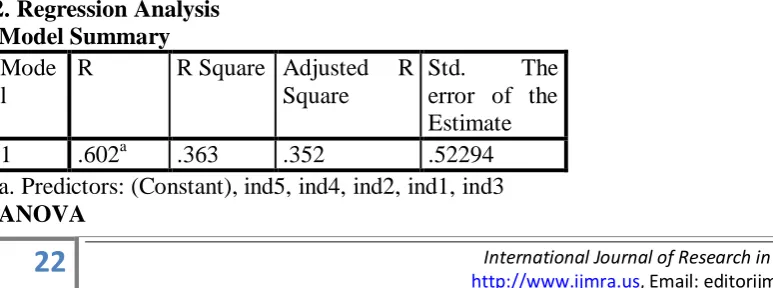
2. Regression Analysis Model Summary Mode
l
R R Square Adjusted R
Square
Std. The
error of the Estimate
1 .602a .363 .352 .52294
23
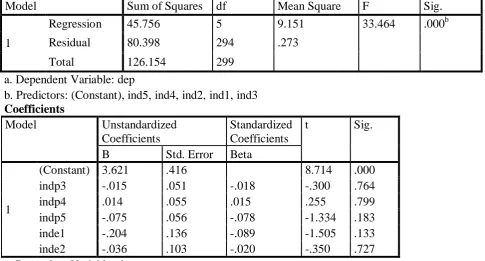
International Journal of Research in Social Sciences http://www.ijmra.us, Email: [email protected]Model Sum of Squares df Mean Square F Sig.
1
Regression 45.756 5 9.151 33.464 .000b
Residual 80.398 294 .273
Total 126.154 299
a. Dependent Variable: dep
b. Predictors: (Constant), ind5, ind4, ind2, ind1, ind3 Coefficients
Model Unstandardized
Coefficients
Standardized Coefficients
t Sig.
B Std. Error Beta
1
(Constant) 3.621 .416 8.714 .000
indp3 -.015 .051 -.018 -.300 .764
indp4 .014 .055 .015 .255 .799
indp5 -.075 .056 -.078 -1.334 .183
inde1 -.204 .136 -.089 -1.505 .133
inde2 -.036 .103 -.020 -.350 .727
a. Dependent Variable: depnt
From the above analysis made by using a regression technique, it is observed that we have Regression value as 60.2 where R represents simple Regression value in the Model summary table. That means it has a high correlation between the dependent and independent variables considered. Work-life balance has maximum relation with the independent variables under consideration.
From the second table, it is observed that significant value is noticed to be sig 0.000 and F value is less than 0.5. So we conclude to reject the null hypothesis in which there is no significance between the variables. Thus it is concluded that the variables are significant.
Conclusion and Future scope
In the present study, the social factors that influence the work-life balance of women working in the IT sector are analyzed. Work-life balance is an effective factor and strong state for estimating the economic, social, health issues, family management and job satisfaction of women. In the present analysis, it is proved that family management is highly correlated (91%) towards the work-life balance and quality of life of women in the IT sector. That means women's working information technology sectors are highly impacted to manage their personal life, family responsibilities, children at home. It is more appropriate to say that women are not getting enough time to manage both professional and personal life. So it becomes difficult for women in the IT sector to manage the family and her personal life with the stress of professional demands. Moreover, it is also concluded from the above table 1. On the other hand, the social and economic impacts of women in IT sectors towards work-life balance and wellbeing for a quality of life in a deeper sense can be the future scope for this paper.
24
International Journal of Research in Social Sciences http://www.ijmra.us, Email: [email protected] 1. Banton, Michael. 1996. Role. In The social science encyclopedia. 2d ed. Edited byAdam Kuper and Jessica Kuper, 749–751. London and New York: Routledge Taylor and Francis.
2. Bharathi, V., & Bhattacharya, S. (2015). Work-life balance of women employees in the information technology industry.
3. Crowley, J. E., & Kolenikov, S. (2014). Flexible work options and mothers' perceptions of career harm. The Sociological Quarterly, 55(1), 168-195.
4. Rendon, R. A. (2016). Work-Life Balance Among Working Married Women: What Social Workers Need to Know.
5. Fernando, L. S. R., & Sareena Umma, M. A. G. (2016). The factors affecting work-life balance of married working women: with special reference to Bank of Ceylon head office.
6. Rendon, R. A. (2016). Work-Life Balance Among Working Married Women: What Social Workers Need to Know.
7. Bharathi, S. V., & Mala, E. P. (2016). A study on the determinants of work-life balance of women employees in information technology companies in India. Global Business Review, 17(3), 665-683.
8. Clark, S. C. (2000). Work/family border theory: A new theory of work/family balance. Human relations, 53(6), 747-770.
9. Reddy, N. K., Vranda, M. N., Ahmed, A., Nirmala, B. P., & Siddaramu, B. (2010). Work–Life balance among married women employees. Indian journal of psychological medicine, 32(2), 112.
10.Azeez, P. N., & Priyadarshini, R. G. (2018, July). Glass ceiling factors affecting women career advancement in IT industry in India. In IOP Conference Series: Materials Science and Engineering (Vol. 390, No. 1, p. 012021). IOP Publishing.
11.Mohanty, A., & Jena, L. K. (2016). Work-Life Balance Challenges for Indian Employees: Socio-Cultural Implications and Strategies. Journal of Human Resource and Sustainability Studies, 4(01), 15.
12.Ernst Kossek, E., & Ozeki, C. (1998). Work–family conflict, policies, and the job–life satisfaction relationship: A review and directions for organizational behavior–human resources research. Journal of applied psychology, 83(2), 139.
13.Bansal, A. K., & Raj, L. (2017). A Study on Work Life Balance of Women Employees in Indian Oil Corporation Limited Mathura (UP). CPUH-Research Journal, 2(1), 6-11. 14.Kamalaveni, S., & Suganya, B. (2017). A Study of Work Life Balance of Women
Employees concerning Garment Sectors in Tirupur. Asian Journal of Management, 8(2), 127-131.
15.Mushfiqur, R., Mordi, C., Oruh, E. S., Nwagbara, U., Mordi, T., & Turner, I. M. (2018). The impacts of work-life-balance (WLB) challenges on social sustainability: The experience of Nigerian female medical doctors. Employee Relations.
16.Dr. Saloni Pahuja (2016). Work life balance of female‘s employees: A case study
17.Crompton, R., & Lyonette, C. (2006). Work-life ‗balance‘in Europe. Acta sociological, 49(4), 379-393.
25
International Journal of Research in Social Sciences http://www.ijmra.us, Email: [email protected]‖
‖
‖
‖
‖
‖
‖
26
International Journal of Research in Social Sciences http://www.ijmra.us, Email: [email protected]‖
‖
‖
‖
‖
2
27
International Journal of Research in Social Sciences http://www.ijmra.us, Email: [email protected]‖
‖
‖
‖
‖
‖
‖
‖
‖
3
28
International Journal of Research in Social Sciences http://www.ijmra.us, Email: [email protected]‖
‖
‖
‖
‖
‖
‖
‖
29
International Journal of Research in Social Sciences http://www.ijmra.us, Email: [email protected]‖
‖
‖
‖
‖
‖
‖
‖
‖
‖
‖
‖
‖
‖
‖
‖
‖
‖
‖
‖
‖
‖
‖
‖
‖
‖
30
International Journal of Research in Social Sciences http://www.ijmra.us, Email: [email protected]‖
‖
‖
‖
4
5
31
International Journal of Research in Social Sciences http://www.ijmra.us, Email: [email protected] EFFECTS OF CALLISTHENICS EXERCISES AND YOGIC ASANAS ON RESTINGPULSE RATE OF COLLEGE STUDENTS
Dr. Madhu Gaur
Assistant Professor, Shri J.N.P.G College, Lucknow
Abstract
The objective of this research was to study the effects of callisthenics exercises and yogic asanas on resting pulse rate of college students (males) in Lucknow district of Uttar Pradesh. Total of 120 male students acted as subjects (40 callisthenics group, 40 yogic asanas group, and 40 control group).A pre test was taken for all the 120 subjects. After six weeks training of callisthenics exercises and yogic asanas was given to the respective groups. A post test was taken after six weeks of the training. Analysis of variance was applied to compare the three groups for their heart rate response pattern, and Scheffe‘s post hoc test was applied to find out the superiority of the group. The result of the study indicated that Resting pulse rate of yogic asanas group was better than the other two groups.
Keyword: Callisthenics, Resting pulse rate,asanas.
INTRODUCTION
Callisthenics exercises and Yogic asanas are essential for the development of wholesome personality of a person that would depend upon the opportunity provided for wholesome development of the mental, physical, social and spiritual aspects. Hence a well organized and properly administered physical education programme for college students is very essential to measure the physiological and psychological variables. Man‘s physical activity and movement is as old as human existence. It played numerous roles, from struggle for existence to struggle for excellence. In this role playing fundamental motor skills developed into various movement patterns at times involving basic living skills sometime forming skills for leisure time pursuits, at times braving the enquired, often applying skill for excelling the sporting performance, but at every stage of human history yogic asanas and physical exercises provided an exciting outer for human expression often creative in nature.
Fitness is for everybody and not just for youth. This make fitness everybody‘s business. It is a part of the education, but it is also a part of life. Everybody who wants to be fit must do exercise. A person who does not exercise regularly according to a well-designed exercise programme will have an extra energy reserve because of the increased efficiency of the body.
Therefore it is truly said ―Exercises may not add years to your life but will definitely add life to your years‖.
METHODOLOGY
32
International Journal of Research in Social Sciences http://www.ijmra.us, Email: [email protected] groups did callisthenics exercise and yogic asanas for six weeks. Pre test and post were taken for all the subjects before and after the training respectively.The investigator keeping the purpose in mind collected the data from the subjects. The reliability of the collected data was tested and the intra class correlation coefficient obtained for data are presented in the table 1.
Table -1
Intra Class Correlation Co-efficient of Scores
Variables Correlation Values
Resting Pulse Rate 0.98
PROCEDURE
The resting pulse rate of the subjects was monitored by the pulse monitor. The pulse rate of all the subjects were recorded in a sitting position, in the morning session between 8:00 a.m. to 9:00 a.m. before taking the pulse rate, the subjects were aske4d to sit down on the bench and relax for 15 minutes. The investigator fixed the monitor on the wrist of the subjects and placed in from of chest, nearer to the heart after that the start button was put on, the monitor shows the pulse rate for one minute of the subjects which is recorded by the researcher.
SCORING
The number of pulse beats per minute was recorded as the scores. The ANCOVA statistical technique was used to test the adjusted post test me4an differences among the experimental groups. When the adjusted post-test result was significant, the Scheffe‘s post hoc test was used to find out the paired mean differences.
RESULTS and DISCUSSIONS
33
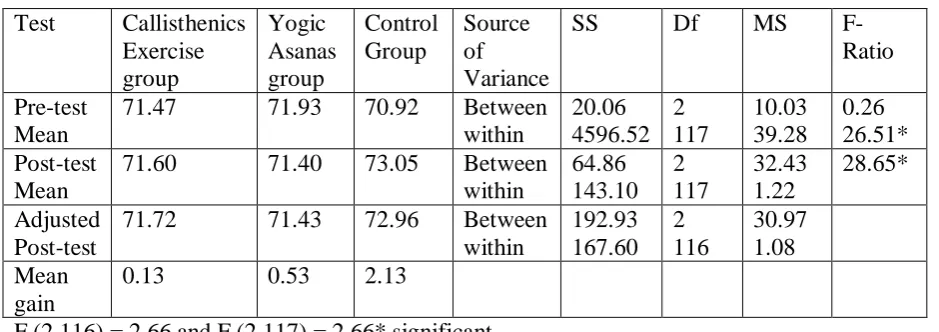
International Journal of Research in Social Sciences http://www.ijmra.us, Email: [email protected] Table -2Computation of analysis of covariance of pre-test, post-test and adjusted post-test on resting pulse rate of three experimental groups
(scores in seconds)
Mean scores
Test Callisthenics Exercise group Yogic Asanas group Control Group Source of Variance
SS Df MS F-
Ratio
Pre-test Mean
71.47 71.93 70.92 Between
within 20.06 4596.52 2 117 10.03 39.28 0.26 26.51* Post-test Mean
71.60 71.40 73.05 Between
within 64.86 143.10 2 117 32.43 1.22 28.65* Adjusted Post-test
71.72 71.43 72.96 Between
within 192.93 167.60 2 116 30.97 1.08 Mean gain
0.13 0.53 2.13
F (2,116) = 2.66 and F (2,117) = 2.66* significant
RESULTS OF RESTING PULSE RATE
Table -2 shows the analysed data on resting pulse rate. The pre-test means of resting pulse rate were 71.47 for callisthenics exercise group, 71.93 for yogic asanas group and 70.92 for control group. As the obtained F-ratio 0.26 was lesser than the tabulated F-ratio 0.266, the pre test was significant at 0.05 level of confidence for the degrees of freedom 2 and 117.
The post-test means were 71.40 for yogic asanas group, 71.60 for callisthenics exercises group and 73.05 for control group. As the obtained F-ratio 26.51 was greater than the tabulated F-ratio 2.66, the post-test was significant at 0.05 level of confidence for the degrees of freedom 2 and 117. The adjusted post-test means were 71.43 for yogic asanas group, 71.72 for callisthenics exercise group and 72.96 for control group. As the obtained F-ratio 28.63 was greater than the tabulated F-F-ratio 2.66, the post-test was significant at 0.05 level of confidence for the degrees of freedom 2 and 116.
34
International Journal of Research in Social Sciences http://www.ijmra.us, Email: [email protected] Table-2(A)Adjusted final mean difference on resting pulse rate of three experimental groups in analysis of covariance and scheffe‘s post hoc test
Callisthenics exercise group
Yogic Asanas group
Control group M.D. CI
71.72 71.43 - 0.29 0.66
71.72 - 72.96 1.54 0.66*
- 71.43 72.96 1.25 0.66*
*significant
The mean difference between experimental group I and II, I and III, II and III, were 0.29, 1.54 and 1.25 respectively. The mean difference 0.29 was seen to be less than the confident interval value of 0.66 in the following comparisons I and II. Hence the above comparison was not significant.
The mean difference 1.54 and 1.25 were seen to be higher than the confident interval value of 0.66 in the following comparison I and III, II and III. Hence the above comparisons were significant.
Hence the paired mean difference was not significant at 0.05 level of confidence with degrees of freedom 2 and 116.
FINDINGS
The table 2 shows that there was no significant difference in resting pulse rate of callisthenics exercise, yogic asanas and control group when the pre-test was conducted.
Resting pulse rate was significantly improved due to the influence of six weeks callisthenics exercise and yogic asanas among college students of Lucknow district of Uttar Pradesh.
The table 2(A) shows that there was no significant difference in resting pulse rate between callisthenics exercise group and yogic asanas group.
The table 2(A) shows that there was significant difference in resting pulse rate between callisthenic exercises group and control group. The resting pulse rate of callisthenic exercises group was greater than the control group.
The table 2(A) shows that there was significant difference in resting pulse rate between yogic asanas group and control group. The resting pulse rate of yogic asanas group was greater than the control group.
35
International Journal of Research in Social Sciences http://www.ijmra.us, Email: [email protected] CONCLUSIONFrom the above findings, it is concluded from the results that the level of resting pulse rate is increased significantly due to six week training program of callisthenics exercises and yogic asanas.
It is further concluded from the results that the level of resting pulse rate is decreased by yogic asanas is greater than the callisthenics exercises.
REFERENCES
Devi, Indira. Yoga, (1967) The Technique of Health and Happiness (Bombay: Jaico Publishing House).
Iyengar,B.K.S.(1983) Light on Pranayama (London: Umvin paper backs).
Singh, Hardayal. Sports Training General Theory and Methods, Patiala: Netaji Subhash National Institute of Sports, pp 44-48.
36
International Journal of Research in Social Sciences http://www.ijmra.us, Email: [email protected] FREE AND FAIR ELECTIONCHANDRAHASA Assistant Professor
M.Krishna Law College, Hassan,Karnataka
―Everyone has the right to take part in the government of his country, directly or through freely chosen representatives…. The will of the people shall be the basis of the authorit y o f government ; this will shall be expressed in periodic and genuine elect ions which shall be by universal and equal suffrage and shall be held by secret vote or by equivalent free voting procedures‖
Article 21, Universal Declaration of Human rights, 1948
ABSTRACT:
There are three main ingredients in a truly democratic electoral system – awareness on the part of the public of the significance of their vote, a spirit within the community that looks towards the welfare of a sound electoral machinery. A Constitution or the laws can provide only one of these ingredients – the system through which the people can give effect to the other two. In the following few pages an effort has been made to find what principles and machinery the Constitution of India has devised for the purpose of conducting free and fair elections, and to make an assessment of its efficacy as an institution. The electoral authority is the Election Commission, with its headquarters at New Delhi. In the Commission is vested complete power to be exercised in accordance with the provisions of the Constitution and the Representation of Peoples‘ Acts 1950 and 1951.
Key words: Free & fair, Democracy, Elections, Right to Vote etc.,
INTRODUCTION:
37
International Journal of Research in Social Sciences http://www.ijmra.us, Email: [email protected] three main ingredients in a truly democratic electoral system, awareness on the part of the public of the significance of their vote, a spirit within the community that looks towards the welfare of sound electoral machinery. A Constitution or the laws can provide only one of these ingredients – the system through which the people can give effect to the other two. In the following few pages an effort has been made to find out what principles and machinery the Constitution of India has devised for the purpose of conducting free and fair elections, and to make an assessment of its efficacy as an institution.CONCEPT OF FREE AND FAIR ELECTION:
An ELECTION is the embodiment of the popular will, the expression of the sovereign will of the people. In common parlance an election is the act of casting and receiving the ballots, counting them and making them the return. In democratic country like India election involves selection of peoples‘ representatives to the Houses of Parliament. The basic difference between election and referendum is that referendum refers to the determination of questions as to certain existing or proposed legislation by reference to popular vote where as election refers to selection of representatives for making and implementing law.
Elections are the foundation of democracy. Modern democracy by definition is a system under which people rule over themselves through the representatives they elect. For elections to express the will of the electorate, they must be ‗free and fair‘.
„Free‟ means that all those entitled to vote have the right to registered and vote and must be free to make their choice. In India every citizen over the age of 18 is entitled to vote. An election is considered ‗free‘ when you can decide whether or not to vote and vote freely for the candidate or party of your choice without fear or intimidation. A ‗free‘ election is also one where you are confident that whom you vote for remains your secret.
„Fair‟ means that all registered political parties have an equal right to context the election, campaign for voters support and hold meetings and rallies. This gives them a fair chance to convince voters to vote for them. A fair election is also one in which all have an equal opportunity to register, where all votes are counted, and where the announced results reflect the actual vote totals.
TYPES OF ELECTION:
There are three types of elections viz;
(1) General Election: Is an election held to select an officer after the expiration of the full term of the former officer.
(2) Primary Election: Is purely a creation of political parties and associates as a means for selecting their candidates.
38
International Journal of Research in Social Sciences http://www.ijmra.us, Email: [email protected] WHEN IS AN ELECTION FREE AND FAIR ?The following are few of the basic requirements may be essential to make the elections free and fair:
An equal opportunity for all people to register to vote;
Freedom for every registered voter to confidentially cast his or her vote; A fair process for all political parties to contest elections;
All votes are counted, and the actual results are announced publicly;
An independent and trusted electoral Commission, which is supported by election observers and party agents to monitor the entire electoral process;
Legal mechanisms are in the place to safeguard voter‘s rights, etc.,
REPRESENTATION OF PEOPLES‟ ACT 1951 AND ELECTIONS IN INDIA:
The Representation of the Peoples‘ Act, 1951 in its preamble provides for the conduct of elections to the House of Parliament and to the House or Houses of the legislature of each State, the qualifications and the disqualifications for membership of those Houses, the corrupt practices and other offences at or in connection with such election and the decision of doubts and disputes arising out of or in connection with such elections.
Section 2(d) of the Act defines the term ‗ELECTION‘ as a means to fill a seat in either House of parliament or in the House or either house of the legislature of a State other than the State of Jammu & Kashmir.
The meaning of ‗ELECTOR‘ is provided in Section 2(e) of the Act as follows;
‗elector‘ in relation to a constituency means a person whose name is entered for the time being in force and who is not subject to any of the disqualification mentioned in Section 16 of the Representation of the Peoples‘ Act 1951.
REQUIREMENTS OF FREE & FIAR ELECTION:
For conducting free & fair elections, we require an impartial & transparent election system. In Indira Nehru Gandhi Vs Raj Narain, 1975 (Suppl) SCC 1, the necessity of free and fair election has been emphasized in the following words;
―Democracy further contemplates that the elections should be free and fair, so that the voters may be in a position to vote for candidates of their choice. Democracy can indeed function only upon the faith that elections are free and fair and not rigged and manipulated, that they are effective instruments of ascertaining popular will both in reality and form and are not rituals calculated to generate illusion of defence to mass nation. Free and fair elections require that the candidates and their agents should not resort to unfair means or mal practices as may impinge upon the process of free and fair elections‖.
Indian Constitution has listed many provisions to have free & fair elections, but we will be discussing about two measures:
39
International Journal of Research in Social Sciences http://www.ijmra.us, Email: [email protected] Universal adult franchise:Elections are held on the basis of adult suffrage and every person who is a citizen who is a citizen of India, is above 18 years of age, is not otherwise disqualified is a voter. A voter may be disqualified is a voter. A voter may be disqualified on any ground as of non-residence, unsoundness of mind, undischarged insolvency, commission of a criminal wrong, doing of corrupt or illegal practice, etc. A person found guilty of adopting illegal or corrupt practices may be debarred for 6 years by the Courts, but the Election Commission may reduce or waive it after giving reasons for it in writing. Universal adult franchise ensures that everybody above the age of 18 is able to participate in elections. This shows the principle of equality and non discrimination. Thus, equality has been accorded to each citizen in the matter of franchise nd the electoral roll is prepared on a secular basis.
Right to contest:
In Jamuna Prasad Mukhariya Vs Lachhi Ram, (1955) 1 SCC 608, the Supreme Court of India observed: ―…. The right to stand as a candidate and contest an election is not a common law right. It is a special right created by statute and can only be exercised on the conditions laid down by the statute. The Fundamental Rights chapter has no bearing on a right like this created by statute….‖ The right to stand for an election is conferred by Articles 84(b) and 173(b) of Indian Constitution. The basic qualifications that a person who has reached the age of 25 years can contest for a seat in the Lok Sabha or the State Assembly cannot be taken away by any law. What a statute can do is to lay down qualifications and disqualifications for a candidate (Articles 102 & 190), and also to make procedural provisions regarding filing of nomination paper, etc. But no statute can completely negate or temper with the right conferred by Articles 84 and 173 of Indian Constitution.
Independent Election Commission:
To have free & fair elections, our Constitution has created an independent body to look at the functioning of elections in India. The superintendence, direction and control of the entire election process in the country have been vested in the Election Commission under Article 324. The Commission heads the entire election machinery and wields plenary powers for taking appropriate steps to ensure free and fair elections. In Mohinder Singh Gill Vs Chief Election Commissioner, AIR 1978 SC 851, Krishna Iyer. J observed: ―The Constitution contemplates a free and fair election and vests comprehensive responsibilities, directions and control of the conduct of elections in the Election Commission. This responsibility may cover powers, duties and functions of many sorts, administrative or other, depending on the circumstances‖.
40
International Journal of Research in Social Sciences http://www.ijmra.us, Email: [email protected] parties and allot symbol, power regarding the disqualifications of candidates and voters, power to control officers on election duty, and to formulate code of conduct etc.,JUDICIAL VIEW OF ELECTION:
Norman D. Palmer in his book, ‗Elections and Political Development‘ has observed: ―Elections are complex events involving individual and collective decisions which directly affect, and are effected by, the total political and social process. They open up channels between the elite and the masses, between the individual and his government. They are major agencies of political socialization and political participation‖.
In N.P.Ponnuswami Vs Returning Officer, Nammakkal, AIR 1952 SC 64:1952 SCR 218 the Supreme Court explained the meaning of the term election. The word election used in the narrow sense means the final selection of a candidate. In the wider sense, the word is used to connote the entire process culminating in a candidate being elected.
Also in Dr. Narayan Bhaskar Khare Vs Election Commissioner of India, AIR1957 SC 694 the Supreme Court held that the term election in Article 329(b) of Constitution of India has been used in its comprehensive sense, embracing the whole procedure whereby an elected member is returned.
COMPONENTS OF FREE AND FAIR ELECTION:
Free and fair elections are the foundations of democratic form of government. To ensure the free, fair and purity in elections the following essential conditions must be fulfilled:
There should be a set of election laws which must cover the entire process of elections with the primary object to create and maintain the sort of atmosphere in which the electorate can choose their representatives by the exercise of their free will without any pressure or hindrance or undue influence from any quarter. Law should extend full protection to the electorates against any fear, injury, fraud, misrepresentation or other undesirable practices, which may be indulged in by or on behalf of the candidate at an election. Such laws must also provide unfettered freedom to every person, who is qualified to offer himself as a candidate for election, and all civil liberties should be allowed to him for campaigning his policies and the candidature, so long as he is permitted to do so under the law.
It is now recognized that the conduct of elections must enable the fair representation of all citizens, in keeping with the growing recognition of the equality of men and women, and the rights of various categories of minorities within the general population.
Freedom of political debate is now acknowledged by institutions and governments, as an essential foundation for a democratic society. The vital importance of free political expression rests largely on the fact that an informed electorate is crucial to the proper functioning of a genuine democracy;