ENHANCEMENT OF ORGANIZATIONAL SKILLS
BY IMPLEMENTING BRAIN BASED LEARNING
PROGRAM BASED ON LEARNER’S LEARNING
STYLE
1
Mrs.Gangotri V. Rokade, 2Dr. Navnath Tupe 1Student of Ph.D., 2Assistant professor 1Department of Education and Extension,
Savitribai Phule Pune University, Pune State- Maharashtra , Country- India, 2Department of Lifelong Learning and Extension,
Savitribai Phule Pune University, PuneState- Maharashtra , Country- India.
Abstract -This research paper mainly focuses on studying the effectiveness of Brain based Learning Programme on enhancement of Organizational skills of pre-service teachers. For the identification of learning styles of the pre-service teachers a standardized test constructed by Dr. Venkataraman (SOLAT) was used. The sample selected for the study was identified with two dominant learning styles out of the five learning styles. A teacher made Self Evaluation Rating Scale test was administered for the quantitative evaluation of Organizational skills. This study implies that the use of brain based learning programs based on learner’s learning style is effective in enhancing Organizational skills of pre-service teachers.
Key words: Brain based learning Programme, learning styles, Organizational skills.
I. INTRODUCTION
The skills taxonomy developed by Brikett (1993) describes that the skills taxonomy is classified into cognitive skills and behavioural skills. The behavioral skills can be further classified into personal skills and mentoring skills.
Mentoring skills can be divided into organizational and interpersonal skills.
Classification of Mentoring skills developed from ‘Preparedness to practice, mentoring scheme, July 1999. NHSE/ Imperial College school of Medicine.[1]
Organizational Skills:
The Organizational skills are the abilities to efficiently manage your time, workload, and resources which may help you to improve your productivity, schedule and prioritize your projects and lower your stress level.[2]
The Organizational skills involved are Planning, Contracting, recording, structuring sessions, time management, scheduling, evaluating, assessing, report writing, maintaining boundaries, action planning, prioritizing and facilitating.
The five highly rated Organizational skills were selected after the Opinionnaire filled by the Teacher Educators from various English medium B.Ed. Colleges. They were planning, time management, scheduling, evaluating and action planning.
Learning styles:
Learning styles are simply different approaches or ways of learning. Learning style refers to prefer mode of problem solving thing or learning used by an individual.[8]
Dr.D.Venkataraman (1994), an Indian expert has constructed the SOLAT test which is best suitable for Indian learning environment. This test of learning and thinking styles of the students is an advance version of Torrance SOLAT test. This test was selected for identification of learning styles of students in the research study.
Brain based Learning (BBL):
The roots of brain-based learning principles are in neurological research, particularly during the 1990s. In fact, the 1990s was themed "the decade of the brain"(Bush, 1990; Roberts, 2002; Sousa, 2001).
BBL involves accepting the rules of how the brain processes, and then organizing instruction bearing these rules in mind to achieve meaningful learning (Caine and Caine, 1994).
Brain based principles by Caine and Caine are, The brain is a parallel processor.
Learning engages whole physiology. Search for mentoring innate.
Search for meaning through patterning Emotions critical to patterning
Brain processes whole and part simultaneously Learning both focused and peripheral
Learning enhanced by Challenges & inhibited by threats
Learning is developmental.
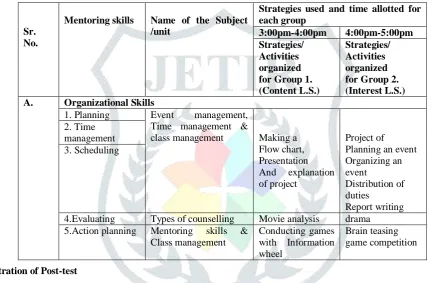
The brain based learning Programme involves a range of activities/strategies which included flow chart presentation, projects, movie analysis, drama, conducting/organizing game competition and participation in brain teasing games..[3]
In the present study, learning style was used as the criterion to classify the learners, to provide them with different learning experiences by selecting appropriate brain based learning Programme for enhancing Organizational skills of pre-service teachers.[9]
II. STATEMENT OF THE PROBLEM
Development of brain based learning Programme for enhancing Organizational skills of pre-service teachers from English medium B.Ed. colleges, which are affiliated to Savitribai Phule Pune University, Pune and see its effectiveness.
III. NEED AND IMPORTANCE OF THE STUDY
3.1 Need
B.Ed. degree in Teacher Education is a course of two years. The pre-service teachers have to develop the various skills of teaching and mentoring. For enhancing these skills, the brain based learning Programme can be developed. The teacher trainees practice microteaching skills but the equally important interpersonal skills and Organizational skills are not included in the course. The researcher feels that there is a need to develop the Organizational skills of the teacher trainees.
The learning styles can be identified for developing and enhancing the potentials of the teacher trainees and they will be the effective teachers, organizers and mentors for their organization and students..
3.2 Importance
The brain based learning Programme will be practically used in the classroom to enhance the Organizational skills of pre-service teachers. The teacher educator will develop and enhance the Organizational skills based on the learning styles of the pre-service teachers.
IV.DEFINITIONS OF THE IMPORTANT TERMS:
A. Brain based learning: Theoretical definition
“Brain-based learning is a comprehensive approach to learning based on neuroscience.” (Jensen, 2008). In research,
Brain-based learning includes selection of appropriate teaching methods, lesson designs, and activities/strategies that are based on the latest scientific research about the way our brain learns. The students learn differently as they age, grow, and mature socially, emotionally, and cognitively. They are the cognitive development factors of brain based learning.
B. Learning Styles:
Theoretical definition
“Knowledge acquired by the different ways of learning and making the meaning of information is called learning Style.” (Illustrated Oxford dictionary, 2006)
In research,
Every student has a unique primary learning mode or a way of learning by which he/she learns speedily and effectively. The learning styles were identifies by implementing SOLAT test of Dr. Venkataraman.
C. Organizational skills: In research,
The skills e.g. Planning, Contracting, recording, structuring sessions, time management, scheduling, evaluating, assessing, report writing, maintaining boundaries, action planning, prioritizing and facilitating are included in organizational skills. These are needed to be developed in the pre-service teachers for making them effective mentors.
D. Pre-service teachers: Theoretical definition
“A person, who has taught how to do a teaching job,” (Hornby, 2000) In research,
The students pursuing their Bachelor’s in Education degree and are undergoing training at English medium B.Ed. College to become secondary school teachers.
E. Effectiveness In research,
V. OBJECTIVES OF THE STUDY
1. To identify the learning styles of B.Ed. pre-service teachers using a standardized test.
2. To develop brain based learning Programme based on learning Styles of the pre-service teachers for developing their organizational skills and implement the BBL Programme.
3. To study the effectiveness of brain based learning Programme on organizational skills of the pre-service teachers.
VI. VARIABLES
Independent Variable of the experiment was the treatment given i.e. a BBL program prepared by the researcher using brain based learning activities/strategies according to the learner’s learning style for enhancing organizational skills of the pre-service teachers.
Dependent Variable of the experiment is the development of organizational skills in the pre-service teachers in the post-test, with reference to their learning styles.
Control Variables of the experiment are organizational skills, subjects: Educational Management & Guidance and Counselling, Pre-service teachers studying in English medium B..Ed. Colleges.
Intervening variables- interest of the students, attention, grasping power.
VII. HYPOTHESIS
7.1. Research Hypothesis
1. There will be a significant difference between mean scores of the pre-test and post-test of the organizational skills of pre-service teachers when BBL Programme is implemented.
7.2. Null Hypothesis
1. There will be no significant difference between mean scores of pre-test and post-test of the organizational skills of teacher-trainees when BBL Programme is implemented.
VIII. METHODOLOGY
The experiment was conducted to find a new knowledge through the theoretical knowledge.
For the above research study, Multi-method of research was adopted.
For the present study, the researcher has selected the Incidental Sampling Method based on Non-Probability method of Sampling.
8.1. Sample:
The Experimental group comprised of 44 pre-service teachers of second year B.Ed. Course, studying in MIT saint Dnyaneshwar B.Ed. college Alandi (D), Pune in the academic year 2019-2020.
8.2. Design:
The study adopted Pre-experimental design of Single group pre-test post-test design.
O 1 X O 2
Pre-test Treatment1 Post-test
8.3. Procedure:
The procedure of the present study was as follows:
8.3.1. Selection of tools for identification of learning style of the students:
Dr.Venkataraman (1994) is an Indian expert. The credit of constructing an advance version of Torrance SOLAT test goes to him. The researcher has selected this SOLAT test for the identification of the learning styles of the pre-service teachers as it is simple, easy to understand and best suited for Indian learning environment.
In learning style inventory there are 50 items. Each item is consisting of two statements ‘a’ and ‘b’. In the tool, checking of the statement ‘a’ indicates right hemisphere, checking of statement ‘b’ indicates left hemisphere and checking of both the statements indicate integrated hemisphere. After getting responses of the students on Learning Style Inventory, the frequencies of each response on each item was counted. The brain dominance was identified. Based on the brain hemisphericity and the frequency of responses for a particular learning style, the learner’s dominant learning style was decided.
There are total 5 learning styles and 5 thinking styles suggested in the tool [4].
8.3.2. Administration of learning style inventory:
The researcher administered SOLAT learning style inventory to 44 S.Y.B.Ed. Pre-service teachers of the Experimental group. Classification of pre-service teachers of the sample into the groups based on the Learning preferences was done.
According to the learning styles of the students, they are classified into 2 groups.
Group 1- 20 students out of 44 students have preferred Content learning style (45.45 %) Group 2- 24 students out of 44 students have preferred Interest learning style (54.55 %)
8.3.3. Brain Based learning (BBL) Programme
The learning style was used as criteria to classify the learner, to provide them with different learning experiences.
The 2 groups were taught 3 units from educational management and 3 units from Guidance and counseling text-book using the Brain based learning Programme.
The text-books are based on the New Revised Syllabus (2015) published by Success Publication, Pune [5][6].
TABLE 1
The details of BBL Programme based on Learning styles and Subjects/ units of Brain based learning
8.4.4 Administration of Post-test
The teacher made Self-Assessment Rating Scale Post-test was administered. The total marks were 200 and the duration of the test was 1 hours.
IX. TOOLS
The Standardized test (SOLAT) constructed by Dr. Venkataraman and the Self-Assessment tests prepared by the researcher were used for the data collection.
Mean & t-test were the statistical techniques used for analysis of data.
X. ANALYSIS OF DATA 10.1. Qualitative Analysis
The learning style inventory (SOLAT test constructed by Dr. Venkataramanwas administered and the data was collected.
TABLE 2
The percentage of Pre-service teachers and the preferred learning styles. Sr.
No.
Mentoring skills Name of the Subject /unit
Strategies used and time allotted for each group
3:00pm-4:00pm 4:00pm-5:00pm
Strategies/ Activities organized for Group 1. (Content L.S.)
Strategies/ Activities organized for Group 2. (Interest L.S.)
A. Organizational Skills
1. Planning Event management, Time management &
class management Making a Flow chart, Presentation And explanation of project
Project of Planning an event Organizing an event Distribution of duties Report writing 2. Time management 3. Scheduling
4.Evaluating Types of counselling Movie analysis drama 5.Action planning Mentoring skills &
Class management
Conducting games with Information wheel
Brain teasing game competition
Sr. No.
Particulars Total Content L.S. Interest L.S.
1. No. of Pre-service
teachers
44 20 24
2 % of the Pre-service
teachers
10.2. Quantitative Analysis
The techniques adopted for data analysis were Percentage, Mean and t-test [7].
Mean value was derive for group 1(content learning style) and group 2(interest learning style) T-test was used for group 1 and group 2 separately.
.
Graphical representation and Summary table of obtained t-values for the groups.
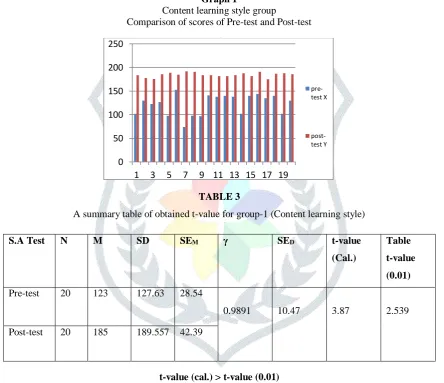
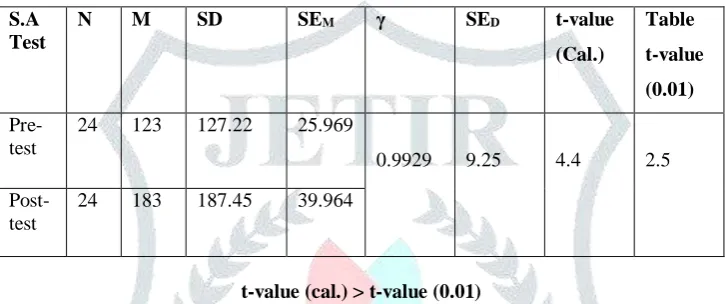
The comparison of the scores of pre-test and post-test was shown in the Graph 1 and Graph 2.
For Group 1 (Content learning style group) and Group 2 (Interest learning style group) respectively.
The summary table of obtained t-value for Group 1 (Content learning style group) and Group 2(Interest learning style group) is given in the Table 3 and Table 4 respectively.
Graph 1
Content learning style group Comparison of scores of Pre-test and Post-test
TABLE 3
A summary table of obtained t-value for group-1 (Content learning style)
t-value (cal.) > t-value (0.01)
There is significant difference between mean scores of pre-test and post-test at 0.01 level of significance. So the null
hypothesis was rejected. The brain based learning Programme used for group-1 (i.e. content learning style group) was
effective.
0 50 100 150 200 250
1 3 5 7 9 11 13 15 17 19
pre-test X
post-test Y
S.A Test N M SD SEM γ SED t-value
(Cal.)
Table
t-value
(0.01)
Pre-test 20 123 127.63 28.54
0.9891 10.47 3.87 2.539
Interest learning style
Comparison of scores of Pre-test and Post-test
TABLE 4
A summary table of obtained t-value for group-2 (Interest learning style)
t-value (cal.) > t-value (0.01)
There is significant difference between mean scores of pre-test and post-test at 0.01 level of significance. So the null hypothesis is rejected. The brain based learning Programme used for group-1 (i.e. Interest learning style group) was effective.
We can say that the Brain based learning Programme prepared based on the learning styles of the pre-service teachers for development of Organizational skills is effective.
XI. FULFILLING THE OBJECTIVES
Objective 1-
To identify the learning styles of B.Ed. teacher-trainees using a standardized test.
Inference-
The pre-service teachers in the sample were identified with two learning styles out of five learning styles. These students were categorized in 2 different groups.
Group 1-Content L.S. and Group 2-Interest L.S.
20 students out of 44 students have preferred Content learning style i.e. 45.45%. 24 students out of 44 students have preferred Interest Learning style i.e. 54.55%.
Objective 2-.
To develop brain based learning programme based on learning Styles of the pre-service teachers for developing their Organizational Skills and implement the BBL programme.
Inferences-For the present study, the researcher has prepared a brain based learning programme according to the learning style of the pre-service teachers. The programme prepared for the selected 2 types of learners is given in the table 1.
Objective 3-
To study the effectiveness of brain based learning Programme on Organizational skills of the pre-service teachers.
Inferences-The enhancement is seen in the mean scores obtained in the post-test after the implementation of brain based learning Programme for enhancing Organizational skills of pre-service teachers according to the learner’s learning style.
A summary table of obtained t-value for group-1(Content learning style) and group-2 (Interest learning style) is given in tables 3 and 4 respectively.
XII. MAJOR FINDINGS OF THE STUDY 0 50 100 150 200
1 3 5 7 9 11 13 15 17 19 21 23
pre-test X
post-test Y
S.A Test
N M SD SEM γ SED t-value
(Cal.)
Table
t-value
(0.01)
Pre-test
24 123 127.22 25.969
0.9929 9.25 4.4 2.5
Post-test
The null hypothesis states that there is no significant difference between mean scores of pre-test and post-test of the Organizational skills of teacher-trainees when BBL Programme is implemented.
Group 1- Content Learning Style
From table No. 3 It is seen that for Group 1 (content learning style) t-values (calculated) =3.87, which was higher than table t-value (0.01 level) 2.539, so the effectiveness of the Brain based learning program is significant at 0.01 level. The null hypothesis is rejected.
Group 2- Interest Learning Style
From table No. 4 It is seen that for Group 2 (Interest learning style) t-value (calculated) =4.4 , which was higher than table t-value (0.01 level) 2.5, so the effectiveness of the brain based learning program is significant at 0.01 level.
The null hypothesis was rejected.
The pre-service teachers have shown development and enhancement in the Organizational skills when the brain based learning Programme based on the learner’s learning style was implemented.
XIII. CONCLUSIONS
Since the obtained t-ratio is significantly greater than the tabulated t –ratio in case of group 1 and group 2, the null hypothesis is rejected. The brain based learning Programme developed based on the learning style of the pre-service teachers for the enhancement of Organizational skills was effective.
XIV. RECOMMENDATIONS
Brain based learning is a new trend in education. It develops and enhances Organizational skills of the pre-service teachers. The brain based learning program develops good interactions in the class-rooms and the learning process becomes more interesting and joyful.
It is recommended that the similar study can be carried out for enhancing the life skills, Interpersonal skills and entrepreneur skills. Correlation between learning style and thinking style of the pre-service teachers can also be studied.
XV. SELECTED REFERENCES
[1] Kram, K.E.(1986)“Mentoring in the Workplace”. In Career development in Organisations, edited by D.T. Hall San Francisco: Jossey-Bass.
[2] Matsidiso Nehemia Naong.(2009). “Impact of skills development training on Employee motivation, perceptions of Organisational climate and individual Performance”. University of Kwazulu-Natal ,Durban, Westville.
[3]Sousa, D.A “How the brain learns”. (2006) A Sage Publication Company, Thousand Oaks, California.
[4] Venkataraman, D.(1994) “Styles of learning and thinking, Manual of Inventory”, Psy-com-services, New Delhi.
[5] Chaudhari, A. and Aher, R. (2015) “Guidance and Counselling”. Success Publication.
[6] Waykule, P.and Gaikwad, A.(2015) “Quality and Management of school education”. Success Publication. Pune.
[7] Best, J.W. and Kahn, J.V. (2009).“Research in Education””. (10th Ed.) New Delhi: Prantice-Hall of India Pvt. Ltd.
[8] C. Rose. (2013).“Accelerated Learning”. Chaminade College, Published Article, Retrieved from: http://www.chaminade.org/inspire/learnst.htm. May 16, 2013. p.1