537 Abstract—The effect of constellation size on energy efficiency of Multi carrier Direct Sequence code-division multiple-access (MC DS/ CDMA) system for M-QAM modulation is studied using a game theoretic approach. A non cooperative game is proposed in which each user seeks to choose its transmit power, transmit symbol rate as well as the constellation size in order to maximize its own utility while satisfying its delay quality of service (QoS) constraint. The utility function used here measures the number of reliable bits transmitted per joule of energy consumed and it is particularly suitable for energy-constrained networks. It is shown that in order to maximize the user’s utility, a user must choose the lowest constellation size that can accommodate the user’s delay constraint. This strategy is different from one that could maximize spectral efficiency. Using this approach, the trade offs among energy efficiency, delay, throughput and constellation size are also studied and quantified.
I. INTRODUCTION
Code division multiple access (CDMA) is a multiple access technique where different users simultaneously access the same frequency band at the same time. Orthogonal frequency division multiplexing (OFDM) is a multicarrier technique that performs serial to parallel conversion of the data and modulates each sub-stream with a different subcarrier. To transmit data at higher rates as well as to accommodate more users with the available resource, a combination of OFDM and CDMA systems is used. This result in a powerful transmission technique called Multi-carrier Direct Sequence CDMA which has the benefits of both the time diversity gain of CDMA and the high data rates of OFDM systems. Multicarrier direct sequence CDMA is technique where the data streams is first serial to parallel converted, spread with a pre assigned code and then the same spreading stream modulates different sub-carriers [1]. Due to the wide bandwidth occupied by the future wireless communication systems, the MC DS/CDMA with spreading in the time domain requires high chip rate. This provides an efficient approach to reduce the chip size. Wireless networks are expected to support a variety of applications with diverse QoS requirements. The goal is to use the network resources as efficiently as possible while providing the required QoS to the users. Game-theoretic approaches to power control have recently attracted considerable attention [2-7]. In [4] motivations for using game theory to study communication systems and in particular power control are provided.
Department of Electronics and Communication Engineering, SMVEC, Pondicherry and *Jayaram Engineering college, Cuddalore.
In [2], an overview of multicarrier code division multiple access techniques is studied and in [3] the effect of orthogonal multicarrier techniques applied to CDMA. In [4], power control is modeled as a non-cooperative game in which users choose their transmit powers in order to maximize their utilities, where utility is defined as the ratio of throughput to transmit power. A game-theoretic approach to power control for multicarrier systems is studied in [8]. In [9] pricing is used to obtain a more efficient solution for the power control game. Similar approaches are taken in [10-13] for different utility functions. In this work we formulate power control as a non cooperative game where each user of the MC-DS/CDMA network chooses its strategy, which includes the choice of the transmit power, transmit symbol rate and the constellation size in order to maximize its own utility while satisfying its QoS constraints. In this work, we use a game-theoretic approach to study the effects of modulation on energy efficiency of MC-DS /CDMA networks.
II. MULTI CARRIER DS/CDMA
To transmit data at higher rates as well as to accommodate more users with the available resource, a combination of OFDM and CDMA systems is used. This result in a powerful transmission technique called Multi-carrier Direct Sequence CDMA which has the benefits of both the time diversity gain of CDMA and the high data rates of OFDM systems. The Multicarrier DS-CDMA transmitter spreads the S/P-converted data streams using a given spreading code in the time domain so that the resulting spectrum of each subcarrier can satisfy the orthogonality condition with the minimum frequency separation [14]. This scheme is originally proposed for a uplink communication channel. In [9], a multicarrier based DSCDMA scheme with a larger sub-carrier separation is proposed in order to yield both frequency diversity improvement and narrow band interference suppression. In addition a Multicarrier based DS-CDMA scheme, which transmits the same data using several sub-carriers, is proposed in [15-16].
III. NON COOPERATIVE GAME
A non-cooperative game is a one in which players can cooperate, but any cooperation must be self-enforcing. A game in which players can enforce contracts through third parties is a cooperative game. There are 3 basic concepts pertaining to non cooperative game which are as follows.
Energy Efficient Modulation in MC DS/CDMA
Using Game Theory Approach: Performance
Results
538 This is the major non-cooperative game concept where everyone plays their best move as a reply to the opponent's best move. When this is done, no player is benefited alone but as a group.
Concept 2:Sub-game perfect equilibrium:
This concept deals with reading the opponents moves and thinking forward but for making our moves, we must study and reason back.
Concept 3: Expectations equilibrium:
If we play our best move thinking that the opponent is playing his best, then this result implies that we are heading towards equilibrium and that we do not want to move. This type of equilibrium is called expectations equilibrium. Of all the above conditions, Nash equilibrium is the most sought after for wireless engineering and in our paper too, we make use of Nash equilibrium.
A non-cooperative power control game, in general, can be expressed as G = [K, {Ak}, {uk}] where K = {1, ...,K} is the set of users/players, Ak is the strategy set for the kth user, and uk is the utility function given by (3). Each user decides what strategy to choose from its strategy set in order to maximize its own utility. Hence, the best-response (i.e. utility maximizing) strategy of user k is given by the solution of max akЄAk uk ≡max akЄAk R k* f(γk) /Pk For this game, a Nash equilibrium is a set of strategies (a∗1 , · · ·, a∗k) such that no user can unilaterally improve
its own utility, that is, uk(a∗k, a∗-k) ≥ uk(ak ,a∗-k) for all akЄ Akand k = 1, · · · ,K. .
IV. PROPOSED GAME
In this work, a non-cooperative games in which the actions open to each user are the choice of transmit power, and possibly transmit symbol rate, as well as the choice of
constellation size, choosing which the user’s utility is
maximized.
The utility function of a user as the ratio of its throughput to its transmit power is defined as, i.e.
,uk= Tk pk . (1)
This utility function is similar to the one used in [5] and [16]. Throughput in (1) is defined as the net number of information bits that are transmitted without error per unit time (it is sometimes referred to as goodput), and is expressed as
Tk= Rkf(γk) (2)
where Rk= bkRs,kis the transmission rate, γk is the output signal-to-interference-plus-noise ratio (SIR) for user k, and
f(γk) is the “efficiency function” which represents the packet
success rate (PSR) for the kth user. We require that f(0) = 0 to ensure that uk= 0 when pk = 0. In general, the efficiency function depends on the modulation, coding and packet size. An automatic-repeat-request (ARQ) mechanism in which the user keeps retransmitting a packet until the packet is
uk= Rkf(γk) pk. (3)
This utility function, which has units of bits/joule, measures the number of reliable bits that are transmitted per joule of energy consumed, and is particularly suitable for energy constrained networks.
The efficiency function of the user for MC DS /CDMA is given by
fb(γ) = ((1 −αbQ(√βbγ))2L/b−2−L) M (4)
V. DELAY-CONSTRAINED GAME
In this part, the effects of constellation size on delay. It is best for a user to use the lowest-order modulation for the utility function is studied [1]. The case in which the users have delay QoS requirements is considered. A game is considered such that each user seeks to maximize its own utility by choosing its transmit power, symbol rate and constellation size. This is done taking into account the required delay QoS constraint. By delay QoS constraint we take into account the delay to reach the receiver and also the packet’s waiting time in case of a queue.
The delay model considered is a M/G/1 model, where M refers to the arrival rate and G refers to the service rate. M signifies that arrival rate, incoming packets, follows a poisson distribution. G signifies that service rate follows an arbitrary distribution. The model considered here is similar to the one considered in [1]. The received packets are assumed to be stored in a queue and transmitted in a first-in-first-out (FIFO) fashion. The packet success probability (per transmission) as before is represented by the efficiency function fb(γ). ARQ mechanism is followed where each packet is retransmitted until the packet is received without error. The packet transmission time takes into account the time taken to receive the acknowledgement. Since it is assumed to be small we neglect the time taken for receiving the acknowledgement. From [1]
We specify the delay QoS constraint of a user by an upper bound on the average packet delay, i.e., we require
This delay constraint can equivalently be expressed as
539 Note that it is equivalent to the condition
Where
Based on (4 ), is given by
This means that the delay constraint in (6) translates into a lower bound on the output SIR. However the upper bound cannot be less than the time taken for transmission time, i.e., D ≥τ, we must have that bRs ≥ L/D. So L/(b2R
s2D) becomes smaller than L/(bRsD). Hence the negative term in (8) becomes smaller which implies that ηb > 0. Since the efficiency function is limited as 0 ≤ fb(γ) ≤1, (7) is possible only if ηb <1.
We propose a game in which each user chooses its transmit power and symbol rate as well as its constellation size in order to maximize its own utility while satisfying its delay requirement. Fixing the transmit powers and rates of other users, the best-response strategy for the user of interest is given by the solution of the following constrained maximization:
or equivalently
Proposition 1: For a fixed b, the source rate λ and the delay constraint D are feasible if and only if
where B is the system bandwidth.
Proof: If ηb < 1, only then it is possible for the source rate and the delay constraint to be feasible and ηb is obtained from (8). From (8) it can also be seen that ηb is a decreasing function of Rs. The maximum value of Rs is achieved at Rs=B. Hence the lowest possible value of ηb is achieved when Rs = B. Therefore (14) has to be satisfied so that the source rate λand the delay constraint D are feasible.
The delay constraint however has a minimum value of transmission delay i.e. D cannot be smaller than τ. Hence, it can be shown that the condition 0 ≤ηb < 1 is equivalent to Rs > Ω∞/b where
Where Ω∞ is the symbol rate for which the efficiency function satisfying the delay constraint is between 0 and 1.
Also, let us define Ωb* is the rate for which γb^=γb*, i.e.,
where fb*= fb(γb*)
Utility is maximum when γb^=γb* and this value of the SIR occurs at a symbol rate of Ωb*.
Proposition 2: For given values of λ and D, the
bestresponse strategy for a user (i.e., the solution of (12)) is any combination of p and Rs such that
and
where is the lowest constellation size for which λand D are feasible, γb* is the solution of fb(γ)= γ f'b(γ), and γb^ is given by (10).
Since ηb represents the packet success probability, ηb ≤ 2−L would correspond to a very poor design. This can be seen from (4) and (7) .In fact, in such a case, there would not be any need to transmit the packets since random guessing at the receiver would give a PSR of 2−L.
Proof: [Proposition 2] The utility is maximized when the user’s SIR is equal to γb*which is the solution of fb(γ)= γ f'b(γ) . It is straightforward to show that γˆb is a decreasing function of Rs for all Rs ≥ Ω∞/b . Including the effect of
constellation size, let us assume b'>b″ and consider the following cases.
• Since b'>b″, if we have Ωb″*/b″≤B, then this implies that
Ωb″*/b'≤B. This means both γb'* and γb″* are feasible. However, it is evident that the user’s utility will drop in case the user moves to a higher-order modulation i.e. if the number of bits per symbol increases. The gain in utility which is because of an increase in b is dominated by the increase in the optimum operating SIR Therefore, in this case, the user would choose the smallest b.
• If Ωb″*/b″≤B but λand D are feasible with b″, then the
540 switch to a higher constellation size and a similar argument as above would follow.
Therefore, the user must always choose the lowest constellation size for which the user’s QoS constraint can be satisfied.
Proposition 2 implies that, in terms of energy efficiency, choosing the lowest-order modulation (i.e., QPSK) is the best strategy unless the user’s delay constraint is too tight. In other words, the user would jump to a higher-order modulation only when it is transmitting at the highest symbol rate (i.e., Rs = B) and still cannot meet the delay requirement. Also, the proposition suggests that if
the user has infinitely many best-response strategies. In particular, the user chooses the lowest constellation size that can accommodate the delay constraint. Then, for that constellation, any combination of pk and Rs,k for which γk= γbk* and R
s,k≥Ωbk*/b is a best response strategy.
At Nash equilibrium, the transmit powers, symbol rates and constellation sizes of all the users have to satisfy Proposition 2 simultaneously. There are, therefore, cases where we have infinitely many Nash equilibria. For a matched filter, for example, the best-response transmit power of user k is given
by
where
and γk and Rs,k are determined according to Proposition 2 for
k = 1, · · · ,K. We refer to Φk as “size” of user k. Φk is a measure of the amount of network resources that is consumed by the kth user. Note that γk and Rs,k are feasible if and only if
Utility of user k at Nash equilibrium is given by
Therefore, the Nash equilibrium with the smallest Rs,k achieves the largest utility. A higher symbol rate (i.e., smaller processing gain) for a user requires a larger transmit power by that user to achieve the required SIR. This causes more interference for other users in the network and forces them to rise their transmit powers as well. As a result, the level of interference in the system increases and the users’
Proposition 2, the user will increase its symbol rate. This results in an increase in the user’s “size”. When the symbol rate becomes equal to the system bandwidth, the user will increase its SIR which again results in an increase in Φ. Finally, when the user’s delay constraint is not feasible anymore, the user will switch to a higher constellation size. This results in an exponential increase in the required SIR, which dominates the linear decrease in the symbol rate. Therefore, Φ increases again. This shows that the user’s “size” increases as the delay requirement becomes more stringent. The feasibility condition given by (21) determines the maximum number of users that can be accommodated by the network. A tighter delay constraint results in a larger “size’ for the user. This, in turn, results in a smaller network capacity.
VI. SIMULATION RESULTS
The effect of constellation size on energy efficiency of a user with a delay QoS constraint is quantified in this section. The effect of constellation size is studied taking into account the delay constraint as well. The number of subcarriers is assumed to be 4. The packet size is assumed to be 100 bits, and the source rate (in bps) for the user is assumed to be equal to 0.01B where B is the system bandwidth. We further assume that a user chooses its constellation size, symbol rate and transmit power according to its best-response strategy corresponding to the Pareto-dominant Nash equilibrium. For the coded system, we assume an 8-state convolutional encoder with rate 2/3. The code rate for QPSK is chosen to be 1/2.
541
0 5 10 15 20 25 30 35
0 0.1 0.2 0.3 0.4 0.5 0.6 0.7 0.8 0.9 1
SIR(dB)
E
ff
ic
ienc
y f
unct
ion (
unco
ded)
b=2 b=4 b=6 b=8
Fig. 1. Efficiency function without coding (packet success rate) as a function of SIR for different constellation sizes.
Hence, the user’s utility decreases. As the delay requirement becomes tighter, a point is reached where the spectral efficiency of QPSK is not enough to accommodate the delay constraint. In this case, the user jumps to a higher-order modulation and the process repeats itself. The trends are similar for the coded system except that, due to coding gain, the required transmit power is smaller for the coded system. This results in an increase in the user’s utility.
0 5 10 15 20 25 30 35
0 0.05 0.1 0.15 0.2 0.25
SIR(dB)
N
or
m
al
iz
ed U
ser
U
til
ity
(
uncoded
)
b=2 b=4 b=6 b=8
Fig.2. Normalized user utility without coding as a function of SIR for different constellation sizes.
0 5 10 15 20 25 30 35 40 45 50
-2 -1 0 1 2 3 4 5
SIR (dB)
C
odi
ng G
ai
n (
dB
)
b=2 b=4 b=6 b=8 b=10
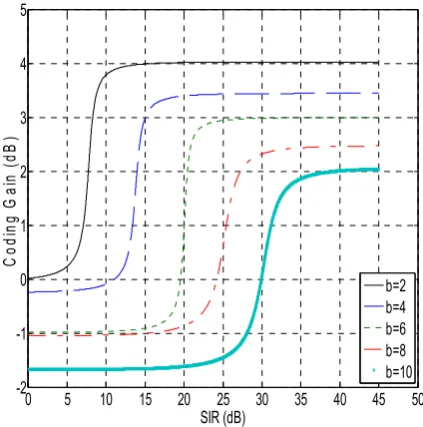
Fig 3. Coding gain as a function of SIR for different constellation sizes
Figs. 1 and 2 show the efficiency function and the normalized user utility without the effect of coding as a function of the SIR for different choices of b. It is observed that the user’s utility is maximized when b = 2(i.e., QPSK modulation). This is because, as b increases, the linear increase in the throughput is dominated by the exponential increase in the required transmit power (which results from the exponential increase in SIR). Therefore, it is best for a user to use QPSK modulation. Fig 3 shows the variation of coding gain as a function of SIR. The BER curves are used to estimate the coding gain as a function of SIR for various values of constellation sizes.
Gb(γ) = Ab+ Cbtan−1 ((γ−¯γb)/Db)
The above function gives a reasonable estimate of coding gain. Ab, Cb, ¯γb, Db are constants and their values can be determined by trial and error method.
VII. CONCLUSION
542
[1] S. Hara and R. Prasad, “Overview of Multicarrier CDMA”, IEEE Communication Magazine, pp. 126-133, Dec. 1997.
[2] A.Chouly, A. Brajal and S. Jourdan, “Orthogonal Multicarrier Technique Applied to Direct Sequence Spread Spectrum CDMA Systems”, GLOBECOM’93, Houston, TX, pp. 1723-1728, Nov. 1993. [3] A.B.Mackenzie and S.B. Wicker, “Game theory in communications Motivation, explanation and application to power control,” IEEE Proceedings Global Telecommunications conference (Globecom), pp.821-826, San Antonio, TX, USA, 2001.
[4] D. J. Goodman and N. B. Mandayam, “Power control for wireless data”, IEEE Personal Communications, vol.7, pp. 48-54, April 2000. [5] M.Xiao, N.B.Shroff and E.K.P. Chong, “A utility-based power
control scheme in wireless cellular systems,” IEEE/ACM Transactions on Networking, vol 11, pp.210-221, April 2003. [6] C.Zhou, M.L. Honig and S.Jordan, “Two-cell power allocation for
downlink CDMA,” IEEE Transactions on Wireless Communications, vol. 5, pp.2256-2266, November 2004.
[7] F.Meshkati, M.Chiang, H.V. Poor and S.C. Schwartz, “A game theoretic approach to energy-efficient power control in multicarrier CDMA systems,” IEEE journal on Selected areas in Communications
(JSAC), vol. 24, pp.1115-1129, June 2006.
[8] R. Liu, E.G. Chester, B. S. Sharif and S.J. Yi, ”Performance of Asynchronous Multicarrier CDMA Multiuser Receiver over Frequency Selective Multipath Fading Channels,” PIMRC’03, vol 2, pp. 1536-1540, Sept. 2003.
[9] T.Yoo, R.J Lavery, A.J. Goldsmith and D.J> Goodman, “Throughput Optimization using adaptive techniques,” to appear in IEEE Communication Letters.
[10] C.Zhou, M. L. Honig and S.Jordan, “Two cell power allocation for downlink CDMA,” IEEE Transactions on Wireless Communications, vol. 5, pp. 2256-2266, November 2004.
[11] T. Alpcan, T. Basar, R. Srikant and E. Altman, “CDMA uplink power control as a non cooperative game,” Wireless Networks, vol.8, pp. 659-669, November 2002.
[12] C.W. Sung and W.S. Wong, “ A non cooperative power control game for multirate CDMA data networks,” IEEE transactions on Wireless Communications, vol. 2, pp. 186-194, January 2003.
[13] V.M. DaSilva and E. S. Sousa, “Performance of Orthogonal CDMA Codes for Quasi-Synchronous Communication Systems,”
Proceedings of IEEE ICUPC ’93, Ottawa, Canada, Oct. 1993, pp.995-99.
[14] E. Sourour and M. Nakagawa, “Performance of Orthogonal Multicarrier CDMA in a Multipath Fading Channel,” IEEE Transactions Communication, vol. 44, no.3, Mar. 1996, pp.356-67 [15] C.U. Saraydar, N.B. Mandayam and D.J. Goodman, Efficient power
control via pricing in wireless data networks,” IEEE Transactions on Communications, vol. 50, pp. 291-303, February 2002.