797
An application of Structural Equation Modeling for
Continuous Improvement
Yehun Xu1, 2, Carlos Llopis-Albert3, and J. González4
1
State Key Laboratory of Hydrology-Water Resources and Hydraulic Engineering, Hohai University, Nanjing, 210098, PR China
2
Business School, Hohai University
Jiangning, Nanjing, 211100, China; [email protected] 3 Universitat Politècnica de València, CITV, Campus Vera s/n
Valencia, 46022, Spain; [email protected] * Corresponding Author
4 Department of Business Administration, Universitat Politècnica de València, Campus Vera s/n, Valencia, 46022, Spain; [email protected]
Abstract. More and more firms are adopting Web 2.0 technologies for different purposes. Despite some studies about the impact on different aspects of the organization of these technologies, few studies have empirically tested their effects. This study confirms that the there is a positive relationship between Web 2.0 adoption and Innovativeness and between Innovativeness and Business Performance. We can conclude that Innovativeness is a mediating variable between Web 2.0 and Firm Performance. The relationships were tested in a sample of 244 hospitality firms, using a structural modeling approach. The results are presented and discussed. In the last section of the article, the conclusions are discussed and finally, some future lines of research are suggested.
Keywords: Web 2.0, Innovativeness, Organizational Performance, Hospitality firms.
1.
Introduction
Innovation has been regarded as a source of sustainable competitive advantage and positively related to firm performance by several authors [1-3]. Innovativeness or the firm´s capacity to innovate is more important in the current dynamic and turbulent markets, in which firms need to constantly develop or adapt their products to the changing demands of their consumers. This challenge brings along the need to improve the firm´s capacity to collect and process external information and to share it within the firm.
On this realm, Web 2.0 technologies are revolutionizing different aspects in the organization, and are fostering collaboration, communication and participation; which has caught the attention of managers and researchers.
addition, due to the characteristics of Web 2.0 technologies, even universities and faculty members are using them to support different aspects of higher education [2-3]. Since Web 2.0 technologies are easy to use, more and more people have started to use them for different purposes, both in their personal life and at work. Some authors have analyzed the impacts of Web 2.0 adoption in specific aspects of the organization. However, there a few empirical studies, and to our knowledge only one that analyzes empirically the relationship between Web 2.0 adoption and entrepreneurial orientation.
The purpose of this study is, to analyze the relationships among Web 2.0 adoption, innovativeness and performance. Based on the results reported so far in the literature, we believe that the use of Web 2.0 technologies might positively influence business performance through innovativeness. Later in the paper we will theoretically explain our assumption.
In order to fulfill our purpose we need to achieve the following objectives:
To briefly review the existing literature about, Web 2.0, innovativeness and performance.
To theoretically establish the relationships among the variables To empirically test the relationships
To discuss the results and their implications
The document is organized in various sections. The first section, reviews the literature about Web 2.0 technologies, innovativeness and business performance. Once each variable is reviewed, we will theoretically support the relationships. The second section, describes the data and the method employed to test the relationships. The third section, presents the results and the final section, discusses the conclusions and suggests future lines of research.
2.
Literature review
2.1. Web 2.0
O´Reilly [2] refers to Web 2.0 as a new version of the internet and technologies that are able to promote collaboration and communication. In this version of the internet most of the content is generated by users. There are various definitions of the term Web 2.0. One of them argues that Web 2.0 is ‘a new philosophy that emphasizes collective intelligence, active participation and collaboration2.
Web 2.0 can be seen from four perspectives and it has three main characteristics [3]. The four perspectives are: technological, sociological, economical and legal. From a technological perspective, Web 2.0 tools allow information to be used in new ways. From a sociological perspective Web 2.0 increases social interaction. From an economical perspective, Web 2.0 enables and requires new business models. Finally, from a legal perspective, Web 2.0 brings new legal issues to the Web. The three main characteristics of Web 2.0 are: collaboration, participation and openness.
written in a chronological order by one or more authors. Wikis are more a structured Web sites, were users participate adding, editing or erasing information [3]. One of the most famous Wiki is the Wikipedia.
Podcasts are audio files that can be reproduced in a computer, Ipod or any other audio player. The most used format is MP3. RSS or really simple syndication, allows user to receive updates about the content of web pages, such as a news paper web site.
A social network is a Web portal where the users, previously registered, can create a personal profile and contact other users who want to share digital contents. Facebook is one of the most known social networks. Online social networks have become a relevant phenomenon in order to create sound relationships, in a personal and professional way.
It is also necessary to highlight that in all the interaction process between the customer and the software application, the customer should receive all the necessary information in order to perceive a high quality service. In this sense, CEM processes (Customer Experience Management) have been developed, based on the experience of a customer using a product or service.
Various studies about the effects, possible implications and uses have been published in the last years. We will briefly discuss some of the most important findings about Web 2.0 adoption by firms.
Some studies point out that Web 2.0 technologies have a strong bottom-up element and engage a broad base of workers, which in turn, is expected to improve participation and collaboration within the firm3. Among the implications of Web 2.0 adoption in the marketing field we have: Built of innovative brands, viral marketing campaigns, consumer behavior and direct marketing [4-5].
Others papers report the implications of Web 2.0 on knowledge management [10], organizational learning [4], organizational innovation4 and entrepreneurial orientation [5].
Some web 2.0 applications that have failed due to they have used many channels for a client, but they have not used the channels in an integrated way. It is not possible to generate synergies if they do not transmit a brand image during all the stages. Secondly, it is necessary to develop a long-term relationship with the client. Firm should not only use a transactional approach, but it should develop processes that let the client interact continuously with the firm. There are some applications such as CRM (Customer Relationship Management) solutions, that include the processes related to customer management, and they help to build confidence with clients in the long-term.
2.2. Innovativeness
In the literature, different types of innovations are distinguished such as: product, process, technology and organizational and market innovation [3, 21, 19].
There are various determinants of innovation. According to some authors these antecedents can be grouped in: external determinants, context variables, organizational, individual and group determinants [22].
Finally, various authors report that innovation positively effect, business processes, competencies, financial performance and competitiveness [23].
Innovativeness on the other hand, is somewhat different from innovation because it is a characteristic of an organization [24], some authors refers to it, as the capability of a firm to innovate [25], which implies the generation of new ideas, products, services or processes [26].
Other authors have defined innovativeness as the openness to new ideas [27]; and yet others as the rate of innovation adoption or the organization´s will to change [28].
2.1 Business Performance
Business performance is the variable of the most interest for researchers. Its measurement is essential for both, managers and researchers to know where the firm stands versus its rivals and how the firm is performing. In general, business performance has been consistently considered as a dependent variable. For instance, a review of 439 studies in a period of three years, the variable acted as a dependent variable [29].
According to some authors [30], business performance is composed of three specific areas: financial performance, market performance and return for stockholders. In addition, it is argued that business performance is a multidimensional theoretical construct; therefore, it should be measured in multiple dimensions [31].
There are two different groups of measures to evaluate business performance, objective and subjective. An objective measure is a real and current number about the firm, for instance sales growth. On the other hand, the term subjective is used to mean that the company’s performance score is derived using a scale with anchors such as “much lower” to “much higher” compared to competitors [32]. Finally, it is pointed out that subjective evaluations allow more flexibility and consistency that cannot be obtained by objective measures [33].
2.2 Theoretical relations
In order to theoretically establish the relationship among the variables of interest, we will review previous studies that link information technologies with organizational learning —an important antecedent of innovation—, knowledge management processes and innovation, web 2.0 and organizational learning, web 2.0 and entrepreneurial orientation and finally, innovativeness and business performance.
antecedent to an innovation orientation [30], and similarly, other results have supported that learning orientation is critical for innovation and performance [31].
With regards to the relationship between knowledge management and innovation, among the various studies, one of them concluded that knowledge management components do correlate with innovation, that is, a firm with a capability in knowledge management can also be more innovative [2]. Another study indicated that employees´ willingness to both donate and collect knowledge is related to firm innovation capability [38].
Studies about Web 2.0 and its adoption, affirm that they have a positive effect on organizational learning, knowledge sharing and innovation. First of all, it has been argued that the development of systems, combining social (e.g. Web 2.0 applications) and technical systems could provide an effective solution to the problem of knowledge sharing [39].
Regarding organizational learning, a recent study [40] affirm that Web 2.0 “has the potential not only to improve individual and team learning, but also to promote organizational learning resulting in higher levels of performance”. These technologies have the potential to support both, generative and adaptive learning in the organization.
At last, it has been reported that Web 2.0 adoption might has an impact on some aspects of innovation such as: organize innovation, improve research and development success, increase the number of innovation initiatives [41] and productize innovations more effectively [4]. A recent study tested the relationship between Web 2.0 adoption and entrepreneurial orientation [17]. In the mentioned study, the authors argued that entrepreneurial orientation is composed of five dimensions: Innovativeness, Proactiveness, Risk taking, Autonomy and Competitive aggressiveness. Based on the results of the study the authors affirmed that there is positive relationship between Web 2.0 adoption and entrepreneurial orientation and more specifically they pointed out that Web 2.0 adopters showed a stronger mindset for innovation.
As presented in the discussion above, previous studies have established and tested the relationship between organizational learning with innovativeness and the link between knowledge management and innovativeness. Since Web 2.0 adoption is related to both, organizational learning and knowledge sharing it is plausible to infer that Web 2.0 adoption might be related to innovativeness. Finally, in a recent study the liaison between Web 2.0 adoption and entrepreneurial orientation was tested. The entrepreneurial orientation operationalization included innovativeness as a dimension. As a consequence we formulated the first hypothesis as:
H1: There is a positive relationship between the adoption of Web 2.0 technologies and innovativeness.
The relationship between innovation and performance and more specifically innovativeness with performance has been previously studied by several authors. Some empirical findings confirmed that innovativeness is a key determinant of business performance [39]. Others authors also found a positive relation between firm innovativeness with firm performance [31]. Finally, technical and administrative innovations have a positive and direct impact on performance [42].
H2: Innovativeness is positively related with business performance.
3.
Measurement Data and Sample
3.1. Measurement
Web 2.0 adoption measurement
There are few validated scales in the literature about Web 2.0 adoption. However some authors27 have developed and validated a scale. This scale is composed of 8 items that are measured on a five-point Likert scale, where 1 = never, 3 = sometimes, and 5 = always. The items are:
WA1: Blogs are used to issue firm release or to spread ideas.
WA2: Firm uses collaborative software to communicate with the rest of employees.
WA3: Firm uses an intranet for knowledge management.
WA4: The site of the firm allows users to introduce contents and express their necessities.
WA5: Employees know suggestions that customers formulate.
WA6: The site of the firm has, apart from text, multimedia files to enable the interaction with the user.
WA7: Firm develops practices so that employees share their knowledge. WA8: Employees keep the know-how of the processes in an electronic way.
Innovativeness measurement
There are several scales to measure innovativeness. One of the first scales was developed in 1977 [5]. The scale that was chosen in this study was developed in 2002 by Calantone [28]. The scale is based on previous studies and six items composed it. The items are measured on a seven-point Likert scale where 1 = strongly disagree and 7 = strongly agree.
The items are:
I1: Our Company frequently tries out new ideas. I2: Our Company seeks out new ways to do things. I3: Our Company is creative in its methods of operation.
I4: Our Company is often the first to market with new products and services. I5: Innovation in our company is perceived as too risky and is resisted. I6: Our new product introduction has increased over the last 5 years.
Business performance measurement
compare to our competitors; 3=equal to our competitors and 5=much higher compare to our competitors
BP1= Product or service quality BP2= New product or service success BP3= Client retention rate
BP4= Sales level BP5= Return on equity BP6= Gross profit margin BP7= Return on investment
3.2. Data and Sample
The questionnaire was sent to Spanish four and five starts hotels that provided their e-mail on the Spanish tourism web page. Between January and July of 2010, we received 255 questionnaires; however 11 were eliminated due to different faults, leaving a total sample of 244. The response rate gave us a sample error of 6 percent for a confidence level of 95 percent.
According to the two step approach for structural equation modeling, first we estimated the measurement modeling using confirmatory factor analysis (CFA) and then we estimated the structural model. We used EQS 5.7 to conduct the tests.
4.
Results
According to the method employed first, we will present the confirmatory factor analysis on the entire set of measurement items.
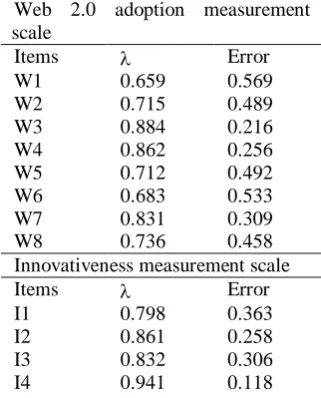
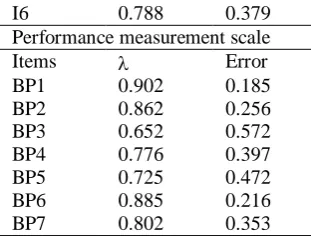
This step resulted in the elimination of 1 item of the innovativeness scale. The factor loading magnitudes are presented in Table I.
Table I. Factor loadings magnitudes and measurement errors
Web 2.0 adoption measurement scale
Items Error
W1 0.659 0.569
W2 0.715 0.489
W3 0.884 0.216
W4 0.862 0.256
W5 0.712 0.492
W6 0.683 0.533
W7 0.831 0.309
W8 0.736 0.458
Innovativeness measurement scale
Items Error
I1 0.798 0.363
I2 0.861 0.258
I3 0.832 0.306
I6 0.788 0.379 Performance measurement scale
Items Error
BP1 0.902 0.185
BP2 0.862 0.256
BP3 0.652 0.572
BP4 0.776 0.397
BP5 0.725 0.472
BP6 0.885 0.216
BP7 0.802 0.353
The estimated parameters are statistically significant at a 95% confidence level (t>1.96). The factor loading magnitudes are between 0.652 and 0.941, which are high and above the minimum required of 0.4. The construct´s scales presented a high compound reliability. For the Web 2.0 adoption scale a compound reliability of 0.88, for the Innovativeness scale a compound reliability of 0.89 and for the Business performance scale a compound reliability of 0.89.
4.1. Empirical testing of the hypotheses
H1: The results confirm and adequate global fit, so we can consider the model an adequate representation of the causal relationship between the studied latent variables.
The absolute goodness fits are excellent. The Chi2 Satorra-Bentler is significant 13.74 for 13 degrees of freedom and the RMSR is 0.019. The incremental goodness fit indicators are according to satisfactory levels, where BB NNFI is close to 1 The GFI index is 0.997, and the parsimonious goodness fit indicator NC is 1.11.
Table II. Coefficient and reliability index for the structural model
Equation Coefficient γ Reliability of the structural equation
0.762 0.911
The estimated parameter in Table II is statistically significant at a 95% confidence level (t=29.124≥1.96). The equation coefficient and the reliability of the structural model show an adequate fit; therefore, we could confirm a positive and statistically significant relationship between Web 2.0 adoption and innovativeness.
H2: The Chi2 Satorra-Bentler is significant with a value of 31.61 for 32 degrees of freedom. The incremental goodness fit indicators reached satisfactory levels, where BB NNFI and IFI are close to 1. The parsimonious goodness fit indicator (NC) does not present a good adjustment but it is near one (0.951)
5.
Conclusions and Future Research
The purpose of this study was to analyze the relationships among Web 2.0 adoption, innovativeness and performance. To do so, we first conducted a literature review about the variables of interest. Afterwards we theoretically established the relationships among the variables. Based on, previous studies, we argued that Web 2.0 adoption is related to innovativeness, since it could improve knowledge and cognitive processes of the organization and since these aspects are related to innovation, we assumed that Web 2.0 adoption could be related with innovativeness. Then we theoretically sustained the link between innovativeness and performance, a relationship previously studied by several authors.
Based on the empirical analysis, using a structural modeling approach on 244 Spanish firms, we tested the relationships. The results supported the relationships between Web 2.0 and innovativeness and between innovativeness and business performance.
The findings of the present study have several implications for both, researchers and managers. For researchers the results contribute to the understanding of the effects that Web 2.0 adoption has on a very important organizational aspect such as innovativeness. In addition, some of the previous reported impacts of Web 2.0 on innovation, to certain point, now are confirmed, which open additional questions about the effects of Web 2.0 on other organizational variables.
Managers should encourage the adoption of Web 2.0. To do so, managers must decide first which aspect of the organization they want to improve and then they should decide about the Web 2.0 technology that has a positive impact on the chosen aspect. The results indicate that in general these technologies could improve knowledge sharing, organizational learning and innovativeness.
On the other hand, once more it is proven that innovativeness is very important to sustain competitive advantage and that it has a direct and positive effect on performance. Therefore, managers are advised to constantly increase the firm´s capacity to innovative, if they want to achieve a better performance.
We should recognize some limitations in this study. The first, the cross sectional nature of the study impeded the assessment of other effects of Web 2.0 adoption; we believe that a longitudinal analysis could reveal other effects. The scale used to the measure Web 2.0 adoption is composed of 8 items; however not all the technologies are included, it could be interesting to analyze the effect of other technologies. Another limitation is related to the single industry used in the study; therefore, generalizations about the study are not advisable until the relationships in other industries are tested.
References
1. W.E. Baker and J.M. Sinkula: The synergistic effect of market orientation and learning orientation on organizational performance. Journal of Academy Market Science, Vol. 27, 411-427. (1999).
2. J. Darroch: Knowledge management, innovation and firm performance. Journal of Knowledge Management, Vol. 9, 101-115. (2005).
3. J. M. Utterback; W. J. Abernathy: A Dynamic Model of Process and Product Innovation. Omega, Vol. 3, No. 6, 639-656. (1975).
4. S. Andriole: Business Impact of Web 2.0 Technologies. Communications ACM, Vol. 53, 67-79. (2010).
5. Y. Koçak; S. Güzin: Adoption of Web 2.0 tools in distance education. International Journal of Human Science, Vol. 6, 75-89 (2009).
6. D. Churchill: A teacher’s reflections on educational applications of blogs with a postgraduate class. International Journal of Continuing Engineering Education and Life- Long Learning, Vol. 19, Nos. 2/3, 112–125. (2009).
7. T. O´Reilly: What Is Web 2.0: Design Patterns and Business Models for the Next Generation of Software (2005).
8. S. Lim; D. Palacios-Marques: Culture and purpose of Web 2.0 service adoption: a study in the USA, Korea and Spain, Services Industries Journal, Vol. 31, No. 1, 123-131. (2011).
9. S. Lee; D. DeWester; S. Park: Web 2.0 and opportunities for small businesses, Service Business, Vol. 2, 335-345. (2008).
10. M. Levy: Web 2.0 implications on knowledge management, Journal of Knowledge Management, Vol. 13, 120-134. (2009).
11. M. Chui; A. Miller; R. Roberts: Six ways to make Web 2.0 work, McKinsey Quarterly, (2009).
12. E. Constantinides; S. J. Fountain: Web 2.0: Conceptual foundations and marketing issues, Journal Direct Data Digital Marketing Practice, Vol. 9, No. 3, 231–244. (2008).
13. G. Masurek: Web 2.0 Implications on Marketing, Management Organization Systems Research, Vol. 51, 69-82. (2009).
14. R. Boateng; A. Malik; V. Mbarika: Web 2.0 and Organizational Learning: Conceptualizing the Link, AMCIS Proceedings, 546. (2009).
15. N. Choi; L. Horowitz; K. Huang: Web 2.0 Use and Organizational Innovation: A Knowledge Transfer Enabling Perspective, AMCIS Proceedings, (2010).
16. S. Lim; S. Trimi; H. Lee: Web 2.0 service adoption and entrepreneurial orientation, Service Business, Vol. 4, 197-207. (2010).
17. V. A. Thompson: Bureaucracy and Innovation, Administrative Science Quarterly, Vol. 10, No. 1, 1-20. (1965).
18. OECD-EUROSTAT: The Measurement of Scientific and Technological Activities. Oslo Manual. Guidelines for Collecting and Interpreting Innovation Data, Third Edition (Paris: Organisation for Economic Co-operation and Development Eurostat, Paris, (2005). 19. R. M. Walker; F. Damanpour and C.A. Devece: Management Innovation and
Organizational Performance: The Mediating Effect of Performance Management, Journal of Public Administration Research Theory, Vol. 21, 367-386. (2011).
20. S. Gopalakrishnan; F. Damanpour: A review of innovation research in economics, sociology and technology management, Omega, Vol. 25, 15-28. (1997).
21. J. R. Kimberly; M. J. Evanisko: Organizational Innovation: The Influence of Individual, Organizational, and Contextual Factors on Hospital Adoption of Technological and Administrative Innovations, Academy Management Journal, Vol. 24, 689-713. (1981). 22. M. Crossan; M. Apaydin: A multi-dimensional framework of organizational innovation:
23. T. H. Aas; P. E. Pedersen: The Firm-Level Effects of Service Innovation: A Literature Review, International Journal Innovation Management, Vol. 14, 759-794. (2010). 24. A. J. Johnson; C. C. Dibrell; E. Hansen: Market Orientation, Innovativeness, and
Performance of Food Companies, Journal of Agribusiness, Vol. 27, 85-106. (2009). 25. A. Subramanian, Innovativeness: Redefining the concept, Journal Engineering
Technology Management, Vol. 13, 223-243. (1996).
26. S. H. Hsu: Human Capital, Organizational Learning, Network Resources and Organizational Innovativeness. Total Quality Management and Business Excellence, Vol. 18, 983-998. (2007).
27. R. F. Hurley; T. M. Hult: Innovation, Market Orientation, and Organizational Learning: An Integration and Empirical Examination, Journal of Marketing, Vol. 3, 42-54. (1998). 28. R. J Calantone; S. T Cavusgil; Y. Zhao: Learning orientation, firm innovation capability,
and firm performance, Industrial Marketing Management, Vol. 31, No. 6, 515–524. (2002).
29. J. G. March and R. I. Sutton, Organizational Performance as a Dependent Variable, Organization Science, Vol. 8, 698-706. (1997).
30. P. J. Richard; T. M. Devinney; G. S. Yip; G.Johnson: Measuring Organizational Performance: Towards Methodological Best Practice, Journal of Management, Vol. 35, 718-804. (2009).
31. J. Eskildsen; A. H. Westlund; K. Kristensen: The predictive power of intangibles: Measuring Business Excellence, Vol. 7, 46-54. (2003).
32. J. Dawes: The relationship between subjective and objective company performance measures in market orientation research: further empirical evidence. Marketing Bulleting-Department of Marketing Massey University, Vol. 10, 65–75. (1999).
33. G. G. Dess; R. B. Robinson: Measuring Organizational Performance in the Absence of Objective Measures: The Case of the Privately-held Firm and Conglomerate Business Unit, Strategic Management Journal, Vol. 5, 265-273. (1984).
34. G. C Kane; M. Alavi: Information technology and organizational learning: An investigation of exploration and exploitation processes, Organization Science, Vol. 18, 796–812. (2007).
35. W. E. Baker; J. M. Sinkula: Learning Orientation, Market Orientation, and Innovation: Integrating and Extending Models of Organizational Performance, Journal Market Management, Vol. 4, 295-308. (1999).
36. G. Hult, R.F Hurley and G.A Knight: Innovativeness: Its antecedents and impact on business performance, Industrial Market Management, Vol. 33, 429–438. (2004). 37. D. Jiménez-Jiménez; R. Sanz-Valle: Innovation, organizational learning, and
performance, Journal of Business Research, Vol. 64, 408-417. (2011).
38. H. F Lin: Knowledge sharing and firm innovation capability: An empirical study, International Journal of Manpower, Vol. 28, 315–332. (2007).
39. K. Patrick; F. Dotsika: Knowledge sharing: developing from within, Learning Organization, Vol. 14, 395–406. (2007).
40. M. London; M. J. Hall: Web 2.0 support for individual, group and organizational learning, Human Resource Development, Vol. 14, 103-113. (2011)
41. J. K. Han; N. Kim; R. K. Srivastava: Market Orientation and Organizational Performance: Is Innovation a Missing Link?, Journal of Marketing, Vol. 62, 30-45. (1998).
42. G. Prause; D. Palacios; F. Garrigós: What happens if a hotel introduces Web 2.0?, (presented at the International Conference of the Network of Business and Management Journals Proceedings, Valencia, Spain, (2010).
44. C. Nakata; Z. Zhu; M. L. Kraimer: The Complex Contribution of Information Technology Capability to Business Performance, Journal of Management Issues, Vol. 20, 485-506. (2008).
Yejun Xu was born in 1979. He received an MS degree in 2005 and Ph.D degree in 2009 both in management science and engineering from SouthEast University, Nanjing, China. He is currently an associate professor with the Business School of Hohai University, Nanjing, China. He has contributed over 50 journal articles to professional journals such as Fuzzy Sets and Systems, Information Sciences, International Journal of Approximate Reasoning, Knowledge-Based Systems, Soft Computing, Applied Soft Computing, Applied Mathematical Modelling, International Journal of Computational Intelligence Systems, Expert Systems with Applications, International Journal of Uncertainty, Fuzziness and Knowledge-Based Systems, Journal of Systems Engineering and Electronics, etc. His current research interests include multicriteria decision making, computing with words, and information sciences.
C. Llopis-Albert received the MSc in industrial engineering and the PhD degree (with Extraordinary Award) in Hydraulic and Environmental Engineering at Universitat Politècnica de València, Spain. He works as an adjunct faculty in the Department of Mechanical Engineering at Universitat Politècnica de València and as senior researcher at Geological Survey of Spain. He has published tens of papers on different research areas in top journals, books and conference proceedings. He is on the editorial board of several journals and scientific committees and serves as a reviewer in a wide range of journals. He has been involved in several multidisciplinary national and international research projects. His research focuses on mathematical modeling and numerical analysis in different fields such as mechanics, water resources, environmental science and economics. Special attention is paid to the integration of those fields.
Dr. Joaquín González-Garcia is currently a Tenured Associate Professor of the Department of Business Organization at the Universidad Politécnica de Valencia (U.P.V.) Spain. He is Bachelor with Honours in Electronic Engineering (BEng (Hons)) from Middlesex University of London U.K. . He is a Chartered Engineer (CEng), Member of the U.K. professional body Institution of Engineering and Technology (I.E.T.)(formerly The Institution af Electrical and Electronic Engineers) (M.I.E.T.).He worked for I.B.M. as a Quality Engineer (Q.E.) in the Engineering Department at Valencia´s Manufacturing Plant. He is a PhD in Industrial Engineering from Universidad Politécnica de Valencia (U.P.V.) Spain. Graduate in Law from The University of Valencia (U.V.) and a Member of the Lawers Professional Body (I.C.A.V.).