fo r m a tiv e f e e d b a c k i n t e r v e n ti o n , t o s u p p o r t a c a d e m i c lit e r a cy.
P r a c ti tio n e r R e s e a r c h in H i g h e r E d u c a tio n , 8 ( 1). p p . 7 4-8 8 .
Do w n l o a d e d fr o m : h t t p ://i n si g h t . c u m b r i a . a c . u k /i d/ e p ri n t/ 1 4 9 3 /U s a g e o f a n y i t e m s f r o m t h e U n i v e r s i t y o f C u m b r i a’ s i n s t i t u t i o n a l r e p o s i t o r y ‘I n s i g h t ’ m u s t c o n f o r m t o t h e f o l l o w i n g f a i r u s a g e g u i d e l i n e s .
Any it e m a n d it s a s s o ci a t e d m e t a d a t a h el d i n t h e U niv e r si ty of C u m b r i a ’s in s ti t u ti o n al r e p o si t o r y I n si g h t ( u nl e s s s t a t e d o t h e r wi s e o n t h e m e t a d a t a r e c o r d ) m a y b e c o pi e d , di s pl ay e d o r p e rf o r m e d , a n d s t o r e d i n li n e wi t h t h e JIS C f ai r d e a li n g g ui d eli n e s ( av ail a bl e h e r e) fo r e d u c a t i o n al a n d n o t-fo r-p r ofi t a c tiviti e s
p r o v i d e d t h a t
• t h e a u t h o r s , ti tl e a n d full bi blio g r a p h i c d e t ail s of t h e it e m a r e ci t e d cl e a rly w h e n a n y p a r t
of t h e w o r k is r ef e r r e d t o v e r b a lly o r i n t h e w ri t t e n fo r m
• a h y p e rli n k/ U RL t o t h e o ri gi n al I n si g h t r e c o r d of t h a t it e m is i n cl u d e d i n a n y ci t a ti o n s of t h e w o r k
• t h e c o n t e n t is n o t c h a n g e d i n a n y w a y
• all fil e s r e q ui r e d fo r u s a g e of t h e it e m a r e k e p t t o g e t h e r wi t h t h e m a i n it e m fil e.
Yo u m a y n o t
• s ell a n y p a r t of a n it e m
• r e f e r t o a n y p a r t of a n it e m wi t h o u t ci t a ti o n
• a m e n d a n y it e m o r c o n t e x t u ali s e it i n a w a y t h a t will i m p u g n t h e c r e a t o r ’s r e p u t a t i o n
• r e m ov e o r a l t e r t h e c o py ri g h t s t a t e m e n t o n a n it e m .
T h e full p oli cy c a n b e fo u n d h e r e.
Citation
Burns, C., Foo, M. (2014) What are our international students telling us? Further explorations of a formative feedback intervention, to support academic literacy, Practitioner Research in Higher Education Journal, 8(1), January, 74-88.
74 What are our international students telling
us? Further explorations of a formative feedback intervention, to support academic literacy
Practitioner Research In Higher Education
Copyright © 2014 University of Cumbria Vol 8 (1) pages 74-88
Caroline Burns and Martin Foo Northumbria University
Abstract
This study reports on a further iteration of an action research cycle, discussed in Burns and Foo (2012, 2013). It explores how formative feedback on academic literacy was used and acted upon, and if a Formative Feedback Intervention (FFI) increased the students’ confidence in future assignments. It also considers whether the assignment of a grade was beneficial. Students were asked to give written reflections using Gibbs reflective model (1988) and later via a semi-structured questionnaire. In-depth interviews were also carried out to provide rich data. Findings suggest students are taking appropriate actions to close the gap (Sadler, 1989) in particular sharing with their peers. Feedback is reported to be an emotional experience; the grade assigned is highly valued and appears to be used for self-motivation. In addition, students raised the issue of the cultural adjustment they are making to bridge the gap between the teaching and learning of their home and new environment.
Keywords
Academic literacy; formative feedback; international students.
Introduction
Assessment and feedback is the area of most concern within the Higher Education sector; National Student Survey results indicate 72% satisfaction in this area compared with 85% overall student satisfaction (NSS, 2013). The Open University has the best ratings of 4.5 for overall satisfaction and 4.2 for feedback and assessment, with the figures for our institution at 3.9 and 3.4 respectively.
Survey findings show there is cause for concern about feedback to students on their progress and performance (Hounsell et al., 2008), and the NSS results have resulted in initiatives across the higher education sector. However, in this case, students had in previous years expressed concern about the timing of feedback, which was not received until the second semester. This study aims to build upon our previous evaluation of a Formative Feedback Intervention (FFI) which was piloted in 2009/10 and in subsequent years has been adopted module-wide both in the United Kingdom and overseas (Burns & Foo, 2012).
75 The authors of this study come from two different disciplines: Accounting and English for Academic Purposes (EAP), and are working together to enhance the learning of the students in one particular module: the Professional Development Project (PDP). Collaboration between EAP and subject lecturers is seen as a new challenge for UK universities (Wingate, Andon & Cogo, 2011).They are working towards an embedded model of academic literacy and transferable skills, including the development of students’ English language competence, regarded as critical by Arkoudis and Tran (2010).
Literature review
Gibbs and Simpson (2004) note that for a long time assessment in Higher Education was
characterised by a lack of transparency, and founded on tacit knowledge, ‘that which we know but cannot tell,’ (Polyani, cited by Elander, 2003:117) so the move over the last decade towards
assessment for learning, or even assessment as learning (Boyd & Bloxham, 2009), which encourages student involvement and engagement in the process, is to be welcomed.
Feedback is central to learning (Carless, 2007) as it is part of the scaffolding which helps students to learn and improve (Orsmond, Merry & Reiling, 2010). There is a considerable amount of research into formative assessment (see McDowell, Sambell, & Davison, 2009, for an overview). Black and Wiliam’s (1998) review revealed significant and consistent positive effects of formative feedback on student learning across a wide range of educational contexts. Similarly, Gibbs and Simpson (2004) reported feedback as having the single most powerful effect on student achievement. Hattie and Timperley (2007) note, however, that its effectiveness depends on how its type and how it is given.
The work of Sadler (1989) underpins much of the research; he identifies three necessary conditions for students to benefit. Firstly, students must possess a concept of the standard, or goal being aimed for; secondly, they must be able to compare their own work with this standard; and thirdly, they must engage in appropriate action which leads to some closure of the gap (Sadler, 1989:121). In order to take these actions, he argues, students must necessarily have some of the evaluative skills of their teacher, yet in the context of this study, with the vast majority being international students on one year ‘top-up’ degrees, new to the institution and to the country, this cannot be taken for granted.
Gibbs and Simpson (2004) and Nicol and Macfarlane-Dick (2006) provide very useful analyses of formative assessment and the conditions under which it promotes worthwhile learning. Both models are offered to teachers as a means to evaluate their own assessment practice, and were considered when designing this Formative Feedback Intervention (FFI).
Globalisation and the change from industrial economies to a global knowledge economy have dramatically increased the demand for Higher Education across the world (Gürüz, 2008,
Charlesworth, 2011). Anglophone countries are host to more than half of all international students, a major reason being that English is now the global lingua franca, or, the Latin of the 21st century (Altbach, 2004). The UK as the second largest host, following the USA, can be attributed to a number of factors, including colonial connections, institutional reputations and its active international student recruitment policy (Gürüz, 2008).
76 Charlesworth (2011) argues that internationally mobile students bring with them expectations and familiarity with their own country-specific pedagogical practices. Although these are not easily shrugged off, she argues that students do work hard to adapt their concepts and approaches to achieve success in the new environment. Charlesworth’s study provides evidence for the idea that there are different learning style preferences between students of Eastern versus Western origin, though she warns against assuming that all Asian or all European students are the same. Using an adaptation of Honey and Mumford’s Learning Styles Questionnaire, she found, perhaps
unsurprisingly, the Eastern sample had a lower preference for the activist style and a higher preference for the reflector style.
According to Charlesworth, problems occur when learning styles are misinterpreted in the classroom by the educator, for example when ‘reflector’ is misinterpreted as ‘passive’, which has negative connotations. The idea that International students are ‘lacking’ has been called the ‘deficit’ approach (Wingate, 2006). Perhaps a fairer explanation is that some of their skills that worked in their home institutions are valued less in their UK institutions (Volet, 1999). Charlesworth (2011) advocates a deeper understanding of students’ learning cultures and awareness-raising of these cultural issues with the students themselves as a way of improving the learning experience.
A study of 45 international students on one year Masters Programmes by Robson et al. (2013) revealed a tension between what students wanted from feedback and the types that are commonly given. One source of tension was that students considered feedback from their tutor as more valuable than others, such as peer assessment or self assessment, implying that they wanted tutors to take more control over their learning, whilst staff encouraged students to take more control of learning themselves. Robson et al. (2013) draw on Bernstein’s notion of a pedagogic device suggesting that student – teacher relationships are influenced by power relationships in their countries of origin, which are challenged in the new environment. They note the importance of formative dialogue in order to bring cultural issues out in the open which might allow students to make choices about how to respond to feedback opportunities.
The problems outlined above have resonance with the authors of the present study, who sought to improve the learning and achievement of final year direct-entrant undergraduates in a Business School in the North of England by introducing formative assessment early in the academic year. In this context, timeliness and the development of academic literacy were key concerns.
The study comes from a social constructionist perspective, in the sense that feedback messages are not assumed to be simply transmitted from teacher to student, but that messages are jointly created between student and teacher, and are complex and difficult to decipher (Nicol & MacFarlane-Dick, 2006). Furthermore, feedback messages are socially situated within power relations of learning and teaching and struggle for identity (Sutton & Gill, 2010) and within a wider unequal world order (Altbach, 2004).
Module background and intervention
The PDP was developed for final year direct entrant students as an alternative to the traditional dissertation. As a 30 credit module running over two semesters, via weekly workshops, more contact time is available. The PDP comprises two parts: Part A is a reflective piece of writing entitled ‘Who am I as a Learner?’ and Part B, requires a critical investigation of a topic important to the students’ future occupation. The summative assessment of around 10,000 words, represents 25% of the final degree classification.
77 Our earlier research showed that many international students had little or no experience of many of the academic skills required by this and other modules of independent research, extended academic writing and critical evaluation of source material (Burns & Foo, 2011). Significantly, before the FFI was introduced, students had expressed concern at the timing of formal feedback, none of which came in the first semester, so that semester one assignments were done ‘in the dark’ with the same skills deficit being punished in all assignments. Formal feedback typically arrived some three weeks into semester two (Higgins, Hartley, & Skelton, 2002) and when it was disappointing we noticed a devastating effect on the self-belief and motivation of some individuals, which is recognised by Nicol and MacFarlane-Dick (2006).
Our response to these problems was to design an intervention (FFI) which would give feedback on an ‘exploratory essay’ of around 1,500 words (Wingate et al., 2011), but which would involve academic skills that could in theory be applied to a range of other modules.
A matrix based on the school-wide marking criteria (McKeever et al., 2010) was adapted and
extended for our students whose first language is generally not English, and was used to indicate the current level of the student’s work, by circling the respective degree classification for the each criterion. The matrix, as seen in Table 1., shows students where they are – as evidenced by their exploratory essay – according to the four criteria and identifies the skills needed to reach the next level, i.e. the ‘gap’ referred to by Sadler (1989).
Class Knowledge and understanding
Theory and practice recognition
Use of resources and references Presentation, structure and language Lower Second (50-59) Sound comprehension of topic. Awareness of concepts and critical appreciation are apparent, but the ability to
conceptualise, and/ or apply theory is slightly limited. Sound evidence of critical thinking as applied to theory /practice links.
Sound use of a range of academic resources, although some may be less relevant. Few referencing errors.
Although it may be patchy in places, on the whole the structure and flow of work is appropriate. Some grammatical and spelling errors occur, but do not adversely affect the meaning of the work. Adequate use of vocabulary and style.
Table1. FFI criteria (extract)
During workshops ‘threefold feedback’ was given via:
1. annotations on the essay itself, alongside
2. the circled indication of degree performance across the four FFI criteria 3. one-to-one tutorial
Having a one to one dialogue between student and teacher is highly valued by students (Murtagh & Baker, 2009, Arkoudis & Tran, 2010, Wingate et al., 2011; Robson et al., 2013).
78 these criteria is vital if students are to develop the necessary evaluative skills to become self
regulated learners (Nicol & MacFarlane-Dick, 2006) and to be able to close the gap (Sadler, 1989).
Objectivity, clarity and transparency are considered to be essential elements of a fair and valid system of assessment (Sambell, McDowell & Brown, 1997, cited by Hockings, 2010). As Hockings (2010) notes, these principles underpin much of the assessment research and quality assurance literature but they are subject to criticism from some scholars. The claim that pre-set marking criteria increase the openness for students and increase objectivity in grading is questioned by Sadler (2009, cited by Hockings, 2010). Bloxham (2007) warns against grading students on only ‘tacitly understood’ criteria, and Orr (2007, both cited by Hockings, 2010) takes a post-positivist stance, asking who benefits, and who is disadvantaged by the emphasis on measurement and objectivity? Whilst we take these concerns on board, for the moment our students are graded on the school-wide criteria and we sought to ensure that they understood this, and could relate it to their own work.
The decision to use the matrix aligned to the school criteria meant that, in addition to the feedback, a grade was also given, since otherwise it could have easily been inferred. This caused some
deliberation on our part, since there is evidence that if a grade is given, less attention is given by students to the comments. Furthermore, giving a grade is likely to lead to ego involvement on the part of the student, and can encourage competition rather than cooperation (see Butler, 1988; Butler & Winnie, 1995, both studies cited by Nicol & MacFarlane-Dick, 2006). Lower than expected grades also run the risk of demotivating students as we had discovered with our own students in previous years.
Nevertheless, the effects of assigning a grade seem to depend on the context and the individuals involved. It is suggested that if grades are task-focussed rather than people-focussed, and care is taken to highlight what students can do to improve their work, grades can be helpful (Black & Wiliam, 1998). On balance, we decided that the use of the matrix and grade, accompanied by the annotated work and mediated with reassurance and guidance from the tutor, was more likely to enhance learning and motivation.
Research methodology and objectives
The FFI represented a further cycle of our on-going action research, designed to embed academic skills into the business school programmes, and generally ‘build a supportive learning environment’ (Arkoudis & Tran, 2010:174) for our students. The first stage of our study had been to gather information about our students, their prior learning experiences and their current needs (Burns & Foo, 2011). As well as giving a questionnaire to students, we observed each other’s teaching and engaged in post observation reflection and discussion, which at times led to modification of the curriculum. The need for the FFI emerged as a result of such discussions and from student feedback. Thus, we were moving from a phase of ‘what’s going on here?’ to ‘what happens if?’ question, which is a common process in action research (Lofthouse, Hall & Wall, 2012).
79 students’ ability to ask questions freely. This is particularly pertinent when working with
international students who bring with them cultural expectations of teacher student relationships, as noted earlier.
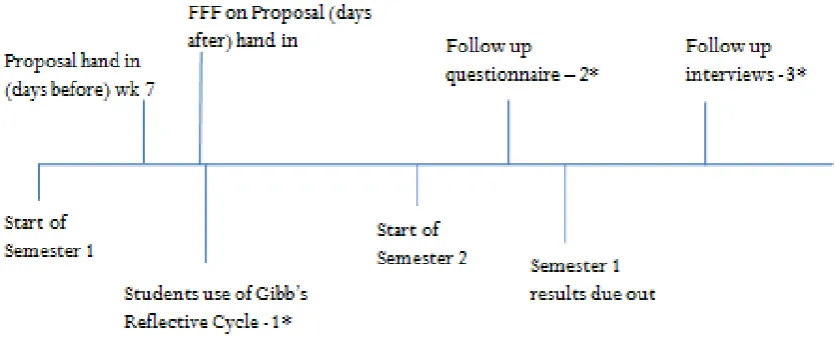
Building on two earlier cycles of action research, we wished to clarify several issues. First, although we expected student confidence to increase as a result of FFI the findings were not consistent. Second, students had previously been asked to give both their analysis of and actions taken in response to the FFI via Gibbs Reflective Cycle (1988) and the student response revealed little difference between the two. Finally, we sought the student perspective on this. So, this iteration reports the findings of stages 1 and 2 of the 2012/13 student evaluation of FFI as shown in the timeline on Figure 1. Additionally, we carried out a series of in depth interviews to explore the above issues further. Interviews are recognised by Zuber-Skerritt and Fletcher (2007:423) as one of a number of methods to be adopted by action researchers ‘to collect and analyse rich data from individuals and small groups’. The purpose was ‘to understand the world from the subjects’ points of view, to uncover their lived world prior to scientific experiences’ (Kvale & Brinkmann, 2009:1).
Our research questions were as follows:
1. How did students use the feedback? What actions, if any, did they take as a result? 2. Does the use of grades support the feedback process?
3. Did the FFI increase the students’ confidence in preparing for semester one assignments?
A number of new themes emerged from the data, and are reported in the stage 3 analysis. These are:
The students’ views of the face to face feedback An apparent lack of feedback from other modules A change in the students’ motivation
The students’ adjustment to the new learning environment
Data Collection
The data was collected in three stages, the first during the FFI intervention to capture the students’ initial experience (Gibbs, 1988). Following the one-to-one tutorial, the students were asked to give written reflections by completing a self-administered questionnaire, which aimed to elicit their immediate feelings, subsequent evaluation, analysis and actions. Students were invited to access the module’s website where the background details of the study, together with informed consent details were posted, in accordance with the university’s ethical policy; this resulted in 16 student responses.
The second stage involved a second questionnaire, handed out at the start of the second semester, when it was expected that the first semester’s assessments would be still fresh in the students’ minds. The aim was to find out whether the FFI had helped students to prepare them for summative assessments at the end of semester one, and whether they were feeling more confident as a result. Twenty two self-administered questionnaires were completed.
80 The data collection points are as shown in Figure 1.
Figure 1. Timeline of study.
Findings and analysis
The qualitative data was subjected to a thematic analysis, as outlined by Bryman (2008). Themes were identified on the basis of repetition, theory related material and similarities and differences to themes in earlier interations of our action research (Ryan and Bernard, 2003, as cited in Bryman, 2008).
Stage One: The students initial feelings based on Gibbs reflective model (1988) included:
‘I was really sad after I got the feedback from the teacher, because the work was not very good based on the marking sheet. I am so disappointed that I felt I am loss confidence to do the project better.’
‘I am happy because I get good feedback which I think it can improve my final essay.’
‘A little bit upset as below the degree (classification) I expected’
These show a range of emotional responses (Carless, 2007), notably in connection with the grade, and raises questions of how the experience affects future learning and its relationship with confidence and motivation.
Further evaluation after 2–3 days included:
‘I think the feedback on the referencing and the layout of my essay were very useful as when I compared it against the referencing guideline and the structure of other students’ essay, mine is a bit more messy and need(s) improvement.’
‘I sensed a little more confident as I realise where I should improve and the formative feedback plays a role as guidance.’
81 The comments suggest that the FFI prompted the recognition of a gap and reflection on how to reduce it for some students (Orsmond, Merry, & Reiling, 2010); the grade was referred to again, suggesting that it motivated them to improve.
Actions beyond 2–3 days included:
‘I’ve been reading and thinking about what others – practitioner and theorists – have written, and using their ideas in my writing through quotation and citation.’
‘Reading and searching for more useful information, and thinking more critical and logical.’
‘Based on the feedback I have received, I know that I have to give a proper references and citation to prove that I respect the author which I have cited their work and also to avoid low marks for my assignment.’
‘Review the whole feedback…outline the areas to improve …follow the APA guideline to recite…give more example in analysing.’
Stage 2 Follow up questionnaire:
In the past it was difficult to know whether students were taking appropriate action to close the gap. As our earlier paper explained a clearer distinction between feedback analysis and actions taken had been expected; for example, to the latter question some specific actions such as signing up for a class in information literacy, or consulting a specific grammar book were, perhaps naively on the part of the staff, expected (Burns & Foo, 2012). However, this year the students certainly seem to be taking appropriate actions in response to the feedback.
The similarity of the students’ responses in previous years to questions regarding their evaluations and actions has been replaced this time with more detail about actions taken (see Figures 2 and 3 below). For example, students report more group sharing, ‘Got examples from different resources e.g. books, did group work, helped other class mates’ and ‘Looking at previous students work and evaluating their formal writing’– these represent clear differences from our 2011/12 wordles (Burns & Foo, 2013).
Figure 2. Wordle of Stage 2 Question: As a result Figure 3. Wordle of Stage 2 of FFI what aspects of your study did it draw Question: As a result of FFI what
your attention to? actions did you take in preparation
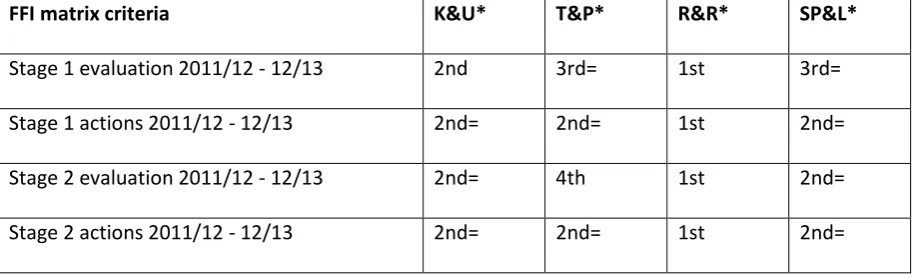
82 The students’ averaged ranked responses have been tabulated as shown in Table 2.
Table 2. Stage 1 and Stage 2 averaged rankings of FFI criteria.
FFI matrix criteria K&U* T&P* R&R* SP&L*
Stage 1 evaluation 2011/12 - 12/13 2nd 3rd= 1st 3rd=
Stage 1 actions 2011/12 - 12/13 2nd= 2nd= 1st 2nd=
Stage 2 evaluation 2011/12 - 12/13 2nd= 4th 1st 2nd=
Stage 2 actions 2011/12 - 12/13 2nd= 2nd= 1st 2nd=
The international students have indicated throughout how resources and references have dominated their studies and whilst not immediately apparent how the other three criteria - knowledge and understanding, theory and practice recognition, and presentation, structure and language, are all equal second. Further examination of these actions across two academic years reveals the major focus is on finding more journal articles and books for further research and reading. This represents a major shift for these students, from a previous ‘teacher centred’ eastern instruction mode to acceptance of one that is ‘learner centred’ western.
Students were asked about their confidence level in relation to their preparation for their semester one assessments. Working on the basis that receiving timely feedback in a low risk setting would be beneficial to the approach to assessment in a high risk setting, we expected that student confidence might increase as a result. However, Table 3. shows across both years this is not so, there is no direct correlation, and that the issue of confidence is more complex than we first imagined.
Table 3. Results in relation to Research Question 3 Did the FFI increase the students’ confidence in preparing for semester one assignments?
Student level of confidence Down a little No change Up a little
Up a lot Undisclosed Total no of respondents to question Number of respondents to question 2011/12 3 (7%) 15 (37%) 11 (27%) 3 (7%) 9 (22%) 41 Number of respondents to question 2012/13 1 (5%) 4 (18%) 14 (64%) 2 (9%) 1 (5%) 22
Stage 3 Follow up interviews:
A number or emergent themes came through the interviews, which can be related to the
83 The use of a grade appeared to be highly valued as commented on by the interviewees:
‘As I said this is really new, so I really don’t know where I’m starting at, so …giving me like where I am now, it helps me know like, what I have to do to get better and better’ (Kate).
‘It’s better than what I expected, but still since it’s not so good, from what I see …it actually makes me work harder to improve on it’ (Laura).
‘According to your indication I remember it’s just about 2.2, I know what my ability is, I know how to achieve a higher score’ (Pauline).
Clarification of the task and the standard required are clearly shown. The grade motivates students to learn and to improve future learning (Higgins et al., 2002; Orsmond et al., 2010). The South East Asian students’ belief in the power of hard work, diligence and effort (Charlesworth, 2011) to achieve a higher grade are demonstrated here, factors which are under their own control. The FFI experience impacted on the students’ confidence and emotions was apparent from the following remarks, both positive and negative as in Laura’s case:
‘It affects my confidence because I know I’ve done quite well, I ‘m in the right way for doing the (other) assignment’ (Kate).
‘I have to say that …because the classification is not so good, when I first received it (written feedback) my confidence level (went) a bit lower than before but when you say it was good, my writing style, it actually brought my confidence back up’ (Laura).
‘I’m a very confident girl, but when you gave some feedback I feel that I can improve it and make it better and make good progress, I feel more confident to get a higher degree’ (Olivia). These remarks show the impact on student confidence and students emotional reactions to feedback (Carless, 2007).
Feed-forward and transferability was evident in the following remarks:
‘…this project makes us practice more’ (Jane).
‘It helps me in terms of my other assignments too ‘cause I start to take notice about the structure’(Kate).
‘I think there are some influences because for the feedback...for example my references are not really appropriate, so I can improve on the other modules about my references’(Natalie). ‘This module is the most important. I think I started this module first, after that I made enquiries on the other modules…’ (Olivia).
‘I am continuing to improve my Section A, and change my method for working, before I just write and find evidence from journal articles… now I can (make a ) list from journal articles before I write and this will be better. I also apply this method for other modules in semester two’ (Pauline).
84 The use of face to face dialogue for feedback appeared to be highly valued:
‘It’s a good thing...’cause if there’s no conversation about this, you don’t know if it’s good or bad, and in which way you should continue to do better’ (Jane).
‘It helps me, it’s clear, like where I am now and what I have to do to improve to get better...in terms of structure and all that’ (Kate).
‘Yeah, I know what to do, rather than just writing…’ (Laura).
‘When you are face to face, I can ask any question’ (Pauline).
The remarks indicate that one to one feedback is appreciated, allowing for the clarification of any points raised from annotated comments on the proposal itself and FFI matrix grade indicated, as well as discussing any issues in a supportive manner (Murtagh & Baker, 2009, Arkoudis & Tran, 2010 )
There appears to be lack of feedbackfrom other modules as indicated:
‘For the last semester I have no idea about the other modules ... so when I do the assignment I have a lot of problems...’ (Jane).
‘We rarely get (feedback) ‘cause lecturers very busy and students too many, so it’s hard to meet them and have them feedback’ (Kate).
‘Feedback, only one of it, it was my XXX module ... for 3-4 weeks it was quick verbal feedback ... it was not written’(Laura).
‘Just one ... in the project, it’s very useful ... but, because I didn’t receive the feedback from other modules I ‘m not sure, yeah’ (Mark).
‘With other modules we just ... we don’t have any opportunities to receive comments from tutor or lecturer before submission, so we don’t feel confident about our work’ (Pauline).
From the students’ perspective there certainly seems to be a lack of formative feedback in semester one, in which case they are perhaps not as well prepared as they could have been. In terms of assessment for learning, the benefit of having feedback in a ‘low risk’ setting, prior to the end of semester summative ‘high risk’ assessment is not happening from the students’ perspective. The multi-faceted nature of motivation was explored and revealed via:
‘At first it stays high during the transfer time from old style to new style (studying)…most of my friends go to a higher level so I need to be on the same level as them…this is very competitive I need to work hard to a higher level, maybe they have (put) some pressure on me’ (Jane). ‘It’s increasing ’cause everything is new because I have to learn more to achieve the mark I want’ (Kate).
‘My motivation is higher (than before) because I want to do something valuable , I want to set up my own business … it gives me motivation to get better’ (Mark).
85 mark … they are wrong … we had to study really hard adapting to a new environment and final year is hard … more than other students (UK)’ (Pauline).
There appears to be a degree of competition between students, which can be a source of motivation, and as Jane’s comment shows is linked to confidence. Once again the eastern work ethic appears as shown in Pauline’s comparison with the ‘home’ students. The comments also show transition, not only in academic life but country.
An insight into the extent of the change of the international students’ learning environment was revealed via:
‘In China we just need to do as teacher says and then have some pointers. You follow the teacher and means it's okay and you have a good mark. There it's not hard. Here everything means it's independent thinking, you need to organise your time ... you need to find everything by yourself...’ (Jane).
‘Pretty much the same as here, but we were more spoon-fed...’ (Laura).
‘Because I am a foreigner from a different country the education system is different. I should follow the western education system ... very different system ... follow the guideline it can help me better to understand what I should do’ (Mark).
‘Before I came here I listen to (the) lecture and just do the exercise, there’s not much critical thinking’ (Natalie).
‘...references (are) very difficult to me because I never met it in (my) studies in my home country’ (Olivia).
These specific examples are an indication that the international students are aware of the cultural nature of teaching and learning, and aware that they are in a phase of transition, and trying to adapt (Charlesworth, 2011).
Conclusions
Our study confirms our earlier findings that the majority of students perceived the FFI to be effective; stages one and two this year indicate again that the feedback messages were clearly received and internalised and that the use of a grade was valued by students. Yet, questions remained at that stage about how feedback was used, whether the grade encouraged further learning. It was then still also unclear how the FFI impacted on student confidence towards this task and future assignments.
The stage three interviews provided rich data and allowed us to probe further into these areas. Students revealed that they acted upon the feedback in several ways. They reported that they shared their feedback, engaging in discussion and mutual support in order to close the gap. There was a degree of competition, but students did not comment that this was negative or stressful but rather that it motivated them to improve. This is in keeping with other studies, such as Carless (2007) and Orsmond et al. (2010).
86 many of our international students, although there are signs of group discussion occurring. The cultural adjustment required could partly explain the fluctuating confidence and emotional involvement cited here. This is an area we’d like to explore in future.
The study shows that the FFI enhanced reflection, and prompted students to think about how to improve future learning. The grade (Sadler, 1989) was specifically mentioned as helpful for clarifying the standard required and showing students their current level, and appeared to act as a motivator to learn and improve (Higgins et al., 2002). This iteration of the study has revealed specific examples of how students have implemented feed forward within the module and transferability to other modules, previously student examples were lacking in terms of clarity. From the students’ perspective formative feedback is still lacking across the other modules.
Students claimed that the FFI influenced their approach to both the summative task and to other assignments (Duncan, 2007) indicating that the exercise was timely (Gibbs & Simpson, 2004). This could be interpreted as another indicator of confidence. However, our assumption that confidence would automatically increase has been replaced by the suggestion that confidence is one of a range of emotions experienced by students in the feedback process, and it is something which rises and falls.
Feedback can be an upsetting experience, and it raises ethical questions as regards the type and the way that tutors give feedback. It is suggested that feedback should be directed at the task and the process and not at the person (Hattie & Timperley, 2007). In terms of modes of feedback, a feedback dialogue is likely to respond to the emotional needs of the student, giving time for reassurance and follow-up questions. Written feedback alone may leave the student emotional and unclear about how to act upon feedback.
Learning about assessment practices is, arguably, as important as learning about the subject, and so we would suggest that collaborative projects such as this, which provide the opportunity for
students to engage in feedback dialogues in ‘low risk’ settings, and where assessment processes and criteria are made more accessible (Wingate et al., 2011), are a step in the right direction.
References
Altbach, P. G. (2004) Globalisation and the university: myths and realities in an unequal world,
Tertiary Education and Management, 10, 3–25.
Arkoudis, S. and Tran, L. (2010) Writing Blah, Blah, Blah: Lecturers’ Approaches and Challenges in Supporting International Students, International Journal of Teaching and Learning in Higher Education, 22 (2), 169–178.
Black, P. and Wiliam, D. (1998) Assessment and classroom learning, Assessment in Education, 5(1), 7–74.
Boyd, P. and Bloxham, S. (2009) Editorial: assessment special edition, Practitioner Research in Higher Education, 3(1), 1–2.
Bryman, A. (2008) Social Research Methods. (3rd edn.) Oxford, New York: Oxford University Press inc. Burns, C. and Foo, M. (2011) International students’ perceptions of their global skills development: a
collaborative approach, Northumbria University Emerge, 3, 25–42.
Burns, C. and Foo, M. (2012) Evaluating a formative feedback intervention for international students, Practitioner Research in Higher Education, 5(1), 40–49.
Burns, C. and Foo, M. (2013) How is feedback used? – The international student response to a Formative Feedback Intervention, The International Journal of Management Education, 11(3), 174-183.
87 Coghlan, D. and Brannick, T. (2010) Doing action research in your own organization (3rd ed.). London:
Sage Publications Ltd.
Charlesworth, Z., M. (2011) Cultures of Learning, in Rayner, S. and Cools, E. (eds.), Style Differences in Cognition, Learning, and Management: Theory ,Research and Practice. New York: Routledge. Duncan, N. (2007) Feed-forward: improving students’ use of tutors’ comments, Assessment and
Evaluation in Higher Education, 32(3), 271–283.
Elander, J. (2003) Student assessment from a psychological perspective. Psychology, Learning and Teaching, 3(2), 114–121.
Gibbs, G. (1988) Learning by doing: A guide to teaching and learning methods. London: Further Education Unit.
Gibbs, G. and Simpson, C. (2004) Conditions under which assessment supports students’ learning, Learning and Teaching in Higher Education, 1, 3–31.
Gürüz, K. (2008). Higher education and international student mobility in the global knowledge economy. Albany: State University of New York.
Hattie, J. and Timperley, H. (2007) The power of feedback, Review of Educational Research, 77(1), 81–112.
Healey, N. M. (2008) Is higher education in really ‘internationalising’? Journal of Higher Education, 55, 333–355.
Herr, K. and Anderson, G. L. (2005) The action research dissertation: A guide to faculty and students. Thousand Oaks, California: Sage Publications Inc.
Higgins, R., Hartley, P. and Skelton, A. (2002) The conscientious consumer: reconsidering the role of assessment feedback in student learning, Studies in Higher Education, 27(1), 53–64.
Hockings, C. (2010) Inclusive learning and teaching in higher education: A synthesis of research. York: Higher Education Academy. Available at:
http://www.heacademy.ac.uk/resources/detail/evidencenet/Inclusive_learning_and_teaching _in_higher_education_synthesis (Accessed: 23 May 2013).
Hounsell, D., McCune, V., Hounsell, J. and Litjens, J. (2008) The quality of guidance and feedback to students, Higher Education Research and Development,27(1), 55-67.
Kvale, S. and Brinkmann, S. (2009) Interview: learning the Craft of Qualitative Research Interviewing. (2nd edn.). Thousand Oaks, California: Sage Publications Inc.
Lofthouse, R., Hall, E., and Wall, K. (2012) Practitioner research, in Briggs, A. R. J., Coleman, M. and Morrison M. (eds.), Research methods in educational leadership and management. London: Sage Publications Ltd. 170–187.
McDowell, L., Sambell, S., and Davison, G. (2009) Assessment for learning: a brief history and review of terminology, in C. Rust (edn.), Improving student learning through the curriculum.
Proceedings of the 2008 16th international improving student learning symposium. Oxford: Oxford Centre for Staff and Learning Development. 54–56.
McKeever, M., Davies, E., Stephenson, K., Wild, and Williams. (2010) Research with not on: students as partners in pedagogical research. 5th Academic Practice as CETL Conference. Northumbria University. Newcastle Upon Tyne, 28th June.
Murphy, C. and Cornell (2010) Student perceptions of feedback: Seeking a coherent flow, Practitioner Research in Higher Education, 4(1), 41-51.
Murtagh, L., and Baker, N. (2009) Feedback to feed forward: student written response to tutors’ written comments on assignments, Practitioner Research in Higher Education, 3(1), 20–28. Nicol, D. and MacFarlane-Dick, D. (2006) Rethinking formative assessment in higher education: a
theoretical model and seven principles of good feedback practice, Studies in Higher Education. 3(2), 199–218.
NSS (2013) National Student Survey 2013. Available at:
88 Orsmond, P., Merry, S., and Reiling, K. (2010) Biology students’ utilization of tutors’ formative
feedback: a qualitative interview study, Assessment and Evaluation in Higher Education, 30(4), 369–386.
Reason, P. and Bradbury, H. (2006) The handbook of action research. London: Sage Publications Ltd. Robson, S., Leat, D.,Wall, K. and Lofthouse, R. (2013) Feedback or feed forward? Supporting master’s
students through effective assessment to enhance future learning, in Ryan J. (ed.), Cross cultural teaching and learning for home and international students: Internationalisation of pedagogy and curriculum in higher education. Abingdon, Oxon: Routledge. 53–58.
Robson, S., and Turner, Y. (2007) ‘Teaching is a co-learning experience’: academics reflecting on learning and teaching in an ‘internationalised’ faculty, Teaching in Higher Education, 12(1), 41–54.
Sadler, D. R. (1989) Formative assessment and the design of instructional systems, Instructional Science, 18(2), 119–144.
Sutton, P. and Gill, W. (2010) Engaging feedback: meaning, identity and power, Practitioner Research in Higher Education, 4(1), 3–13.
Volet, S. (1999) Learning across cultures: appropriateness of knowledge transfer, International Journal of Educational Research, 31, 625–643.
Wingate, U. (2006) Doing away with ‘study skills’, Teaching in Higher Education, 11(4): 457–469. Wingate, U., Andon, N. and Cogo, A. (2011). Embedding academic writing instruction into subject
teaching: A case study, Active Learning in Higher Education.,12(1), 69–81.