2019
How recorded audio-visual feedback can improve academic language
How recorded audio-visual feedback can improve academic language
support
support
Michelle Cavaleri
Asia Pacific International College, [email protected]
Satomi Kawaguchi
Western Sydney University, [email protected]
Bruno Di Biase
Western Sydney University, [email protected]
Clare Power
Charles Sturt University, [email protected]
Follow this and additional works at: https://ro.uow.edu.au/jutlp
Recommended Citation
Recommended Citation
Cavaleri, Michelle; Kawaguchi, Satomi; Di Biase, Bruno; and Power, Clare, How recorded
audio-visual feedback can improve academic language support, Journal of University Teaching &
Learning Practice, 16(4), 2019.
feedback, is becoming more widely used, and as such, it is important to evaluate whether these methods help students engage with the feedback more successfully than conventional methods. While previous research has explored students’ perceptions of audio-visual feedback, this paper seeks to fill a gap in the literature by examining the impact of the audio-visual mode on undergraduate students’ engagement with feedback compared to written-only feedback. Evidence from an analysis of feedback comments (n = 1040) and corresponding revisions as well as interviews (n = 3) is used to draw conclusions about the value of providing audio-visual feedback to help students revise their writing more successfully. In line with multimedia learning theory (Mayer 2009), it is argued that the multimodal format, conversational tone, verbal explanations and personalised feel of audio-visual feedback allows for a more successful engagement with the feedback, particularly for students with a lower level of English language proficiency.
Keywords
Keywords
Introduction
It is widely accepted that feedback is an essential component in the learning cycle in higher education and helps students develop their approaches to studying and writing in their degree (Foster, McNeil & Lawther 2013; Hyland 2013). Feedback is particularly important for students in the early stages of their course when they encounter a new ‘threshold’ in writing (Adler-Kassner & Wardle 2015) as it can help socialise and induct students into academic writing practices. However, this positive effect on learning is maximised if students engage with the feedback comments. One of the most influential scholars in the area of formative feedback, Sadler (1989, 1998), argues that feedback can only truly be considered successful if the ‘feedback loop’ is completed; that is, it can be detected in the work of students that the feedback provided has made a difference to what students do. Research shows that this is not always achieved; students often seem to ignore or fail to understand and internalise feedback and state that feedback can be difficult to understand, ambiguous, impersonal, and lacking detail on how to improve (Bennett & Nair 2011; Crook et al. 2012; Douglas et al. 2016; Han & Hyland 2019). This is concerning given that good feedback is highly valued and desired by students (Hyland 2013; Winstone, Nash & Rowntree 2016) and yet national student experience surveys show that feedback tends to have one of the lowest ratings (Bennett & Nair 2011, Quality Indicators for Learning and Teaching, 2019). Therefore, how to provide effective, high quality feedback that students engage with remains an important issue in higher education today.
The potential of technology to improve feedback practice has drawn increasing attention from researchers. In general, technology-enhanced feedback is well received by students and has been shown to improve efficiency (Race 2014; 2015). However, the majority of the research findings are based on survey or interview data and focus on students’ perceptions of the technology. As a result, there is limited evidence regarding the actual impact of technology-enhanced feedback modes on students’ understanding and use of the feedback. To contribute to addressing this gap in the literature, this paper presents a study that examines the effects of written and audio-visual mode on students’ engagement with feedback in the context of academic language support. While the effects of mode on the feedback itself is another key area of inquiry (and was, in fact, investigated as part of the larger project from which this paper arises (Cavaleri 2017)), the aim of this paper is to specifically examine the impact of written and audio-visual modes of feedback on students’ revisions by answering the following research questions:
1. Does the mode of feedback affect students’ successful uptake of feedback? 2. What mode-related factors impact students’ uptake of the feedback?
The overall goal is to analyse the impact of the different feedback modes, to shed some light on which mode may be more effective and why, as well as identify implications for learning support and feedback provision in an educational environment where student needs are diverse and there is a strong call to embrace new technology to enhance feedback practices.
Literature Review
Academic language support in higher education can often involve providing students with formative feedback on draft assignments to develop students’ understanding of academic writing and guide students in their revisions. Feedback in this context aligns best with the definition proposed by Carless et al. (2011, p. 397) who describe it as “dialogic processes and activities which can support and inform the student on the current task, whilst also developing the ability to self-regulate performance on future tasks”. In other words, feedback is more than simply identifying errors and making corrections; it also is about teaching and learning through
interaction so that students become confident, competent and independent writers with strategies for revising their own work.
This educative approach to feedback is advocated in the literature on feedback practice. For example, Nicol and Macfarlane-Dick’s (2006, p. 205) widely-cited principles of good feedback practice propose that effective feedback should “clarify what good performance is”, “facilitate the development of self-assessment and reflection” and “provide high quality information to students about their learning”. Similarly, Meyer and Niven (2007) argue that good feedback should provide students with information about how to close the gap to meet expectations and ‘feed-forward’ by providing advice on how to improve the next draft or assignment. A more nuanced set of principles proposed by Straub (2000, pp. 28-48) resonates particularly well in the context of academic language support, as his advice is the consequence of an investigation of feedback within a first-year college writing class. He advises that teachers should “turn comments into a conversation”, and “individualise comments to fit each student”.
These principles and approaches to feedback reflect the notion of ‘scaffolding’, which is a core concept of sociocultural learning theory (Lidz 1991; Vygotsky 1978). Scaffolding refers to techniques that support developmental learning and problem solving that allow the student to grow in independence as a learner. In terms of feedback, scaffolding may include breaking down a task into steps to make it more manageable and achievable, providing some direction to help the student focus on achieving the goal, clearly indicating the differences between the student’s work and the desired standard, modelling the expectations or goals, encouraging the student that he/she has done something well to boost self-esteem, and providing direct instruction (Lidz 1991; Panahi Birjandi & Azabdaftari 2013). Ideally, these scaffolding techniques will help reduce frustration and obstacles as well as encourage the student to become more self-sufficient in monitoring and evaluating their writing and revisions. This kind of feedback is, arguably, easiest to provide face-to-face as part of a conversation. However, in many cases, feedback is not a live interaction and is provided asynchronously.
Written feedback is the most common form of asynchronous feedback and its benefits and drawbacks have been well documented in the literature. Students in Mathieson’s (2012, p. 149) study stated that they liked written feedback because it was clear what part of the text the marker was referring to as the “comments and suggestions [were] provided at the point of occurrence”. Parkin et al. (2012, p. 10) found that typed written feedback was perceived as thoughtful as students recognised that teachers “could more easily edit and revise their feedback as they read through assignments, thus presenting a more cohesive and considered response”.
Despite these benefits, paradoxical findings have also been reported in the literature regarding the shortcomings of written feedback. On the one hand, students report that written comments often lack detail or explanation to be meaningful and useful (McGrath & Atkinson-Leadbeater 2016; Weaver 2006). On the other hand, it has been found that students, in particular students with lower levels of language proficiency, can feel overwhelmed by large amounts of written feedback (Mathieson 2012; Lee 2014). Researchers also note that students may misconstrue written comments and suggest that students are perhaps “becoming less comfortable in processing written information” (Kerr & McLaughlin 2008, p. 3). Crook et al. (2012) concur that written feedback has the potential to be misunderstood, and additionally note that written feedback rarely conveys all the nuances the writer is trying to put across. In a practical sense, word-processed comments can be hard to decipher when scattered through a document (Bond 2009). Consequently, many scholars advocate using alternative forms of feedback delivery, particularly forms that are multimodal (for example, Anson 2015, Cavaleri, Di Biase & Kawaguchi 2014; Crook et al. 2012).
Alternatives to written feedback include audio feedback and ‘talking head’ webcam feedback, and these methods have been generally well received. Studies show that students find these types of recorded spoken comments engaging and helpful, but report that it can be difficult to find the specific sections of the paper that the teacher is discussing (Bond 2009; Borup, West & Thomas 2015; Henderson & Phillips 2015; Kerr & McLaughlin 2008). Recorded audio-visual feedback using screen-capture video (also referred to as screencasts) is becoming a more widely-used alternative or supplement to written feedback as it addresses the visual barrier. Screen-capture software allows the teacher to record their on-screen activity as if there was a camera pointed at the computer screen. Every on-screen action, such as scrolling through a student’s paper, highlighting text and navigating through websites, is recorded as a video. In addition, audio commentary is simultaneously recorded using a built-in microphone or headset. The video can be emailed to the student as a video file or it can be uploaded to a server and shared with the student via a link.
Because the use of screen-capture technology is a relatively recent development in educational contexts, there is as yet a limited amount of research on its use for feedback purposes. Of the literature that does exist, four common themes have emerged with regards to the students’ perspective. First, students feel that they receive a greater quantity of feedback and are provided with richer and more detailed information when given screen-capture video feedback (Anson 2015; Jones, Georghiades & Gunson 2012; Mathieson 2012; Stannard & Mann 2018; Turner & West 2013). Second, students tend to find video feedback clear and easier to understand than written feedback (Anson 2015; Harper, Green & Fernandez-Toro 2012; Jones, Georghiades & Gunson 2012; Silva 2012; Stannard 2008). Third, students felt that video feedback increased the social presence of the teacher and was, therefore, perceived as being more personal, caring and engaging (Anson 2015; Harper, Green & Fernandez-Toro 2012, 2018; Stannard & Mann, 2018; Turner & West 2013). The final key theme in the research findings is that students strongly prefer screen-capture video feedback to other forms of feedback (Mathieson 2012; Turner & West 2013), and in some cases even prefer it over face-to-face feedback conversations as they can watch the video multiple times (Harper, Green & Fernandez-Toro 2018).
All of the abovementioned themes, however, are based on students’ perceptions of screen-capture video feedback, as almost all of the studies relied on survey or interview data. As a result, there is limited evidence regarding the actual impact of audio-visual mode on the feedback itself or on students’ uptake of feedback. Our recent study (Cavaleri, Di Biase & Kawaguchi 2014) investigated the impact of video feedback compared to written feedback by quantifying the feedback and the revised drafts. Analysis of the 12 students’ revisions after receiving feedback revealed that 89% of the video comments led students to make a successful revision, compared to 72% of written comments. The video feedback contained more explanation and advice comments, and we argue that these types of spoken comments led to the higher proportion of successful revisions. More empirical research that measures the extent to which students are able to use feedback to successfully close the feedback ‘loop’ (Jonsson 2013; Sadler 1998) is needed to help determine the effectiveness of different feedback modes.
Further, differences between students’ uptake of written and video feedback require explanation. Some researchers suggest that screen-capture video feedback may be more effective because audio-visual, personalised media helps learners to process information better (Anson 2015; Cavaleri et al. 2014; Silva 2012; Stannard 2008) as theorised by Mayer’s (2009) multimedia learning theory. This theory stems from educational psychology and posits that the brain is a dual-channel, limited-capacity, active processing system; therefore, information that is presented in multiple modes (for example, visually and aurally) minimises the cognitive load and thereby helps learners process information better than if it were presented in one mode only (Clark & Mayer
2008; Mayer 2009). The evidence indicates that hearing the spoken feedback while viewing the relevant part of the paper may support students’ understanding as the spoken commentary, image and text on screen, and movement that is captured all contribute to the meaning-making process (Sindoni, 2014). Mayer et al. (2004) also claim that people learn more deeply from information presented in a conversational style rather than in a formal style. Speech is more social and communicatively oriented than written texts and the more extensive use of personal pronouns, hedges and praise reduces the level of formality (Sindoni 2014; Berman 2015). Moreover, nuances of speech and prosodic features such as intonation, stress and pauses help create meaning (Sindoni 2014) which may help students to digest the audio-visual feedback more easily.
However, studies have not yet provided convincing evidence for these claims given the lack of research examining the students’ use of audio-visual feedback throughout the writing process. The extent to which this theory accounts satisfactorily for the perceived positive learning outcomes of video feedback needs to be investigated more rigorously. It is also not clear whether this theory and mode of feedback might have particular implications for students who can have difficulty applying written feedback, such as those with lower language proficiency (Lee 2014).This study is designed to help fill this gap by examining the impact of recorded audio-visual feedback on students’ engagement with feedback compared to written-only feedback. Drawing on multimedia learning theory (Mayer 2009), it is hypothesised that video feedback will lead to higher engagement due to the audio-visual approach and spoken nature.
Method
Study Design
This study employed a longitudinal, mixed method design to quantify impacts and explore perceptions of written feedback and recorded audio-visual feedback. It examined 80 authentic papers from 20 undergraduate students who had received feedback from an Academic Skills Advisor. Using grounded theory methodology (Glaser 1992), the inductive analysis examined and classified each feedback comment (n = 1040) and each revision that was made as a result of a feedback comment (n = 920). In addition, three student participants took part in a semi-structured interview to help explain the findings of the analysis.
Participants
The study’s participants were 20 first-year undergraduate students at an Australian higher education institution who had an individual email consultation with an Academic Skills Advisor. The students had emailed the advisor to request language- and literacy-focused feedback on a written assignment before they submitted it to their lecturer. This is a service that the institution encouraged new students to use. If the student was enrolled in a Bachelor degree and was in their first year of study, the email reply informed the student that they were eligible to participate in a study on feedback. Of the 48 students who were invited to participate in the study, 20 individuals (41.6%) volunteered, gave consent, and completed all requirements of the study. The participants were a fair representation of the first-year student cohort; 16 of the 20 students (80%) spoke English as their first language, 12 student students (60%) studied on-campus, six were fully online, and two studied in blended mode. Each participant’s level of English language proficiency (ELP) was determined based on evaluation of their writing using the Measuring the Academic Skills of University Students (MASUS) tool (Bonanno & Jones 2007) so that the results of the students with the lowest and highest levels of proficiency could be compared. The three student participants who were interviewed were given pseudonyms: Kris, Noora and Heidi.
The first author was a participant in the study as the advisor giving feedback and as the interviewer. Only one advisor participated in the study to ensure a homogeneous approach and style and minimise further variables that may impact on the results.
Data Collection
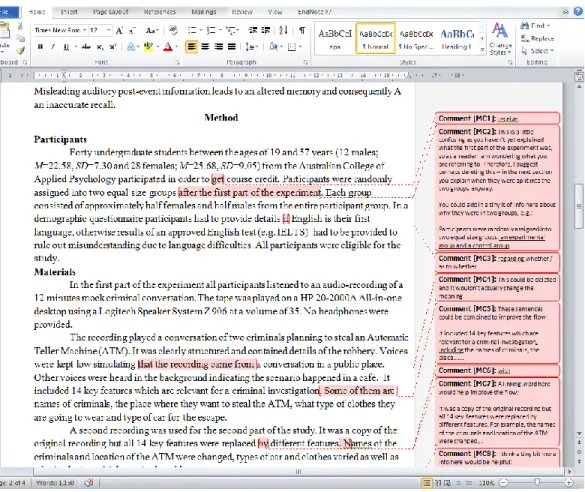
Over one semester, each participant submitted two draft assignments to the advisor for language and literacy feedback. One paper received written feedback comments only. The advisor provided these comments using the ‘Comment’ feature of Microsoft Word. The annotated document was then saved and emailed to the student. A sample of this kind of feedback is shown in Figure 1.
Figure 1. Example of the advisor's written feedback using ‘Comments’ in Microsoft Word
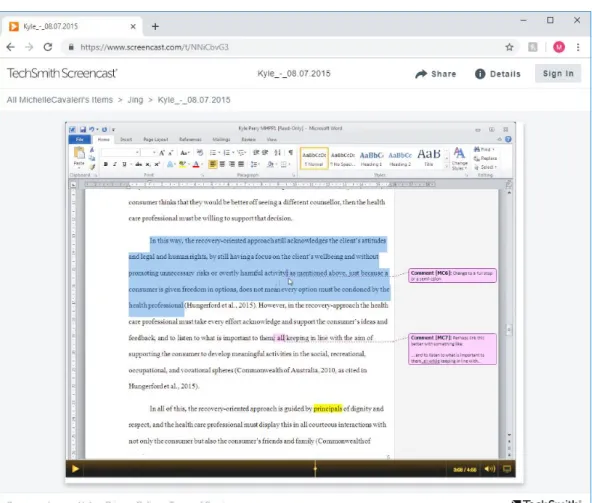
For the other piece of writing, the students received audio-visual feedback, comprising capture video feedback and minimal written comments. The video was created using the screen-capture program called Jing. Before creating the video, the advisor read the paper and wrote minimal comments using the ‘Comments’ feature of Microsoft Word (many of which were cues to which more detailed comments were made verbally). The advisor then opened the software and recorded the video; the student’s assignment was on-screen as the advisor scrolled through it, highlighted and circled aspects of it, and showed formatting demonstrations while making verbal
comments which were recorded using a headset. The video was saved in a secure online account, and the advisor then emailed the student the resulting link to the video. A shot of a screen-capture video is shown in Figure 2 and the full video can be found here: http://www.screencast.com/t/NNiCbvG3
Figure 2. Screen shot of an example of the advisor's video feedback using Jing
To counterbalance the influence of the order of different modes of feedback, the participants were randomly assigned to receive either written feedback on the first text they submitted and audio-visual feedback on their second, or audio-audio-visual feedback on their first text and written feedback on their second text. This cross-over design was employed to ensure all students received both modes of feedback by the end of the trimester and to control for order effects.
In total, 80 papers from the 20 student participants were gathered for analysis, comprising 40 draft and revised pairs, of which 20 had received written feedback and 20 had received audio-visual feedback. The papers included academic essays, reflective essays, laboratory reports, summaries, learning journals, case studies and reports. The students’ first drafts with the advisor’s written comments and the feedback videos were saved for analysis. The students emailed their revised draft to the advisor which was also saved for analysis so it could be compared with the first draft.
Individual interviews with three student participants were the second source of data in this study. Interviews were conducted individually as a video call at the end of the term after students had received both modes of feedback from the advisor. The interviews proposed several questions about the students’ views on the feedback they received. The overall aim was to achieve an extended conversation between the researcher and interviewee (Rubin and Rubin 2011).
Data Analysis
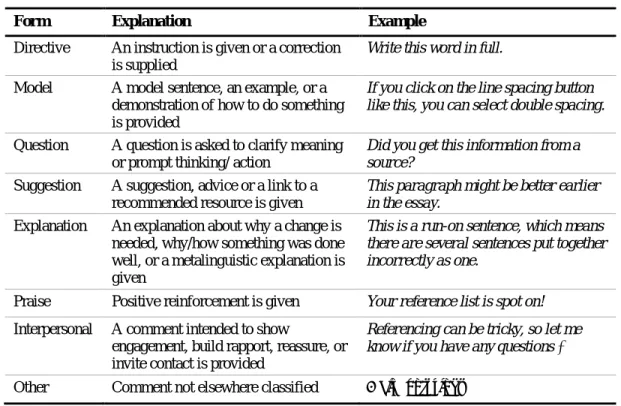
To assess the effect of the different feedback modes, the data analysis involved categorising the form of each feedback comment as well as how the student revised their text in response to the comment. Each of the advisor’s comments was examined and classified according to how it was expressed in terms of the type of language, structures and strategies that were used. From the analysis of the 1040 feedback comments, seven main categories for the feedback form inductively emerged from the data: directive, model, question, suggestion, explanation, praise and interpersonal. A summary of these categories is given in Table 1. In the same way, the corresponding revision in response to each comment was also examined, classified and coded. Comments that did not require the student to make a specific revision, such as a comment offering praise, were excluded from this part of the analysis (n = 120). In total, 920 revisions were analysed and four main categories emerged: successful revision, unsuccessful revision, no change and deleted text. Some of the revisions involved substantial changes, such as incorporating additional material or restructuring the paper, whereas other revisions involved minor adjustments such as correcting a misspelled word or rearranging a sentence.
Table 1. Analytical framework for classifying the form of the feedback
Form Explanation Example
Directive An instruction is given or a correction is supplied
Write this word in full.
Model A model sentence, an example, or a demonstration of how to do something is provided
If you click on the line spacing button like this, you can select double spacing.
Question A question is asked to clarify meaning or prompt thinking/ action
Did you get this information from a source?
Suggestion A suggestion, advice or a link to a recommended resource is given
This paragraph might be better earlier in the essay.
Explanation An explanation about why a change is needed, why/how something was done well, or a metalinguistic explanation is given
This is a run-on sentence, which means there are several sentences put together incorrectly as one.
Praise Positive reinforcement is given Your reference list is spot on!
Interpersonal A comment intended to show
engagement, build rapport, reassure, or invite contact is provided
Referencing can be tricky, so let me know if you have any questions ☺
The data and codes were entered in a Microsoft Excel spreadsheet and formulae were created to enable analysis of the data. In addition, a logistic regression analysis was conducted using the statistics software R to test for significant differences between written and video feedback. The analysis predicted the probability of successful revision for each mode and effect sizes are presented as odds ratios. The results were further analysed to see whether there were any differences between student proficiency levels.
In addition, the interview data were analysed with the aim of exploring three students’ experiences specifically to gain insights on how they understood and used the feedback. The interviews were professionally transcribed and each of the transcriptions was examined separately. The analysis focused on identifying segments where the student discussed what made the feedback useful, understandable and engaging.
Ethical, Reliability and Validity Considerations
The study was approved through a formal review process by Western Sydney University’s Human Research Ethics Committee. It is acknowledged that the interactional context, and in particular the interviewer’s identity, may have impacted the interviews; however, it was important for the researcher to interview the students as both parties had a shared and deep understanding of the feedback that was given. It was also stressed to the students that they should speak freely and openly, as the overall purpose of the study is to enhance the way feedback is given (rather than to critique the advisor’s feedback specifically), and, therefore, their input was valuable. The advisor’s role does not involve setting assignments or giving marks to students, so there was no conflict of interest in this regard.
Results and Discussion
Table 2 shows the findings for the types of revisions students made in response to the feedback. As mentioned, the audio-visual mode incorporates video feedback and accompanying written comments; hence, ‘audio-visual mode’ is the superordinate category in Table 2, (parallel to written feedback mode) and ‘video feedback’ and ‘written feedback’ are shown as subcategories. Table 2 shows that the degree of successful uptake of feedback varied depending on the mode of feedback: 77% of the written-only feedback led to a successful revision compared to 88% of the video feedback. There was a corresponding reduction in the amount of unsuccessful revision, no change and deleted text with video feedback.
Table 2. Summary of student revisions in response to feedback
Student response Written feedback mode Audio-visual feedback mode
Video feedback Written feedback Total Successful revision 384 (77%) 144 (88%) 209 (82%) 353 (84%) Unsuccessful revision 14 (3%) 1 (1%) 4 (2%) 5 (1%) No change 71 (14%) 17 (10%) 38 (15%) 55 (13%) Deleted text 31 (6%) 2 (1%) 5 (2%) 7 (2%) TOTAL 500 164 256 420
A logistic regression revealed that the odds of a successful revision were 2.17 times higher for video feedback relative to written feedback, which is statistically significant (p = 0.002). Taken together the successful revisions in response to audio-visual mode (video and accompanying written feedback) reached 84% compared to 77% in written-only mode with a logistic regression showing that the odds of a successful revision were 1.59 times higher with audio-visual mode, slightly smaller than video-only feedback, but still significant at p = 0.006.
The findings were further dissected to show individual results for each of the 20 participants. Fifteen students had a higher percentage of successful revisions after receiving audio-visual feedback, three students had a higher percentage of successful revisions after receiving written feedback, and two students had an equal proportion of successful revisions with each mode of feedback.
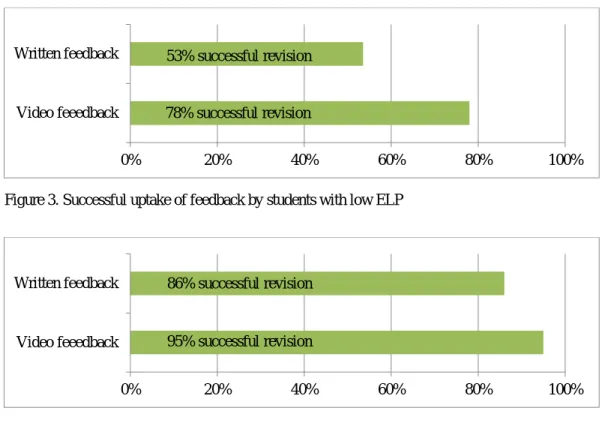
The data were further analysed by examining the results of the five students with the lowest ELP and the five with highest ELP, which are given in Figure 3 and Figure 4 respectively. As shown, both groups revised more successfully in response to video feedback, although the difference was greater for the group of students with low ELP. With the written mode of feedback, students with low proficiency revised successfully in response to only 53% of the comments, compared to 78% of the video comments, which is a difference of 25%. This gap is smaller for the group of students with higher proficiency; they revised successfully in response to 86% of the written comments, compared to 95% of the video comments, which is a difference of 9%.
Figure 3. Successful uptake of feedback by students with low ELP
Figure 4. Successful uptake of feedback by students with high ELP
0% 20% 40% 60% 80% 100%
Video feeedback
Written feedback 53% successful revision
78% successful revision
0% 20% 40% 60% 80% 100%
Video feeedback
Written feedback 86% successful revision
A logistic regression analysis revealed that for students with low ELP, the odds of a successful revision are 5.69 times greater with video feedback than written feedback, which is statistically significant (p < 0.0001). Similarly, the odds ratio is 5.48 for students with high ELP, which is also significant (p = 0.037).
The analysis of the feedback itself showed that the form of the advisor’s feedback, that is, how the feedback was expressed, varied depending on the mode. Written feedback tended to be highly directive (49%), whereas video feedback was more likely to include explanations, suggestions and praise. The most noteworthy differences were in the proportion of directives (written mode 49%, video mode 17%) and explanations (written mode 17%, video mode 30%). Figure 5 shows a visual representation of this shift.
Figure 5. Advisor's feedback according to feedback form
Results demonstrate that both modes of feedback led to a high proportion of successful revisions. In the context of academic language support, the findings are encouraging because they confirm that students make good use of feedback to revise and improve their work, regardless of whether it is provided in written or audio-visual mode. Nevertheless, the results also revealed that the mode of feedback did affect the extent to which students successfully revised their work, confirming our earlier findings (Cavaleri et al. 2014). The analysis and interviews with the three student participants reveal several possible explanations for why video feedback led to more successful revisions, which are discussed below.
One explanation for the higher successful uptake of video feedback is that the combined audio-visual approach helps learners process information, as posited by multimedia learning theory (Mayer 2009). An example of feedback that exploits the potential of both the aural and visual elements is shown in (1) (the phrases in square parentheses describe the advisor’s on-screen
Directive 49% Model 11% Question 9% Suggestion 9% Explanation 17% Praise 3% Interpersonal 2% Other <1% Written feedback Directive 17% Model 12% Question 1% Suggestion 17% Explanation 30% Praise 11% Interpersonal 11% Other <1% Video feedback
actions captured in the video). The advisor talked through a model reference she had created in APA style that was displayed on the screen and then demonstrated how she found the information from the source that was needed to create the reference:
(1) “I’ve referenced that one in full for you as an example. You can see there’s the author [highlights author’s name], there’s the year [highlights the year] … So I’m just going to
show you the webpage nowto show you where I got all that info from [switches to web browser where website has been pre-loaded]. So this is the link you gave me. I went to the, I think, ‘contact us’ page and I found that the author is the ‘Department of Community Services’ [highlights author]. I found the year at the bottom here [moves cursor and highlights the year] … So all of that information needs to be put into the reference list – not just the URL. So, have a go at doing that with the rest of the references - it’s really important that you get this right.”
In contrast, an example of written feedback that led to an unsuccessful revision is shown in (2). The feedback was given on the section of the student’s text shown in ‘Original text’, and the student’s unsuccessful revision in response to the comment is shown in ‘Revised text’.
(2) If you are going to use the names at the start of the sentence like this, then there’s no
need to add the names again to the end of the sentence – just don’t forget to put the year after the names.
Original text
Revised text
In contrast with the written feedback in (2), the video feedback in (1) comprises commentary as well as image, text and movement on screen which all contributed to the meaning-making process (Sindoni 2014), and, consequently, the student successfully revised her other website references that were not formatted according to APA style. Interestingly, video feedback seemed to particularly benefit this student, who was classified as having low ELP; she made successful revisions in response to only 32% of the written feedback compared to 80% of the video feedback.
In fact, the multimodal format appeared to benefit all of the five students who were classified as having low ELP. As shown earlier in Figure 3, these students successfully revised only 53% of the written comments, compared to 78% of the video comments. Due to their lower levels of proficiency, these students may have trouble processing large amounts of written feedback (Lee 2014), which explains why only just over half of the written feedback was revised successfully. However, exploiting the audio-visual aspect to offer verbal explanations and visual models to students with low ELP in particular seemed to have a very positive effect on their understanding and subsequent successful uptake of the feedback, as exemplified in (1).
Students with higher levels of ELP also benefitted from receiving and processing feedback audio-visually rather than in just written mode. In his interview, Kris, who was classified as having high
Boylan & Scott point out that clients come to counselling feeling vulnerable, nervous and with their own concerns. (Boylan, J., & Scott, J. 2009).
Boylan & Scott point out that clients come to counselling feeling vulnerable, nervous and with their own concerns.
ELP, stated that he liked the video feedback because he found it less overwhelming and more manageable than the written feedback:
(3) “I love the video feedback, because it kind of guided me through the comments much
quicker and also, I wasn’t really overwhelmed by the writing. Because if you’re just looking at this page of text and you’ve got more text telling you how to change the text, it’s kind of daunting and you have to kind of work yourself up to kind of tackle it.”
As Kris’ comment suggests, presenting information via both visual and aural channels helps distribute cognitive load for students, thus enhancing the effectiveness of the message compared to a single channel of presentation, such as in writing only (Clark & Mayer 2008; Mayer 2009).
Nevertheless, although students liked the video feedback, both Kris and Heidi stated that there were instances where they would prefer written-only feedback. For example, Heidi preferred directive written feedback on grammar and referencing errors so that she could see the written model or the correct form: “If it was just on the video I’d have to write it down, and ‘Is that what
she meant?’”
Another explanation for the higher successful uptake of video feedback is that spoken feedback is more accessible to students than written feedback. Although the advisor’s written feedback was not given in an overly formal or complicated style, written feedback can be difficult for students to understand and unpack (Wingate 2010). The comment in (4) is a typical example of a written comment that did not lead to a successful revision (in this case, no change).
(4) Use a comma after linking words at the start of a sentence.
Like the written feedback in (4), the video feedback in (5) also addressed a punctuation issue but was delivered in a conversational style and led to a successful revision.
(5) “The other thing I noticed, I’m just going to scroll down [scrolls down the page], just with your use of colons, so there’s a couple here [circles the pointer]. Colons aren’t really used in the way that you’ve used them. They’re used when you have a sentence and then you’re introducing, say, a list. But if you’ve got two full sentences like here
[highlights sentences], it’s actually better to use a semi-colon. So a semi-colon functions more like a full stop, but it shows that the sentences on either side are actually closely related, so they’re talking about the same point for example. A colon is not really used in that way. Have a think about that – there are a few of them in your paper where it would be better to either change it to a semi-colon, or perhaps even a full stop.”
As these examples illustrate, speech is more social and communicatively oriented than written texts (Berman 2015) and the nuances of speech appeared to help students understand the feedback and, consequently, led to more successful revisions. The more familiar language appears to help simplify concepts and avoid misunderstandings, and prosodic features such as intonation, stress and pauses help create meaning (Sindoni 2014). Further, written feedback was typically direct, compact and concise, but spoken feedback tended to repeat and recycle information, which helped reinforce points and clarify the intended meaning. Even though the spoken video feedback contained less directive and more suggestion-based comments (as illustrated in Figure 5) due to use of qualifiers and hedges (such as “not really”, “actually”, “it would be better to…” in (5)) which mitigate the force of what is said, students were still able to more successfully utilise the video feedback as they revised. This supports the assumption that people learn more deeply from information presented in a conversational style rather than in a formal style (Mayer et al. 2004).
Spoken feedback may be particularly helpful for students with low ELP who may find it easier to understand less formal, conversational language. Noora acknowledged as much in her interview. Noora’s first language is not English and is one of the students classified as having low ELP.
(6) “In the video feedback, … because I was hearing your voice I know how you mean … I did understand your written one but when I’m hearing your words, the way you’re saying, it gives me more understanding.”
Similarly, Kris claimed in his interview that feedback in writing “is not going to have the same impact as being told through the video”. Like Noora and Kris, students in previous studies on audio and video feedback also felt that the voice made it much easier to follow the feedback and to understand more clearly what the teacher was trying to convey (Anson 2015; Harper et al. 2012; Jones et al. 2012; Silva 2012).
A third possible reason for the higher percentage of successful revisions with video feedback could be attributed to the verbal explanations. Congruent with our earlier study (Cavaleri et al. 2014), results show that the written feedback comments were highly directive and often did not contain explanations, which may affect the usefulness of the feedback (Weaver 2006; McGrath & Atkinson-Leadbeater 2016). An example of written feedback that did not contain an explanation and led to no change is shown in (7). The feedback was given on the section of the student’s text shown in “Original text”.
(7) Is this information related to child protection? If so, make the link clearer.
Original text
As shown, the feedback drew the student’s attention to an issue but did not explicitly explain why the content needs revising. On the other hand, many of the video comments that led to successful revisions contained explanations, such as the example in (8). The feedback referred to the section of the student’s paper shown in “Original text”, and the student added the sentence shown in “Revised text” to the introduction of his report.
(8) “The other thing I was a bit confused about is you talked about secondary and primary psychopathy [highlights secondary and primary psychopathy] and I’m still, even at the
end of your paper, I’m still unclear about what the difference is. I couldn’t find anywhere in your paper where you’d actually defined them. A sentence that says, ‘Primary refers to blah, blah, and secondary refers to blah, blah’ would make it really clear to the reader what you’re talking about, so have a think about that.”
Original text
In the case of poor homeless women, the state did intervene legally by arresting women for vagrancy which highlights how the state enforced its authority with gender bias. (Twomey, 1997).
Recent findings suggest that individuals high in secondary psychopathy, not primary, are more likely to partake in risky decision-making (Lyons, 2015).
Revised text
In this example, the advisor explained why additional information was needed and how the student might do this. This kind of explicit support in the form explanations helps situate the feedback within the students’ learning schemata by providing scaffolding to help students construct their own understanding (Lidz 1991; Vygotsky 1978). These explanations seemed to be key to students’ understanding of the feedback and supported the learners’ ability to revise successfully.
The impact of explanations to scaffold understanding was illustrated by Heidi during her interview when she stated that the explanations in the video “could go into more depth about something and explain what I’m doing, perhaps maybe not so much ‘wrong’ but how I could improve it.” She recalled a particular instance when a video explanation helped her extend her understanding of word forms:
(9) “I prefer the explanation with it as well because it helps to consolidate in my head …
Like with ‘affect’ and ‘effect’, by you explaining the differences – and I did look at the dictionary and it’s vague - but the way that you worded it was easy for me to understand and I go, oh, yeah, okay, I see the difference here. Affect is a verb, or whatever it was, and effect is blah, blah, blah, blah, and so, yeah, that helps me to put it into practice. Every time I saw affect and effect throughout the paper it would be, okay, I’d think back, yeah, okay, it’s affect, it’s not effect.”
The impact of explanations on the uptake of feedback was something that Kris also discussed in his interview. Kris stated that he had clear intentions about his writing and was reluctant to make changes to his text if the feedback did not contain an explanation. He said that he would be more likely to take up feedback that contained a rationale for why a change might be beneficial:
(10)“If they say, ‘Oh you know, the essay might flow better if this argument’s there,’ then …
that doesn’t really matter too much to me. I’ve already decided the flow is good. But if they say, ‘This will make your argument stronger’ or, ‘This better suits the academic format,’ then I’m going to go, ‘Okay, yep. Sure.’”
Kris’s comment suggests that statements without an explanation about why a change might be beneficial are more likely to be ignored, which may explain why brief written comments in the margins of the paper had less successful uptake. The verbal explanations helped students see the advisor’s reasoning and influenced the student to address the feedback and revise their work. A fourth possible reason for the more successful uptake of video feedback is that there is higher engagement due to the personal and encouraging nature of the feedback. As shown in Figure 5, there were a higher proportion of praise and interpersonal comments with video mode (22%) compared to written mode (5%). For example, in all of the videos the advisor began by verbally greeting the student by name, thanking them for sending the draft and offering positive reinforcement, which is likely to have the student immediately engaged. Other contributors to this sense of personalisation are the more extensive use of personal pronouns, hedges and praise,
Primary psychopathy is characterised by personality traits of manipulation,
pathological lying, and a lack of remorse or empathy; while secondary psychopathy is characterised by socially influenced traits of impulsivity, poor behavioural controls and inability to plan ahead (Hare, 1999).
which creates a less-distant discourse stance and stronger interpersonal feel (Berman 2015; Sindoni 2014). Moreover, many of the spoken comments are framed in a developmental context; the use of strategies like hedging and offering encouragement helps position the student as an apprentice and constructs the advisor as a colleague providing feedback of a more formative nature. Kris noted this in his interview:
(11)“Just even acknowledging the fact that oh, you know - the educator has actually put in the time and effort to help me with this stuff … it would make me feel a little bit more encouraged about what I’m doing.”
Like students in previous studies (Anson, 2015; Harper et al. 2012, 2018; Jones et al. 2012; Turner & West 2013), Kris felt that the video conveyed that the advisor invested effort into reading and evaluating his work and cared about his learning, which was motivating. Motivational and encouraging feedback positively influences a student’s emotional response to feedback which affects his or her readiness to engage with it (Handley, Price & Millar 2011; Winstone et al. 2017). Increased engagement with the feedback and revision process may also explain why the written comments that accompanied the video feedback also had more successful uptake (82%) than the written-only feedback (77%). In other words, because the video feedback engaged students, the students may have been more likely to also engage with the written comments that accompanied the video.
Conclusions and implications for practice
Although this study is relatively small in scale and exploratory in nature, it offers some initial findings in the under-researched area of technology-enhanced academic language support. By analysing 1040 written and audio-visual feedback comments and 920 revisions, this study adds to self-report by students by contributing more objective analysis to the limited body of literature in this area. Individual interviews brought in-depth individual perspectives to research questions, in contrast to other studies which primarily used questionnaires, and illuminated the students’ experience of technology-enhanced academic language support.
The study’s findings lend support to multimedia learning theory and the notion that information that is presented multimodally helps learners process that information better than if it were in one mode only. Results also suggest that the inherent characteristics of speech helped students revise more successfully, and thus support the theory that information presented in a conversational and personal tone assists learning. In addition, the findings indicate that the verbal explanations that scaffolded understanding about academic writing appeared to lead to more successful uptake of the feedback.
The study’s findings point towards several implications for feedback practice for academic language support. First, there is value in providing video feedback to help overcome some of the limitations of written-only comments and to enhance students’ learning about writing in their discipline. However, this is not to deny the value of written feedback; written and video feedback mode should be viewed as complementary and could effectively be used in tandem. For example, common themes in the written feedback could be highlighted in the video, as students in this study found it a helpful way to consolidate and navigate the written comments. Ideally, advisors would prioritise using video for feedback on aspects of academic writing that would benefit from a visual demonstration or verbal explanation, so that they could exploit the affordances of screen-capture technology. This can help avoid misunderstandings which can result from interpreting written feedback.
There are also implications for using technology for academic language support to engage students in the writing and revision process more generally. Given that feedback is important to students but is not always utilised to close the feedback ‘loop’, a method that is perceived as clear, personal, and encouraging can help motivate students to seek and implement feedback during the writing process. Additionally, the research findings have implications for how to support students with low language proficiency. The significantly higher percentage of successful revisions with video feedback for students with low ELP suggests that this mode of feedback helps scaffold understanding. Further, providing feedback as a combination of spoken and written comments may help make the written part more manageable because much of the detail can be discussed verbally in the video. If, as the evidence suggests, this leads to more successful revisions and a better final product, it could increase the likelihood of passing assessment tasks as well as contribute to a better understanding of academic writing and writing processes which could potentially have an impact on the students’ success in other writing tasks.
Given that technology-enhanced academic language support is an under-researched area of inquiry, there are many possible directions for future research to expand on the contribution of this study. As this research was a case study conducted with only one advisor and a relatively small number of students from a particular institution, similar studies situated at other institutions may enhance the usefulness of the findings to inform a broader and more integrated understanding of the impacts of technology-enhanced feedback. Larger-scale studies with a quantitative analysis would also help to confirm the statistical significance of some of the differences between written and audio-visual feedback. A longitudinal study comparing the impact of written feedback and audio-visual feedback would also be beneficial to determine which mode of feedback works best in what areas and has greater transferability. The cognitive processing of different feedback modalities is a topic that would also benefit from direct empirical testing.
References
Adler-Kassner, L & Wardle, E 2015, Naming what we know: Threshold concepts of writing studies, Utah State University Press, Boulder, Colorado.
Anson, I 2015, ‘Assessment feedback using screen-capture technology in political science’,
Journal of Political Science Education, vol. 11, no 4, pp. 375–390.
Bennett, L & Nair, S 2011, ‘Demonstrating quality: Feedback on feedback’, in AuQF2011: Demonstrating Quality, Australian Universities Quality Agency, Melbourne, Australia, pp. 26–31. Berman, R 2015, ‘Linguistic literacy and later language development’, in J Perera, M Aparici, E Rosado, N Salas (eds.), Written and spoken language development across the lifespan, Springer International Publishing, Cham, Switzerland, pp. 181–200.
Bonanno, H & Jones, J 2007, The MASUS procedure: Measuring the academic skills of university students, Learning Centre, University of Sydney, Sydney, Australia, viewed 21 May 2019, <https://sydney.edu.au/stuserv/documents/learning_centre/MASUS.pdf >
Bond, S 2009, Audio feedback, Centre for Learning Technology, London School of Economics and Political Science, London, England, viewed 7 May 2019, <http://eprints.lse.ac.uk/30693/> Borup, J, West, RE & Thomas, R 2015, ‘The impact of text versus video communication on instructor feedback in blended courses’, Educational Technology Research and Development, vol. 63, no. 2, pp. 161–184.
Carless, D, Salter, D, Yang, M & Lam, J 2011, ‘Developing sustainable feedback practices’,
Studies in Higher Education, vol. 36, no 4, pp. 395–407.
Cavaleri, M 2017, ‘Effects of video feedback mode on students’ academic writing’, PhD thesis, Western Sydney University, Sydney, Australia, viewed 14 April 2018, <https://researchdirect.westernsydney.edu.au/islandora/object/uws%3A46766>
Cavaleri, M, Di Biase, B & Kawaguchi, S 2014, ‘Academic literacy development: Does video commentary feedback lead to greater engagement and response than conventional written feedback?’, International Journal of Literacies, vol. 20, no. 3, pp. 19–38.
Clark, R & Mayer, R 2008, e-Learning and the science of instruction: Proven guidelines for consumers and designers of multimedia learning, 2nd edn, Pfeiffer, San Francisco, California. Crook, A, Mauchline, A, Maw, S, Lawson, C, Drinkwater, R, Lundqvist, K, Orsmond, P, Gomez, S & Park, J 2012, ‘The use of video technology for providing feedback to students: Can it enhance the feedback experience for staff and students?’, Computers and Education, vol. 58, no. 1, pp. 386–396.
Douglas, T, Salter, S, Iglesias, M, Dowlman, M & Eri, R 2016, ‘The feedback process: Perspectives of first and second year undergraduate students in the disciplines of education, health science and nursing’, Journal of University Teaching and Learning Practice, vol. 13, no. 1, viewed 20 March 2019, <http://ro.uow.edu.au/jutlp/vol13/iss1/3>
Foster, E, McNeil, J & Lawther, S 2013, ‘Exploring new students’ conceptions of engagement and feedback’, in L Clouder, C Broughan, S Jewell, G Steventon (eds), Improving student engagement and development through assessment, Routledge, Oxon, England.
Glaser, BG 1992, Basics of grounded theory analysis, Sociology Press, Mill Valley, California. Han, Y & Hyland, F 2019, ‘Learner engagement with written feedback: A sociocognitive perspective’, in K Hyland & F Hyland (eds), Feedback in second language writing: Contexts and issues, 2nd edn, Cambridge University Press, Cambridge, England, pp. 247–264.
Handley, K, Price, M & Millar, J 2011, ‘Beyond “doing time”: Investigating the concept of student engagement with feedback’, Oxford Review of Education, vol. 37, no. 4, pp. 543–560. Harper, F, Green, H & Fernandez-Toro, M 2012, ‘Evaluating the integration of Jing screencasts in feedback on written assignments’, in 15th International Conference on Interactive Collaborative Learning (ICL), IEEE, Villach, Austria, viewed 27 February 2019, <https://ieeexplore.ieee.org/document/6402092/>
Harper, F, Green, H & Fernandez-Toro, M 2018, ‘Using screencasts in the teaching of modern languages: Investigating the use of Jing in feedback on written assignments’, The Language Learning Journal, vol. 46, no. 3, pp. 277–292.
Henderson, M & Phillips, M 2015, ‘Video-based feedback on student assessment: Scarily personal’, Australasian Journal of Educational Technology, vol. 31, no. 1, pp. 51–66.
Hyland, K 2013, ‘Student perceptions of hidden messages in teacher written feedback’, Studies in Educational Evaluation, vol. 39, no. 3, pp. 180–187.
Jones, N, Georghiades, P & Gunson, J 2012, ‘Student feedback via screen capture digital video: Stimulating student’s modified action’, Higher Education, vol. 64, no. 5, pp. 593–607.
Jonsson, A 2013, ‘Facilitating productive use of feedback in higher education’, Active Learning in Higher Education, vol. 14, no. 1, pp. 63–76.
Kerr, W & McLaughlin, P 2008, ‘The benefit of screen recorded summaries in feedback for work submitted electronically’, 12th Computer Assisted Assessment Conference, Leicestershire, England, viewed 2 February 2019, <https://www.reading.ac.uk/web/files/Engagein
Feedback/The_benefit_of_screen_recorded_summaries_in_feedback_for_work_submitted_electro nically.pdf>
Lee, I 2014, ‘Revisiting teacher feedback in EFL writing from sociocultural perspectives’, TESOL Quarterly, vol. 48, no. 1, pp. 201–213.
Lidz, CS 1991, Practitioner’s guide to dynamic assessment, Guildford Press, New York, New York.
Mathieson, K 2012, ‘Exploring student perceptions of audiovisual feedback via screencasting in online courses’, American Journal of Distance Education, vol. 26, no. 3, pp. 143–156.
Mayer, RE, Fennell, S, Farmer, L & Campbell, J 2004, ‘A personalization effect in multimedia learning: Students learn better when words are in conversational style rather than formal style’,
Journal of Educational Psychology, vol. 96, no. 2, pp. 389-395.
Mayer, RE 2009, Multimedia learning, 2nd edn, Cambridge University Press, New York, New York.
McGrath, A & Atkinson-Leadbeater, K 2016, ‘Instructor comments on student writing: Learner response to electronic written feedback’, Transformative Dialogues, vol. 8, no. 3, pp. 1–16. Meyer, W & Niven, P 2007, ‘Critical reflections on the role of identity in two respondents’ formative assessment practices’, English Academy Review, vol. 24, no. 2, pp. 121–133.
Nicol, D & Macfarlane‐Dick, D 2006, ‘Formative assessment and self‐regulated learning: A model and seven principles of good feedback practice’, Studies in Higher Education, vol. 31, no. 2, pp. 199–218.
Panahi, P, Birjandi, P & Azabdaftari, B 2013, ‘Toward a sociocultural approach to feedback provision in L2 writing classrooms: The alignment of dynamic assessment and teacher error feedback’, Language Testing in Asia, vol. 3, no. 1, pp. 1–10.
Parkin, H, Hepplestone, S, Holden, G, Irwin, B & Thorpe, L 2012, ‘A role for technology in enhancing students’ engagement with feedback’, Assessment and Evaluation in Higher Education, vol. 37, no. 8, pp. 963–973.
Quality Indicators for Learning and Teaching 2019, 2018 Student experience survey: National report, viewed 20 April 2019, <https://www.qilt.edu.au/about-this-site/student-experience> Race, P 2014, Make learning happen, 3rd edn, SAGE, London, England
Race, P 2015, The lecturer’s toolkit, 4th edn, Routledge, Oxon, England.
Rubin, HJ & Rubin, IS 2011, Qualitative interviewing: The art of hearing data, 3rd edn, SAGE, Thousand Oaks, California.
Sadler, DR 1989, ‘Formative assessment and the design of instructional systems’, Instructional Science, vol. 18, no. 2, pp. 119–144.
Sadler, DR 1998, ‘Formative assessment: Revisiting the territory’, Assessment in Education, vol. 5, no. 1, pp. 77–84.
Silva, ML 2012, ‘Camtasia in the classroom: Student attitudes and preferences for video commentary or Microsoft Word comments during the revision process’, Computers and Composition, vol. 29, no. 1, pp. 1–22.
Sindoni, MG 2014, Spoken and written discourse in online interactions: A multimodal approach, Routledge, New York, New York.
Stannard, R 2008, ‘A new direction in feedback’, Humanizing Language Teaching, vol. 10, no. 6 viewed 17 April 2019, <http://old.hltmag.co.uk/dec08/mart04.htm>
Stannard, R & Mann, S 2018, ‘Using screen capture feedback to establish social presence and increase student engagement: A genuine innovation in feedback’, in CH Xiang (ed.), Cases on audio-visual media in language education, IGI Global, Hershey, Pennsylvania, pp. 93–116. Straub, R 2000, ‘The student, the text, and the classroom context: A case study of teacher response’, Assessing Writing, vol. 7, no. 1, pp. 23–55.
Turner, W & West, J 2013, ‘Assessment for “digital first language” speakers: Online video assessment and feedback in higher education’, International Journal of Teaching and Learning in Higher Education, pp. 288–296, viewed 15 April 2019,
<https://files.eric.ed.gov/fulltext/EJ1029131.pdf>
Vygotsky, LS 1978, Mind in society: The development of higher psychological processes, Harvard University Press, Cambridge, Massachusetts.
Weaver, MR 2006, ‘Do students value feedback? Student perceptions of tutors’ written responses’,
Assessment and Evaluation in Higher Education, vol. 31, no. 3, pp. 379–394.
Winstone, NE, Nash, RA, Rowntree, J & Menezes, R 2016, ‘What do students want most from written feedback information? Distinguishing necessities from luxuries using a budgeting methodology’, Assessment and Evaluation in Higher Education, vol. 41, no. 8, pp. 1237–1253. Winstone, NE, Nash, RA, Parker, M & Rowntree, J 2017, ‘Supporting learners' agentic engagement with feedback: A systematic review and a taxonomy of recipience processes’,