t o ol in a UK s e c o n d a r y s c h o ol: a c a s e s t u dy. Te a c h e r E d u c a ti o n
Adv a n c e m e n t N e t w o r k Jo u r n al (TEA N), 6 ( 2). p p . 3 6-4 7 .
Do w n l o a d e d fr o m : h t t p ://i n si g h t . c u m b r i a . a c . u k /i d/ e p ri n t/ 1 5 8 7 /
U s a g e o f a n y i t e m s f r o m t h e U n i v e r s i t y o f C u m b r i a’ s i n s t i t u t i o n a l r e p o s i t o r y ‘I n s i g h t ’ m u s t c o n f o r m t o t h e f o l l o w i n g f a i r u s a g e g u i d e l i n e s .
Any it e m a n d it s a s s o ci a t e d m e t a d a t a h el d i n t h e U niv e r si ty of C u m b r i a ’s in s ti t u ti o n al r e p o si t o r y I n si g h t ( u nl e s s s t a t e d o t h e r wi s e o n t h e m e t a d a t a r e c o r d ) m a y b e c o pi e d , di s pl ay e d o r p e rf o r m e d , a n d s t o r e d i n li n e wi t h t h e JIS C f ai r d e a li n g g ui d eli n e s ( av ail a bl e
h e r e) fo r e d u c a t i o n al a n d n o t-fo r-p r ofi t a c tiviti e s
p r o v i d e d t h a t
• t h e a u t h o r s , ti tl e a n d full bi blio g r a p h i c d e t ail s of t h e it e m a r e ci t e d cl e a rly w h e n a n y p a r t
of t h e w o r k is r ef e r r e d t o v e r b a lly o r i n t h e w ri t t e n fo r m
• a h y p e rli n k/ U RL t o t h e o ri gi n al I n si g h t r e c o r d of t h a t it e m is i n cl u d e d i n a n y ci t a ti o n s of t h e w o r k
• t h e c o n t e n t is n o t c h a n g e d i n a n y w a y
• all fil e s r e q ui r e d fo r u s a g e of t h e it e m a r e k e p t t o g e t h e r wi t h t h e m a i n it e m fil e.
Yo u m a y n o t
• s ell a n y p a r t of a n it e m
• r e f e r t o a n y p a r t of a n it e m wi t h o u t ci t a ti o n
• a m e n d a n y it e m o r c o n t e x t u ali s e it i n a w a y t h a t will i m p u g n t h e c r e a t o r ’s r e p u t a t i o n
• r e m ov e o r a l t e r t h e c o py ri g h t s t a t e m e n t o n a n it e m .
T h e full p oli cy c a n b e fo u n d h e r e.
Alt e r n a t iv ely c o n t a c t t h e U niv e r si t y of C u m b ri a R e p o si t o ry E di t o r b y e m a ili n g
Ahmed, D,H., Jackson, E. (2014)’Implementing a social networking platform as an educational tool in a UK secondary school: a case study’, TEAN journal, 6(2), pp. 36-47.
36 Implementing a social networking platform
as an educational tool in a UK secondary school: a case study
Teacher Education Advancement Network Journal Copyright © 2014 University of Cumbria Vol 6(2) pages 36-47 Deeba Hussain Ahmed & Elizabeth Jackson
University of Cumbria
Abstract
This paper presents a case study of the implementation of a social networking platform in a UK secondary school, its use by pupils and teachers, and identification of potential advantages and challenges as an educational tool. It is intended to be of interest to secondary schools regarding the implementation of a social networking platform for use in teaching and learning, as it provides recommendations based on the research carried out in the case study school. A social networking platform was used with groups of secondary school pupils and its use observed, pupils questioned and a sample of pupils and teachers interviewed regarding its use. Analysis of the findings resulted in the implications for the use of the social networking platform being identified. Benefits were found to outweigh difficulties and implications were useful to take the use of social networking forward within the school. Whilst the study is relevant to the school and of potential interest to other schools, and serves to widen understanding of how social networking might be used effectively within education, there is scope in future for a wider scale study to be made as generalisation is not made here. In particular, the study raises the need for schools to consider not just how a tool such as a social networking platform can be used within existing pedagogy, but how teaching and learning may need to be redesigned if the benefits are to be embraced but the disadvantages to be
overcome.
Key words
Social networking; educational tool; case study; UK secondary school.
Introduction
This small scale case study was undertaken in a UK faith girls’ high school at the time of a whole school improvement plan to consider the use of technology for teaching and learning. A social networking site was introduced and the advantages and disadvantages of its use as an educational tool were determined from data collected from teachers and pupils.
Theoretical Context
Technology is constantly evolving, and if, as Vanderhoven et al. (2013) suggests, social networking (SN) has the power to ‘transform’ our interactions, there is value in considering its use in education. According to Mason and Rennie (2006), the range of use of available technology in education has been confusing and contradictory. Children make everyday use of a range of ICT and there is scope to build on their existing skills in order to explore the potential of relatively new developments such as SN (social networking) for educational purposes (Kurthakoti et al., 2013) as well as seeking to address possible challenges in designing a new learning environment (Segrave and Holt, 2003). Literature suggests that ICT has many advantages as an educational tool (Mason and Rennie, 2008) but the question for a study such as this into SN is how it can be used (Balog et al., 2013).
37 other and with their teachers beyond the classroom. According to Minocha (2009:15), SN ‘provides two-way communication and so lends itself to collaboration, co-operation and the development of a learning community’ and can hence facilitate ‘interaction, communication and collaboration’
(Veletsianos and Navarrette (2012:144) including the sharing and collaborative use of resources (Hsu-Whan Chen, 2010). There is the added motivational and fun aspect of the use of educational tools such as this, alongside the academic value of collaboration through pupils working together, co-ordinating tasks and communicating regularly with each other as they do so (Kurthakoti et al., 2013).
Whilst there is evidence of positive uses of SN (Ofcom, 2008), it is useful to also consider possible barriers for schools, such as those suggested by Armstrong and Franklin (2008) including access restrictions, financing the implementation of resources, knowledge and confidence of users and remembering passwords and those raised by Sims et al. (2005) with regard to cultural and gender issues. Ensuring the safety of users is a concern (Vanderhoven et al., 2013), hence the need to consider the use of SN in terms of safeguarding children (HMSO, 2004) including the avoidance of anti-social behaviour and bullying (Brady, 2008).
Methodology
Since SN is a real life, contemporary phenomenon for children, case study methodology was chosen as the best approach to fulfil the purpose of exploring a particular SN platform as an educational tool since, according to Wilson (2009), it is a means by which the researcher can reach an understanding of a specific phenomenon. The SN platform chosen was ‘Edmodo’, hitherto referred to as SNE throughout this paper. This small scale case study does not seek to generalise, but provides insight into the phenomenon of SN as an educational tool with the intention of identifying advantages and challenges for the school of using SNE, and adding to the existing research for such use of
technology.
The research was carefully designed in order to increase reliability through accurate gathering and presentation of data and validity was strengthened by the use of multiple sources of evidence and the avoidance of subjective judgement by the researcher (Wilson, 2009). Ethical guidelines of the institutions involved in this study – both the school in which the research was carried out and the university to which the researchers were connected – were followed alongside more general ethical advice (BERA, 2011).Consent from participants was gained. Due to the age and hence vulnerability of the child participants, letters with information regarding the research project were given to parents and a meeting was arranged with parents to give more information of their children’s involvement. Ethical consideration was also given to the dual role of the teacher-researcher in terms of power structures between teacher and pupil, and potential conflict between teacher and colleague as data was interpreted (BERA, 2011). All participants were kept anonymous and to conduct the online research pupils edited their personal profiles by coding their names.
Due to the small scale nature of this study, to strengthen rigour through triangulation, different methods of data collection were used (Cohen et al., 2000). Forty-one mixed ability pupils from two BTEC Health and Social Caregroupswere observed using SNE.Questionnaires were also completed by these pupils to further explore perceived benefits and challenges of using SNE. From this data, two pupils and two teachers were selected for interview to represent regular and non-regular SN users in order to consolidate the data collected in terms of perceptions of SNE usage.
38 SNE usage were identified from the pooled data to create themes (Ritchie and Lewis, 2003) to analyse how SNE was used by this sample of teachers and pupils in a school as an educational tool.
Findings
Themes identified from the data pertaining to SNE usage as an educational tool were:
safeguarding access
technological skill building communication
feedback engagement support for learning support for teaching collaboration
independent learning
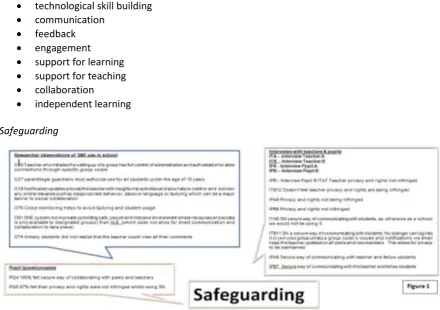
Safeguarding
Figure 1. Safeguarding.
39 Access
Figure 2. Access.
A major benefit of the SNE was the global access (O60) but at local level there were issues to be dealt with. It was ascertained that all pupils had a valid email address as required to sign on, although had this not been the case it was determined that this could be overcome through a peer buddy system where shared access was agreed with another pupil who had a valid email address (O24), subject to permission gained from the parents of both users. Parental permission was a school requirement for all users, but this caused some delays in setting up SNE (O24). Other hindrances to the use of SNE included malfunctions of the system (O70), internet speed (O8, O71, ITB8) and operator error such as pupils forgetting passwords (O68) and not receiving alerts due to notifications being switched off (O72).
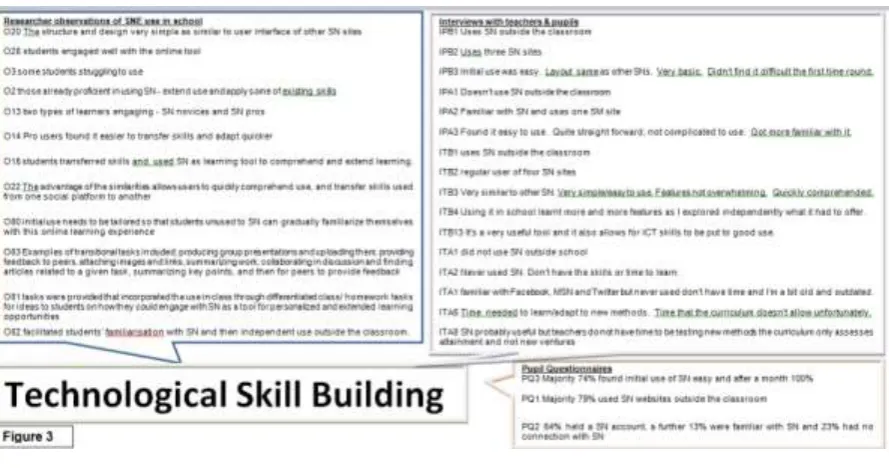
Technological skill building
Figure 3: Technology skill building.
40 Initial usage of SNE was found to be dependent on former use of SN sites. On the whole, pupils engaged well with SNE (O28), but existing SN users found it easier to transfer skills and adapt more quickly to SNE. SN users found SNE to be easy to use (IPB1, IPB2, IPB3) with an interface similar to popular SN sites (O20, ITB3, IPB3) and use increased familiarisation (IPA3, ITB4). Pupils unfamiliar with other SN sites struggled initially (O3), but after an initial 74% of users finding SNE
straightforward, within a month this increased to 100% (PQ3). It was found that pupils transferred skills (O15) and those initially unfamiliar with SN were provided with tasks to build up their
technological skills (O80, O83) that were differentiated for personalised and extended learning opportunities (O81), facilitating development that led to independent use outside the classroom (O82).
The teacher used to SN sites outside school (ITB1, ITB2) substantiated pupil-generated data that SNE was similar to other SN sites which aided its use (ITB3) and benefits as a tool and as a means to extend ICT skills were suggested (ITB13, O22, O2). Data from the teacher familiar with but unused to SN sites (ITA1) raised a need both for skill-building for teachers (ITA2) as well as time for such new learning (ITA5, ITA8).
Communication
Figure 4. Communication
SNE was used as a means of general communication between school and home, allowing pupils to be reminded of deadlines (O54), for pupils to communicate with their teachers away from the public forum of the classroom (IPB5, IPA5) for pupils to communicate with their peers, with parents
assured that this was school-related (IPB4) and for teachers to communicate with each other (ITB16). A drawback to the wide scope of communication possibilities was the need for teachers to limit the amount so as not to become unmanageable (ITB17).
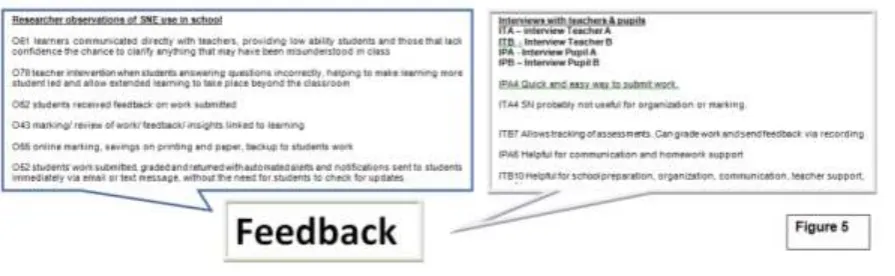
Feedback
Figure 5. Feedback.
41 away from the public forum of the classroom (O61) and receive feedback on their work (O62) which was deemed to be helpful (IPA6, ITB10). Teachers were able to intervene during pupil interactions on SNE to address misconceptions, whilst maintaining provision of student-led learning which was extended beyond the classroom (O78). SNE provided a quick and easy means of submitting work (IPA4), allowing teachers to monitor pupils’ assessments, gain insight into their learning mark work and provide feedback (ITB7, O43). Online marking via SNE saved on hard copy resources as well as providing a backup of pupils’ work (O65) and automated alerts and notifications to pupils were facilitated (O52). However, in contrast to those using SNE, indication that it would not be useful for organisation and marking (ITA4) suggests, as above, that further training for its use would be valuable in facilitating teachers to consider its possibilities.
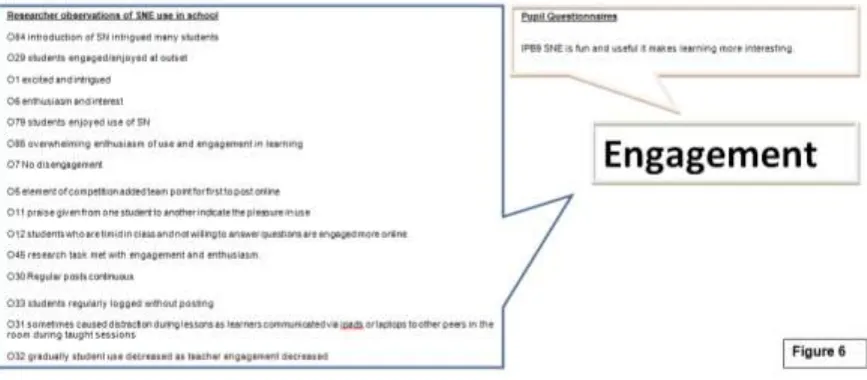
Engagement
Figure 6. Engagement.
Pupil interest and enthusiasm was evident at the introduction of SNE as a new tool (O84, O29, O1) which continued throughout (O6, O79, O86, O45, O30, IPB9) with no disengagement amongst pupils apparent (O7). Encouragement was provided by teachers (O5), although there were times when pupils logged on without posting (O33). It was noted that usually timid pupils in class were more engaged online (O12). A drawback to its use was that SNE sometimes caused a distraction during lessons as pupils communicated with each other during taught sessions (O31). Although to begin with pupils were motivated to use SNE, findings showed that teachers’ regular contact was needed to maintain its use as an approach to teaching and learning (O32).
42 Figure 7. Support for learning.
SNE was considered a useful means of learning support (ITB5) including the development of ICT skills as outlined above (O15), the use of resources to prompt discussion and link to real life (O37) and to extend thinking through questioning (ITB9). Learning activities included finding articles related to a given task, producing group presentations and uploading them to share with others, providing feedback to peers, attaching images and links, summarising work, collaborating in discussion, summarizing key points, and receiving feedback from peers (O83). Learning opportunities observed included: skill building, understanding of the use of SN; providing resources for peers; collaboration and interaction with peers; communication online; engaging online to answer questions; confidence to ask questions; consulting and seeking advice from peers; assisting peers; acting as a peer buddy; direct posts to teachers; discussion; submission of assignments; (O90, O91). However, whilst the SN-familiar teacher found SNE useful for school preparation, organisation and teacher/peer support, the SN-novice teacher did not (IPA7, IPB6), suggesting that if the apparent range of scope for the use of SNE for learning as observed overall is to be fully implemented, training is needed for SN-novice teachers to be in a position to further consider its use.
Support for teaching
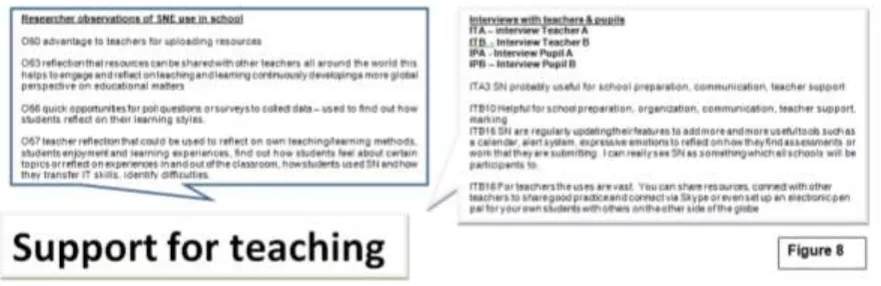
Figure 8. Support for teaching.
SNE was considered useful for teaching by means of sharing resources for pupils’ use (O50) and between teachers on a global scale (O63); for teachers to share good practice (ITB16) and set up pupil communication globally (ITB16); for surveying pupil reflections on learning (O56) and for teacher reflection on learning experiences (O57); and for school preparation, organisation and teacher support (ITB10, ITA3). It was noted that as SNE update their features, further opportunities for its use could be considered (ITB15).
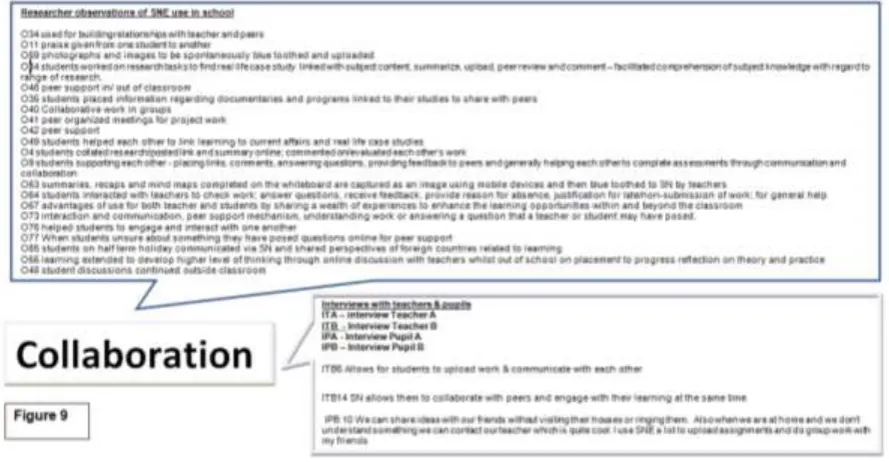
43 Figure 9. Collaboration.
SNE was useful for building relationships between teachers and pupils (O34) for, as well as communicating reasons for absence and late or non-submission of work (O64), pupils interacted with their teachers via SNE to check work, ask questions, receive feedback, seek to gain further understanding and for general help (O64, O73). As teachers shared resources from class-based work, they were able to extend the learning environment beyond the school (O53, O67) which stretched globally for the pupil who shared perspectives of the foreign country she visited with regard to the subject mattered being studied (O85). For learning, its use helped pupils to engage and interact with each other (O76, ITB14,), particularly in group projects (O40, IPB10). As well as observations of pupils collaborating through the sharing of learning resources such as
documentaries to link their learning to current affairs and real life case studies (O49, O59, O35, ITB6), they used SNE to support each other in and out of the classroom (O46) by organising meetings for project work (O41) and helped each other through praise, support, evaluation of each other’s work, asking and answering questions, providing feedback to peers and collaborating on
assignments (O11, O42, O4, O9, O77) which was observed to facilitate comprehension of subject knowledge with regard to a range of research (O44). Collaboration included pupil discussions outside the classroom (O48) with observed development of higher levels of thinking through online discussion with teachers whilst pupils were out of school on placement as they reflected on the links between theory and practice (O55).
Independent Learning
Figure 10. Independent learning.
44 beyond the classroom (O36) as pupils became increasingly collaborative with each other, less reliant on the teacher (O10) and increased active self-management of learning (O36) including linking theory to practice and relating aspects of the course with primary insights into a developing country (O39) and staying in touch with teachers and peers when absent through regular interaction with SNE via posts, comments and uploaded learning materials, enabling a smooth transition upon return to school (O38).
Discussion
Since an essential element of using ICT as an educational tool is ensuring the safety of users
(Vanderhoven et al., 2013; Brady, 2008), in line with school policy and government guidance (HMSO, 2004), the SN platform chosen for use in the school ensured safeguarding through the teachers’ administration, authorisation control settings and monitoring of use.
As the school had scheduled the use of ICT into the improvement plan, the potential problem of finance identified by Armstrong and Franklin (2008) was not an issue, however, as also suggested by Armstrong and Franklin (2008), some problems with access were evident as email accounts were needed by all users, some pupils found remembering passwords difficult, sometimes the system malfunctioned and it was dependent on users’ speed of internet connection. Hence there is a need for teachers to anticipate and deal with logistics when setting up SN for school use.
In this girls’ school, no gender issues arose as raised by Sims et al. (2005) but their suggestion of potential cultural issues was pertinent since some cultural concern was apparent when setting up the new technology and hence there was a particular need to reassure parents regarding what was involved.
The choice of SN platform was considered advantageous as its interface shared similarities with other popular SN sites, allowing users to quickly comprehend, use and transfer skills. However, disadvantages were determined for users who had never previously experienced any form of SN and so the need for this area of skill development was identified. It was evident that the pupils making use of SNE developed their technical skills but, in line with Kurthakoti et al.’s (2013) advocation of existing skills being built upon, this study demonstrated a need for teachers to plan gradual provision of skill-building activities for users who are unfamiliar with SN.
It was found that the SN platform implemented in the school had generic uses (Abbott, 2001) in terms of general communication between teachers and pupils for information purposes and between teachers for the sharing of resources.
Just as previous research has advocated the use of various forms of ICT as a tool for learning (Mason and Rennie, 2006), SN was also found in this study to be useful via the logistics of online marking and feedback, facilitation of teachers’ collaboration, facility for setting up surveys for pupils to express their thoughts and for teachers to reflect on pupils’ learning, teachers’ identification of the need for support and development of technological skills.
SNE was met with interest and enthusiasm by pupils, although an identified drawback was that some distraction was caused to during school-based learning as pupils communicated with each other via SNE. Also, the findings indicated the level of teacher engagement proving a potential difficulty in the use of SN as an educational tool as, despite the pupils making use of it for a range of learning
opportunities and enhancing their ability to learn independently as outlined above, in the long term this was dependent on teachers maintaining their level of contact which proved to be
45 teacher learning is needed. These elements of pupil and teacher engagement with the technology suggest changes in pedagogical approaches may be needed if its benefits are to be encompassed alongside the best use of learning and teaching time; this reflects Segrave and Holt’s (2003) indication of challenges inherent in designing new learning environments.
However, more pertinent to the purpose of this study was to gain an understanding of how the SN platform was implemented for pupils’ learning. It was viewed very positively in terms of
engagement and enjoyment by pupils, as recognised as being of value by Kurthakoti et al. (2013). Implementation within this school supported the indications from Ofcom (2008) that SN has positive uses since:
teachers used SN to provide differentiated, personalised and extended learning activities for use in class and at home
an active learning community was enhanced through increased communication between teachers and pupils
pupils were found to engage with subject knowledge and relate this to the external environment
links were made between theory and practice outside the classroom
pupils extended their discussions beyond the classroom, linking learning in school to real life, with evidence of progression and transfer of knowledge and skills
pupils provided and shared learning resources, thus increasing their interaction with each other as well as their engagement and collaboration in learning
enhanced interaction providing added opportunities for learning through discussion
extension of pupils’ self-management skills and independent learning beyond the classroom support was enhanced between pupils and between teachers and pupils, including discrete
access to support from pupils needing to contact their teacher away from a public setting pupil support for each other and willingness to collaborate in learning opportunities meant a
more pupil-led approach developed in the classroom with less reliance on the teacher learning relationships between teachers and pupils were enhanced
learning was facilitated via easily accessible marking comments, feedback and review from teachers and peer feedback
insights into learning were facilitated
teachers were able to extend learning through the use of specific questioning to develop a higher level of thinking
The findings therefore determined how SN was used positively to enhance learning opportunities in the school. Although there may be other resources that could be implemented in similar ways with similar results, the findings certainly suggested that SN has its positive uses as an educational tool. In terms of enhancing pupils’ support for each other and their development of self-managed learning (Bentley, 1998), alongside the development of pedagogical elements as identified in the literature (Kurthakoti et al., 2013; Minocha, 2009; Veletsianos and Navarrete, 2012; Hsu-Wan Chen, 2010) pupils used SN to communicate and collaborate with each other and with teachers, extending their learning beyond the classroom (Tansey, 2003). This study therefore indicates some of the ways in which SN can be used in a secondary school as an educational tool (Balog et al., 2013), the findings resonating with Mason and Rennie’s (2008) views on SN being a potential tool for learning and suggestion of the transformative power of SN (Vanderhoven et al., 2013) as pupils evidently developed their knowledge and made links between their shared experiences.
Conclusion
46 through the connections facilitated between pupils and between pupils and teachers, whereby engagement and interaction was found to be supportive and collaborative for the educational process. The sharing of resources between teachers, between pupils and between teachers and pupils was also found to be advantageous. Interaction and collaboration between pupils and school and between home and school were increased, both for learning and for more generic logistics. Generic and transferable technological skills were developed through the use of SN.
However, whilst pupil engagement was found to be positive, the study raised some concern about the time involved for teacher engagement as well as the need for training for teachers’ use of SN, which suggests further consideration of pedagogy regarding implementing SN in terms of teacher and pupil expectation and independent learning. Issues of access were dealt with, but this is also an area found to be potentially problematic for a school setting up a SN platform for use by pupils. Safeguarding is paramount, with this study demonstrating the importance of the choice of SN platform in order to enable teachers to maintain a secure environment for the pupils involved.
In the interests of removing some of the confusion surrounding how ICT can be advantageous as an educational tool (Mason and Rennie, 2006), this study helps to ascertain the potential of the use of SN as an educational tool (Tansey, 2003) within a particular secondary school. As such, it contributes to the widening understanding of how SN can be used in education (Balog et al., 2013). However, there remain issues to be considered for its future use. The benefits of SN in the case study school were considered to outweigh the difficulties that arose, but, especially with the nature of constantly evolving technology and opportunities for ICT to be used in education, this study has determined that a school needs to consider not just how a tool such as a SN platform can be used within existing pedagogy, but how teaching and learning may need to be redesigned if the benefits are to be embraced but the disadvantages to be overcome.
Reference List
Abbott, C. (2001) ICT: Changing Education. London: Routledge Falmer.
Armstrong, J. and Franklin, T. (2008) A Review Of Current And Developing International Practice In The Use Of Social Networking (Web 2.0) In Higher Education, Available at:
http://www.franklin-consulting.co.uk/ (Accessed: 07 January 2014).
Balog, A., Pribeanu, C., Lamanauskas, V. & Slekiené, V. (2013) ‘A Multidimensional Model for the
Exploration of Negative Effects of Social Networking Websites as Perceived by Students’,
Journal of Baltic Science Education, 12(3), pp. 378-388.
Bentley, T. (1998). Learning Beyond The Classroom. London: Routledge.
Brady, K. (2008) ‘The Promises and Pitfalls of Social-Networking Websites’,School Business Affairs, 74(9), pp. 24-28.
British Educational Research Association (BERA) (2011). Ethical Principles. Available at:
www.bera.ac.uk/system/files/3/BERA-Ethical-Guidelines-2011.pdf (Accessed: 7th January, 2014).
Cohen, L., Manion, L. & Morrison, K. (2000) Research Methods In Education. 5th edn. London: Routledge Falmer.
HMSO(2004) Children Act 2004. Available at:
http://www.legislation.gov.uk/ukpga/2004/31/contents (Accessed: o2 December 2013). Hsu-Wan Chen (2010) Applying Social Networking to Construct an Elementary Science Learning
Community. E-Science Workshops, 2010 Sixth IEEE International Conference on E-Science. Brisbane, Australia.
Kurthakoti, R., Boostrom, R.E., Summey, J.H. & Campbell, D.A. (2013) ‘Enhancing Classroom Effectiveness Through Social Networking Tools’ Marketing Education Review, 23(3), pp. 251– 263.
47 Mason, R. & Rennie, F. (2008) The E-Learning Handbook: Social Networking for Higher Education.
London: Routledge.
Minocha, S. (2009) ‘Role Of Social Software Tools In Education: A Literature Review’,Education and Training, 51(5/6), pp. 353–369.
Ofcom (2008) Social Networking – A Quantitative And Qualitative Research Report Into Attitudes, Behaviours And Use. Available at: http://stakeholders.ofcom.org.uk/binaires/research/media-literacy/report1.pdf (Accessed: 07 January, 2014).
Ritchie, J. & Lewis, J. (2003) Qualitative Research Practice: A Guide for Social Science Students and Researchers. London: Sage.
Segrave, S. & Holt, D. (2003)’Contemporary Learning Environments: Designing E-Learning For Education In The Professions’, Distance Education, 24(1), pp.7-24.
Sims, J., Powell, P. & Vidgen, R. (2005). ‘E-Learning And The Digital Divide: Perpetuating Cultural And Socio-Economic Elitism In Higher Education’,. European Conference on Information Systems (ECIS) Milan, 13 February 2005.
Tansey, S. (2003) Business, Information Technology and Society. London: Routledge.
Vanderhoven, E., Schellens, T. & Valcke, M. (2013) ’Exploring the Usefulness of School Education about Risks on Social Network Sites: A Survey Study’, The National Association for Media Literacy Education’s Journal of Media Literacy Education, 5(1) pp.285-294.
Veletsianos, G. & Navarrete C.C (2012) ‘Online Social Networks as Formal Learning Environments: Learner Experiences and Activities’, The International Review of Research In Open and Distance learning, 13(1), pp.144-166.