A Fuzzy Rule-Based System to Predict Energy
Consumption of Genetic Programming Algorithms
Josefa D´ıaz ´Alvarez1, Franciso Ch´avez de la O1, Pedro A. Castillo2, Juan Angel Garc´ıa1, Francisco J. Rodriguez3, and Francisco Fern´andez de Vega1
1
M´erida Campus. University of Extremadura, M´erida, Spain
{mjdiaz, fchavez, juangm, fcofdez}@unex.es
2
Computer Architecture and Technology Department. University of Granada, Spain [email protected]
3
Computer Science Department. University of Burgos, Spain [email protected]
Abstract. In recent years, the energy-awareness has become one of the most
in-teresting areas in our environmentally conscious society. Algorithm designers have been part of this, particularly when dealing with networked devices and, mainly, when handheld ones are involved. Although studies in this area has increased, not many of them have focused on Evolutionary Algorithms. To the best of our knowl-edge, few attempts have been performed before for modeling their energy consump-tion considering different execuconsump-tion devices. In this work, we propose a fuzzy rule-based system to predict energy comsumption of a kind of Evolutionary Algorithm, Genetic Prohramming, given the device in wich it will be executed, its main param-eters, and a measurement of the difficulty of the problem addressed. Experimental results performed show that the proposed model can predict energy consumption with very low error values.
Keywords:Green computing, energy-aware computing, performance measurements,
evolutionary algorithms.
1.
Introduction
Nowadays, power consumption has become a major concern due to electricity cost and availability constraints. Energy efficiency issues has been extensively addressed in the last decades by the scientific community. New products, procedures, and systems have been designed for ensuring the environmental sustainability, and computing environments are not an exception. The management of the energy consumption is a crucial problem in all kind of systems: mobile devices battery-powered, desktop computers and large data cen-ters. A data center includes both traditional servers and new hardware platforms such as blade systems, which consume a huge amount of energy for both working and dissipating the heat generated. The energy dissipation causes thermal problems. A portion of the en-ergy consumed is converted into heat, which affects the system reliability. The problem is more serious for battery-powered devices. Thus, reducing the power consumption is not only a matter of environmental awareness but also reliability.
These techniques can be labelled as Green Computing [20] techniques. The latter reduce the environmental impact and promote the energy efficiency, sustainability, and obtain positive results under most circumstances. However, the energy consumed by the algo-rithms executed in those systems has been always forgotten.
In particular, Evolutionary Algorithms (EA) are broadly applied for many complex optimization problems and diverse areas on previously mentioned hardware platforms. It is important to note that big systems are not always necessary to address an optimiza-tion problem. Desktop systems and new and powerful ephemeral platforms [10] help to experiment and solve problems in different scientific areas in academic and research en-vironments. They can help to reduce the power consumption when the problem is not too complex from a computational point of view. These platforms may need lower power consumption facing a higher execution time.
However, how much energy is needed to get some experiments done for a given opti-mization problem? It must be noticed that the energy consumed by the algorithm not only depends on its parameters such as number of generations or population size, but also the hardware platform and the problem to be addressed. A good prediction about the energy consumption according to the problem at hand and the parameters of the algorithm would be very useful to make an appropriate decision. This decision can be oriented towards the algorithm settings, the solutions quality (which is not addressed in this work) or the hard-ware platform to be used. One of the goals of theGreen Computingapproach is modeling the behavior of a system, for example, for being able to predict and respond to future events.
Less powerful hardware platforms can run algorithms with higher number of genera-tions or population size with a lower energy consumption than others more powerful [34]. Therefore, addressing the generation of a predictive model of energy consumption might be interesting to know a priori the most suitable hardware platform. We deal with the prob-lem of predicting the energy consumption of a popular kind of EA, Genetic Programing (GP) [21], which tries to evolve computer programs when looking for optimal solutions for a given problem.
In particular, we focus on implementing a predictive model for energy consumption of GP dealing with two typical regression problems on three different hardware plat-forms. We aim to predict it taking into account the main GP parameters, the difficulty of the problem addressed, and the hardware platform. For this purpose, we apply a Takagi-Sugeno-Kang Fuzy Rule-Based System [29] (TSK-FRBS), usingk-fold cross validation as training strategy in order to improve the generalization capability of the predictive model.
The rest of the paper is organized as follows. Section 2 reviews the related work about energy optimization techniques. Section 3 describes the optimization framework, detailing how data are obtained and processed, and how the model has been built. Then, Section 4 describes the experimental framework and analyzes results obtained. Finally, Section 5 draws conclusions and future work.
2.
Related Work
Some works have developed models to predict the performance of a GP algorithm until the optimal solution is found. Graff and Poli [15] introduce two models of performance based on difficulty indicators for EPAs (Evolutionary Program-induction Algorithm). They were applied to symbolic regression and Boolean induction problems. However, the prediction of the performance do not include any study neither about the energy consumed nor the hardware platform that can be used. Trujillo et al. [30,31] developed an approach for pre-dicting the performance of GP applied to data classification. Recently, Martinez et al. [25] presented a predictive model of expected performance. This predictor adds new descrip-tive measures and evaluates the performance of the GP classifier on the test set of fitness cases.
One of the main goals for last decades has been both to increase the performance and built more energy efficient hardware systems. However, a performance increasing implies a significant growth in energy consumption. Thus, both must evolve at the same speed to improve the energy footprint.
The optimization of the power consumption can be addressed from a hardware or software perspective. In this regard, some successfull techniques have been designed to improve the energy efficiency. The Dynamic Power Management (DPM) [7] is a method-ology for dynamically reconfiguring systems by turning off/on some components without performance loss. Power-down mechanism [5] applies different DPM techniques and off/on line algorithms that allow systems to move from a high power state to a lower one (standby or hibernate mode), when there is no activity for a period of time accord-ing to an algorithm. Dynamic Voltage Frequency Scalaccord-ing (DVFS) [8,18] is a stable and powerful technique in power management to save energy. It provides the ability to adjust voltage and work frequency based on the workload requirements. Speed Scaling has long been applied at a chip level for save energy and nowadays is applied at all systems lev-els [6,28]. Moreover, the search for the optimal algorithms is a promising research field nowadays [2]. These techiques are based on processor speed scaling and power-down mechanisms and assume that they are supported by the CPU technology. Therefore, EAs benefit from this techniques.
On the other hand, new hardware technologies and core-based processor technologies, such as ARM [4], allow changing others hardware settings like the structural parameters of the cache memory according to the running application to be more efficient in terms of performance and energy.
The energy management is a key issue not only in computer based systems. EAs have been applied in different areas to improve the energy efficiency. Literature mentioned below uses tangentially EAs to optimize the energy consumption. Vasicek et al. [32] proposed a new systematic method for designing energy efficient electronic component based on circuit approximation and Cartesian Genetic Programming (CGP). DVFS com-bined with scheduling techniques and multicore systems at the task level can improve the memory energy consumption [26]. Diaz et al. [3] presented a multi-objective algorithm (NSGA-II) approach to find cache configurations for reducing power consumption and execution time.
efficiently virtual machines to physical machines and improve the energy efficiency and reduce the wasted resources.
Regarding mobile devices, for example, Linares et al. [23] proposed a Graphical User Interface of Android applications, which uses a colour palette aiming to optimize the energy consumption. This colour palette is generated using a multi-objective optimization technique.
From other different perspectives, Lu et al. [12] reviewed several research works, where multi-optimization algorithms are applied for solving problems in the area of re-newable and sustainable energy. Logenthiran et al. [24] presented a management strategy from the demand side to be applied in smart grid. They developed a heuristic optimiza-tion based on evoluoptimiza-tionary algorithms to help clients to take decisions about their energy consumption.
However, works where EAs are applied, including all previously mentioned, generally consider EAs as a tool to improve the energy efficiency when facing a given problem, and they do not take into account their own energy consumption whilst the optimization process is carried out.
In this context, a preliminary work [33] measured the energy consumed by an EA, particularly GP. The behavior of the multiplexer problem was analized on several different platforms such as blade systems, tablet, laptop and Raspberry-pi. The main goal was to determine the relationship between the main parameters of the algorithm and the power consumption. As a conclusion, a device like Raspberry-Pi can be more energy efficient when not a very computationally complex problems are addressed.
Wang et al. [35] presented an instruction-level energy model for a single core and RISC processor architecture, however their approach is different the one we present.
An energy estimation model, especially aimed at GP algorithms, was proposed in a subsequent work [11]. This preliminary model applied a simple Fuzzy Rule-Based System to predict the energy consumption by using an inference engine. Experimental tests with the multiplexer-6 problem were carried out on Raspberry-Pi, laptop and tablet platforms. As a result, the energy consumption predictive model has a low error in the predictive phase. However, this preliminary work obtained one predictive model for each hardware platform and only the multiplexer problem.
3.
Methodology
As mentioned before, in this work we propose an approach to implement an energy pre-dictive model for EAs, particularly GP. This approach is based on the study of the main three GP parameters: the number of generations, population size and maximum depth. We add two new parameters: the hardware platforms to be used and the difficulty of the optimization problem to be solved, obtained by a profiling.
input the profiling report previously obtained, where the values of the parameters that describe the problem executed are stored, together the energy consumption value.
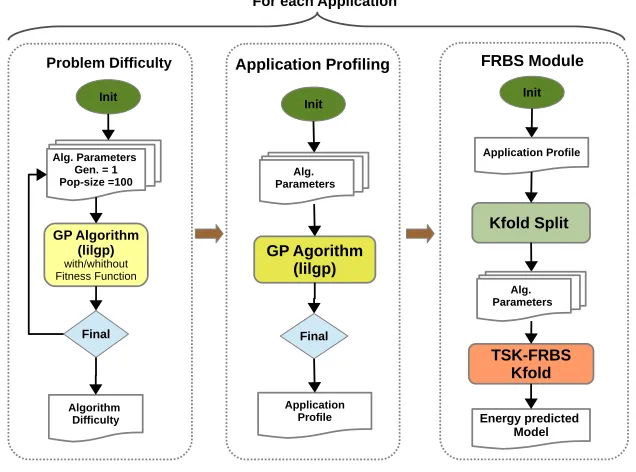
First and second stages are intended to provide key information to fulfill the profiling report needed for the third one. The profile report designed contains a line for every differ-ent combination of the main GP parameters addressed, the measuremdiffer-ent of the problem difficulty obtained in the first stage, and the energy consumption according to the pa-rameters. Next, we explain each stage in detail. The following subsection details how we compute the difficulty of the problems addressed.
Fig. 1.Stages involved in the process to obtain the energy prediction model.
3.1. Optimization Problem Difficulty
To identify the difficulty of a problem, the algorithm must be executed. Different metrics can be applied to evaluate the problem difficulty until the algorithm finds the optimal solution. However, the method applied to find the optimal solution is a key factor and it is represented by the fitness function [17]. Thus, the difficulty of an optimization problem to be solved by means of EAs is evident in the fitness function, which also identifies the optimization problem.
We compute the difficulty as the effort needed to solve an optimization problem as shown in (1), whereCxis the effort the algorithm have to do according to the problem
at hand;Taf is the time computed when the algorithm evaluates each solution with the
Table 1.Main GP Parameters. A total number of 1716 combinations were tested.
Generations 10,20,40,60,80,100,150,200,300,400,500
Population sizes 10,20,30,40,50,60,70,80,90,100,120,140,160,180,200,250,
300,350,400,450,500,600,700,800,900,1000
Max depth 3,5,6,7,8,9
Crossover probability0.9
Mutation probability 0.1
fitness function. In order to compute this value accurately, we launch twenty times each experiment for one generation and 100 individuals and we average the values obtained. This set of tests are done for each problem and value of maximum depth to be addressed. As a result, we obtain the time influence of the fitness function in terms of percentage, with respect to the total time of the algorithm.
Cx=
(Taf−Tsf)
Taf
×100 (1)
The time measurements are calculated taking the difference between the time just immediately before launching the algorithm and just after finishing. This measurement do not take into account the time spent filling the log report neither computing these measures. Time units used in seconds and the percentage computed will complement the information obtained by the second stage, which is explained below. Moreover, whilst this first stage is carried out we measure the average power delivered for each device, which is used to compute the percentage over the highest power and allow us to adjust the ECPM proposed.
3.2. Application Profiling
This stage is in charge of executing the GP algorithm for each problem according to the parameters chosen, and get a profiling report to which computational effort obtained in the previous stage will be added.
To design this energy consumption estimation model, two well-known GP benchmark problems have been selected: multiplexer (6 bits) and regression. The multiplexer prob-lem simulates the behavior of this electronic component. The 6 bits impprob-lementation has two address input and four data entries. The regression problem uses GP to discover the functionY = X4+ X3+ X2+ X. Both are included in lilgp4, a well-known GP
im-plementation inClanguage. The language related decisions have a high computational influence on the algorithm [27] and, thus on the energy consumption, which is addressed in this work. Functions and terminal sets are the standard ones described by Koza [21].
The main EAs parameters have a considerably impact on the algorithm performance and, hence on the energy consumption. Table 1 shows the main parameters and their set of values considered to carried out the experimental tests and obtain the profiling report. The stop condition is set when the optimal solution is found. The more information we provide to the fuzzy system, the better prediction we obtain.
Each individual experiment has been launch 30 times because of the stochastic nature of EAs and we compute the performance and energy consumption as the average of the 30 runs. Each run is parameterized with a different seed and the same thirty seeds are used in all experiments and devices. We use seconds to compute the performance as the difference between time before launching the algorithm with a particular combination of parameter values and just after finishing. We do not compute the time needed to store log information neither computing.
The energy consumption is computed assuming devices are working at the highest power according toEnergy = P ower∗T ime. This decision was taken given the in-terest of this work in testing this methodology to provide a model to predict the energy consumption. Future development will need accuracy measures about the average power delivered by each device and problem addressed, whilst the algorithm is carried out. As previously mentioned, for each different combination of the main parameters of GP algo-rithms described in Table 1, the algorithm is run thirty times and computes the average time and energy consumption in each device.
Results obtained for each GP problem and devices are stored in a different profiling report for being further processed by the fuzzy system in order to build the energy estima-tion model, where units used for energy, power and time are Joules, Watts and Seconds, respectively. As soon as the profiling stage finishes, the next stage executes the FRBS module, which is addressed in the following subsection.
3.3. FRBS Module
As previously stated, the prediction model is performed by the FRBS module, as seen in Fig. 1. The Energy Consumption Predictive Model (ECPM) we propose needs, first of all, to establish the relationship among the set of parameters defined, whose values are col-lected in the profiling report previously mentioned, by executing the GP problems chosen. These data or input variables are included as key information during the learning phase to design the ECPM, what will allow subsequently evaluate the energy consumption. The variables defined for the ECPM described are:
– Input Variables
• device
• population size
• number of generation
• maximum depth
• problem difficulty
– Output Variable
• energy consumption, defined as the value to be predicted.
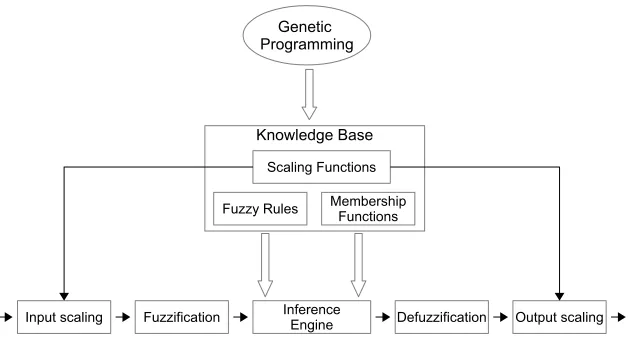
Fig. 2.TSK-FRBS model.
an antecedent and a consequent. The antecedent is composed of linguistic variables, and the consequent is a polynomial function of the input variables. Thus, the rules format of a TSK-FRBS has the following structure:
I F X1 i s A1 . . . and Xn i s An
t h e n Y = p1 ∗ X1 + . . . + pn ∗ Xn + p0
where the system inputs variables are denoted asXi,Y is the system output variable,pi
represents real-values coefficients andAiare fuzzy sets.
Fig. 2 shows the flow of the TSK-FRBS model. Considering the KB containsmTSK rules the output of TSK system is computed as the weighted average of each individual rule outputYias shown (2):
Pi=1
m hi·Yi
Pi=1
m hi
(2)
wherei= 1...m,hi=T(A1(x1)...An(xn))represents the matching degree between
the antecedent part of theithrule and the current system inputsx= (x1...xn), and with
T being a t-norm.
TSK FRBSs have been applied successfully to a large quantity of problems. The main advantage of these kinds of systems is the fact that they present a compact system equa-tion for estimating the parameterspi using classical methods, and obtaining an accurate
system, which can be very useful for accurate fuzzy modeling.
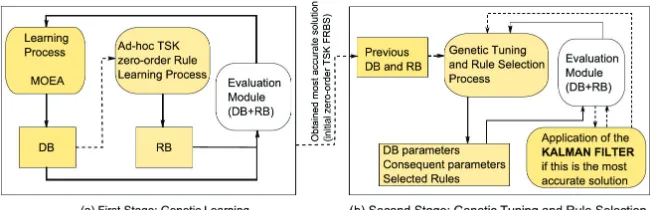
Problems with large or high-dimensional data sets make non-feasible an ad-hoc im-plementation and need an automatic learning process for the KB and RB. The process is divided into different stages due to the high complexity of the search space involved, although KB and RB should be learnt and optimized together. Different techniques have been applied for this task, but the Genetic Fuzzy Systems (GFS) [19] has the best results. EAs are able to learn the antecedents and consequents of the rules system together, and to optimize the MF of the KB. Figure 3 shows the summary of the optimization process of TSK FRBS.
This process is divided into two stages, calledLearningandTuning. In the first stage, Learning, the initial Data Base (DB) based on a fuzzy grid in order to obtain zero-order TSK candidate rules, is learned. The second stage, Tuning, applies an advanced post-processing for fine scatter-based evolutionary tuning of MFs combined with a rule selec-tion. Figure 4 shows the process described previously.
train-Fig. 3.Processes involved in the FRBS module.
ing data into K different sets,S= (S1...Sk). For a particular evaluationi,Sirepresents
the test set and the combination of the remaining sets are used for model fitting.
4.
Experimental Results
4.1. Experimental Framework
In order to test our proposal, we have selected the two benchmarks previously mentioned from the lilgp suite: multiplexer-6 and regression, which are representative benchmark problems. Three computational platforms have been tested: Raspberry-Pi, laptop and tablet. Table 2 provides the technical details of the hardware architectures and operat-ing systems. Facoperat-ing an optimization problem, the power consumption depends not only on the algorithm but also the architectural features of the device in which it is executed. Future decisions on the hardware to run an optimization algorithm may take into account the processor speed, instruction set architecture and operating system, which we do not take into account in this work.
We are aware of the possibility of disabling services unused such as wifi, bluetooth, hdmi connection, leds on the board, etc. to reduce the power consumption. In this paper, we consider all components are enabled and devices are plugged whilst the GP algorithm is running.
Fig. 4.TSK FRBS optimization process.
Table 2.Computational platforms (devices) used in this work.
Device raspberry pi tablet laptop
Processor Cortex-A7 Samsung Galaxy Tab 3 Intel(R) Core(TM)
900 MHz SM-T311. Exynos 4212 1.5 GHz i5-2450M 2.5GHz
Cores 4 2 4
RAM 1GB 1.5GB 8GB
OS Raspbian
GNU/Linux 7
Android 4.4.2 (kernel 3.0.31)4 Ubuntu 12.04.5 LTS
Watt-hour 12.5 14.8 75
Finally, the ECPM is built after the execution of TSK-FRBS with 5-fold cross valida-tion as the training strategy. As menvalida-tioned before, TSK-FRBS is launched 30 times for each experiment due to the stochastic nature of this kind of algorithms.
For the sake of clarity, we would like to remark that in this work an ECPM model for each kind of problem have been built. The TSK-FRBS used has two different processes. The first process is calledLearning, in this process the systems used a EA to design the whole KB (DB and MFs). In this process the system begins with an initial FRBS designed randomly and, be means of an EA, the systems describe the whole system, where the DB and MFs are described. The second process tries to improve the FRBS designed in the above stage. In this stage, again a EA is applied to reduce the number of MFs obtained in thelearningprocess. But not only do they try to reduce the rules, but also try to improve their efficiency again. In both processes, the method applied will try to eliminate variables that apparently are not necessary.
4.2. Experimental Analysis
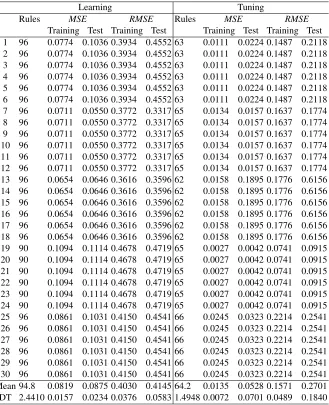
This section analyzes the experimental results obtained. Fig.5 shows the evolution of the Mean Squared Error (MSE) and Root Mean Squared Error (RMSE) metrics for the multiplexer problems in training and test. Results obtained with our methodology reach a high hit rate, values predicted are close to the original values. More detailed information is given in Appendix A, Table 3, which compiles results obtained for each individual experiment of FRBS, particularly: the number of rules,MSEandRMSEfor training and test. We can see values forMSEandRMSEare close to0, which would be the perfect tuning between the observed value and the estimated value.
1 2 3 4 5 6 7 8 9 10 11 12 13 14 15 16 17 18 19 20 21 22 23 24 25 26 27 28 29 30 MSE training MSE test RMSR training RMSE test
0.8
0.7
0 0.1 0.2 0.3 0.4 0.5 0.6 0.9
Fig. 5.MSEandRMSEvalues for the multiplexer problem in training and test through 30
executions.
1 2 3 4 5 6 7 8 9 10 11 12 13 14 15 16 17 18 19 20 21 22 23 24 25 26 27 28 29 30
MSE training MSE test RMSE training RMSE test
0.14
0 0.02 0.04 0.06 0.08 0.10 0.12 0.16 0.18 0.20
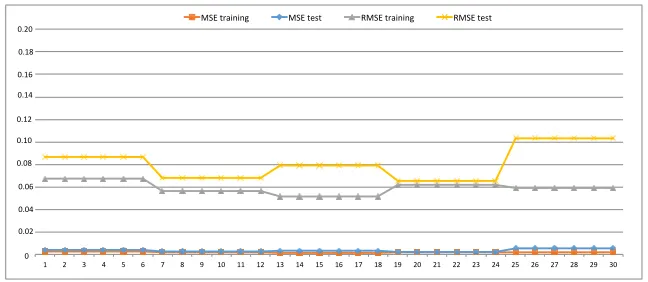
Fig. 6.MSE and RMSE values for the regression problem in training and test through 30
executions.
gen-erated a model for the multiplexer problem and each hardware platform, thus we refer to the average number of rules81. A lower number of rules allows to improve the system interpretability and makes easier a further development to provide predictions to users.
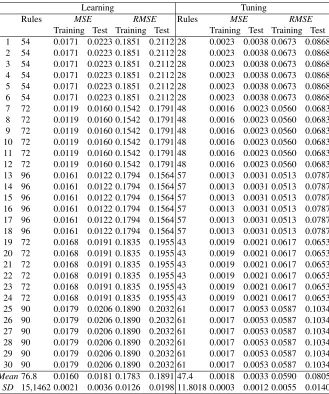
Fig.6 plots the evolution of theMSE andRMSEfor the regression problem. More extended information is represented in Appendix A, Table 4. Values obtained for theMSE andRMSEmetrics are more relevant in the case of the regression problem. These metrics are lower than in the multiplexer problem and they are closer to0, which shows the tuning obtained is near the perfect tuning. On the other hand, the number of rules for the ECPM built is low enough to make easier the development of an interactive applications for final users. Users could introduce their custom parameters and the system would give as answer the energy consumption of the set of tests, using a given hardware platform. Users could take the decision according to the information that best fits the desired energy consumption.
1 18 35 52 69 86
103 120 137 154 171 188 205 222 239 256 273 290 307 324 341 358 375 392 409 426 443 460 477 494 511 528 545 562 579 596 613 630 647 664 681 698 715 732 749 766 783 800 817 834 851 868 885 902 919 936 953 970 987 1004 1021 MSE
0 0.1 0.2 0.3 0.4 0.5 0.6 0.7 0.8 0.9 1.0
Samples from an single K-fold for mul>plexer in test
MS
E
val
ue
s
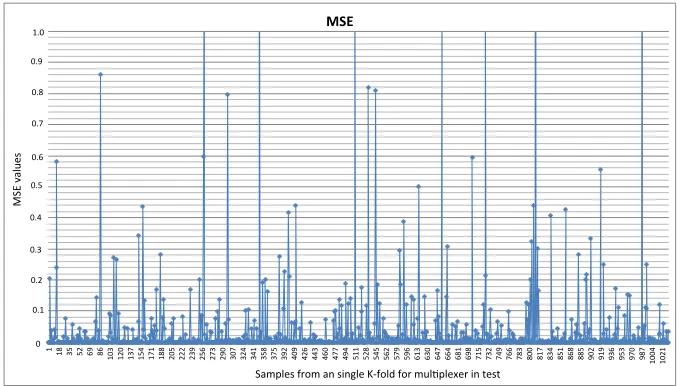
Fig. 7.MSE for the multiplexer problem for an individual kfold
parameters is small for the lower range, these intervals increase as we approach the upper range. Therefore, we think that we could improveMSEby including more values for GP parameters within their upper ranges. However, it is important to point out that despite this, the accuracy obtained by our model is outstanding, asMSEvalues show.
We also perform the same analysis for the regression problem, but using a different k-fold. Fig. 8 shows theMSEvalues for each of the65profiling data of the chosen k-fold. In this case, we can clearly see that are much less than in the previous case the values that move away from the most frequent value, which as can be appreciated is very close to0. Again, we can verify that these instances with largerMSEvalues correspond to instances with values of the GP parameters in their highest ranges. The conclusions obtained are therefore very similar to those obtained for the of the multiplexer problem.
1 17 33 49 65 81 97
113 129 145 161 177 193 209 225 241 257 273 289 305 321 337 353 369 385 401 417 433 449 465 481 497 513 529 545 561 577 593 609 625 641 657 673 689 705 721 737 753 769 785 801 817 833 849 865 881 897 913 929 945 961 977 993 1009 1025
MSE
0 0.1 0.2 0.3 0.4 0.5 0.6 0.7 0.8
Samples from an single K-fold for regression in test
MS
E
val
ue
s
Fig. 8.MSE for the regression problem for an individual kfold
5.
Conclusions and Future Work
We have presented an energy estimation model, which is especially aimed at EAs, in particular, GP algorithms. To implement this model we have applied a TSK-FRBS that is able to predict the energy consumption by using an inference engine. A 5-fold cross validation process has been applied as the training strategy. We have addressed two typical problem of GP, the multiplexer-6 and regression problems developed withlilgp, a well known C implementation for the GP algorithms. Experimental tests have been carried out on three different hardware platforms:raspberry pi,laptopandtablet, where a different operating system is running:Raspbian,UbuntuandAndroid.
As it is expected, the main parameters of the GP algorithm and the difficulty of the prob-lem must have a considerable influence on the energy consumption. The ECPM is able to make good predictions, however there are some differences due to the lack of samples of the high range of the GP parameters. This can be solved running the algorithm with these parameters and adding values to the profiling report to improve both the learning and tuning phase.
The main conclusion we may present from the results is that this ECPM built with TSK-FRBS is able to correctly estimate the energy consumption of GP for each problem addressed. The usefulness is extensive when some problems need to be solve, an upper limit of energy is established, and different hardware platforms are available to be used. The model would allow to compare several settings before launching the run and propose the best option at the least energy consumption. Moreover, this model can be improved associating the energy consumption with the solutions quality in order to reach the best compromise between the energy efficiency and the solutions quality found.
It is important to note that, unlike the preliminary work, this model is not dependent on the hardware platform. The hardware platform is added as an additional input parameter of the designed model. Moreover, the difficulty of the problem has been also included as an input parameter to the TSK-FRBS prediction model. Those parameters did not belong to the preliminary prediction model presented in previous works.
Although the Energy Consumption Predictive Model presented is based on two GP problem, we think it can be applicable to other EAs. We hope to extend in the future this model with a wide set of experiments, considering more different problems and EAs. Moreover, we do not have a system that automatically analyzes the set of rules when a final user requests information. An interesting future work would be the development of an application, which give automatically the answer according to the given parameters values.
Acknowledgements. We acknowledge support from Spanish Ministry of Economy and
Competitiveness under projects TIN2014-56494-C4-{1,2,3}-P and
Table 3.Individual experiments of FRBS 5-fold for the multiplexer problem.
Learning Tuning
Rules MSE RMSE Rules MSE RMSE
Table 4.Individual experiments of FRBS 5-fold for the regression problem.
Learning Tuning
Rules MSE RMSE Rules MSE RMSE
Training Test Training Test Training Test Training Test
1 54 0.0171 0.0223 0.1851 0.2112 28 0.0023 0.0038 0.0673 0.0868
2 54 0.0171 0.0223 0.1851 0.2112 28 0.0023 0.0038 0.0673 0.0868
3 54 0.0171 0.0223 0.1851 0.2112 28 0.0023 0.0038 0.0673 0.0868
4 54 0.0171 0.0223 0.1851 0.2112 28 0.0023 0.0038 0.0673 0.0868
5 54 0.0171 0.0223 0.1851 0.2112 28 0.0023 0.0038 0.0673 0.0868
6 54 0.0171 0.0223 0.1851 0.2112 28 0.0023 0.0038 0.0673 0.0868
7 72 0.0119 0.0160 0.1542 0.1791 48 0.0016 0.0023 0.0560 0.0683
8 72 0.0119 0.0160 0.1542 0.1791 48 0.0016 0.0023 0.0560 0.0683
9 72 0.0119 0.0160 0.1542 0.1791 48 0.0016 0.0023 0.0560 0.0683
10 72 0.0119 0.0160 0.1542 0.1791 48 0.0016 0.0023 0.0560 0.0683
11 72 0.0119 0.0160 0.1542 0.1791 48 0.0016 0.0023 0.0560 0.0683
12 72 0.0119 0.0160 0.1542 0.1791 48 0.0016 0.0023 0.0560 0.0683
13 96 0.0161 0.0122 0.1794 0.1564 57 0.0013 0.0031 0.0513 0.0787
14 96 0.0161 0.0122 0.1794 0.1564 57 0.0013 0.0031 0.0513 0.0787
15 96 0.0161 0.0122 0.1794 0.1564 57 0.0013 0.0031 0.0513 0.0787
16 96 0.0161 0.0122 0.1794 0.1564 57 0.0013 0.0031 0.0513 0.0787
17 96 0.0161 0.0122 0.1794 0.1564 57 0.0013 0.0031 0.0513 0.0787
18 96 0.0161 0.0122 0.1794 0.1564 57 0.0013 0.0031 0.0513 0.0787
19 72 0.0168 0.0191 0.1835 0.1955 43 0.0019 0.0021 0.0617 0.0653
20 72 0.0168 0.0191 0.1835 0.1955 43 0.0019 0.0021 0.0617 0.0653
21 72 0.0168 0.0191 0.1835 0.1955 43 0.0019 0.0021 0.0617 0.0653
22 72 0.0168 0.0191 0.1835 0.1955 43 0.0019 0.0021 0.0617 0.0653
23 72 0.0168 0.0191 0.1835 0.1955 43 0.0019 0.0021 0.0617 0.0653
24 72 0.0168 0.0191 0.1835 0.1955 43 0.0019 0.0021 0.0617 0.0653
25 90 0.0179 0.0206 0.1890 0.2032 61 0.0017 0.0053 0.0587 0.1034
26 90 0.0179 0.0206 0.1890 0.2032 61 0.0017 0.0053 0.0587 0.1034
27 90 0.0179 0.0206 0.1890 0.2032 61 0.0017 0.0053 0.0587 0.1034
28 90 0.0179 0.0206 0.1890 0.2032 61 0.0017 0.0053 0.0587 0.1034
29 90 0.0179 0.0206 0.1890 0.2032 61 0.0017 0.0053 0.0587 0.1034
30 90 0.0179 0.0206 0.1890 0.2032 61 0.0017 0.0053 0.0587 0.1034
Mean76.8 0.0160 0.0181 0.1783 0.1891 47.4 0.0018 0.0033 0.0590 0.0805
References
1. Albers, S.: Energy-efficient algorithms. Communications of the ACM 53(5), 86–96 (2010) 2. Albers, S.: Algorithms for dynamic speed scaling. In: Symposium on Theoretical Aspects of
Computer Science (STACS2011). vol. 9, pp. 1–11 (2011)
3. ´Alvarez, J.D., Risco-Mart´ın, J.L., Colmenar, J.M.: Multi-objective optimization of energy
con-sumption and execution time in a single level cache memory for embedded systems. Journal of Systems and Software 111, 200 – 212 (2016)
4. ARM946E-S TM: Technical reference manual. http://www.arm.com/products/processors/-classic/arm9/ arm946.php (2014)
5. Augustine, J., Irani, S., Swamy, C.: Optimal power-down strategies. SIAM Journal on Com-puting 37(5), 1499–1516 (2008)
6. Bansal, N., Kimbrel, T., Pruhs, K.: Speed scaling to manage energy and temperature. Journal of the ACM (JACM) 54(1), 3 (2007)
7. Benini, L., Bogliolo, A., De Micheli, G.: A survey of design techniques for system-level dy-namic power management. IEEE Trans. Very Large Scale Integr. Syst. 8(3), 299–316 (jun
2000),http://dx.doi.org/10.1109/92.845896
8. Brooks, D.M., Bose, P., Schuster, S.E., Jacobson, H., Kudva, P.N., Buyuktosunoglu, A., Well-man, J., Zyuban, V., Gupta, M., Cook, P.W.: Power-aware microarchitecture: Design and mod-eling challenges for next-generation microprocessors. IEEE Micro 20(6), 26–44 (2000) 9. Burke, E.K., Gustafson, S., Kendall, G.: Diversity in genetic programming: an analysis of
mea-sures and correlation with fitness. IEEE Transactions on Evolutionary Computation 8(1), 47–62 (Feb 2004)
10. Cotta, C., Fern´andez-Leiva, A., de Vega, F.F., Ch´avez, F., Merelo, J., Castillo, P., Bello, G., Ca-macho, D.: Ephemeral computing and bioinspired optimization – challenges and opportunities. In: 7th International Joint Conference on Evolutionary Computation Theory and Applications. pp. 319–324. Scitepress, Lisboa, Portugal (2015)
11. Daz, J., Chvez, F., Garca, J., Castillo, P., de Vega, F.F.: Estimating energy consumption in evolutionary algorithms by means of frbs. towards energy-aware bioinspired algorithms. In: Proceedings of the 18th EPIA Conference on Artificial Intelligence. pp. 1–12. Oporto, Portugal (2017)
12. Fadaee, M., Radzi, M.: Multi-objective optimization of a stand-alone hybrid renewable en-ergy system by using evolutionary algorithms: A review. Renewable and Sustainable Enen-ergy Reviews 16(5), 3364 – 3369 (2012)
13. Gacto, M.J., Alcal´a, R., Herrera, F.: A multi-objective evolutionary algorithm for an effective tuning of fuzzy logic controllers in heating, ventilating and air conditioning systems. Applied Intelligence 36(2), 330–347 (2012)
14. Gao, Y., Guan, H., Qi, Z., Hou, Y., Liu, L.: A multi-objective ant colony system algorithm for virtual machine placement in cloud computing. Journal of Computer and System Sciences 79(8), 1230 – 1242 (2013)
15. Graff, M., Poli, R.: Performance models for evolutionary program induction algorithms based on problem difficulty indicators. In: European Conference on Genetic Programming. pp. 118– 129. Springer (2011)
16. Hameed, A., Khoshkbarforoushha, A., Ranjan, R., Jayaraman, P.P., Kolodziej, J., Balaji, P., Zeadally, S., Malluhi, Q.M., Tziritas, N., Vishnu, A., Khan, S.U., Zomaya, A.: A survey and taxonomy on energy efficient resource allocation techniques for cloud computing systems. Computing 98(7), 751–774 (Jul 2016)
17. He, J., Chen, T., Yao, X.: On the easiest and hardest fitness functions. IEEE Transactions on Evolutionary Computation 19(2), 295–305 (2015)
19. Herrera, F.: Genetic fuzzy systems: taxonomy, current research trends and prospects. Evolu-tionary Intelligence 1(1), 27–46 (2008)
20. HOOPER, A.: green-computing (2008)
21. Koza, J.R.: Genetic Programming: On the Programming of Computers by Means of Natural Selection. MIT Press, Cambridge, MA, USA (1992)
22. Langdon, W.B., Poli, R.: Foundations of Genetic Programming. Springer-Verlag New York, Inc., New York, NY, USA (2002)
23. Linares-Vsquez, M., Bavota, G., Crdenas, C.E.B., Oliveto, R., Di Penta, M., Poshyvanyk, D.: Optimizing energy consumption of guis in android apps: A multi-objective approach. In: Pro-ceedings of the 2015 10th Joint Meeting on Foundations of Software Engineering. pp. 143–154. ESEC/FSE 2015, ACM, New York, NY, USA (2015)
24. Logenthiran, T., Srinivasan, D., Shun, T.Z.: Demand side management in smart grid using heuristic optimization. IEEE Transactions on Smart Grid 3(3), 1244–1252 (Sept 2012) 25. Mart´ınez, Y., Trujillo, L., Legrand, P., Galv´an-L´opez, E.: Prediction of expected performance
for a genetic programming classifier. Genetic Programming and Evolvable Machines 17(4), 409–449 (2016)
26. Merkel, A., Bellosa, F.: Memory-aware scheduling for energy efficiency on multicore proces-sors. In: Proceedings of the 2008 Conference on Power Aware Computing and Systems. pp. 1–1. HotPower´08, USENIX Association, Berkeley, CA, USA (2008)
27. Nesmachnow, S., Luna, F., Alba, E.: An empirical time analysis of evolutionary algorithms as
c programs. Software: Practice and Experience 45(1), 111–142 (2015),http://dx.doi.
org/10.1002/spe.2217
28. Sharma, R.K., Bash, C.E., Patel, C.D., Friedrich, R.J., Chase, J.S.: Balance of power: dynamic thermal management for internet data centers. IEEE Internet Computing 9(1), 42–49 (Jan 2005) 29. Takagi, T., Sugeno, M.: Fuzzy identification of systems and its applications to modeling and
control. IEEE transactions on systems, man, and cybernetics (1), 116–132 (1985)
30. Trujillo, L., Mart´ınez, Y., Galv´an-L´opez, E., Legrand, P.: Predicting problem difficulty for ge-netic programming applied to data classification. In: Proceedings of the 13th annual conference on Genetic and evolutionary computation. pp. 1355–1362. ACM (2011)
31. Trujillo, L., Mart´ınez, Y., Galv´an L´opez, E., Legrand, P.: A comparative study of an evolvability indicator and a predictor of expected performance for genetic programming. In: Proceedings of the 14th annual conference companion on Genetic and evolutionary computation. pp. 1489– 1490. ACM (2012)
32. Vasicek, Z., Sekanina, L.: Evolutionary approximation of complex digital circuits. In: Proceed-ings of the Companion Publication of the 2015 Annual Conference on Genetic and Evolu-tionary Computation. pp. 1505–1506. GECCO Companion ’15, ACM, New York, NY, USA (2015)
33. de Vega, F.F., Ch´avez, F., D´ıaz, J., Garc´ıa, J.A., Castillo, P.A., Merelo, J.J., Cotta, C.: A Cross-Platform Assessment of Energy Consumption in Evolutionary Algorithms, pp. 548–557. Springer International Publishing, Cham (2016)
34. Vega, F., Ch´avez, F., D´ıaz, J., A. Garc´ıa, J., Castillo, P., J. Merelo, J., Cotta, C.: A cross-platform assessment of energy consumption in evolutionary algorithms 9921, 548–557 (09 2016) 35. Wang, W., Zwolinski, M.: An improved instruction-level energy model for risc
microproces-sors. In: Ph. D. Research in Microelectronics and Electronics (PRIME), 2013 9th Conference on. pp. 349–352. IEEE (2013)
Josefa D´ıaz ´Alvarez obtained a M.S. degree in Computer Engineering in 2007 from
UNEX. Her current research interests focus on Evolutionary Algorithms. A special inter-est in design methodologies for the optimization of hardware resources, dynamic memory management and memory hierarchy optimizations for embedded systems. She is also in-terested on the application of artificial intelligence for the study of neurodegenerative diseases.
Franciso Ch´avez received his Ph.D. in Computer Science from the University of
Ex-tremadura in 2012. Since 2001, he has belonged to the Department of Engineering of Computer Science and Telematics Systems of the University of Extremadura. He is cur-rently an Assistant Professor and belongs to the Artificial Evolution Research Group. It has over 50 national and international publications. He has worked as a researcher in several research projects granted by the Spanish Government, he has been a Principal In-vestigator in two of them EPHEMCH and DEEPBIO. He has also worked as a researcher in several research projects awarded by the Autonomous Community of Extremadura. He recently leads a project granted by the Autonomous Community of Extremadura, where he performs the tasks of principal investigator. Finally, he has worked on several projects with companies in the sector in the field of technology transfer with companies. He has three patents and his lines of research focus on systems based on fuzzy rules and diffuse genetic systems, image processing through deep learning and massive data processing.
Pedro A. Castilloreceived his Ph.D. degree in 2000 from the University of Granada. He
has been visiting researcher at the Napier University (July, 1998) and at the Santa Fe In-stitute (September, 2000). He was a Teaching Assistant at Computer Science Department of the University of Jan, Spain. He is currently Associate Professor at the Department of Computer Architecture and Technology of the University of Granada (Spain). His main research interests are in the fields of bio-inspired systems, hybrid system and combination of evolutionary algorithms and neural networks.
Juan Angel Garc´ıareceived his Ph.D. in Electrical, electronic and Control Engineering
from the National Distance Education University (UNED). He is currently assistant pro-fessor in the University of Extremadura. His research interests are in the field of numerical analysis, construction of algorithms, and robust control.
Francisco J. Rodriguezreceived his Ph.D in Computer Science in 2012 from the
Uni-versity of Granada. He is currently assistant professor in the Department of Computer Science in the University of Burgos. He has over 40 publications in prestigious confer-ences and journals, 17 of which in JCR journals. His main research interests are focused on evolutionary computation, hybrid metaheuristics, and machine learning.
Francisco Fern´andez de Vega is associate professor of Computer Architecture at the
around the world, including Vancouver, Paris and New York. His work was selected final-ist in the ”Show Your World” international art competition, New York 2017. Hi is co-chair of the Creative Intelligence Task Force, IEEE Computational Intelligence Society.