R E S E A R C H
Open Access
Universal distortion function for steganography
in an arbitrary domain
Vojtˇech Holub
*, Jessica Fridrich and Tomáš Denemark
Abstract
Currently, the most successful approach to steganography in empirical objects, such as digital media, is to embed the payload while minimizing a suitably defined distortion function. The design of the distortion is essentially the only task left to the steganographer since efficient practical codes exist that embed near the payload-distortion bound. The practitioner’s goal is to design the distortion to obtain a scheme with a high empirical statistical detectability. In this paper, we propose a universal distortion design called universal wavelet relative distortion (UNIWARD) that can be applied for embedding in an arbitrary domain. The embedding distortion is computed as a sum of relative changes of coefficients in a directional filter bank decomposition of the cover image. The directionality forces the embedding changes to such parts of the cover object that are difficult to model in multiple directions, such as textures or noisy regions, while avoiding smooth regions or clean edges. We demonstrate experimentally using rich models as well as targeted attacks that steganographic methods built using UNIWARD match or outperform the current state of the art in the spatial domain, JPEG domain, and side-informed JPEG domain.
1 Introduction
Designing steganographic algorithms for empirical cover sources [1] is very challenging due to the fundamental lack of accurate models. The most successful approach today avoids estimating (and preserving) the cover source distribution because this task is infeasible for complex and highly non-stationary sources, such as digital images. Instead, message embedding is formulated as source cod-ing with a fidelity constraint [2] - the sender hides her message while minimizing an embedding distortion. Prac-tical embedding algorithms that operate near the theo-retical payload-distortion bound are available for a rather general class of distortion functions [3,4].
The key element of this general framework is the dis-tortion, which needs to be designed in such a way that tests on real imagery indicate a high level of securitya. In [5], a heuristically defined distortion function was parametrized and then optimized to obtain the smallest detectability in terms of a margin between classes within a selected feature space (cover model). However, unless the cover model is a complete statistical descriptor of the
*Correspondence: [email protected]
Department of Electrical and Computer Engineering, Binghamton University, Binghamton, NY 13902, USA
empirical source, such optimized schemes may, paradoxi-cally, end up being more detectable if the warden designs the detector ‘outside of the model’ [6,7], which brings us back to the main and rather difficult problem - modeling the source.
In the JPEG domain, by far the most successful paradigm is to minimize the rounding distortion with respect to the raw, uncompressed image, if available [8-12]. In fact, this ‘side-informed embedding’ can be applied whenever the sender possesses a higher-quality ‘precover’b that is quantized to obtain the coverc. Cur-rently, the most secure embedding method for JPEG images that does not use any side information is the uni-form embedding distortion (UED) [13] that substantially improved upon the nsF5 algorithm [14] - the previous state of the art. Note that most embedding algorithms for the JPEG format use only non-zero DCT coefficients, which makes them naturally content-adaptive.
In the spatial domain, embedding costs are typically required to be low in complex textures or ‘noisy’ areas and high in smooth regions. For example, HUGO [15] defines the distortion as a weighted norm between higher-order statistics of pixel differences in cover and stego images [16], with high weights assigned to well-populated bins
and low weights to sparsely populated bins that corre-spond to more complex content. An alternative model-free approach called wavelet obtained weights (WOW) [17] uses a bank of directional high-pass filters to obtain the so-called directional residuals, which assess the con-tent around each pixel along multiple different directions. By measuring the impact of embedding on every direc-tional residual and by suitably aggregating these impacts, WOW forces the distortion to be high where the content is predictable inat least onedirection (smooth areas and clean edges) and low where the content is unpredictable in every direction (as in textures). The resulting algorithm is highly adaptive and has been shown to better resists steganalysis using rich models [18] than HUGO [17].
The distortion function proposed in this paper bears similarity to that of WOW but is simpler and suitable for embedding in an arbitrary domain. Since the
distor-tion is in the form of a sum ofrelativechanges between
the stego and cover images represented in the wavelet domain, hence its name universal wavelet relative distor-tion (UNIWARD).
After introducing the basic notation and terminology in Section 2, we describe the distortion function in its most general form in Section 3 - one suitable for embed-ding in both the spatial and JPEG domains and the other for side-informed JPEG steganography. We also describe the additive approximation of UNIWARD that will be exclusively used in this paper. In Section 4, we introduce the common core of all experiments - the cover source, steganalysis features, the classifier used to build the detec-tors, and the empirical measure of security. A study of the best settings for UNIWARD, formed by the choice of the directional filter bank and a stabilizing constant, appears in Section 5. Section 6 contains the results of all experiments in the spatial, JPEG, and side-informed JPEG domains as well as the comparison with previous art. The security is measured empirically using classifiers trained with rich media models on a range of payloads and quality factors. The paper is concluded in Section 7.
This paper is an extended and adjusted version of an article presented at the First ACM Information Hiding and Multimedia Security Workshop in Montpellier in June 2013 [19].
2 Preliminaries 2.1 Notation
Capital and lowercase boldface symbols stand for matri-ces and vectors, respectively. The symbolsX=(Xij),Y= (Yij)∈In1×n2will always be used for a cover (and the cor-responding stego) image withn1×n2elements attaining
values in a finite setI. The image elements will be either 8-bit pixel values, in which caseI= {0,. . ., 255}, or quan-tized JPEG DCT coefficients,I = {−1, 024,. . ., 1, 023}, arranged into ann1×n2matrix by replacing each 8×8
pixel block with the corresponding block of quantized coefficients. For simplicity and without loss on generality, we will assume thatn1andn2are multiples of 8.
For side-informed JPEG steganography, a precover (raw,
uncompressed) image will be denoted as P = (Pij) ∈
In1×n2. When compressing P, first a blockwise DCT
transform is executed for each 8×8 block of pixels from a fixed grid. Then, the DCT coefficients are divided by
quantization steps and rounded to integers. Let P(b) be
the bth 8×8 block when ordering the blocks, e.g., in a row-by-row fashion (b = 1,. . .,n1·n2/64). With a
lumi-nance quantization matrix Q = {qkl}, 1 ≤ k,l ≤ 8,
we denoteD(b) = DCT(P(b))./Qthe raw (non-rounded) values of DCT coefficients. Here, the operation./is an elementwise division of matrices and DCT(.)is the DCT transform used in the JPEG compressor. Furthermore, we denoteX(b) =[D(b)] the quantized DCT coefficients
rounded to integers. We use the symbols D and X to
denote the arrays of all raw and quantized DCT coeffi-cients when arranging all blocksD(b)andX(b)in the same
manner as the 8× 8 pixel blocks in the uncompressed
image. We will use the symbolJ−1(X)for the JPEG image
represented using quantized DCT coefficients X when
decompressed to the spatial domaind.
For matrix A, AT is its transpose, and |A| = (|aij|) is the matrix of absolute values. The indices i,j will be used solely to index pixels or DCT coefficients, whileu,v
will be exclusively used to index coefficients in a wavelet decomposition.
2.2 DCT transform
We would like to point out that the JPEG format allows several different implementations of the DCT transform, DCT(.). The specific choice of the transform implemen-tation may especially impact the security of side-informed
steganography. In this paper, we work with the DCT(.)
implemented as ‘dct2’ in Matlab when feeding in pixels represented as ‘double’. In particular, a block of 8×8 DCT coefficients is computed from a precover blockP(b)as
DCT(P(b))kl= 7
i,j=0 wkwl
4 cos
πk(2i+1) 16
×cosπl(2j+1)
16 P
(b)
ij , (1)
where k,l ∈ {0,. . ., 7} index the DCT mode and w0 =
1/√2,wk=1 fork>0.
To obtain an actual JPEG image from a two-dimensional array of quantized coefficientsX(cover) orY(stego), we first create an (arbitrary) JPEG image of the same
dimen-sions n1 × n2 using Matlab’s ‘imwrite’ with the same
quantized coefficients in this structure withXandYto obtain the cover and stego images, respectively. This way, we guarantee that both images were created using the same JPEG compressor and that all that we will be detect-ing are the embedddetect-ing changes rather than compressor artifacts.
3 Universal distortion function UNIWARD
In this section, we provide a general description of the proposed universal distortion function UNIWARD and explain how it can be used to embed in the JPEG and the side-informed JPEG domains. The distortion depends on the choice of a directional filter bank and one scalar parameter whose purpose is stabilizing the numer-ical computations. The distortion design is finished in Section 5, which investigates the effect of the filter bank and the stabilizing constant on empirical security.
Since rich models [18,20-22] currently used in ste-ganalysis are capable of detecting changes along ‘clean edges’ that can be well fitted using locally polynomial models, whenever possible the embedding algorithm should embed into textured/noisy areas that are not eas-ily modellable in any direction. We quantify this using outputs of a directional filter bank and construct the distortion function in this manner.
3.1 Directional filter bank
By a directional filter bank, we understand a set of three linear shift-invariant filters represented with their ker-nelsB = {K(1),K(2),K(3)}. They are used to evaluate the
smoothness of a given imageXalong the horizontal,
ver-tical, and diagonal directions by computing the so-called
directional residuals W(k) = K(k) X, where ‘’ is a
mirror-padded convolution so thatW(k) has againn1×
n2 elements. The mirror padding prevents introducing
embedding artifacts at the image boundary.
While it is possible to use arbitrary filter banks, we will exclusively use kernels built from one-dimensional
low-pass (and high-pass) wavelet decomposition filtersh
(andg):
K(1)=h·gT, K(2)=g·hT, K(3)=g·gT. (2)
In this case, the filters correspond, respectively, to two-dimensional LH, HL, and HH wavelet directional high-pass filters, and the residuals coincide with the first-level undecimated wavelet LH, HL, and HH directional decom-position ofX. We constrained ourselves to wavelet filter banks because wavelet representations are known to pro-vide good decorrelation and energy compactification for images of natural scenes (see, e.g., Chapter 7 in [23]).
3.2 Distortion function (non-side-informed embedding) We are now ready to describe the universal distortion function. We do so first for embedding that does not use
any precover. Given a pair of cover and stego images,
X andY, represented in the spatial (pixel) domain, we
will denote withWuv(k)(X)andWuv(k)(Y),k = 1, 2, 3,u ∈ {1,. . .,n1}, v ∈ {1,. . .,n2}, their corresponding uvth wavelet coefficient in thekth subband of the first decom-position level. The UNIWARD distortion function is the sum of relative changes of all wavelet coefficients with respect to the cover image:
D(X,Y) 3
k=1
n1
u=1
n2
v=1
|Wuv(k)(X)−Wuv(k)(Y)| σ+ |Wuv(k)(X)|
, (3)
where σ > 0 is a constant stabilizing the numerical
calculations.
The ratio in (3) is smaller when a large cover wavelet coefficient is changed (where texture and edges appear). Embedding changes are discouraged in regions where |Wuv(k)(X)|is small for at least onek, which corresponds to a direction along which the content is modellable.
For JPEG images, the distortion between the two arrays
of quantized DCT coefficients,XandY, is computed by
first decompressing the JPEG files to the spatial domain, and evaluating the distortion between the decompressed images,J−1(X)andJ−1(Y), in the same manner as in (3):
D(X,Y)DJ−1(X),J−1(Y). (4)
Note that the distortion (3) is non-additive because changing pixel Xij will affect s ×s wavelet coefficients,
wheres×s is the size of the 2D wavelet support. Also,
changing a JPEG coefficient Xij will affect a block of
8×8 pixels and therefore a block of(8+s−1)×(8+
s−1)wavelet coefficients. It is thus apparent that when changing neighboring pixels (or DCT coefficients), the embedding changes ‘interact,’ hence the non-additivity of
D.
3.3 Distortion function (JPEG side-informed embedding) By side-informed embedding in JPEG domain, we under-stand the following general principle. Given the raw DCT coefficientDijobtained from the precoverP, the embed-der has the choice of roundingDijup or down to modulate its parity (usually the least significant bit of the rounded value). We denote witheij = |Dij−Xij|,eij ∈[0, 0.5], the rounding error for theijth coefficient when compressing
the precover P to the cover image X. Rounding ‘to the
other side’ leads to an embedding change, Yij = Xij +
For the side-informed embedding in JPEG domain, we therefore define the distortion as the difference:
D(SI)(X,Y)DP,J−1(Y)−DP,J−1(X) =
3
k=1
n1
u=1
n2
v=1
|Wuv(k)(P)−Wuv(k)
J−1(Y)| σ+ |Wuv(k)(P)| − |W
(k)
uv(P)−Wuv(k)
J−1(X)| σ+ |Wuv(k)(P)|
. (5)
Note that the linearity of DCT and the wavelet trans-forms guarantee that D(SI)(X,Y) ≥ 0. This is because
rounding a DCT coefficient (to obtain X) corresponds
to adding a certain pattern (that depends on the modi-fied DCT mode) in the wavelet domain. Rounding to the
other side (to obtain Y) corresponds to subtracting the
same pattern but with a larger amplitude. This is why
|Wuv(k)(P)−Wuv(k)(J−1(Y))|−|Wuv(k)(P)−Wuv(k)(J−1(X))| ≥0 for allk,u,v.
We note at this point that (5) bears some similarity to the distortion used in Normalized Perturbed Quantiza-tion (NPQ) [11,12], where the authors also proposed the distortion as arelativechange of cover DCT coefficients. The main difference is that we compute the distortion using a directional filter bank, allowing thus directional sensitivity and potentially better content adaptability. Fur-thermore, we do not eliminate DCT coefficients that are zeros in the cover. Finally, and most importantly, in contrast to NPQ, our design naturally incorporates the effect of the quantization step because the wavelet coefficients are computed from the decompressed JPEG image.
3.3.1 Technical issues with zero embedding costs
When running experiments withanyside-informed JPEG
steganography in which the embedding cost is zero, when
eij = 1/2, we discovered a technical problem that, to
the best knowledge of the authors, has not been dis-closed elsewhere. The problem is connected to the fact
that when eij = 1/2 the cost of rounding Dij ‘down’
instead of ‘up’ should not be zero because, after all, this does constitute an embedding change. This does not affect the security much when the number of such DCT coeffi-cients is small. With an increasing number of coefficoeffi-cients witheij = 1/2 (we will call them 1/2-coefficients), how-ever, 1− 2eij is no longer a good measure of statistical detectability and one starts observing a rather patho-logical behavior - with payload approaching zero, the detection error does not saturate at 50% (random guess-ing) but rather at a lower value and only reaches 50% for payloads nearly equal to zeroe. The strength with which this phenomenon manifests depends on how many 1/2-coefficients are in the image, which in turn depends on two factors - the implementation of the DCT used to
compute the costs and the JPEG quality factor. When using the slow DCT (implemented using ‘dct2’ in Mat-lab), the number 1/2-coefficients is small and does not affect security at least for low-quality factors. However, in the fast-integer implementation of DCT (e.g., Matlab’s imwrite), allDijare multiples of 1/8. Thus, with decreas-ing quantization step (increasdecreas-ing JPEG quality factor), the number of 1/2-coefficients increases.
To avoid dealing with this issue in this paper, we used the slow DCT implemented using Matlab’s dct2 as explained in Section 2.2 to obtain the costs. Even with the slow DCT, however, 1/2-coefficients do cause problems when the quality factor is high. As one can easily verify from the formula for the DCT (1), whenk,l ∈ {0, 4}, the value of
Dkl is always a rational number because the cosines are
either 1 or√2/2, which, together with the multiplicative weightsw, gives again a rational number. In particular, the DC coefficient (mode 00) is always a multiple of 1/4, the coefficients of modes 04 and 40 are multiples of 1/8, and the coefficients corresponding to mode 44 are multiples of 1/16. For all other combinations ofk,l ∈ {0,. . ., 7},Dij is an irrational number. In practice,anyembedding whose costs are zero for 1/2-coefficients will thus strongly prefer these four DCT modes, causing a highly uneven distribu-tion of embedding changes among the DCT coefficients. Because rich JPEG models [24] utilize statistics collected for each mode separately, they are capable of detecting this statistical peculiarity even at low payloads. This problem becomes more serious with increasing quality factor.
These above embedding artifacts can be largely
sup-pressed by prohibiting embedding changes in all
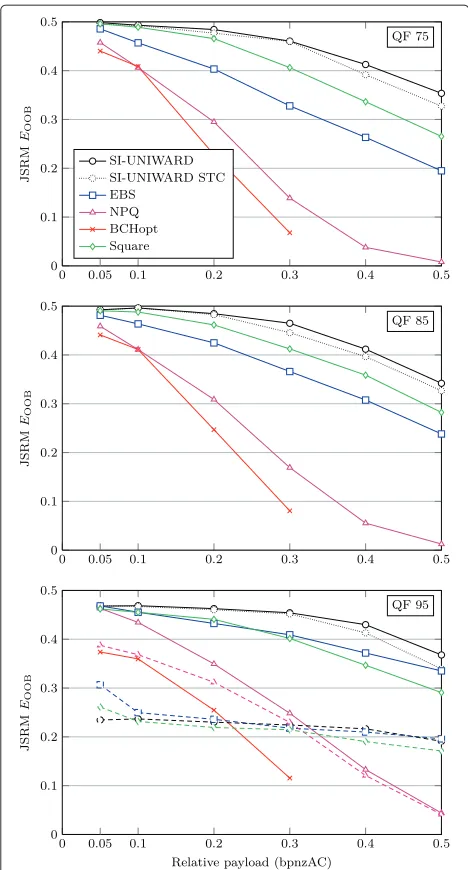
1/2-coefficients in modes 00, 04, 40, and 44f. In Figure 1,
where we show the comparison of various side-informed embedding methods for quality factor 95, we intentionally included the detection errors for all tested schemes where this measure was not enforced to prove the validity of the above arguments.
The solution of the problem with 1/2-coefficients, which is clearly not optimal, is related to the more funda-mental problem, which is how exactly the side information in the form of an uncompressed image should be utilized for the design of steganographic distortion functions. The authors postpone a detailed study of this quite intriguing problem to a separate paper.
3.4 Additive approximation of UNIWARD
Figure 1Comparison of various side-informed embedding methods.Detection errorEOOBfor SI-UNIWARD and four other methods with the union of SRMQ1 and JRM and the ensemble classifier for JPEG quality factors 75, 85, and 95. The dashed lines in the graph for QF 95 correspond to the case when all the embedding methods use all coefficients, including the DCT modes 00, 04, 40, and 44 independently of the value of the rounding erroreij.
this paper are carried out with additive approximations of UNIWARD.
The cost of changingXijtoYijand leaving all other cover elements unchanged is
ρij(X,Yij)D(X,X∼ijYij), (6) whereX∼ijYijis the cover imageXwith only itsijth ele-ment changed:Xij→Yijg. Note thatρij=0 whenX=Y.
The additive approximation to (3) and (5) will be denoted asDA(X,Y)andDA(SI)(X,Y), respectively. For example,
DA(X,Y)=
n1
i=1
n2
j=1
ρij(X,Yij)[Xij =Yij] , (7)
where [S] is the Iverson bracket equal to 1 when the
statementSis true and 0 whenSis false.
Note that, due to the absolute values in D(X,Y) (3), ρij(X,Xij+1) = ρij(X,Xij−1), which permits us to use aternaryembedding operation for the spatial and JPEG
domainsh. Practical embedding algorithms can be
con-structed using the ternary multi-layered version of STCs (Section 4 in [3]).
On the other hand, for the side-informed JPEG steganography,D(ASI)(X,Y)is inherently limited to abinary
embedding operation becauseDijis either rounded up or
down.
The embedding methods that use the additive approx-imation of UNIWARD for the spatial, JPEG, and side-informed JPEG domain will be called S-UNIWARD, J-UNIWARD, and SI-UNIWARD, respectively.
3.5 Relationship of UNIWARD to WOW
The distortion function of WOW bears some similarity to UNIWARD in the sense that the embedding costs are also computed from three directional residuals. The WOW embedding costs are, however, computed a different way that makes it rather difficult to use it for embedding in other domains, such as the JPEG domaini.
To obtain a cost of changing pixelXij → Yij, WOW
first computes the embedding distortion in the wavelet domain weighted by the wavelet coefficients of the cover. This is implemented as a convolutionξij(k) = |Wuv(k)(X)| |Wuv(k)(X)−Wuv(k)(X∼ijYij)|(see Equation 2 in [17]). These so-called embedding suitabilitiesξij(k)are then aggregated over all three subbands using the reciprocal Hölder norm, ρij(WOW)=3k=11/ξij(k)to give WOW the proper content adaptivity in the spatial domain.
4 Common core of all experiments
Before we move to the experimental part of this paper, which appears in Sections 5 and 6, we introduce the common core of all experiments: the cover source, steganalysis features, the classifier used to build the steganography detectors, and an empirical measure of security.
4.1 Cover source
All experiments are conducted on the BOSSbase database ver. 1.01 [25] containing 10,000 512×512 8-bit grayscale images coming from eight different cameras. This database is very convenient for our purposes because it contains uncompressed images that serve as precovers for side-informed JPEG embedding. Also, the images can be compressed to any desirable quality factor for the JPEG domain.
The steganographic security is evaluated empirically using binary classifiers trained on a given cover source and its stego version embedded with a fixed payload. Even though this setup is artificial and does not correspond to real-life applications, it allows assessment of security with respect to the payload size, which is the goal of academic investigations of this typej.
4.2 Steganalysis features
Spatial domain steganography methods will be analyzed using the spatial rich model (SRM) [18] consisting of 39 symmetrized sub-models quantized with three different quantization factors with a total dimension of 34, 671k. JPEG domain methods (including the side-informed algo-rithms) will be steganalyzed using the union of a down-scaled version of the SRM with a single quantization step
q=1 (SRMQ1) with dimension 12, 753 and the JPEG rich
model (JRM) [24] with dimension 22,510, giving the total feature dimension of 35,263.
4.3 Machine learning
All classifiers will be implemented using the ensemble [26] with Fisher linear discriminant as the base learner. The security is quantified using the ensemble’s
‘out-of-bag’ (OOB) error EOOB, which is an unbiased estimate
of the minimal total testing error under equal priors,
PE =minPFA 12(PFA+PMD)[26]. The statistical
detectabil-ity is usually displayed graphically by plottingEOOB as a
function of the relative payload. With the feature dimen-sionality and the database size, the statistical scatter of
EOOB over multiple ensemble runs with different seeds
was typically so small that drawing error bars around the data points in the graphs would not show two visually discernible horizontal lines, which is why we omit this information in our graphs. As will be seen later, the differ-ences in detectability between the proposed methods and prior art are so large that there should be no doubt about
the statistical significance of the improvement. The code for extractors of all rich models as well as the ensemble is available at http://dde.binghamton.edu/download.
5 Determining the parameters of UNIWARD In this section, we study how the wavelet basis and the
stabilizing constant σ in the distortion function
UNI-WARD affect the empirical security. We first focus on the parameterσand then on the filter bank.
The original role of σ in UNIWARD [19] was to
sta-bilize the numerical computations when evaluating the relative change of wavelet coefficients (3). As the
follow-ing experiment shows, however, σ also strongly affects
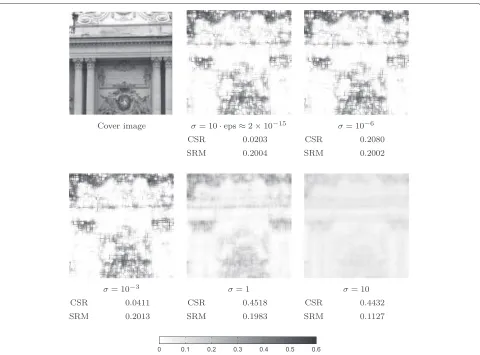
the content adaptivity of the embedding algorithm. In Figure 2, we show the embedding change probabilities for
payload α = 0.4 bpp (bits per pixel) for six values of
the parameterσ. For this experiment, we selected the 8-tap Daubechies wavelet filter bankBwhose 1D filters are shown in Figure 3l. Note that a small value ofσ makes the
embedding change probabilities undesirably sensitive to content. They exhibit unusual interleaved streaks of high and low values. This is clearly undesirable since the con-tent (shown in the upper left corner of Figure 2) does
not change as abruptly. On the other hand, a large σ
makes the embedding change probabilities ‘too smooth,’ permitting thus UNIWARD to embed in regions with less complex content. Intuitively, we need to choose some
middle ground forσto avoid introducing a weakness into
the embedding algorithm.
Because the SRM consists of statistics collected from the noise residuals of all pixels in the image, it ‘does not see’ the artifacts in the embedding probabilities - the interleaved bands of high and low values. Notice that the position of the bands is tied to the content and does not correspond to any fixed (content-independent) checker-board pattern. Thus, we decided to introduce a new type of steganalysis features designed specifically to uti-lize the artifacts in the embedding probabilities to probe the security of this unusual selection channel for small values ofσ.
5.1 Content-selective residuals
The idea behind the attack on the selection channel is to compute the statistics of noise residuals separately for pix-els with a small embedding probability and then for pixpix-els with a large embedding probability. The former will serve as a reference for the latter, giving strength to this attack. While it is true that the embedding probabilities estimated from the stego image will generally not exactly match
those computed from the corresponding cover imagem,
they will be close and ‘good enough’ for the attack to work.
Figure 2Embedding change probabilities.The effect of the stabilizing constantσon the character of the embedding change probabilities for a 128×128 cover image shown in the upper left corner. The numerical values are theEOOBobtained using the content-selective residual (CSR) and the SRM on BOSSbase 1.01 for relative payloadα=0.4 bpp.
Rij=Xi,j−Xi,j+1, i∈ {1,. . .,n1}, j∈ {1,. . .,n2−1}.
(8)
To curb the residuals’ range and allow a compact sta-tistical representation,Rijwill be truncated to the range [−T,T],Rij ←truncT(Rij), whereT is a positive integer, and
truncT(x)=
⎧ ⎪ ⎨ ⎪ ⎩
x when −T ≤x≤T
−T whenx<−T T whenT <x.
(9)
Since this residual involves two adjacent pixels, we will divide all horizontally adjacent pixels in the image into four classes and compute the histogram for each class sep-arately. Letpij(X,α)denote the embedding change
prob-ability computed from imageXwhen embedding payload
ofαbpp. Given two thresholds 0<ts<tL<1, we define the following four sets of residuals:
Rss= {Rij|pij(X,α) <ts ∧ pi,j+1(X,α) <ts} (10) RsL= {Rij|pij(X,α) <ts ∧ pi,j+1(X,α) >tL} (11) RLs= {Rij|pij(X,α) >tL ∧ pi,j+1(X,α) <ts} (12) RLL= {Rij|pij(X,α) >tL ∧ pi,j+1(X,α) >tL}. (13)
The so-called content-selective residual (CSR) features will be formed by the histograms of residuals in each set. Because the marginal distribution of each residual is sym-metrical about zero, one can merge the histograms of residuals from RsL and RLs. The feature vector is thus
the concatenation of 3× (2T +1)histogram bins,l =
−T,. . .,T:
hs(l)={Rij|Rij=l ∧ Rij∈Rss} (14)
hL(l)={Rij|Rij=l ∧ Rij∈RLL} (15)
hsL(l)={Rij|Rij=l ∧ Rij∈RsL∪RLs}. (16)
The set Rss holds the residual values computed from
pixels with a small embedding change probability, while the other sets hold residuals that are likely affected by embedding - their tails will become thicker.
All that remains is to specify the values of the parame-tersts,tL, andα. Since the steganalyst will generally not
know the payload embedded in the stego imagen, we need
to choose a fixed value of α that gives an overall good
performance over a wide range of payloads. In our
exper-iments, a medium value ofα = 0.4 generally provided
a good estimate of the interleaved bands in the embed-ding change probabilities. Finally, we conducted a grid search on images from BOSSbase to determinetsandtL. The found optimum was rather flat and located around
ts = 0.05,tL = 0.06. The thresholdT for truncT(x)was kept fixed atT =10.
For the value ofσ as originally proposed in the
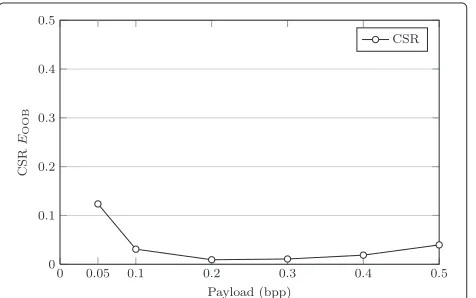
work-shop version of this paper [19],σ =10·eps≈2×10⁻¹⁵ (‘eps’ defined as in Matlab), the detection error of the 3× (2×10+1)=63-dimensional CSR feature vector turned out to be a reliable detection statistic. Figure 4 shows the
detection error EOOB as a function of the relative
pay-load. This confirms our intuition that too small a value of
σ introduces strong banding artifacts, the stego scheme
becomes overly sensitive to content, and an approximate
Figure 4Detection errorEOOBobtained using CSR features as a function of relative payload forσ=10·eps.
knowledge on the faulty selection channel can be used to successfully attack S-UNIWARD.
As can be seen from Figure 2, the artifacts in the embed-ding change probabilities become gradually suppressed when increasing the value of the stabilizing constant σ.
To determine the proper value ofσ, we steganalyzed
S-UNIWARD with both the CSR and SRM feature sets (and
their union) on payloadα = 0.4 bpp as a function ofσ
(see Figure 5)o. The detection error using both the SRM and the CSR is basically constant untilσbecomes close to 2−14when a further increase ofσmakes the CSR features
ineffective for steganalysis. From σ = 1 the SRM starts
detecting the embedding more accurately as the adaptiv-ity of the scheme becomes lower. Also, at this value ofσ, adding the CSR does not lower the detection error of the SRM. Based on this analysis, we decided to set the
stabiliz-ing constant of S-UNIWARD toσ =1 and kept it at this
value for the rest of the experiments in the spatial domain reported in this paper.
The attack based on content-selective residuals could be expanded to other residuals than pixel differences, and one could use higher-order statistics instead of his-tograms [27]p. While the detection error for the original
S-UNIWARD settingσ = 10·eps can, indeed, be made
smaller this way, expanding the CSR feature set has
virtu-ally no effect on the security of S-UNIWARD forσ = 1
and the optimality of this value.
We note that constructing a similar targeted attack against JPEG implementations of UNIWARD is likely not feasible because the distortion caused by a change in a DCT coefficient affects a block of 8×8 pixels and,
con-sequently, 23 × 23 wavelet coefficients. The distortion
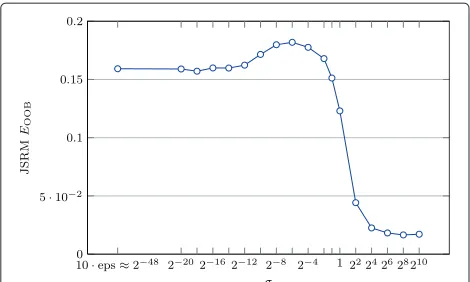
‘averages out’ and no banding artefacts show up in the embedding probability map. Steganalysis of J-UNIWARD
with JSRM shown in Figure 6 indicates that the optimalσ
Figure 6Steganalysis of J-UNIWARD with JSRM.Detection error EOOBobtained using the merger of JRM and SRMQ1 (JSRM) features as a functionσfor J-UNIWARD with payloadα=0.4 bpnzAC and JPEG quality factor 75.
for J-UNIWARD is 2−6, which we selected for all experi-ments with J-UNIWARD and SI-UNIWARD in this paper.
5.2 Effect of the filter bank
As a final experiment of this section aimed at finding the best settings of UNIWARD, we studied the influence of the directional filter bank. We did so for a fixed payload
α = 0.4 bpp and two values of σ when steganalyzing
using the CSR and SRM features. Table 1 shows the results for five different wavelet bases (http://wavelets.pybytes. com/wavelet/db8/) with varying parameters (support sizes). The best results have been achieved with the 8-tap Daubechies wavelet, whose 1D low- and high-pass filters are displayed in Figure 3.
6 Experiments
In this section, we test the steganography using UNI-WARD implemented with the 8-tap Daubechies
direc-tional filter bank andσ = 1 for S-UNIWARD andσ =
Table 1 Detection errorEOOBobtained using CSR and SRM
features when using different filter banks in UNIWARD
CSR SRM
σ=10·eps σ=1 σ=10·eps σ=1
Haar 0.0649 0.3302 0.0339 0.0707
Daubechies 2 0.0278 0.4299 0.1313 0.1744
Daubechies 4 0.0106 0.4279 0.1763 0.1966
Daubechies 8 0.0203 0.4518 0.2001 0.1981
Daubechies 20 0.1934 0.4646 0.2046 0.1868
Symlet 8 0.0235 0.4410 0.1635 0.1919
Coiflet 1 0.0458 0.4426 0.0796 0.1444
Biorthogonal 44 0.0264 0.4388 0.0859 0.1683
Biorthogonal 68 0.0376 0.4459 0.1259 0.1820
2−6for J- and SI-UNIWARD. We report the results on a
range of relative payloads 0.05, 0.1, 0.2,. . ., 0.5 bpp, while JPEG domain (and side-informed JPEG) methods will be tested on the same payloads expressed in bits per non-zero cover AC DCT coefficient (bpnzAC).
6.1 Spatial domain
In the spatial domain, we compare the proposed method with HUGO [15], HUGO implemented using the Gibbs construction with bounding distortion (HUGO BD) [4], WOW [17], LSB matching (LSBM), and the edge-adaptive (EA) algorithm [28] With the exception of the EA algo-rithm, in which the costs and the embedding algorithm are inseparable, the results of all other algorithms are reported for embedding simulators that operate at the theoretical payload-distortion bound. The only algorithm that we implemented using STCs (with constraint height
h = 12) to assess the coding loss is the proposed
S-UNIWARD method.
For HUGO, we used the embedding simulator [25] with
default settings γ = 1,σ = 1 and the switch --T with
T =255 to remove the weakness reported in [7]. HUGO
BD starts with a distortion measure implemented as a weighted norm in the SPAM feature space, which is non-additive and not locally supported either. The bounding distortion is a method (see Section 7 in [4]) to give the distortion the form needed for the Gibbs construction to work - the local supportedness. HUGO BD was imple-mented using the Gibbs construction with two sweeps as described in the original publication with the same parameter settings as for HUGO. The non-adaptive LSBM was simulated at the ternary bound corresponding to uniform costs,ρij=1 for alli,j.
Figure 7 shows the EOOB error for all stego methods
as a function of the relative payload expressed in bits per pixel. While the security of the S-UNIWARD and WOW
is practically the same due to the similarity of their dis-tortion functions, the improvement over both versions of HUGO is quite apparent. HUGO BD performs better than HUGO especially for large payloads, where its detectabil-ity becomes comparable to that of S-UNIWARD. As expected, the non-adaptive LSBM performs poorly across all payloads, while EA appears only marginally better than LSBM.
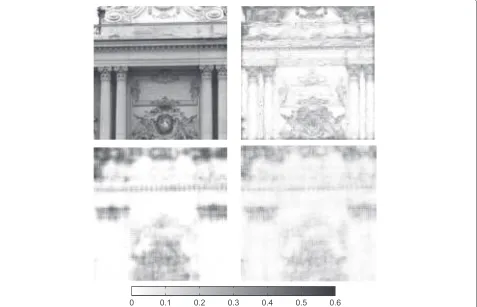
In Figure 8, we contrast the probability of embed-ding changes for HUGO, WOW, and S-UNIWARD. The selected cover image has numerous horizontal and ver-tical edges and also some textured areas. Note that while HUGO embeds with high probability into the pillar edges as well as the horizontal lines above the pillars, S-UNIWARD directional costs force the changes solely into the textured areas. The placement of embedding changes for WOW and S-UNIWARD is quite similar, which is correspondingly reflected in their similar empirical security.
6.2 JPEG domain (non-side-informed)
For the JPEG domain without side information, we com-pare J-UNIWARD with nsF5 [14] and the recently pro-posed UED algorithm [13]. Since the costs used in UED
are independent of the embedding change direction, we decided to include for comparison the UED implemented usingternarycodes rather than binary, which indeed
pro-duced a more secure embedding algorithmq. All methods
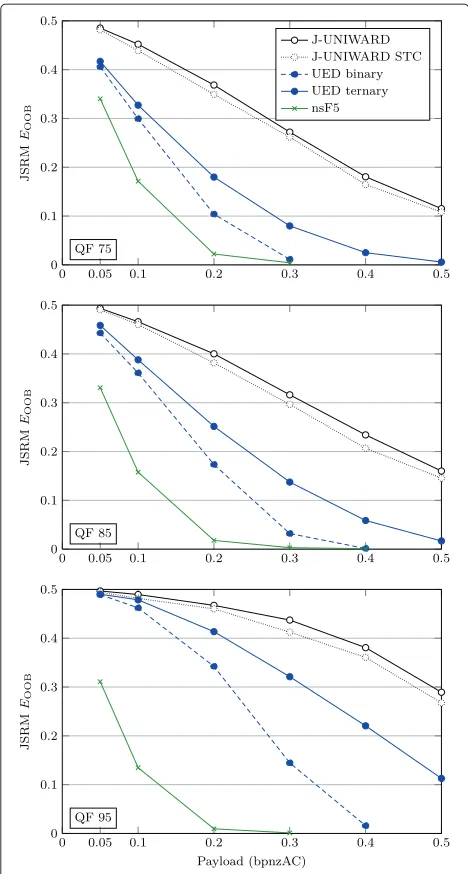
were again simulated at their corresponding payload-distortion bounds. The costs for nsF5 were uniform over all non-zero DCTs with zeros as the wet elements [29]. Figure 9 shows the results for JPEG quality factors 75, 85, and 95. As in the spatial domain, J-UNIWARD clearly outperformed both nsF5 and both versions of UED by a sizeable margin across all three quality factors.
Further-more, when using STCs with constraint heighth=12, the
coding loss appears rather small.
6.3 JPEG domain (side-informed)
Working with the same three quality factors, we com-pare SI-UNIWARD with four other methods - the block entropy-weighted method of [10] (EBS), the NPQ [11], BCHopt [9], and the fourth method, which can be viewed as a modification (or simplification) of [9] or as [10] in which the normalization by block entropy has been removed. Following is a list of cost assignments for these four embedding methods; ρij(kl) is the cost of changing
DCT coefficientijcorresponding to DCT modekl.
Figure 9Results for JPEG quality factors 75, 85, and 95.Testing errorEOOBfor J-UNIWARD, nsF5, and binary (ternary) UED on BOSSbase 1.01 with the union of SRMQ1 and JRM and ensemble classifier for quality factors 75, 85, and 95.
1. ρij(kl)=
qkl(0.5−|eij|)
H(X(b))
2
2. ρij(kl)= q λ1 kl(1−2|eij|) (μ+|Xij|)λ2
3. ρij(kl)as defined in [9]
4. ρij(kl)=qkl(1−2|eij|)
2
In method 1 (EBS),H(X(b))is the block entropy defined as H(X(b)) = −ih(b)i logh(b)i , where h(b)i is the nor-malized histogram of all non-zero DCT coefficients in blockX(b). Per the experiments in [11], we setμ = 0 as
NPQ embeds only in non-zero AC DCT coefficients, and λ1=λ2=1/2 as this setting seemed to produce the most
secure NPQ scheme for most payloads when tested with various feature sets. The costρijfor methods 1 to 4 is equal to zero wheneij = 1/2. Methods 1 and 4 embed into all DCT coefficients, including the DC term and coefficients that would otherwise round to zero (Xij =0). We remind from Section 3.3.1 that methods 1, 2, and 4 avoid embed-ding into 1/2-coefficients from DCT modes 00, 04, 40, and 44. Since the cost assignment in method 3 (BCHopt) is inherently connected to its coding scheme, we kept this algorithm unchanged in our tests.
Figure 1 shows that SI-UNIWARD achieves the best security among the tested methods for all payloads and all JPEG quality factors. The coding loss is also quite neg-ligible. Curiously, the weighting by block entropy in the EBS method paid off only for quality factor 95. For factors 85 and 75, the weighting actually increases the statistical detectability using our feature vector (c.f., the ‘Square’ and ‘EBS’ curves). The dashed curves for quality factor 95 in Figure 1 are included to show the negative effect when 1/2-coefficients from DCT modes 00, 04, 40, and 44 are used for embedding (see the discussion in Section 3.3.1). In this case, the detection error levels off at approximately 25% to 30% for small-medium payloads because most embedding changes are executed at the above four DCT modes. Note that NPQ and BCHopt do not exhibit the pathological error saturation as strongly because they do not embed into the DC term (mode 00).
7 Conclusion
Perfect security seems unachievable for empirical cover sources, examples of which are digital images. Currently, the best the steganographer can do for such sources is to minimize the detectability when embedding a required payload. A standard way to approach this problem is to embed while minimizing a carefully crafted distortion function, which is tied to empirical statistical detectabil-ity. This converts the problem of secure steganogra-phy to one that has been largely resolved in terms of known bounds and general near-optimal practical coding constructions.
heuristic approach has been implemented in the spa-tial, JPEG, and side-informed JPEG domains. In all three domains, the proposed steganographic schemes matched or outperformed current state-of-the-art steganographic methods. A quite significant improvement was especially obtained for the JPEG and side-informed JPEG domains. As demonstrated by experiments, the innovative concept to assess the costs of changing a JPEG coefficient in an alternative domain seems to be quite promising.
Although all proposed methods were implemented and tested with an additive approximation of UNIWARD, this distortion function is naturally defined in its non-additive version, meaning that changes made to neighboring pix-els (DCT coefficients) interact in the sense that the total imposed distortion is not a sum of distortions of indi-vidual changes. This potentially allows UNIWARD to embed while taking into account the interaction among the changed image elements. We plan to explore this direction as part of our future effort.
Last but not the least, we have discovered a new phenomenon that hampers the performance of side-informed JPEG steganography that computes embedding costs based solely on the quantization error of DCT coefficients. When unquantized DCT coefficients that lie exactly in the middle of the quantization intervals are assigned zero costs, any embedding that minimizes dis-tortion starts introducing embedding artifacts that are quite detectable using the JPEG rich model. While the makeshift solution proposed in this article is by no means optimal, it raises an important open question, which is how to best utilize the side information in the form of an uncompressed image when embedding data into the JPEG compressed form. The authors postpone detailed investigation of this phenomenon into their future effort.
Endnotes
aFor a given empirical cover source, the statistical
detectability is typically evaluated empirically using classifiers trained on cover and stego examples from the source.
bThe concept of precover was used for the first time by
Ker [30].
cHistorically, the first side-informed embedding
method was the embedding while dithering algorithm [31], in which a message was embedded to minimize the color quantization error when converting a true-color image to a palette image.
dThe processJ−1involves rounding to integers and
clipping to the dynamic rangeI.
eThis is because the embedding strongly prefers
1/2-coefficients.
fIn practice, we assign very large costs to such
coefficients.
gThis notation was used in [4] and is also standard in
the literature on Markov random fields [32].
hOne might (seemingly rightfully) argue that the cost
should depend on the polarity of the change. On the other hand, since the embedding changes with UNIWARD are restricted to textures, the equal costs are in fact plausible.
iThis is one of the reasons why UNIWARD was
conceived.
jBuilding a universal detector of steganography is not
the goal of this paper.
kIn Section 5, we will describe and work with another
small feature set whose sole purpose will be to probe the security of the selection channel and to determine the proper value of the stabilizing constantσ.
lThis filter bank was previously shown to provide the
highest level of security for WOW [17] from among several tested filter banks. We thus selected the same bank here as a good initial candidate for the experiments.
mAlso because the embedded payloadαis unknown to
the steganalyst.
nA study on building steganalyzers when the payload is
not known appears in [33].
oWhen steganalyzing with the union of CSR and SRM
using the ensemble classifier, we made sure that all 63 CSR features were included in each random feature subspace to avoid ‘diluting’ their strength in this type of classifier.
Also, the value ofσfor extracting the embedding change probabilitiespij(X;α)was always fixed atσ =10·eps as the location of interleaved bands of high and low
probabilities are more accurately estimated this way than with the value used in S-UNIWARD for the actual message embedding.
pNote for reviewers: A preprint of this article is
available upon request.
qThe authors of UED were apparently unaware of this
possibility to further boost the security of their algorithm.
Competing interests
The authors declare that they have no competing interests.
Acknowledgements
The work on this paper was supported by the Air Force Office of Scientific Research under the research grant number FA9950-12-1-0124. The U.S. Government is authorized to reproduce and distribute reprints for
governmental purposes notwithstanding any copyright notation thereon. The views and conclusions contained herein are those of the authors and should not be interpreted as necessarily representing the official policies, either expressed or implied of AFOSR or the U.S. Government. The authors would like to thank Tomáš Filler and Jan Kodovský for the useful discussions.
Received: 10 October 2013 Accepted: 4 December 2013 Published: 3 January 2014
References
1. R Böhme,Advanced Statistical Steganalysis. (Springer-Verlag, Berlin, 2010) 2. CE Shannon, Coding theorems for a discrete source with a fidelity
3. T Filler, J Judas, J Fridrich, Minimizing additive distortion in steganography using syndrome-trellis codes. IEEE Trans. Inf. Forensics Secur.6(3), 920–935 (2011)
4. T Filler, J Fridrich, Gibbs construction in steganography. IEEE Trans. Inf. Forensics Secur.5(4), 705–720 (2010)
5. T Filler, J Fridrich, Design of adaptive steganographic schemes for digital images, inProceedings SPIE, Electronic Imaging, Media Watermarking, Security and Forensics III,vol. 7880, ed. by A Alattar, ND Memon, EJ Delp, and J Dittmann (San Francisco, 2011), pp. 1–14
6. R Böhme, A Westfeld, Breaking Cauchy model-based JPEG steganography with first order statistics, inComputer Security - ESORICS 2004. Proceedings
9th European Symposium on Research in Computer Security,ed. by P
Samarati, PYA Ryan, D Gollmann, R Molvapages, Sophia Antipolis, France. Lecture Notes in Computer Science, vol. 3193 (Springer, Berlin, 2004), pp. 125–140
7. J Kodovský, J Fridrich, V Holub, On dangers of overtraining steganography to incomplete cover model, inProceedings of the 13th ACM Multimedia &
Security Workshop, ed. by J Dittmann, S Craver, and C Heitzenrater
(Niagara Falls, 2011), pp. 69–76
8. Y Kim, Z Duric, D Richards, Modified matrix encoding technique for minimal distortion steganography, in8th International Workshop on
Information Hiding,ed. by JL Camenisch, CS Collberg, NF Johnson, P
Sallee, Alexandria, 10–12 July 2006. Lecture Notes in Computer Science, vol. 4437 (Springer-Verlag, New York, 2006), pp. 314–327
9. V Sachnev, HJ Kim, R Zhang, Less detectable JPEG steganography method based on heuristic optimization and BCH syndrome coding, in Proceedings of the 11th ACM Multimedia & Security Workshop, ed. by J Dittmann, S Craver, and J Fridrich (Princeton, 2009), pp. 131–140 10. C Wang, J Ni, An efficient JPEG steganographic scheme based on the
block–entropy of DCT coefficients, inProceedings of IEEE ICASSP(Kyoto, 25–30 March 2012)
11. F Huang, J Huang, Y-Q Shi, New channel selection rule for JPEG steganography. IEEE Trans. Inf. Forensics Secur.7(4), 1181–1191 (2012) 12. F Huang, W Luo, J Huang, Y-Q Shi, Distortion function designing for JPEG
steganography with uncompressed side-image, in1st ACM Information
Hiding and Multimedia Security Workshop(Montpellier, 17–19 June 2013)
13. L Guo, J Ni, Y-Q Shi, An efficient JPEG steganographic scheme using uniform embedding, inFourth IEEE International Workshop on Information
Forensics and Security(Tenerife, 2–5 December 2012)
14. J Fridrich, T Pevný, J Kodovský, Statistically undetectable JPEG steganography: dead ends, challenges, and opportunities, inProceedings of the 9th ACM Multimedia & Security Workshop, ed. by J Dittmann, J Fridrich (Dallas, 20–21 September 2007), pp. 3–14
15. T Pevný, T Filler, P Bas, Using high-dimensional image models to perform highly undetectable steganography, inInformation Hiding,ed. by R Böhme, R Safavi-Naini. 12th International Conference, IH 2010, Calgary, 28–30 June 2010. Lecture Notes in Computer Science, vol. 6387 (Springer Heidelberg, 2010), pp. 161–177
16. T Pevný, P Bas, J Fridrich, Steganalysis by subtractive pixel adjacency matrix. IEEE Trans. Inf. Forensics Secur.5(2), 215–224 (2010)
17. V Holub, J Fridrich, Designing steganographic distortion using directional filters, inFourth IEEE International Workshop on Information Forensics and
Security(Tenerife, 2–5 December 2012)
18. J Fridrich, J Kodovský, Rich models for steganalysis of digital images. IEEE Trans. Inf. Forensics Secur.7(3), 868–882 (2011)
19. V Holub, J Fridrich, Digital image steganography using universal distortion, in1st ACM Information Hiding and Multimedia Security Workshop (Montpellier, 17–19 June 2013)
20. J Fridrich, J Kodovský, M Goljan, V Holub, Steganalysis of content-adaptive steganography in spatial domain, inInformation Hiding, 13th International
Conference,Lecture Notes in Computer Science, ed. by T Filler, T Pevný, A
Ker, S Craver (Czech Republic Prague, May 18–20, 2011), pp. 102–117 21. G Gül, F Kurugollu, A new methodology in steganalysis: breaking highly
undetactable steganograpy (HUGO), Information Hiding,ed. by T Filler, T Pevný, A Ker, S Craver, 13th International Conference, IH 2011, Prague, 18–20
May 2011. Lecture Notes in Computer Science, vol. 6958 (Springer,
Heidelberg, 2011), pp. 71–84
22. Y-Q Shi, P Sutthiwan, L Chen, Textural features for steganalysis, in
Information Hiding,ed. by M Kirchner, D Ghosal. 14th International
Conference, IH 2012, Berkeley, 15–18 May 2012. Lecture Notes in Computer Science, vol. 7692 (Springer, Heidelberg, 2012), pp. 63–77
23. M Vetterli, J Kovacevic,Wavelets and Subband Coding. (Prentice Hall, Englewood Cliffs, 1995)
24. J Kodovský, J Fridrich, Steganalysis of JPEG images using rich models, in Proceedings SPIE, Electronic Imaging, Media Watermarking, Security, and
Forensics 2012, vol. 8303, ed. by A Alattar, ND Memon, and EJ Delp (San
Francisco, 23–26 2012 January), pp. 0A 1–13
25. T Filler, T Pevný, P Bas, BOSS (Break Our Steganography System). http://www.agents.cz/boss, accessed date 20/12/13
26. J Kodovský, J Fridrich, V Holub, Ensemble classifiers for steganalysis of digital media. IEEE Trans. Inf. Forensics Secur.7(2), 432–444 (2012) 27. T Denemark, J Fridrich, V Holub, inProceedings SPIE, Electronic Imaging,
Media Watermarking, Security, and Forensics 2014, vol. 9028, ed. by A
Alattar, ND Memon, and CD Heitzenrater (San Francisco, 2–6 February 2014), p. TBD
28. W Luo, F Huang, J Huang, Edge adaptive image steganography based on LSB matching revisited. IEEE Trans. Inf. Forensics Secur.5(2), 201–214 (2010)
29. J Fridrich, M Goljan, D Soukal, P Lisonˇek, Writing on wet paper, in Proceedings SPIE, Electronic Imaging, Security, Steganography, and
Watermarking of Multimedia Contents VII, vol. 5681, ed. by EJ Delp, PW
Wong (San Jose, 16–20 January 2005), pp. 328–340
30. AD Ker, A fusion of maximal likelihood and structural steganalysis, in Information Hiding,ed. by T Furon, F Cayre, G Doërr, P Bas. 9th International Workshop, IH 2007, Saint Malo, 11–13 June 2007. Lecture Notes in Computer Science, vol. 4567 (Springer-Verlag, Berlin), pp. 204–219 31. J Fridrich, R Du, Secure steganographic methods for palette images, in
Information Hiding,ed. by A Pfitzmann, 3rd International Workshop, IH
1999, Dresden, 29 September–1 October 1999. Lecture Notes in Computer Science, vol. 1768 (Springer-Verlag, New York, 1999), pp. 47–60 32. G Winkler,Image Analysis, Random Fields and Markov Chain Monte Carlo
Methods: A Mathematical Introduction (Stochastic Modelling and Applied Probability), 2nd edition. (Springer, Berlin, 2003)
33. T Pevný, Detecting messages of unknown length, inProceedings SPIE, Electronic Imaging, Media Watermarking, Security and Forensics III, vol. 7880, ed. by A Alattar, ND Memon, EJ Delp, and J Dittmann (San Francisco, January 23–26, 2011), pp. OT 1–12
doi:10.1186/1687-417X-2014-1
Cite this article as:Holubet al.:Universal distortion function for steganography in an arbitrary domain.EURASIP Journal on Information Security20142014:1.
Submit your manuscript to a
journal and benefi t from:
7Convenient online submission
7Rigorous peer review
7Immediate publication on acceptance
7Open access: articles freely available online
7High visibility within the fi eld
7Retaining the copyright to your article