R E S E A R C H
Open Access
DNA methylation loci associated with atopy
and high serum IgE: a genome-wide application
of recursive Random Forest feature selection
Todd M. Everson
1*, Genevieve Lyons
2, Hongmei Zhang
3, Nelís Soto-Ramírez
3, Gabrielle A. Lockett
4,
Veeresh K. Patil
5, Simon K. Merid
6, Cilla S
ӧ
derh
ӓ
ll
7, Erik Melén
6,8, John W. Holloway
4,9, S. Hasan Arshad
5,9and Wilfried Karmaus
3Abstract
Background:The prevalence of allergic diseases are increasing worldwide, emphasizing the need to elucidate their pathogeneses. The aims of this study were to use a two-stage design to identify DNA methylation levels at cytosine–phosphate–guanine (CpG) sites across the genome associated with atopy and high serum immunoglobulin E (IgE), then to replicate our findings in an independent cohort.
Methods:Atopy was assessed via skin prick tests and high serum IgE. Methylation levels were measured from whole blood using the Illumina Infinium HumanMethylation450 BeadChip from 18-year-old women (n = 245) and men (n = 122) in the Isle of Wight birth cohort. After data cleaning and processing, and removing probes with possible single nucleotide polymorphisms, DNA methylation levels from 254,460 CpG sites from the 245 women were subjected to recursive Random Forest feature selection for stage 1. The sites selected from stage 1 were tested in stage 2 for associations with atopy and high IgE levels (>200 kU/L) via logistic regression adjusted for predicted cell-type proportions and sex. Sites significantly associated with atopy in stage 2 underwent replication tests in the independent Swedish birth cohort BAMSE (n = 464).
Results:In stage 1, 62 sites were selected, of which 22 were associated with atopy in stage 2 (P-value range 6.5E−9 to 1.4E−5) and 12 associated with high IgE levels (P-value range 1.1E−5 to 7.1E−4) at the Bonferroni adjusted alpha (0.05/62 = 0.0008). Of the 19 available sites, 13 were replicated.
Conclusions:We identified 13 novel epigenetic loci associated with atopy and high IgE that could serve as candidate loci for future studies; four were within genes with known roles in the immune response (cg04983687 in the body of ZFPM1, cg18219873 in the 5′UTR ofPRG2, cg27469152 in the 3′UTR ofEPX, and cg09332506 in the body ofCOPA).
Background
The prevalence of allergic disease is increasing world-wide; approximately 40 % of the population of industri-ally developed countries are considered to be affected [1]. Many of these allergic diseases appear to have a hereditary component but are also influenced by envir-onmental stimuli [2], and the origin of the immune response, including allergen sensitization, is thought to start during the fetal period [3]. It is well recognized that
environmental stimuli during critical prenatal and post-natal periods can permanently alter metabolism and in-fluence the risk of allergic diseases [4], yet the specific molecular mechanisms through which this occurs are poorly understood [1, 5].
Epigenetics, changes in gene activity not caused by alter-ations to the sequence of DNA, may clarify some of these mechanisms because much of cell lineage and tissue-specific gene expression is tightly regulated by epigenetic programming [1]. One of the most commonly studied epigenetic mechanisms is DNA methylation (DNA-M), the covalent addition of a methyl group to a cytosine followed by a guanine (cytosine–phosphate–guanine; CpG). * Correspondence:[email protected]
1Department of Epidemiology and Biostatistics, Arnold School of Public
Health, University of South Carolina, 915 Greene Street, Columbia, SC 29208, USA
Full list of author information is available at the end of the article
Changes in DNA-M affect gene transcription and have been associated with disease [6]. Some of DNA-M’s roles in the development of the immune system, immune cell-fate, and allergic diseases have been unlocked, but substantial gaps in knowledge still exist [1].
Atopy is defined as a positive reaction to a skin prick test (SPT) or immunoglobulin E (IgE) production in response to allergens [7]. IgE plays an important role in many, but not all, allergic diseases, for example, asthma, rhinitis, and eczema [7, 8]. High levels of IgE in the blood are associated with both the risk and severity of asthma, and cord blood IgE levels have been studied as possible predictors of asthma and other atopic allergic diseases [4]. Atopy is therefore connected to allergic dis-ease, although many of the details of this relationship are still unknown. Epigenetic epidemiology can help to clarify the role that DNA-M plays in atopy by confirm-ing candidate loci and revealconfirm-ing novel loci associated with atopy [5].
Advances in genetic biotechnology have made it feas-ible to measure DNA-M throughout an individual’s epigenome and, consequently, epigenetic assessments are becoming feasible in larger epidemiologic studies [9]. A growing challenge with epigenetic epidemiology is that a vast amount of data is generated and new statis-tical techniques are necessary to make sense of it. This is because of small-n-large-p (few observations relative to the number of predictors) and because traditional methods are not optimized for identifying complex bio-logical processes. Because of the large-scale data gener-ated for each completed methylation assay, techniques to select a subset of informative variables are needed [10–12], particularly in cases of sparse data in which the vast majority of predictors are uninformative [13].
Random Forest (RF), developed by Leo Breiman, is a machine learning algorithm used for classification that can handle the data issues discussed above [14]. A forest composed of classification trees is grown using randomly selected bootstrap samples of the data to form training and testing sets of study participants. At each node within each tree, the training set is partitioned into dif-ferent classes with the split determined by a subset of randomly chosen predictors. These two levels of ran-domness, random selection of training/testing sets and random testing of predictors, allow the RF to produce robust classification predictions. Once the forest is grown using the training sets, the observations in the testing sets are classified via the forest and misclassifica-tion rates can be used to evaluate the accuracy of the forest [14].
Utilization of RF to analyze array data has increased in recent years [15–18]; it is an ideal method for classifica-tion with methylaclassifica-tion data for several reasons. Unlike most traditional methods, RF can be used for feature
selection when the number of variables exceeds the number of observations, even when most variables are uninformative; RF can use both numeric and categorical variables; the algorithm can be optimized fairly easily by varying the RF parameters; and adding trees does not cause the model to become over-fit [14, 15, 19]. In addition, biological processes are probably not linear in nature; rather, they involve interactions between many different molecules. Thus it is likely that methylation changes at a combination of CpG sites could influence disease states. RF allows for the identification of multiple interacting predictors and identifies which of these are most important without imposing a structure or model on the way that it takes place.
Despite its increased presence in the analysis of genomic data, few applications of the algorithm have utilized the variable importance measures (VIM) and its potential for feature selection [18]. While RF lends itself to a variety of applications, we focused on using it for feature selection.
In this study, we implemented a two-stage discovery study within the Isle of Wight (IOW) birth cohort to first select a set of atopy-candidate CpGs from epigenome-wide data using a subsample and then to test which of these sites were significantly associated with atopy as defined by positive SPT or high total serum IgE levels in the joint sample. Then, to validate our findings, we ran replication tests in the independent Swedish cohort BAMSE.
Methods
The Isle of Wight birth cohort
The IOW birth cohort was established to study the nat-ural history of allergic disease among children born be-tween 1 January 1989 and 28 February 1990 on the Isle of Wight, UK. The study was approved by the local research ethics committee (now named the National Research Ethics Service, NRES Committee South Central – Southampton B; 06/Q1701/34) and written informed consent was provided by the infants’ parents. After exclusion of adoptions, perinatal deaths, and re-fusals, 1,456 children (95 %) were enrolled. Participants were followed-up at ages 1 (n = 1,167), 2 (n = 1,174), 4 (n = 1,218), 10 (n = 1,373), and 18 years (n = 1,313); detailed questionnaires were administered at each follow-up. Details of the birth cohort have been described elsewhere [20, 21]. At age 18 years, 245 women and 122 men were randomly selected from the cohort for genome-wide DNA methylation screening as part of another study assessing trans-generational inheritance of atopy.
Data collection and DNA methylation
and with a battery of common allergens. Inhalant aller-gens tested were house dust mite, cat, dog, Alternaria alternata, Cladosporium herbarum, grass pollen mix, and tree pollen mix. Food allergens tested were cows’ milk, soy, hens’egg, peanut, and cod. Of the 245 women included in the epigenetic analyses, SPTs were con-ducted on 242 of them; 120 of the men received SPTs. Blood samples for DNA extraction and serum for mea-surements of IgE levels were also collected at 18 years of age. Total serum IgE was measured in a subset of male and female serum samples collected at age 18 (n = 144) using Immunocap (Phadia, Uppsala, Sweden), designed to measure IgE between 2.0 to 1,000 kU/L. DNA was ex-tracted from whole blood using a standard salting-out procedure [23]. DNA concentration was determined by the Qubit quantitation kit (Life Technologies Ltd, Paisley, Renfrewshire, UK). One microgram of DNA was bisulfite-treated for cytosine to thymine conversion using the EZ 96-DNA methylation kit (Zymo Research, Irvine, CA, USA), following the manufacturer’s standard protocol. Genome-wide DNA methylation was assessed using the Illumina Infinium HumanMethylation450K BeadChip (Illumina, Inc., San Diego, CA, USA), which interrogates >484,000 CpG sites associated with approxi-mately 24,000 genes. The BeadChips were scanned using a BeadStation, and the methylation levels (β value, de-scribed below) were calculated for each queried CpG locus using the methylation module of GenomeStudio software (Illumina, Inc.). Arrays were processed using a standard protocol as described elsewhere [24], with mul-tiple identical control samples assigned to each batch to assess assay variability and samples randomly distributed on microarrays to control against batch effects.
Data cleaning
The program for data cleaning was written in R (R Development Core Team, 2012). Quality control (QC) measures were employed to improve the reliability of data prior to analysis. In our study, the detectionP-value reported by GenomeStudio was used as a QC measure of probe performance. Probes with detectionP-values > 0.01 in >10 % of the samples were removed [25]. The methyla-tion data were then preprocessed and technical variamethyla-tions removed via peak-correction using the Bioconductor IMA (Illumina Methylation Analyzer) package. Excluding con-trol probes and probes with poor detection P-values yielded 383,998 remaining probes; 9,650 CpGs on the sex chromosomes were also removed. The arrays were processed in two batches; batch number was recorded as a categorical variable, which was used in ComBat to adjust for inter-array variation [26, 27]. Because the fe-male and fe-male samples were assessed in different batches, some sites that survived QC in the female sample did not survive QC in the male sample. A very
conservative approach was utilized for addressing intra-probe single nucleotide polymorphisms (SNPs); to ensure that our findings were not biased by SNPs af-fecting methylation levels, we excluded all probes with potential SNPs in the binding region or at base-pair ex-tension (119,888 probes) according to the dbSNP data-base (version 137), resulting in a final set of 254,460 CpGs for analysis. Removing all probes with possible SNPs was necessary with our variable selection method because the selection of any variable is conditional upon the effects of other selected variables, thus inclu-sion of SNP-biased probes can affect the incluinclu-sion of other unbiased probes.
Variable definitions
Participants were defined as being atopic, the primary outcome variable for this study, if they had a positive SPT to at least one of the tested allergens [7]. Positive SPTs were determined by a mean wheal diameter of 3 mm greater than the negative control; SPT results were deemed inconclusive if the positive control resulted in a diameter less than 3 mm. To internally validate our find-ings from the SPT analyses, we also tested the same stat-istical models but with dichotomous serum IgE levels (IgE≥200 kU/L versus IgE < 200 kU/L), which has been shown to be predictive of allergy [28], as an alternate outcome variable.
Methylation levels for each queried CpG were calcu-lated as β values. These represent the proportions of methylated (M) over methylated (M) and unmethylated (U) sites (β = M/[c + M + U], with constant c intro-duced to prevent the possibility of a zero in the denom-inator), and can be interpreted as percent methylation;β values close to 0 or 1 tend to suffer from severe hetero-scedasticity. Theβvalues were utilized for RF, described below, which is a non-parametric method and does not assume a normal distribution. However, for parametric statistical analyses, such as logistic regressions used for validation and replication, we utilized M-values, which address the issue of heteroscedasticity and thus perform better. M-values were calculated from the β values via log2[β/(1−β)] [29]. Prior to running parametric models, boxplots and histograms were used to verify approxi-mate normality and identify potential outliers.
marker of atopy, high IgE, in the joint sample (n = 367). The specific methods within each stage are detailed below. The normalized DNA-M microarray data, as well as covariates and outcomes used in both stage 1 and stage 2 analyses, described below, are available via the University of Southampton ePrints Soton (DOI: 10.5258/SOTON/379389).
The BAMSE cohort
Sites that were significantly associated with atopy in stage 2 analyses were selected for replication in the Children, Allergy, Milieu, Stockholm, Epidemiology (BAMSE), a prospective population-based cohort study of children recruited at birth and followed during child-hood. Details of the study design, inclusion criteria, en-rolment, and data collection are described elsewhere [31]. In brief, 4,089 children born between 1994 and 1996 in four municipalities of Stockholm County were enrolled. Longitudinal sensitization and questionnaire data were collected through to age 8. The baseline and follow-up studies were approved by the Regional Ethical Review Board, Karolinska Institutet, Stockholm, Sweden, and the parents of all participating children provided in-formed consent. Blood samples collected at 8 years were screened with Phadiatop [a mixture of common inhalant allergens: birch, timothy, mugwort, cat, dog, horse, mold (Cladosporium herbarum), and house dust mite (Dermatophagoides pteronyssinus)] and fx5 (a mixture of common food allergens: cow’s milk, egg white, soy bean, peanut, cod fish, and wheat) (ImmunoCAP, Phadia AB, Uppsala, Sweden). Atopy was defined as a positive Phadiatop or a positive fx5 test with spe-cific IgE antibody levels ≥0.35 kUA/L. Furthermore, epigenome-wide DNA methylation was measured in 472 children using DNA extracted from blood samples collected at the 8 year follow-up [32]. For this, 500 ng DNA per sample underwent bisulfite conversion using the EZ-96 DNA Methylation kit (Shallow; Zymo Research Corporation, Irvine, CA, USA). Samples were processed with the Illumina Infinium HumanMethylation450 BeadChip (Illumina, Inc.). Data pre-processing (signal correction and data normalization) and QC were per-formed using standard criteria described elsewhere [33]. This study included those with valid DNA-M samples and that were non-missing for atopy-status or adjustment covariates (N = 464).
Statistical analysis (IOW)–stage 1
The randomForest package in R was used to implement the RF algorithm [34]. The output from the RF includes the out-of-bag error rate (OOB-ER), class-specific misclassification rates, and VIMs. The OOB-ER is the overall misclassification rate of the complete forest. Class-specific misclassification rates, which are also
calculated from the out-of-bag samples, are the rates at which the classes of the outcome variable are misclassi-fied, in our case atopic classification and non-atopic classification. VIMs are measures of the amount of information a variable contributed to the classification throughout the forest. Hapfelmeier and Ulm, whose pro-posed feature selection method used OOB-ER or an-other cross-validated error measure, acknowledge that the VIM depends on the data and the underlying re-search question [35]. We used the mean decrease Gini (MDG) as VIM because it was shown to be more robust to small deviations to the data when compared to the mean decrease accuracy (MDA) [36].
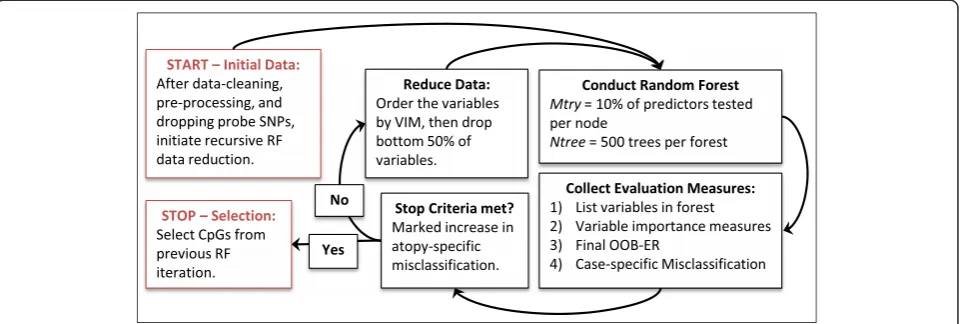
Prior to implementing the recursive RF [15] described below, we explored how prediction accuracy of the forest was influenced by altering the parameters sampsize, mtry, andntree, so these could be optimally set for the recursive RF implementation described below. The sampsizeparameter controls whether to use balanced or imbalanced sampling to generate the training datasets; mtry specifies the number of variables to be randomly selected and tested at each node of each tree; andntree determines the number of trees to be grown in a forest. Using the default values for mtry (√p, where p is the number of variables available) andntree (500), we com-pared the OOB-ER and class-specific misclassification rates for an imbalanced RF grown withoutsampsizeand a balanced RF grown withsampsize= (50,50). Specifying sampsize = (50,50) meant that 50 observations from those with atopy and 50 observations from those with-out atopy were randomly selected when creating the training set for each tree. Once we determined whether or not to utilize the sampsizeparameter, we tracked the prediction accuracy of the RF at different combinations ofmtry(√p, 2*√p, 0.05p, 0.1p, and 0.5p) andntree (200, 300, 400, 500, 1,000, and 2,000). Once the optimal parameter values were selected, the recursive RF was implemented.
most concerned with correct classification of those with atopy. The variables from the iteration prior to the increase in misclassification were selected for further analyses. Each CpG site that was selected by the recur-sive RF was annotated with information about what gene the CpG site was within, when applicable.
The sites selected from the recursive RF were then tested for univariate associations with atopy via logistic regression. Given that methylation levels vary signifi-cantly by cell type, peripheral blood samples are com-posed of multiple different cell types, and allergic diseases often influence the proportions of circulating immune cell types, we considered the potential con-founding effect of cell-type differential for each par-ticipant. However, logistical limitations prevented the acquisition of cell differential at the original time of blood sample collection. Thus, we utilized the methy-lation data to predict cell differential [38, 39], then calculated the percent differences between the crude and cell-type adjusted β coefficients from the logistic regression models, to observe the impact of cell type on the association between methylation levels and atopy.
Statistical analysis (IOW)–stage 2
Boxplots ofβvalues stratified by atopy status were used to ensure that the distributions of methylations levels in the female and male samples were similar and could be combined. Two observations (in cg12819873 and in cg13168187) were identified as strong outliers, and re-coded as missing. The joint sample was then used for all stage 2 analyses in which each CpG was tested for its in-dividual association with atopy and high IgE, adjusted for important covariates. These tests were conducted
with logistic regression in which high IgE and atopy were the dependent variables and M-values for CpGs were the primary independent variables, while cell type proportions and sex were included as covariates. CpG sites that were significantly associated with both atopy and high IgE at the Bonferroni corrected α were sub-jected to set analyses, used to show the combined effect of DNA-M on atopy [40].
Statistical analyses (BAMSE)–replication
For each site that was significantly associated with atopy in stage 2, we conducted multiple logistic regression models in the BAMSE cohort. Atopy status was the dependent variable and M-values for CpGs were the in-dependent variables, while cell type proportions, sex, asthma treatment within the last 12 months, and batch (bisulfite treatment date) were included as covariates (identified as confounders in the regression model). Successful replication was defined as having the same direction of association and a P-value < 0.05. These sites were submitted for functional annotation ana-lyses in DAVID [41, 42].
Results
epigenetic subsample was not significantly different (P-value = 0.0972) between the female sample, used in stage 1, and the male sample which was pooled with the female sample in stage 2. However, preva-lence of high serum IgE (≥200 kU/L) was significantly (P-value = 0.0469) lower in the female sample (23.8 %) than in the male sample (41.9 %). These differences in high IgE did not affect the analytic methods because serum IgE was only used as a secondary and alternate biomarker of atopy to provide further confidence in our top results (Table 1).
For stage 1 we conducted a recursive RF algorithm with feature selection very similar to balanced iterative RF, described in detail in the methods section [18]. Prior to implementing the full algorithm we optimized the RF parameters by testing multiple combinations mtry and ntree. We selected anmtryof 0.1p, which was observed to be effective in a similarly large scale RF analysis with sparsity [17], and an ntree of 500 that allowed the error rates to stabilize, but limited computational time.
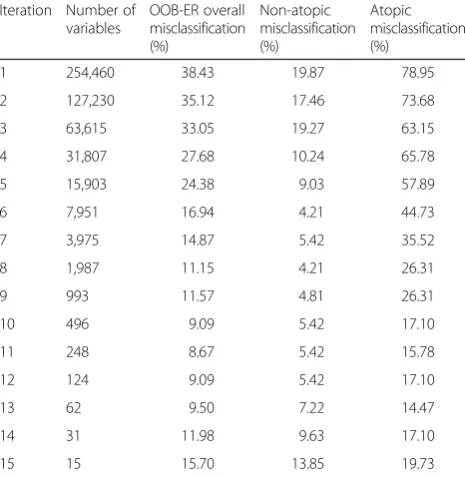
The initial RF in the recursive implementation was fit-ted with all CpG sites (p = 254,460) that survived data cleaning, pre-processing, and removal of probes poten-tially containing SNPs. At each step in the reduction, the dataset was reduced by half; by the 15th iteration the data was reduced to a total of 15 CpG sites. The OOB-ER achieved its lowest point (overall misclassification of 8.67 %) at the 11th iteration, which included 248 CpGs (Table 2). However, we reduced the data further to the 13th iteration, which resulted in the lowest misclassifica-tion of atopics (14.47 %) and included 62 CpGs. From the first iteration to the 13th, the OOB-ER improved from 38.42 to 9.50 %, while the misclassification for atopics and non-atopics improved from 78.95 to 14.47 % and 19.87 to 7.22 % respectively. After the 13th iteration, each of the misclassification rates increased, thus the CpGs (p = 62) from this iteration were selected for stage 2 analyses.
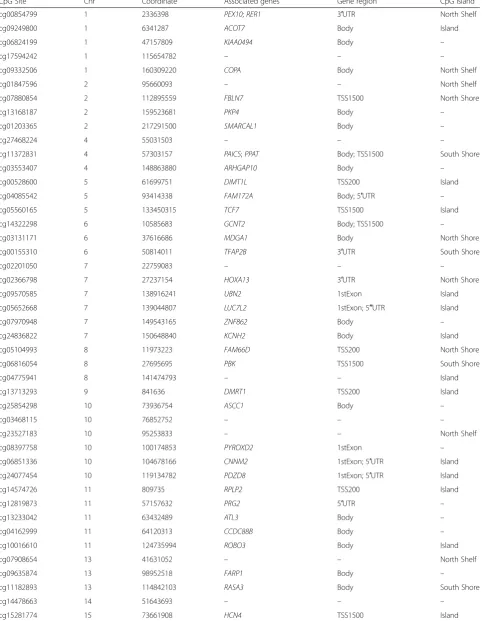
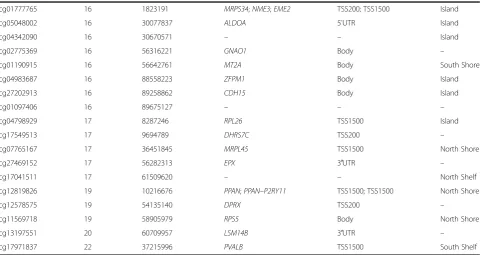
All 62 selected CpG sites were annotated with relevant genetic information (Table 3). We used logistic regres-sion to describe the individual associations of all the selected CpG sites. Only cg09570585 and cg10016610 had P-values > 0.05 (P-values = 0.06353 and 0.09771,
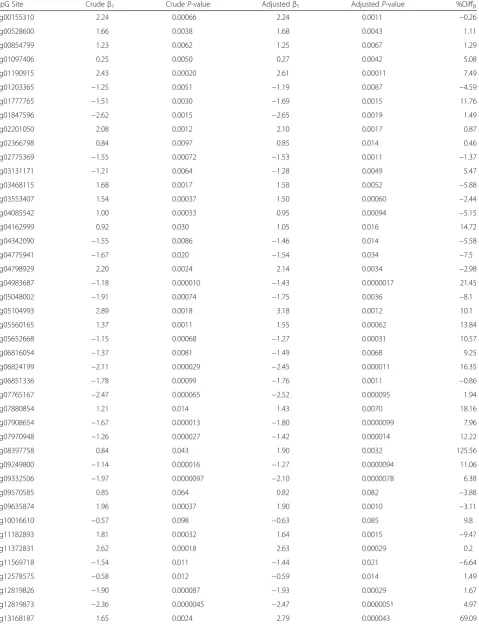
respectively). Prior to implementing stage 2 analyses, we tested whether any of the selected sites may have been selected due to confounding by cell type. Many of the associations were altered by adjusting for proportions of CD8+ T cells, CD4+ T cells, natural killer cells, B cells, monocytes, and granulocytes (Table 4). Thus all further associations were adjusted for cell type.
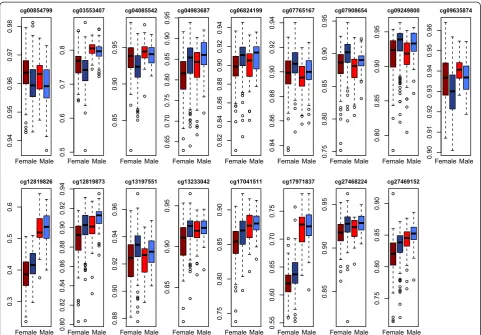
Prior to running the stage 2 joint analyses we com-pared the distribution of methylation levels in the male and female samples stratified by atopy status. The distri-butions (Fig. 2 and Additional file 1) were similar be-tween the two samples for most loci and thus we proceeded with pooling the data. However, since the distribution of methylation levels did differ by sex for some loci, we included sex as a covariate in the stage 2 analyses.
For stage 2, we tested each of the 62 CpG sites for their associations with atopy and high serum IgE levels in the joint sample. Only 50 of the 62 sites were present in both samples, because the female and male samples were analyzed as separate batches and 12 of these sites were removed from the male sample during data clean-ing and pre-processclean-ing. The sites that were only present in the female sample were still analyzed in stage 2.
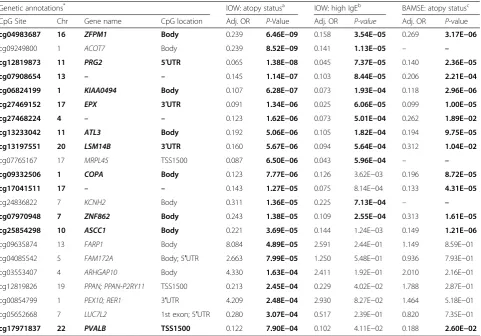
Of the 62 sites, 22 had statistically significant associa-tions with atopy (P-value range 6.5E−9 to 7.9E−4) (Table 5). At four of these sites, higher levels of DNA-M were associated with increased likelihood of atopy [odds ratio (OR) range 2.66–8.08]. For the other 18 sites, lower levels of DNA methylation were associated with higher likelihood of atopy (OR range 0.311–0.065). We also found that 12 sites had statistically significant associa-tions with both atopy and high IgE (P-value range 1.1E−5 to 7.1E−4) in the IOW. Set analyses [40] showed a mild but statistically significant joint effect of DNA methylation on atopy at the 10 IgE-associated and atopy-associated sites shared between men and women (estimate 0.0016, 95 % confidence interval 0.0003–0.023).
Finally, 19 of the 22 sites (data on three sites were not available in BAMSE) associated with atopy in IOW were studied in an independent cohort. Of the 19 sites tested, 13 were significantly associated (P-values < 0.05) with atopy in BAMSE and had comparable ORs (Table 5):
Table 1Prevalence of atopy via positive skin prick tests and high serum IgE among females and males
Epigenetic subsample Full cohort Subsample vs full cohort
Outcome variables Females Males χ2 Females Males
χ2
(n = 245) (n = 122) P-value (n = 786) (n = 750) P-value
Atopy At least one positive 76 (31.4 %) 49 (40.8 %) 0.097 159 (35.6 %) 194 (47.7 %) Females: 0.30
All negative 166 (68.6 %) 71 (59.2 %) 287 (64.4 %) 213 (52.3 %) Males: 0.22
IgE IgE≥200 kU/L 24 (23.8 %) 18 (41.9 %) 0.047 66 (25.9 %) 81 (32.5 %) Females: 0.78
cg04983687 inzinc finger protein,FOG family member 1 (ZFPM1), cg18219873 in proteoglycan 2 (PRG2), cg07908654 (intergenic), cg06824199 in EF-hand cal-cium binding domain 14 (KIAA0494, also known as EFCAB14), cg27469152 in eosinophil peroxidase (EPX), cg27468224 (intergenic), cg13233042 in atlastin GTPase 3 (ATL3), cg13197551 in SCD6 homolog B (LSM14B, also known as C20orf40), cg09332506 in coatomer pro-tein complex, subunit alpha (COPA), g07970948 in zinc finger protein 862 (ZNF862), cg25854298 in activating signal cointegrator 1 complex subunit 1 (ASCC1), and cg17971837 in parvalbumin (PVALB). For all 13 sites, persons with atopy or high IgE had lower methylation levels compared to those without atopy or with lower IgE. All nine sites that were associated with both atopy status and high IgE in IOW after adjusting for multiple tests (P-value < 8.06E−4) were successfully replicated in BAMSE, whereas the remaining four replicated sites (cg09332506 in COPA, cg17041511 (intergenic), cg25854298 in ASCC1, and cg17971837 in PVALB) had nominal (P-value < 0.05) associations with high IgE in IOW. Interestingly, almost all sites (five out of six) that were not replicated in BAMSE did not have even nominal associations with high IgE in IOW.
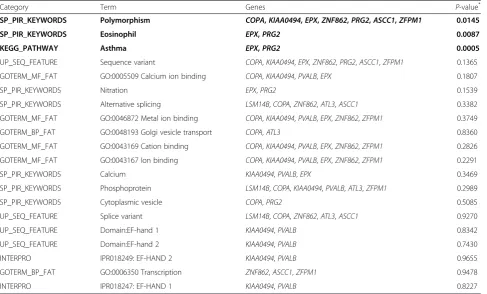
The 13 replicated sites were investigated for functional annotation in DAVID and for individual biological relevance via literature review. Functional annotation of the 10 genes (ZFPM1, PRG2, KIAA0494, EPX, ATL3, LSM14B, COPA, ZNF862, ASCC1, and PVALB) associ-ated with the 13 replicassoci-ated CpG sites (Table 6) revealed
three statistically significant annotations: polymorphism, eosinophil, and asthma. The most interesting of these findings involved two genes (EPX and PRG2) in the KEGG pathway for asthma (BenjaminiP-value = 0.00056) and associated with the eosinophils annotation (Benjamini P-value = 0.0087).
Discussion
Our methodological approach and the biological rele-vance of our findings are noteworthy to researchers studying epigenetic mechanisms in atopy. We selected 62 CpG sites from a starting set of 254,460, resulting in vastly improved classification of atopics (from 78.95 to 14.47 % error) and non-atopics (from 19.87 % to 7.22 % error) when compared to the RF on the full dataset. Of particular note was the large proportion of CpG loci that were statistically significant at a Bonferroni-adjusted α for atopy (35 %) and high IgE (19 %) within the IOW sample and the large proportion (13 of 19) of sites that were successfully replicated in the BAMSE cohort.
Our findings are the latest in a series of recent work that supports the application of RF for genome-wide as-sociation studies (GWAS) and in allergic diseases. The recursive RF process we utilized was similar to methods proposed elsewhere [13, 15, 17, 35]. It has been used by Menze et al. [37] and Anaissi et al. [18] but, to the best of our knowledge, has never been implemented in epige-nomics. Goldstein et al. presented one of the first suc-cessful applications of RF for GWAS, demonstrating its ability to identify genes known to be associated with the multiple sclerosis as well as genes with previously un-known disease associations [13]. Xu et al. successfully identified SNPs predictive of asthma exacerbations in children via RF [16]. These findings indicate the promis-ing nature of the use of RF for feature selection in future epigenome-wide studies.
The true challenge with high-throughput techniques is in connecting the results to biological processes, which are complex and can involve combinations of many genes working together. We investigated the biological roles of the ten genes associated with the 13 replicated CpGs sites: ZFPM1, PRG2, KIAA0494, EPX, ATL3, LSM14B,COPA, ZNF862,ASCC1, andPVALB. For each of these genes, we performed a search of the literature for possible roles in atopy and conducted functional an-notation in DAVID.
Among the replicated loci, a number of their associ-ated genes were involved in intriguing processes that may have a role in atopy. ZFPM1 (also known as FOG-1) is a binding factor for the transcription fac-tor GATA-1 and has been primarily studied for its role in the differentiation of erythroid, megakaryo-cyte, and mast cells [43]. However the consequences of FOG-1 expression appear to be dependent on its Table 2Misclassification rates throughout the recursive RF process
Iteration Number of variables
OOB-ER overall misclassification (%)
Non-atopic misclassification (%)
Atopic misclassification (%)
1 254,460 38.43 19.87 78.95
2 127,230 35.12 17.46 73.68
3 63,615 33.05 19.27 63.15
4 31,807 27.68 10.24 65.78
5 15,903 24.38 9.03 57.89
6 7,951 16.94 4.21 44.73
7 3,975 14.87 5.42 35.52
8 1,987 11.15 4.21 26.31
9 993 11.57 4.81 26.31
10 496 9.09 5.42 17.10
11 248 8.67 5.42 15.78
12 124 9.09 5.42 17.10
13 62 9.50 7.22 14.47
14 31 11.98 9.63 17.10
15 15 15.70 13.85 19.73
Table 3Genetic annotations for 62 sites selected by recursive Random Forest
CpG Site Chr Coordinate Associated genes Gene region CpG island
cg00854799 1 2336398 PEX10;RER1 3′UTR North Shelf
cg09249800 1 6341287 ACOT7 Body Island
cg06824199 1 47157809 KIAA0494 Body –
cg17594242 1 115654782 – – –
cg09332506 1 160309220 COPA Body North Shelf
cg01847596 2 95660093 – – North Shelf
cg07880854 2 112895559 FBLN7 TSS1500 North Shore
cg13168187 2 159523681 PKP4 Body –
cg01203365 2 217291500 SMARCAL1 Body –
cg27468224 4 55031503 – – –
cg11372831 4 57303157 PAICS;PPAT Body; TSS1500 South Shore
cg03553407 4 148863880 ARHGAP10 Body –
cg00528600 5 61699751 DIMT1L TSS200 Island
cg04085542 5 93414338 FAM172A Body; 5′UTR –
cg05560165 5 133450315 TCF7 TSS1500 Island
cg14322298 6 10585683 GCNT2 Body; TSS1500 –
cg03131171 6 37616686 MDGA1 Body North Shore
cg00155310 6 50814011 TFAP2B 3′UTR South Shore
cg02201050 7 22759083 – – –
cg02366798 7 27237154 HOXA13 3′UTR North Shore
cg09570585 7 138916241 UBN2 1stExon Island
cg05652668 7 139044807 LUC7L2 1stExon; 5′′UTR Island
cg07970948 7 149543165 ZNF862 Body –
cg24836822 7 150648840 KCNH2 Body Island
cg05104993 8 11973223 FAM66D TSS200 North Shore
cg06816054 8 27695695 PBK TSS1500 South Shore
cg04775941 8 141474793 – – Island
cg13713293 9 841636 DMRT1 TSS200 Island
cg25854298 10 73936754 ASCC1 Body –
cg03468115 10 76852752 – – –
cg23527183 10 95253833 – – North Shelf
cg08397758 10 100174853 PYROXD2 1stExon –
cg06851336 10 104678166 CNNM2 1stExon; 5′UTR Island
cg24077454 10 119134782 PDZD8 1stExon; 5′UTR Island
cg14574726 11 809735 RPLP2 TSS200 Island
cg12819873 11 57157632 PRG2 5′UTR –
cg13233042 11 63432489 ATL3 Body –
cg04162999 11 64120313 CCDC88B Body –
cg10016610 11 124735994 ROBO3 Body Island
cg07908654 13 41631052 – – North Shelf
cg09635874 13 98952518 FARP1 Body –
cg11182893 13 114842103 RASA3 Body South Shore
cg14478663 14 51643693 – – –
cellular origin and the biochemical surroundings, which can determine whetherFOG-1acts as a repressor or co-activator of GATA-1 [43, 44]. Recently, ZFPM1 was shown in an in vitro study to down-regulate IL-4 and therefore facilitate TH1 differentiation [45]. Also, two dif-ferentially methylated regions in ZFPM1 were recently identified in association with asthma [46]. The multifa-ceted roles ofZFPM1in immune-cell activity and allergic disease suggest that this is an interesting yet possibly overlooked gene in atopy and atopic diseases.
Eosinophils are subtypes of granulocytes that are heav-ily involved in inflammatory responses and atopic asthma through the mechanism of airway inflammation [47]. EPX encodes eosinophil peroxidase, a protein expressed by eosinophils. Previous investigations found that both serum and urine levels of EPX were elevated in children who had positive SPTs, as well as those with allergic diseases such as asthma, allergic rhinoconjuncti-vitis and atopic dermatitis [48–51]. A recent epigenome-wide study found multiple CpG sites, including one within PRG2, which were associated with high versus low total IgE, primarily driven by eosinophils. Interest-ingly, this study also found that the methylation levels in isolated eosinophils differed among asthmatics with high total IgE, asthmatics with low total IgE, and controls, suggesting that eosinophils from persons with allergic hypersensitivity or asthma may have different epigen-etic profiles compared to eosinophils from non-allergic
individuals [52]. Also, a recent genome-wide expres-sion study of peripheral blood mononuclear cells found that PRG2 expression was up-regulated in response to dust-mite exposure, suggesting a possible role in the adap-tive immune response [53].
A GWAS of atopic asthma implicated SNPs that were in linkage disequilibrium with SNPs in COPA, though these did not achieve genome-wide significance [54]. More recently, four deleterious variants within COPA have been linked to an autoimmune disease character-ized by high-titer autoantibodies, interstitial lung disease, and inflammatory arthritis [55]. These mutations may induce stress on the endoplasmic reticulum leading to defective intracellular protein transport between the golgi and the endoplasmic reticulum; such defects have been linked to autoimmune and lung-disease. Interest-ingly, mutant COPA also appears to drive CD4+ T-cells toward TH17 phenotype via increased expression of IL-1β, IL-6 and IL-23 [55]. Thus, mutant COPA does appear to affect immune pathways which can lead to autoimmune disease and our findings suggest that differ-ential epigenetic regulation of COPA may play a role in hypersensitivity, though further research is necessary to elucidate this role.
LSM14Bmay be involved in mRNA translation [56, 57]. Some of the genes encode proteins that perform structural roles in different areas of the body. ATL3 participates in tethering, creating a tubular connective network of
Table 3Genetic annotations for 62 sites selected by recursive Random Forest(Continued)
cg01777765 16 1823191 MRPS34;NME3;EME2 TSS200; TSS1500 Island
cg05048002 16 30077837 ALDOA 5'UTR Island
cg04342090 16 30670571 – – Island
cg02775369 16 56316221 GNAO1 Body –
cg01190915 16 56642761 MT2A Body South Shore
cg04983687 16 88558223 ZFPM1 Body Island
cg27202913 16 89258862 CDH15 Body Island
cg01097406 16 89675127 – – –
cg04798929 17 8287246 RPL26 TSS1500 Island
cg17549513 17 9694789 DHRS7C TSS200 –
cg07765167 17 36451845 MRPL45 TSS1500 North Shore
cg27469152 17 56282313 EPX 3′UTR –
cg17041511 17 61509620 – – North Shelf
cg12819826 19 10216676 PPAN;PPAN–P2RY11 TSS1500; TSS1500 North Shore
cg12578575 19 54135140 DPRX TSS200 –
cg11569718 19 58905979 RPS5 Body North Shore
cg13197551 20 60709957 LSM14B 3′UTR –
cg17971837 22 37215996 PVALB TSS1500 South Shelf
Abbreviations: ChrChromosome number,CpGcytosine–phosphate–guanineIgEImmunoglobulin E,IOWIsle of Wight cohort,TSSTranscription Start Site,
UTRuntranslated region
Table 4Stage 1–Assessment of the influence of cell type on CpG selection in stage 1 analyses (n = 245)
CpG Site Crudeβ1 CrudeP-value Adjustedβ1 AdjustedP-value %Diffβ
cg00155310 2.24 0.00066 2.24 0.0011 −0.26
cg00528600 1.66 0.0038 1.68 0.0043 1.11
cg00854799 1.23 0.0062 1.25 0.0067 1.29
cg01097406 0.25 0.0050 0.27 0.0042 5.08
cg01190915 2.43 0.00020 2.61 0.00011 7.49
cg01203365 −1.25 0.0051 −1.19 0.0087 −4.59
cg01777765 −1.51 0.0030 −1.69 0.0015 11.76
cg01847596 −2.62 0.0015 −2.65 0.0019 1.49
cg02201050 2.08 0.0012 2.10 0.0017 0.87
cg02366798 0.84 0.0097 0.85 0.014 0.46
cg02775369 −1.55 0.00072 −1.53 0.0011 −1.37
cg03131171 −1.21 0.0064 −1.28 0.0049 5.47
cg03468115 1.68 0.0017 1.58 0.0052 −5.88
cg03553407 1.54 0.00037 1.50 0.00060 −2.44
cg04085542 1.00 0.00033 0.95 0.00094 −5.15
cg04162999 0.92 0.030 1.05 0.016 14.72
cg04342090 −1.55 0.0086 −1.46 0.014 −5.58
cg04775941 −1.67 0.020 −1.54 0.034 −7.5
cg04798929 2.20 0.0024 2.14 0.0034 −2.98
cg04983687 −1.18 0.000010 −1.43 0.0000017 21.45
cg05048002 −1.91 0.00074 −1.75 0.0036 −8.1
cg05104993 2.89 0.0018 3.18 0.0012 10.1
cg05560165 1.37 0.0011 1.55 0.00062 13.84
cg05652668 −1.15 0.00068 −1.27 0.00031 10.57
cg06816054 −1.37 0.0081 −1.49 0.0068 9.25
cg06824199 −2.11 0.000029 −2.45 0.000011 16.35
cg06851336 −1.78 0.00099 −1.76 0.0011 −0.86
cg07765167 −2.47 0.000065 −2.52 0.000095 1.94
cg07880854 1.21 0.014 1.43 0.0070 18.16
cg07908654 −1.67 0.000013 −1.80 0.0000099 7.96
cg07970948 −1.26 0.000027 −1.42 0.000014 12.22
cg08397758 0.84 0.043 1.90 0.0032 125.56
cg09249800 −1.14 0.000016 −1.27 0.0000094 11.06
cg09332506 −1.97 0.0000097 −2.10 0.0000078 6.38
cg09570585 0.85 0.064 0.82 0.082 −3.88
cg09635874 1.96 0.00037 1.90 0.0010 −3.11
cg10016610 −0.57 0.098 −0.63 0.085 9.8
cg11182893 1.81 0.00032 1.64 0.0015 −9.47
cg11372831 2.62 0.00018 2.63 0.00029 0.2
cg11569718 −1.54 0.011 −1.44 0.021 −6.64
cg12578575 −0.58 0.012 −0.59 0.014 1.49
cg12819826 −1.90 0.000087 −1.93 0.00029 1.67
cg12819873 −2.36 0.0000045 −2.47 0.0000051 4.97
membranes in the endoplasmic reticulum, which is the site where ribosomes build proteins from DNA tran-scripts. The functional annotation results implicated the genes EPX and PRG2 in eosinophil activity and in the KEGG pathway for late hypersensitive responses in asthma. Some of the genes (KIAA0494, ATL3, LSM14B, ASCC1, andPVALB) did not have any apparent role in im-mune response.
These findings should be interpreted within the limita-tions of the study. Although we provide evidence in sup-port of associations between 13 CpG sites and atopy, variations in methylation at these sites may not cause al-lergic sensitization. The cross-sectional nature of this sample prohibited us from distinguishing between which DNA-M variations at CpG sites may have caused, been caused by, or just been markers of sensitization. How-ever, associations in any of these directions may yield important insights into the development, persistence, and consequences of allergic sensitization. Some of the CpG sites that were selected could not be replicated and some that were replicated were not involved in any known biological processes related to atopy or allergy. The unsuccessful replication could be due to false-positive findings from the discovery analyses, or differ-ences in how atopy was assessed between the discovery and replication cohorts. The lack of biological roles for these CpG sites could be explained by selected CpG sites
possibly being highly correlated with other CpG sites that truly influence atopy status, or by CpG sites having roles in unknown, but still important, biological path-ways involved in atopy.
Correlated predictors may present an issue that we were unable to address [13, 17]. If the methylation level at a biologically important CpG site was highly corre-lated with methylation levels at other unimportant loci, the inclusion of those unimportant loci in a forest would decrease the VIM of the important CpG site and may re-sult in its exclusion during data reduction. This would result in a statistically strong but biologically ambiguous result. It is possible that some of our results that were not biologically consistent with allergic disease were due to this issue. Applying an approach similar to linkage disequilibrium and haplotype identification from genetic studies may improve the prediction accuracy of the for-est and save computational time [17], but such applica-tions have not been studied with genome-wide DNA-M arrays at this time. Furthermore, there is no consensus with respect to which VIM is best for large-scale data with correlated predictors. We used MDG, which was also utilized by Menze et al. to recursively eliminate un-important predictors [37]. Calle and Urrea found that MDA was unstable when there were small alterations to the data, but that MDG was robust to such changes [36]. However, MDG does not perform as well if the
Table 4Stage 1–Assessment of the influence of cell type on CpG selection in stage 1 analyses (n = 245)(Continued)
cg13197551 −1.84 0.000062 −1.77 0.00016 −3.49
cg13233042 −1.64 0.000032 −1.74 0.000031 6.21
cg13713293 −1.43 0.00039 −1.40 0.00070 −1.67
cg14322298 −1.53 0.0031 −1.57 0.0052 2.77
cg14478663 1.81 0.00020 1.91 0.00017 5.64
cg14574726 1.75 0.0058 1.91 0.0037 9.54
cg15281774 −1.91 0.0014 −2.13 0.00076 11.37
cg17041511 −1.97 0.000021 −2.25 0.000027 14.69
cg17549513 1.62 0.0094 1.82 0.0051 12.16
cg17594242 1.72 0.000035 1.71 0.000071 −0.93
cg17971837 −3.38 0.000061 −3.64 0.000069 7.85
cg23527183 −0.83 0.0048 −0.92 0.0034 10.38
cg24077454 1.33 0.0056 1.27 0.012 −4.29
cg24836822 −1.09 0.000020 −1.17 0.000014 8.19
cg25854298 −1.40 0.000042 −1.51 0.000037 7.39
cg27202913 −0.67 0.010 −0.69 0.0094 2.01
cg27468224 −1.83 0.00013 −1.85 0.00019 1.29
cg27469152 −1.99 0.00021 −2.21 0.000094 11.21
Results of 62 logistic regressions between methylation M-values and atopy for each selected CpG. We present crude associations as well as associations adjusted for predicted cell proportions of CD8+
T cells, CD4+
T cells, natural killer cells, B-cells, monocytes, and granulocytes.β1represents the value of the regression coefficient for the CpG site in that statistical model. The percent change inβ-values (%Diffβ) was calculated as [(crudeβ1–adjustedβ1)/crudeβ1] and was used to evaluate whether cell
scales of the variables differ widely or if they have differ-ent numbers of categories [36, 58], which would be an important consideration for researchers incorporating both DNA-M and SNP data in a single dataset. More work needs to be done to determine which VIMs per-form best under the typical characteristics of genome-wide DNA-M studies: sparsity, skewed continuous predictors, very largenand very smallp, statistical inter-actions, or correlations between predictors. Despite the issues of correlated predictors, such variables can still provide useful information. DNA-M loci that are merely surrogates of actual CpGs associated with atopy can still serve as biomarkers of disease, but do not serve to im-prove our understanding of the etiology of atopy.
Some of the CpGs that we identified with the recursive RF but that did not meet our replication criteria may in fact be biologically relevant in atopy. We would not ex-pect all biologically relevant findings to be included in the functional annotation results of our gene list for two reasons: first, our gene list of 10 genes is quite small
because DAVID is optimized for lists between 100 and 2,000 genes in length [41]; and second, functional anno-tation relies on current knowledge of gene functions, and may not correctly classify the functions of novel loci. Also, these sites were selected with RF, which allows for complex interactions to be identified [13]. CpGs that were selected via RF due to unknown interaction effects may not have had an independent association with atopy and thus could not have survived our stage 2 analyses with strict multiple testing adjustments to significance levels.
responses, this may have resulted in some residual con-founding. However, given the inability to collect actual cell differentials in this study, the predictions we used likely accounted for the majority of cellular heterogen-eity in our blood samples.
The lack of independence between the samples used for RF feature selection (stage 1) and the samples used for determinations of statistical significance (stage 2) was another limitation, and may have led to some over-fitting during stage 2 analyses. Also, 12 CpG sites that were se-lected in stage 1 were not present in the male sample. Al-though these were still evaluated in the stage 2 analyses, the lack of full methylation data reduced the power to identify significant findings at these 12 sites. However, the strong replication results in the BAMSE cohort would sug-gest that the majority of our findings were not due to ran-dom chance or over-fit to the IOW sample.
Not all of our findings were replicated; six sites that were tested did not successfully replicate and three sites could not be tested because the data were unavailable. The six non-replicated sites may represent false-positives from our stage 2 analyses or could be due to differences in the measurement of atopy status be-tween the two cohorts. One limitation of the replica-tion study was that atopy was defined as at least one positive SPT to any allergen in the IOW; whereas atopy was defined as specific IgE antibody≥0.35 kUA/L to any allergen in BAMSE. The associations with high serum IgE in the IOW support that at least some of the unsuccessful replications may have been due to these differences in measurement. All 13 sites that replicated in BAMSE had at least nominal associa-tions with high serum IgE in IOW (P-values < 0.05), whereas only one of the six sites that did not replicate Table 5Comparison of stage 2 (n = 367) and replication (n = 464) results
Genetic annotations* IOW: atopy statusa IOW: high IgEb BAMSE: atopy statusc CpG Site Chr Gene name CpG location Adj. OR P-Value Adj. OR P-value Adj. OR P-value
cg04983687 16 ZFPM1 Body 0.239 6.46E−09 0.158 3.54E−05 0.269 3.17E−06
cg09249800 1 ACOT7 Body 0.239 8.52E−09 0.141 1.13E−05 – –
cg12819873 11 PRG2 5′UTR 0.065 1.38E−08 0.045 7.37E−05 0.140 2.36E−05
cg07908654 13 – – 0.145 1.14E−07 0.103 8.44E−05 0.206 2.21E−04
cg06824199 1 KIAA0494 Body 0.107 6.28E−07 0.073 1.93E−04 0.118 2.96E−06
cg27469152 17 EPX 3′UTR 0.091 1.34E−06 0.025 6.06E−05 0.099 1.00E−05
cg27468224 4 – – 0.123 1.62E−06 0.073 5.01E−04 0.262 1.89E−02
cg13233042 11 ATL3 Body 0.192 5.06E−06 0.105 1.82E−04 0.194 9.75E−05
cg13197551 20 LSM14B 3′UTR 0.160 5.67E−06 0.094 5.64E−04 0.312 1.04E−02
cg07765167 17 MRPL45 TSS1500 0.087 6.50E−06 0.043 5.96E−04 – –
cg09332506 1 COPA Body 0.123 7.77E−06 0.126 3.62E−03 0.196 8.72E−05
cg17041511 17 – – 0.143 1.27E−05 0.075 8.14E−04 0.133 4.31E−05
cg24836822 7 KCNH2 Body 0.311 1.36E−05 0.225 7.13E−04 – –
cg07970948 7 ZNF862 Body 0.243 1.38E−05 0.109 2.55E−04 0.313 1.61E−05
cg25854298 10 ASCC1 Body 0.221 3.69E−05 0.144 1.24E−03 0.149 1.21E−06
cg09635874 13 FARP1 Body 8.084 4.89E−05 2.591 2.44E−01 1.149 8.59E−01
cg04085542 5 FAM172A Body; 5′UTR 2.663 7.99E−05 1.250 5.48E−01 0.936 7.93E−01
cg03553407 4 ARHGAP10 Body 4.330 1.63E−04 2.411 1.92E−01 2.010 2.16E−01
cg12819826 19 PPAN; PPAN-P2RY11 TSS1500 0.213 2.45E−04 0.229 4.02E−02 1.788 2.87E−01
cg00854799 1 PEX10; RER1 3′UTR 4.209 2.48E−04 2.930 8.27E−02 1.464 5.18E−01
cg05652668 7 LUC7L2 1st exon; 5′UTR 0.280 3.07E−04 0.517 2.39E−01 0.820 7.35E−01
cg17971837 22 PVALB TSS1500 0.122 7.90E−04 0.102 4.11E−02 0.188 2.60E−02
Associations for methylation M-values with atopy and high IgE from the IOW epigenetic sample, as well as with atopy in the BAMSE replication sample. IOW analyses were adjusted for predicted cell proportions of CD8+
T cells, CD4+
T cells, natural killer cells, B cells, monocytes, granulocytes, and sex. BAMSE replication analyses were adjusted for the same predicted cell proportions, sex, batch (bisulfite treatment date), and asthma treatment
Abbreviations: Adj. ORadjusted odds ratio,BAMSEChildren, Allergy, Milieu, Stockholm, Epidemiology cohort,ChrChromosome number,CpGcytosine–phosphate–guanine,
IgEImmunoglobulin E,IOWIsle of Wight cohort,TSSTranscription Start Site,UTRuntranslated region
*
CpGs and their annotations highlighted in bold were the sites replicated in the BAMSE cohort
a
Atopy defined as at least one positive skin prick test; significant sites determined viaα= 8.06E−4 (0.05/62 tests)
b
High IgE defined as serum IgE≥200 kU/L; significant sites determined viaα= 8.06E−4 (0.05/62 tests)
c
in BAMSE had an association with high serum IgE in IOW (P-value < 0.05). These findings suggest that the only sites that could be replicated in this study may be involved in IgE-mediated allergic sensitization. Also, some atopy-associated CpG sites in IOW, which were measured at 18 years old, may not have been able to replicate in BAMSE, measured at 8 years of age, because methylation levels can be age dependent [59]. It is possible that some of these six sites may have replicated had the outcome of atopy status been measured with the same method and at the same age in both cohorts. Thus, although these six sites were not considered positive findings in this study, future epi-genetic studies that utilize SPTs to evaluate sensitization, and evaluate sensitization in young adults close to age 18, may consider attempting to replicate these sites. The three sites for which data were not available in the rep-lication cohort should also be considered for future replication studies. The CpG site (cg09249800) in ACOT7, which was strongly associated with both atopy and high IgE in the IOW cohort, is particularly inter-esting because others have identified differentially methylated regions within this gene associated with asthma [46]; thus, it may play a role in allergic sensitization or allergic diseases.
Conclusions
Utilizing a two-stage design with a well-characterized but sparsely implemented RF feature selection method followed by logistic regression for both atopy and an alternate marker of atopy (high IgE), we identified a number of CpG sites associated with atopy. Most im-portantly, 13 sites were replicated in an independent co-hort for atopy status: cg04983687 in the body ofZFPM1, cg12819873 in the 5′UTR of PRG2, cg07908654 (intergenic), cg06824199 in the body of KIAA0494, cg27469152 in the 3′UTR ofEPX, cg27468224 (intergenic), cg13233042 in the body of ATL3, cg13197551 in the 3′ UTR of LSM14B, cg09332506 in the body of COPA, cg17041511 (intergenic), cg07970948 in the body of
ZNF862, cg25854298 in the body of ASCC1, and
cg17971837 in the TSS1500 of PVALB. Three of the 22 sites associated with atopy in IOW were not available for testing in the BAMSE cohort, so may be of interest for follow-up in future studies of DNA-M and atopy: cg09249800 in the body of ACOT7, cg07765167 in the TSS1500 of MRPL45, and cg24836822 in the body of KCNH2. These CpG sites and their associated genes could be treated as under-studied candidates for future studies of atopy; particularly cg04983687 in ZFPM1, cg12819873 in PRG2, cg27469152 in EPX, and cg09332506 in COPA. Table 6Functional annotation for genes associated with the 13 sites that were successfully replicated
Category Term Genes P-value*
SP_PIR_KEYWORDS Polymorphism COPA,KIAA0494,EPX,ZNF862,PRG2,ASCC1,ZFPM1 0.0145
SP_PIR_KEYWORDS Eosinophil EPX,PRG2 0.0087
KEGG_PATHWAY Asthma EPX,PRG2 0.0005
UP_SEQ_FEATURE Sequence variant COPA,KIAA0494,EPX,ZNF862,PRG2,ASCC1,ZFPM1 0.1365
GOTERM_MF_FAT GO:0005509 Calcium ion binding COPA,KIAA0494,PVALB,EPX 0.1807
SP_PIR_KEYWORDS Nitration EPX,PRG2 0.1539
SP_PIR_KEYWORDS Alternative splicing LSM14B,COPA,ZNF862,ATL3,ASCC1 0.3382
GOTERM_MF_FAT GO:0046872 Metal ion binding COPA,KIAA0494,PVALB,EPX,ZNF862,ZFPM1 0.3749
GOTERM_BP_FAT GO:0048193 Golgi vesicle transport COPA,ATL3 0.8360
GOTERM_MF_FAT GO:0043169 Cation binding COPA,KIAA0494,PVALB,EPX,ZNF862,ZFPM1 0.2826
GOTERM_MF_FAT GO:0043167 Ion binding COPA,KIAA0494,PVALB,EPX,ZNF862,ZFPM1 0.2291
SP_PIR_KEYWORDS Calcium KIAA0494,PVALB,EPX 0.3469
SP_PIR_KEYWORDS Phosphoprotein LSM14B,COPA,KIAA0494,PVALB,ATL3,ZFPM1 0.2989
SP_PIR_KEYWORDS Cytoplasmic vesicle COPA,PRG2 0.5085
UP_SEQ_FEATURE Splice variant LSM14B,COPA,ZNF862,ATL3,ASCC1 0.9270
UP_SEQ_FEATURE Domain:EF-hand 1 KIAA0494,PVALB 0.8342
UP_SEQ_FEATURE Domain:EF-hand 2 KIAA0494,PVALB 0.7430
INTERPRO IPR018249: EF-HAND 2 KIAA0494,PVALB 0.9655
GOTERM_BP_FAT GO:0006350 Transcription ZNF862,ASCC1,ZFPM1 0.9478
INTERPRO IPR018247: EF-HAND 1 KIAA0494,PVALB 0.8227
Statistically significant DAVID functional annotation and pathway results are in bold
*
Furthermore, we showed that recursive RF data reduction can be an effective approach for epigenome-wide DNA-M studies, and may be considered by other investigators as it has now been successful in multiple studies with large-scale data.
Additional file
Additional file 1:Boxplots of the distributions of methylation levels within the male (bright redandbright blue) and female (dark red anddark blue) samples, stratified by atopy status (red= atopic; blue= non-atopic) for the 33 CpGs sites present in both the male and female samples that were not significantly associated with atopy in stage 2 analyses.(PDF 20 kb)
Abbreviations
BAMSE:Children, Allergy, Milieu, Stockholm, Epidemiology (Swedish abbreviation); CpG: cytosine-phosphate-guanine; DNA-M: DNA methylation; GWAS: genome-wide association study; IgE: immunoglobulin E; IOW: Isle of Wight; MDA: mean decrease accuracy; MDG: mean decrease Gini; OOB-ER: out-of-bag error rate; OR: odds ratio; QC: quality control; RF: Random Forest; SNP: single nucleotide polymorphism; SPT: skin prick test; VIM: variable importance measures.
Competing interests
The authors declare that they have no competing interests.
Authors’contributions
TME and GL designed the study and wrote the manuscript. WK, HZ, and NSR supervised and provided guidance on analytical aspects. TME performed statistical analyses for the IOW data. WK, JWH, and SHA provided guidance on epigenomic and clinical aspects. GAL, VKP, and SHA were involved in IOW sample collection, data acquisition, and DNA-M arraying. EM, SKM, and CS were involved in the BAMSE study design and statistical analyses. All authors were involved in editing and revising the manuscript. All authors read and approved the final manuscript.
Acknowledgements
The authors gratefully acknowledge the cooperation of the children and parents on the Isle of Wight who participated in this study, and appreciate the hard work of the Isle of Wight research team in collecting data, and Nikki Graham for technical support. We thank the High-Throughput Genomics Group at the Wellcome Trust Centre for Human Genetics (funded by Wellcome Trust grant reference 090532/Z/09/Z and MRC Hub grant G0900747 91070) for the generation of the methylation data. Research reported in this publication was supported by the National Institute of Allergy and Infectious Diseases under award number R01 AI091905 (PI, WK) and R01 AI061471 (PI, SE). The 10-year follow-up of this study was funded by National Asthma Campaign, UK (Grant No 364) and the 18-year follow-up by a grant from the National Heart and Blood Institute (R01 HL082925, PI, SHA). The BAMSE study was supported by grants from the Swedish Foundation for Strategic Research, the Swedish Research Council, the Swedish Heart-Lung Foundation, Stockholm County Council, and the Strategic Research Programme in Epidemiology at Karolinska Institutet.
Author details
1
Department of Epidemiology and Biostatistics, Arnold School of Public Health, University of South Carolina, 915 Greene Street, Columbia, SC 29208, USA.2Department of Biostatistics, University of Texas M. D. Anderson Cancer Center, Pickens Tower, 1400 Pressler, Houston, TX 77230, USA.3Division of
Epidemiology, Biostatistics and Environmental Health, School of Public Health, University of Memphis, 236A Robison Hall, Memphis, TN 38152, USA.
4
Human Development and Health, Faculty of Medicine, University of Southampton, Southampton General Hospital, Southampton SO16 6YD, UK.
5
The David Hide Asthma and Allergy Research Centre, St Mary’s, Hospital, Parkhurst Road, Newport, Isle of Wight PO30 5TG, UK.6Institute of
Environmental Medicine, Karolinska Institutet, Stockholm, Sweden.
7Department of Biosciences and Nutrition, and Center for Innovative
Medicine (CIMED), Karolinska Institutet, 141 83 Stockholm, Sweden.8Sachs’
Children’s Hospital, Stockholm, Sweden.9Clinical and Experimental Sciences and NIHR Respiratory Biomedical Research Unit, Faculty of Medicine, University of Southampton, Southampton General Hospital, Southampton SO16 6YD, UK.
Received: 16 June 2014 Accepted: 3 August 2015
References
1. Prescott S, Saffery R. The role of epigenetic dysregulation in the epidemic of allergic disease. Clin Epigenetics. 2011;2:223–32.
2. Tezza G, Mazzei F, Boner A. Epigenetics of allergy. Early Hum Dev. 2013;89:S20–1.
3. Wu C-C, Chen R-F, Kuo H-C. Different implications of paternal and maternal atopy for perinatal IgE production and asthma development. Clin Dev Immunol. 2012;2012:132142.
4. Lockett GA, Huoman J, Holloway JW. Does allergy begin in utero? Pediatr Allergy Immunol 2015, epub ahead of print.
5. Waterland RA, Michels KB. Epigenetic epidemiology of the developmental origins hypothesis. Annu Rev Nutr. 2007;27:363–88.
6. Scheen AJ, Junien C. Epigenetics, interface between environment and genes: role in complex diseases. Rev Med Liege. 2012;67:250.
7. Roberts G, Zhang H, Karmaus W, Raza A, Scott M, Matthews S, et al. Trends in cutaneous sensitization in the first 18 years of life: results from the 1989 Isle of Wight birth cohort study. Clin Exp Allergy. 2012;1989:1501–9. 8. Arshad SH, Tariq SM, Matthews S, Hakim E. Sensitization to common
allergens and its association with allergic disorders at age 4 years: a whole population birth cohort study. Pediatrics. 2001;108:e33–3.
9. Wylie C. NIH Epigenomics Program: creating a wealth of reference data. Epigenetics. 2010;5:670–84.
10. Dunning MJ, Barbosa-Morais NL, Lynch G, Tavare S, Ritchie ME. Statistical issues in the analysis of Illumina data. BMC Bioinformatics. 2008;9:85. 11. Lynch AG, Dunning J, Iddawela M, Barbosa-Morais NL, Ritchie ME.
Considerations for processing and analysis of GoldenGate-based two-colour Illumina platforms. Stat Methods Med Res. 2009;18:437–52.
12. Xie Y, Wang X, Story M. Statistical methods of background correction for Illumina BeadArray data. Bioinformatics. 2009;25:751–7.
13. Goldstein BA, Hubbard AE, Cutler A, Barcellos LF. An application of Random Forests to a genome-wide association dataset: methodological considerations & new findings. BMC Genet. 2010;11:49.
14. Breiman L. Random Forests. Mach Learn. 2001;45:5–32.
15. Díaz-Uriarte R, Alvarez de Andrés S. Gene selection and classification of microarray data using random forest. BMC Bioinformatics. 2006;7:3. 16. Xu M, Tantisira KG, Wu A, Litonjua AA, Chu J, Himes BE, et al. Genome wide
association study to predict severe asthma exacerbations in children using random forests classifiers. BMC Med Genet. 2011;12:90.
17. Goldstein BA, Polley EC, Briggs FBS. Random forests for genetic association studies. Stat Appl Genet Mol Biol. 2011;10:32.
18. Anaissi A, Kennedy PJ, Goyal M, Catchpoole DR. A balanced iterative random forest for gene selection from microarray data. BMC Bioinformatics. 2013;14:261.
19. Hua J, Xiong Z, Lowey J, Suh E, Dougherty ER. Optimal number of features as a function of sample size for various classification rules. Bioinformatics. 2005;21:1509–15.
20. Arshad SH, Hide DW. Effect of environmental factors on the development of allergic disorders in infancy. J Allergy Clin Immunol. 1992;90:235–41. 21. Kurukulaaratchy RJ, Fenn MH, Waterhouse LM, Matthews SM, Holgate ST,
Arshad SH. Characterization of wheezing phenotypes in the first 10 years of life. Clin Exp Allergy. 2003;33:573–8.
22. Dreborg S. The skin prick test in the diagnosis of atopic allergy. J Am Acad Dermatol. 1989;21:820–1.
23. Miller SA, Dykes DD, Polesky HF. A simple salting out procedure for extracting DNA from human nucleated cells. Nucleic Acids Res. 1988;16:1215.
24. Bibikova M, Fan J-B. GoldenGate assay for DNA methylation profiling. Methods Mol Biol. 2009;507:149–63.
26. Wang D, Yan L, Hu Q, Sucheston LE, Higgins MJ, Ambrosone CB, et al. IMA: an R package for high-throughput analysis of Illumina’s 450K Infinium methylation data. Bioinformatics. 2012;28:729–30.
27. Johnson WE, Li C, Rabinovic A. Adjusting batch effects in microarray expression data using empirical Bayes methods. Biostatistics. 2007;8:118–27. 28. Amarasekera M. Immunoglobulin E in health and disease. Asia Pac Allergy.
2011;1:0–3.
29. Du P, Zhang X, Huang C-C, Jafari N, Kibbe WA, Hou L, et al. Comparison of Beta-value and M-value methods for quantifying methylation levels by microarray analysis. BMC Bioinformatics. 2010;11:587.
30. Skol AD, Scott LJ, Abecasis GR, Boehnke M. Joint analysis is more efficient than replication-based analysis for two-stage genome-wide association studies. Nat Genet. 2006;38:209–13.
31. Kull I, Melen E, Alm J, Hallberg J, Svartengren M, van Hage M, et al. Breast-feeding in relation to asthma, lung function, and sensitization in young schoolchildren. J Allergy Clin Immunol. 2010;125:1013–9. 32. Melén E, Granell R, Kogevinas M, Strachan D, Gonzalez JR, Wjst M, et al.
Genome-wide association study of body mass index in 23,000 individuals with and without asthma. Clin Exp Allergy. 2013;43:463–74.
33. Gruzieva O, Merid SK, Melén E. An update on epigenetics and childhood respiratory diseases. Paediatr Respir Rev. 2014;15:348–54.
34. Liaw A, Wiener M. Classification and regression by randomForest. R News. 2002;2:18–22.
35. Hapfelmeier A, Ulm K. A new variable selection approach using Random Forests. Comput Stat Data Anal. 2013;60:50–69.
36. Calle ML, Urrea V. Letter to the editor: Stability of Random Forest importance measures. Brief Bioinform. 2011;12:86–9.
37. Menze BH, Kelm BM, Masuch R, Himmelreich U, Bachert P, Petrich W, et al. A comparison of random forest and its Gini importance with standard chemometric methods for the feature selection and classification of spectral data. BMC Bioinformatics. 2009;10:213.
38. Houseman EA, Accomando WP, Koestler DC, Christensen BC, Marsit CJ, Nelson HH, et al. DNA methylation arrays as surrogate measures of cell mixture distribution. BMC Bioinformatics. 2012;13:86.
39. Koestler DC, Christensen BC, Kargas MR, Marsit CJ, Langevin SM, Kelsey KT, et al. Blood-based profiles of DNA methylation predict the underlying distribution of cell types. Epigenet. 2013;8:816–26.
40. Zhang H, Maity A, Arshad H, Holloway J, Karmaus W. Variable selection in semi-parametric models. Stat Methods Med Res. 2013, epub ahead of print. 41. Huang DW, Sherman BT, Lempicki RA. Systematic and integrative analysis of
large gene lists using DAVID bioinformatics resources. Nat Protoc. 2008;4:44–57.
42. Huang DW, Sherman BT, Lempicki RA. Bioinformatics enrichment tools: paths toward the comprehensive functional analysis of large gene lists. Nucleic Acids Res. 2009;37:1–13.
43. Sugiyama D, Tanaka M, Kitajima K, Zheng J, Yen H, Murotani T, et al. Differential context-dependent effects of friend of GATA-1 (FOG-1) on mast-cell development and differentiation. Blood. 2008;111:1924–32. 44. Wang X, Crispino JD, Letting DL, Nakazawa M, Poncz M, Blobel GA. Control
of megakaryocyte-specific gene expression by GATA-1 and FOG-1: role of Ets transcription factors. EMBO J. 2002;21:5225–34.
45. Kitamura N, Mori A, Tatsumi H, Nemoto S, Hiroi T, Kaminuma O. Zinc finger protein, multitype 1, suppresses human Th2 development via downregulation of IL-4. Int Arch Allergy Immunol. 2011;155:53–6.
46. Yang IV, Pedersen BS, Liu A, O’Connor GT, Teach SJ, Kattan M, et al. DNA methylation and childhood asthma in the inner city. J Allergy Clin Immunol. 2015;136:1–12.
47. Hogan SP, Rosenberg HF, Moqbel R, Phipps S, Foster PS, Lacy P, et al. Eosinophils: biological properties and role in health and disease. Clin Exp Allergy. 2008;38:709–50.
48. Remes S, Korppi M, Remes K, Savolainen K, Mononen I, Pekkanen J. Serum eosinophil cationic protein (ECP) and eosinophil protein X (EPX) in childhood asthma: the influence of atopy. Pediatr Pulmonol. 1998;25:167–74. 49. Tauber E, Halmerbauer G, Frischer T, Gartner C, Horak F, Veiter A, et al.
Urinary eosinophil protein X in children: the relationship to asthma and atopy and normal values. Allergy. 2000;55:647–52.
50. Gore C, Peterson CGB, Kissen P, Simpson BM, Lowe LA, Woodcock A, et al. Urinary eosinophilic protein X, atopy, and symptoms suggestive of allergic disease at 3 years of age. J Allergy Clin Immunol. 2003;112:702–8. 51. Kristjánsson S, Strannegård IL, Strannegård O, Peterson C, Enander I,
Wennergren G. Urinary eosinophil protein X in children with atopic asthma:
a useful marker of antiinflammatory treatment. J Allergy Clin Immunol. 1996;97:1179–87.
52. Liang L, Willis-Owen SAG, Laprise C, Wong KCC, Davies GA, Hudson TJ, et al. An epigenome-wide association study of total serum immunoglobulin E concentration. Nature. 2015;520:670–4.
53. Sordillo JE, Kelly R, Bunyavanich S, Mcgeachie M, Qiu W, Croteau-Chonka DC et al. Genome-wide expression profiles identify potential targets for gene-environment interactions in asthma severity. J Allergy Clin Immunol 2015, epub ahead of print.
54. Imada Y, Fujimoto M, Hirata K, Hirota T, Suzuki Y, Saito H, et al. Large scale genotyping study for asthma in the Japanese population. BMC Res Notes. 2009;2:54.
55. Watkin LB, Jessen B, Wiszniewski W, Vece TJ, Jan M, Sha Y, et al. COPA mutations impair ER-Golgi transport and cause hereditary autoimmune-mediated lung disease and arthritis. Nat Genet. 2015;47:654–60. 56. Safran M, Dalah I, Alexander J, Rosen N, Iny Stein T, Shmoish M, et al.
GeneCards Version 3: the human gene integrator. Database (Oxford). 2010;2010:baq020.
57. Weizmann Institute of Science. n.d. GeneCards: The Human Genome Database; Gene=LSM14B. http://www.genecards.org/cgi-bin/ carddisp.pl?gene=LSM14B (Accessed June 1, 2014)
58. Strobl C, Boulesteix A-L, Zeileis A, Hothorn T. Bias in random forest variable importance measures: illustrations, sources and a solution. BMC Bioinformatics. 2007;8:25.
59. Day K, Waite LL, Thalacker-Mercer A, West A, Bamman MM, Brooks JD, et al. Differential DNA methylation with age displays both common and dynamic features across human tissues that are influenced by CpG landscape. Genome Biol. 2013;14:R102.
Submit your next manuscript to BioMed Central and take full advantage of:
• Convenient online submission
• Thorough peer review
• No space constraints or color figure charges
• Immediate publication on acceptance
• Inclusion in PubMed, CAS, Scopus and Google Scholar
• Research which is freely available for redistribution