3715
Optimizing Energy Efficiency In Wireless Sensor
Networks On Various Qos Parameters Using
Grasshopper Optimization Algorithm
Amrinder Singh, Dr. Anand Sharma
Abstract: Wireless Sensors play an active role in today's research domain. The sensing devices connected in a wireless sensor network are higher in number and the amount of data being handled or transmitted is also high, which results in large amount of energy being consumed. In addition to this, the quality of service support required for effective functioning of the sensor network also gets affected. The energy and QoS issues become more drastic when the nodes are of heterogeneous nature. In this paper, we propose a new optimizati on routing scheme based on nature inspired Grasshopper Optimization Algorithm which optimizes the energy consumption of the sensor network in addition to providing bett er quality of service support. The performance of the proposed routing scheme is evaluated on the basis of residual energy as well as few QoS parameters such as Packet loss, Delay Time and, Throughput. The results show that our technique has performed better by providing an energy-efficient network along with reduced time delay, reduced packet loss and increased throughput.
Keywords: wireless, sensor, grasshopper optimization, energy, efficiency, packet loss, network
————————————————————
1. INTRODUCTION:
Wireless sensor network consists of an enormous number of sensing elements capable to identify, recognize process and physical marvels and communicate them through the sink to a base station. WSNs in present scenario are regarded as revolutionary information gathering tools as they feature easier deployment and better flexibility of devices in comparison to the wired solutions [1]. The exploration in WSNs began during 1980s, when the United States Defense Advanced Research Projects Agency carried out the distributed sensor networks program for U.S military and it is only since 2001 that WSNs generated an increased interest from industrial and research perspectives [2]. The WSN consists of nodes that are capable of detecting a change and all the nodes inter-connected and collectively transmit data to the sink. A transformation representing the operation of sensor networks is:
Sensing+ Central Processing+ Radio
=Large no. of applications
These applications including building of a smart road network infrastructure, monitoring of sewage for reducing the blockage, helping the individuals to discover nearest parking spot in a new city etc.
The productivity of such organizations is estimated by:
The lifetime of the WSN usually calculated as the difference between time spanning from the outset of the WSN and when the battery of the first sensor is exhausted,
The throughput calculated by the extent of the data detected in nature which has effectively achieved the destination, and
The delay and time were taken by the data gathered by the WSN to go from the detecting zone to the passage where the data is to be processed.
The architectural model of OSI is followed by the WSNs for communication but the topology of the networks changes frequently because the many nodes enter into and leave the network at a time. This increase and fall in the number of nodes communicating in the networks directly impacts the energy efficiency as well as the quality of service of the sensor network. Energy or Power is an essential requirement for sensors to perform various operations. And the energy is devoted to the node components in the idle state also [3] therefore, the sources of energy have to be recharged or changed after particular intervals of time, but at times it becomes hard to recharge the batteries or to change them due to demographic conditions then there should be reliable alternatives to overcome such problems[4]. In addition to this, as the size of a sensor node is really small due to which it results in other corresponding constraints on resources such as energy, memory, computational speed, and communications bandwidth effecting the quality of service of the network. QoS [5] is the intensity of service provided to the users. In WSNs, the effectiveness of an application depends not only on the broadcast capability but also the tracking & monitoring capability. So, the QoS of a WSN is application-specific, such as the monitor ability of events, the covered area of the network, time delay in transmitting the data, the power consumption of network, etc [6]. Following parameters are used to evaluate the QoS of the sensor network [5], [7]:
Time Delay: It is the time elapsed from the departure of a data packet from the source node to the arrival at the destination node, including queuing delay, switching delay, propagation delay, etc.
Packet Loss: It is the number of packets that were sent by the sender node but failed to reach the destination node. Lesser number of dropped packets specifies the higher QoS of the network
Throughput: It is effective number of data flow transported within a certain period of time, also specified as bandwidth in some situations. In general, the bigger the throughput of the network, the better is the QoS [8]. WSNs are mostly used in various real-time and critical applications, so it is mandatory for the network to provide good QoS. This paper proposes a new Grasshopper ————————————————
Amrinder Singh, is currently pursuing Ph.D degree in Computer Science and Engineering at Guru Kashi University,Talwandi Sabo, Bathinda (Punjab) India,
PH-09915010868. E-mail: [email protected]
Dr. Anand Sharma is currently working as an Assistant Professor in UCCA, Guru Kashi University,Talwandi Sabo, Bathinda (Punjab) India
3716
optimization algorithm based energy efficiency routing scheme for wireless sensor networks which in addition to optimize the energy of the network also provides better quality of service. A new optimization approach called Grasshopper optimization algorithm [9] is used in our work to optimize the energy efficiency of the sensor network. This approach is mathematical modelling of the behaviour of swarming of grasshoppers for cracking the optimization issues. A set of anonymous solutions is created by GOA in its initial step & normalizing the positions of the grasshoppers in the next step. The position of the search agents is updated on the basis of certain criteria. The position of the best target obtained so far is updated after each iteration. Further, the fitness function is calculated and the distances between grasshoppers are normalized in each iteration. Positions are updated iteratively until the fulfillment of an end criterion. The position & fitness of the best target is returned as the best solution for the global optimum.
2. LITERATURE REVIEW:
Mostafaei (2019) in [10] presented a scheme which focused on the quality of distributed learning automaton to select the smallest number of nodes to preserve the desired QoS requirements. The simulation outcomes revealed that this algorithm outperformed other traditional algorithms on various QoS parameters The algorithm tried to select best possible nodes to save other nodes’ residual energies. It utilized less number of sensor nodes having more reliable links for data transmission about any specific event in a network. Bahbahani and Alsusa (2018) in [11] proposed cooperative clustering protocol to improve the lifetime of WSNs using LEACH. It worked by maintaining energy consumption between cluster nodes and cluster head according to the duty cycle. In order to maintain an unbiased operation in terms of energy, a transmission duty cycle is adopted by Non-CH nodes so that the excess energy can be utilized to transmit the data packets of other relaying nodes. In this TDMA approach is used with the cross-layer to optimize relaying process. Chincoli and Liotta (2018) in [12] worked on controlling the transmission power in WSNs by using cognitive methods. Cognitive protocols that are used this work are fuzzy logic, swarm intelligence and reinforcement learning. These protocols helped in conserving the energy and providing quality of service management. The study also gives information related to benefits of these protocols. Hong et al. (2018) in [13] introduced a Forwarding Area Division and Selection routing protocol for WSNs to classify the collisions in two forms that are same slot collision and distinct slot collision. It reduces the probability of same slot collision and it balances the load by using dynamic load balancing approach. Forwarding area division method is applicable on nodes within the same area and selecting sub area by reducing the number of candidates. This process reduced the same slot collision. Adaptive forwarding area selection is used to channelize the subarea dynamically. The simulation result of the proposed method reduced the packet delay, energy consumption. Shehadeh et al. (2018) in [14] proposed a noble meta-heuristic optimization approach, known as ―Sperm Swarm Optimization (SSO)‖. The fertilization of egg via sperm motility was the major cause of inspiration which led to the development of
proposed method. In the particular method, the sperm swarm started from an area of low temperature known as Cervix. While the movement, the sperm reached in a zone known as Fallopian Tubes which was the destination for the egg, to wait for the swarm for fertilization because that high temperature zone was considered as the optimal solution. The testing of proposed method was performed by taking into account various objectives such as delay reduction, minimization of latency, optimal packet throughput and better energy efficient as well. Mann and Singh (2017) in [15] presented Bee-Swarm, a swarm intelligence based energy-efficient hierarchical routing scheme for WSNs. The protocol consisted of three phases i.e., setting up Bee Cluster, discovering the Route using Bee-Search and Data transmission via Bee-Carrier. The presented protocol conserved more energy than other SI based routing protocols. The primary reason behind improvement in the performance was the use of SI based hierarchical approach. Huang et al. (2017) in [16] presented an energy-efficient multicast geographic routing (EMGR) protocol to form a scalable as well as energy-efficient WSN supporting multicast communications. Proposed protocol utilizes an energy-efficient multicast tree which formed by the set of destination and the source node based on the energy. It works by aiming to form a multicast-tree and ensuring data & bypass delivery. The multicast-tree is used by EMGR for multicast delivery of the transmitted message by selecting the neighbouring nodes on the basis of energy optimal relay position in order to appoint the select node as next data forwarder to save energy consumption. The simulations results show that it provided low energy consumption, low computational overhead and high packet delivery ratio in comparison to GMREE and LEMA. Siavoshi et al. (2016) in [17] introduced a clustering protocol for load balancing in WSNs. The proposed protocol formed virtual circles having varied radii and consisted of various clusters. The cluster size & the circle size increase are directly in proportion with the distance for sink. The network model considered is homogenous in nature with sink at centre. The performance of the proposed approach is measured in comparison to LEACH, TCAC and DSBCA protocols in terms of network lifetime.
3. PROBLEM STATEMENT
Due their easy installation, the WSNs are are being used at a large scale. Sensors nodes being the tiny devices have a limited amount of battery life, therefore the routing mechanisms should be designed in order to provide data transmission in an energy efficient way. Further one important concern here is that the technique should be such that it should also assure required quality of service in addition to optimizing the energy efficiency of the network.
4. PROPOSED TECHNIQUE
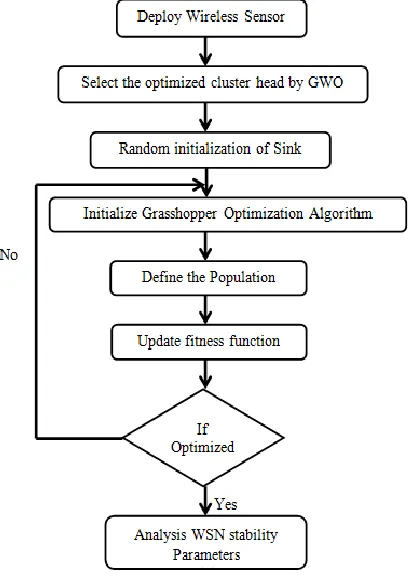
The proposed technique is based on Grasshopper Optimization algorithm which works in the following steps: I. The initial step is to deploy the WSN network where
initial parameters which in our case are the number of nodes, the network area.
3717
III. The sink is initialized randomly i.e., initial position of
the sink is selected at random.
IV. Initialization of grass hopper optimization (GOA) is done. The unique aspect of the grasshopper swarm is that the swarming behaviour is found in both nymph and adulthood and the size of the swarm varies from a single grasshopper to a continental scale.
V. Define the target population in GOA and initialize the randomly distributed population in order to start the swarming process.
VI. Then the optimization process is started and the fitness function defining social forces on the basis of distance between the grasshoppers, energy and social interaction is calculated and updated after each iteration.
VII. If the cluster size according to the sink is optimized
then next steps are started otherwise the control is returned to the Step III.
VIII. After optimization of the sink and cluster size two
steps are taken.
IX. The outputs are collected in terms of various QoS parameters i.e., Time Delay, Packet Loss, and, Throughput. In addition to this the residual energy of the nodes in the network is also calculated for checking the efficiency of the proposed scheme. The steps described above are represented in form of a flowchart in fig.1.
Fig.1: Representing the working of Grasshopper Optimization Algorithm
5. SIMULATION RESULTS AND ANALYSIS
The Simulations are performed in MATLAB and the environment stating the network scenario taken into consideration for performing simulations is as shown in the table 1 below:
Table 1: Simulation Environment
Parameters Value
Network Size 500 x 500 sq. mtr.
Nodes 100
Capacity of Queue 50 Packets Number of Maximum
retransmissions allowed 03 Node's initial energy 100 Joules
Packets Size 128 bytes
Initial Rate of Data 300 kb/s
Node's Sensing range 35 m
The Proposed routing techniques is examined in the simulation environment stated in Table 5.2 on the basis of delay, throughput, packet loss, and residual energy in comparison to Directed Diffusion, LEACH, GEAR, and Grey wolf Optimization algorithm.
GoSink is the term used to represent proposed technique and HybridGWO represents the Grey wolf optimization algorithm
Time Delay: Table 2 and Fig 2 represent the delay time occurred during data transmission using Proposed Routing Approach in comparison to Hybrid GWO, Directed Diffusion, LEACH & GEAR schemes.
Table 2: Comparison of Proposed Energy-efficient routing technique with DD, LEACH, GEAR & HybridGWO in terms
of Time Delay.
Rounds Time Delay (in Milliseconds)
DD LEACH GEAR Hybrid GWO GoSink
500 3335 5021 2061 1363 1630
1000 6670 9892 4009 2684 2115
1500 10117 12028 4721 3724 2175
2000 13190 12253 4871 4258 2218
2500 14576 12365 4909 4693 2237
3000 14838 12403 4909 4960 2255
3500 14876 12463 4909 5115 2267
4000 15026 12515 4909 5241 2281
4500 15026 12553 4909 5258 2291
5000 15026 12553 4909 5258 2299
3718
of rounds. It is noticed that DD represents highest time delay i.e., 15026ms, in comparison to all others whereas the time delay is minimum for the proposed approach i.e., GoSink which shows 2299ms which is followed by HybridGWO that shows approx. 4900ms time delay in 5000 rounds.
Packet Loss: Table 3 and Fig. 3 represent the quantity of packets lost during data transmission using Proposed Routing Approach in comparison to Hybrid GWO, Directed Diffusion, LEACH & GEAR schemes.
Table 3: Comparison of Proposed Energy-efficient routing technique with DD, LEACH, GEAR & HybridGWO in terms
of Packet Loss.
Rounds Packet Loss (in Numbers)
DD LEACH GEAR Hybrid GWO GoSink
500 17 0 0 0 0
1000 82 29 17 0 0
1500 91 90 90 0 40
2000 97 98 98 21 50
2500 97 98 99 90 56
3000 97 100 99 96 64
3500 98 100 99 97 71
4000 98 100 99 97 84
4500 100 100 99 98 97
5000 100 100 100 100 100
Fig. 3: Comparison of Proposed Energy-efficient routing technique with DD, LEACH, GEAR & HybridGWO in terms
of Packet Loss.
Figure 3 and table 3 represent the number of data packets lost during the transmission in WSN scenario given in table 1 using proposed GoSink and HybridGWO in comparison to LEACH, DD, and, GEAR for varied number of rounds. As seen in table 3 and fig. 3, the first packet loss was found in DD at the initial stage but one thing that is common for all excluding the the proposed GoSink is that the time elapsed between the first packet lost and the last packet lost is very less where in our approach the packet loss is slow and the last packet is also dropped at the end of 5000 rounds.
Throughput: Table 4 and Fig. 4 represent the throughput achieved during data transmission using Proposed Routing Approach in comparison to Hybrid GWO, Directed Diffusion, LEACH & GEAR schemes.
Table 4: Comparison of Proposed Energy-efficient routing technique with DD, LEACH, GEAR & HybridGWO in terms
of Throughput.
Rounds Throughput (in packets per second) X 104
DD LEACH GEAR Hybrid
GWO GoSink 500 0.5995 0.2435 0.2435 0.6132 0.9716 1000 1.1765 0.4833 0.3559 1.2169 1.8679 1500 1.4426 0.5658 0.3859 1.8207 2.5849 2000 1.4688 0.5807 0.3934 2.3867 2.9622 2500 1.4800 0.5920 0.4009 2.6415 3.2641 3000 1.4875 0.5920 0.4084 2.6886 3.4528 3500 1.4950 0.5920 0.4159 2.6981 3.5943 4000 1.5025 0.5920 0.4196 2.7075 3.6320 4500 1.5025 0.5920 0.4234 2.7264 3.6320 5000 1.5025 0.5920 0.4271 2.7264 3.6320
Fig. 4: Comparison of Proposed Energy-efficient routing technique with DD, LEACH, GEAR & HybridGWO in terms
of Throughput.
Figure 4 and table 4 represent the level of throughput achieved during the transmission of data in the sensor network using proposed GoSink and HybridGWO in comparison to LEACH, DD, and, GEAR for varied number of rounds. The throughput achieved using proposed GoSink routing scheme is maximum from the start itself and it keeps on increasing till the 5000 rounds. As seen in table 3 and fig. 3, the throughput for all other techniques experienced an increase during the initial phase but it becomes stable and constant by 1200 rounds only whereas the same increased for the HybridGWO till 2500 rounds before coming to a constant phase. Therefore, it can be stated that the proposed technique outperforms all other techniques in terms of all the QoS parameters considered. Residual Energy: Table 5 and Fig. 5 represent the residual energy of sensor nodes during data transmission using Proposed Routing Approach in comparison to Hybrid GWO, Directed Diffusion, LEACH & GEAR schemes.
Table 5: Comparison of Proposed Energy-efficient routing technique with DD, LEACH, GEAR & HybridGWO in terms
of Residual Energy.
Rounds Residual Energy (in Joules)
3719 500 87.35 100.00 85.25 100.00 100.00
1000 18.97 73.77 9.37 100.00 100.00 1500 8.67 10.07 1.87 100.00 59.719 2000 2.81 2.34 0.94 69.3208 50.1171 2500 2.81 0.00 0.94 9.83607 44.0281 3000 2.81 0.00 0.94 3.74707 36.0656 3500 1.87 0.00 0.94 2.8103 29.0398 4000 1.87 0.00 0.94 2.8103 20.6089 4500 0.70 0.00 0.94 0.234192 2.8103
5000 0.00 0.00 0.00 0.00 0.00
Fig. 5: Comparison of Proposed Energy-efficient routing technique with DD, LEACH, GEAR & HybridGWO in terms
of Residual Energy.
Figure 5 and table 5 represent the residual energy of the nodes in the WSN stated in table 1 using proposed GoSink and HybridGWO in comparison to LEACH, DD, and, GEAR for varied number of rounds. It can be seen in table 5 and fig. 5 that the energy of nodes decreases with the increasing number of rounds. The energy drop is very fast in case of DD, LEACH and GEAR where as HybridGWO retains the energy in the initial phase of simulation but once the residual energy of nodes start decreasing, it kept on decreasing very rapidly. The proposed GoSink in which the optimization is done using Grasshopper Optimization algorithm the residual energy is retained for the longest duration, thus extending the network lifetime and optimizing its energy efficiency.
6. CONCLUSION:
The working or operation of wireless sensor network is affected by many parameters but the major ones are the energy and QoS. This research mainly focused on to optimize energy-efficiency of the sensor networks on various QoS parameters. The quality of service depends on how effective packets reach to destination, level of throughput achieved and the time delay experienced by the data packets to reach their destination. The energy efficiency of the scheme is represented by the amount of energy retained with the nodes in directly proportion to the increasing number of rounds. The results show that the proposed optimization routing approach not only kept the network active for a longer duration i.e., till 5000 rounds also provided the required quality of service in terms of reduced packet loss, reduced time delay and increased throughput in contrast to Grey-wolf optimization and basic
routing techniques namely; Directed diffusion, LEACH and GEAR.
REFERENCES:
[1] K. Sohrabi, D. Minoli, and T. Znati, ―Introduction and Overview of Wireless Sensor Networks,‖ in Wreless Sensor Networks: Technology, Protocols and Applications, 2007, pp. 1–38.
[2] S. P. Kumar and C. Y. Chong, ―Sensor networks: Evolution, opportunities, and challenges,‖ Proceedings of the IEEE, vol. 91, no. 8, pp. 1247– 1256, 2003.
[3] W. Dargie and C. Poellabauer, ―Node Architecture,‖ in Fundamentals of wireless sensor networks: theory and practice, John Wiley & Sons, 2010, pp. 47–61.
[4] M. H. Anisi, A. H. Abdullah, and S. A. Razak, ―Energy-Efficient Data Collection in Wireless Sensor Networks,‖ Wireless Sensor Network, vol. 03, no. 10, pp. 329–333, 2011.
[5] D. Chen and P. K. Varshney, ―QoS Support in Wireless Sensor Networks: A Survey,‖ in InInternational conference on wireless networks, Vol. 233, 2004, pp. 1–7.
[6] Y. Daoyuan and W. Hailin, ―QoS-based sensing scheduling protocol for wireless sensor networks [J],‖ Journal on Communications, vol. 5, pp. 128– 134, 2010.
[7] H. M. Nimbark, ―Optimizing QoS Parameters of High Performance Computer Network Using Optimized Artificial Intelligence Algorithms,‖ 2016. [8] Y. Li, C. S. Chen, Y.-Q. Song, and Z. Wang,
―REAL-TIME QOS SUPPORT IN WIRELESS SENSOR NETWORKS: A SURVEY,‖ IFAC Proceedings Volumes, vol. 40, no. 22, pp. 373–380, 2007. [9] S. Saremi, S. Mirjalili, and A. Lewis, ―Grasshopper
Optimisation Algorithm: Theory and application,‖ Advances in Engineering Software, vol. 105, pp. 30–47, Mar. 2017.
[10] H. Mostafaei, ―Energy-Efficient Algorithm for Reliable Routing of Wireless Sensor Networks,‖ IEEE Transactions on Industrial Electronics, vol. 66, no. 7, pp. 5567–5575, Jul. 2019.
[11] M. S. Bahbahani and E. Alsusa, ―A Cooperative Clustering Protocol With Duty Cycling for Energy Harvesting Enabled Wireless Sensor Networks,‖ IEEE Transactions on Wireless Communications, vol. 17, no. 1, pp. 101–111, Jan. 2018.
[12] M. Chincoli and A. Liotta, ―Transmission Power Control in WSNs: From Deterministic to Cognitive Methods,‖ in Integration, Interconnection, and Interoperability of IoT Systems, 2018, pp. 39–57. [13] C. Hong, Y. Zhang, Z. Xiong, A. Xu, H. Chen, and
W. Ding, ―FADS : Circular/Spherical Sector based F orwarding A rea D ivision and Adaptive F orwarding A rea S election routing protocol in WSNs,‖ Ad Hoc Networks, vol. 70, pp. 121–134, Mar. 2018.
3720
[15] P. S. Mann and S. Singh, ―Energy-Efficient Hierarchical Routing for Wireless Sensor Networks: A Swarm Intelligence Approach,‖ Wireless Personal Communications, vol. 92, no. 2, pp. 785–805, Jan. 2017.
[16] H. Huang, J. Zhang, X. Zhang, B. Yi, Q. Fan, and F. Li, ―EMGR: Energy-efficient multicast geographic routing in wireless sensor networks,‖ Computer Networks, vol. 129, pp. 51–63, Dec. 2017.