Licensed under Creative Common Page 1
http://ijecm.co.uk/
ISSN 2348 0386
THE ROLE OF FORMALITY, KNOWLEDGE SHARING
CULTURE AND ICT INFRASTRUCTURE IN FACILITATING
KNOWLEDGE MANAGEMENT MEASURES
Foad Shakouri Ganjavi
MA Management of Technology
Islamic Azad University of Science and Research Branch, Iran [email protected]
Fateme Firoozi Nia
MA Public Management Islamic Azad University, Iran
Ali Reza Roohazad
MA Management Information Technology PayameNour University, Iran
Taghi Mahallati
MA Public Management Islamic Azad University, Iran
Licensed under Creative Common Page 2 Abstract
Successful implementation of knowledge management in an organization requires a comprehensive and systemic approach about different organizational factors. The fundamental prerequisite of successful implementing knowledge management is to be sure of sufficiency, coherence and consistency of these factors condition. The main objective of this study is to investigate the impact of three major organizational factors (i.e. structure formality, knowledge sharing culture and IT infrastructure) on the strategy of knowledge management in government agencies. Furthermore, the impact of these factors on the two main stages of the KM process is investigated i.e. knowledge creation and knowledge transfer. Research design used is descriptive. Population included 527 Personnel of management and administrative units of the Ministry of Labor and Social Affairs that has been conducted with a random sampling, of whom 370 people were selected. Results of data analysis by using structural equation modeling show these factors have a significant impact on knowledge creation and transfer. These results confirm the need to prepare fundamental prerequisites for the effective implementation of knowledge management in the organization. In this case, the structure with low formality, encouraging culture of knowledge sharing and sufficient IT infrastructure can increase the effectiveness of knowledge management measures.
Keywords: knowledge management, formality, knowledge sharing culture, IT infrastructure, knowledge creation, knowledge transfer.
INTRODUCTION
Licensed under Creative Common Page 3 "knowledge creation" and "knowledge transfer" are considered as two key activities of knowledge management [Wang & Ahmed, 2003]. Thus, in this study we investigate the impact of mentioned organizational factors on two major activities of KM, namely "knowledge creation" and "knowledge transfer”.
LITERATURE REVIEW
Knowledge Management
In today's competitive world, knowledge has become the strategic source of many organizations [Barney, 1991]. According to Nonaka (1194) in the current unstable conditions, the only reliable source to gain a sustainable competitive advantage is knowledge [Nonaka, 1994]. But the existence of knowledge in the organization cannot be a source of competitive advantage, but this depends on the organization's ability to effectively apply existing knowledge to create new knowledge assets and to act upon it [Alavi & Leidner, 2001] .The knowledge management has become therefore an important tasks of organizations that look for ways to benefit from this valuable capital [Monavvarian & Asgari, 2007] . Knowledge management refers to the systemic and coherent process of coordinating extensive activities including acquisition, creation, storage, sharing and applying knowledge by individuals and groups to accomplish organizational goals [Rastogi, 2000]. The impact of knowledge management projects on the overall success of the organization has been widely confirmed [Chennemaneni, 2006]. However, what factors and how they lead to success is to its success is a question that needs extended reviews. Hence the impact of various hard and soft factors on the success of management projects has been reviewed in different researches that have been conducted in the regard. In this study, the impact of structure formality rate, knowledge sharing culture and the existence of suitable IT infrastructure on the effectiveness of KM process is examined. Among the activities included in the process of knowledge management, the ability to "knowledge creation" and "knowledge transfer" have more significance [Wang & Ahmed, 2003] . Hence these two factors are studied as dependent variables.
Knowledge creation
Licensed under Creative Common Page 4 Table 1: three types of interaction between tacit and explicit knowledge
To tacit
knowledge
To explicit
knowledge
From tacit
knowledge Socialization externalization
From
explicit
knowledge
internalization Combination
Source: Nonaka & Takeuchi [1991]
The process of creating / converting knowledge is performed when these four stages are well managed. This is the advantage of team-oriented organizations. When team members share their experiences and views, the socialization will be started and new tacit knowledge will be created from tacit knowledge. In second stage, members use models and metaphors and examples to reveal their knowledge and implicit experiences. During the third stage, the combination, members process the knowledge that has obtained from two previous stages so that they combine and integrate them. Stage four, the internalization is started when individuals learn while working and the implicit knowledge is converted to tacit knowledge [Nonaka, 1994].
Knowledge Transfer
Licensed under Creative Common Page 5 knowledge and the receiver‟s ability to compensate [Gupta & Guvindarajan, 2000]. Davenport and Prusak consider the knowledge transfer as knowledge exchange between individuals and groups [Davenport, 1998].
Formality
Organizational structure reflects how the division of labor and coordination between individuals and organizational units take place for organizational affairs [Daft, 1998]. Robbins introduces three factors of formality, complexity and centralization as structural dimensions [Kalantari & Khalili, 2009]. Organizational structure can encourage or inhibit knowledge management success. Levels of centralization, formality, and how information flows between units , status of confidential documents and ... are main structural factors that their characteristics and status influence creation, transfer, storage and applying knowledge in the organization directly [Monavvarian & Kasaei, 2007].
Some scholars believe that the low centralization and formality can improve-organizational effectiveness with increasing levels of improve-organizational interactions, employee motivation and flexibility [Piercy & Cravens, 1994]. The existence of formality and centralization in decision making authority will decrease the amount of creative solutions provision. While the distribution of power in the organization causes self-motivation, empiricism and freedom of expression. These factors make infrastructure of knowledge creation and transfer. Too much formality and centralization leads to reducing independence of employees and thereby reducing the level of employee satisfaction and motivation [Bennett & Gabriel, 1999, Gold et. al, 2001].
Culture of sharing
Licensed under Creative Common Page 6 growth, the organization must develop effective knowledge sharing and encourage employees to share their knowledge with others [Bock & Kim, 2002].
ICT Infrastructure
Although, IT is just one of the enablers of knowledge management, it is considered to be the most effective tool of knowledge and information acquisition, storage, conversion and transfer and the availability of information technology tools, plays a key role in knowledge management [Wang & Ahmed, 2003]. What we mean by technology is IT tools such as hardware, software and protocols that provide the possibility to store, to code and to exchange knowledge [Monavvarian & Kasaei, 2007]. No matter what type of strategy the organization applies, this is technology that accomplishes knowledge sharing. Hence, organizations have widely invested in tools and technologies in a form of electronic systems of knowledge management [Teeni, 2001]. ICTs lead to empowerment and are considered as the most effective tools to collect, to store, to transfer and to promote knowledge[ Wang & Ahmed, 2003].IT influences KM in a various methods: Rapid collection, storage and exchange of knowledge, integration of different knowledge components and strengthening all the ways of creation, transfer, storage, and Application of Knowledge [Lee & Choi, 2003].
Theoretical framework
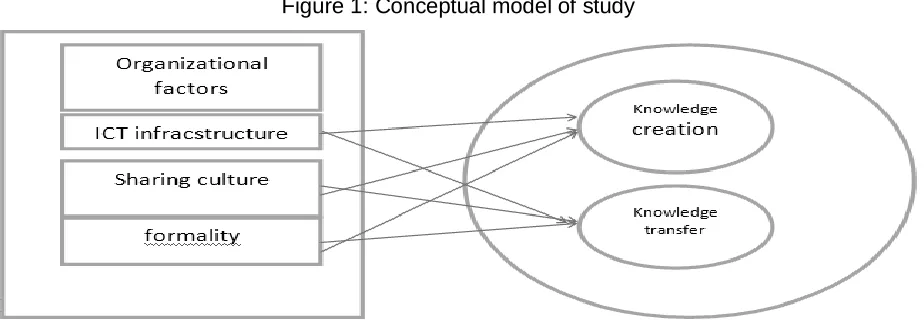
In this study, based on mentioned literature, two factors of “knowledge creation” and “knowledge transfer” have been considered as dependent variables among four-stage process of KM and three fundamental organizational factors including formality rate of organizational structure, knowledge sharing culture and suitable infrastructure of IT have been considered as independent variables that their impact on the effectiveness of the knowledge creation and transfer will be discussed. Fig. 1 indicates the conceptual model of these relations.
Licensed under Creative Common Page 7 Research Hypotheses
1) Structure formality has a reverse impact on knowledge creation in organization 2) Structure formality has a reverse impact on knowledge transfer in organization 3) Knowledge sharing culture has direct impact on knowledge creation
4) Knowledge sharing culture has direct impact on knowledge transfer 5) ICT infrastructure has direct impact on knowledge creation in organization 6) ICT infrastructure has direct impact on knowledge transfer in organization
RESEARCH METHODOLOGY
This study is an applied research based on its goal because the results of its findings are used to solve the special problems in organization. From the perspective of how data collection takes place, it is descriptive and survey because it tries to obtain required information of statistical sample status quo using questionnaire. According to time period it is cross-sectional and according to data type it is quantitative research.
Statistical sample
Population included 527 Personnel of management and administrative units of the Ministry of Labor and Social Affairs. In this study, simple random sampling is used. Based on the formula of finite population sampling, including 370 People, the numbers of population has been determined. In order to be ensured of the appropriate number of questionnaires collected, 400 questionnaires were distributed between managers and experts and at the end, 380 questionnaires were collected (10 questionnaires were excluded due to confounding).
Data collection tools
Tools to collect primary field data was a 21-item questionnaire that has been used as a Likert scale. The validity of questionnaire has been confirmed by professors and experts and, to measure its reliability, a basic sample including 30 questions was pretested and then confidence level was calculated by Cronbach‟s Alpha with the help of SPSS software and the result was 0.952. Accordingly, four questions were eliminated from first 25-item questionnaire in this stage.
Methods of data analysis
In this research, the structural equation modeling is used by means of LISREL to analyze the obtained data from samples and investigating the presence or absence of simultaneous relationship between research variables.
Licensed under Creative Common Page 8 ANALYSIS AND FINDINGS
Investigation of relationships between variables using structural equation modeling
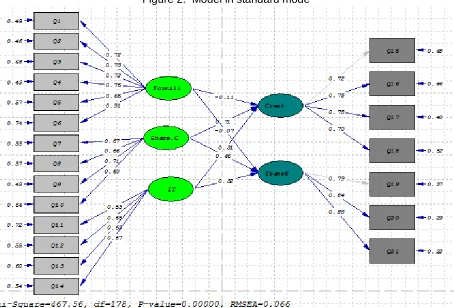
In structural model, we seek to determine the relationship between latent traits will be approved or not, that are extracted based on theory according to collected data [Robbins, 1997]. In this model, there are 21 obvious variables (survey questions) and 5 latent variables (knowledge creation, knowledge transfer, sharing culture, technology infrastructure, structure formality). Following the model, measuring the truth of model will be tested. In order to do this, special indicators will be used including: chi-two to degrees of freedom ratio that must be less than 3 (allowable value),The root mean square error of approximation that its allowable value should be less than 0.08 and adjusted goodness of fit index should be greater than 0.9. The following model refers to investigation of mentioned cases for appropriateness.
Figure 2: Model in standard mode
Licensed under Creative Common Page 9 Table 2: Goodness of fit indices
Indicators Allowable Estimated Value Results Chi-square to the degrees
of freedom ratio
2
/df<3 2.63 Goodness of fitRMSEA >0.08 RMSEA>0.05 0.066 Goodness of fit GFI Greater than 0.9 0.9 Goodness of fit AGFI Greater than 0.9 0.96 Goodness of fit CFI Greater than 0.9 0.97 Goodness of fit
Provided indices and its comparison with desirable value for fitted model shows the good fit of model. In next step, we should examine the significance of obtained numbers of model. Since we seek to test hypotheses in this research at 0.95 of confidence level, there will be significant numbers that are not between 1.96 and -1.96. This means if there is a number between 1.96 and -1.96 ,it will not be significant. In the following model (except one item of impact of formality on knowledge transfer)obtained numbers are significant and we can review their impact.
Licensed under Creative Common Page 10 Based on this Fig., the model is in good condition according to fit indices. Thus according to the model in status of significant numbers and standard estimation model, we investigate the following hypotheses.
According to Fig. 3, obtained numbers (except one item) show the significance of impact (because it is not between 1.96 and -1.96). Fig. 3 also shows that impact of structure formality on knowledge transfer is not significant but has a reverse impact on knowledge creation (a rate of -0.11). The confirmation of negative impact of formality on knowledge creation is compatible with results of previous researches [Monavvarian & Kasaei, 2007, Wang & Ahmed, 2003] but the lack of confirmation of formality impact on knowledge transfer is not compatible with previous researches [Monavvarian & Kasaei, 2007, Wang & Ahmed, 2003]. Nevertheless, some scholars consider the formality as reinforcing factor for KM measures. For example, Hansen and others (1999) know the KM strategies including strategies of codification and personalization. Codification strategies focus on the role of interpersonal interactions in knowledge creation and sharing and personalization strategies focus on knowledge storage and making it available for employees [Hansen, 2002]. Therefore, if the organization chooses the personalization strategy, structure formality (such as instructions and documentation ) can help to this strategy.
About the impact of knowledge sharing culture on knowledge creation and transfer, it can be said that according to significance of impact and obtained numbers in standard figure, knowledge sharing culture has a direct impact on knowledge creation and transfer and the amount of explanation of each is 0.71 and 0.46,respectively; this means this culture explains 0.71 of knowledge creation and 0.46 of knowledge transfer in studied population and their other changes are related to other variables that were not examined in this study. These findings are compatible with results of previous researches in this regard [Monavvarian & Kasaei, 2007, Wang & Ahmed, 2003].
Finally, regarding the impact of ICT infrastructure on knowledge creation and transfer, it can be said that his infrastructure has a direct impact both on knowledge creation and transfer (according to charts 2,3).Levels of infrastructure explanation for knowledge creation are 0.31 and 0.32 for knowledge transfer and the rest are related to other variables except ICT infrastructure. The confirmation of this positive impact has been in line with results of previous researches in this regard [Monavvarian & Kasaei, 2007, Wang & Ahmed, 2003].
Licensed under Creative Common Page 11 CONCLUSIONS AND RECOMMENDATIONS
Based on the results of data analysis, three studied factors have considerable importance in the successful implementation of knowledge management strategies in governmental organizations. Thus the recognition of these factors status will provide a strong foundation for effective knowledge management with systemic approach and coordination between them. Following recommendations can have effective results, in this regard.
From organizational factor point of view, the formality of establishing such reforms can facilitate successful implementation of KM in governmental organizations: Reducing written regulations and procedures in organization, increasing informal relationships and interactions in organization, increasing autonomy and decision making of employees about their job, reducing the emphasis on careful consideration of the approved guidelines and procedures, facilitating communication between different units of the organization.
Knowledge sharing leads employees to have access to each other„s knowledge and experiences. Hence the managers should provide the atmosphere so that employees can share their knowledge and experiences with others and be ensured simultaneously that doing this does not jeopardize their career; because most employees see knowledge as their power source. To this end, it is necessary to promote such approach among employees that "knowledge distribution is power rather than hoarding it. "To promote a culture of knowledge sharing in organizations such actions can be useful: encouraging employees to exchange their knowledge and experiences with each other, group meetings to exchange ideas, creating friendly and reliable atmosphere of employees, group discussion to decide in specific cases, increasing interaction between managers and employees, facilitating their access to information about their career, increasing interactions among the employees who work together.
Licensed under Creative Common Page 12 LIMITATIONS
1) To study the variables the survey (questionnaire tools) has been used; while it was better to use observation and/or interview for some factors. The questionnaire is a tool by which the understandings and attitude of any person is investigated; whereas, the reality might be different with respondent`s answers.
2) There are two issues must be considered regarding the nature and generalization of the research: firstly, there might be some practical behaviors like other survey researches that are mostly dependent on environmental conditions. Furthermore, intervening variables might affect the supposed relations among variables that are considered in this study.
3) Some other important limitations to this research include: reluctance of some of the respondents to answer the questionnaires, not enough carefulness of some of the respondents in answering the questions, the possibility of bias in answering the questions by some of the respondents.
REFERENCES
Alavi, M., and Leidner, DE (2001). "Review: Knowledge Management and Knowledge Management Systems: Conceptual Foundations and Research Issues, " MIS Quarterly (25:1), in 2001, pp..107-136 (in Persian).
Barney, J. (1991). "Firm Resources and Sustained competitive Advantage, "Journal of Management, (17:1), one thousand nine hundred and ninety-one, pp.. 99-120
Bennett, R. Gabriel, H. (1999) " Organizational factors and knowledge management marketing large Whiten Departments: An empirical study ", Vol. 3, no. 3, pp: 212-225.
Bock, GW, and Kim, YG (2002). "Breaking the Myths of Rewards: An exploratory Study of Attitudes about Knowledge Sharing, "Information Resource Management Journal (15:2), 2002, pp.. 14-21
Bose, R. (2004), "Knowledge management metrics", Industrial Management & Data Systems, Vol. 104 No. 6, pp. 457-68.
Chennemaneni, A. (2006), Determinants of knowledge sharing behavior: Developing and testing a theoretical model ,, The University of Texas.
1 Daft, R. (1998). Theory and organization design, translated by Parsaiian Ali and Arabi, Muhammad, Tehran, Office of Cultural Research, 1998.
2 Davenport, TH, and It refers, L. (1998). "Working Knowledge: How Organizations Manage What They Know, "Harvard Business School Press, Boston.
Kalantari,Khalil, (2009) , " Structural equation model in social- economic studies " consulting engineers and landscape publications (in Persian).
Robbins, Stephen (1997). Organization Theory : Structure, Design, Applications , translated by AlvaniS.Mehdi and Danaii ,Hasan, , Tehran, Saffar publication, 1997 (in Persian).
Gold, Malhotra A. & Segar AH AH (2001) " knowledge management: An Organizational Capabilities perspectives ", Journal of management information systems, Vol. 18, No. 1, pp: 185-214
Licensed under Creative Common Page 13 Steel, "Sloan Management Review (42:1), in 2000, pp. 71-80.
Hansen, MT (2002). "Knowledge networks, Explaining effective knowledge sharing in Multiunit companies," Organization Science, 2002, 13: 232-248.
Lee, H. & Choi, B. (2003). 'Knowledge management Enablers, processes, and organizational performance: An Integrative view and empirical examination' , Journal of Management information Systems, (20:1), 2003 pp.. 179-228
Monavarian, Abbas, Asgari, Naser, (2007). contextual and structural dimensions of knowledge-based organizations , Tehran,1st national conference of KM, 2007 (in Persian).
Monavvarian, A., Kasaei, M., A (2007). KM model for public administration: the case of Labour Ministry , The journal of information and knowledge management systems, Vol. 37 No. 3, 2007, pp. 348-367 Nonaka, I. & Takeuchi, H. (1995). "The Knowledge Creating Company: How Japanese Companies Create the Dynamics of Innovation ". New York: Oxford University Press, 1995.gold, AH
Nonaka, I. (1994). "A dynamic theory of organizational knowledge creation , "Organization Science, (5:1), pp.. 134-139.
Piercy, N., Cravens , D., (1994), "The network paradigm and the marketing organization ", European Journal of Marketing, Vol. 29, no, 3, pp: 7-34.
Rastogi, PN (2000) "Knowledge management & intellectual capital-The new Virtuous reality of Competitiveness ". Human Systems Management, Vol. 9, no, 1, pp: 39-49.
Te'eni, D. (2001). "A Cognitive-Affective Model of Organizational Communication for Designing IT , "MIS Quarterly (25:2), June in 2001, pp. 251-312.
Wang , c. and Ahmed, p0, (2003), " Structural dimensions for knowledge based Organizations ", business measures Excellence, Vol. 7, No. 1, pp. 51-62