Neuropsychiatric Disease and Treatment 2018:14 2923–2930
Neuropsychiatric Disease and Treatment
Dove
press
submit your manuscript | www.dovepress.com 2923
O r i g i N a l r e s e a r c h
open access to scientific and medical research
Open access Full Text article
structural equation modeling analysis of social
support, coping strategies, depression and suicidal
ideation among people living with hiV/aiDs
in changsha, china
Xun Tang1
hui-Ying Wang1
Min Wang2
Xiao-hua ren3
Fu-rong Jiang1
Jian-ling li1,3
1clinical Psychology Department of
Xiangya hospital, Xiangya Medical school, central south University, changsha, china; 2Department of
hiV, The First hospital of changsha, changsha, china; 3Traning Department
of Xiangya hospital, central south University, changsha, china
Introduction: People living with HIV/AIDS (PLWHA) have a higher rate of suicide compared
to the general population. Psychosocial factors closely correlate with suicidal ideation and it is essential to explain the relationships between related factors among PLWHA.
Objectives: To establish a structural equation model and examine direct and indirect effects of social support, coping strategy, depression symptoms and suicidal ideation among PLWHA.
Patients and methods: A total of 504 PLWHA completed a set of questionnaires in the HIV
clinic of Changsha Infectious Disease Hospital between December 2015 and January 2016.
Results: Among the 504 respondents, a total of 27.2% (n=137) had experienced suicidal ide-ation in their lifetime. The goodness of fit for the two structural equide-ations model was highly satisfactory. Depression symptoms had a significant direct impact on suicidal ideation (β1=0.401,
β2=0.422), while problem-focused coping (β=-0.067), emotion-focused coping (β=-0.081) and
social support (β=-0.137) had a significant indirect effect with suicidal ideation via depression symptoms. Factors of total effects were ranked from large to small as follows: depression, social support, emotion-focused coping and problem-focused coping.
Conclusion: Findings provide more understanding of direct and indirect associations between variables, suggesting that depression screening services, and the strengthening of social support and psychological care services among PLWHA can potentially prevent suicide.
Keywords: SEM, PLWHA, depression, problem-focused coping, emotion-focused coping
Introduction
Suicidal ideation is considered as the explicit desire for killing oneself.1 People living
with HIV/AIDS (PLWHA) have an elevated rate of suicide and accounts for twice mortality rates compared to the general population, based on a national cohort in
England and Wales between 1997 and 2012.2 The rate of suicidal ideation in newly
diagnosed PLWHA is high up to 27.5% in Changsha and 12.4% of those with lifetime
suicidal ideation attempt suicide,3 which may lead to irreversible loss of life.
Psychosocial factors such as low social support, negative coping strategies and
psychological status are closely related with suicidal ideation among PLWHA.4,5 A
con-siderable amount of research showed that PLWHA had low social support worldwide which was an independent risk factor for suicidal ideation. Adequate social support could moderate the impact of stress, whereas poor social support can adversely
influ-ence psychological condition.3,6,7
correspondence: Jian-ling li clinical Psychology Department of Xiangya hospital, Xiangya Medical school, central south University, 87 Xiangya road, Kaifu District, changsha 410008, hunan, china
Tel +86 138 7497 2690 email [email protected]
Journal name: Neuropsychiatric Disease and Treatment Article Designation: Original Research
Year: 2018 Volume: 14
Running head verso: Tang et al
Running head recto: SEM analysis of psychological factors among PLWHA DOI: 177460
Neuropsychiatric Disease and Treatment downloaded from https://www.dovepress.com/ by 118.70.13.36 on 25-Aug-2020
For personal use only.
Dovepress
Tang et al
Coping refers to cognitive and behavioral efforts made to
deal with stress.8 PLWHA might take the following coping
strategies including denial, concealment of their health status from others, isolation from others and crying after learning the diagnosis of HIV infection to cope with the impact of
stressors.9 Previous researches reported that there are two
major coping strategies that have a significant association with less depression: emotion-focused coping (to regulate distressing moods) and problem-focused coping (to solve the
troublesome situation).10 Moreover, emotion-focused coping
reduces depression if social support is available to PLWHA;
however, if people with poor social support,11,12 emotional
coping aggravates depression.
Depression is a typical mental disorder which increases the risk of suicide ideation and suicide attempt among
PLWHA.13 Only limited literature showed the direct and
indirect relationship between the factors among PLWHA, especially the relationship between social support and coping strategies in regard to suicidal ideation.
The purpose of this research was to establish a structural equation model (SEM) and examine the direct and indirect effects of social support, coping strategies, depression symptoms and suicidal ideation among PLWHA. SEM allows for dealing with complicated relationships between multiple factors which can provide theory-based models for understanding interrelationships between these factors. According to previous studies, we hypothesized the follow-ing: 1) social support has a direct impact on problem-focused coping and depression; 2) problem-focused coping might play a mediating role between social support and depres-sion and suicidal ideation; 3) problem-focused coping, emotion-focused coping and depression have a direct impact on suicidal ideation, with depression possibly playing an intermediary role between coping strategies and suicidal ideation.
Methods
study population
This cross-sectional design was used to study and 504 PLWHA who visited the HIV clinic in the Changsha Infec-tious Disease Hospital, China, were enrolled for the survey between December 2015 and January 2016. Participants who were recruited fulfilled the following inclusion criteria: 1) confirmed diagnosis of HIV-positive status by Centers for Disease Control of Hunan Province and 2) registered resident of Changsha. Meanwhile, cases who were unable to communicate were excluded. All eligible patients received anonymous questionnaires through face-to-face interviews by trained interviewers.
Measurements
Suicidal ideation was assessed by the Chinese version of the Beck Scale for Suicide ideation which included 19 items in two domains: the intensity of suicidal attitudes and suicidal tendency. Each item assessed for symptoms at two periods of time: in the preceding week and at the most depressive moments and was rated on a 3-point scale ranging from 0 to 2 (no ideation to strong ideation). The scale was well validated
in China (Cronbach’s α=0.87 for the most depressive
moments/Cronbach’s α=0.68 for the preceding week).14
Any respondents would be recognized as having suicidal ideation if their answers were “a little bit” or “medium to strong” to item 4 “How about your willingness to commit suicide?” or item 5 “To what extent would you end your life passively?” if not, they did not continue to finish the following 14 items.
Depression was assessed using the 20-item Zung Self-Rating Depression Scale (SDS). The instruments were proved
with good validity and reliability in China15 and were scored
on a four-point Likert scale from 1 to 4 (“Seldom [1],” “Sometimes [2],” “Usually [3],” “Always [4]”). Some items were reversely scored. The standard score equaled the total raw score timing 1.25 (ranging from 25 to 100), with a higher score indicating severe symptomatology. Cut points were used to determine the status. Participants had the
stan-dard score .53 for SDS manifested positive symptoms of
depression.
Coping strategy was assessed using a simplified
cop-ing style questionnaire (SCSQ) with a Cronbach’s α=0.90
in China.15 The questionnaire measured the ways how the
participants dealt with negative life events which consisted of five dimensions: emotion-focused coping (active and passive), problem-focused coping (active and passive) and
psychological counseling.16 Twenty items were rated on a
four-point Likert scale from 0 to 3.
Social support rate scale (SSRS) was implemented to assess social support states of participants and had been well validated in suicide-related research in China with a
Cronbach’s α=0.762.17 The subscales included subjective
support, objective support and availability of support. Higher total score indicated better social support. The norm score for
this scale in the Chinese population was 44.38±8.38.
HIV/AIDS-related information was also assessed. Par-ticipants were asked how long they had been diagnosed with HIV infection and whether their spouses or sexual partners had HIV infection. In addition, the clinical information, including CD4 cell count, viral load and treatment regimen, was switch from medical records with the patients’ and physicians’ permission.
Neuropsychiatric Disease and Treatment downloaded from https://www.dovepress.com/ by 118.70.13.36 on 25-Aug-2020
Dovepress seM analysis of psychological factors among PlWha
Sociodemographic characteristics, including gender, edu-cation level, marital status and monthly average income, were self-reported through a questionnaire. Sexual orientation and self-perceived health status were obtained via interview. Fur-thermore, they were asked if they ever committed suicide.
Ethical considerations: This research was approved by the Human Research Ethics Committee of Xiangya Hospital Central South University. A written informed consent was acquired from all participating adults and legal guardians of each participant under the age of 18 years. We kept the content of this research completely confidential, and the data were kept in the file cabinet of the locked project office or in the computer with password protection. The answer was not seen by anyone other than the staff of the survey. We also contacted each of the family members of the study and identified emergency contacts and reported to doctors and security departments especially for the patients who had strong suicidal ideation to ensure safety.
statistical analysis
Data were analyzed using SPSS 22.0 and SEM analysis was run using AMOS 22.0. Descriptive statistics were used to describe the sample characteristics. The correlation among factors associated with suicidal ideation was conducted using bivariate Pearson correlation analysis, which was prepared for building model. And then the relationship of model fitting among factors for suicidal ideation was analyzed using SEM.
structural equation model
All missing values of factors (less than 5% of data) associated with suicidal ideation were replaced by series mean method using SPSS 22.0 before starting the analysis. According to the results of bivariate Pearson correlation analysis and previous studies, we decided to set a path analysis with mixed variables including two exogenous latent variable (social support and suicidal ideation) and two endogenous observation variable (coping strategies and depression).
Results
sample characteristics
We interviewed 545 eligible patients and 41 of them could not complete the questionnaires, giving an overall response rate of 92.5%. The data were summarized in Table 1. The median age of 504 patients was 32 (range: 9–72) and the ratio of male to female was about 4:1. More than half (55%) were heterosexual and 12.1% reported their lovers/spouses suffered from HIV infection. The median of CD4 cell count
was 369/μL (P25=317, P75=401).
Table 1 Demographic characteristics, clinical characteristics and psychological factors with suicidal ideation of hiV/aiDs patients
Total, n (%) Suicidal ideation, n (%) Demographic characteristics
gender
Female 95 (18.8) 17 (17.9)
Male 409 (81.2) 120 (29.3)
age (years)
#32 252 (50.0) 80 (31.7)
.32 252 (50.0) 57 (22.6)
Nationality
han 479 (95%) 129 (26.9)
Non-han 20 (5.0) 7 (35)
Missing 5 (1.0)
Marital status
Unmarried 216 (42.9) 69 (31.9)
Married 220 (43.7) 48 (21.8)
Divorced 52 (10.3) 15 (28.8)
Widowed 13 (2.6) 4 (30.8)
Missing 3 (0.5)
sexual orientation
homosexual 126 (25.0) 50 (39.7)
heterosexual 277 (55.0) 66 (23.8)
Bisexual 50 (9.9) 11 (22.0)
education
senior or lower 296 (58.7) 70 (23.6)
college or higher 191 (37.9) 64 (33.5)
Missing 17 (3.4)
Monthly income (rMB)
,4,000 376 (73.8) 107 (28.5)
$4,000 112 (22.2) 27 (24.1)
Missing 16 (3.2)
Clinical characteristics
course
#1 year 233 (46.2) 65 (27.9)
.1 year 271 (53.8) 51 (26.7)
cD4 count
,500 231 (45.8) 65 (28.1)
$500 74 (14.7) 16 (21.6)
Viral load
No 146 (29.0) 44 (30.1)
Yes 177 (35.1) 46 (26.0)
complications
No 270 (53.6) 81 (30.0)
Yes 144 (28.6) 30 (20.8)
Treatment changed
No 301 (59.7) 85 (28.2)
Yes 38 (7.5) 13 (34.2)
state of health
Well 268 (53.2) 71 (26.5)
general 172 (34.1) 51 (29.7)
Poor 27 (5.4) 8 (29.6)
Missing 37 (7.3)
suicidal ideation
Among the 504 participants, a total of 27.2% (n=137) had
experienced suicidal ideation in their lifetime, 13.9% (n=70)
had suicidal ideation in the last week and 26.6% (n=134)
were at the most depressive moments.
Neuropsychiatric Disease and Treatment downloaded from https://www.dovepress.com/ by 118.70.13.36 on 25-Aug-2020
Dovepress
Tang et al
Table 2
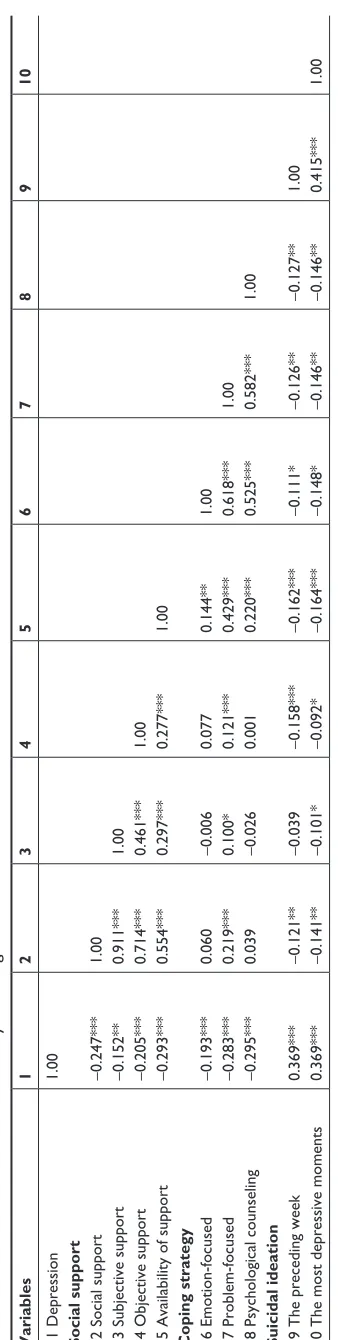
Bivariate Pearson correlation analysis among variables associated with suicidal ideation
Variables
1
2
3
4
5
6
7
8
9
10
1 Depression Social support 2
social support
3
subjective support
4 Objective support 5
a
vailability of support
Coping strategy 6
emotion-focused
7 Problem-focused 8 Psychological counseling Suicidal ideation 9 The preceding week 10 The most depressive moments 1.00 -0.247*** -0.152** -0.205*** 0.293***- -0.193*** -0.283*** -0.295*** 0.369*** 0.369*** 1.00 0.911*** 0.714*** 0.554*** 0.060 0.219*** 0.039 -0.121** -0.141**
1.00 0.461*** 0.297*** -0.006 0.100* -0.026 -0.039 -0.101*
1.00 0.277*** 0.077 0.121*** 0.001 -0.158*** -0.092*
1.00 0.144** 0.429*** 0.220*** -0.162*** -0.164***
1.00 0.618*** 0.525*** -0.111* -0.148*
1.00 0.582*** -0.126** -0.146**
1.00 -0.127** -0.146**
1.00 0.415***
1.00
Notes:
Two-tailed *0.01
,
P
#
0.05; **
P
,
0.01; ***
P
,
0.001.
correlation analysis
Bivariate Pearson correlation analysis showed that emotion-focused coping and psychological counseling were not related to social support. As displayed in Table 2, the remain-ing variables were significantly correlated. We considered that emotion-focused coping and suicide ideation are closely related. Therefore, we divided two types of coping style into two separated models that one consisted of social support, problem-focused coping, depressive symptom and suicidal ideation, and the other one just included emotion-focused coping, depressive symptom and suicidal ideation without social support.
structural equation model
Model testingSince the data collected by the survey did not satisfy multiple normal distribution, two estimation methods were conducted to examine the hypotheses. Maximum likelihood and gener-ally weighted squares methods were conducted to examine the hypotheses and indicated that the theoretical model met well with the variables demonstrating a good fit. As shown in
Table 3, unstandardized (B) and standardized regression (β)
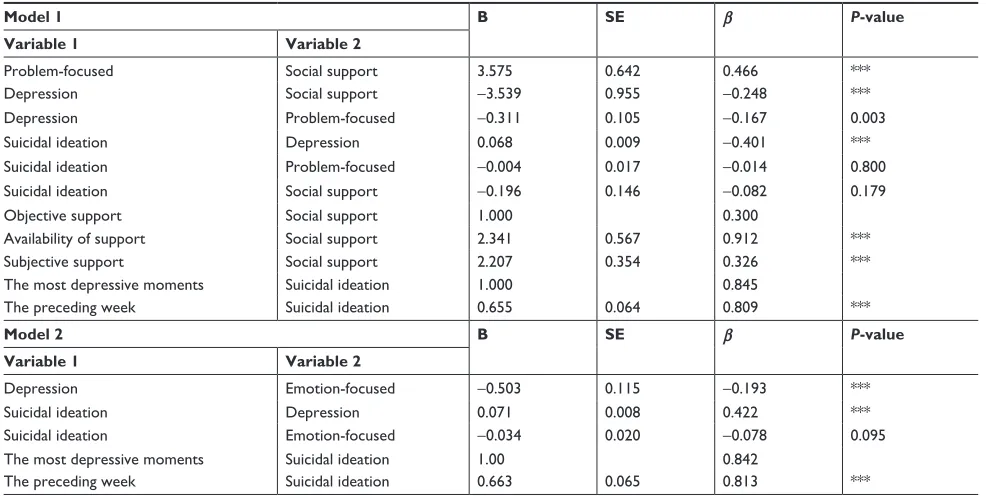
coefficients, along with the standard errors and P-values for B are reported in Table 4. Bootstrap method would be used to examine the mediating effects. As displayed in Table 4, the final models were determined (Figures 1 and 2).
Direct and indirect effects of factors affecting suicidal ideation
Standardized direct and indirect effects are reported in Table 5. Depression symptom directly affected suicidal
ide-ation (β1=0.401, bootstrap 95% CI 0.294, 0.511, β2=0.422,
bootstrap 95% CI=0.323, 0.511) during both models.
Problem-focused coping had an indirect effect (β=-0.067,
bootstrap 95% CI=-0.117, -0.001) with suicidal ideation
via depression symptom and emotion-focused coping had an
indirect effect (β=-0.081, bootstrap 95% CI=-0.130, -0.036)
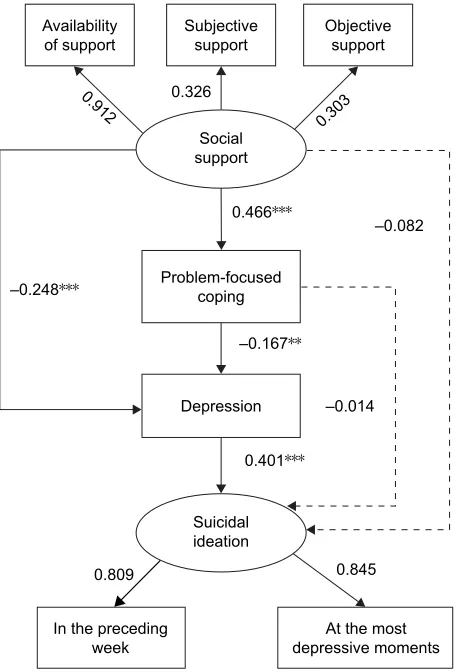
manifesting a statistical mediation. Social support could directly influence the depression symptoms but could also be indirectly through problem-focused coping to depression
symptoms and the value of total effects was (β=-0.137,
bootstrap 95% CI=-0.223, -0.075) suggesting a statistical
mediation between social support and suicidal ideation. Depression had the greatest direct effect on suicidal ideation and partly mediated the association of social support with suicidal ideation. Additionally, social support had the second greatest total effect on suicidal ideation with both a direct effect and indirect effect through problem-focused coping
Neuropsychiatric Disease and Treatment downloaded from https://www.dovepress.com/ by 118.70.13.36 on 25-Aug-2020
Dovepress seM analysis of psychological factors among PlWha
and depression. During the process of analysis, the observa-tion variables of social support, problem-focused coping and emotion did not load significantly onto the latent variable of
suicidal ideation (P.0.05).
Discussion
The main purpose of this study is to explore the relationship between suicidal ideation and its three influencing factors among PLWHA and the difference between different coping strategies using SEM. Only few such studies have been done for this population so far. The data analysis methods used for socio-psychological factors of suicidal ideation include multifactor logistic regression analysis and Path analysis. The drawback is that these methods cannot handle multiple dependent variables or estimate factor structures and factor relationships simultaneously and cannot estimate the fit of the entire model. In comparison, SEM can compensate for these flaws. Therefore, we developed models using SEM.
The annual incidence of suicidal ideation among college
students in China was 6.76%.18 The incidence of suicidal
ideation among adolescents aged 11–16 years old was
17.4%.19 The incidence of suicidal ideation in rural elderly
over 60 years old was 5.6%.20 In contrast, the detection rate
of lifelong suicide ideation in AIDS patients in Changsha was higher, which deserves social attention.
Our findings showed that depression symptoms had sig-nificant direct associations with suicidal ideation. Depression has a positive effect on suicidal ideation among PLWHA, and the effect size was the largest among the psychological fac-tors, which is consistent with previous research among college
students and which also proved to be applicable to PLWHA.21
The social support and coping strategies could indirectly influence suicidal ideation by depression which confirmed the importance of depression on suicidal ideation.
Social support was second only to the effect size of depression on suicidal ideation. Model 1 shows that social
Table 3 Effects of structural equation model fitting
Estimation methods χ2/df P-value GFI AGFI RMSEA NFI CFI
reference standard ,3 0.05 .0.9 .0.9 ,0.05 .0.9 .0.9
Maximum likelihood (model 1) 1.638 0.108 0.993 0.974 0.036 0.983 0.993
Maximum likelihood (model 2) 0.952 0.329 0.999 0.990 0.000 0.998 1.000
generally weighted squares (model 1) 1.652 0.105 0.992 0.973 0.036 0.962 0.984
generally weighted squares (model 2) 0.949 0.330 0.999 0.990 0.000 0.995 1.000
Table 4 Standardized regression coefficients and standard errors for all pathways of the ML SEM model fitting (N=504)
Model 1 B SE β P-value
Variable 1 Variable 2
Problem-focused social support 3.575 0.642 0.466 ***
Depression social support -3.539 0.955 -0.248 ***
Depression Problem-focused -0.311 0.105 -0.167 0.003
suicidal ideation Depression 0.068 0.009 -0.401 ***
suicidal ideation Problem-focused -0.004 0.017 -0.014 0.800
suicidal ideation social support -0.196 0.146 -0.082 0.179
Objective support social support 1.000 0.300
availability of support social support 2.341 0.567 0.912 ***
subjective support social support 2.207 0.354 0.326 ***
The most depressive moments suicidal ideation 1.000 0.845
The preceding week suicidal ideation 0.655 0.064 0.809 ***
Model 2 B SE β P-value
Variable 1 Variable 2
Depression emotion-focused -0.503 0.115 -0.193 ***
suicidal ideation Depression 0.071 0.008 0.422 ***
suicidal ideation emotion-focused -0.034 0.020 -0.078 0.095
The most depressive moments suicidal ideation 1.00 0.842
The preceding week suicidal ideation 0.663 0.065 0.813 ***
Note: Two-tailed ***P,0.001.
Neuropsychiatric Disease and Treatment downloaded from https://www.dovepress.com/ by 118.70.13.36 on 25-Aug-2020
Dovepress
Tang et al
support indirectly influences suicidal ideation through depression symptoms via two paths. First, social support can have a direct impact on problem-focused coping, which in turn has a direct impact on depression and hence ultimately influences suicidal ideation. Additionally, social support can directly affect depression, which again, in turn, influences suicidal ideation. Availability of support has the largest loading of the three observed variables of social support. For PLWHA, family members and friends are the main sources of social support. However, they typically do not seek support and even conceal the disease from them. This unwillingness to reach out for social support might be caused by the fear of being abandoned and being discriminated which make them unwilling to seek social support and even conceal the
disease.22 This unwillingness to reach out for social
sup-port might be caused by the fear of being abandoned and discriminated. Social support, a protective factor conducive to a positive response and mood improvement, enhances the faith in survival and strengths the will to survive.
Problem-focused coping and emotion-focused coping indicating indirect effects on suicidal ideation have negative
associations with effects on depression symptoms, where emotional attention scores are significantly different from
issues of concern (t=-28.849, P,0.05). This difference
might be related to the particular reality of AIDS, includ-ing infectivity, nonspecific drug treatment and HIV stigma
which could mediate self-efficacy.23 The patients may deal
with stress by actively changing the perception of events rather than using social support coping. But in our study, we find that emotion-focused coping is not influenced by social support among PLWHA, as opposed to problem-focused cop-ing. Hence, emotion-focused coping may play a significant role in diminishing PLWHA’s suicidal ideation by reducing depression when they do not perceive a high level of social support from others. Problem-focused coping and emotion-focused coping cannot directly affect the suicidal ideation, we guess that coping strategies and suicidal ideation have an adverse correlation, only when the coping level reaches to a certain extent can improve the mood and in turn to reduce suicidal ideation.
There were several limitations to this study. This con-secutive sample in the HIV clinic of Changsha may not represent other PLWHA in China. A cross-sectional data cannot explain the causal relationship between variables. In future studies, longitudinal data are needed to conduct
$YDLODELOLW\ RIVXSSRUW
6XEMHFWLYH VXSSRUW
±
±
±
,QWKHSUHFHGLQJ
ZHHN GHSUHVVLYHPRPHQWV$WWKHPRVW
±
6RFLDO
VXSSRUW
3UREOHPIRFXVHG FRSLQJ
'HSUHVVLRQ
6XLFLGDO LGHDWLRQ
2EMHFWLYH VXSSRUW
Figure 1 structural equation model testing the direct and indirect relationships among social support, problem-focused coping, depression and suicidal ideation.
Note: Two-tailed **P,0.01; ***P,0.001.
± ±
,QWKHSUHFHGLQJ
ZHHN GHSUHVVLYHPRPHQWV$WWKHPRVW
6XLFLGDO LGHDWLRQ (PRWLRQIRFXVHG
FRSLQJ
'HSUHVVLRQ
Figure 2 structural equation model testing the direct and indirect relationships among emotion-focused coping, depression and suicidal ideation.
Note: Two-tailed ***P,0.001.
Neuropsychiatric Disease and Treatment downloaded from https://www.dovepress.com/ by 118.70.13.36 on 25-Aug-2020
Dovepress seM analysis of psychological factors among PlWha
the temporal analysis. Additionally, the models should be interpreted with caution because the measurement of suicidal ideation was zero-inflated, which may increase the risk of type II error. Despite limitations, our model still provided a good fit to data, interpreting the mechanism of the forma-tion of suicidal ideaforma-tion among PLWHA preliminarily. This research highlights the importance of depressive symptoms to the direct effects of suicidal ideation, suggesting that strengthening depression screening and troubleshooting timely is necessary. Meanwhile, using emotion-focused coping strategies may be the easier and more effective way when facing complicated environment. Last but not the least, enhancing information and emotional support and providing psychological care services can intervene in suicide ideation among people living with HIV effectively.
Acknowledgment
This work was supported by Xiangya – UCLA AIDS Related Behavior Research Project, China (UX2015-2).
Disclosure
The authors report no conflicts of interest in this work.
References
1. Xiao S, Zhou L, Xu H. Crisis intervention and suicide prevention (Two): The definition and classification of suicidal behaviors. J Clin Psych. 2005;5:298–299. Chinese.
2. Croxford S, Kitching A, Desai S, et al. Mortality and causes of death in people diagnosed with HIV in the era of highly active antiretroviral therapy compared with the general population: an analysis of a national observational cohort. Lancet Public Health. 2017;2(1):e35–e46. 3. Liu Y, Niu L, Wang M, Chen X, Xiao S, Luo D. Suicidal behaviors
among newly diagnosed people living with HIV in Changsha, China.
AIDS Care. 2017;29(11):1359–1363.
4. Kang CR, Bang JH, Cho SI, et al. Suicidal ideation and suicide attempts among human immunodeficiency virus-infected adults: differences in risk factors and their implications. AIDS Care. 2016;28(3):306–313. 5. Lewis JV, Abramowitz S, Koenig LJ, Chandwani S, Orban L. Negative
life events and depression in adolescents with HIV: a stress and coping analysis. AIDS Care. 2015;27(10):1265–1274.
6. Bitew H, Andargie G, Tadesse A, Belete A, Fekadu W, Mekonen T. Suicidal Ideation, Attempt, and Determining Factors among HIV/AIDS Patients, Ethiopia. Depress Res Treat. 2016;2016:8913160.
7. Rukundo GZ, Mishara BL, Kinyanda E. Burden of Suicidal Ideation and Attempt among Persons Living with HIV and AIDS in Semiurban Uganda. AIDS Res Treat. 2016;2016:3015468.
8. Folkman S, Lazarus RS. An analysis of coping in a middle-aged com-munity sample. J Health Soc Behav. 1980;21(3):219–239.
9. Hackl KL, Somlai AM, Kelly JA, Kalichman SC. Women living with HIV/AIDS: the dual challenge of being a patient and caregiver. Health
Soc Work. 1997;22(1):53–62.
10. Folkman S, Lazarus RS. If it changes it must be a process: study of emotion and coping during three stages of a college examination.
J Pers Soc Psychol. 1985;48(1):150–170.
11. Chan I, Au A, Li P, Chung R, Lee MP, Yu P. Illness-related factors, stress and coping strategies in relation to psychological distress in HIV-infected persons in Hong Kong. AIDS Care. 2006;18(8):977–982. 12. Noh S, Kaspar V. Perceived discrimination and depression: moderating
effects of coping, acculturation, and ethnic support. Am J Public Health. 2003;93(2):232–238.
13. Niu L, Luo D, Liu Y, Silenzio VM, Xiao S. The Mental Health of People Living with HIV in China, 1998–2014: A Systematic Review.
PLoS One. 2016;11(4):e0153489.
14. Li X, Philips M, Tong Y, et al. Reliability and validity of the Chinese version of Beck Suicide Ideation Scale (BSI-cv) in adult community residents. Chin Mental Health J. 2010;4:250–255. Chinese.
15. Wang X, Wang X, Ma H. Mental Health Assessment Scale. (Revised Ed). Beijing: Mental Health Journal Publishing House; 1999;194–197: 247–250.
16. Wang R. Factor analysis and application of the Simplified Coping Style
Questionnaire [master’s thesis]. Jinan: Shandong University; 2014.
17. Xiao S. The theory basis and application of the social support rating scale. J Clin Psych. 1994;2:98–100. Chinese.
18. Li Y, Lei X, Zhang D, Liu L, Tang S. Determinant Factors of Suicidal Ideation among College Students: a Meta-analysis. Chin J Clin Psych. 2014;4:638667–640. Chinese.
19. Qin R, Zhao Y, Fang L, Yu M. Prevalence and related factors of suicidal ideation in adolescents from China and Philippine. Chin Ment Health J. 2015;3:193–198. Chinese.
20. He J, Tian Y, Hu M, Xiao S, Zhou L. Association between loneliness and suicidal ideation among rural elderly. Chin Mental Health J. 2014;8: 618–622. Chinese.
21. Bantjes JR, Kagee A, McGowan T, Steel H. Symptoms of posttraumatic stress, depression, and anxiety as predictors of suicidal ideation among South African university students. J Am Coll Health. 2016;64(6): 429–437.
22. Yu M. Research Progress on the disclosure of the diagnosis and Related Social Support of AIDS Patients in the World. Chin J Nurs. 2008;2: 159–161. Chinese.
23. Li X, Huang L, Wang H, Fennie KP, He G, Williams AB. Stigma mediates the relationship between self-efficacy, medication adherence, and quality of life among people living with HIV/AIDS in China. AIDS
Patient Care STDS. 2011;25(11):665–671.
Table 5 standardized direct, indirect and total effects of all study variables on suicidal ideation
Variables Direct effect
β (95% CI)
Indirect effect β (95% CI)
Total effect β (95% CI)
Depression (model 1) Problem-focused social support emotion-focused Depression (model 2)
0.401 (0.294, 0.511) –
– –
0.422 (0.323, 0.511)
–
-0.067 (-0.117, -0.001)
-0.137 (-0.223, -0.075)
-0.081 (-0.130, -0.036) –
0.401 (0.294, 0.511)
-0.067 (-0.117, -0.001)
-0.137 (-0.223, -0.075)
-0.081 (-0.130, -0.036) 0.422 (0.323, 0.511)
Neuropsychiatric Disease and Treatment downloaded from https://www.dovepress.com/ by 118.70.13.36 on 25-Aug-2020
Neuropsychiatric Disease and Treatment
Publish your work in this journal
Submit your manuscript here: http://www.dovepress.com/neuropsychiatric-disease-and-treatment-journal Neuropsychiatric Disease and Treatment is an international,
peer-reviewed journal of clinical therapeutics and pharmacology focusing on concise rapid reporting of clinical or pre-clinical studies on a range of neuropsychiatric and neurological disorders. This journal is indexed on PubMed Central, the ‘PsycINFO’ database and CAS,
and is the official journal of The International Neuropsychiatric Association (INA). The manuscript management system is completely online and includes a very quick and fair peer-review system, which is all easy to use. Visit http://www.dovepress.com/testimonials.php to read real quotes from published authors.
Dovepress
Dove
press
Tang et al
Neuropsychiatric Disease and Treatment downloaded from https://www.dovepress.com/ by 118.70.13.36 on 25-Aug-2020