Abstract
PART 1
A Warm-Up Scan of Behavior Page Preface
1. Why to Pretend Value Free Behavior 1 2. Self Its Kernel and Environment 8
3. On Motivation Shortly 12
4. Individual and Environment 14 5. Beliefs and Facts, Images and Coping Behavior 22 6. Demographic, and Experiential Backgrounds 25
7. A Couple of Complexity 29
PART 2
An Exercise Scan of Behavior
8. Why to Mind About Mind-Body Problem? 34
9. Mind is Developing 38
10. Problem Solving as a Means of Mindy Dynamic 53 11. Modeling Growth Processes of Mindamic 55 12. Background, Croupier, Mental Shape, Mindy,
And Configuration 59
13. Transitional Processes 69
17. How to Deal With Incomplete Information 84 18. Individual And Dyadic Mindamic 88 19. Inner Guided and Outer Guided Persons 92 20. Mindamic Between Boundaries 97 21.Conceptual Enlargements Continue
101
22. Mindamic in Leadership 106
23. Organizer’s Causal Process With Social Info 108
24. Complex Task, Mindamic, and Dynas 114
PART 3
A Cool-Down Scan of Behavior 25. A Model of Mindamic
123
26. Theoretic Test of Model 126
26.1 Construction of Processes 126
26.2 Matrices for Simulation, and Emulation 132
26.3. Results of Simulation, and Emulation 135
26.5. Results of Emulation 138
Discussion
27. Theoretic Aspects
Abstract
The book is a stroll through those subject matters I have considered worth of research. The targets vary but the focus is on the processes of the mind, and behaviors that join with it. There are some attempts of
conceptualizations, and methodical tryouts to find
probable causes assumed to exist in the mindamic or in the mind dynamic. However, to figure out of behavioral facts is not so rewarding a thing as one might expect at the first sight. As anybody wrestling with behavioral research, knows. Therefore, there lives hope to knockout some problems, at least. Inventions are rare, and
discoveries several, probably, because a human being has been about the same during the last 120000 years or so but a sparkle smolders.
PART 1
Harry Enfield Preface
The write-up bases on different empirical
results obtained in past years. The focal point of the book is theoretic discursiveness the papers warrant. I hope, the essential points will be dealt with, and idealizations do not lose information. At present, persons live in the age of persuasion as shown (Pratkanis and Aronson 1992), excellently. Consequently, results of behavioral research are used other purposes than theory construction, and for the benefit of fellow people. The point concerns a long-term basic research whose neglect increases because of increased impatience, and short-term profits make children grow to children. Besides, the formula
P=E/t is used to measure power of persons. Well, it is a simple-minded approach. A next step might be writing the history of the last second. So waiting for the history some literary work has its place in this context.
To my beloved Olli, Maakka, and Lea, and late Labi the best of the best dogs
1. Why to Pretend Value Free Behavior?
Values are a hot potato as they were 30 years ago. However, there is not a possibility to put up a sign “Value Area, No Trespassing”. The values cannot be passed by shrug of one’s elbows or eyebrows and/or grow silent to death in research enterprises. The choice of a problem as such includes an aspect of importance that is a result what is seen valuable. There are different values such as political with strong prone to power. The economic value emphasizes utility. The religious value means a disposition to avoid personal responsibility. The social value
weights work for the benefit of persons. The
theoretic value is to search for general truths, and the aesthetic value exists with emphasis of
2
The crucial point is conditionals between the values and actual behavior. One point Sutherland does not mention the values have objects such as persons, things, and matters. The value of persons can mean importance persons give to others as human beings. The persons can evaluate the value of thing according to their beauty, utility, or handiness. Third, in solving different tasks the persons weight what is worth of solving, or the value of matters?
It appears probable that the values form a
system with different interactions ranging from very weak to rather strong. An alternative is that
The aesthetic value of things is the regressor to the theoretic value of persons. The theoretic value of matters is an antecedent for the view of life. Summarily, the theoretic value that focus on environmental matters are necessary for the view of life. The necessity is emphasized by the social value with the theoretic value, and the aesthetic value, which is prevented by the latter ones when connected with the view of life as, is the case with the aesthetic value with the theoretic one of the persons.
4
unity (the religious value), power (the
political value), and form (the aesthetic value). In the hierarchy, cognitive seeking controls
transcendental view, and attainment of personal
power; the variables that control search for harmony, fitness, and symmetry. A peculiar factor is the
similarity hypothesis where the persons assume others to have the same hierarchy. How about having a lunch with cannibals?
What the before have to do with behavioral research? Probably, it has nothing at all. If the values influence in the view of life then it is likely that they affect how behavioral research
The lack of the hard controls produces some other problems. As an example, can be the sketch of Kandel (2006, pp. 62-67) for a new science of mind based on a biological approach. Deductively, the starting points are to be axioms or premises from which theorems with lemmas are deduced. The only problem is the premises are interdependent which is contradictory because the axioms have to be
independent. How about to use induction?
Observations cumulate and from them a behavioral scientist is to construct entities. A tiny factor exists; a perceiving subject has to lie outside a perceivable object. Does an entity form in the mind of the subject or is the entity in the object? In an inductive way, a surplus factor enables the
construction of complexities from simplicities. What is it? Accordingly, deduction, and induction in
their strict sense are not suitable to behavioral research. In the background, the values hover
6
Sometimes heuristics is offered a way to theory construction but it forms a closed loop that stays in observation or plain finding. The theory
construction in behavioral sciences as in other sciences is an obligation, and especially theories that has to do with reality. However, a danger occurs when the behavioral scientist begins to
consider conceptual apparatuses real, although they belong to symbolic environment. A fact, which
warrants consultation with big money without
consideration of earlier histories, and situational stimulus aggregates. It is likely that the indirect influence of the values is greater in a consultation than in a situation of some degree controls.
In behavioral research, a possibility exists, namely the facts found, and the will-be found facts are dynamic in nature. Persons learn, and adopt
Second, it may be the assumption about complexity of behavior has been exaggerated. Physiological complexity is not a necessary and sufficient condition for mind complexity. For example, the values idealize the World seen and impact on every day life. In daily life, there are no branches of behavioral sciences only persons, things, and matters with their interactions. The teleology of the former examination is not to annul the achievements until now such as in Danziger
(1997). It just happens to be the case of an urge for novel ways of doing behavioral theory.
Verification of the dynamic nature of the behavioral facts has biconditional with kinetic conceptualizations. The kinetic conceptualizations can be causal, functional, structural, or in
combination. For example, axiolize can mean a process where persons change their value system
8
Therefore, a few words are in their place. There seems to be a tendency to convert human behavior into economic quantities. One of the reasons can be the deep adoption of utilitarianism from the era of the industrial revolution. On the other hand, money as a measure is a kind of a clear concept to deal with. Persons are priced according to their utility
compared with what. What are the criteria of the prices? Efficiency is irrelevant chatter with a
stack of papers in the armpit, and walk around in the work place? Utility in behavior means taking care of many businesses in the same way. However, there are two obstacles for efficiency. They are the law of least effort, and the law of avidity which with connective AND create ventures. An obstacle is a childish adult who among other things created concentration camps, and gas chambers. There is something similar going on nowadays in economy.
2. Self Its Kernel and Environment
Presented in pairs according to the scale gives the next combinations: theoretic-practical,
non-talkative-talkative, creative-usual abilities, reflecting-active, minor gestures-lively, working alone-working in large groups, very intelligent-medium intelligence, and matters important-persons important. However, there is another kind of kernel, which comprises of self-improvement, deprivations experienced in self, and self-profile. The
improvement means the aspects persons want to better in them. The deprivations purpose the deficiencies a person sees in him or herself. The profile means a self-description of a person’s main features.
The former core leads behavior of a person
towards or away from other persons. The latter core induces role behavior for projection to social
environment. Because of that, the
10
It is thinkable that the introversion-extroversion is behavior according to one’s
personality whereas the role behavior is behavior concerning the social environment. On the other hand, the role behavior may be more dynamic than behavior on the level of personality. It is likely that the lack of improvement in the kernel produces polarization in the self. Therefore, the
deprivations and the profile produce the
polarization. Especially, the function inverts the produced roles before projecting them into the social environment and it inverts the polarization. Thus, the improvement is necessary for the roles otherwise the polarization results. In behavior, the aspects the persons wants to improve in them, the experienced deficiencies, and the main features of the self
determine the roles the persons take. However, the processing of the persons’ conceptions converts the roles for the projection into other roles. Moreover, the processing turns positive seeing of others’
Probably, the role conversion process is a conformity process. Where do the roles and other behaviors develop? The answer lies in a small group where the group has direct, and indirect impacts on the persons. Especially, the activities, which prevail in the small group, have the greatest
influences. Therefore, the activities of the small group are preconditions for functioning of other variables. Being more exact the activities in the small group cause evaluation. The
self-evaluation controls conflicts in social interaction, and the activities regulate the social interaction. Consequently, the activities regulate the role
structure in the small group. More exactly, the activities direct the development of the self-evaluation, and of the roles. However, the activities in the small group produce emergent properties, and transformations in the roles. Another viewpoint is a split of the social
12
The evaluative sub environment has a much stronger connection with a human-image than the active one. Probably, the activities of the social sub environment maintain the conception of a role that originates from the mutual evaluation of the persons through communication. The role of a human is born in small social units. The maintenance of the evaluative output for a role is one of the purposes of the activities in the social units.
Therefore, face-to-face situations are necessary for the development of coping with the social
environments.
3. On Motivation Shortly
Motivation is definable as experiential arousal of deprivations or of deficiencies of the persons; because of either endogenous or exogenous stimulus configurations bound up action with causal
probabilities. In this way, the definition avoids long lists of telling what kinds of motivation exist.
the senses bring forth low physical activity. Alternatively, the low gratification produces a high disposition to regulate mental states of ones’ own. Furthermore, the high disposition to regulate ones’ own mental states induces the low physical activity. Second, a high orientation towards new situations causes the low gratification through the senses. Alternatively, the high orientation to novel
situations produces the low physical activity, and the low physical activity induces the low
gratification obtained from the senses. The former means the existence of a full-stomach effect.
Nowadays, the question is about the obesity-effect. On the other hand, the social environment
14
How about the case when persons come into a new environment? Motivation connects with
approach-avoidance behavior. The cumulative experiences of the newcomers modify the preconceptions before contacts. Transactions mediate the experiences in the new environment; they contaminate, and transform the conceptions prevailing in the new environment. The modifying conceptions because of interaction reflect the nature of the contacts that arouses
ambivalence in the newcomers. The newcomers want to contact and do not. Consequently, they want to
approach and to avoid. However, time plays a part but in a minor time span, no greater changes take place. Therefore, assimilation of a new minority is matter of generations in spite of attempts of
domestication.
4. Individual and Environment
It is likely that behavioral transformations are outcomes of an interplay between former experiences, survival of emerged organization in behavior,
environment, and value organization. The former
experiences energize the persons. Energy mediates to the person through communication with an environment. Inner organizations of the persons have dynamic that promotes survival. The organizations, which support survival, are more important than inverse dynamic. Third, human environment is not stable like physical environment but a complex, turbulent, and dynamic. As to intrinsic filters of behavior, the values are the most noteworthy because their distance to overt behavior is the shortest one. Therefore, the idea is a behavioral transformation emerges when the person utilizes the survived organizations, the former
16
processes. Consequently, entities, and their relations are processes.
Processes change when differentiation between the environments begins to occur. The consequence is a transformation system that concerns biological
(forest), geographical (a foreign region), and medical environments (a health center). This time values are not the only processes. There occur positive emotions, non-cognitive values, and participation. The intervening processes have biconditional, and accordingly, one of the three
occurs iff others occur. The resulted overt behavior is aesthetic or social in nature. Evidently, a
direct contact with Nature arouses positive emotions which instigate non-cognitive values or emotion based ones, and participation. The processes produce an aesthetic response(s). Situations in the environment coming more problematic the transformations take
In theory, the transformation process is an experiential dynamic that takes into account of situational specificity, and functions according to adequate coping with the environment. Naturally, there are several ways to differentiate between environments. For example, the environment can be immediate, near, and far according to some distance from the standpoint of the persons. Physical
distance is not adequate but frequency of contacts is a possibility.
In the immediate environment, the contacts are in face-to-face situations. The formal nature of the contacts increases in the near environment such as with neighbors. The far environment comprises of bureaucrats, decision makers, and other persons. In the latter cases, the contacts are rare. Persons have a conceptual boundary with their environments in the dimensions of pleasantness-unpleasantness, and acceptance-rejection. The pleasantness of the
18
On the other hand, the acceptance of the boundary increases when the distance from the
immediate environment grows. Evidently, the social distance has order in the social environment. It is possible to classify the conceptual relations between the persons and the environments. Naturally, there is variation in the boundaries ranging from
pleasantness to rejection. It means the different sub environments have different importance to the persons depending on in which sub environment the persons are. Therefore, there is environmental specificity that regulates the utilization of the conceptual organization.
The question is about diachronic
transformations. The transformations differentiate to animation, and to idiosyncrasy. The animation means construction of a contour cartoon from the external structures, and it is an outcome from interaction with the social environment. The
animation is an operator in the social frame of the persons that modifies the external structures in the internal ones. The idiosyncrasies produce an
individual flavor into the internal structures.
Accordingly, the internal structures are stimuli and responses, simultaneously. Consistently, the
viewpoint offers an opportunity to self-modification that is necessary for the emergence of the internal structures in a behavior repertoire. In certain
circumstances, the animation, the idiosyncrasies, and the self-modification control shaping of the external structure. Simultaneously and parallel, they produce the internal structure. Besides, the
20
the internal structure. In a more detailed way, the animation gives an organized form to
environmental information, and the idiosyncrasies fill in the form with contents. The
self-modification transforms or transmutes the form and the contents into the internal structure. However, the structure remains incomplete, and its maintenance is weak. The incompleteness causes projective
behavior towards the social environment. Another behavior emerges where the
transformation controls the cartoons, and their
contents. The cartoons, and their contents regulate shaping of the external structure, in equal amount. In the latter case, the completion is more powerful than previously. No projective behavior occurs but correspondence with the assimilated structure is reasonable. The transformed internal structures absorb in the mind but there is no model
Aping is learning but learning is not adoption. Adoption is a prerequisite for flexible mental
organizations, which have applied worth in theory, and in practical matters. Maybe, the lack of the mind models for real behavior is because of the narrow scope of an approach. Perhaps, the
backgrounds of viewpoints of the persons have to do with the no model construction in the mind.
Machinery philosophy includes basic aspect. Nature is assumed behave according to simple
principles. Persons assume others to behave in a similar manner as they themselves. Knowledge and, individual information are seen to belong to an
organized information body. No stochastic phenomena are allowed. Prediction of events has its place in a deterministic form. Creativity, and change have no room in the machinery philosophy.
22
reciprocity). Knowledge is seen as relative. Evolution is approved as well as the mind-body
interactions. However, the both viewpoints include common elements such as the social mutuality, and the relativity of knowledge. It is likely, the machinery philosophy its mechanistic nature maintains stability in behavior. Simultaneously, the behavioral model is ready, non-questionable. There is no information gap to fill in. On the contrary, the acceptance of
randomness produces behavioral exploration, approval of development, and search for general truths. The model construction probably is higher under the
philosophy of the randomness of the human behavior. A good point is, in spite of the former theoretic examination there remains research between the persons and their environment.
5.Beliefs and Facts, Images and Coping Behavior It seems probable that human beliefs are
other words, the persons have various degrees of hypotheses about the facts that correspond more or less with facts. Instead, deductions from the facts to the beliefs do not take place. Therefore, the relations are not symmetrical. The human beliefs regulate what kinds of guesses are made about the known facts. In addition, there exist some overlap between the beliefs and the facts such as energy can be saved (wrong).
Persons form images from different groups
through classification. More accurately, the images are reconstruction processes but the concept of the image is convenient. A child image includes such characterization as tabula rasa, and spontaneous activity. A youngster image contains a
pro-development feature. An adult image includes a viewpoint of selfishness. An olds image
24
Typical ways of coping are 1) Logical analysis: A careful, causal analysis of situational aspects. 2) Concentration: the persons set aside unpleasant thoughts to stick to a task. 3) Empathy: the
persons jump into other persons’ situation. 4) Sublimation: the persons find behaviors that are socially acceptable, and satisfy expression of
primitive impulses. 5) Suppression: the persons are able to postpone their needs.
The persons form connections between the images and the coping behavior in pairs: the child image and the logical analysis; the people image and the
suppression; the youngster image and the
concentration; the adult image and the empathy; and the olds image and sublimation. There exists a
function between the images and the coping behavior. The function is nameable to a selective mode that determines how the persons cope with the different social environments if the image of the sub
Controls impulses, and sticks at a task. The selective mode produces a situational-causal
analysis, too. There is the selective mode that transforms the conceptions of the persons into the ways of adaptation that is usable in contacts with the sub environments of the social environment. The images, and the defenses of the persons do not seem to have associations. Adaptation can be seen as a series of choices. Therefore, the selective mode regulates continual choices with the social
environment.
6. Demographic, and Experiential Backgrounds In behavioral research, the properties of the demographic variables are assumed given.
Reliability, and validity of the demographic variables are assessed, seldom. However, the
properties can be examined against random data. The inverse relations with the random data are to
26
basic education, further education, social group, and type of work are demographic variables. The comparison in some cases with the random
distributions give better results than the usual true value estimates. The random conditions can be used as criteria to reveal regularities. It appears the case that measurement errors are greater with the random criteria than compared with the true value estimates. Validity is another property of a
measurement device. The use of the true value estimates as the criteria of the validity by
definition warrants saying a demographic variable is more reliable than valid. The reason is the greater the errors are from the randomness, the more reliable the measure is. The closeness of the observed, and of the true values shows the validity of the
variable.
answer what occurs. A third possibility is the axioms of measure theory are related, and the theory may be too complex to adapt to behavioral
circumstances.
In the experiential background, interaction between acceptance of reality and care of duties
lessens a belief in fate control in the age group pf 19-37. The decreased belief produces an interactive complexity that comprises of the acceptance of
reality, achievement of goals, identity, and former experience. The belief has a separate relationship with the care of duties. The latter one does not interact with the other variables. The variable influences in time order are growing in nature.
In about 19 to 37 years, the persons acquire an occupation, make babies, make career, and then settle down in their traces. The phase characterizes as trying one’s vigor. Evidently, the acceptance of reality, and the care of duties are dependent on the outcomes of the vigor that give a vision of the
28
Along the increase of the accomplishments, the belief of the fate control decreases. The vision of ones’ possibilities to mold ones’ life grows.
Thereafter the persons step into the age group of 38-56 or into the middle age. Work life continues,
children grow, quantity of deciding ones’ own affairs increases, and the belief in the fate control
decreases. The persons are in a regular life, and the sense of mastering the matters develops further. Then there comes the age group of 57-75. The
children get married. Some of the friends die. The persons begin to approach the age of the advanced years. Retirement comes nearer. In this phase, the persons examine the accomplishments of their desires, their philosophy of life. In the same way, the
7. A Couple of Complexity
There are two topics left in the warm-up session. They are complex productivity, and the culture bound interpretations of other persons. It is likely; when the persons do a task of increasing complexity, there forms a two-phase dynamic system. There emerges emotional tension, stress, and
inhibited, and released behavior in the goal
achievement. In the 1st phase the inhibition, the release, and the dynamic state of the persons
decelerate. Negative feedback between the
intentional image of the organization and the done one holds the output of the task in approved limits. It means the task performance is fluent, and there is convergence on the image, and the real organization. Accordingly, interaction of inhibition and release controls the emotional tension in tolerances.
In the 2nd phase, stress increases and it becomes the prevailing variable in acceleration of the emotional tension. Simultaneously, there begins to emerge
30
The task performance slows considerably. The construction of the complex task becomes difficult because of the counter action of the variables the two phases. Therefore, the two processes exist one for simple tasks, and the other for complex tasks. In a way, it can be said that the dynamic progresses from clear to ambiguous. The growth of the
complexity beyond a threshold of 4 to 6 initials in the productive test causes the fluency of the
construction to drop, significantly. The difference between the intentional organization of the task, and the resulted output originates from the increase of the stress, and the emotional tension that hinder the function of the other variables. It means the
organized outcome remains in a half away.
Production of complex organizations is a matter of tolerance, too. The difference of the
Probably, the dynamic ceases when the emotional level exceeds the threshold between the phases.
Consequently, there are two means to process information based on the former experience. A
conservative one, for example the persons draw a cup because they drank the morning coffee. The creative alternative is to utilize the former experience as material for the novel solution. There occurs
experimentation in the mind. Sometimes the result of the processing has match with reality that can be called creative. That is because productivity is a necessary condition for creativity but not a
sufficient one. As an entity, in the production of the complex tasks the persons stay in the states of ‘Mess’.
As to the 2nd subject referred in the heading. The persons seem to have a dynamic kernel of a system to infer from others’ mental states called a socially learned meaning dynamic. The dynamic is iterative, and its function depends on wherefrom the others are seen to originate. The iteration becomes more
32
Besides, the socially learned meaning dynamic functions most adequately with similar kind of
circumstances the persons live in. More accurately, the perceived origin of the persons regulates the socially learned meaning dynamic. The iteration of the mental states is hampered when cultural
differences grow. It makes the inferences from non-verbal cues more uncertain. The relations between the non-verbal behavior, and the mental states become loose. A factor is cultural dissimilarity that
produces equal iteration first. Along time, the iteration begins to amplify according to the
perceived differences in the persons. Especially, the iteration of the socially learned dynamic
functions optimally, with the persons in the same cultural region. The inferences are at their
sharpest with the persons who have the same kind of the background. Transfer to the tangential cultural regions impairs the inferences. The weakness of the inferences rises when the strangeness of the cultural regions increases. The inferences cease when
Thus, the socially learned dynamic does not produce meanings to the relations of the non-verbal configurations and the mental states. Mutual
understanding among different cultures is a dream world because the socially learned dynamic is culture specific. Therefore, the systems do not warrant
PART 2
8. Why to Mind About Mind-Body Problem?
In the previous part, there were some references to the mind, and the mental states. This time the intention is to focus on examination of mindamic. The term comes from the combination of the mind and dynamic. Therefore, the mindamic is definable as a process system where processes process processes in the mind. In a simple case, the expression at-1 Rt bt+1 comprises of the processes a, R, and b, for example, probable causal processes. The definition avoids two pitfalls to engage in the eternal discussion about the mind-body problem. Second, there is no
deprivation to fulfill the definition of the mind. The definition gives the full number of the degrees of freedom to decide the starting points for
different approaches. One matter has to be cleared up right in this context.
35
It is likely; the persons construct a mental shape according to five processes, and two mental configurations. The processes, and the
configurations are: the purpose, the separator and sorter, the collector, the slider-into, the filler-in, the economic value, and the social value. The construction begins when the stimuli make active the processes, and the configurations. The construction is iterative where the remobilizations occur. The separator and sorter process the pieces of contour with the collector, simultaneously. During function, the collector communicates with the economical value configuration. The economic value modifies the
information entity giving meaning to it. The
transformation produces a preliminary purpose for the mental shape. The growing purpose begins to regulate how the open pieces of the contour gather. The
The open pieces of the contour are re-collected together. The economic value configuration processes the purpose. The purpose regulates how the filler-in works. Simultaneously, the exchange process between the purpose and the filler-in, the slider-into starts to modify the social value configuration.
Thereafter, the purpose of the mental shape is separated and sorted, again.
The economic value configuration controls how the slider-into of the information entity proceeds, simultaneously. At the same time, the separator and sorter, and the collector control how the filler-in continues. After that, the separator and sorter transform the information entity of the slide-in. The constructed purpose communicates with the social configuration giving to it contents. However, a
pause occurs that probably includes repetitive, and evaluative activities for the emergence of the mental shape. After the pause, the economic value
configuration re-modifies the social value
37
A pause occurs again. Probably, it is for the evaluation of the adequacy of the mental shape. The collector forms an entity from the social value
configuration. The separator and sorter fine-tune the social value configuration. Emphasis is on the sorter because there is not a need for the separator before the social suitableness of the mental shape. As an entity, the construction process of the mental shape proceeds in a serial processing of information but the discrete parts of the process include
parallel processes. The most influential processes are the separator, the sorter, and the collector; together they become a croupier process, the
executive process. It is what the croupiers do.
The formation of the mental shape proved to be fertile in spite of its vague nature. The next step was to figure out whether it is possible to define a unit process of the mind. The unit process was
Interaction of information between the mindies takes place trough bursts (fire, not fire), diffusion or propagation as an activeness-maker of the
processes, absorption as a blockage of interaction, and assimilation where the mindies change their elastic states into plastic ones, and back again
producing new mindies. The postulate of the mediator processes proved to be true. On the other hand,
there appeared to be mind processes of various degrees. Accordingly, the mindy is one of them, only.
9. Mind is Developing
The interval of the years 13 and 16
characterizes rapid development both physically and mentally. That is why it was profitable to examine the age interval, and the origin of the mind
processes joined with it.
39
The preparer process is serial while the builder process includes a parallel part that works up the mindies, and their behavioral applications. The quick process is the preparer process. The
construction of the mindies begins from the preparer process. The sub processes of the croupier; the
separator and sorter arrange pieces of information necessary for the construction. Thereafter, the
separator and sorter burst the pieces of information to the contour former. The contour former selects the pieces of contour that are necessary for the mindies, and are fit for information under
processing. After it, the separator and sorter
message information to the collector. The collector begins to join the pieces of information. The
separator and the sorter send messages to the
complexity process to start. Then the separator and the sorter convey messages to the filler-in that sets working. At this time, the contour former has
them the former experience and the filler-in, simultaneously. The collector spurts out the design of the pieces to join them with the complexity
process first, and after that with the filler-in. The complexity process, and the filler-in are the junction processes.
The complexity process absorbs, assimilates the whole of information, and produces the mental shapes. Furthermore, the complexity process conveys the
mental shapes to the former experience,
simultaneously. In addition, the complexity process bursts out the mental shapes to the filler-in for the release of information from the contours,
simultaneously again. Finally, the former
experience, and the filler-in convey the assimilated information from the upper processes into ambiguous information. Therefore, the ambiguous information is interpreted according to the assimilation, the other processes have prepared.
41
There is a difference between the data
processing and the construction of the mindies. Interruptions are not likely in the mindy
construction. The contour former associates with the collector first, and then with the filler-in. The contour former feeds both of them bursting with the pieces of information. The collector communicates with the former experience, and the filler-in with the transformed design, simultaneously. The
complexity process continues to transform the mental shapes. In spite of it, the ambiguous information evolves from the former assimilations. Especially, the simultaneous feedback loops between the former experience, the filler-in, and the mental shapes produce the mindies in the parallel part of the builder process.
In addition, it feeds back to the filler-in to inform about the transformation of the mental shapes. The outcome is the mindies that are open, organized, elastic, and kinematical. A significant thing is, the croupier process is not ready because it does not include in the separator and sorter together with the collector. The fact shows an incomplete process to form the organized entities. The process of the mindy was usable. Therefore, it was adequate to extend the mindy to social behavior. This time the relations of the social mindy with private behavior, public behavior, and interaction with social
environment were the focal points.
A process of post-social simulation takes place in the privacy after social interaction with other persons. In the process, the persons calm down, and repeat the former chains of the events in social
situations. The public behavior characterizes an easygoing process because of participation in common activities, and of an unconcerned behavior.
43
to the environment positively. Two kinds of mindies emerge: a loose social mindy, and a close social mindy. The loose social mindy indicates slack interaction with the social environment, and
correspondingly, the close social mindy shows tight interaction.
The social dynamic that progresses in the phase of the rapid development includes some notable
processes of causation. The entire dynamic is a
process of dress. Metaphorically, a baker dresses a cake with whipped cream from a high and round carton. The process of the dress starts with tight
dicausality and during the dynamic loose, and tight processes occur but the direction is towards slack processes as outputs.
The suppressive causation induces a dicausality of the positive orientation towards the social
environment. Additionally, the dicausation brings forth cool and relaxed behavior in the presence of others. The dicausation is a maintenance circle because a great amount of behavior sustains a great amount. Thereafter, the maintenance dicausation reduces the suppressive dicausality. Consequently, reason, coherence, and repetition increase in
behavior. The more coherent social mindies, and the increased repetitions slack the maintenance circle. It means a great amount of the positive orientation to the social environment. Correspondingly, the cool, relaxed public behavior diminishes. However, the loose maintenance circle with the reduced
positive orientation, similarly to the diminished cool, relaxed behavior in the presence of others
intensifies the coherence of the social mindies, and the repetitions of the social situations, in the
45
the growing, coherent social mindies, and the repetition of the social situations sustain the
reduced positive orientation, and the decreased cool, relaxed public behavior. The positive towards the social environment and the lesser cool, relaxed public behavior has dual impacts. On one hand, the continued dicausality decreases the coherent social mindies and the private repetition. On the other hand, the continued dicausality generates another dicausality between the increased private repetition and the reduced cool, relaxed public behavior. The dicausation is a process of an evaluation of one’s own social action. It indicates social
consideration, and paying attention to others. Again, the evaluation of one’s own social behavior, the reduced social mindies, and the decreased,
private repetition work in a dual way. On one hand, the dicausality furthers the reduced positive
maintenance circle. On the other hand, the circles produce a dicausality between the decreased positive ness, and the lowered social mindies. The both
The resulted dicausality is a preliminary stage of the processing of reality because the persons are giving up an either-or thinking in social
relationships. Summarily, the entire dynamic
develops from a minute social concern, from social amusement towards examination of one’s social
relationships, and towards behavior that is more realistic.
Some discussion has occurred how about the brain works. Is it a calculator or a module structure
organ in information processing? Less discussion has been about the mind. It may be exaggeration to put the brain and the mind in one-to-one correspondence because the mind calculation can be ordinal in nature or some kind of calculation of order arrangements. There is no unanimity about how the mind processes information whether serially or parallel? Maybe, in the next theoretic examination some light is shed on the process where the relations are processes. It is rather natural that information processing has a
47
To begin with, the serial and parallel modes of information processing are about equal in strength. It means incoming information is dealt with in a
both-and manner. The modulators steer the modes in the same intensity. After that, transition occurs to the parallel mode, and the parallel mode is
prevailing. The parallel mode lasts some time,
except the mode weakens its steering action. Again, a reversal takes place between the serial and
parallel modes. The parallel mode is slightly dominant. The mode steers the reversal rather powerfully. Thereafter, the serial processing becomes clearly dominant, although the steering of the mode weakens. Therefore, there is not a greater need to steer because the serial mode functions, and accordingly, the serial processing prevail. As an entity, the dynamic indicates the information
modes lie in the dynamic, where the transitions are the greatest. Evidently, in the ‘still water’ places it not necessary to modulate the already settled mode. In the transitional phases, the
steering of the modulators is understandable because the information processing is to accomplish.
Consequently, the serial, and the parallel modes emphasize on the development towards the serial processing at time.
A glimpse between social environment, self-esteem, and processing the mindies in the elastic-plastic dimension has its place here. It is likely the social environment enhances the positive self-esteem that promotes the full elastic-plastic
processing of the mindies. The dynamic accelerates, and transfers from an unstable equilibrium to a
49
processing. Probably, the expectations of the social environment change when children grow. The expectations transform the self-esteem that modifies the mindy processing. A fact, which means the
processing of the environmental meanings, comes in line with the social environment through the enhanced self-esteem. Simultaneously, the mindies change
their elasticity to plasticity, and back to more
stable mindies. At the same time, hustle ceases, and behavior that is more organized emerges. Gradually, the entire croupier process begins to function, to control the processing of the mindies, and the
interaction between the mindies. As an entity, the behavioral organization increases with the social environment.
Finally, yet importantly the relations between tunneling of the mind, motivation to novelties, and creative mindies occur in the age group of 13 to 16 years on. The dynamic begins when dogmatism and
and the other way around. The variation in the entity of the processes takes place in the same pace. The tunneling of the mind continues but instead of
the tunneling the production of the creative mindies becomes a crucial process. The production of the creative mindies maintains both the tunneling and the motivation to novelties. In addition, the tunneling of the mind sustains the motivation to novelties. However, the motivation to novelties diminishes the production of the creative mindies. Thereafter, the tunneling becomes the main process. It maintains both the production of the creative mindies and the motivation to novelties. The latter sustains the production of the creative mindies. Then the
production of the creative mindies returns to the former state, and it maintains the motivation to novelties.
51
The opening tunneling sprouts a feedback loop with the motivation to novelties, and lessens the motivation to novelties. The lesser motivation to novelties keeps going the opening tunneling of the mind. The born loop maintains the production of the creative mindies through the reduced motivation to novelties but raises the production of the creative mindies through the opening tunneling. The entire maintenance lowers the motivation to novelties, further. Next, in the dynamic the tunneling of the mind opens because the decreasing dogmatism
suppresses the tolerance that again suppresses the dogmatism, further. The decreased motivation to novelties continues to open the tunneling that decreases the motivation to novelties. The
the production of the creative mindies. It again maintains the decreased motivation to novelties.
In the next transition, the opening of the tunneling continues because the lowered dogmatism suppresses the tolerance further. The tolerance
sustains the decrease of the dogmatism. The feedback loop is as before but changes take place in it. The lowered motivation to novelties maintains the
production of the creative mindies that further lowers the motivation to novelties. The whole loop lessens the tunneling of the mind further via the lowered motivation to novelties. Instead, the loop maintains the opening tunneling via the production of the creative mindies. In the last part of the
dynamic the tunneling stops. The feedback loop is between the same processes but the loop changes,
again. The low motivation suppresses the production of the creative mindies that decreases the motivation to novelties, further. The feedback loop diminishes the tunneling of the mind further via the low
53
mindies. As an entity, the dependent, and the independent processes change place in the dynamic but probably that is development.
10. Problem Solving as a Means of Mindy Dynamic In problem solving gender is a regulator. It determines how the croupier process utilizes partial information from the problem, and gender ignites the needed outfit for the mindy formation. In this case, the croupier works serially. The croupier regulates the parallel builder process and its behavioral
modification. The resulted behavior solves a problem or the problem remains open. The solution of the problem takes place in loops of varying speed. Information increases in the loops towards the
solution. A failure in a phase of the solution knows going into the second loop with the speed of the
previous loop. In the successive loop, the croupier process utilizes the increase of information,
rearranges the serial directions to the parallel
The loops spin so many times as necessary for the solution of the problem. More specifically, orientation, and evaluation as the outcomes of the loops continue so long as the solution emerges.
Simultaneously, the croupier process rearranges, and the builder process remobilizes behavior according to the accumulation of the partial information up to the solution.
Gender regulates how the croupier process generates a mental shape, and how the croupier
utilizes the accumulation of the partial information. Loop by loop the vagueness of the shape decreases. The shape organizes into a mindy that transforms into a configuration, and the solution is ready. The
configuration is definable as a stable mindy that resists influence for example, beliefs, attitudes, and values.
The problem solving can be seen from another angle. The different number of the loops is needed to match the solution. In the dynamic of the
55
Gender as the crucial operator controls how the loops set going. Therefore, gender discharges the process of the loops from vagueness to the matching solution. More analytically, gender is the initial regulator that sets the standards according to whom the croupier process functions, and guides the
builder process with the help of meaningful
information. The variability of the loops for the matching organizations probably is owing to the lack of meanings. The partial meanings enable the
croupier process to control the formation of the configurations. Therefore, the meanings in the problem solving for the persons emerge in different positions from whom to construct the solutions. In a way, the development of the solution is a kind of step-function where the length of the steps varies.
11. Modeling Growth Processes of Mindamic
Modeling can be used in different purposes. In this context, modeling is used to filter the adequate processes that take place in the age of 13 to 16
Surprisingly, the negative affects are an energizer for the mindy development. However, the croupier process is not developed because feedback between the separator-sorter-collector is not
established in processing environmental information. The separator and sorter are more functional than the collector. Thus, the croupier process, and the
filling-in grow in separation. The mindy
construction has not begun. The energizer induces growth because it sprouts more up the related self-esteem to other persons. In this phase, the process of the mindies begins, incrementally. The social environment modifies the self-esteem that mediates impulses to the elastic-plastic process of the mindies. The processing the environmental
57
control raises the negative affects. It makes the parallel processing of information more
efficient, and intensifies the capacity of the
croupier process. The builder process begins to get its power in the development. The reason is the
builder process includes the proper parallel part that makes the mental shape into the mindy. In the same way, the croupier process starts to establish the missing connective between the separator and
sorter, and the collector. The more positive affects improve the related self-esteem to the small group. The peer aggregate transforms the mindy processing in the same way as the social environment through the enhanced self-esteem. The growing negative affects, the more efficient builder process, and the more
developed croupier process append to the positive affects.
continues to modify the elastic-plastic
processing through the growth of the self-esteem. The more intense affects have many-sided impacts. They spurt out the positive responses with the social environment. They cause the more vigorous preparer process, and the more powerful builder process in the construction of the mindies.
The higher capacities to deal with the
environmental information, the more effective process of the mindies, and the bursts of the positive
behavior with the social environment are the processes, which feed the negative affects, the filling-in, and the croupier process. Especially, the negative affects are a necessary companion in the development of the mind processes. Thereafter, the croupier process loops the separator, the sorter, and the collector. The filling-in starts to function smoothly. As an entity, the croupier process
59
12. Background, Croupier, Mental Shape, Mindy, And Configuration
As with the background variables gender is not the only one that has its influences. In the next phase, it was necessary to widen the collection of the variables to figure out whether there are other influential variables in the background of the
persons. The variables included were age, the nature of social relationships, the nature of occupation, and the nature of hobbies. The mind processes were the mental shape, the mindy, and the configuration. The mental shape is a vague process without a definite organization. The mindy is an organized unit process that is capable to interact with other mindies. A configuration is a stabilized mindy with a disposition to resist change. The croupier process arranges the mental processes.
of the experiential contents or the filling-in of the mental shape before its organization. The croupier process is needful when there emerge
difficulties between the contents, and the formalism. The croupier process completes the mental shape. In a more detailed way, there are three kinds of
influences between the background variables. The influences are the antecedents, the direct effects, and the distorter.
Age has direct influences in the nature of the social relations, in the nature of the occupation, and in the nature of the hobbies. The nature of the social relations has direct influences in the nature of the occupation, and in the nature of the hobbies. Age and the nature of the social relations are the antecedent conditions through the nature of the
occupation to the nature of the hobbies. The nature of the occupation is the distorter that transmutes the influences of age in the nature of the social relations, and in the nature of the hobbies.
61
the impact of the social relations on the nature of the hobbies. In the accumulation of the
experiences the increase of age, and the widening of the social relations are the crucial operators with other variables. They both establish what kind of work the persons do. The kind of work rules the kinds of hobbies the persons have. However, the nature of the occupation diminishes the widening of the social relations whom the age produces. In a similar way, the kind of the work reduces with what kinds of the hobbies the person can participate. The nature of the occupation also weakens the influence of the social relations in the nature of the hobbies. Therefore, the nature of the occupation disturbs the other operators. The kind of the work the persons do prevents to accumulate other experiences than the ones in the work life along age. The consequence is the principal accumulation of the experiences trough working.
the configuration fills in the active mental shape with the experiential contents. The
transformed mental shape retains until its activity raises somewhat. The configuration, and the mindy modify the more active mental shape, simultaneously. The retransformed mental shape is maintained shorter time than before until it becomes the target of the remobilizations. Again, the configuration, and the mindy fill in and organize the mental shape in a new way. In the maintenance, the activity of the mental shape lowers temporarily but returns about its former level.
The transformed contents of the mental shape absorb in the configuration, and the organization assimilates the mindy, in the very order. The configuration becomes active, and remobilizes the contents. After that, the configuration generates the contents for the organization of the mindy. The croupier process separates, sorts, and collects the filled-in, and the recontoured mental shape into
63
time until the mindy again organizes the mental shape, and reorganizes it again. The modified mental shape maintains for a while. Thereafter, the
configuration refills in the mental shape for the organization of the mindy. In-between the activity of the mental shape lowers somewhat. Again, the
mindy rearranges the transforming mental shape. The renewed organization retains once again but this time the contents assimilates the configuration. The
configuration returns to the former organization. Therefore, conservatism prevails.
In the age interval of 26-36, the mental shape is maintained a short time until the mindy organizes it. The mental shape transfers for the
remobilizations. The mindy transfers to the
rearranged organization. The organization and the contents of the mental shape assimilate the mindy, and the configuration. Both transmute the mental shape, again. However, the accumulative process changes. The version of the mental shape lets its contents absorb into the configuration, its
and the whole figure into the croupier process. The one that becomes active is the configuration. The configuration retains for a while. The croupier process transforms the configuration, and transforms it anew. The assimilated configuration is maintained a short time and it generates the transmuted mental shape. This time, the configuration produces the experiential contents into the mental shape
beforehand. Thereafter, the croupier process
rearranges the mental shape into an organized entity. The former assimilation of the mental shape, the
mindy, the configuration, and the croupier process repeats in the same order. Consequently, the
configuration transfers the contents, the mindy moves the organization, and the croupier process completes the mental shape until the mindy modifies the
organization, again. The renewed mental shape is retained for a moment until the mindy rearranges the shape and then again remobilizes it. The
65
The contents of the mental shape assimilate the configuration but no measures are taken.
In the age group of 37 to 47, the modification of the mental shape continues some time until the configuration begins to transmute the experiential meanings of the mental shape. The transformation is rather slow. Thereafter, the contents absorb into the configuration that assimilates the croupier
process. Before the assimilation, the configuration is retained for a while. After that, the croupier process transforms the configuration that generates the transmuted contents of the mental shape. The mental shape remains its present state. The
configuration that generated the mental shape is retained some time until it generates the new contents for the former shape. The mindy again organizes the mental shape while the configuration modifies the contents of the mental shape. The experiential meanings, and the organization
66
the configuration and the mindy remodify the mental shape, again and the mindy continues the transformation until the contents, and the entire shape assimilate the configuration and the croupier process. The configuration modifies the transforming contents. The croupier process arranges the
wholeness of the mental shape, and the mindy
reorganizes the transmuting shape. Again, the mental shape repeats its assimilations with the
configuration, the mindy, and the croupier process in the same order as twice before. The configuration transforms the contents of the mental shape, only. The function continues. The transmutation of the meanings continues until the mental shape assimilates the configuration, the mindy, and the croupier
process. Exceptionally, the configuration generates the new contents, transforms it, and is retained for a while. The maintenance of the mental shape, and the transformation of the contents take place
As an entity, the mind processes characterize as the processes of the transmutation where the target is the mental shape formed from environmental
information. No clear-cut phases can be extracted from the processes. However, the most salient quality of the processes is the precedence of the experiential contents (the fill-in) before the organization of the mental shape. Evidently, the croupier process is needful when difficulties emerge between the contents, and the organization. The
croupier process completes the mental shape. During the processes, the modification of the mental shape transfers more to the configuration. The
construction of the organization is needed more seldom. Maybe, the contents become more important during years. Probably, the organization is ready to deal with new meanings. Therefore, resistance to change the mind processes increases during age. The organization stays. As wholeness, the processes
68
The configurations seem to include knowledge of former experiences that is applied to new
environmental information. Consequently, the machinery philosophy is the main idea.
It is known that the persons lean towards their former experiences in new situations. Accordingly, it was thinkable whether the mind processes phase. They phase. Gender kicks off the croupier process. The croupier process starts the reconstruction of the former experiences. The reconstruction of the former experiences outfits the croupier process that
produces the mental shape. The mental shape
feedbacks into the croupier process. The croupier process turns the shape into the mindy fetching the outfit from the reconstruction of the former
of the processes is valid in the circumstances where information cumulates. Iff there is cumulating information then the croupier process transforms the mental shape into the configuration through the
mindy.
13. Transitional Processes
In theory, there is a problem to patch holes in the conclusions. Stipulation, and postulation are the devices of the patchiness. However, the
situation releases considerably when a postulate is testable empirically.
The postulate of the transitional processes assumed two states, elasticity, and plasticity. Elasticity by definition is resilient whereas
plasticity is irreversible into the former state. Interaction between the mind processes is possible in the plasticity. The storage of the mind processes occurs in the elasticity or in the active rest. Information exchange takes place between the mind processes through 1) bursts, 2) diffusion, 3)
70
A burst of information is a quick way of mediating between the processes. Diffusion
(propagation) means, the activation of the processes spreads out to other processes. Absorption means to receive information, and not to send it further to other processes. Assimilation means, the processes have freedom to mutual transformation in the
plasticity before moving into elasticity.
In addition, one of the former mind processes an initial form was defined as a hazy process that
precedes the mental shape. The postulate was tested in a four phase dynamic. The diffusion was deduced from the existence of the processes in the dynamic. The absorption came from a one-way implication. The assimilation was known from a biconditional.
At first in the dynamic, the mind produces the initial shape that diffuses its activity to the
croupier process, the mental shape, the mindy, and the configuration. The phase differentiates between the active processes and the passive ones. The
and the croupier process. The passive processes include the mindy, and the configuration. The mindy, and the configuration absorb the active initial form while the initial form ignites the mental shape, and the croupier process to transfer into the plasticity. In detail, the initial form assimilates the mental
shape, and next it assimilates the croupier process. The mental shape transmutes the initial form and
communicates the changes to the croupier process. Before that, the mental shape produces the transmuted initial form for further modification of the croupier process. The croupier process organizes contents and form of the transformed initial form. The
transmutation continues to the end of the phase. Next, the mind activates the configuration that spreads out its activity to the initial form, the mental shape, the mindy, and the croupier process. In the same way as before, the phase differentiates between the active and passive processes. The
72
form and the croupier process, simultaneously. The configuration transmutes the initial form. The transmuted initial form assimilates the
configuration. The croupier process modifies the transformed configuration at the same time with the assimilation of the initial form. The sequence
continues to the end of the phase. The next phase is a replication of the 1st phase with an exception. In the phase, the processes work quicker than in the 1st phase. In the next phase, the mind activates the configuration, again. The mindy, and the mental
shape are the passive processes. The activity of the configuration diffuses to the initial form, the
mindy, and the mental shape. Evidently, the initial form is not necessary in the phase. In place
thereof, the configuration assimilates the croupier process that transmutes the configuration until the end of the last phase. The entire dynamic indicates that the diffusion, the absorption, and the
14. Towards More Dynamic Concepts
Before long, during the progress of the research activities it became obvious that a contradiction
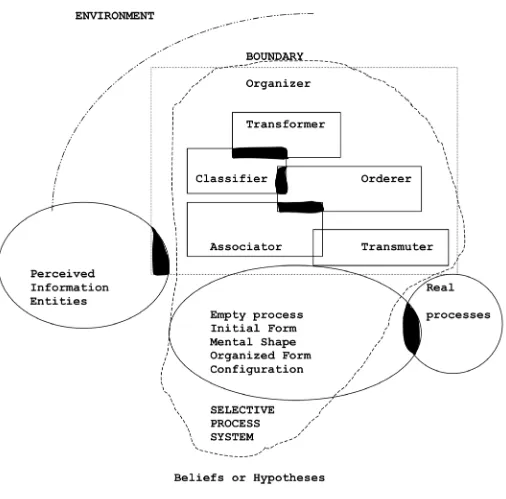
existed between the concepts of stable nature and the processes under scrutiny. The croupier process was convenient up to appoint when the question was about conventional processes. However, rapid, sudden, and direct changes remained out of the scrutiny. It was necessary to utilize the transformer in addition to the separator that differentiates environmental information, the sorter that arranges it, and the collector that connects information. In this way, it was possible to include in the processes, which
change into other processes. The croupier process was replaced with the transmuter because the
transmuter warrants an entire change or changes in variety of degrees among and between the processes.
In an experimental sense, it was interesting to derive dynamic concepts from the mind term. Thus, a mindition is a process of kinetic, discrete bursts. A mindic is a relational process such as the