A Study On The Influence Of Organizational
Culture, Leadership, Transformational Leadership,
And Compentency On The Commitment Of Dprd
Members And The Implication To The
Performance Of The Regency/Municipal Dprd
Members In Riau Province
Nyoto, Astri Ayu Purwati, Suyono
Abstract: The purpose of this research study is was to examine and analysis analyze of the influence of several variables, such as : organicational organizational culture, transformational leadership, and competence, on totthe commitment of DPRD (the regional house of representatives) members of local parliament and the implication to the member performance of the regency/municipal DPRD imember of local parliament in R iau Province. This researchstudy i wass done by using the descriptive and verificative verification method. As forThe sampling technique used in this study was Cluster Random Sampling sampling with the a total sample as muchof 173 respondents. Meanwhile, As for analyzethe data were analyzed r useding Structure Equation Modeling. The Rresult of this inferential research design showed that there are significantthe variables such as influence from variable: organiczational culture, transformational leadership, and competence had a significant influence ony, to the commitment of DPRD members member of local parliamentwith a score of, equal to 7676.30,30%, percent and the score for the significant influence from variable commitment of DPRD members member of local parlement toward the member performance of the regency/municipal DPRD local parliamentwas, equal to 79.,00 percent%.
Keywords: Organizational culture, Ttransformational leadershipLeadership, and competencyCompetence, and the commitment Commitment and the pPerformance of DPRD members member of local parliament.
—————————— ——————————
1.
INTRODUCTION
As an institution representing the people and the element of government executor, the image of DPR (the House of Representatives), both Provincial DPRD (the Provincial Regional House of Representatives) and Regency/Municipal DPRD, is becoming worse (Survey at Poltracking Indonesia) towards the performance level of democratic institutions in Indonesia). Based on the result of the survey, the performance of democratic institutions was DPR (66.5 %), political party (63.5 %), and the Indonesian National Police (55.9 %). The bad performance of Indonesian DPR is not significantly different from the performance of DPRD, especially in Riau Province. The image of DPRD in Riau Province has been being worse in the community after the Corruption Eradication Commission (KPK) stated that the members were the suspects of committing a corruption two times. First, it happened when the bribery scandal in The National Sports Week (PON) held in Riau, which involved 7 members and one of the members was the suspect of a bribery scandal in Local Government Budget (APBD) in Riau, 2015. Not until a year after the service term of the DPRD members in Riau during the period 2014-2019, one of the members had become a suspect of committing corruption. The poor performance of the DPRD of Riau Province can be reflected from how they complete their duties according to their functions as the people‟s representatives, as in legislation. During the 2009-2014 periods, the DPRD of Riau Province could only ratify 48 regional regulations or 78% from 61 regional regulations that had been designed. Therefore, the DPRD of Riau Province in the 2009-2014 periods left 13 regional regulation designs to the DPRD of Riau Province in the 2014-2019 periods. Meanwhile, the DPRD of Riau Province in the 2014-2019 periods, within 2015, could only ratify 11 regional regulation
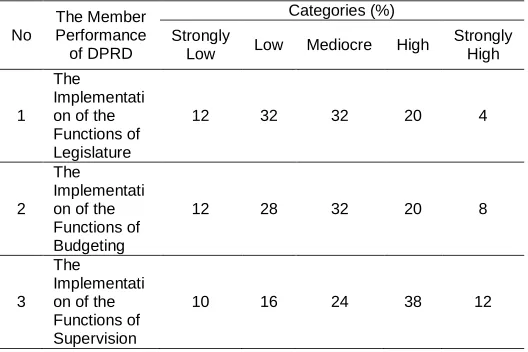
Regency/Municipal DPRD in Riau Province is also explained in the table below:
Table 1
The Member Performance of Regency/Municipal DPRD in Riau Province
No
The Member Performance of DPRD
Categories (%) Strongly
Low Low Mediocre High
Strongly High
1 The Implementati on of the Functions of Legislature
12 32 32 20 4
2 The Implementati on of the Functions of Budgeting
12 28 32 20 8
3 The Implementati on of the Functions of Supervision
10 16 24 38 12
Source: The result of pre-survey, 2016
The following table is the illustration of the result of a survey towards 40 respondents on the member commitment of the Regency/Municipal DPRD in Riau Province:
Table 2
The Member Commitment of the Regency/Municipal DPRD in Riau Province
No Member Commitment
Categories (%) Strongly
Low
Low Moderate High Strongly High 1 Affective
commitment
16 20 32 20 12
2 Continuance commitment
8 24 32 28 8
3 Normative commitment
8 16 24 36 12
Source: The result of pre-survey
Next, the table below is the illustration of the result of a survey towards 40 respondents on the organizational culture of the Regency/Municipal DPRD in Riau Province:
Table 3
The Organizational Culture of the Regency/Municipal DPRD in Riau Province
No Organizational Culture
Categories (%)
Ineffective Less Effective
Fairly
Effective Effective
Strongly Effective 1 Innovation and
Risk-taking
1 20 32 28 8
2 Concern for details
8 16 32 28 16
3 Outcome Orientation
16 24 32 20 8
4 People Orientation
12 16 36 28 8
5 Team Orientation
16 20 32 24 8
6 Aggressiveness 12 20 36 20 12
7 Stability 12 20 32 28 8
Source: The result of pre-survey, 2016
Referring to the result of pre-survey on the transformational leadership in the Regency/Municipal DPRD in Riau Province, it shows that most of them are categorized as strongly low to moderate. This indicates that transformational leadership was not optimal yet. It is shown from the score of more than 50 percent in the „unsatisfactory‟ category. The lowest dimension is the dimension that becomes the source of inspiration/motivation. It is due to several points, such as the educational background and the limited capability of the members in the transformational aspect. Besides, the supporting facility and infrastructure were limited to perform transformational leadership.The table below is the illustration of the result of a survey towards 40 respondents on the competencies of the Regency/Municipal DPRD members in Riau Province:
Table 4
The Competence of the Regency/Municipal DPRD Members in Riau Province
No Member Competence
Categories (%) Strong
ly Low
Low Moder ate
High Strongly High
1 Motive 16 20 20 32 12
2 Characteristic 12 20 32 28 8
3 Personal Concept
8 16 40 20 36
4 Knowledge 16 20 36 16 12
5 Skill 12 24 32 24 8
Source: The result of pre-survey, 2019
The result of the pre-survey showed that the competencies of the Regency/Municipal DPRD members in Riau Province were mostly categorized as strongly low to moderate. This indicates that their competencies are not optimal yet. It is shown from a score of more than 50 percent with limited competencies. The weakest dimension was the dimension of level and the mastery of knowledge because of several points, such as the low education level of DPRD members. Besides, the capability and the willingness to improve their education level and skill of the Regency/Municipal DPRD members in Riau Province are relatively low.
Problem Statement
1. How are the organizational culture, transformational leadership, and competence in the Regency/Municipal DPRD in Riau Province?
2. How is the commitment of the Regency/Municipal DPRD members in Riau Province?
3. How is the performance of the Regency/Municipal DPRD members in Riau Province?
4. How significant and simultaneous the organizational culture, transformational leadership, and the competence can influence the commitment of the Regency/Municipal DPRD members in Riau Province?
5. How significant the organizational culture can influence the commitment of the Regency/Municipal DPRD members in Riau Province.
6. How significant transformational leadership can influence the commitment of the Regency/Municipal DPRD members in Riau Province.
8. How significant the commitment can influence the increase in the performance of the Regency/Municipal DPRD members in Riau Province?
Research Objective
1. To find out, to study, and to analyze deeper on the organizational culture, transformational leadership, and competence in the Regency/Municipal DPRD members in Riau Province.
2. To find out, to study, and to analyze deeper on the commitment of the Regency/Municipal DPRD members in Riau Province.
3. To find out, to study, and to analyze deeper on the performance of the Regency/Municipal DPRD members in Riau Province.
4. To find out, to study, and to analyze deeper on how significant the organizational culture, transformational leadership, and competence can simultaneously influence the commitment of the Regency/Municipal DPRD members in Riau Province.
5. To find out, to study, and to analyze deeper on how significant the organizational culture can influence the commitment of the Regency/Municipal DPRD members in Riau Province.
6. To find out, to study, and to analyze deeper on how significant the transformational leadership can influence the commitment of the Regency/Municipal DPRD members in Riau Province.
7. To find out, to study, and to analyze deeper on how significant the competence can influence the commitment of the Regency/Municipal DPRD members in Riau Province.
8. To find out, to study, and to analyze deeper on how significant the commitment can influence the increase in the performance of the Regency/Municipal DPRD members in Riau Province.
2 INTRODUTION
1. Theory of Management
Generally, management is everything performed by the manager (Robbins & Coulter, 2007). Therefore, management can be defined as a process for coordinating the work activity to be accomplished effectively and efficiently by other people. Empowering other people in accomplishing the duties is the thing that differentiates the position of manager from the non-managerial position. The effectiveness is illustrated as „performing the job well‟, namely the work activities that can help the organization to achieve the target. Meanwhile, efficiency refers to the achievement of the biggest output with the smallest input. It is illustrated as doing everything well. Henry Mintzberg, the research expert on management suggests that the managers perform ten different roles yet those are interrelated. Those ten managerial roles by Mintzberg are classified into an interpersonal relationship, information exchange, and decision-making. The decision to use the management function to illustrate the things performed by the manager does not indicate that the category of roles by Mintzberg does not apply when the person offers a new insight to the manager‟s duty
.
2. Theory of Organization
The more comprehensive definition given by Stephen P. Robbins (2007), from all definitions suggested by some experts, is that the organization is a social unit or a social entity built by people in a relatively long-term consisting of a group of people, at least two persons, and having a coordinated, well-organized, and structured activity to achieve a certain goal. Besides, it has a specific self-identity that differs from one to another entity.
Organization is a setting arranged for some people to achieve a certain goal (Robbins &Coulter (2007:14). On the other hand, Sopiah (2008) in Saptono (2014) states that an organization should fulfill the four essential elements, namely 1) system, 2) activity patterns, 3) a group of people, and 4) a goal that has been established.
3. Theory of Human Resource Management
Managing human resources in an organization seriously and responsibly will increase the performance and the target achievement towards the organization‟s goal. Can the human resource management become an essential strategic instrument? Can Human resource management create competitive excellence for a sustainable organization? Some studies show that those are strongly possible.
A study reported that improving the practice of Human Resource Management in an organization could increase the market value of 30% (Robbins &Coulter, 2007). The term used for illustrating such results is the practice of human resource management with high performance. It can result in high organizational and individual performance.
a. Human Resource Management Planning
The human resource planning is the process performed by the managers to guarantee that they have many people with proper characteristics, the right place, and at the right time. Through planning, an organization can avoid a shortage of funds and excess funds. Generally, human resource planning consists of assessing the current human resources, assessing the human resource needs in the future, and fulfilling future needs.
b. The Fulfillment of Human Resource Needs in the Future The quantity and the qualification of human resources required in the future strongly depend on the target and the strategy of an organization. The demand for the employee is the result of the demand for the products or services of the organization. Based on the estimated total revenue, the managers can try to determine the total employee and the employee mix required to achieve the amount of revenue. Sometimes, the situation might be turned upside down. When a certain skill is required yet the availability is limited. The sufficient availability of human resources determines the total revenue.
c. The Management of Employee Performance
Evaluating employee performance becomes a part of the performance management system, a process of determining the performance standard and the assessment of employee performance to result in the objective human resource decision as well as providing the documentation to support the decision. The performance assessment is an important part of the performance management system.
d. The Target of Management by Objective (MBO)
evaluated based on how well they achieve a certain target that has been made by them and the manager. The 360-degree feedback is the performance management system using feedback from the supervisors, employees, and co-workers. Feedback is a system of performance assessment using the feedback from supervisors, employees, and co-workers. This type of study uses the information from a circle containing people whom the manager interacts with. Even though the use of this performance assessment is good for career training and helps the manager to identify the strength and the weakness of the employees. Nonetheless, this performance assessment is not sufficient for determining the salary, promotion, or firing. e. Compensation and Incentives
The managers should arrange the compensation system that reflects the character of occupation and changeable workplace. As a result, it can always motivate employees. The compensation of an organization can cover many types of rewards and various allowances, such as wage and basic salary, wage and bonus, incentives, allowance, and other services. Many factors can influence the compensation rates and allowance for employees.
f. Human Resource Maintenance
Maintenance is the responsibility of each leader. The human resource maintenance with reward system will influence the operation of an organization. The main purpose of maintenance is to make the people in the organization stay and play their roles optimally. The human resources that are not maintained and feel that they do not get a proper reward can motivate them to leave the organization or not work optimally. Human resource maintenance is, generally, to pay attention and consider carefully the nature of human.
d. Theory of Organizational Behavior
Organizational behavior is an area of study discussing the influence of individual, group, and structure to the behavior in an organization. It is done aiming at applying the knowledge on the behavior for the sake of the improvement of organizational effectiveness (Robbins, 2007). Wood, et al. (2001) in Saptono (2014) state that organizational behavior is a study of individuals and groups in an organization to help the manager to interact with the employees effectively for improving the organizational performance. Organizational behavior is also known as a study of an organization. This study is an academic analysis area specifically to learn about the organization by using the methods from the economy, sociology, political science, and psychology.
Each discipline of science has several points that should be existed in the discussion (essential thing). Similarly, organizational behavior has some concepts that should reflect the situational conditions or has many possibilities. The contingency is the situational factor, the variables that consider the relationship between two or more variables. That is how organizational behavior is considered. Organizational behavior is developed by taking the general concepts and applying them in a certain situation, individual, or group. The theories of organizational behavior reflect the main problems being handled. Human is a complex and complicated creature, so do the theories developed for explaining their actions.
g. Productivity
Some factors that influence productivity are (1) Individual. This factor comes from the employees themselves and it has existed before they start to work. The individual factor comprises the characteristic of biography, personality and emotion, values and attitude, perception, motivation, individual
learning, and competence. (2) Group. This factor is a group level factor such as communication, conflict, power and politics, group structure, leadership and trustworthiness, and group decision-making; and (3) Organization. This factor comes from the outside of the employee and can be organized thoroughly and changed by the company‟s leader. Therefore, it can be called as management factors.
h. Absenteeism
Absenteeism is an extremely big loss and disturbance for the employer. The high number of absenteeism can damage the company since the company should keep on spending money to pay the employee salary. On the other hand, the employees contribute nothing when they are absent.
Some absenteeism causes according to Streers and Rhodes in Novianto (2012) are (1) Work situation such as area of work, working-level, pressure towards the group, the norms of workgroup, leadership style, the relationship between employees, and the opportunities to be improved; (2) The employee values and job expectations. (3) Personal characteristics comprising of education, experience, age, sex, and family size. (4) Satisfaction in work situations. (5) The pressure to be present comprising of the economic and market condition, incentive system, the norms of the workgroup, personal work ethics, and organizational commitment. (6) Motivation and Presence. (7) The ability to be present consisting of sick and accident, family responsibility, and transportation problems. (8) Employee presence.
i. Turnover
Employee turnover is a permanent resignation from an organization either voluntarily (quitting) or involuntarily (being fired). Some aspects that can be used as predictors of turnover (Mueller, 2003), such as: (1) the alternatives available outside the organization (External alternatives). The tendency of the employees to leave the organization when they have a pre-determined place makes the literature emphasizes more on the perception of the external alternatives as to the predictors of organizational turnover. (2) The alternatives inside the organization (Internal alternatives). One of the essential organizational contexts is the availability of alternatives in the organization. The availability and work quality that can be achieved in an organization can be used as the utility index of turnover besides perception towards external alternatives. The employees will not perform turnover from an organization if they can or have an opportunity to transfer (internal transfer) to another job, in the same organization that is considered better. (3) Cost/value of job change (Cost of job change). An individual leaving the organization is due to the availability of alternatives that motivate them to leave the organization.
e. Theory of Organizational Culture
Organizational culture is collective beliefs and values that provide a sense for the members of an institution and make the beliefs and values as a rule/ guide towards behavior in the organization (Robbins, 2016) (Davis, 2007). Keith Davis and John W. Newstrom (Mangkunegara, 2008), organizational culture is the set of assumptions, believes, values, and norms that are shared among its members. Furthermore, John R. Schermerhorn and James G. Hunt (Mangkunegara, 2008) reveal that “organizational culture is the system of shared beliefs and values that develop within an organization and guides the behavior of its members”.
organization (Grifin and Ebert, 2005). It is also a basic assumption pattern found or developed by a group of people when they learn to solve the problems, to adapt to the external environment, and to integrate with the internal environment (Schein, 1985).
f. Theory of Leadership
Leadership is perceived as an essential thing because of two points, namely, first, the fact that leadership succession often changes the performance of a unit, institution, or organization; second, the research findings show that one of the internal factors affecting the success of an organization is leadership including the leadership process at every level of organization, competence, and the relevant leader‟s action (Yulk, 1989), (Stuart, 2002), & (Spillane, 2006).
Leadership is an influence related to leaders and staff/followers (Richard L. Daft, 2005). Further, Gibson states that leadership is an attempt to use the influence to motivate individuals to accomplish some goal. Ken Blanchard, related to influence, cited by Marcelene Caroselli (2000), states that the key for leadership in these days is “influence” not “power”. Moreover, it is also stated that the leaders know how to influence people and persuade them for high job demands. A leader is a core of management. It indicates that management will achieve the goal if there is a leader. Leadership can only be performed by a leader. A leader is a person who has skills in leading people, the ability to influence the individual or group conviction without asking for reasons.
g. Competence Theory
Competence means in-depth personality and it is embedded in a person with predictable behaviors in various situations and job duties. The prediction about the people‟s well performance and poor performance can be measured from the criteria or standards that are currently used. The analysis of competence is arranged mostly for career development, yet the determination of competence level is required for finding out the effectiveness of the expected performance level. Competence is available capacity in a person that can make the person able to fulfill job qualifications in an organization. Consequently, the organization can achieve the expected outcome. Competence is considered as a characteristic required by a jobholder to perform their position well, or it can also be defined as the person‟s obvious characteristics, including knowledge, skills, and behavior that allow them to perform.
h. Theory of Commitment
There are many definitions for organizational commitment, yet the researchers agreed that organizational commitment reflects a “multidimensional psychological attachment” from an individual to an organization. Organizational commitment has two basic dimensions, namely (1) organizational commitment is a behavior reflecting the employee loyalty to an organization, and (2) a sustainable process where the members of an organization express their attention on the organization, success, and sustainable development (Luthans, 2006) (Mowday, Porter, and Streers, 2004). Organizational commitment is a characteristic of a relationship between an individual with an organization showing some characteristics, such as accepting the values and the goals of the organization, having a willingness to perform for the organization, and having a strong willingness to be with the organization.
i. Theory of Performance
In most of the works of literature on human resource management, the most frequently discussed topic is about how to increase the performance of the members of the organization to achieve the organization‟s goal. Employee performance is a function of the interaction between competence and motivation. In a study on employee performance management, there is a thing that needs an important consideration because the individual performance of an employee in an organization is a part of organizational performance, and it can determine the performance of the organization. The success parameter for employee performance achieved by the organization will be influenced by the performance level of employees both individually or collectively (Robbins, 2006). Performance reflects how well and how accurate an individual to fulfill the employee demand. Performance is perceived as qualitative and quantitative outcome combination. The success of performance achieved by the organization is affected by the employee performance level individually or collectively, in that performance is measured by an instrument developed in a study that depends on the general standard of performance. Further, it is interpreted into basic behavioral assessment consisting of several points such as job quantity, job quality, opinion, or statement that is conveyed, the decision made in performing the job, and job description.
j. The Functions and the Authorities of DPRD
The Regional House of Representatives (DPRD) is a regional institution of people‟s representatives (parliament) (provincial/regency/municipal) in Indonesia that has a status as the element of regional government executor with the regional government. DPRD is regulated by law, and the latest is regulated by Law No. 27 the Year 2009.
DPRD is located in each administrative area as follows: 1) The Provincial Regional House of Representatives
(Provincial DPRD), located in the capital cities of the provinces.
2) Regency Regional House of Representatives (Regency DPRD), located in the capital cities of the regencies. 3) Municipal Regional House of Representatives
(Municipal DPRD), located in cities.
According to Law No 32 the Year 2004 on Regional Government amended to Law No 23 the Year 2014 on Regional Government. Further, based on Law No 27 the Year 2009 on MPR (the People's Consultative Assembly), DPR (the House of Representatives), DPD (the Regional Representative Council), and DPRD (the Regional House of Representatives) amended to Law No 17 the Year 2014 on MPR, DPR, DPD, and DPRD, stating that DPRD has the functions of legislature, budgeting, and supervision. The legislation function is realized in structuring the regional regulation by DPRD with the regional head. The budgeting function is realized in discussing and confirming the Draft Local Government Budget (RAPBD) by DPRD with the regional head. Meanwhile, the supervision function is realized in supervising the implementation of regional regulation and APBD (Local Government Budget). Those three functions are performed in representing the people in the regional area.
on MPR, DPR, DPD, and DPRD, stating that DPRD has duties and authorities to design regional regulation with the regional head, discussing and ratifying the regional regulation design about APBD proposed by the regional head, performing supervision towards the implementation of regional regulation and APBD, proposing the promotion and/or the termination of regional head and/or the deputy of regional head to the President through the Minister of Home Affairs for Provincial DPRD and to the Minister of Home Affairs through governor for Regency/Municipal DPRD to obtain the approval of promotion and/or termination, selecting the deputy of regional head when the position for deputy of regional head is available, giving opinions and considerations to regional government towards the international agreement design in the regional area, providing approval towards the international cooperative plan performed by the regional government, requesting the progress report of regional head for the implementation of regional government, providing approval towards the cooperative plan either with other regions or the third party that burdens the community and the region, trying to implement the regional obligation according to laws and regulations, and performing other duties and authorities regulated in the laws and regulations.
Research Hypothesis
The hypotheses of this study are as follows:
1. Do Organizational Culture, Transformational Leadership, and Competence simultaneously influence Commitment?
2. Does Organizational Culture influence the commitment of the Regency/Municipal DPRD Members in Riau Province?
3. Does Transformational Leadership influence Commitment?
4. Does Competence influence Commitment? 5. Does Commitment influence Performance?
3. METHODOLOGY
The method used in this study was a descriptive and explanatory survey. It was done by describing each variable and explaining the relationship between the investigated variables. This study was conducted based on cross-sectional time-frame that reflected the description of a situation and phenomenon that occurred at a certain time within 2014-2016. The verification analysis of this study was conducted using the statistical test known as Structural Equation Modeling (SEM). It is a technique of multivariate data analysis by mixing path analysis and factor analysis (Hair, 1998). The population of this study was 480 people consisting of DPRD members in all regencies/municipalities in Riau Province.
1. Population and Research Sample
The population of this study was all the Regency/Municipal DPRD members in Riau Province. The members were classified based on their position levels (stratified). The position levels in the Regency/Municipal DPRD consisted of Head of DPRD, the chairman of the commission, faction chairman, and ordinary members. The total population in this study was 480 people consisting of DPRD members in all regencies/municipalities in Riau Province. Sampling was done by using non-proportional stratified random sampling. It means that the percentage of sampling at each level is different. The total sample from a certain population was conducted based
on the theory developed by Isaac and Michael for some error rates of 1%, 5%, and 10%.
2. Data Testing
Data testing was done by using validity test, reliability test, and normality test.
3. Data Analysis
The problem formulation in the form of description was analyzed using descriptive statistics by calculating the mean and deviation standard. Meanwhile, to know the overall response from the respondents about the research variables, the data was made into a range score. The result of the frequency distribution was used to know the response of each respondent‟s profile toward each research variable that was being analyzed. Besides, the frequency distribution was used for knowing the total response from the respondents toward the research variables. The verification analysis method for hypothesis testing was conducted using the statistical method known as SEM. This method was a statistical technique for analyzing the indicator variable, latent variable, and measurement Error (Joreskog and Sorbon, 1996). SEM is also one of the complex multivariate analyses to analyze the relationship between variables (Ferdinand, 2006). To make easier in data processing, a computer program known as Amos version 20 was used.
4. RESULTS AND DISCUSSION
1. Partial InfluenceTable 5
The Result of Partial Test on Organizational Culture towards Organizational Commitment
Structural Path Coefficient
Calculat ed-t
Tabula
ted-t Conclusion
Y1.1 0.523 4.439 1.9741
H0 is rejected. There is a significant influence from Organizational Culture towards Organizational Commitment. Source: The Result of Data Processing (2016)
For path coefficient X1 towards Y of 0.523, it was obtained a calculated-t score of 4.439 by using a significance level of (α) of 5%. Therefore, the tabulated-t score or t0.05.173 was 1.9741. Since the calculated-t score was 4.439 or higher than the tabulated-t score of 1.9741, H0 was rejected. Organizational Culture influenced Organizational Commitment of 0.523. Consequently, an increase in Organizational Culture will increase Organizational Commitment of 0.523 units.
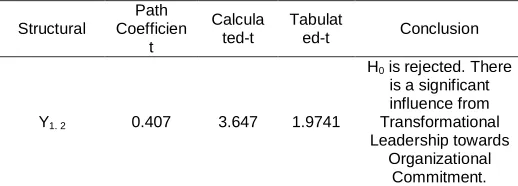
Table 6
The Result of Partial Test on Transformational Leadership towards Organizational Commitment
Structural
Path Coefficien
t
Calcula ted-t
Tabulat
ed-t Conclusion
Y1. 2 0.407 3.647 1.9741
H0 is rejected. There is a significant influence from Transformational Leadership towards
Source: The Result of Data Processing (2016)
For path coefficient X2 towards Y=0.407, it was obtained a calculated-t score of 3.647 by using a significance level of (α) of 5%. Therefore, the tabulated-t score or t0.05.173 was 1.9741. Since the calculated-t score was 3.647 or higher than the tabulated-t score of 1.9741, H0 was rejected. Transformational Leadership influenced Organizational Commitment of 0.407. Consequently, an increase in Transformational Leadership will increase Organizational Commitment of 0.407 units.
Table 7
The Result of Partial Test on Competence towards Organizational Commitment
Structural Path
Coefficient Calculated-t Tabulated-t Conclusion
Y1. 3 0.319 3.338 1.9741
H0 is rejected. There is a significant influence from Motivation towards Work Ethics Source: The Result of Data Processing (2016)
For path coefficient X3 towards Y = 0.319, it was obtained a calculated-t score of 3.647 by using a significance level of (α) of 5%. Therefore, the tabulated-t score or t0.05.173 was 1.9741. Since the calculated-t score was 3.338 or higher than the tabulated-t score of 1.9741, H0 was rejected. Competence influenced Organizational Commitment of 0.319. Consequently, an increase in Competence will increase Organizational Commitment of 0.319 units.
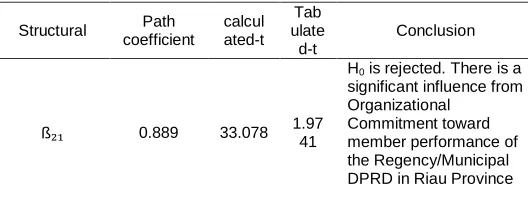
Table 8
The Result of Partial Test on Organizational Commitment towards Member Performance of the Regency/Municipal
DPRD in Riau Province
Structural Path coefficient
calcul ated-t
Tab ulate
d-t
Conclusion
ß₂₁ 0.889 33.078 1.97 41
H0 is rejected. There is a significant influence from Organizational
Commitment toward member performance of the Regency/Municipal DPRD in Riau Province
Source: The Result of Data Processing (2016)
For path coefficient Y towards Z= 0.889, it was obtained a calculated-t score of 33.078 by using a significance level of (α) of 5%. Therefore, the tabulated-t score or t0.05.173 was 1.9741. Since the calculated-t score was 33.078 or higher than the tabulated-t score of 1.9741, H0 was rejected. Organizational Commitment influenced the Member Performance of the Regency/Municipal DPRD in Riau Province of 0.889. Consequently, an increase in Organizational Commitment will increase the member performance of the Regency/Municipal DPRD in Riau Province of 0.889 units.
Verification Analysis
After the analysis of the research instrument, scale analysis, and descriptive analysis were done, the collected data were used for verification analysis. It was initiated by analyzing the data using Structural Equation Modeling (SEM) followed by the statistical hypothesis testing. The result of LISREL estimation, each research dimension, needed a further explanation. This explanation was needed since each variable
was measured indirectly. However, it was formed by several indicators that the role was needed to be analyzed to form the variables. For detail, it will be discussed in each hypothesis. As a result of data calculation from 173 respondents that had been collected by using Structural Equation Modeling (SEM ) and LISREL 8.7, the model as illustrated in the figure below is obtained.
Figure 1. The Structure of Relationship between All Research Variables
1. The Discussion on the Organizational Culture, Transformational Leadership, and Member Competence that Simultaneously Influence the Member Commitment of the Regency/Municipal DPRD in Riau ProvinceThe total influence (Coefficient of Determination/R2) from organizational culture, transformational leadership, and competence simultaneously influenced the member commitment of the Regency/Municipal DPRD in Riau Province of 76.30 %. The total result of this influence was supported by statistical tests showing that the influence was significant. It was based on the calculated-F score of 181.3601) which was higher than the tabulated-F score of 2.08. The variable with the biggest contribution in influencing organizational commitment was the organizational culture with a score of 45.80 %, while the variable with the least contribution in influencing organizational commitment was the member competence with a score of 22.90%.The influence of other variables affecting organizational commitment yet it was not analyzed (epsilon) had a score of 33.70%. Meanwhile, those variables were member motivation, the facility, and infrastructure in DPRD, communication between members, and other variables. If it is seen from the score of epsilon (ε), the influence of other variables that were not analyzed was still high since the score was less than the significance level value (around 7 times of alpha score of 5%).
2. The Discussion on the Influence of Organizational
Culture towards Organizational Commitment
Organizational culture partially had a significant influence on the commitment in the Regency/Municipal DPRD in Riau Province. The total direct and indirect influence of organizational culture toward commitment was 45.80%. The result was supported by a statistical test indicating that the influence was significant according to the calculated-t score compared to the required tabulated-t score. The dimension of Team Orientation has the most significant influence on the organizational culture with a score of 90.09%, while the dimension of Aggressiveness was the least significant influence toward the organizational culture with a score of 65.10%.The significance of the statistical test stating that organizational culture was a dominant variable toward commitment. The increase and the decrease in commitment will be strongly determined by organizational culture with the dimension of Innovation and Risk-taking, Concern to Details, Outcome Orientation, People Orientation, Team Orientation, Aggressiveness, and the dimension of Stability.
3. The Discussion on The Influence of Transformational
Leadership towards Organizational Commitment.
result was supported by a statistical test indicating that the influence was significant according to the calculated-t score compared to the required tabulated-t score. The dimension of Intellectual Stimulation had the most significant influence on Transformational Leadership with a score of 49.50%, while the dimension of Aggressiveness was the dimension of the Source of Inspiration/Motivation having the least significant influence toward Transformational Leadership with a score of 44.80%.
4. The Discussion on the Influence of Member
Competence towards Organizational Commitment
The dimension of Motive had the most significant influence on the organizational culture with a score of 98.60%, while the dimension of knowledge level had the least significant influence on the organizational culture with a score of 61.00%.The significance of the statistical test indicated that the Competence of members was the dominant variable toward commitment. The increase and the decrease in commitment will be strongly determined by the Competence of members with several dimensions, such as Motive, Characteristics, Personal Concept, Knowledge, and Skill. Competence will influence Commitment or the embeddedness of a person towards the institution/organization. Based on the concepts stated above, the researcher expected that the member competence of the Regency/Municipal DPRD in Riau Province had a positive influence on commitment. The suitability between competence and self-development that they believe can also make the employees happy in carrying out their job. Finally, this condition can increase their commitment towards the institution/organization where they work.
5. The Discussion on the Influence of Commitment
towards the Member Performance of DPRD
Commitment partially had a significant influence on the member performance of the Regency/Municipal DPRD in Riau Province. The total score for the direct and indirect influence of Commitment toward the member performance of DPRD was 79.00 %. The result was supported by a statistical test showing that the influence was significant according to the calculated-t score compared to the required tabulated-t score. The dimension of budgeting task had the most significant influence on the performance of members with a score of 86.86 %, while the dimension of supervision task had the least significant influence toward performance with a score of 75.67 %.The significance of the statistical test indicated that commitment was the dominant variable toward the member performance of DPRD. The increase and the decrease in performance will be strongly determined by Commitment with several dimensions, such as affective commitment, continuance commitment, and normative commitment. Since this study was supported by several theories and research findings, the findings in this study could be a consideration and suggestions for the organization leader in increasing the commitment of DPRD by concerning on the synergy or collaboration from the three dimensions of variable, namely affective commitment, continuance commitment, and normative commitment.
5. CONCLUSION
1a. The condition of organizational culture in the Regency/Municipal DPRD in Riau Province is categorized as moderate to good. The result of the interview with the experts
through expert judgment interview states that organizational culture in the Regency/Municipal DPRD in Riau Province is not effective yet and the implementation is not optimal yet. 1b. The condition of transformational leadership in the Regency/Municipal DPRD in Riau Province is categorized as moderate to good. The result of the interview with the experts through expert judgment interview states that transformational leadership in the Regency/Municipal DPRD in Riau Province is not optimal yet.
1c. The condition of member competence of the Regency/Municipal DPRD in Riau Province is categorized as moderate to good. The result of the interview with the experts through expert judgment interview states that the member competence of the Regency/Municipal DPRD in Riau Province is limited and is not optimal yet.
2. The condition of commitment in the Regency/Municipal DPRD in Riau Province is categorized as moderate to good. The result of the interview with the experts through expert judgment interview states that the commitment in the Regency/Municipal DPRD in Riau Province is low, and the effort for increasing the commitment is not optimal yet.
3. The condition of member performance in the Regency/Municipal DPRD in Riau Province is categorized as moderate to good. The result of the interview with the experts through expert judgment interview states that the member performance in the Regency/Municipal DPRD in Riau Province is still limited, and the effort for increasing the member performance is not optimal yet.
4. The total influence from organizational culture, transformational leadership, and competence simultaneously influence the member commitment of the Regency/Municipal DPRD in Riau Province with a score of 76.30 percent. The variable with the biggest contribution to organizational commitment is the organizational culture with a score of 45.80 percent, while the variable with the least contribution to organizational commitment is member competence with a score of 22.90 percent. The result of the interview with the experts through expert judgment interview states that organizational culture, transformational leadership, and competence are the dominant variables to improve commitment. If the three variables are performed efficiently, effectively, and productively, they can influence on the improvement of member commitment in the Regency/Municipal DPRD in Riau Province significantly. 5. The total influence from organizational culture towards the member commitment of the Regency/Municipal DPRD in Riau Province is 45.80 percent. The result of the interview with the experts through expert judgment interview states that the culture of effective, dynamic, and conducive will be able to influence the improvement of member commitment in the Regency/Municipal DPRD in Riau Province significantly. 6. The total score for transformational leadership to influence the member commitment of the Regency/Municipal DPRD in Riau is 30.50 percent. The result of the interview with the experts through expert judgment interview states that effective transformational leadership will be able to influence the improvement of member commitment in the Regency/Municipal DPRD in Riau significantly.
7. The total influence of competence towards the member commitment of the Regency/Municipal DPRD in Riau Province is 22.90 percent.
is 79.00 percent. The dimension of affective commitment has the biggest influence towards commitment with a score of 94.40 percent, while the dimension of aggressiveness has the least influence towards commitment with a score of 61.00 percent.
The result of the interview with the experts through expert judgment interview states that if the high commitment of members is performed continuously, it will be able to influence the member performance of the Regency/Municipal DPRD in Riau Province significantly
Suggestions
1.a. The effort to continuously improve organizational culture, from either inside the organization or adopted from other institutions. The expert judgment interview, in improving the work culture in the Regency/Municipal DPRD in Riau, needs to be concerned by the DPRD members, especially on the problem details that they should solve. The developed organizational culture should be able to improve the decision-making of DPRD. Besides, organizational culture should stimulate the betterment of member behavior.
1.b. To improve the transformational leadership, all DPRD members should continuously improve their education and make an improvement for sustainable leadership. The suggestions added from the result of the interview with experts through expert judgment interviews to improve transformational leadership state that it needs optimization in improving morals and the aspect of leadership by example in the eyes of the DPRD members and the DPRD staff. On the other hand, the leader should have charisma and should stimulate the DPRD members‟ motivation.
1.c. In improving the competence of the DPRD members, the effort to improve the member competence continuously, related to either knowledge, skill, or attitude owned by the member, is needed. The suggestions added from the result of the interview with experts through expert judgment interview to improve the member competence states that the optimization for improving attitude and developing specific competence that stimulates the improvement in commitment and work activity is needed.
2. In improving the commitment of members and organization, various new policies and the efforts that can stimulate the commitment improvement are needed. The result of the interview with the experts through expert judgment interview, in improving commitment, states that the optimization towards the partiality side of policy and the substance of problem-solving to struggle for the sake of people‟s interest.
3. In improving the member performance, new policies and efforts to stimulate the improvement of performance more followed with rewards are needed. The suggestions added from the result of the interview with experts through expert judgment interview to improve performance states that the member performance of the Regency/Municipal DPRD in Riau needs to be more improved so that the functions can be performed better and the community can improve their welfare.
4. Improving the influence of organizational culture, transformational leadership, and competence towards the member commitment of the Regency/Municipal DPRD in Riau province needs a well-prepared planning and consistent implementation of the planning as well as continuous evaluation. Consequently, the commitment of the members and organization can be improved better. The suggestions
added from the result of the interview with experts through expert judgment interview to improve organizational culture, transformational leadership, and competence of the members towards commitment states that the optimization of those three variables is needed, and the leader should improve morals and the aspect of leadership by example collectively in the eyes of other DPRD members.
5. Organizational culture influences organizational commitment. Therefore, it is suggested to improve organizational culture to be more conducive and dynamic in the Regency/Municipal DPRD in Riau province. Besides, all dimensions of organizational culture should be continuously improved, developed, and implemented consistently. The suggestions added from the result of the interview with experts through expert judgment interview to improve organizational culture states that it needs an optimization, especially, the seriousness and the behavior of DPRD members in solving problems.
6. Transformational leadership influences organizational commitment. Hence, it is suggested to improve the transformational leadership more in the Regency/Municipal DPRD in Riau province to have better quality, responsibility, and high dedication. The suggestions added from the result of the interview with experts through expert judgment interview to improve the contribution of transformational leadership towards commitment states that optimization in performing duties and the leadership functions, and morals and the aspect of leadership by example in the eyes of DPRD members and the staffs.
7. Competence influences organizational commitment. Hence, it is suggested to improve the competence of the Regency/Municipal DPRD members in Riau province, so it can be more specific and useful. The suggestions added from the result of the interview with experts through expert judgment interview to improve the contribution of competence towards commitment states that the improvement actions, especially in improving the member competence to be more specific, and the optimization of the conceptual and technical training of the members are needed.
8. Commitment influences member performance. Therefore, it is suggested to improve the commitment of the Regency/Municipal DPRD members in Riau province to be more obvious, effective, and continuous. The improvement in commitment should be initiated by the head of DPRD supported by each political party that promotes the DPRD chairman/members. The result of the interview with experts through expert judgment interview to improve the contribution of commitment towards performance states that technical training, such as the knowledge improvement in policies on politics, economy, law, education, and socio-culture, as well as the aspects related to the formation of general policy. The DPRD members should be equipped with knowledge in improving motivation (soft skill), and self-development.
REFERENCES
[1] Bernardin and Russell, JEA, 2003. Human Resources Management, New York, Mc. Graw Hill Inc. [2] Davis, Keith,dan Newstorm. 2005. Perilaku Dalam
Organisasi. Jakarta. Erlangga.
[4] Faraz. Jaidi Nahiyah. 2013. Kepemimpinan Transformasional. Fakultas Ekonomi Universitas Negeri Yogyakarta.
[5] Ferdinand, Augusty 2006. Structural Equation Modeling Dalam Penelitian Manajemen. BP. Undip, Semarang. [6] Gibson, James L., John M. Ivancevich, James H. Donelly,
Robert Konopaske. 2012.Organization Behavior, Structure, Processes, McGraw-Hill Irwin, New York. America.
[7] Griffin, Ricky.W. 2000. Business, 8th Edition. NJ: Prentice Hall.
[8] Ivancevich, John.M, Konopaske, Robert dan Matteson. 2007. Perilaku dan Manajemen Organisasi, Edisi 7 Jilid 1, Alih bahasa: Gina Gania. Jakarta. Erlangga.
[9] Kandula, S. R. 2006. Performance Management, New Delhi: Prentice Hall of India private limited.
[10]Komariah, Aan dan Cepi Triatna. 2005. Visionary Leadership. Jakarta. Bumi Aksara.
[11]Kreitner dan Kinicki. 2005. Perilaku Organisasi. Buku 1 & 2. Jakarta. Salemba Empat.
[12]Luthans, Fred. 2005. Organizational Behavior, 7-ed. Mc. Graw-Hill Interntional, New York.
[13]Luthans, Fred. 2006. PerilakuOrganisasi. Edisi 10, Yogyakarta. Penerbit Andi.
[14]Mangkunegara, A.A. Prabu. 2006. Evaluasi Kinerja Sumber Daya Manusia. Bandung. Refika Aditema. [15]Mathis dan Jackson. 2006. Human Resource
Management Manajemen Sumber Daya Manusia. Alih bahasa. Diana Anggelica. Jakarta. Salemba Empat. [16]Mexley and Yuki, G.A. 2003. Kepemimpinan Dalam
Organisasi. Edisi Bahasa Indonesia. Jakarta. Elex Media Komputindo.
[17]Rivai, Veithzal. 2003..Kepemimpinan dan Perilaku Organisasi. Jakarta. Raja Grafindo Persada.
[18]Robbins,Stephen P. dan Timothy A. Judge. 2006. Organizational Behavior. New Jersey: Pearson Prentice Hall.
[19]--- 2008. Perilaku Organisasi; Organizational Behavior, Buku 2, Terjemahan Diana Angelica, Jakarta: Salemba Empat.
[20]Sedarmayanti, 2009. Reformasi Administrasi Publik, Reformasi Birokrasi dan Kepemimpinan Masa Depan. Bandung. Refika Aditama.
[21]Silalahi, BY. 2008. “Pengaruh Kepemimpinan Transformasional, Motivasi Kerja, dan Budaya Organisasi terhadap Komitmen Organisasi”. Jurnal Psikologi Vol 2. [22]Sugiyono. 2008. Metode Penelitian Bisnis. Bandung.
Alfabeta.
[23]Undang-undang Nomor 33 Tahun 2004 Tentang Perimbangan Keuangan Pusat dan Daerah. Jakarta: Laksana Mandiri.
[24]Undang-Undang Nomor 27 Tahun 2009,Tentang MPR, DPR, DPD dan DPRD. Jakarta: BP. Panca Usaha. [25]Undang-UndangNomor 17 Tahun 2014, TentangMPR,
DPR, DPD dan DPRD. Yogyakarta: Pustaka Mahardika. [26]Wibowo. 2008. Manajemen Perubahan.Edisi kedua.
Jakarta. Raja Grafindo Persada.
[27]Yuyun Wirasasmita. 2008. Uji Kelayakan Model. Fakultas Ekonomi dan Bisnis Universitas Padjadjaran. Bandung [28]Yulk, Gary. 2007. Kepemimpinan Dalam Organisasi,