Drying Induced Phase Separation in
Multicomponent Polymeric Coatings –
Simulation Study
Raj Kumar Arya*
Abstract: Phase separation simulation study related to cellulose acetate-water-acetone has been done. Results show that porous asymmetric and symmetric membranes can be produced by changing the nonsolvent concentration or by the drying conditions without altering the polymer content using dry-casting process. Dry-casting process is the process in which complete evaporation of solvent and nonsolvent takes place. At low initial nonsolvent concentration phase separation may not take place and dense polymer film may be obtained rather than a porous membrane. At high air velocity the phase separation is completely suppressed and uniformly dense coating devoid of substantial microstructure will result.
Index Terms- Phase Separation, Polymeric Membranes, Asymmetric Membranes, Simulation
————————————————————
1. Introduction
Polymeric membranes are used in large scale in membrane filtration and other separation techniques. There are two types of membranes asymmetric and symmetric. Each of them has its own advantages. These membranes are manufactured by phase separation processes of homogenous polymer solutions. During phase separation, macrovoids are formed that are useful in drug delivery systems, ultrafiltration, composite membrane supports, bioreactors, screen printing media and breathable fabrics[1]. Macrovoids are the pores of having size 10-50µm. Phase inversion can be achieved by wet casting process, dry casting process, vapor induced phase separation, and thermally induced phase separation[2,3]. In wet cast process, polymer casting solution is immersed in the nonsolvent bath which results formation of porous membranes due the solvent loss and counter diffusion of nonsolvent into the casting solution[4,5]. Thermally induced phase separation process begins by dissolving the polymer in the diluent at elevated temperature. After that solution is to be cast in desired shape and subjected to cool to induce phase separation. By solvent exchange process diluent is extracted and extractant is evaporated to yield a microporous structure[6].
Dry cast process is one of the process by which thermodynamic state of polymer solution can be altered to achieve the phase inversion. It is characterized by evaporation of nonsolvent and solvent from initially homogeneous single phase solution[4-5,7]. Due to external effects homogenous polymer solution becomes thermodynamically unstable initially[2] and two phase solution is formed due to evaporation. Hence phase separates into polymer lean and polymer rich phases.
On solidification polymer rich phase precipitated to form solid matrix that envelops the polymer lean phase that is rich in solvent and nonsolvent fill the pores. This process avoids the complication associated with the use of coagulation baths as in wet cast process. Polymer concentration is increased to reduce the solvation character of polymer solvent as the solvent is evaporated from the solution[7]. Evaporation step significantly influences the final membrane morphology in dry and wet cast phase inversion process.
If the drying rate is high and coating thickness is small, top surface becomes dense in polymer due to high rate of solvent and nonsolvent evaporation that is called trapping skinning. Once the skin formation takes place, the nonsolvent penetrates the skin at the weak spots it initiates the macrovoids[4,5]. Below the skin layer liquid-liquid phase separation takes place[8]. Liquid –liquid phase separation takes place when a homogeneous solution becomes thermo-dynamically unstable due to introduction of a non solvent. Original solution decreases its free energy of mixing by splitting up into two liquid phases of different composition[9]. Liquid-liquid demixing is caused either by nucleation and growth or spinodal decomposition. Nucleation growth mechanism occurs in metastable region between spinodal and bimodal however spinodal decomposition occurs in the unstable region inside the spinodal curve[3]. Structure is evolved by spinodal decomposition mechanism if composition passes through the critical point and phase separation occurs in the unstable region.
If the composition passes slowly in the metastable region, phase separation occurs in nucleation growth region. This followed by the growth of macrovoids because of diffusion of solvent and nonsolvent from the surrounding polymer solution and precipitation bath. During dry casting process and precipitation in wet casting process macrovoids are formed. Macrovoids formation can be eliminated by decreasing the rate of evaporation. Macrovoids appear to occur in the systems that begin phase separation shortly after the casting[1]. Macrovoid formation can be explained by several hypotheses. At some time interfacial tension between the casting solution and water bath interface becomes zero during mass transfer process. At this time water intrusion is favored ___________________
which cause the initiation of fingers. Solvent from the casting solution diffuse into these intrusions causes further growth resulting in formation of macrovoids[4,5]. When the difference in chemical potential of the solvent in the polymer solution and nonsolvent is lowered then number of finger like cavities gets diminished and when the difference is large then finger like cavities occur[8]. Effective number of pores on membrane surface does not change significantly with the change of rate of evaporation. However longer evaporation time results in bigger and more uniform pores and shorter evaporation time results in smaller and less uniform pores on the membrane surface layer[10]. Creation of higher effective number of pores is favored by higher casting solution temperature. Lower evaporation rate tends to increase productivity of films at a given level of solute separation.
Number of pores, size, and distribution on the membrane surface are controlled by evaporation rate only. Yamamura et al.[11] has studied that at higher drying rate polymer component do not have enough time to phase separate. Hence smaller microstructure is generated at high drying rate. Matsuyama et al.[12] has studied the effect of nonsolvent weight fraction, polymer weight fraction, and membrane thickness on membranes structures produced by dry-cast process. They found that as the nonsolvent weight fraction increases then membrane morphology changes from dense film to asymmetric to porous structure. Sambrailo and Kunst[13] have studied that membrane performance improves with evaporation and reproducibility decreases with the evaporation. Evaporation step is not necessary in order to produce skinned membrane. Membranes with evaporation have numerous small pores hence higher product rate. Dickson et al.[14] has studied that as the surface skin thickness increases the membrane flux decreases. Phase inversion can be promoted by evaporating the casting solution by dry-casting process[7]. By controlling the drying conditions one can manipulate the membrane porosity, pore size, and permeability[15]. We can also produce asymmetric and symmetric membranes by controlling the polymer solution phase separation [3]. Final structure of membrane is determined by the rate of solvent evaporation[7]. Membrane morphology is greatly affected by slight change in temperature. In the literature people have done image analysis study related to phase separating system[2,9,16].
In all the studied, only final microstructure has been discussed. Image is analysis is one way to study the phase separation systems. In the present work modeling and simulation study is given for the formation of asymmetric and symmetric membrane by dry-cast process. Time based study along the depth of coating will be the more rigorous analysis for phase separating systems. It will provide information about how the microstructure is changing with time as the drying proceeds. Various diffusion models[17-19] have been developed for continuous polymer film. As the polymer-solvent-nonsolvent system phase separates, all these diffusion models may or may not be valid. Hence, a study is needed to check the validity of various available diffusion models and time based study for phase separating systems. Cellulose acetate(3)– water(1)–acetone(2) is selected for the study because all the free volume parameters are available for this system. Water works as the nonsolvent due to low diffusion and
mass transfer coefficient compared to acetone. Experimental study will performed using Confocal Raman Microscopy. It enables to catch the Raman spectra and image analysis with time within the coating. That can be convoluted to get the concentration within the coating with time.
Modeling and Simulation Study of Drying
Coating
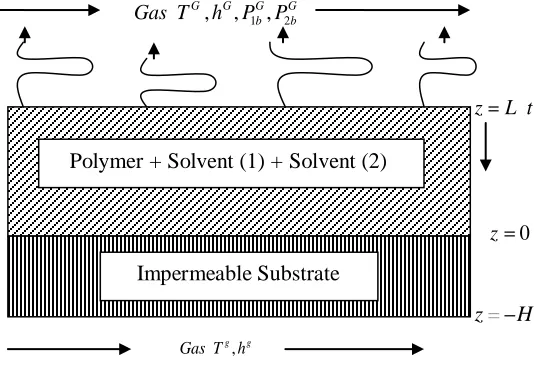
Various diffusion models have already been discussed. Figure 1 shows the schematic of a drying coating, which has been cast on impermeable substrate.
Figure 1 Schematic of a drying coating.
As the solvent reaches at the surface, it evaporates into the air on the top side of the coating. As mass of solvents decreasing with time, hence coating – gas interface is moving closer to the substrate opposite to diffusion. There is no mass transfer from the substrate side; hence fluxes will be zero at the substrate. Coupled heat and mass transfer takes place in drying process.
Results and Discussion
All the free volume parameters and experimental conditions for cellulose acetate(3)-water(1)-acetone(2) system are given in Table 1 and Table 2 respectively.
Effect of Nonsolvent Concentration
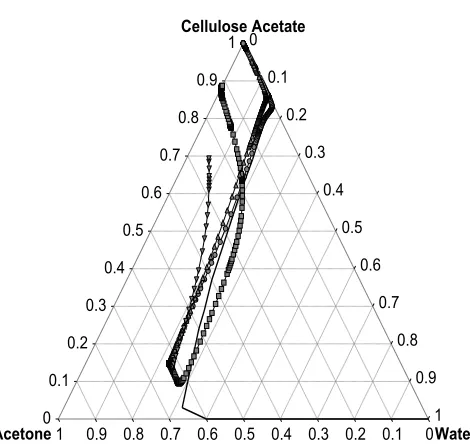
In the Cellulose acetate-water-acetone system, water works as the nonsolvent. From the Figure 2, we can say that if the initial nonsolvent concentration is very low, phase separation may not take place and dense polymer film may be obtained rather than a porous membrane. At higher nonsolvent concentration the rate of shrinkage is decreased, due to lower polymer concentration the formation of more graded pore sublayer structure having higher porosity is favored. If we further increase the water content then we will get symmetric membrane. As the water content increases the skin thickness decreases and voids volume increases. Water works as the controlling factor because of low diffusion and mass transfer coefficient. As the drying takes place the acetone evaporated faster from the top surface and surface beneath have high amount of
Polymer + Solvent (1) + Solvent (2)
Impermeable Substrate
1 2
,
,
,
G G G G
b b
Gas T
h
P
P
,
g g
Gas T h
z
L t
0
z
water. Due to this initially homogenous solution becomes thermodynamically unstable hence phase separates.
Table 1 Free volume parameters[2]
Table 2. Experimental parameters for Cellulose acetate/water/acetone System[2]
Figure 2. Concentration paths for cellulose acetate – water – acetone systems (case 1. volume fraction of cellulose acetate, water, and acetone is 10, 10 and 80 respectively, surface-air interface - ○, solution –substrate interface- □. Case 2. Volume fraction of cellulose acetate, water, and acetone is 10, 20 and 70 respectively, surface-air interface -●, solution –substrate interface- ■ , for the same thickness: 0.01cm and hear transfer coefficient: 2.2x10⁻⁴ 2
.
W cm K ).
Effect of Polymer Concentration
From Figure 3, it can be concluded that at low polymer concentration we will get dense polymer film and at higher polymer concentration asymmetric polymer membrane. Since only substrate side evade the two phase region and surface side is out of two phase region. At low polymer concentration, solvent and nonslovent can diffuse easily within the film due to which skin formation does not take place. Hence no phase separation takes place. By increasing the polymer content we are increasing more resistance to solvent and non solvent diffusion hence probability to phase separation at substrate side is higher.
Effect of Coating thickness
Figure 3. Concentration paths for cellulose acetate –water-acetone system. (Case 1. volume fraction of cellulose acetate, water, and acetone is 5, 20 and 75 respectively, surface-air interface - ○, solution –substrate interface- □. Case 2. Volume fraction of cellulose acetate, water, and acetone is 10, 20 and 70 respectively, surfaceair interface -●, solution –substrate interface- ■ for the same thickness: 0.01cm and hear transfer coefficient: 2.2x10⁻⁴ 2
.
W cm K ).
Figure 4. Concentration paths for cellulose acetate –water-acetone system.( Case 1. thickness: 0.01cm, surface-air interface-●, solution–substrate interface- ■. Case 2. Thickness: 0.05cm, surface-air interface-▲, solution– substrate interface-▼. For the same volume fraction of cellulose acetate, water and acetone is 10, 20 and 70 respectively and hear transfer coefficient: 2.2x10⁻⁴ 2
.
W cm K ).
Effect of Air Velocity
From Figure 5, we can say that as we increase the air velocity the phase separation is completely suppressed and uniformly dense coating devoid of substantial microstructure will result. At higher air flow rate of evaporation will be higher than the diffusion mass transfer. Top surface becomes dried very soon however beneath we have much amount of water and acetone which favor the phase separation. Hence, we are likely to get the asymmetric membranes. At low air flow rate external mass transfer is less compared to diffusion controlled mass transfer rate. Drying takes place slowly and have high acetone content. Higher amount of acetone favor homogeneous polymer film.
Figure 5. Concentration paths for cellulose acetate –water-acetone system (Case 1. heat transfer coefficient:
4
2.2 10
2.
W
cm K, surface-air interface-●, solution – substrate interface- ■. Case 2. Heat transfer coefficient: 8.4x10⁻⁴ 2
.
W
cm K , surface-air interface-▲, solution – substrate interface-▼. For the same volume fraction of cellulose acetate, water and acetone is 10, 20 and 70 respectively and thickness: 0.01cm).
Conclusions
References
[1] Penky, M.R., Zartman, J., Krantz, W.B., Greenberg, A.R. and Todd, P., 2003, ―Flow-Visualization during macrovoids pore formation in dry-cast cellulose acetate membranes‖, Journal of Membrane Science, 211, 71-90.
[2] Altinkaya, A. S. and Ozbas, B., 2004, ―Modeling of asymmetric membrane formation by dry – casting method‖, Journal of Membrane Science, 230, 71– 89.
[3] Matsuyama, H., Nishiguchi, M. and Kitamura, Y., 2000, ―Phase Separation Mechanism during Membrane Formation by Dry-Cast Process‖, Journal of Applied Polymer Science, 77, 776-782. [4] Shojaie, S. S., Krantz, W. B. and Greenberg, A. R.,
1994, ―Dense polymer film and membrane formation via the dry-cast process Part I. Model development ‖, Journal of Membrane Science, 94, 255 – 280.
[5] Shojaie, S. S., Krantz, W. B. and Greenberg, A. R., 1994, ―Dense Polymer Film and Membrane Formation via the dry-cast process Part II. Model validation and morphological studies‖, Journal of Membrane Science, 94, 281 – 298.
[6] Teramoto, M. , Kitada, S., Ohnishi, N., Matsuyama, H. and Matsumiya, N., 2004, ―Separation and concentration of CO2 by capillary-type facilitated transport membrane module with permeation of carrier solution‖, Journal of Membrane Science, 234, 1–2, 83-94
[7] Young, T.H., Huang, J.H. and Chuang, W.Y., 2002, ―Effect of evaporation temperature on the formation of particulate membranes from crystalline polymers by dry-cast process‖, European Polymer Journal, 38, 63-72.
[8] Koenhen, D. M., Mulder, M.H.V. and Smolders, C.A., 1977, ―Phase separation Phenomena during the Formation of Asymmetric Membranes‖, Journal of Applied Polymer Science, 21, 199-215.
[9] Broens, L., Altena, F.W. Smolders, C.A. and Koenhen, D.M., 1980, ―Asymmetric Membrane Structures as a Result of phase separation phenomena‖, Desalination, 32, 33 – 45.
[10] Kunst, B. and Sourirajan, S., 1970, ―Effect of Casting Conditions on the Performance of Porous Cellulose Acetate Membranes in Reverse Osmosis‖, Journal of Applied Polymer Science, 14, 723-733.
[11] Yamamura, M., Nishio, T., Kajiwara, T. and Adachi, K., 2001, ―Effect of stepwise change of drying rate on microstructure evolution in polymer films‖, Drying Technology, 19, 7, 1397-1410. [12] Matsuyama, H., Teramoto, M. and Uesaka, T.,
1997, ―Membrane Formation and Structure Development by dry-cast Process‖, Journal of Membrane Science, 135, 271-288.
[13] Sambrailo, D. and Kunst, B., 1987, ―Asymmetric Membrane Formation. Is the Evaporation Step Necessary?‖ Desalination, 64, 321-328.
[14] Dickson, J.M., Lloyd, D.R. and Huang, R.Y.M., 1979, ―Ionically crosslinked Poly (acrylic acid) Membranes. III. Reverse Osmosis Results for Dry Cast Membranes‖ Journal of Applied Polymer Science, 24, 1341 – 1351.
[15] Matsuyama, H., Kim, M. and Lloyd, D. R., 2002, ―Effect of extraction and drying on the structure of microporous polyethylene membranes prepared via thermally induced phase separation‖, Journal of Membrane Science, 2004, 413-419.
[16] Altinkaya, A. S. , Yenal, H. and Ozbas, B., 2005, ―Membrane Formation by dry-cast process model validation through morphological studies‖, Journal of Membrane Science, 249, 163 – 172.
[17] Alsoy, S. and Duda, J.L., 1999, ―Modeling of Multicomponent Drying of Polymer Films‖, AICHE Journal, 45, 4, 896-905.
[18] Zielinski, J.M. and Hanley, B., 1999, ―Practical Friction-Based Approach to Modeling Multicomponent Diffusion‖, AICHE Journal, 45, 1, 1-12.
![Table 1 Free volume parameters[2]](https://thumb-us.123doks.com/thumbv2/123dok_us/9124678.1447506/3.612.326.573.77.311/table-free-volume-parameters.webp)