The Affinity of the Platinum
Metals
for
Refractory Oxides
REACTIONS UNDER REDUCING CONDITIONS
By Dieter
Ott and
Christoph
J.
Raub
Forschungsinstitut f u r Edelmetalle und Metallchemie, Schwabisch Gmiind, West Germany T h e presence of a p l a t i n u m metal enhances the ability of hydrogen, carbon,
carbon monoxide and organic vapours to reduce the more stable refractory oxides. Such reactions, which m a y start at temperatures as low as 6OO0C,
occur because of the high a f i n i t y of the p l a t i n u m metals f o r the metal of
the refractory oxide and result in the formation of intermetallic compounds or stable d i d solutions. T h i s account, based o n experimental studies which yielded useful information on the thermodynamic behaviour of
p l a t i n u m metal alloys, presents results which should assist in preventing damage to industrial p l a t i n u m apparatus. It also suggests that metals could be brazed to refractory oxides using a p l a t i n u m containing brazing alloy under suitable reducing conditions.
Practical experience has shown that even platinum and palladium are not completely resistant to oxidation, and that they can, under certain conditions, also react with base metal oxides at high temperatures
(1-5). When heated in air some of the platinum metals, initially develop an oxide skin which disappears by dissociation or evaporation above a critical temperature. Others, such as platinum itself, retain a clean surface, but suffer a more or less rapid decrease in weight because of volatile oxide formation.
The more stable and refractory base metal oxides can also react with platinum in an argon atmosphere, in vacuum, or even in air, the reactions being particularly severe with zirconia, thoria and alumina. Under such conditions magnesia can be considered the only oxide which is truly inert with respect to platinum (3, 4). These reactions are greatly accelerated by the presence of strong reducing agents, Bronger and his collaborators (6, 7, 8) having shown that many inter-metallic compounds can be
synthesised by reacting the platinum metals with oxides in a hydrogen atmosphere. Similar techniques were also used for the production of palladium-tungsten alloys (9). Within an industrial environment strongly reducing conditions are sometimes difficult to avoid. The platinum alloy bushings used for glass fibre production provide a good example of the hazards likely to be encoun- tered, as they can be rapidly destroyed by silicon if the glass feed is contaminated by organic residues such as oil or wood. Platinum thermocouples can also react with their refractory insulators if the assembly is accidently brought into direct contact with luminous or other reducing flames.
Following earlier studies of the reactions between platinum and the transition metal carbides ( IO), the programme described
below was undertaken to identify those industrial situations where reducing con- ditions caused by the presence of carbon monoxide, carbon or the hydrocarbons, could lead to the rapid failure of platinum plant or equipment.
The Temperature of the Reactions of Platinum Metals with Oxides in a Hydrogen Atmosphere, and the Compounds Formed (8)
(Temperature in degrees Celsius) Ruthenium Rhodium Palladium
B
1
+I4001
+I400Si
I
1450 RuSiI
1400 Rh,SiI
1100 Pd,SiTi
I
1750*
I
1600 Rh,TiI
1200 Pd,Ti 1450 RhAl1300 Pd,AI,
I
- I
1450 RhAl Pd,Al1300 Pd,AI,
I
PdAlBa
I
I
- I
I I I
I I I I
Osmium
I
IridiumI
PlatinumI I
+I400
1
+14CO1
+I100-
I
1500 lrSiI
+I100-
I
1600 Ir,Til 1200 Pt,Ti 1600 lrAl 1500 Pt,AI,1250 Pt,AI, 1200 Pt,AI 1100 Pt,,AI,
1200 Pt,Sr Pt,Sr Pt,Sr 1100 Pt,Mg
Pt,Mg
Ca - ? - 1200 Pt,Ca
Pt,Ca, Pt,Ca
- I ?
-
I
-
I
1200 Pt,ScI
- I ? 1 - 1 - I
1200 Pt,Y scI
+ reaction a t the given temperature. - no reaction observed. ?reaction products not identified. * noble metal solid solution.
Reactions in Hydrogen
The principle of these reactions is best shown by the reaction of platinum and alumina in hydrogen (6) :
112 ~ 1 , 0 , = ~ 1 + 3 / 2 0 , AH, =zoo kcal Equation I
I/Z Als0,+3Pt =Pt,AI+3 12 Os AH,== 170 kcal
Equation z
For Equation I, AH amounts to an oxygen
vapour pressure at 1200°C of p o 2 z 10-s2, for Eqn. z of pol- 1 0 - 2 ~ torr making it possible
to reduce M,O, with H, in the presence of platinum only. This example shows the decisive importance of the heat of decom- position of the oxides and of the heat of formation of the various intermetallic com- pounds for these reactions. From their results, Bronger and Klemm (6) concluded
1200 Pt,Ba Pt,Ba
1000 Pt,Cr
(ordered)
1000 Pt,Cr
(ordered)
5t
that the heats of formation are highest for the platinum compounds and decrease on moving from platinum to palladium and from platinum via iridium to osmium. This makes ruthenium the metal least likely to react with base metal oxides in hydrogen.
A summary of the results of Bronger’s hydrogen reduction experiments is given in the Table. In general an increase in the reaction temperature decreases the concen- tration of the noble metal in the inter- metallic compound, as can be seen for platinum-aluminium alloys. With alumina, silica and titania the AB-phases RuSi, RhA1, PdAl, IrSi and IrAl were obtained, whereas in almost all other reactions only those phases containing more than 50 atomic per cent platinum metals were synthesised. The explanation may be that A1,0,, TiO, and SiO, have low heats of formation (- 135.5,
-112.5 and -105.0 kcals per mol of OJ.
From these results one must conclude that refractories based o n lime, magnesia or the rare earths should be preferred to aluminous materials for use in contact with industrial platinum equipment where reducing con- ditions are likely to be encountered. The behaviour of thoria and zirconia under such conditions has, unfortunately, not yet been investigated, Since it is known that the affinity of platinum for thorium and zirconium is stronger than its desire for aluminium,
(3, 11) it seems fair to assume that zirconia and thoria will also react readily with platinum in hydrogen.
Reactions in Carbon Monoxide
Carbon monoxide is often present in combustion gases and may therefore be of some danger to the platinum metals at the higher temperatures. Unlike hydrogen, carbon monoxide is insoluble in the platinum metals and, since no dilute solid solutions are involved, the reaction conditions are therefore likely to be somewhat simplified.
A detailed study was undertaken at this Research Institute to establish the way in which the platinum metals reacted with base
Platinum Metal Rev., 1976, 20, (3),
81
Fig. 1 Low melting point palladium-silicon eutectic on the surface of a palladium sample. Nominal composition 20 atomic per cent silicon, silicon added as silica, 1000°C, 100h, carbon monoxide atmosphere x 10 approx.
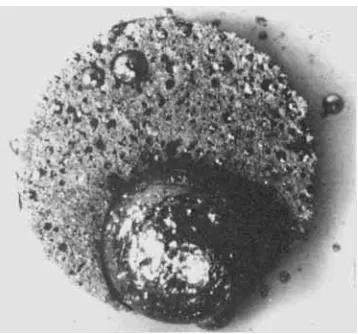
Fig. 2 Condensed palladium near the reaction pellet on an alumina substrate x 10 appror.
metal oxides, in a carbon monoxide atmos- phere, at various temperatures, under practical conditions (12, 13).
At the temperature levels investigated, carbon monoxide was found to reduce the stable base metal oxides in contact with platinum in much the same way as hydrogen
(12). Silica and zirconia reacted with pal- ladium even below
IOOO~C,
and above 800°C small molten droplets provided evidence of liquid phase formation, as shown in Figure I.Fig. 3 Whiskers formed on the surface of u
palladium sample. Nominal composition 20 atomic per cent magnesium, magnesium added as magnesia, 14OO"C, 12Oh, carbon monoxide atmos- phere x 45 approx.
formed above IZOO'C, has reacted with the aluminous crucible material. Unusual whiskers were sometimes formed as a result of these reactions, those shown in Figure 3 being produced when palladium dissociated mag- nesia in the presence of carbon monoxide. Adorning the tip of each of these whiskers is a small ball having a duplex microstructure. As in hydrogen, lime and magnesia reacted with the platinum metals under carbon monoxide less readily than silica and zir- conia. The rare earth, Dy,O, displayed remarkable resistance to decomposition, little evidence of reduction being seen even after
120 hours at 1400'C. When mixed with
vanadium pentoxide, the platinum metals reacted quantitatively to produce f.c.c. solid solutions containing up to 40 atomic per cent vanadium.
Similarly quantitative reductions resulted from Pd-Cr,O, and Pd-TiO, mixtures con- taining an excess of palladium. In other instances, for example, when palladium reacted with zirconium oxide, X-ray analysis indicated the presence of phases not de- lineated on the binary equilibrium diagram.
The diffraction patterns obtained contained many lines which were difficult to index. This complexity might be attributed to the presence of ternary carbides, or oxygen or carbon stabilised pseudo-binary compounds. The more or less continuous transition phases, such as those observed by Bronger et al. (6),
which bridge the gap between one structure and another in the series Pt-Pt,iMg-Pt,Mg might also be involved.
In carbon monoxide, as in hydrogen, platinum reacted strongly with the base metal oxides, being, in this respect at least as active as palladium. The hexagonal metals such as ruthenium were far more stable.
The reaction sintered pellets which resulted from these experiments sometimes displayed a fair amount of ductility even at high oxide concentrations, and it seems possible that technically viable methods of cermet pro- duction could be based on such reductions.
Reactions
in
the Presence
of
Carbon
These reactions, and especially their thermodynamics, have also been studied a t this Research Institute, and some of the results obtained will be mentioned below.
When carbon is mixed with, for example, palladium and silica, the following reactions must be considered :
SiO, +2C+2CO
+
Si AG, Equation 35Pd+ Si+Pd,Si AG, Equation 4
Si0,+gPdi-zC+2COfPdsSi AG5 Equation 5
Equation 6
For AG6 we tind
(AG=free enthalpy)
I n addition the formation of carbides and solid solutions may add extra terms to Equation 6 .
As has been mentioned earlier one of the decisive factors of the reaction is the free enthalpy of formation of the metallic phase (AGJ. If this is high the CO pressure above the cermet pellet will be increased, or at a constant CO pressure the reaction will occur at lower temperatures. We therefore studied the reactions by CO equilibrium pressure
measurements, weight loss determinations and X-ray methods.
Chromic Oxide and Carbon
Although chromic oxide should theoretic- ally be reduced by carbon at 600°C at pres- sures of I O - ~ torr, practical tests showed no
significant reaction until 800°C was reached. The presence of palladium strongly enhanced this reaction, a palladium-chromium solid solution bcing formed. At 900°C the carbide Cr,C, was also detected.
Figure 4 shows how the free energy of formation of the solid solution (corresponding to AG, in Equation 6, the value of AG, for Cr20,+3C+2Cr+3C0 being taken from the literature) varies with the chromium concentration of the alloy which is formed. Platinum reacted with chromium less readily than palladium. Compared with palladium, rhodium had little influence on the reduction of chromic oxide with carbon. Ruthenium, however was more active. The reaction began at 7oo0C, and after zoo hours at 900°C the ruthenium solid solution which was formed contained 18 atomic per cent chromium.
Silica and Carbon in Vacuum
Both palladium and platinum have a similar influence on this reaction which begins at about 700°C. The palladium and platinum phases formed are, respectively, Pd,Si, Pd,Si, Pd,Si; and Pt,Si, Pt,Si,, Pt,Si.
The formation of low melting point eutectics may complicate the reduction processes. As shown in Figure 5, the partial molar free energy of formation of the Pd$, phases is not greatly influenced by the amount of silica reduced to silicon. The value of 30 kcals at ~ o o o K might be attributable to the formation of Pd,Si. With ruthenium a weak reaction starts a t 900°C and at 10oo"C small amounts of Ru,Si can be detected by X-ray diffraction methods. Rhodium has no influence upon the reduction of silica with carbon up to 1000°C.
Zirconia and Carbon in Vacuum
Zirconia is readily reduced by carbon in the presence of platinum and palladium. As can be seen from Figure 5, the driving force for the reaction may be the high free energy of formation of Pd,Zr. Over the temperature range investigated, the reaction ceased when the zirconium concentration in the reacted alloy exceeded 25 atomic per cent. Figure 6 shows how the surface reactions between the larger particles of zirconia, and the surround- ing carbon and palladium powders, resulted in the formation of a reaction zone of Pd,Zr which was deficient in carbon.
Magnesia and Carbon in Vacuum
Although the reactions with magnesia have not yet been fully clarified, it seems evident that the high weight losses which occur at
900°C can not be entirely attributed to the reduction of magnesia with carbon. Our experimental work shows that this occurs only at temperatures of
IIOOOC
and above. Similarly, a mixture of palladium and mag- nesia shows little weight loss when heated, in the absence of carbon, up to 110o"c. Thephases formed when magnesia is heated with both carbon and a platinum metal at
900°C
and above are Pd,Mg, Pt,Mg and Pt,Mg.Above
IOOO~C,
the weight losses which occur are unexpectedly high, and only traces of these intermetallic compounds can be detected. Similar effects are observed when magnesia is heated with carbon and ruthenium or rhodium. These effects might involve the formation of some volatile ternary phase, or the catalytic decomposition of the oxide which allows the magnesium to escape as vapour.Reactions
of Base
Metal Oxides
with Organic
Vapours
Preliminary tests indicate that palladium- silica mixtures react readily at
900°C
with propane and methyl alcohol. With platinum- silica mixtures the reaction proceeds ratherslowly. A very low reaction rate is observed when mixtures of platinum or palladium are heated with zirconia or alumina in the above mentioned atmosphere.
Summary
The abilities of hydrogen, carbon, carbon monoxide and organic vapours to reduce the more stable refractory oxides are strongly
enhanced by the presence of the platinum metals. Palladium and platinum tend, in general, to be more effective in promoting such reactions than ruthenium or rhodium.
Most of the reactions start in the tempera- ture range 700 to Soo'C, although reduction temperatures as low as 600°C have been observed. The driving force for these reactions is the high affinity of the platinum metals for the metal of the refractory oxide. This afmity results in the formation of intermetallic compounds or stable solid solutions, whose partial molar free energies of formation might be as high as -roo kcal per mol at IOOO"C (the Pd/Pt-Mg systems). The results of this experimental study are of value not only in helping to prevent damage to industrial platinum apparatus, They also suggest that metals could be brazed to refractory oxides with the aid of a platinum- containing brazing alloy, under suitably reducing conditions. Useful information on the thermodynamic behaviour of platinum metal alloys has also been obtained.
Acknowledgement
The authors wish to thank the A.I.F. (Arbeits- gemeinschaft Industrieller Forschungsvereini- gungen e.V.) for supporting these investigations.
I 2 3 4 5 6 7 8 9 I 0 I1 I 2 I 3 References
A. R. Powell, Platinum Metals Rev., 1958, 2,
C. B. Alcock, Platinum Mstals Rev., 1961, 5 , A. S. Darling, G. L. Selman and R. Rushforth, Platinum Metals Rev., 1970, 14, (2), 54 and Platinum Metals Rev., 1971, IS, (I), 13
W. Gorski, Z . Anorg. Allgem. Chem., 1968,
358, (3/4), 163
E. Raub and W. Plate, Z . Metallkunde, 1957, W. Bronger and W. Klemm, Z . Anorg. Allgem. Chem., 1962, 319, ( I /z), 58
W. Bronger,Q. Less-Common Metals, 1967, 12,
(I), 63
H. Schulz, K. Ritapal, W. Bronger and W.
Klemm, Z . Anorg. Allgem. Chem., 1968, 357,
(4/6)3 299
H. R. Khan and Ch. J. Raub,J. Less-Common Metals, 1971, 25, (41, 441
E. Raub and G. Falkenburg, Metall, 1973,27, 669 and 2. Metallkunde, 1964, 55, (4), 190 L. Brewer, Acta Metall., 1967, 15, (3), 553 E. Roschel and Ch. J. Raub to be published D. Ott and Ch. J. Raub to be published (319 95
(4)J '34
48, (101, 529
High Temperature Thermodynamic Properties
of
Platinum-Titanium Alloys
Many of the enigmas of the interaction of platinum metal with other substances, in particular refractory oxides, are yielding to the systematic application of thermodynamic analysis, guided in no small measure by the Engel-Brewer predictions made over the past few years. Among the latest contributions to this field is the work recently reported by P. J. Meschter and W. L. Worrell (Metall.
Trans. A, 1976, 7, (z), 299-305) who describe high temperature thermodynamic measurements on platinum-titanium alloys.
The study concentrated on platinum-rich alloys containing 2 to 25 atomic per cent titanium and over the temperature range 1150 to 1400K. The thermodynamic infor- mation was obtained from e.m.f. measure- ments, using a solid ionic conductor as the electrolyte in a cell of the type :
The e.m.f. data were used to derive the
integral molar free energies, enthalpies and entropies for the range of platinum-titanium compositions studied, and also the partial molar quantities for platinum and titanium in the alloys. The activity of titanium in platinum was shown to be extremely low, that for the 20 per cent titanium alloy at
1300K being, a ~ i = 2 . 6 x 10-l~. In accordance
with Brewer's predictions, the standard free energies of formation of the intermetallic compounds also proved to be highly negative AGP(TiPt,) = -73.8, and AGP(TiPt,) =
-71.3 kcal/g atom T i at 1300K.
A tentative phase diagram is presented for the o to 25 atomic per cent titanium region of the system, based on the e.m.f. and X-ray data. It is proposed that TiPt, forms peri- tectoidally from TiPt, and Pt at 135o&zoK. The authors have made similar thermo- dynamic studies of the related systems, Pt-Zr and Pt-Hf, and expect to present these in a future publication. A. G. K.