United Kingdom Vol. IV, Issue 12, December 2016
Licensed under Creative Common Page 343
http://ijecm.co.uk/
ISSN 2348 0386
ROLE OF STAKEHOLDER MANAGEMENT ON THE
PERFORMANCE OF PROJECTS FUNDED BY CONSTITUENCY
DEVELOPMENT FUND IN KENYA
Samuel Muli
Jomo Kenyatta University of Agriculture & Technology, Nairobi, Kenya [email protected]
Henry Bwisa
Jomo Kenyatta University of Agriculture & Technology, Nairobi, Kenya [email protected]
John Kihoro
Cooperative University of Kenya, Kenya [email protected]
Abstract
Since the enactment of Constituency Development Fund Act in the year 2003 there have been
several cases of wastage of the CDF money through malpractices in the tendering process
which have been leading to stalled, abandoned and quality issues being raised for the on-going
and completed projects. Several studies have been done in relation to use CDF in different
constituencies in Kenya for which procurement in the constituencies has been put on the spot.
However, no specific study has been specifically geared towards the role stakeholder
management plays in determining the success or failure of projects funded by Constituency
Development. This backdrop formed the research question “what is the role of stakeholder
management on the performance of projects funded by Constituency Development Fund? The
study adopted cross-sectional research design where the target population was all the projects
funded by CDF in Machakos County constituencies. The study used stratified random sampling
and the sample size was 450 projects. Questionnaires were used for collection of primary data.
Licensed under Creative Common Page 344 Sciences (SPSS) for analysis. Descriptive statistics were generated. To test the relationship
between stakeholder management and performance of projects funded by CDF, correlation
analysis was undertaken where there was a positive correlation. To test the significance of the
model and test of hypothesis, logistic regression was used where the results showed that those
projects where stakeholder management had been done were five times more likely to succeed
than those where stakeholder management hadn’t been done. The study recommended for
establishment of a framework that cuts across to ensure stakeholder management is done for
all the projects funded by Constituency Development Fund nationally.
Keywords: Stakeholder management, Constituency Development Fund, performance of
projects, Kenya
INTRODUCTION
Walker and Rowlinson (2008) suggest that, the project procurement choice can be guided by the project typology and the degree of collaboration and integration between the supply chain parties and their relationships. The current process of procurement selection tends to be carried out in a rather unstructured manner, and this may give rise to the adoption of procurement system which could be beyond the deliberate choice (Luu & Chen, 2003). The result of employing an imprudently selected procurement method could be an impediment to the realization of certain anticipated benefits associated, and might eventually lead to project failure (Ambrose & Tucker, 1999). Inappropriate procurement strategies may lead to cost and time overruns claims and disputes on projects. Conversely, appropriate procurement strategies are needed to help achieve optimal solutions in terms of cost, time and quality. They can also contribute positively to other aspects of performance, such as meeting agreed targets (Jagger, 1995).
Public procurement is increasingly recognized as a profession that plays a key role in the successful management of public resources, and a number of countries have become increasingly aware of the significance of procurement as an area vulnerable to mismanagement and corruption and have thus made an effort to integrate procurement into a more strategic view of government efforts. As part of the efforts to adopt a long-term and strategic view of their procurement needs and management, most countries have resorted to using their annual procurement plans as a possible problem solver (Mahmood, 2010).
Licensed under Creative Common Page 345 ordinary times. Further, Woolcock (2008) shows that among African countries such as Uganda and Tanzania, procurement accounts for about 10% of GDP and sometimes even up to 70% of total government expenditure. Moreover, apart from wealth generation, public procurement can be utilized in other activities such as environmental conservation and cultural cohesion. Overall, public procurement is important today than at any other time before. This is attributable to factors such as, market liberalization, globalization and technology which have played key roles in opening up local public procurement to the global business periphery.
Chandra (2010) defines a project as an investment activity that involves a current or future outlay of funds in the expectation of a stream of benefits extending far into the future. A public project is one where such an investment involves the use of public financial resources by a government body mandated to carry out certain specific missions to achieve specific objectives for the benefit of the greater public majority. As Brown and Hyer (2010) assert, a project is a temporary endeavor intended to solve a problem, utilize an opportunity, or respond to a mandate. All types of organizations engage in project activities: Families, Government agencies, small businesses and multinational corporations. Further they cite examples of public projects as, street lighting, street repair and public parking.
Although several developing countries have taken steps to reform their public procurement systems, the whole procurement system is still marred by corruption, secrecy, inefficiency, and unaccountability. In all these cases, huge amounts of public resources are wasted (Kamau & Odhiambo, 2003). In addition despite the existence of the devolved funds, internal inefficiencies in their management have made them not to achieve the desired results. For instance, Wanjiru (2008) documents that poverty levels have increased from 56% in 2002 to 60% in 2008, public service delivery has failed, inequalities in resource distribution prevails and funds meant for community use have been looted by corrupt civil servants and politicians. Of specific importance is the Community Development Fund that was meant to control imbalances in regional development and combat poverty at the grassroots (TISA, 2009).
In reference to CDF status report (2009), tendering and procurement procedures have become conduits through which some suppliers, contractors, Members of Parliament and their political allies fleece hundreds of millions of shillings from the constituency kitties through procurement processes. Common malpractices range from establishing ghost and briefcase companies which are awarded procurement tenders un-procedurally and use the opportunity to inflate prices of goods and services.
Licensed under Creative Common Page 346 procurement is a cause of stalling of CDF projects (cited in Malala, 2011). Considering some of these studies and taking into considering that procurement is a process, studies and reports have generally not addressed the specifics of procurement that affect the performance of projects funded by CDF. This gap created the need to undertake a study to examine the role of stakeholder management on the performance of projects funded by constituency development fund in Kenya. A survey was carried out across Machakos county constituencies where Constituency Development project committee members were involved.
Research objective
To examine the role of stakeholder management on the performance of projects funded by constituency development fund in Kenya
Research hypothesis
H0. Stakeholder management has no significant role on the performance of projects funded by
Constituency Development fund in Kenya.
LITERATURE REVIEW
Stakeholder Theory
The area of stakeholder management was pioneered by Freeman (1984) where he introduced the idea that corporations have stakeholders and outlined the basic features of the stakeholder concept. The stakeholder approach has been described as a powerful means of understanding the firm in its environment. Mitchell et al., (1997) argue that, this approach is intended to broaden the management‟s vision of its roles and responsibilities beyond the profit maximization function and stakeholders identified in input output models of the firm, to also include interests and claims of non-stockholding groups.
Licensed under Creative Common Page 347 Overall, a central and original purpose of stakeholder theory is to enable managers to understand stakeholders and strategically manage them (Freeman, 1999). The managerial importance of stakeholder management has been accentuated in various studies (Jawahar & McLaughlin, 2001; Mitchell et al., 1997; Rowley & Moldoveanu, 2003) that demonstrate that just treatment of stakeholders is related to the long term survival of the organization.
Stakeholder theory has been applied to a number of fields, research management (Bunn, Savage & Holloway 2002; Elias, Cavana & Jackson 2002), water utilities (Ogden & Watson 1999), and construction project management (Bourne & Walker, 2005). Construction management, as a field of research, has tended to focus on planning and managing the complex array of activities required to deliver a construction project, such as a road or building (Morris, 1994). Being able to manage construction stakeholders expectations and concerns is a crucial skill for managers of construction projects (Vinten, 2000), as failure to address these has resulted in countless project failures (Bourne & Walker, 2005), primarily because construction stakeholders tend to have the resources and capability to stop construction projects (Lim et al., 2005). Successful completion of construction projects is therefore dependant on meeting the expectation of stakeholders (Cleland, 1995).
Stakeholders, include clients, project managers, designers, subcontractors, suppliers, funding bodies, users, owners, employees and local communities (Newcombe, 2003). As a consequence a robust construction management literature has developed on how to identify and manage stakeholder interests and relationships. An adaptation of Freeman‟s (1984) original conceptualization of stakeholders to CDF works procurement include; Suppliers, Media, environmentalists, training organizations, public regulators, local community organizations, clients/owners, local and regional communities, construction firms, employees and other government departments.
Licensed under Creative Common Page 348 uncertainty of the situation. Each stakeholder usually has different interests and priorities that can place them in conflict or a disagreement with the project thus the way is to ignore them.
Conceptual Framework
Figure 1. Conceptual Framework
Stakeholder management
Mitchell and Chang (1997), considered stakeholders to posses the power to influence the organization either coercive, utilitarian or normative; the legitimacy of the relation with the organization either individual, organizational or societal based and the urgency of the stakeholders claim on the organization calling for immediate action; either time sensitive or critical to the stakeholder.
However Fassin (2009) criticizes earlier stakeholder conceptualizations and proposes that a distinction should be made between stakeholders, stakewatchers and stakekeepers. In his categorization stakeholders are those who have a concrete and real stake in a company. Stakewatchers do not really have a stake themselves but they protect the interests of real stakeholders. They include local and national unions and community lobby groups. Stakekeepers are the independent regulators who have no stake in the firm but have influence and control, they include government, regulatory agencies, authorities and certification organizations.
For projects funded by Constituency Development Fund, the key stakeholders include; Government, project manager, constituents, CDF parliament committee, District projects committee, contractors, Project Management Committee, Constituency Development Fund Committee, Non Governments Organizations, CDF board, government departmental heads and the public at large. The constituents should play a critical role in decision making because they are the beneficiaries of the projects (Flaman & Gallagher, 2001). The constituents should be involved at all stages of the project from initiation through planning, implementation and monitoring and evaluation be done at every of this stages.
Stakeholder Management
Stakeholder mapping
Stakeholder involvement
Communication
Performance of projects
funded by Constituency
Development Fund
Cost
Time
Licensed under Creative Common Page 349 According to Project Management Institute (2008), stakeholder management is the systematic identification, analysis and planning of actions to communicate with, negotiate and influence stakeholders. McEllroy and Mills (2003) define project stakeholder management as the continuing development of relationships with stakeholders for the purpose of achieving a successful project. The idea of stakeholders was originally introduced to the mainstream general management by Freeman (1984) while Cleland (1986) brought stakeholder thinking into the project management paradigm. The role of stakeholder management is defined through stakeholders as the process of adapting the specifications, plans, and approaches to the different concerns and expectations of the various stakeholders (PMI, 2008).
The stakeholder approach has been described as a powerful means of understanding the firm in its environment. This approach is intended to broaden the management‟s vision of its roles and responsibilities beyond the profit maximization function and stakeholders identified in input-output models of the firm, to also include interests and claims of non-stockholding groups (Mitchell et al., 1997). Donaldson and Preston (1995) elucidated that the stakeholder model entails that all persons or groups with legitimate interests participating in an enterprise do so to obtain benefits and that there is no pre-set priority of one set of interests and benefits over another. Consequently, stakeholder theory argues that stakeholders who include communities, community groups, trade unions, trade associations, environmental groups, governmental bodies, associated corporations, prospective employees, prospective customers, and the public at large, need to be taken into consideration.
Considering Project Management Institute, (2008) views, managing a project includes adapting the specifications, plans and approaches to different concerns and expectations of the various stakeholders. The underlying assumption in project stakeholder literature is that efficient and effective execution of projects requires management to pay attention to stakeholders.
Considering (Artto & Kujala‟s, 2008; Söderlund, 2004), project research has recently been widening from the focus on traditional project management aspects, such as planning and organization of the single project, to the politics, stakeholders, environments, as well as relationships between different firms. The importance of project stakeholder management can be considered to be especially emphasized in the context of inter-firm projects that are temporary constellations of multiple business and non-business organizations with differing objectives and goals.
Licensed under Creative Common Page 350 position towards the project, the stakeholders role in the project and the degree to which stakeholder‟s behavior can be expected.
Winch (2004) states that, internal stakeholders are the stakeholders who are formally members of the project coalition and hence usually support the project. Such stakeholders have a formal, official, or contractual relationship with the organization or are directly involved in an organization‟s decision making processes (Atkin & Skitmore, 2008). Internal stakeholders are clients, sponsors, contractors, and suppliers. External stakeholders are not formal members of the project coalition, but may affect or be affected by the project. Such groups are often referred to as non-business stakeholders or secondary stakeholders (Cova & Salle, 2005). Winch, (2004) further breaks down external stakeholders into private and public actors Examples of private actors are local citizens, local landowners, environmentalist and conservationists; examples of public actors are regulatory agencies, local governments, county and national governments.
Stakeholder management activities can be divided into two; demonstrating and articulating the managerial importance of stakeholder management and examining the role and value of stakeholder management process (Bourne, 2005; Olander & Landin, 2005) the majority of the research on managerial behavior with regard to project stakeholders has adopted a practice-oriented view and focused on the conceptual development of different managerial frameworks, tools and processes to identify, categorize and manage project stakeholders.
Stakeholder management tools are crucial in supporting decision-making, to share knowledge, to reduce the level of subjectivity and to remain transparent for project-outsiders. They also facilitate understanding of stakeholders‟ expectations and finally monitors if the process is done effectively (Bourne & Weaver, 2010). Considering the views of (Bourne & Weaver, 2010; Olander & Atkin, 2010; Manowong & Ogunlana, 2010), the different terms in stakeholder management tools vary from stakeholder analysis; stakeholder mapping; stakeholder risk assessment; power-interest matrix; power-impact grid; influence-interest grid; impact-probability matrix; stakeholder impact index; vested interest index; stakeholder attribute value; stakeholder position value; stakeholder circle; relationship matrices; stakeholder ethical responsibility matrix; stakeholder-commitment matrix; to stakeholder review techniques.
Licensed under Creative Common Page 351 according to (Leung, 2010), the power-interest graph constitutes the bespoken methodology for classifying stakeholders.
Performance of projects funded by Constituency Development Fund
According to Pinto and Mantel (1990), project failures are caused by lack of efficiency and external effectiveness. A project is considered a failure “whenever a project does not meet the expectations of the stakeholders”. This has lots of impact to both the organization and all stakeholders to the project. They include cost and time overruns quality degradation, frustration and stress, sometimes resulting to people quitting, low corporate market value, low public opinion and negative media campaigns.
There are many times when project success measured in time and budget is not sufficient, especially over a longer period of time after the project is complete. “Quite often, what seemed to be a troubled project, with extensive delays and overruns, turned out later to be a great business success” (Shenhar et al., 2001). Shenhar et al (2001) cite the example of the Sydney Opera House. It took three times longer and five times the cost than anticipated. But it quickly became Australia‟s most famous landmark, with few tourists wanting to leave Australia without seeing it (Shenhar et al., 2001). With projects reported to be continually failing, Atkinson (1999) questioned this failure with respect to the criteria for success, particularly with respect to the commonly used „iron triangle‟ time, cost and quality. He asserted that the reason for projects to be labeled as failed could be due to the criteria used for success.
Bienkoski (1989) asserts that project failures are caused by; inadequate resources leading to task taking longer than expected to complete, deadlines and milestones get missed, and project completion date comes into jeopardy; Poor risk management meaning that the project initiation stage is not properly planned and insufficient non-resources are not allocated to the project; for instance, it is not possible for a project to succeed if the right resources are made available for that project.
Licensed under Creative Common Page 352 led to halting of production and deliveries postponed for 2 years and costs escalated significantly.
According to Okungu (2008), 70% of the constituencies have reported mismanagement, theft, fraud and misappropriation and that CDF issues are of political nature. Ongoya and Lumallas, (2005) asserted that, CDF has the potential of being used by politicians to build their reputation in their constituencies and mobilize political support. The fund has no specific development agenda; hence, it stands out as a political tool (Gikonyo, 2008).
According to Radoli (2008), 60% of Members of Parliament who had billions of CDF money unspent in the CDF bank accounts, had incomplete and poor projects. Further Kairu (2014) in his study factors affecting effective implementation of CDF projects in Machakos Town Constituency reported that between 2006-2012, the National Tax Payers and Auditor General reports revealed irregularities in procurement procedures and systems led to embezzlement of millions of shillings by skewing resource allocation in the constituency.
Projects that are classified as challenged usually are completed and operational but over-budget, over the time estimates and offers fewer features and functions than originally specified. Projects that are considered to be impaired or failed are at some point during the development cycle cancelled. This method allows clear divide between the success and the partial successes that still get completed but not meeting all expectation. It also allows clear measurements to be taken against budgeted time and cost although the functionality is still relatively subjective (Standish, 2001).
RESEARCH METHODOLOGY
Research Design
A cross-sectional survey research design was adopted to determine the role of supplier appraisal on the performance of projects funded by CDF. The target population was the projects funded by CDF in Machakos County between 2008-2012 as listed in CDF website (www.cdf.co.ke, 2014).
Sampling Design
The sample population was picked using the following formulae adapted from Kothari (2004) Desired sample size (n)
n= Z² p.q. N e² (N-1) +Z²pq
Licensed under Creative Common Page 353 (constituencies) and a simple random sampling was done to get the sample size which was a minimum of 50 respondents per constituency.
Data Collection Instruments
For this study, questionnaires were used to collect primary data. The questionnaire had both quantitative and qualitative questions which were coined after review of the literature. The qualitative questions were open ended with the essence of capturing factual information on the subject matter. Likert scale was adopted for the quantitative questions.
Data Collection Procedure
The researcher first sought a permit from National Commission for Science, Technology and Innovation (NACOSTI) for the purpose of authorization to collect data from the public schools. Once the permit was granted the questionnaires were hand delivered to the respective respondents with the help of research assistants. The research assistants were first briefed in regard to the structure of the questionnaire for the purpose of ensuring they understood the subject matter for which they would make clarifications to the respondents if need be. In some schools, the response was instant while in other schools the questionnaires were dropped and picked after a day or so. Data collection was undertaken for the period between March-August 2016.
Validity and Reliability
Licensed under Creative Common Page 354 Table 1. Reliability statistics
S/NO Variable No of
items
Cronbach
Alpha
1. Stakeholder management 5 .931
2. Performance of projects funded by Constituency Development Fund
6 .951
Data Analysis
After data collection, both qualitative and quantitative data was coded and entered in Statistical Package for Social Sciences (SPSS) version 18. Descriptive statistics were analyzed for the purpose of determining the different views of the respondents in regard to stakeholder management. To establish the strength and direction of the relationship between stakeholder management and the performance of projects funded by Constituency Development Fund, Correlation analysis was undertaken. Logistic regression was used to determine the predictive role of stakeholder management and subsequently test of the hypothesis. H0: i=0 was rejected
which meant that Xi (i=1) was taken to be a significant predictor of Y. The corresponding t-values and p-t-values were used to arrive at a decision that is H0: rejected whenever p-value <5%.
The Logistic regression model used is illustrated below; Y=0+1 X1+ε
Where,
Y=Logit (p), p being the probability that a project is successfully implemented (Performance of projects funded by CDF)
0= Constant
X1= stakeholder management
1 = Regression co-efficient
ε=Error term
FINDINGS AND DISCUSSION
Descriptive statistics
Stakeholder management
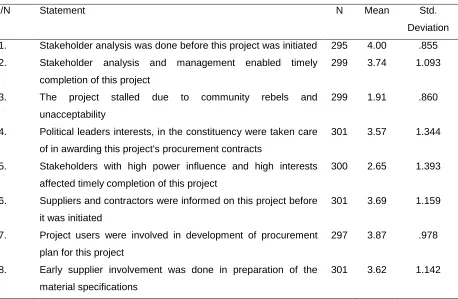
Licensed under Creative Common Page 355 Table 2. Stakeholder management
S/N Statement N Mean Std.
Deviation 1. Stakeholder analysis was done before this project was initiated 295 4.00 .855 2. Stakeholder analysis and management enabled timely
completion of this project
299 3.74 1.093
3. The project stalled due to community rebels and unacceptability
299 1.91 .860
4. Political leaders interests, in the constituency were taken care of in awarding this project's procurement contracts
301 3.57 1.344
5. Stakeholders with high power influence and high interests affected timely completion of this project
300 2.65 1.393
6. Suppliers and contractors were informed on this project before it was initiated
301 3.69 1.159
7. Project users were involved in development of procurement plan for this project
297 3.87 .978
8. Early supplier involvement was done in preparation of the material specifications
301 3.62 1.142
From the table above , a (x̅ =4) of the respondents agreed that stakeholder analysis was done before the CDF funded projects were initiated. This clearly shows that there was clear understanding that projects performance is affected by different stakeholders and all the stakeholders are not equally important thus the need to undertake stakeholder analysis and put in place strategies to manage the different categories of stakeholders.
The study findings concur with Moodley et al., (2008) who found out that, external stakeholder groups; clients, contractors/suppliers and end users were significantly more important than the other stakeholder groups. Further Mahmoud et al., (2014), stated that, stakeholder segmentation was important to enable relevant managerial strategy to be
Licensed under Creative Common Page 356 Correlation analysis
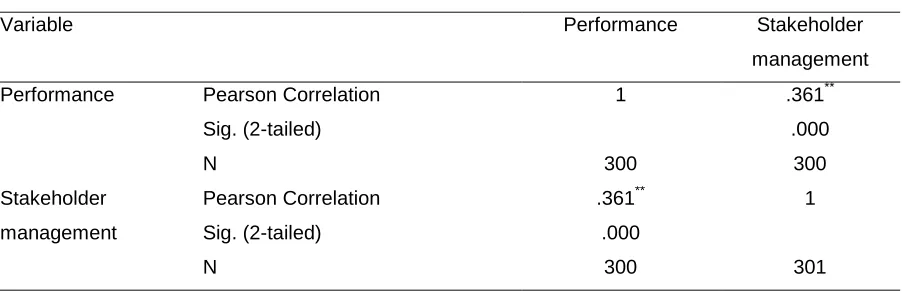
To determine the strength and direction of the linear relationship between stakeholder management and performance of projects funded by Constituency Development Fund, Pearson Product Moment Correlation was used and the results obtained are summarized in the below;
Table 3. Pearson Product-Moment Correlations between stakeholder management and performance of projects funded by CDF
Variable Performance Stakeholder
management
Performance Pearson Correlation 1 .361**
Sig. (2-tailed) .000
N 300 300
Stakeholder management
Pearson Correlation .361** 1
Sig. (2-tailed) .000
N 300 301
**. Correlation is significant at the 0.01 level (2-tailed).
The correlation between stakeholder management and performance of projects funded by CDF was investigated using Pearson product-moment correlation coefficient for which there was positive correlation (r>0.2, p<.001). The strength of the relationship between stakeholder management and performance of projects funded by CDF was medium (r=.361). This finding concurred with (Macharia, 2013) who found out that, involving stakeholders in project implementation as a way to manage them had a positive strong relationship with project success.
Regression results
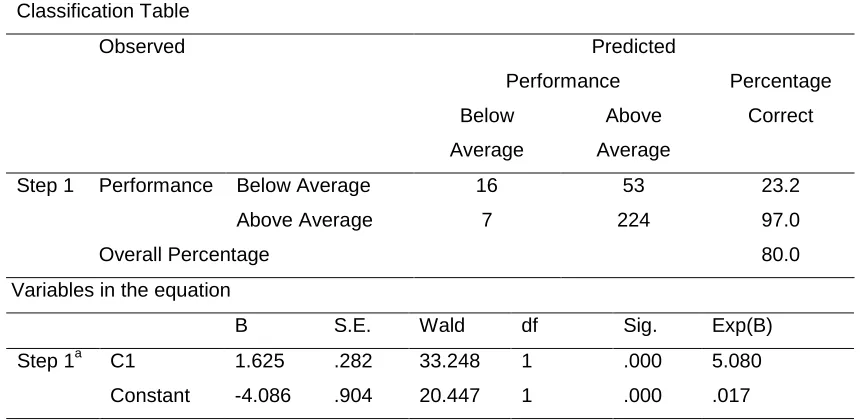
Table 4. Logistic regression for Stakeholder management Omnibus Tests of Model Coefficients
Chi-square df Sig.
Step 1 Step 39.434 1 .000
Block 39.434 1 .000
Model 39.434 1 .000
Model Summary
Step -2 Log likelihood Cox & Snell R Square Nagelkerke R2
Licensed under Creative Common Page 357 Classification Table
Observed Predicted
Performance Percentage Correct Below
Average
Above Average
Step 1 Performance Below Average 16 53 23.2
Above Average 7 224 97.0
Overall Percentage 80.0
Variables in the equation
B S.E. Wald df Sig. Exp(B) Step 1a C1 1.625 .282 33.248 1 .000 5.080
Constant -4.086 .904 20.447 1 .000 .017
Direct logistic regression was performed to assess how well the model performed. The Omnibus Tests of Model Coefficients gives us an overall indication of how well the model performed. In this case, the model with stakeholder management as a predictor variable was found to be significant (chi-square value=39.434, df=1, p<.001). Stakeholder management (X1) explained 12.3% of the variation in Y (Cox R square=.123) which is basically the probability of CDF project performance (success). In the classification table the predictor was able to achieve 80% of correct classification. The Variables in the Equation table gives information about the significance of the predictor variable which is used to test the hypothesis. The model is Y=Logit (p) =-4.086+1.625 (X1). Under the null hypothesis which is H01: 1=0 versus H1: 1≠0, we reject
the null hypothesis (1=1.625, Wald=33.248 df=1 p<.001) The odds ratio revealed that those projects where stakeholder management had been done were five times more likely to succeed than those where stakeholder management hadn‟t been done (Exp (B) =5.080).
These findings are in line with (Moodley, 2008) who found out that, contractors(suppliers), end users, consultants and the general public were the most important external stakeholders and had a (91%) probability of determining project success. This implied that the projects were stakeholders were not involved had a (9%) chance of success. Further the results obtained from this study also concur with (Malala, 2011) who reported that, 90% of the projects were not successfully implemented in Kikuyu Constituency and one of the main reasons cited by the respondents was lack of stakeholder involvement and management. Stakeholders have the ability to determine the project outcome through their action or inaction; therefore, they are the major determinants of project performance (success/failure) (Bourne, 2010).
Licensed under Creative Common Page 358 CONCLUSION AND RECOMMENDATIONS
From the study findings it was eminent that project end users contractors and suppliers were closely involved in the execution of most of projects funded by Constituency Development Fund. This led to the conclusion that, involvement of suppliers/contractors from the initiation of the projects, preparation of material specifications was a clear indicator that the project procurement committee members were not in cognizant of the supply market hence highly relying on the suppliers/ contractors market knowledge. Further establishing close rapport with suppliers/contractors appeared to be maliciously driven as in cases where the projects funded by Constituency Development Fund had stalled, one of the reason given was the contractor wasn‟t in agreement with the project committee members. Although there was more emphasis on involving suppliers/contractors and end users in execution of the projects funded by CDF, the management of stakeholders should not be left to the discretion of project committee. Thus there should be a framework that cuts across to ensure stakeholder management is done for all the projects funded by Constituency Development Fund nationally.
REFERENCES
Ambrose, M.D. & Tucker, S.N. (1999), “Matching a procurement system to client and project needs: a procurement system evaluator”, Bowen: P.A. and Hindle, R.D. (Eds).
Artto, K., Kujala, J., (2008). Project business as a research field. International Journal of Managing Projects in Business, 1(4), 469-497.
Atkin, B., & Skitmore, M., (2008). Editorial: stakeholder management in construction. Construction Management and Economics, 26(6), 549-552.
Atkinson, R. (1999). Project management: cost, time and quality, two best guesses and a phenomenon, its time to accept other success criteria. International Journal of Project Management, 17(6), 337-342.
Bienkowski, D. (1989) Ten Causes of Project Busts, Computerworld, Feb.13; 23, 6; ABI/INFORM Global. Bing, L., Akintoye, A., Edwards, P. J. & Hardcastle, C. (2005). The allocation of risk in PPP/PFI construction projects in the UK. International Journal of Project Management, 23, pp. 25-35.
Bourne, L. & Walker, D.T. (2005). Visualising and mapping stakeholder influence. Management Decision, 43 (5): 649 – 660.
Bourne, L. & Weaver, P. (2010). Mapping Stakeholders: Construction Stakeholder Management. Chichester: Backwell Publishing Ltd.
Brown, B., & Hyer, N., (2010). Managing Projects: A Team-Based Approach, International Edition, Singapore: Mc Graw- Hill.
Bunn, M. D., Savage G. T., & Holloway B. B. (2002).Stakeholder analysis for multi-sector innovations. Journal of Business and Industrial Marketing, 17 (2/3): 181 - 203.Cambridge Advanced Learner‟s Dictionary (2014). http://dictionary.cambridge.org/.
Chandra, P. (2010). Project Planning, Analysis, Selection, Financing, Implementation and Review (7th Ed.). New Delhi: Tata McGrawHill Education.
Licensed under Creative Common Page 359 Cova B., Salle R., (2005). Six key points to merge project marketing into project management. International Journal of Project Management, 23(5), 354-359.
Donaldson, T. & L. E. Preston (1995). The stakeholder theory of the corporation: concepts, evidence and implications. Academy of Management Review, 20 (1): 65 – 91.
Elias, A. A., Jackson L. S. & Cavana. R. Y. (2004).Changing positions and interests of stakeholders in environmental conflict: A New Zealand transport infrastructure case. Asia Pacific Viewpoint, 45 (1): 87 – 104.
Fassin, Y., (2009). The stakeholder model refined. Journal of Business Ethics, 84(1), 113-135.
Flaman, G. & Gallagher U. (2001). Assessment and Control of project Risks. Englewood Cliffs: Prentice-Hall.
Flyvbjerg, B., Bruzelius, N., & Rothengatter, W. (2003). Maga projects and Risk - An anatomy of ambition. Cambridge: Cambridge Unversity Press.
Freeman, R. E. (1984). Strategic Management: A stakeholder approach. Marshfield, MA:Pitman Books. Freeman, R. E. (1999). Divergent stakeholder theory. Academy of Management Review, 24 (2): 233 – 236.
Gikonyo, W. (2008). The CDF social audit guide: A handbook for communities. Open Society Initiative for East Africa: Nairobi.
Jagger, D. (1995), “Editor‟s introduction”, Journal of Construction Procurement, Vol. 2 No. 1, pp. 83-86. Jawahar, I.M., McLaughlin, G.L., (2001). Toward a descriptive stakeholder theory: An organizational life cycle approach. Academy of Management Review, 26(3), 397-414.
Jones, T. M. & A. C. Wicks (1999). Letter to AMR Regarding "Convergent Stakeholder Theory". Academy of Management Review, 24 (4): 621 - 623.
Kairu. P. (2014). Factors affecting effective implementation of CDF projects in Machakos Town Constituency. International Journal of Current Business and Social Sciences 1 (2).
Kamau, P. & Odhiambo, W. (2003) Public procurement: Lessons from Kenya, Tanzania and Uganda. OECD Development Centre, Working Paper No. 208.
Karlsen, J.T. (2008). Forming relationships with stakeholders in engineering projects, European Journal of Industrial Engineering, 2(1).
Kolltveit, B.J., Karlsen, J.T., & Gronhaug, K., (2007). Perspectives on project management. International Journal of Project Management 25(1), 3-9.
Kothari, C.(2004). Research Methodology: Methods and Techniques (2nd Ed.). New Delhi: New Age International.
Kutsch, E., Maylor, H., Weyer, B., & Lupson, J. (2011). Performers, trackers, lemmings and the lost : Sustained false optimism in forecasting project outcomes - Evidence from a quasi-experiment. International Journal of Project Management, 29(8), 1070-1081.
Leung, M. (2010). Risk and Construction Stakeholder Management, In: Chinyio, E. A. O., P. ed/eds. Chichester: Backwell Publishing Ltd.
Lim, G., H. Ahn & Lee. H. (2005). Formulating strategies for stakeholder management: a case based reasoning approach. Expert Systems with Applications, 28: 831 – 840.
Luu, D.T., & Chen, S.E. (2003), “Parameters governing the selection of procurement system – an empirical survey”, Engineering, Construction and Architectural Management, Vol. 10 No. 3, pp. 209-218. Mahmood, S.A.I. (2010). Public procurement and corruption in Bangladesh: confronting the challenges and opportunities. Journal of Public Administration and Policy Research 2(6):103–11.
Licensed under Creative Common Page 360 Malala .J. (2011). Effects of procurement on performance of constituency development fund projects in kenya: A case study of Kikuyu Constituency, (unpublished Msc Procurement & Logistics project) JKUAT, Nairobi, Kenya.
Manowong, E. & Ogunlana, S. (2010). Strategies and Tactics for Managing Construction Stakeholders, In: CHINYIO, E. A. O., P. ed/eds. Construction Stakeholder Management. Chichester: Backwell Publishing Ltd. pp. 121-137.
McElroy B., Mills, C., (2003). Managing Stakeholders: People in Project Management. Aldershot: Gower. Mitchell, R. K., Agle, B.R., & Wood, D.J., (1997). Toward a theory of stakeholder identification and salience: Defining the principle of who and what really counts. Academy of Management Review 22 (4), 853-886.
Moodley, K., Smith, N. & Preece, C. (2008). Stakeholder matrix for ethical relationships in the construction industry. Construction Management and Economics, 26, pp. 625-632.
Morris, P. (1994). The Management of Projects. London: Thomas Telford.
National Taxpayers Association (2012).Citizen‟s Constituency Development Fund Report Card for Machakos Town Constituency, Machakos County. Nairobi Kenya: Author.
Newcombe, R. (2003). From client to project stakeholders: a stakeholder mapping approach. Construction Management and Economics, 21: 841-848.
Nunnally, J. O. (1978). Psychometric theory. New York: McGraw-Hill.
Ogden, S. & Watson, R. (1999). Corporate performance and stakeholder management: Balancing shareholder and customer interests in the U.K. privatized water industry. Academy of Management Journal, 42 (5): 526 – 538.
Okungu, J, (2008). The beauty and shame of Kenya's Constituency Development Fund. [Online] Available: http:/www.afroarticles.com/article-dashboardarticle.php?id=6337&act=print.
Olander S., & Landin, A., (2005). Evaluation of stakeholder influence in the implementation of construction projects. International Journal of Project Management, 23(4), 321-328.
Ongoya, Z. & Lumallas, E. (2005). A critical appraisal of the Constituency Development Fund Act. Nairobi:Kenya.
Organization for Economic Co-operation and Development (OECD) (2007). SIGMA support for improvement in governance and management. Available at: http://sigmaweb.org (accessed on 14 April 2014).
Pinto, J.K., & Mantel, S.J. (1990). The causes of Project failure. IEEE Transaction on Engineering Management, 37(4), 269-276.
Project Management Institute, (2008). A Guide to the Project Management Book of Knowledge (PMBOK). 4th ed., Newtown Square, PA, Project Management Institute.
Radoli, M. (2008). “CDF. A double edged sword. ”The CDF Insight. Nairobi: Kenya.
Rowley, T.J., & Moldoveanu, M. (2003). When will stakeholder groups act? An interest- and identity-based model of stakeholder group mobilization. Academy of Management Review, 28(2), 204-219. Sharma, A., Sengupta, S., & Gupta, A. (2011). Exploring risk dimensions in the Indian software industry. Project Management Journal, 42(5), 78-91.
Shenhar, A. J., Dvir, D., Levy, O., & Maltz, A. C. (2001). Project Success: A Multidimensional Strategic Concept. Long Range Planning, 34(6), 699-725.
Shore, B. (2008). Project Culture and Systematic Biases in Project Failures. Project Management Journal, 39(4), 5-16.
Söderlund, J., (2004). On the broadening scope of the research on projects: a review and a model for analysis. International Journal of project management, 22(8), 655-667.
Licensed under Creative Common Page 361 The Institute for Social Accountability (2009).Gross illegalities in constituency development fund need urgent. Nairobi: Author.
The Institute of Social Accountability. (2009). The CDF Status Report December 2009. Report by The Institute for Social Accountability, Nairobi: Author.
Vinten, G. (2000). The stakeholder manager. Management Decision, 28 (6): 377 – 383.
Walker, D.H.T. & Rowlinson, S. (2008).Procurement Systems: A Project Management Perspective, New York: Taylor & Francis.
Wanjiru, G. (2008). The CDF Social Audit Guide: A Guide Handbook for Communities. Nairobi: Open Society Initiative of East Africa publication.
Winch, G.M., (2004). Managing project stakeholders. New Jersey: John Wiley & Sons Inc., Wiley.