INTRODUCTION
It is well known that various substances cause changes in the conformation of proteins when present in aqueous-protein solutions. The complex conformational and conûgurational factors affecting the structure of proteins in solution make the direct study of protein interactions difficult. Therefore,
www.orientjchem.org
An International Open Free Access, Peer Reviewed Research Journal
2014, Vol. 30, No. (1): Pg. 133-148
Thermo-acoustical Studies on Interionic Interactions
of Some α-amino Acids in Aqueous Sucrose Solution
at Varying Mass Percentages
S.THIRUMARAN* and N. KARTHIKEYAN
*Department of Physics (DDE), Annamalai University, Annamalai Nagar - 608 002, India. *Corresponding author E-mail: [email protected]
http://dx.doi.org/10.13005/ojc/300116
(Received: December 05, 2013; Accepted: January 29, 2014)
AbSTRACT
The present study deals with the structure-making and breaking behaviour of some alpha-amino acids in aqueous sucrose (disaccharide) solution at 301.15K. Experimental values of density, viscosity and speed of sound were carried out on the ternary mixtures of water +sucrose + amino acids namely (L-asparagine, L-glutamine L-serine and L-threonine) at 301.15K. The binary solvent mixtures was prepared by taking sucrose at different mass percentages, say at 0%, 5%, 10%, 15%, 20%, and 25% was added with water. The given amino acids under study were added with aqueous solvent under different molarities at normal atmospheric pressure. The related and relevant parameters correlated to our present study such as adiabatic compressibility (b), molar hydration number (nH), apparent molar compressibility (φK), apparent molar volume (φv), limiting apparent molar compressibility (φ0
K), limiting apparent molar volume (φ0V) and their associated constants (SK, SV), partial transfer volume (∆φ0V) from water to aqueous solution and viscosity B-Coefficient of Jones-Dole equations were meticulously evaluated and eventually this present study predicts dominance of hydrophilic –ionic interactions in the solution. Besides, our investigation also explores about the presence of possible interionic interactions such as solute-solvent, solute-solute, ion-solvent and ion-ion in the solution.
Key words: molar hydration number, solute-solvent, solute-solute, ion-solvent, viscosity B-Coefficient.
one useful approach is to investigate interactions of the model compounds of proteins, i.e., amino
acids in aqueous and mixed-aqueous solution 1-5.
and physiological processes in a living cell 6. Water
is chosen for preparing mixed solvent because its
presence gives rise to hydrophobic forces 7, which are
of prime importance in stabilizing the native globular structure of proteins. The interactions of water with the various functional groups of proteins are important factors in determining the conformational stability of
proteins2-4. The stabilization of native conformations
of biological macromolecules (proteins) is related to several non-covalent interactions including
hydrogen-bonding, electrostatic and hydrophobic interactions9,
10. These interactions are affected by the surrounding
solute and solvent molecules; for this reason, the physicochemical properties of proteins are strongly affected by the presence of these solutes. Because of direct solute–solvent interactions and/ or alteration of the water structure, these solutes can change many properties of globular proteins, such as their hydration, solubility and the activity
of enzymes1, 4, 5, 11and 12. These interactions are
important in understanding the stability of proteins, and are implicated in several biochemical and
physiological processes in a living cell13–16. The
protein–carbohydrate interactions are important for immunology, biosynthesis, pharmacology, medicine,
and cosmetic industry17- 18. Thus, the properties of
amino acids in aqueous-carbohydrate solutions are essential for understanding the chemistry of
biological systems 19-22.
Direct study of solute/solvent interactions is difficult due to complex conformation of biological
macromolecules5. Therefore, the convenient
approach is to study simpler model compounds i.e. amino acids and peptides, which are the basic
components of proteins5, 6. When dissolved in water
amino acids convert into zwitterionic forms due to the ionization of their carboxyl (“COOH) and amino
groups (NH2). In physiological media, this dipolar
character of amino acids has an important bearing on biological functions. Amino acids differ from each other in size, charge, hydrogen-bonding capacity, hydrophobicity and chemical reactivity. Hence, these side chains contribute to the structure and function
of proteins, individually and collectively 7.
The protein-carbohydrate interactions are important for immunology, biosynthesis,
pharmacology, medicine and cosmetic industry23,
17. Thus, the proper ties of amino acids in
aqueous-carbohydrate solutions are essential for understanding the chemistry of biological systems
18,19,24 have studied the volumetric, ultrasonic, and
viscometric behavior of L-histidine in aqueous
glucose solutions25 have studied the density,
viscosity, and speed of sound of diglycine in aqueous xylose, L(-)arabinose, and D(-)ribose solutions; in aqueous glucose, galatose, and fructose
solutions19 of L-alanine in aqueous fructose solutions2
and the density of L-alanine and L-valanine
in aqueous sucrose solutions26 have studied
the density, viscosity and ultrasonic velocity of L-serine, L-glutamine, and L-aspargine in aqueous glucose solutions.
To the best of our knowledge, no volumetric, ultrasonic, and viscometric studies have been reported on amino acids with polar uncharged side chain in aqueous carbohydrate solutions,
except the study by4 who investigated volumetric
and viscometric properties of arginine in aqueous-carbohydrate solutions. These considerations led
us to undertake the study of α-amino acids (with
polar uncharged R group) in aqueous-disaccharide solutions. In recent years, a number of workers have determined the various thermodynamic properties of these model compounds in aqueous solutions containing simple electrolytes having hydrophilic
nature 25, 3. But very few studies have been done in
aqueous disaccharide solutions 26, 4.
In the present study, we report the densities,
r ultrasonic speeds, u and viscosities, h of solutions
of α-amino acids in aqueous sucrose solvents taken
at regular intervals 0%, 5%, 10%, 15%, 20% and 25% of sucrose, at 301.15 K and at normal atmospheric pressure. An attempt has been carried out in the light following aspects:
Determination of adiabatic compressibility
(b), molar hydration number (nH) as a function of
molar concentration of α-amino acids in aqueous
sucrose solutions at 301.15K.
· Determination of apparent molar compressibility
(ϕk), apparent molar volume (ϕv), Limiting
apparent molar compressibility (ϕ0
K)
and its related constants (SK) limiting apparent
molar volume and its related constants (SV),
partial transfer volume (∆φ0
V) from water to
· To shed more details on the viscometric study, viscosity B-coefficient of Jones– Dole equation has also been evaluated.
Experimental methods
The α-Amino acids (SRL India, mass fraction
purity > 0.99) was used after re-crystallization from
ethanol–water mixture and dried in vacuum over P2O5
at room temperature for 72 h. Sucrose (E. Merck, Germany, mass fraction purity > 0.998) was used as such without further purification, except drying in oven for 24 h . The aqueous sucrose solutions 0%, 5%, 10%, 15%, 20% and 25% mass percentage of sucrose, were prepared using triple distilled water
(conductivity less than 1x10⁻⁶ S.cm-1) and these were
used as solvents and amino acids was added of six different molar concentrations (ranging from 0 to 0.1 in step of 0.02). The chemicals were weighed in an electronic digital balance (SHIMADZU AX-200, Japan Make) with a least count of 0.0001g. The density was determined using a 5ml specific gravity bottle by relative measurement method with an accuracy of
±0.01kgm-3. An Ostwald’s viscometer of 10ml capacity
was used for the viscosity measurement. Efflux time was determined using a digital chronometer within ±0.01s. An Ultrasonic interferometer having the fixed frequency of 2MHz (Mittal Enterprises, New
Delhi-Model: F-81) with an overall accuracy of ±0.1ms-1has
been used for velocity measurement. An electronically digital operated constant temperature bath (RAAGA industries, Chennai) has been used to circulate water through the double walled measuring cell made up of steel containing the experimental solution at desired temperature, whose accuracy is maintained at 0.1K.
RESULTS AND DISCUSSION
The values of density (r), viscosity (h) and
speed of sound (U) of α-amino acids in aqueous
sucrose solution at 301.15K are shown in Table 1. The related parameters such as adiabatic
compressibility (b), molar hydration number (hH),
apparent molar compressibility (ϕk), apparent molar
volume (ϕv), limiting apparent molar compressibility
(ϕk0), limiting apparent molar volume (ϕ0V) and their
associated constants (SK, SV), partial molar transfer
volume (∆ϕ0
V) and viscosity A and B-coefficient of
Jones-Dole equation were meticulously evaluated and are reported in Table (1-6).
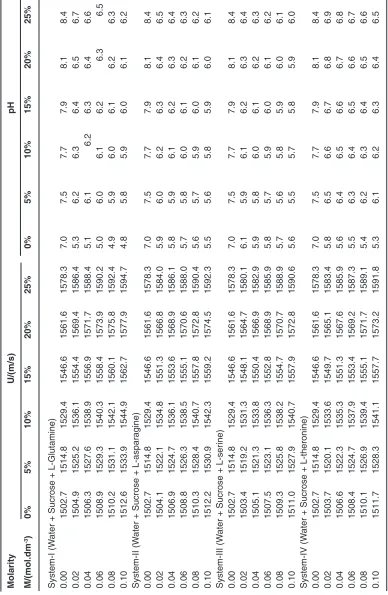
In the all four amino acid systems studied, (from Table-1) our present values of density increase with increase in molar concentration of amino acids as well as mass percentage of sucrose content. The other measured parameter ultrasonic velocity (U) which is also found (from Table-2) to be increased with increase in same concentration of amino acids as well as aqueous sucrose content. Such an observed increase in the ultrasonic velocity in these solutions may be attributed to the cohesion brought about by the ionic hydration; which may also be due to the overall increase of cohesion brought about by solute-solute and solute-solvent interaction in solution.
Incidentally, the density (r) which is a
measure of solute-solvent interactions, which can be attributed as increase of density with concentration indicates the increase in solute-solvent interactions, whereas the decrease in density indicates the lesser magnitude of solute-solvent interactions. Increase in density with concentration is due to the shrinkage in the volume which in turn is due to the presence of solute molecules. As observed in Table-1, an increasing trend of density values may be interpreted to the structure-making behavior of the solvent due
to the added solute 29.
In the present study, the measured pH values of aqueous solution were found to be less than 8.4 (Table-2) however, these pH values decreases, while increasing molarities of amino acids as well as mass percentage of the sucrose. This can be inferred that at the pH of the solution, the side-chains of the acidic amino acids studies are considered to exist mainly as Zwitterions in aqueous sucrose solution, having mainly the –OH groups. Sugar molecules such as glucose or sucrose is a polyhydroxy compound and its addition to amino acid (with short alkyl chains) aqueous solutions
were found to enhance the zwitterions (-CHCOO-
and NH3+) hydrophilic – OH group interactions and
almost eliminate the of hydrophilic – hydrophobic interactions between the –OH group of sucrose or water and non-polar alkyl chain of amino acids, at higher concentrations. Sucrose molecules have a ring structure and have several –OH groups. It may be infered that when amino acids are added with aqueous sucrose solution, the terminal groups of zwitterions
Tab
le 1:
V
alues of Density (
r
) and
Viscosity (
h
) of amino acids in aqueous Sucr
ose solution at 301.15K
Molarity Density( r )(kg/m 3) Viscosity ( h )/(×10
-3 Nsm -2) M/(mol.dm -3) 0% 5% 10% 15% 20% 25% 0% 5% 10% 15% 20% 25% System-I (W
ater + Sucrose + L-glutamine)
0.00 996.59 1007.48 1026.13 1042.46 1061.30 1080.41 0.8836 1.3967 1.5598 1.9232 2.3428 2.7624 0.02 999.94 1009.37 1028.91 1045.29 1065.33 1086.18 0.9099 1.3156 1.5737 1.9366 2.3609 2.7786 0.04 1001.03 1010.98 1029.81 1046.40 1066.54 1087.29 0.9162 1.3326 1.5862 1.9497 2.3734 2.7834 0.06 1002.19 1012.03 1030.89 1047.51 1067.76 1088.47 0.9223 1.3442 1.5992 1.9623 2.3853 2.7997 0.08 1003.43 1013.17 1031.96 1048.76 1068.96 1089.54 0.9291 1.3561 1.6106 1.9750 2.3978 2.8056 0.10 1004.52 1014.26 1032.99 1049.87 1069.99 1090.62 0.9389 1.3681 1.6227 1.9882 2.4108 2.8175 System-II (W
ater + Sucrose + L-aspar
agine) 0.00 996.59 1007.48 1026.13 1042.46 1061.30 1080.41 0.8836 1.2967 1.5598 1.9232 2.3428 2.7624 0.02 999.21 1008.96 1028.04 1044.48 1064.93 1085.38 0.9149 1.3291 1.5832 1.9465 2.3668 2.7893 0.04 1000.56 1010.01 1029.09 1045.62 1065.99 1086.59 0.9255 1.3411 1.5955 1.9590 2.3792 2.7984 0.06 1001.79 1011.11 1029.99 1046.70 1067.08 1087.66 0.9360 1.3531 1.6070 1.9706 2.3911 2.8023 0.08 1002.92 1012.26 1030.93 1047.98 1068.02 1088.74 0.9469 1.3652 1.6199 1.9824 2.4043 2.8167 0.10 1003.89 1013.98 1031.96 1048.95 1068.98 1089.82 0.9581 1.3773 1.6313 1.9948 2.4170 2.8245 System-III (W
ater + Sucrose + L-ser
ine) 0.00 996.59 1007.48 1026.13 1042.46 1061.30 1080.41 0.8836 1.2967 1.5598 1.9232 2.3428 2.7624 0.02 998.69 1007.01 1027.64 1043.04 1062.18 1081.27 0.9210 1.3484 1.6018 1.9660 2.3868 2.8012 0.04 1000.12 1008.69 1028.79 1044.71 1063.74 1083.21 0.9317 1.3595 1.6135 1.9779 2.3989 2.8124 0.06 1000.83 1010.96 1029.67 1046.13 1065.89 1085.29 0.9424 1.3714 1.6234 1.9901 2.4310 2.8218 0.08 1001.99 1011.94 1030.24 1047.37 1066.99 1087.72 0.9532 1.3829 1.6379 2.0018 2.4228 2.8329 0.10 1002.96 1012.86 1031.01 1048.39 1068.19 1088.78 0.9640 1.3944 1.6496 2.0140 2.4355 2.8423 System-IV (W
ater + Sucrose + L-theronine)
Tab
le 2:
V
alues of Ultrasonic velocity (U) and pH of amino acids in aqueous sucr
ose solution at 301.15K
Molarity U/(m/s) pH M/(mol.dm -3) 0% 5% 10% 15% 20% 25% 0% 5% 10% 15% 20% 25% System-I (W
ater + Sucrose + L-Glutamine)
0.00 1502.7 1514.8 1529.4 1546.6 1561.6 1578.3 7.0 7.5 7.7 7.9 8.1 8.4 0.02 1504.9 1525.2 1536.1 1554.4 1569.4 1586.4 5.3 6.2 6.3 6.4 6.5 6.7 0.04 1506.3 1527.6 1538.9 1556.9 1571.7 1588.4 5.1 6.1 6.2 6.3 6.4 6.6 0.06 1508.9 1529.3 1540.3 1558.4 1573.9 1590.2 5.0 6.0 6.1 6.2 6.3 6.5 0.08 1510.2 1531.1 1542.1 1560.1 1575.8 1592.4 4.9 5.9 6.0 6.1 6.2 6.3 0.10 1512.6 1533.9 1544.9 1562.7 1577.9 1594.7 4.8 5.8 5.9 6.0 6.1 6.2 System-II (W
ater + Sucrose + L-aspar
agine) 0.00 1502.7 1514.8 1529.4 1546.6 1561.6 1578.3 7.0 7.5 7.7 7.9 8.1 8.4 0.02 1504.1 1522.1 1534.8 1551.3 1566.8 1584.0 5.9 6.0 6.2 6.3 6.4 6.5 0.04 1506.9 1524.7 1536.1 1553.6 1568.9 1586.1 5.8 5.9 6.1 6.2 6.3 6.4 0.06 1508.8 1526.3 1538.5 1555.1 1570.6 1588.0 5.7 5.8 6.0 6.1 6.2 6.3 0.08 1510.3 1528.4 1540.7 1557.8 1572.8 1590.4 5.6 5.7 5.9 6.0 6.1 6.2 0.10 1512.2 1530.9 1542.3 1559.2 1574.5 1592.3 5.5 5.6 5.8 5.9 6.0 6.1 System-III (W
ater + Sucrose + L-ser
ine) 0.00 1502.7 1514.8 1529.4 1546.6 1561.6 1578.3 7.0 7.5 7.7 7.9 8.1 8.4 0.02 1503.4 1519.2 1531.3 1548.1 1564.7 1580.1 6.1 5.9 6.1 6.2 6.3 6.4 0.04 1505.1 1521.3 1533.8 1550.4 1566.9 1582.9 5.9 5.8 6.0 6.1 6.2 6.3 0.06 1507.5 1523.1 1536.3 1552.8 1568.9 1585.9 5.8 5.7 5.9 6.0 6.1 6.2 0.08 1509.3 1525.8 1538.2 1554.7 1570.7 1588.9 5.7 5.6 5.8 5.9 6.0 6.1 0.10 1511.0 1527.9 1540.7 1557.9 1572.8 1590.6 5.6 5.5 5.7 5.8 5.9 6.0 System-IV (W
ater + Sucrose + L-theronine)
Tab
le 3:
V
alues of Adiabatic compressibility (
b
) and Molar h
ydration n
umber (nH) of amino acids in aqueous sucr
ose solution at 301.15K
Molarity
Adiabatic compressibility
b
(x10
-10 m²N -1) Molar h ydration n umber (n H ) M/(mol.dm -3) 0% 5% 10% 15% 20% 25% 0% 5% 10% 15% 20% 25% System-I (W
ater + Sucrose + L-Glutamine)
0.00 4.4436 4.3256 4.1663 4.0103 3.8638 3.7156 - - - - - -0.02 4.4158 4.2588 4.1182 3.9594 3.8110 3.6582 17.36 43.75 31.53 35.12 37.72 41.15 0.04 4.4028 4.2387 4.1003 3.9425 3.7956 3.6453 13.28 28.30 21.79 23.24 24.24 25.94 0.06 4.3825 4.2249 4.0886 3.9308 3.7807 3.6331 12.77 21.90 17.15 18.23 19.73 20.34 0.08 4.3696 4.2102 4.0748 3.9175 3.7673 3.6195 12.64 20.78 16.71 17.57 18.97 19.62 0.10 4.3510 4.1904 4.0560 3.9004 3.7537 3.6055 11.81 17.11 14.63 15.21 15.78 16.39 System-II (W
ater + Sucrose + L-Aspar
agine) 0.00 4.4436 4.3257 4.1663 4.0103 3.8638 3.7156 - - - - - -0.02 4.4237 4.2779 4.1293 3.9784 3.8258 3.6720 14.72 31.24 24.62 22.06 27.70 32.38 0.04 4.4013 4.2589 4.1182 3.9623 3.8111 3.6582 13.19 21.84 15.99 16.58 18.83 21.31 0.06 4.3849 4.2454 4.1017 3.9505 3.7990 3.6459 12.22 17.53 14.30 13.77 15.45 17.25 0.08 4.3712 4.2289 4.0863 3.9320 3.7850 3.6313 11.29 15.84 13.29 13.45 14.09 15.65 0.10 4.3560 4.2080 4.0738 3.9214 3.7735 3.6190 10.93 15.09 12.30 12.28 12.91 14.35 System-III (W
ater + Sucrose + L-Ser
ine) 0.00 4.4436 4.3256 4.1663 4.0103 3.8638 3.7156 - - - - - -0.02 4.4301 4.3026 4.1499 4.0003 3.8453 3.7042 8.40 13.98 10.93 9.28 13.23 8.46 0.04 4.4138 4.2836 4.1317 3.9821 3.8289 3.6845 10.57 14.04 11.49 9.99 12.45 11.52 0.06 4.3966 4.2639 4.1148 3.9644 3.8115 3.6635 10.28 14.36 11.42 10.56 12.47 12.89 0.08 4.3811 4.2447 4.1023 3.9500 3.7988 3.6415 9.93 13.35 10.62 10.27 12.86 13.74 0.10 4.3670 4.2292 4.0860 3.9300 3.7844 3.6302 9.61 12.70 10.67 11.08 11.35 12.67 System-IV (W
ater + Sucrose + L-Theronine)
Table 4: Values of Apparent molar compressibility (
ϕ
k) and apparent molar v
olume (
ϕ
v) of amino acids in aqueous sucr
ose solution at 301.15K
Molarity Adiabatic compressibility φκ (x10 -10 m²N -1)
Apparent molar v
olume
ϕv
(× m³ mo¹)
M/(mol.dm -3) 0% 5% 10% 15% 20% 25% 0% 5% 10% 15% 20% 25% System-I (W
ater + Sucrose + L-glutamine)
0.00 - - - - - - - - - - - -0.02 -2.7011 -3.7441 -2.9362 -2.7064 -2.6500 -2.4953 -167.926 -143.424 -135.31 -87.632 -81.366 -81.778 0.04 -1.9382 -2.5480 -2.0227 -1.8826 -1.8221 -1.6678 -111.23 -111.630 -89.514 -70.366 -76.183 -66.506 0.06 -1.5970 -2.0036 -1.6173 -1.5222 -1.5198 -1.3835 -93.506 -91.759 -77.170 -64.610 -65.190 -62.495 0.08 -1.4640 -1.7471 -1.4390 -1.3673 -1.3482 -1.2541 -85.645 -82.941 -70.876 -63.411 -62.992 -59.217 0.10 -1.4302 -1.6431 -1.3764 -1.3081 -1.2599 -1.3186 -79.424 -77.153 -66.710 -61.348 -61.013 -57.342 System-II (W
ater + Sucrose + L-aspar
agine) 0.00 - - - - - - - - - - - -0.02 -1.5320 -2.7011 -2.2397 -1.6036 -1.5811 -1.8779 -131.315 -123.070 -92.939 -68.796 -38.978 -73.460 0.04 -1.4977 -1.9382 -1.5036 -1.3139 -1.2566 -1.3774 -99.457 -87.550 -71.986 -58.673 -46.751 -61.891 0.06 -1.3641 -1.5970 -1.3368 -1.1407 -1.0705 -1.1682 -86.830 -76.538 -62.566 -53.673 -43.532 -56.183 0.08 -1.2563 -1.4648 -1.2432 -1.1435 -1.0160 -1.0939 -79.263 -71.653 -58.343 -51.872 -42.511 -52.982 0.10 -1.2001 -1.4044 -1.1616 -1.0628 -0.9527 -0.9016 -73.117 -74.385 -56.686 -44.537 -40.203 -51.709 System-III (W
ater + Sucrose + L-ser
ine) 0.00 - - - - - - - -0.02 -1.1391 -1.2643 -1.1280 -0.6416 -0.8660 -0.6480 -105.239 -56.017 -43.461 -20.258 -13.079 -30.433 0.04 -1.1137 -1.2876 -1.1355 -0.7300 -0.8791 -0.8112 -88.432 -59.992 -47.441 -29.862 -29.097 -36.681 0.06 -1.0965 -1.3495 -1.0980 -0.8688 -0.9222 -0.9000 -70.788 -61.316 -49.950 -41.613 -42.131 -41.694 0.08 -1.0954 -1.3589 -1.1077 -0.8939 -0.8774 -0.9425 -67.611 -67.692 -57.381 -46.770 -42.170 -44.085 0.10 -1.0490 -1.2798 -1.1096 -0.9549 -0.8222 -0.9047 -63.798 -68.437 -64.690 -47.177 -35.598 -45.150 System-IV (W
ater + Sucrose + L-theronine
Table 5: Values of Limiting apparent molar compressibility (0
K) and limiting apparent molar
volume 0
V and their constant Sk and Sv of amino acids in aqueous sucrose at 301.15 K
Amino Water + 0
K(×10-8 Sk (×10-8 N-1 0v(× m³ Sv (×10-8 N-1
acids sucrose m²N-1) m¹ mol-1) mol-1) m¹ mol-1)
L-glutamine 0% -17.34 87.58 -246.74 584.84
5% -57.21 142.17 -232.37 462.49
10% -44.07 106.26 -195.63 452.57
15% -42.52 97.54 -113.64 185.45
20% -39.44 93.45 -108.01 161.29
25% -35.58 81.29 -106.25 171.39
L-asparagine 0% -18.84 21.62 -188.12 395.42
5% -39.32 88.71 -167.40 339.35
10% -31.77 70.58 -128.93 253.90
15% -21.47 37.55 -88.04 138.07
20% -22.18 43.83 -45.15 11.59
25% -27.99 63.65 -781.20 245.17
L-serine 0% -12.87 7.74 -150.80 300.96
5% -13.75 0.47 46.76 -66.94
10% -11.90 10.27 61.58 -12.57
15% 18.60 -5.31 72.86 -178.61
20% 9.75 4.26 4.61 -155.56
25% -15.41 -4.75 -87.48 -18.78
L-threonine 0% -18.98 26.94 -185.08 404.80
5% -29.52 65.17 -159.66 310.41
10% -27.05 57.35 -129.81 272.83
15% -5.76 12.48 -86.25 192.17
20% -14.70 20.13 -35.30 19.76
25% -35.30 19.76 -8.49 -18.42
electrostatic manner whereas, hydration of R group depends on its nature, which may be hydrophilic, hydrophobic or amphiphilic; and the overlap of
hydration co-spheres of terminal NH3+ and COO
-groups and of adjacent -groups results in volume change. This may increase due to reduction in the electrostriction at terminals, whereas it decreases due to disruption of side group hydration by that of
the charged end 30.
The adiabatic compressibility (b) of the
solute can be expressed as the extent to which hydration around the solute molecule can be expressed. The perusal of Table-3 exhibits the values
of adiabatic compressibility (b), which are found to
be decreased with increase in molar concentration of solute (aminoacids) as well as mass percentage of sucrose content. Such a decrease in adiabatic compressibility observed in solvent (aqueous
molecules may also be the reason for decrease in
compressibility31. The present investigation finds that
b values are larger in L-serine system comparing
other amino acid systems, advocating the strong molecular association in this system.
The Molar hydration number (nH) has been
evaluated from
−
=
0 2
1
1
b
b
n
n
n
HWhere b and b0 are adiabatic compressibility
of solution and solvent respectively, n1 and n2 are
number of moles of solvent and solute respectively.
The hydration number (nH) reflecting the
electrostriction effect of the charged centre of the
amino acid and in the vicinity of the water molecules. From Table-3, one can observe that the values of
nH are positive in all the four liquid systems and
such positive values of nH indicate an appreciable
salvation of solutes 30. It can be taken as an added
support for the structure making nature of solutes as well as the presence of dipolar interactions between the solutes and water molecules. This sensitive parameter also suggests that the compressibility of the solution will be less than that of the solvent, resulting in solutes will gain more mobility and have a more probability of contacting solvent molecules, which in turn may enhance the interaction between the solute solvent molecules. Our present study
finds that the values of nH which are decreasing
with increasing molar concentration of solute (amino acids) and however, found to be increased with elevation of mass percentage of sucrose. This may suggest that an enhancement of solute-co solute
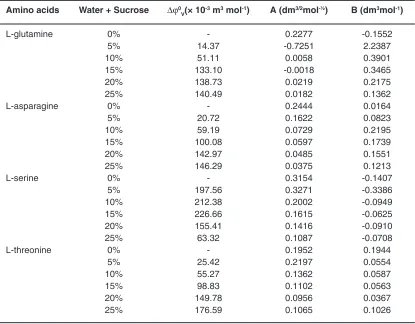
Table 6 Values of Partial transfer volume (∆ϕ0
V), A and b coefficient of Jones
-Dole equation of amino acids in aqueous sucrose solution at 301.15 K Amino acids Water + Sucrose ∆ϕ0
V(× 10-3 m3 mol-1) A (dm3/2mol-½) b (dm3mol-1)
L-glutamine 0% - 0.2277 -0.1552
5% 14.37 -0.7251 2.2387
10% 51.11 0.0058 0.3901
15% 133.10 -0.0018 0.3465
20% 138.73 0.0219 0.2175
25% 140.49 0.0182 0.1362
L-asparagine 0% - 0.2444 0.0164
5% 20.72 0.1622 0.0823
10% 59.19 0.0729 0.2195
15% 100.08 0.0597 0.1739
20% 142.97 0.0485 0.1551
25% 146.29 0.0375 0.1213
L-serine 0% - 0.3154 -0.1407
5% 197.56 0.3271 -0.3386
10% 212.38 0.2002 -0.0949
15% 226.66 0.1615 -0.0625
20% 155.41 0.1416 -0.0910
25% 63.32 0.1087 -0.0708
L-threonine 0% - 0.1952 0.1944
5% 25.42 0.2197 0.0554
10% 55.27 0.1362 0.0587
15% 98.83 0.1102 0.0563
20% 149.78 0.0956 0.0367
interactions in the mixture. The decreasing values
of nH may be presumed as that the strength of the
interactions may be weakened among the solute-co solute molecules.
Molar compressibility studies
The apparent molar compressibility (ϕK) of
the solute is given by the relation
in which, m is the molarity of the solution (mol.dm-3),
ro is the density of the solvent (kgm-3) and r is the
density of the solute, bo and b are the adiabatic
compressibility of the solvent and solution, M is the
molar mass of the solute (kg.mol-1) respectively.
The apparent molar volume (φV) of amino
acids has been calculated from the density values of solvent and solution using the relation.
Where m is the molarity of the solution (mol.
dm-3), M is the molar mass of the solute (kg.mol-1)
and, o and are the density values of the solvent
and solution respectively.
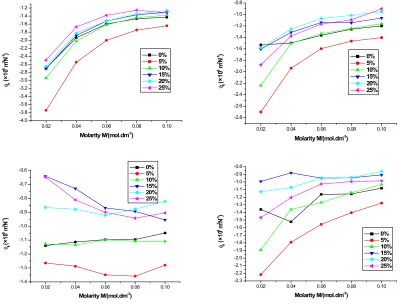
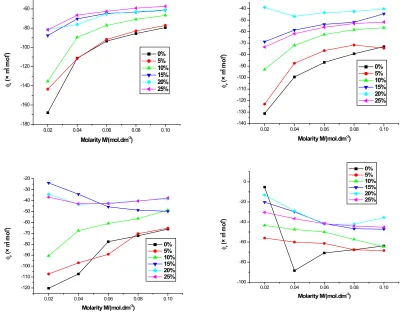
The following observations are noticed
from Table- 4 on apparent molar compressibility (ϕK)
and apparent molar volume (ϕV) of α-amino acids in
aqueous sucrose at 301.15K.
(i) T h e va l u e s o f t h e a p p a r e n t m o l a r
compressibility (φK) and apparent molar
volume (φV) are all negative over the entire
molarity range of amino acids (solute).
(ii) The values of apparent molar compressibility
(φK) are found to be increased with increasing
molarity (m) of solute (amino acids).
(iii) It is also interesting to note that apparent
Fig. 1: Apparent molar compressibility (φK) Vs Molarity (M)
0.02 0.04 0.06 0.08 0.10
-4.0 -3.8 -3.6 -3.4 -3.2 -3.0 -2.8 -2.6 -2.4 -2.2 -2.0 -1.8 -1.6 -1.4 -1.2
φk
(×10
-8 m 2N -1)
Molarity M/(mol.dm-3) 0% 5% 10% 15% 20% 25%
0.02 0.04 0.06 0.08 0.10
-2.8 -2.6 -2.4 -2.2 -2.0 -1.8 -1.6 -1.4 -1.2 -1.0 -0.8
φk
(×10
-8 m 2N -1)
Molarity M/(mol.dm-3)
0% 5% 10% 15% 20% 25%
0.02 0.04 0.06 0.08 0.10
-1.4 -1.3 -1.2 -1.1 -1.0 -0.9 -0.8 -0.7 -0.6
φk
(×10
-8 m
2N
-1)
Molarity M/(mol.dm-3) 0% 5% 10% 15% 20% 25%
0.02 0.04 0.06 0.08 0.10
-2.3 -2.2 -2.1 -2.0 -1.9 -1.8 -1.7 -1.6 -1.5 -1.4 -1.3 -1.2 -1.1 -1.0 -0.9 -0.8
φk
(×10
-8 m 2N -1)
Molarity M/(mol.dm-3)
molar volume (φV) too exhibits the same trend
as that of the apparent molar compressibility
(φK).
(iv) However, one can notice from the Table-4,
both the values of φK as well as φV in L-serine
system decreases with molar concentration of the amino acids, and the same increase with increase of mass percentage of the sucrose content.
(v) Our present investigation observes the values
of apparent molar compressibility (φK) and
apparent molar volume (φV) are higher in
L-serine system over the other amino acids, indicating the molecular association is more pronounced in this system.
The above observations clearly suggesting the existence of solute-solvent interaction in the solution. The negative values of apparent molar compressibility indicate the hydrophilic interactions
occurring in these systems. Since, more number of water molecules are available at lower concentration of aqueous sucrose, the chances for the penetration of solute molecules in the solvent molecules are
highly 31 favored. The decreasing values of apparent
molar compressibility and molar volume in L-serine system with increasing molar concentration of solute and solvent content in aqueous medium reveal the strengthening of the solute-solvent interaction.
The values of Limiting apparent molar
compressibility φk0 in the present study, have been
fitted by Least-squares method with the equation
Where φk0 is the limiting apparent molar
compressibility at infinite dilution and Sk is its
associated constant.
Fig. 2: Apparent molar volume (φv) Vs Molarity (M)
0.02 0.04 0.06 0.08 0.10
-180 -160 -140 -120 -100 -80 -60
φv
(× m
3 mol -1)
Molarity M/(mol.dm-3)
0% 5% 10% 15% 20% 25%
0.02 0.04 0.06 0.08 0.10
-140 -130 -120 -110 -100 -90 -80 -70 -60 -50 -40
φv
(× m
3 mol -1)
Molarity M/(mol.dm-3)
0% 5% 10% 15% 20% 25%
0.02 0.04 0.06 0.08 0.10
-120 -110 -100 -90 -80 -70 -60 -50 -40 -30 -20
φv
(× m
3 mol -1)
Molarity M/(mol.dm-3)
0% 5% 10% 15% 20% 25%
0.02 0.04 0.06 0.08 0.10
-100 -80 -60 -40 -20 0
φv
(× m
3 mol -1)
The evaluated former parameter Limiting
apparent molar compressibility (ϕk0) which is
concerned with the ion-solvent interactions and its
later related constant (SK) of the ion-ion interactions
in the solution, which are systematically tabulated
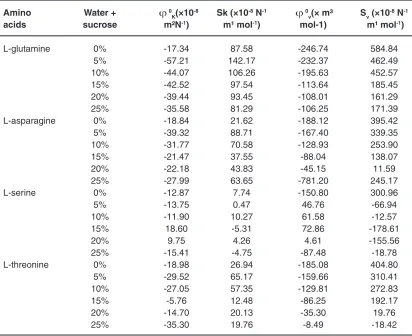
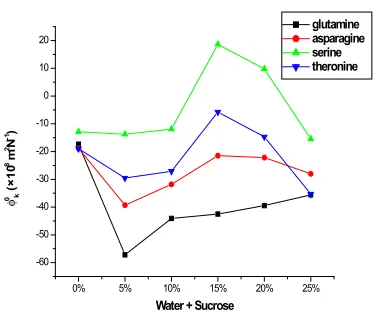
in Table-5. It is noticed that the ϕk0 values are
negative in all the four liquid systems and increase with increase of mass percentage of sucrose content.
From fig-III, the negative values of φk0 for all the
systems, and their increasing trend in the present study suggesting the existence of strong ion-solvent
interactions. The related constant (SK) whose values
are positive in all the systems and however decrease with elevation of sucrose content. Such a decreasing
trend of positive values of SK indicates the weakening
of ion-ion interactions in the solution. The apparent
molar compressibility (ϕk0) values are found to be
higher in L-serine system indicating that molecular association is more pronounced in this system.
The limiting apparent molar volume (φv0)
in the present study have been fitted by method of Least-squares with the equation
Where v0 is the limiting apparent molar
volume at infinite dilution and Svis its associated
constant.
The perusal of Table-5 depicts the values
of limiting apparent molar volume (φv0) furnishing
negative values in all the systems except in system-III, where as reverse trend is observed. And however all the systems increase with increase of mass percentage of sucrose content. Our present
study notices that the large values of φv0 observed
in L-serine system comparing the other amino acid systems. The electrostriction at Zwitterionic terminals due to ionic-hydrophilic interactions between the Zwitterionic centre of L-serine and the –OH group of sucrose molecules decreases, which
in turn, causing the larger values of φv0 of L-serine
in aqueous solution. Such large values of φv0 in
L-serine in aqueous sucrose solution is due to the strong hydrophilic-ionic interactions in the solution, as sucrose molecule contains a larger number of -OH groups than other disaccharides. Further, it is evident from the same Table-5 that the increasing
trend of φv0 values, suggesting the strong ion-solvent
interaction in the solution.
The possession of such large of φv0 in
L-serine system clearly establishing that it serves as an effective structure-maker in the mixture. As
seen from the table-5, the values of Sv are positive
in all liquid systems and except in L-serine system, where it is found to be decreased with increase of mass percentage of sucrose. Such a decreasing of
positive values of Sv clearly indicates the presence
of weak ion-ion interactions in the solution34,24.
Fig. 3: Limiting apparent molar compressibility (φ0
V) Vs mass percentage of sucrose at 301.15K
Fig. 4: Limiting apparent molar volume (φ0 V) Vs
mass percentage of sucrose at 301.15K
0% 5% 10% 15% 20% 25%
-60 -50 -40 -30 -20 -10 0 10 20
φ
0 k (×10 -8 m 2N -1)
Water + Sucrose
glutamine asparagine serine theronine
0% 5% 10% 15% 20% 25%
-260 -240 -220 -200 -180 -160 -140 -120 -100-80 -60 -40 -200 20 40 60 80 100
φ
o v (× m 3 mol -1)
Water + Sucrose
Partial transfer volume studies
The Partial molar transfer volume (∆ϕ0
V), of
amino acids from water to aqueous sucrose solution at a given temperature quoted as.
∆ϕ0
V = ϕ0V = (in aqueous solution) - (in water)
Where ∆φv0 denotes the transfer volume.
The present investigation observes that
the partial transfer volume (∆φv0) exhibit positive
deviations in all the four liquid systems and increase with elevation of mass percentage of sucrose content except in L-serine, (From Table-6) where it shows a reverse trend.
The increasing behavior of partial transfer
volume values (∆φv0) shows stronger and more
extensive interactions between amino acids (co-solute) and sucrose ((co-solute) and vice versa. It
is interesting to note that large value of ∆ϕ0
V are
observed in L-serine system The electrostriction at zwitterionic terminals due to ionic-hydrophilic interactions between the zwitterionic centre of amino acids and the –OH group of sucrose molecules decrease, which in turn, cause the larger values of
“öv0 are dominant in L-serine system over the other
co-solutes, which is attributed due to the existence of strong hydrophilic-ionic interaction
The partial transfer volume (∆φv0) can
be explained on the basis of Co-Sphere Overlap
Model33 The overlap of ions of co-solute (amino
acids) and solute (sucrose) comes into play because of the interaction between (i) ions of
solute (amino acids) and hydrophilic, -OH sites of disaccharide (sucrose) molecules, and (ii) ions of co-solutes (disaccharide) and the hydrophobic parts/ groups of amino acid molecules. Out of which, the former type of interactions contributes positively, and
later type of interactions to negatively to ∆φv0 values.
The possession of positive values of ∆φv0 indicates
the dominance of hydrophilic–ionic interactions. This may be further interpreted as the overlap of hydration co-spheres of two ionic species results in an enhanced volume as some electrostricted water molecules return to the bulk water with a higher volume contribution then electrostricted water molecules; whereas, overlap of hydration co-spheres of hydrophobic- hydrophobic groups and ion- hydrophobic/hydrophilic- hydrophobic groups and results in a net volume decrease. This may due to greater hydrophilic- ionic groups and hydrophilic- hydrophilic groups interactions, with the presence of more hydroxyl groups in sucrose
molecules. Incidentally, the larger values of ∆φv0
are observed in L-serine system comparing its other co-solutes. Hence it is very ambiguous that L-serine identified as an effective structure maker in aqueous sucrose solution as it enhances all possible interionic interactions such as solute-solvent, ion-solvent, solute-co solute etc (except ion-ion) in the mixture. Hence it is very obvious that of all the amino acids, L-serine is an effective structure maker in the present system of the mixture. Similar trend is already noticed by earlier workers, supports our
present study 25, 33.
In general, the following types of interaction occurring between amino acids and sucrose can be
classified as follows36-39
1. The hydrophilic- ionic interaction between OH
groups of sucrose and zwitterions of amino acids.
2. Hydrophilic- hydrophilic interaction between
OH groups of sucrose and OH groups in the side chain of amino acids.
3. Hydrophobic- hydrophilic interaction between
OH groups of sucrose molecule and polar
(-CH2) in the side chain of amino acid
molecule.
4. Hydrophobic- hydrophobic group interaction
between the non-polar groups of sucrose and
polar (-CH2) in the side chain of amino acid
molecule. Fig. 5: Transfer volume (∆ϕ0
V) Vs mass
percentage of sucrose at 301.15 K
5% 10% 15% 20% 25%
0 20 40 60 80 100 120 140 160 180 200 220 240
∆φ
0 v (×10 -8 m 2N -1)
Water + Sucrose
Viscometric studies
We have incorporated the viscometric study
by employing the Jones-Dole equation40.
h/h0 = 1=Am1/2+Bm
Where h and h0 are the viscosities of the
solution and solvent respectively, m is the molar
concentration (mol.dm-3) of the solute. A and B are
constants which predict for a solute-solvent system. A is known as the Falkenhagen co-efficient which characteristics the ionic interaction in the solution and B is the Jones-Dole (or) viscosity B co-efficient, which depends on the size of the solute and the nature of the solute-solvent interactions.
Viscosity is one of the key transport properties of the solutions. Accurate viscosity data give useful information regarding ion-solvent interactions (long-range electrostatic interaction), which are the controlling force in dilute solutions. Viscosity data are necessary to calculate the physical parameters of Jones-Dole equation, which
apply to analyze the experimental data40-41. In the
present study, the values of B for all studied system are positive and the positive values of the B co-efficient is attributed with structure making (ordering) ions. Our present study finds that the viscosity B co-efficient values are decreasing with increase mass percentage of sucrose content. However, in L-serine system, an increasing trend in observed. It is obvious that the increasing positive values of B in this system clearly attribute the dominance of solute-solvent interactions comparing the other three liquid systems.
For identifying the ionic interactions existing in the mixture, which is reflected by the values of A in the present investigation are all positive and decrease with increase of mass percentage of sucrose content (From Table-6), which clearly depicts the weakening of ion-ion interaction in the mixture. This is in well agreement with our earlier conclusion
drawn from the associated constants of Sk and Sv.
CONCLUSION
The acoustical behaviors of α-amino acids
in aqueous disaccharide (sucrose) at 301.15 K have been investigated and are summarized as,
1. It is obvious that L-serine serves as an
effective structure - maker in the aqueous saccharide solution.
2. The addition of solute (amino acids) in the
solvent enhances strong molecular interionic interactions such as ion-solvent, solute-solute, and solute-solvent etc., in the present systems of mixtures. and however a weak ion-ion interaction are observed.
3. Our viscometry study lends another fine
support about the existence of strong solute-solvent interactions in the solution.
4. The trends of partial transfer volume studies
predicting the dominance of ionic-hydrophilic interactions in the mixture.
5. Such predominating ionic-hydrophilic
interactions between solute-cosolute are larger in L-serine system comparing the other co-solute systems.
REFERENCES
1. Banipal T. S., Kaur, J. andBanipal, P. K. “Study
of interactions between amino acids and zinc chloride in aqueous solutions through volumetric measurments at T=(288.15 to 318.15)K” . J. Chem. Eng.Data. 53: 1803-1816 (2008).
2. Pal, A., Kumar, S. “Volumetric properties of
L-alanine, and L-valine in aqueous sucrose
soluions at T= (288.15 and 308.15)K” . J.
Chem. Thermodyn. 35: 1085-1092 (2005).
3. Nain, A. K. and Chand, D. “Volumetric,
ultrasonic, and viscometric behavior of glycine, DL-alanine, and L-valine inaqueous 1,4-butanediol solutions at different temperatures”. J. Chem.Thermodyn. 41: 243-249 (2009).
4. Zhao, C.,Ma, P. andLi, J. “Partial molar volumes
and viscosity coefficients of arginine in aqueous glucose, sucrose and L-ascorbic acid solutions at 298.15K”. J. Chem. Thermodyn. 37: 37-42 (2005).
5. Zhuo, K.,Liu, Q., Yang, Y., Ren, Q. andWang,
Monosaccharides in Aqueous Amino Acid
Solutions at 298.15K”. J. Chem. Eng. Data.
51: 919-927 (2006).
6. Thirumaran S. and Job sabu, K. “Ultrasonic
studies on interionic interactions of some alkali metal halides in aqueous d-glucose solution at varying molarities and temperatures” J.Exp. sci. 3(1): 33-39 (2012).
7. Roneron C. M., Moreno, E. and Rojas, J. L.
“Apparent molar volumes and viscosities
of dl-α-alanine in water-alcohol mixtures”.
Thermochim.Acta. 328, 33-38(1999).
8. Yan, Z., Wang, J., Kong, W. and Lu, J. “Effect
of temperature on volumetric and viscosity
properties of some α-amino acids in aqueous
calcium chloride solutions”. Fluid Phase
Equilibria. 215(2): 143-150 (2004).
9. P.H. Von Hippel, T. Schleich, “Ion effects
on the solution structure of biological
macromolecules”. Accounts Chem. Res. 2:
257-265 (1969).
10. F. Franks, “Protein stability: the value of ‘old
literature”. Biophys. Chem. 96: 117–127
(2002).
11. S. Thirumaran and P. Inbam, “Thermodynamic
and transport studies on some basic amino acids in aqueous sodium acetate solution at different temperatures”. Ind.J.Pure.Appl.Phy. 49: 451-459 (2011).
12. Riyazuddeen, M.A. Usmani, “Interactions in
(l-alanine/l-threonine + aqueous glucose/ aqueous sucrose) systems at (298.15– 323.15) K”. Thermochim. Acta. 527: 112–117 (2012).
13. K. Zhuo, Q. Liu, Y. Yang, Q. Ren, J. Wang,
“Volumetric and Viscosity Properties of Monosaccharides in Aqueous Amino Acid Solutions at 298.15 K”. J. Chem. Eng. Data. 51: 919-927 (2006).
14. A.M. Ronero, E. Moreno, J.L. Rojas, “Apparent
molal volumes and viscosities of dl-α-alanine
in water–alcohol mixtures”. Thermochim.
Acta. 328: 33–38 (1999).
15. S Thirumaran and K.Job sabu, “Ultrasonic
investigation of amino acids in aqueous Sodium acetate medium”. Ind. J. Pure. Appl. Phy. 49: 87-96 (2011).
16. K. Gekko, “Mecbanism of Polyol-Induced
Protein Stabilization: Solubility of Amino acids and Diglycine in Aqueous Polyol Solutions”. J.
Biochem. 90: 1633-1641(1981).
17. F.J. Millero, A. Lo Surdo, C. Shin, “The
apparent molal volumes and adiabatic compressibilities of aqueous amino acids at
25.degree.C”. J. Phys. Chem. 82: 784-792
(1978).
18. M. Wusteman, S. Boylen, D.E. Pegg,
Cryobiology 33: 423–429(1996).
19. S. Li, W. Sang, R. Lin, “Partial molar volumes
of glycine, l-alanine, and l-serine in aqueous glucose solutions at T=298.15 K”. J. Chem. Thermodyn. 34: 1761–1768(2002).
20. A. Pal, N. Chauhan, “Densities, speeds of
sound and viscosities of L-alanine in aqueous fructose, maltose and lactose solutions at
different temperatures”. Indian J. Chem. 48A:
1069–1077(2009).
21. J. Bhavsar, B. Bhaskar and A. Kumar, Orient
J. Chem., 29(1): 241-246 (2013).
22. A.V.L.N.S.H. Hariharan, Ch. Sudhakar and
B.V. Rao, Orient J. Chem., 28(4): 1785-1790 (2012).
23. Metzler, D. E. “The Chemical Reactions
of Living Cells”. vol.1,Academic Press, NewYork.
24. Parfenyuk, E. V.,Davydova, O.I., Lebedeva,
N.S. “Interaction of D-maltose and sucrose with some amino acids in aqueous solutions”. J.Soln.Chem. 33: 1-10 (2004).
25. Nain, A. K., pal, R. and sharma R. K.
“Volumetric, ultrasonic and viscometric behavior of L histidine in aqueous glucose solutions at different temperatures”. J. Chem. Thermodyn. 43: 603-612(2011).
26. Palani, R. and Geetha, A. “Acoustical and
thermodynamical studies of L-glutamine and L-asparagine in aqueous D-glucose solutions
at 298.15K”. Res.Jou.of.Phys.1(2): 82-89
(2007).
27. Harutyunyan, N. G., Harutyunyan, L. R. and
Harutyunyan, R. S. “Volumetric properties of amino acids in aqueous solution of non ionic surfactant”. Thermochim. Acta. 498: 124–127 (2010).
28. Ali, A., Hyder, S., Sabir, S., Chand, D. and
Nain, A. “ Volumetric, viscometric, and
refractive index behaviour of α-amino acids
29. Thirumaran, S. and Mary, Christina Gardilya, D. “Volumetric and ultrasonic studies on interionic interactions of some amino acids in aqueous magnesium acetate medium at 306.15K”. Rect.Res.Sci.and.Tech. 3(8): 56-63 (2011).
30. Anil Kumar Nain and Renu Pal. “Volumetric,
Ultrasonic and Viscometric studies of solute-solute and solute-solute-solvent interactions of l-theronine in aqueous- sucrose solutions at different temperatures”. J. Chem. Thermodyn. 64: 172-181 (2013).
31. Thirumaran, S. and Prakash, N. “Volumetric
and acoustical behaviour of some amino acids in aqueous magnesium acetate medium”. J. Indian Chem.Soc. 89: 497-505 (2012).
32. Mehra, R., and Sajnami, H. “Acoustical studies
in ternary electrolytic mixtures at 25, 35 and
45°C”. Ind.J.PureAppl.Phy. 38: 762-765
(2000).
33. Thirumaran, S. and Job sabu, K.
“Structure-making and breaking behaviour of some
α-amino acids in aqueous sodium butyrate
medium at 298.15K”. J.Appl.sci. 11(18): 3258-3266 (2011).
34. Riyazuddeen and MohdAmilusmani.
“Densities, speeds of sound, and viscosities of (L-proline + Aqueous glucose) and (L-proline + Aqueous sucrose) solutions in the temperature range (298.15 to 323.15K)”. J. Chem.Eng.Data. 56: 3504-3509 (2011).
35. Gurney, R.W. ” Ionic processes in solution”.
McGraw Hill bookco.,Inc, Newyork., 275-284 (1953).
36. G.R. Hedwig, H. Hoiland, “Thermodynamic
properties of peptide solutions Partial molar isentropic pressure coefficients in aqueous solutions of sequence isomeric tripeptides
with a single -CH3 side-chain”. J. Chem.
Thermodyn. 25: 349–354 (1993).
37. A.K. Mishra, J.C. Ahluwalia, “Apparent molal
volumes of amino acids, N-acetylamino acids, and peptides in aqueous solutions”. J. Phys. Chem. 88: 86-92 (1984).
38. S.Banerjee, N. Kishore, “Interactions of Some
Amino Acids with Aqueous Tetraethylammonium Bromide at 298.15 K: A Volumetric Approach”. J. Solution Chem. 34: 137-153 (2005).
39. R. Bhat, N. Kishore, J.C. Ahluwalia,
“Thermodynamic studies of transfer of some amino acids and peptides from water to aqueous glucose and sucrose solutions at
298.15 K”. J. Chem. Soc., Faraday Trans. 188:
2651-2665 (1988).
40. Jones, G., and Dole, M. “The viscosity of
aqueous solutions of strong electroytes with special reference to barium chloride”. J.Am. Chem.Soc. 51: 2950-2964 (1929).
41. Shahjahan, A. “Volumetric and viscometric