E-Banking Satisfaction and Post-Adoption
Behavior in Saudi Arabia: An Empirical Study
Najmul Hoda, Naim Ahmad
Abstract:The internet-based electronic banking (e-banking) has brought strategic changes in the traditional modus operandi of banks. All the stakeholders benefit from e-banking including customers, companies and regulatory organizations. It helps banking companies to reduce the operational costs, increase the reach and offer flexibility. Similarly, customers receive services in the most convenient ways through various channels (mobile, computer, ATMs, etc.) at all times. Nonetheless, the retention and continued usage of the services are imperative for the banks to attain the desired benefits of banking. Therefore, satisfaction level of users is important especially in Gulf Cooperation Countries (GCC) where the rate of adoption of e-banking is still slow. Further, the behavior and reactions of customers who have used e-e-banking services determine their intention to continue as well as recommend to others. This study focuses on the post-adoption (usage) behavior including satisfaction of consumers who have already used the services in the Saudi Arabian context. A survey questionnaire with 5-point Likert scale was used to collect responses on variables of satisfaction and post-adoption behavior. Factor analysis is applied for grouping of items of satisfaction and post-transaction. Further statistical analysis was carried out to study the relationships between demographics, internet and e-banking usage behavior with satisfaction and post-adoption behavior. Total of 137 responses were received through Google survey. Descriptive statistics shows that sample of respondents are good representative of university population. The factor analysis on satisfaction has grouped items into two constructs service quality and security, and savings and convenience. Similarly, post-transaction actions into factors of positive and negative actions. Further, statistical tests reveal that gender, age and education has association with e-banking purpose. Similarly, all demographic variables including internet access have association with e-banking frequency. Further, most males are satisfied for savings and convenience and high internet access cause more satisfaction for service quality and security. Further, people with doctoral degree are likely to take positive actions and high internet access is associated with negative actions. Finally, e-banking consumption pattern also has association with satisfaction and post-transaction actions. The research would be helpful to banks in Saudi Arabia to understand the satisfaction level of banking users and also the factors affecting post-transaction action. Further, the research contributes to the existing literature on e-banking especially focusing on post adoption behavior and in an important GCC country.
Index Terms: Electronic Banking; Customer Satisfaction; Saudi Arabia; Post-adoption Behavior, Demographics, Service Quality, Post-transaction Action ————————————————————
1. INTRODUCTION
Internet-based technologies have resulted in a paradigm shift in customer service operations across industries. Banking and financial companies have been at the forefront of this change. As a result of the adoption of internet-based technologies by banks, the services are no longer bound by time or geography; increasing the ease of access for the customers. On the other hand, banks too have been benefited in the form of reduced costs and flexibility. Banking services provided via internet have been called by many names like Electronic banking (Izogoet al, 2012;Shih and Fang, 2004), Internet banking (Bhattacharjee 2001), Online banking (Shah, 2011). Electronic banking or e-banking is a more comprehensive term than online or Internet banking that includes various types of services (distribution channels) like mobile banking, WAP banking, etc. (Daniel, 1999; Baraghani, 2007). Electronic banking is defined as, “the delivery of banks‘ information and services by banks to customers via different delivery platforms that can be used with different terminal devices such as personal computer and mobile phone with browser or desktop software, telephone or digital television” (Nimako, 2013). The adoption of e-banking will further increase as the cost of information technology decreases with adoption of cloud computing (Ahmad, 2017) by the financial institutions. Similarly the features of e-banking services will improve as the financial institutions incorporate Big Data (Khan et al, 2018) and Internet of Things (Irfan and Ahmad, 2018).
E-banking is now a competitive necessity for banks and they are bound to offer these services to customers to have an edge (Zakaria and Nidal, 2010). Parasuraman et al.(2005) and Turban et al.(2000) highlighted several benefits of e-banking like retained customers, financial performance, cost savings, improved services. E-banking adoption is still low in the GCC countries. As per the report by A T Kearney (2012a), e-banking has been adopted by just 20% bank customers in GCC countries whereas the percentage in developed countries and other developing countries range from 40 -70%. It is important for the banks to not only understand the factors that lead to the adoption of e-banking service but also the satisfaction level of the customers. In a study (Sujana et al 2009), it has been pointed out that beyond initial adoption, the use of e-banking should also be continued. Further, banks should also try to understand the reasons for non-adoption (Kuisma et al., 2007). In nutshell, banks must try to understand the level of customer satisfaction for the e-banking services to be easily adopted and continued by the customers (WaiChing, 2008a). E-banking provides a lot of opportunity for the banks in Saudi Arabia to increase their competitiveness and provide enhanced services to their customers. However, their success mainly depends upon the usage and satisfaction of the current users. Many studies have found a strong relationship between e-banking customer retention and customer satisfaction (Chan and Lu, 2004; Han and Baek, 2004; Santouridis, et al 2009). It is also reported that satisfied consumers may be more likely to adopt e-banking as the primary channel (Karjaluoto et al., 2002; Mattila et al., 2003). This study focuses on the post adoption behavior of customers as proposed by Shao (2007), Lindgaard and Dudek (2003). The next section presents the review of literature; section three explains the research methodology; section four provides the findings and discussions and section five is the conclusion and limitations. ————————————————
Najmul Hoda, Ph.D., is currently Assistant Professor at College of Business, Umm Al-Qura University, Saudi Arabia, PH-00966533465852. E-mail: [email protected]
524
2
LITERATURE
REVIEW
Customer satisfaction and post transaction behaviour with e-banking have been studied from various perspectives in different countries. There are studies focusing on the factors affecting the adoption; satisfaction; and experience of users with e-banking.
2.1DEMOGRAPHIC FACTORS AND E-BANKING CONSUMPTION
PATTERN
Polatoglu and Ekin (2001a) examined the factors affecting adoption of e-banking among Turkish bank consumers. They included consumer related factors as well as the organizational factors. The study also focused on the demographic factors of the consumers. Laukkanen and Pasanen (2008) conducted a survey in a Scandinavian bank in Finland. The study revealed the differences between the adoption rates between innovators, early adopters and other users. Fawzy and Esawai (2017) used technology acceptance model to investigate the factors affecting adoption of E-banking in public and private banks in Egypt. Nasri (2011) studied the factors affecting adoption of e-banking in Tunisia. The test of their model revealed that convenience, risk, security and prior internet knowledge influence adoption. They also considered demographic factors affecting consumer e-bankingbehavior. Akinci et al. (2004a) focused their research on the academicians and their behavior in adoption of e-banking services. They explored the demographic, attitudinal and behavioral characteristics. Supathanish (2010) investigated the barriers to adoption of e-banking. The study based in Thailand found factors like lack of awareness, lack of trust and lack of perception for E-banking. Wai-Ching (2008b) tested ten attributes of e-banking adoption in Malaysia and found all of them to be significant. These attributes are convenience of usage, accessibility, features availability, bank management and image, security, privacy, design, content, speed, and fees and charges. Familiarity with computers and technology is also an important factor that affects the adoption of e-banking (Karjaluoto et al., 2002a;Ghazinoory&Afshari-Mofrad, 2012;Igbaria et al., 1995;Servon and Kaestner; 2008).
It has been found that demographic factors affect the e-banking consumption pattern. Therefore the following hypotheses are formulated to study the relationship between demographic factors (gender, age, occupation, monthly income and access to internet) and e-banking consumption pattern (e-banking purpose and e-banking frequency).
H1: Gender has a significant association with e-banking purpose
H2: Age has a significant association with e-banking purpose
H3: Education has a significant association with e-banking purpose
H4: Access to internet has a significant association with e-banking purpose
H5: Gender has a significant association with e-banking frequency
H6: Age has a significant association with e-banking frequency
H7: Education has a significant association with e-banking frequency
H8: Access to internet has a significant association with e-banking frequency
2.2DETERMINANTS OF SATISFACTION WITH E-BANKING
Jayawardhena and Foley (2000) studied the influencers of satisfaction among e-banking users in UK. They found factors related to website as significant. Jun and Cai (2001) also found website features to be affecting service quality. Broderick and Vachirapornpuk (2002) discovered the customer related factors like participation, comfort, emotional response to be significantly affecting the perceived service quality that is a determinant of satisfaction. Yang and Fang (2004) identified ease of use and usefulness as significant in the service quality whereas Doll and Torkzadeh (1988) had found content, accuracy, format, ease of use and timeliness. Wan et al.(2005) included ease of use, transaction security, transaction accuracy, speed, convenience, time utility, provision of different personal services, social desirability, usefulness, economic benefits and user involvement in understanding the determinant of e-banking service. Chiemeke et al. (2006) studied the barriers to adoption of e-banking in Nigeria and found insecurity, inadequate operational facilities including telecommunications facilities and electricity supply as the main factors. Risk perception or threat has been also found to be a determinant of e-banking service quality (Kesharwani and Bisht, 2012). Perceived ease of use is also a factor that affects the adoption of e-banking (Kasheir et al., 2009). Convenience is also a significant attribute of technology (Yurcan, 2012). Familiarity with computers and technology is also an important factor that affects the adoption of e-banking (Karjaluoto et al., 2002b;Ghazinoory&Afshari-Mofrad, 2012b;Igbaria et al., 1995b; andServon and Kaestner, 2008). Security has been idenitified as a major feature of E-banking that affects its adoption and satisfaction (Tan and Teo, 2000b; Howcroft et al., 2002). Potaloglu and Ekin (2001b) explain security in three dimensions namely reliability, safety and privacy. Susanto et al. (2016) added privacy dimension too. Website design has been also considered an important determinant of e-banking service (Ortega et al., 2007).
2.3POST TRANSACTION ACTION
Parthasarthy and Bhattacharjee (1998) used innovation diffusion theory to understand the post adoption behavior of online service users. Potaloglu and Ekin (2001c) identified six actions that a user may take subsequent to the usage of e-banking.
i. Saying positive things about the service ii. Recommending the service
iii. Encouraging friends and family to use the service iv. Switching to a competitor when face a problem
v. Complain to bank authorities when face a problem vi. Complain to other customers when face a problem
2.4DEMOGRAPHIC FACTORS AND POST ADOPTION BEHAVIOR
Dahlan et al., 2002). In context of an Arab country, Fernandes and Awamleh (2005) found that gender does not affect e-banking behavior in UAE. Akinci et al., (2004b) found significant influence of age on the adoption of e-banking. Trocchia and Janda (2000) found a tendency of resistance to technology among older consumers. Zeithaml and Gilly (1987) found age to be significant influencers of adoption of retailing technologies. Izogo et al. (2012b) examined six demographic factors that included gender, marital status, religion, income, age and education level on the adoption of e-banking in Nigeria. Gan et al. (2006) also studied the impact of gender, age, education, income and occupation on e-banking behavior. Wang et al. (2003) reported that age influences adoption of e-banking. Sarel and Marmorstein (2003) found significant influence of income and education on the adoption of e-banking.
In light of above, the following hypotheses are formulated to study the relationship between demographic factors and post adoption behavior of e-banking customers.
H9: Gender has a significant association with e-banking customer satisfaction
H10: Age has a significant association with e-banking customer satisfaction
H11: Education has a significant association with e-banking customer satisfaction
H12: Access to internet has a significant association with e-banking customer satisfaction
H13: Gender has a significant association withpost transaction action of e-banking customers
H14: Age has a significant association withpost transaction action of e-banking customers
H15: Education has a significant association withpost transaction action of e-banking customers
H16: Access to internet has a significant association withpost transaction action of e-banking customers
2.4E-BANKING CONSUMPTION PATTERN AND POST ADOPTION
BEHAVIOR
This study intends to understand the impact ofe-banking consumption pattern (frequency and purpose) on customer satisfaction and post transaction action. However, a study revealing this dimension of e-banking was not found in the literature survey by the researchers. In order to study the relationship between e-banking consumption pattern and post adoption behavior (satisfaction and post transaction action), the following hypotheses are formulated.
H17: E-banking frequency significantly affects e-banking customer satisfaction
H18: E-banking purpose significantly affects e-banking customer satisfaction
H19: E-banking frequency significantly affects post transaction action of e-banking customers
H20: E-banking purpose significantly affects post transaction action of e-banking customers
3
RESEARCH
METHODOLOGY
The main objectives of the study were:i. to understand the factors affecting satisfaction among e-banking customers,
ii. to study the relationships between demographic variables and e-banking consumption pattern
iii. to study the relationships between e-banking consumption pattern and its relationship with post transaction action
iv. to study the relationships between demographic variables and post adoption behavior of e-banking customers.
3.1SAMPLE OF THE STUDY
The population of the study consisted of the Internet banking users in Kingdom of Saudi Arabia. As per a report published by A T Kearney (2012b), the penetration of Internet banking in the GCC countries was 20 percent. Majority of the banks in Saudi Arabia are providing e-banking services to their consumers.
3.2RESEARCH INSTRUMENT
A structured questionnaire was used to collect the responses from the respondents. The satisfaction variables were adopted mainly from the study by Potaloglu and Ekin (2001c). All the variables identified in this research have been corroborated by the literature review in the above section. The questionnaire comprised of a section for collecting respondent’s profile, another for understanding the familiarity with technology (Internet access and Internet banking usage) and the final section to collect the 5-point Likert scale rating on 5 variables of purpose of E-banking, 12 variables of satisfaction and 6 variables of post-transaction actions.
3.3DATA COLLECTION
The data for the study was collected from students and teachers of a university in Saudi Arabia. The survey was published on Google and the link was shared through snowball method to the Internet banking users. As the links were mainly forwarded to the members of the university of the researchers, the responses were mainly received from the users who are associated with universities. However, these users might represent the behavior of users from cross section as these users come from different backgrounds and contexts. In total, 137 valid responses were received at the end of the survey. Some respondents didn’t provide valid input to the variables of last factor of post-transactions actions therefore the analysis of this factor has 104 valid responses.
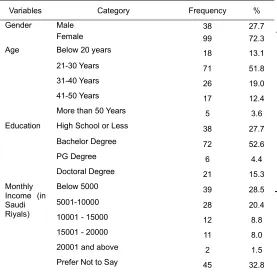
3.4DEMOGRAPHIC PROFILE OF RESPONDENTS
526 Table 1. Demographic Profile of respondents
Variables Category Frequency %
Gender Male 38 27.7
Female 99 72.3
Age Below 20 years 18 13.1
21-30 Years 71 51.8
31-40 Years 26 19.0
41-50 Years 17 12.4
More than 50 Years 5 3.6
Education High School or Less 38 27.7
Bachelor Degree 72 52.6
PG Degree 6 4.4
Doctoral Degree 21 15.3
Monthly Income (in Saudi Riyals)
Below 5000 39 28.5
5001-10000 28 20.4
10001 - 15000 12 8.8
15001 - 20000 11 8.0
20001 and above 2 1.5
Prefer Not to Say 45 32.8
4 FINDINGS
AND
DISCUSSIONS
4.1FACTOR ANALYSIS OF SATISFACTION VARIABLE
The factor analysis was applied to examine underline patterns or relationships for large number of variables (inter-dependent in nature) aiming to determine whether the information can be summarized or extracted in smaller set of factors or components. There were 12 variables under ‘Satisfaction’ section. The variables were measured using 5-point Likert scale (1= Not at all satisfied to 5=Very satisfied). For the factor analysis purpose, these variables are treated as continuous scale type variables. As a first step, the inter-correlation among the 12 attributes which belong to ‘Satisfaction’ section is examined. There exists some level of correlation among these 12 attributes. It is observed that the internal correlation values among these 12 variables positively and all are significant at 95% (and some are significant at 99%). This indicates that the variables are closer to each other. KMO value was found to be 0.903 implying that sample selected for the analysis is adequate for applying factor analysis and can be used for statistical inferences. The factor analysis is based on Principal component analysis in which the factors are based on the total variance. By setting Eigen value > 1, two factors are arrived as shown in Table 2 . The first factor explains around 55.8% variance and second factor explains 10.78%. It is observed that the total variance explained by these two factors is around 66.6%. It is concluded that factor analysis reduces the 12 variables into 2 factors. After examining the factor matrix it is understood that items of first factor point towards service quality and security, and items of second factor point towards savings and convenience and hence named accordingly. The internal consistency reliability of each of the factor holds good as Cronbach’s alpha has come out to be 0.925 and 0.728.
Table 2 Factor Matrix for the Satisfaction variables
Factors Service
quality and security
Savings and convenience
Privacy is maintained 0.87 0.14
IB services are secure 0.85 0.14
IB services are reliable 0.84 0.23
The transactions are done quickly 0.82 0.22
It is self-service 0.74 0.21
I can get instant feedback for my
transactions 0.69 0.31
Satisfies all my banking needs 0.69 0.25
Easy to use 0.63 0.51
The transactions have low or no cost -0.03 0.80
It provides time savings 0.46 0.70
Available 7 days and 24 hours 0.24 0.68 I can access from anywhere 0.58 0.65
4.2FACTOR ANALYSIS OF POST TRANSACTION ACTION VARIABLE
The six variables identified as the action a user may post transaction were also subjected to Factor Analysis. These variables are measured using 5-point Likert scale (1= Very Unlikely to 5=Very Likely) and were treated as continuous scale type variables. It was observed that the internal correlation existed among some of the variables were significant. The KMO value was found to be 0.71 implying that sample selected for the analysis is adequate for applying factor analysis and can be used for statistical inferences. By setting Eigen value > 1, two factors were arrived. The first factor explains around 46.2% variance, second factor explains 26.4% so on. It is observed that the total variance explained by these five factors is around 72.63%. After examining the factor matrix in Table 3, it is understood that items of first factor point towards positive actions, and items of second factor point towards negative actions hence named accordingly. The internal consistency reliability of each of the factor holds good as Cronbach’s alpha has come out to be 0.834 and 0.742.
Table 3 Factor matrix for the post-transaction variables
Factors
Positive
Action Negative Action I say positive things about the service to
other people
0.87 -0.21 I recommend the service to someone who
seeks my advice 0.87 -0.16
I encourage friends and family to use the service
0.84 0.06 I complain to bank authorities if I experience
a problem 0.67 0.06
I complain to other customers if I experience a problem
0.17 0.87 I switch to a competitor if I have a problem
with the service
0.23 0.86
4.3RESULTS OF HYPOTHESES TESTING
order run Chi-square test to see relationships between these variables 5-point Likert scale has been converted into 3-point scale by taking values (averaged values if multi-item scale such as positive actions) from 1 to 2 into 1, greater than 2 and less than 4 into 2, and from 4 to 5 into 3 and named accordingly such as for positive actions: unlikely, likely and very likely. In SPSS, firstly Pearson Chi-Square Test (χ2) is used to test the hypothesis and secondly Fisher’s Exact Test (FET) is used if the minimum expected count is less than 1 or more than 20% of the cells have expected count less than 5.
i) Demographic variables versus e-banking purpose (H1-H4)
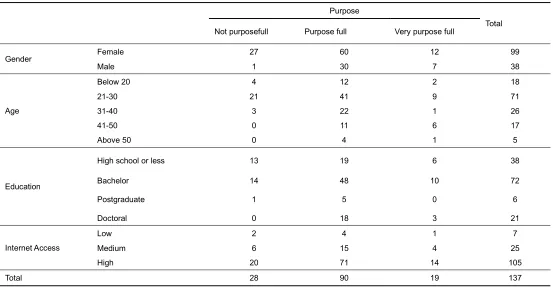
H1 is accepted (χ2 (2) = 10.35, p = .006), hence gender has a significant association with e-banking purpose. It can be seen
from Table 4 that higher number of females find e-banking not purposeful as compared to males.
H2 is accepted (FET = 17.324, p = .014), hence age has a significant association with e-banking purpose. It can be seen from Table 4 that people of ages 41 and above don’t find e-banking not purposeful as compared to that of lower ages. H3 is accepted (FET = 12.351, p = .037), hence education has a significant association with e-banking purpose. It can be seen from Table 4 that people with higher education postdoctoral and doctoral don’t find e-banking not purposeful as compared to those with lower education.
H4 is rejected (FET = 1.517, p = .842), hence internet access has no significant association with e-banking purpose.
Table 4 Cross-tabulation of demographic variables with e-banking purpose
Purpose
Total Not purposefull Purpose full Very purpose full
Gender Female 27 60 12 99
Male 1 30 7 38
Age
Below 20 4 12 2 18
21-30 21 41 9 71
31-40 3 22 1 26
41-50 0 11 6 17
Above 50 0 4 1 5
Education
High school or less 13 19 6 38
Bachelor 14 48 10 72
Postgraduate 1 5 0 6
Doctoral 0 18 3 21
Internet Access
Low 2 4 1 7
Medium 6 15 4 25
High 20 71 14 105
Total 28 90 19 137
ii) Demographic variables versus frequency of E-banking(H5-H8)
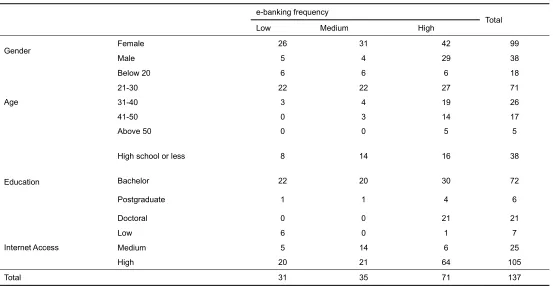
H5 is accepted (χ2 (2) = 12.815, p = .002), hence gender has a significant association with e-banking frequency. It can be seen from Table 5 that males are much more frequent to the e-banking than females.
H6 is accepted (FET = 23.767, p = .001), hence age has a significant association with e-banking frequency. It can be seen from Table 5 that people of ages 31 and above are much more frequent as compared to that of lower ages.
H7 is accepted (FET = 27.979, p < .001), hence education has a significant association with e-banking frequency. It can be seen from Table 5 that people with higher education postdoctoral and doctoral are more frequent compared to those with lower education.
H8 is accepted (FET = 26.000, p < .001), hence internet
access has a significant association with e-banking frequency. It can be seen from Table 5 that people with high internet access are more frequent to the e-banking that that of low internet access.
iii) Demographic variables versus e-banking customer satisfaction (service quality and security, and savings and convenience) (H9-H12)
528 Table 5 Cross-tabulation of demographic variables with e-banking frequency
e-banking frequency Total
Low Medium High
Gender Female 26 31 42 99
Male 5 4 29 38
Age
Below 20 6 6 6 18
21-30 22 22 27 71
31-40 3 4 19 26
41-50 0 3 14 17
Above 50 0 0 5 5
Education
High school or less 8 14 16 38
Bachelor 22 20 30 72
Postgraduate 1 1 4 6
Doctoral 0 0 21 21
Internet Access
Low 6 0 1 7
Medium 5 14 6 25
High 20 21 64 105
Total 31 35 71 137
savings and convenience.
H10 is rejected, since age has no significant association with service quality and security (FET = 7.442, p = .450), and savings and convenience (FET = 12.354, p = .087).
H11 is rejected, since education has no significant association with service quality and security (FET = 4.373, p =.616), and savings and convenience (FET = 7.724, p =.215).
H12 is partially accepted, since internet access has significant association with service quality and security (FET = 14.515, p = .003), but has no significant association with savings and convenience (FET = 7.410, p = .084). It can be seen from Table 6 that people with high internet access are more satisfied for service quality and convenience.
iv) Demographic variables versus post transaction action of e-banking customers (positive and negative) (H13-H16)
H13 is rejected, since gender has no significant association with positive actions (FET= 2.903, p = .202), and negative actions (χ2 (2) = .854, p = .663).
H14 is rejected, since age has no significant association with positive actions (FET = 8.444, p = .329), and negative actions (FET = 6.281, p = .605).
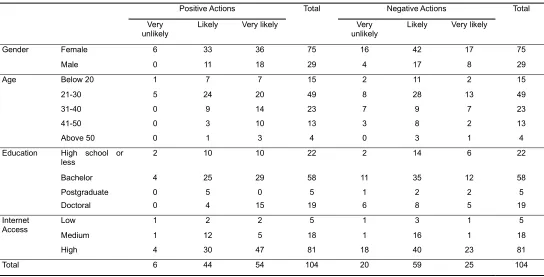
H15 is partially accepted, since education has significant association with positive actions (FET = 12.341, p =.031), and no significant association with negative actions (FET = 5.329, p =.483). It can be seen from the Table 7 that people with doctoral degree are very likely to take positive actions, followed by people with less qualifications.
Table 6 Cross-tabulation of demographic variables with e-banking customer satisfaction
Service Quality and Security
Total
Saving and Convenience
Total Not
satisfied Satisfied
Very satisfied
Not
satisfied Satisfied
Very satisfied
Gender Female 3 36 60 99 8 39 52 99
Male 0 9 29 38 0 6 32 38
Age Below 20 0 8 10 18 2 6 10 18
21-30 2 26 43 71 6 28 37 71
31-40 1 8 17 26 0 9 17 26
41-50 0 2 15 17 0 2 15 17
Above 50 0 1 4 5 0 0 5 5
Education High school
or less 0 16 22 38 4 12 22 38
Bachelor 3 22 47 72 4 28 40 72
Postgraduate 0 2 4 6 0 2 4 6
Doctoral 0 5 16 21 0 3 18 21
Internet Access
Low 1 3 3 7 1 3 3 7
Medium 0 15 10 25 1 13 11 25
High 2 27 76 105 6 29 70 105
Total 3 45 89 137 8 45 84 137
Table 7 Cross-tabulation of demographic variables with post-transaction actions
Positive Actions Total Negative Actions Total
Very unlikely
Likely Very likely Very
unlikely
Likely Very likely
Gender Female 6 33 36 75 16 42 17 75
Male 0 11 18 29 4 17 8 29
Age Below 20 1 7 7 15 2 11 2 15
21-30 5 24 20 49 8 28 13 49
31-40 0 9 14 23 7 9 7 23
41-50 0 3 10 13 3 8 2 13
Above 50 0 1 3 4 0 3 1 4
Education High school or
less 2 10 10 22 2 14 6 22
Bachelor 4 25 29 58 11 35 12 58
Postgraduate 0 5 0 5 1 2 2 5
Doctoral 0 4 15 19 6 8 5 19
Internet
Access Low 1 2 2 5 1 3 1 5
Medium 1 12 5 18 1 16 1 18
High 4 30 47 81 18 40 23 81
530 Table 8 Cross-tabulation of e-banking consumption pattern with customer satisfaction
Service Quality and Security Total Saving and Convenience Total
Not satisfied
Satisfied Very satisfied
Not satisfied
Satisfied Very satisfied e-banking
frequency
Low 2 15 14 31 4 15 12 31
Medium 0 13 22 35 3 18 14 35
High 1 17 53 71 1 12 58 71
e-banking
purpose Not purposeful 2 14 12 28 7 16 5 28
Purposeful 1 27 62 90 1 28 61 90
Very
purposeful 0 4 15 19 0 1 18 19
Total 3 45 89 137 8 45 84 137
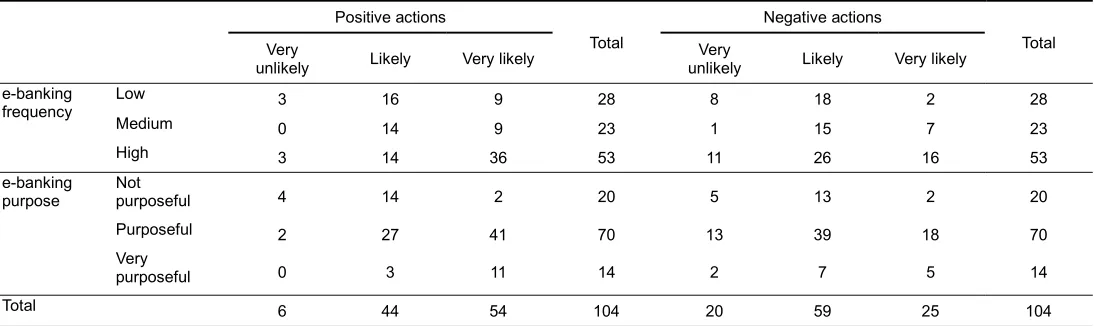
Table 9 Cross-tabulation of e-banking consumption pattern with post-transaction actions
Positive actions
Total
Negative actions
Total Very
unlikely Likely Very likely
Very
unlikely Likely Very likely e-banking
frequency
Low 3 16 9 28 8 18 2 28
Medium 0 14 9 23 1 15 7 23
High 3 14 36 53 11 26 16 53
e-banking purpose
Not
purposeful 4 14 2 20 5 13 2 20
Purposeful 2 27 41 70 13 39 18 70
Very
purposeful 0 3 11 14 2 7 5 14
Total 6 44 54 104 20 59 25 104
.065), but has significant association with negative actions (FET = 9.274, p = .035). It can be seen from Table 7 that people with high internet access are more very likely to take negative actions as compared to others.
v) E-banking consumption pattern (frequency and purpose) versus e-banking customer satisfaction (service quality and security, and savings and convenience) (H17-H18)
H17 is accepted, since e-banking frequency has significant association with service quality and security (FET= 9.839, p = .022), and with savings and convenience (FET = 27.512, p < .001). It can be seen from Table 8 that people with high frequency are more in very satisfied category for both service quality and security, savings and convenience.
H18 is accepted, since e-banking purpose has significant association with service quality and security (FET = 9.345, p = .033), and with savings and convenience (FET = 39.803, p < .001). It can be seen from Table 8 that people with higher purposeful ratings are more in in very satisfied category for both service quality and security, savings and convenience.
vi) E-banking consumption pattern (frequency and purpose) versus post transaction action of e-banking customers (positive and negative) (H19-H20)
H19 is accepted, since e-banking frequency has significant association with positive actions (FET= 14.149, p = .004), and
negative actions (χ2 (4) = 9.658, p = .045). It can be seen from Table 9 that people with high frequency are very likely to take positive actions and less likely to take negative actions. H20 is partially accepted, since e-banking purpose has no significant association with positive actions (FET = 3.528, p = .481), but has significant association with negative actions (FET = 22.342, p <.001). It can be seen from Table 9 that more purposeful people are more likely to take negative actions.
5 CONCLUSION
AND
LIMITATIONS
Arabia, this study aims to fill that gap. Any study in Saudi Arabia can have reasonable generalizations in GCC countries and also to MENA region. The results prove that the banks need to take into account the demographic factors, familiarity with E-banking and their Internet usage behavior. Both satisfaction level and post transaction action are influenced by these factors. Convenience sampling is a limitation of this study as has been in other studies. It is difficult to generalize results when convenience sampling is applied. Other demographic factors could not be included because the sample happened to just include university users. Confirmatory tests may be performed to explore further dimensions of the data, which could not be performed in this study. Since the research was self-sponsored, it proved to be a limitation for the researchers to increase the scope and reach. The findings of this study should facilitate in procuring funds for a study at a higher scale.
ACKNOWLEDGMENT
The authors wish to thank the authorities, especially the Dean and Head in their respective institutions namely Umm Al-Qura University and King Khalid University for their support.
REFERENCES
[1] E. E. Izogo, O. C. Nnaemeka, O. A. Onuoha, K. S. Ezema, “Impact of Demographic Variables on Consumers’ Adoption of E-banking in Nigeria: An Empirical Investigation,” European Journal of Business and Management Vol 4, No 17, 2012a.
[2] Y. Shih and K. Fang, “The use of a decomposed theory of planned behavior to study Internet banking in Taiwan,” Internet Research, Vol. 14 No. 3, pp. 213-223, 2004. [3] M. Tan and T. S. H. Teo, "Factors Influencing the Adoption
of Internet Banking," Journal of the Association for Information Systems: Vol. 1 :Iss. 1 , Article 5, 2000a. Available at: https://aisel.aisnet.org/jais/vol1/iss1/5/ [4] A. Shah, “Factors Influencing Online Banking Customer
Satisfaction and Their Importance in Improving Overall Retention Levels: An Indian Banking Perspective,” Information and Knowledge Management, Vol 1, No.1, 2011.
[5] E. Daniel, “Provision of electronic banking in the UK and the Republic of Ireland”, International Journal of Bank Marketing, Vol. 17 No. 2, pp. 72-83, 1999a.
[6] S. N. Baraghani, “Factors Influencing the Adoption of Internet Banking” Lulea university of Technology. Sweden, 2007. (Unpublished Master’s Thesis).
[7] G. Nimako, N. Kwame, A. M. Gyamfi, A. M. Wandaogou, “Customer Satisfaction With Internet Banking Service Quality In The Ghanaian Banking Industry,” Simon international journal of scientific & technology research volume 2, issue 7, July, 2013.
[8] N. Ahmad, “Cloud computing: Technology, security issues and solutions,” Proc. Second International Conf. on Anti-Cyber Crimes (ICACC), pp. 30-35, 2017.
[9] N. Khan, A. Naim, M. R. Hussain, Q. N. Naveed, N. Ahmad, S. Qamar, “The 51 V's Of Big Data: Survey, Technologies, Characteristics, Opportunities, Issues and Challenges,” Proc. International Conf. on Omni-Layer Intelligent Systems, pp. 19-24, 2019.
[10] M. Irfan and N. Ahmad, “Internet of medical things:
Technology Conference (L&T), pp. 6-13, 2018.
[11] A. Zakaria and M. Nidal, “Effect of Electronic Interactive Technologies Usage on Services Marketing Activities Empirical Study on Banking Sector in Jordan,” International Arab Journal of e-Technology. 1(4), 154-163, 2010.
[12] A. Parasuraman, V. A. Zeithaml and A. Malhotra, “ES-QUAL a multiple-item scale for assessing electronic service quality”, Journal of service research 7.3 213-233, 2005.
[13] E. Turban, J. Lee, D. King and H. M. Chung, “Electronic Commerce: A Managerial Perspective,” Prentice Hall, 2000.
[14] A T Kearney, Online banking in GCC pp 2, 2012a.
[15] A. Sujana, J. R. Ray, V. C. Fredy, “Consumers’ Continued Usage of Internet Banking: Australian Context,” ANZMAC, 1-9, 2009.
[16] T. Kuisma, T. Laukkanen, M. Hiltunen, “Mapping the reasons for resistance to Internet banking: A means-end approach,” International Journal of Information Management, 27, 75-85, 2007.
[17] P. WaiChing, “Users' adoption of e-banking services: The Malaysian perspective,” Journal of Business & Industrial
Marketing, 23. 59-69, 2008a.
10.1108/08858620810841498.
[18] S. C. Chan and M. T. Lu, “Understanding internet banking adoption and use behavior: a Hong Kong perspective,” Journal of Global Information Management, 12: pp. 21– 43, 2004.
[19] S. Han, and S. Baek, “Antecedents and consequences of service quality in online banking: An application of the SERVQUAL instrument,” AdvConsum Res, 31. 208-214, 2004.
[20] I. Santouridis, P. Trivellas, and P. Reklitis, “Internet service quality and customer satisfaction: Examining internet banking in Greece” Total Quality Management. 20. 223-239. 2009. 10.1080/14783360802623084.
[21] H. Karjaluoto, M. Mattila and T. Pento, “Electronic banking in Finland: Consumer beliefs and reactions to a new delivery channel,” Journal of Financial Services Marketing. 6. 346-361, 2002. 10.1057/palgrave.fsm.4770064. [22] M. Mattila, H. Karjaluoto, and T. Pento, “Internet banking
adoption among adult customers: early majority or laggards?” Journal of Services Marketing, 17 (5), 514-28, 2003.
[23] G. Shao, “The Diffusion of Online Banking: Research Trends from 1998 to 2006,” Journal of Internet Banking and Commerce, vol. 12, no.2, 2007.
[24] G. Lindgaard and C. Dudek, “What is the evasive beast we call user satisfaction?” Interacting with Computers 15(3), 429–452, 2003.
[25] N. V. Polatoglu and S. Ekin, "An empirical investigation of the Turkish consumers’ acceptance of Internet banking services,” International Journal of Bank Marketing, Vol. 19
No. 4, pp. 156-165, 2001.
https://doi.org/10.1108/02652320110392527
[26] T. Laukkanen, M. Pasanen, “Mobile banking innovators and early adopters: How they differ from other online users?” Journal of Financial Services Marketing, Vol 13,
Issue 2, pp 86-94, 2008.
https://doi.org/10.1057/palgrave.fsm.4760077
532
of Business and Retail Management Research. 12. 109-118, 2017. 10.24052/JBRMR/V12IS01/IBAIEETAM. [28] W. Nasri, “Factors Influencing the Adoption of Internet
Banking in Tunisia,” International Journal of Business and Management, Vol. 6, No. 8, 2011.
[29] S. Akinci. S. Aksoy and E. Atilgan, “Adoption of Internet banking among sophisticated consumer segments in an advanced developing country,” International Journal of Bank Marketing. 22. 212-232. 2004a. 10.1108/02652320410530322.
[30] T. Supathanish, “Customers' Discernment of Mobile Banking Business: Northern Region of Thailand,” International Trade and Academic Research Conference (ITARC), DBA, Thailand: Marketing Program, Payap University, 2010.
[31] P. Wai Ching, “Users' adoption of e-banking services: The Malaysian perspective,” Journal of Business & Industrial
Marketing, 23. 59-69, 2008b.
10.1108/08858620810841498.
[32] H. Karjaluoto, M. Mattila and T. Pento, “Electronic banking in Finland: Consumer beliefs and reactions to a new delivery channel,” Journal of Financial Services Marketing. 6. 346-361, 2002a. 10.1057/palgrave.fsm.4770064. [33] S. Ghazinoory and M. Afshari-Mofrad, “Ranking different
factors which affect E-Learning outcomes,” International Journal of Computer Theory and Engineering, 4(2), 234, 2012a.
[34] M. Igbaria, T. Guimaraes, B. D. Gordon, “Testing the Determinants of Microcomputer Usage via a Structural Equation Model,” J. of Management Information Systems. 11. 87-114, 1995a. 10.1080/07421222.1995.11518061. [35] L. Servon and R. Kaestner, “Consumer Financial Literacy
and the Impact of Online Banking on the Financial Behavior of Lower-Income Bank Customers,” Journal of Consumer Affairs. 42. 271 – 305, 2008a. 10.1111/j.1745-6606.2008.00108.x
[36] C. Jayawardhena and P. Foley, "Changes in the banking sector – the case of Internet banking in the UK", Internet Research, Vol. 10 No. 1, pp. 19-31, 2001a.
[37] M. Jun and S. H. Cai, “The Key Determinants of Internet Banking Service Quality: A Content Analysis,” International Journal of Bank Marketing, Vol. 19, No. 7, pp. 276-291, 2001.
[38] A. Broderick, and S. Vachirapornpuk, "Service quality in Internet banking: the importance of customer role", Marketing Intelligence & Planning, Vol. 20 No. 6, pp. 327-335, 2002
[39] Z. Yang, and X. Fang, “Online Service Quality Dimensions and Their Relationships with Satisfaction: A Content Analysis of Customer Reviews of Securities Brokerage Services,” International Journal of Service Industry Management, 15, 302-326, 2004.
[40] W. J. Doll and G. Torkzadeh, “The measurement of end-user satisfaction,” MIS Quarterly, Vol. 12, No. 2, pp 259-274, 1988. doi. 10.2307/248851.
[41] W. W. Wan, C. L. Luk and C. W. C. Chow, “Customers' adoption of banking channels in Hong Kong,” International Journal of Bank Marketing. 23. 255-272, 2005. 10.1108/02652320510591711.
[42] S. Chiemeke, A. Evwiekpaefe and F. O. Chete, F. “The Adoption of Internet Banking in Nigeria: An Empirical Investigation,” Journal of Internet Banking and Commerce. 11, 2006.
[43] A. Kesharwani, and S. Bisht, “The impact of trust and perceived risk on Internet banking adoption in India,” International Journal of Bank Marketing. 30. 303-322, 2012. 10.1108/02652321211236923.
[44] D. El- Kasheir and S. A. Ahmed and O. Yacout, “Factors Affecting Continued Usage of Internet Banking Among Egyptian Customers,” Communications of the IBIMA, 2009.
[45] B. Yurcan, “The value of compliance,” Bank Systems and Technology, 49(1), 1-4, 2012.
[46] H. Karjaluoto, M. Mattila and T. Pento, “Electronic banking in Finland: Consumer beliefs and reactions to a new delivery channel,” Journal of Financial Services Marketing. 6. 346-361, 2002b. 10.1057/palgrave.fsm.4770064. [47] S. Ghazinoory and M. Afshari-Mofrad, “Ranking different
factors which affect E-Learning outcomes,” International Journal of Computer Theory and Engineering, 4(2), 234, 2012b.
[48] M. Igbaria, T. Guimaraes, B. D. Gordon, “Testing the Determinants of Microcomputer Usage via a Structural Equation Model,” J. of Management Information Systems. 11. 87-114, 1995b. 10.1080/07421222.1995.11518061. [49] L. Servon and R. Kaestner, “Consumer Financial Literacy
and the Impact of Online Banking on the Financial Behavior of Lower-Income Bank Customers,” Journal of Consumer Affairs. 42. 271 – 305, 2008b. 10.1111/j.1745-6606.2008.00108.x
[50] M. Tan and T. S. H. Teo, "Factors Influencing the Adoption of Internet Banking," Journal of the Association for Information Systems: Vol. 1 :Iss. 1 , Article 5, 2000b. Available at: https://aisel.aisnet.org/jais/vol1/iss1/5/ [51] B. Howcroft, R. Hamilton and P. Hewer, “Consumer
attitude and the usage and adoption of home-based banking in the United Kingdom,” International Journal of Bank Marketing. 20. 111-121, 2002. 10.1108/02652320210424205.
[52] N. V. Polatoglu and S. Ekin, "An empirical investigation of the Turkish consumers’ acceptance of Internet banking services,” International Journal of Bank Marketing, Vol. 19
No. 4, pp. 156-165, 2001a.
https://doi.org/10.1108/02652320110392527
[53] A. Susanto, Y. Chang and Y. Ha, “Determinants of Continuance Intention to Use the Smartphone Banking Services: An Extension to the Expectation-Confirmation Model,” Industrial Management & Data Systems. 116. 508-525, 2016.
[54] B. Hernández-Ortega, An Analysis of Web Navigability in Spanish Internet Banking, 2007.
[55] N. V. Polatoglu and S. Ekin, "An empirical investigation of the Turkish consumers’ acceptance of Internet banking services,” International Journal of Bank Marketing, Vol. 19
No. 4, pp. 156-165, 2001b.
https://doi.org/10.1108/02652320110392527
[56] M. Parthasarthy and A. Bhattacharjee, “Understanding Post-Adoption Behavior in the Context on Online Services,” Information Systems Research, Vol 9, No 4, pp 362-379, 1998.
[57] N. V. Polatoglu and S. Ekin, "An empirical investigation of the Turkish consumers’ acceptance of Internet banking services,” International Journal of Bank Marketing, Vol. 19
No. 4, pp. 156-165, 2001c.
https://doi.org/10.1108/02652320110392527
the Republic of Ireland”, International Journal of Bank Marketing, Vol. 17 No. 2, pp. 72-83, 1999b.
[59] C. Jayawardhena and P. Foley, "Changes in the banking sector – the case of Internet banking in the UK", Internet Research, Vol. 10 No. 1, pp. 19-31, 2001b.
[60] H. Karjaluoto, M. Mattila and T. Pento, “Electronic banking in Finland: Consumer beliefs and reactions to a new delivery channel,” Journal of Financial Services Marketing. 6. 346-361, 2002c. 10.1057/palgrave.fsm.4770064. [61] A.H. Seyal, M. Rahim and M. N. Rahman, “Computer
Attitudes of Non-Computing Academics: A Study of Technical Colleges in Brunei Darussalam”, Information and Management , 37, pp. 169- 180, 2000a.
[62] G. Nimako, N. Kwame, A. M. Gyamfi, A. M. Wandaogou, “Customer Satisfaction With Internet Banking Service Quality In The Ghanaian Banking Industry,” Simon international journal of scientific & technology research volume 2, issue 7, July, 2013.
[63] A.H. Seyal, M. Rahim and M. N. Rahman, “Computer Attitudes of Non-Computing Academics: A Study of Technical Colleges in Brunei Darussalam”, Information and Management , 37, pp. 169- 180, 2000b.
[64] V. Venkatesh, and M. G. Morris, “Why don’t men ever stop to ask for directions: Gender, social influence and their role in technology acceptance and usage behavior,” MIS Quarterly, 24 (1), 115-139, 2000.
[65] T.S.H. Teo and V.G.K. Lim, “Usage and perceptions of the internet: What has age got to do with it?” Cyber Psychology and Behavior, 1(4): 371-381, 1999.
[66] N. Dahlan, T. Ramayah, A. H. Koay, “Data Mining in the Banking Industry: An Exploratory Study”, Proceedings of International Conference on Internet Economy and Business, Kuala Lumpur, Malaysia, 2002.
[67] C. Flavian, M. Guinali, E. Torres, Industrial Journal of Bank Marketing, 24(6), 406-423, 2006.
[68] C. Fernandes and R. Awamleh, “Internet Banking: an empirical investigation into the extent of adoption by banks and the determinants of customer satisfaction in the United Arab Emirates,” Journal of internet banking and commerce, 10 (1), 1-12. 2005.
[69] S. Akinci. S. Aksoy and E. Atilgan, “Adoption of Internet banking among sophisticated consumer segments in an advanced developing country,” International Journal of Bank Marketing. 22. 212-232. 2004b. 10.1108/02652320410530322.
[70] P. Trocchia and S. Janda, “A phenomenological investigation of Internet usage among older individuals,” Journal of Consumer Marketing. 17. 605-616, 2000. 10.1108/07363760010357804.
[71] V. Zeithaml, and M. Gilly, “Characteristics Affecting the Acceptance of Retailing Technologies: A Comparison of Elderly and Nonelderly Consumers,” Journal of Retailing. 63. 49-68, 1987.
[72] E. E. Izogo, O. C. Nnaemeka, O. A. Onuoha, K. S. Ezema, “Impact of Demographic Variables on Consumers’ Adoption of E-banking in Nigeria: An Empirical Investigation,” European Journal of Business and Management Vol 4, No 17, 2012b.
[73] C. Gan, M. Clemes, V. Limsombunchai and A. Weng, “A logit analysis of electronic banking in New Zealand,” International Journal of Bank Marketing. 24, 2006. 10.1108/02652320610701717.
“Determinants of User Acceptance of Internet Banking: An Empirical Study,” International Journal of Service Industry
Management. 14. 501-519, 2003.
10.1108/09564230310500192.
[75] D. Sarel and H. Marmorstein, “Marketing online banking services: The voice of the customer,” Journal of Financial
Services Marketing, 2003. 8.
10.1057/palgrave.fsm.4770111.
[76] A T Kearney, Online banking in GCC pp 2, 2012b.
[77] N. V. Polatoglu and S. Ekin, "An empirical investigation of the Turkish consumers’ acceptance of Internet banking services,” International Journal of Bank Marketing, Vol. 19
No. 4, pp. 156-165, 2001c.