The Effectiveness of Problem-Based Learning to
Improve Students’ Conjecturing Ability in Solving
Block-Paving Problems
Sutarto, Dafik, Intan Dwi Hastuti, SurahmatAbstract—This study was aimed at finding out the effectiveness of Problem-Based Learning (PBL) model to improve students’ ability in solving paving block problems. This study applied the combination between the quantitative and qualitative method (mixed methods) in the data collection and analysis. The quantitative method was used to analyze students’ conjecturing ability, while the qualitative method was functioned to explore the data of the observation and interview. The subject of the quasi-experiment was junior secondary high school students. Thus, the data were analyzed using the inferential statistical analysis. The result of t-test showed the sig (2-tailed) test of the pre-test was 0.832 (p> 0.05). It indicated that it was not significant. It means there are two homogeneous classes in terms of students' conjecturing ability. In addition, the analysis of the independent sample t-test in the post-test, the sig. (2-tailed) was 0.00 (p = <0.05). It was significant. It indicated that the students’ achievement of two classes were different after giving treatments using the PBL model. The result of analysis showed that students’ conjecturing ability from the experimental class was better than the control class. In other words, the application of the PBL model was effective in enhancing students' conjecturing abilities in solving paving block problems.
Index Terms—Problem-Based Learning, Conjecturing Ability, Block Paving Problems.
—————————— ——————————
1 INTRODUCTION
roblem-solving is the most important part of mathematics instruction. NCTM states that problem solving plays an important role in the curriculum because 1) it can build new mathematical knowledge, 2) it can solve problems that arise in the field of mathematics and other contexts, 3) it can apply various kinds of problem solving strategies, 4) it reflects the process of solving mathematical problems (NCTM, 2000). Furthermore, mathematical problem solving is learning processes that can help students learn concepts.Learning mathematics that involves solving-problems is not easy. There are many obstacles faced by teachers when implementing problem-solving in learning mathematics. One of the obstacles faced by the teacher is that many students still have difficulties when solving-problems and when constructing concepts. Brodie (2010) explains that there are still many students who experience mistakes in building mathematical reasoning. Subanji and Nusantara (2013) found that students' thinking errors in constructing mathematical concepts include errors of pseudo correct and pseudo errors thinking, errors of analogy thinking, mistakes of placing concepts, and errors of logical thinking.
In solving-problems, students are also involved in discovery activities, and the conjecture is the main way for discovery (NCTM, 2000). In solving-problems, the process of the conjecturing activity helps the problem solver find a solution to tackle the problem at hand (Sutarto, 2015, 2016). Canadas, et al. (2007) explains that problem solving and
conjecturing are the most important and interconnected parts of mathematical activities.
The process of conjecturing is a process of building a conjecture (Sutarto, et al., 2016). In addition, Fischbein (2002) explains that conjecture is an expression of mental activity to solve problems in line with prior knowledge, the truth of which needs to be proven. The mental activities include a process happening in mind to produce conjecturing. The process of conjecturing is done through some stages; (1) observing cases, (2) organizing cases, (3) searching and predicting patterns, (4) formulating conjectures, (5) validating conjectures, (6) generalizing conjectures, and (7) justifying generalization.
Furthermore, based on a study conducted by Sutarto (2018), it was revealed that there are still many students who have difficulties in constructing conjectures. The difficulty of students in constructing conjectures is inseparable from the teacher's role during the mathematics learning process. The teacher has a major role in the learning process (Turnuklu & Yesilder, 2007). Sutarto and Syarifuddin (2003) also emphasized that the teacher is seen as a facilitator and motivator to facilitate students so as to organize the learning process effectively.
One of approaches recommended for creating the effective mathematics learning and helping students build conjecturing abilities is Problem Based Learning (PBL). PBL is a constructivist learning that focuses on aspects of problem solving (Hein, 1991; Savery, 2006; Strobel & Van Barneveld, 2009). PBL allows students to solve problems with active participation (Doppelt, 2003). In PBL practice, students work collaboratively with others and evaluate what they have learned. Furthermore, students become active in the process of searching and decision making by improving their practical thinking skills (Harris, 2002; McGrath, 2002; Solomon, 2003). In addition, PBL model involves students to develop their
P
————————————————
Sutarto, IKIP Mataram, Indonesia, [email protected]
Dafik, University of Jember, Indonesia, [email protected]
Intan Dwi Hastuti, University Muhammadiyah Mataram, , Indonesia,
Surahmat, Islamic University of Malang (UNISMA), Indonesia
scientific process skills. Therefore, students who develop scientific process skills are able to produce solutions to problems encountered, by asking questions, discussing ideas, making observations and predictions, conducting experiments, collecting and analyzing data, and drawing conclusions (Westwood, 2006).
Studies applying PBL model presented that it can improve students’ learning achievement and thinking abilities (Savery, 2006; Cheung, 2011; Pardamean, 2012; & Chan, 2013). Chan (2013) reported that PBL can improve creative and critical thinking skills. Cheung (2011) states the model has a significant influence on student creativity. In addition, Pardamean (2012) find out that PBL can improve students' critical thinking skills. Also, Savery (2006) suggests for further research that investigations of the IBL model should be conducted in various fields of science.
Many studies investigate the effectiveness of PBL on mathematics learning achievement but those are limited and have not yet investigated the effectiveness of PBL in improving students’ conjecturing ability to solve paving block problems. Furthermore, this research is expected to give a valuable contribution to the mathematics education literature in terms of applying PBL to enhance the conjecturing skills. Therefore, this study was aimed at investigating the effectiveness of Problem Based Learning compared to conventional models in improving students' conjecturing abilities in solving paving block problems.
2
M
ETHODThis study applied a combination of quantitative and qualitative methods (mixed method) in data collection and analysis. The quantitative method is used to analyze the data taken from the test of students' conjecturing abilities after the application of PBL, while the qualitative method is aimed at analyzing the data taken from observations and interviews with selected students. This study investigated two variables, namely the application of PBL as an independent variable and the test of students' conjecturing abilities in solving the problem of Paving Block as the dependent variable. To find out the effectiveness of PBL implementation deeply, all students at the experimental group were observed. Hence, some students were interviewed relation to students’ understanding processes in discovering new patterns.
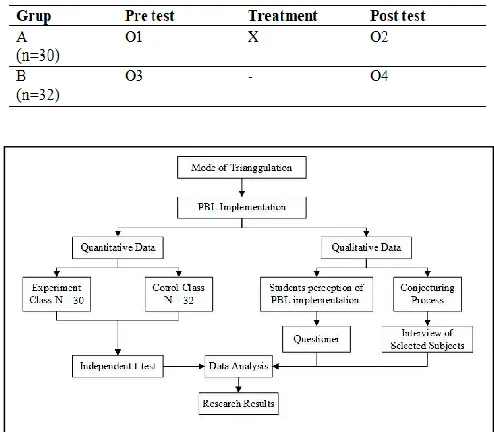
The experimental design of this study was to prepare two class groups, namely the experimental class and the control class, which were selected by purposive random sampling and examined by pre-test and post-test using the following design.
Table 1 showed that A is the experimental group treated by using PBL model, while B represented the control group subjected to the conventional learning. O1 and O3 are the two groups that have the same conjecturing ability and are given pre-test. O2 was the result of the experimental group, while O4 was the result of the control group. In this study, the effect of treatments was analyzed using t-test. Figure 1 indicated the triangulation mode in which the qualitative data were
triangulated with quantitative data to find out the effect of PBL in improving students' conjecturing abilities in solving paving block problems.
2.1 Population
The population of this research was the 8th-grade students of SMP 17 Mataram. This study applied cluster sampling by selecting two classes, producing one experimental class with 31 students taught using PBL. The control class was taught using a conventional learning model with 31 students.
2.2 Instruments
Data were collected using research instruments in the form of a Block Paving Problem (BPP) test in Figure 2. The instruments included questionnaire and interview. BPP was used to collect data of the students’ conjecturing abilities. The questionnaire was used to collect data relating to students’ perceptions towards PBL implementation, with indicators: 1) Students' interest in the PBL model, 2) Benefits obtained by students using the PBL model, 3) students’ constraints during the learning process using the PBL model, and 4) students’ expectations and suggestions for the PBL model. Questionnaire answers were using the Likert scale, consisting of strongly agree, agree, disagree, and strongly disagree. The technique of scoring questionnaire is to see the tendency of students’ responses, whether positive or not. The interview technique used an unstructured interview to understand and explore the process of conjecturing conducted by students in solving paving-Block problems. The instruments used in this study were validated by experts of mathematics education.
TABLE1
THE TABLE DISPLAYS PRE-TEST RESULTS AND MEAN VALUES BETWEEN THE CONTROL CLASS AND THE EXPERIMENTAL CLASS
EQUIVALENT PRE-TEST AND POST-TEST CONTROL GROUP DESIGN.
2.3 Data Collection and Analysis
Students in the experimental and control groups were given the pretest and posttest. The analysis of quantitative data used SPSS device, while qualitative data were collected using questionnaires and interviews. Descriptive and inferential statistics were used to analyze quantitative and qualitative data. Descriptive statistics were used to show the frequency, mean, and standard deviation, while the inferential statistics were independent sample t-test to examine the effectiveness of PBL and the experimental and control class (Hilton et al, 2004). The significance level to compare the average scores of the two groups was in the significance level of 5% or 0.05.
Findings
Based on the results of the study, the research findings related to the effectiveness of PBL used independent sample t-test analysis obtained from pre-t-test and post-t-test scores on the average of the experimental class and the control class. The test of data normality was examined before further analysis. The number of respondents was 62 students. This showed that the pre-test scores of the two classes were equivalent or not significantly different. It can be seen in Table 2 and Table 3.
4 FINDINGS
Based on the results of the study, the research findings related to the effectiveness of PBL used independent sample t-test analysis obtained from pre-t-test and post-t-test scores on the average of the experimental class and the control class. The test of data normality was examined before further analysis. The number of respondents was 62 students. This showed that the pre-test scores of the two classes were equivalent or not significantly different. It can be seen in Table 2 and Table 3.
The mean scores of the control class were 54.17 (SD = 7.826), while the experimental class was characterized by an average score of 55.12 (SD = 8.190). The difference of the pre-test scores between the two groups was [t (62) = 0.781, p> 0.05]. It meant that it was not significant at alpha .05 level. This showed that the two groups were equal from the beginning study.
Table 4 presented the results of post-test at the control class. The average score was 74,000 (SD = 7.42085), while the
average score at the experimental class was 81.4219 (SD = 6.97589). In addition, Table 5 indicated that there were significant differences between the two classes. The t-test was higher than sig. level 0.05 [t (62) = -4,059, p <0.05].
Furthermore, Table 5 indicated that the results of the t-test at the sig (2-tailed) of the independent sample post-test was
0.00 (p = <0.05). It meant it was significant. This indicated that there were differences in the two classes in terms of students' conjecturing abilities in solving paving block problems after PBL implementation. Based on these results, it can be concluded that there was a significant impact on the application of Problem Based Learning in improving students'
TABLE4
THE TABLE DISPLAYS POST-TEST RESULTS AND MEAN SCORES BETWEEN THE CONTROL CLASS AND THE EXPERIMENTAL CLASS.
TABLE2
THE TABLE DISPLAYS PRE-TEST RESULTS AND MEAN VALUES BETWEEN THE CONTROL CLASS AND THE EXPERIMENTAL CLASS.
TABLE3
THE DATA BELOW PRESENTS THE COMPARISON OF THE PRE-TEST SCORE OF THE EXPERIMENT CLASS AND CONTROL CLASS SCORE
USING INDEPENDENT SAMPLE T-TEST
TABLE5
THE DATA BELOW PRESENTS THE COMPARISON OF POST-TEST SCORE OF EXPERIMENT CLASS AND CONTROL CLASS SCORE
conjecturing abilities in solving paving block problems. Based on the results of students’ answers in solving paving-block problems, the data were obtained in accordance with students' thinking processes in building conjectures on paving-block problems. From the experiment class, the average score of students’ answers with the global process of conjecturing and local conjecturing was based on contrast. The following describes the thought processes of the student S1 and S2 in constructing conjectures.
4.1 Student S1
In solving the problem of paving blocks, the S1 has realized that the 1st image, 2nd image, and 3rd image formulate a pattern. At the stage of observing cases, the students S1 observed and counted the number of paving blocks as a whole, without distinguishing black and white. In Picture 1, there are 7, picture 2 there are 11, and picture 3 there are 15. Following are the results of the work of the subject S1 in observing the cases in Figure 3 as follows.
Based on the number of squares in the 1st pattern, there is 1, in the 2nd pattern, there is 4, and in the 3rd pattern, there is 9. The S1 organizes cases by sorting the pattern of the sequence of numbers, namely 1 × 1 = 1, 2 × 2 = 4, 3 × 3 = 9 and then the subject looks for and predicts the 4th pattern which is 4 × 4 = 16. The following are excerpts of interviews and the results of S1 work in Figure 4.
Researcher: How did you find out the next pattern?
Student S1: ―the number of the 1st paving, there is 1 written 1×1=1, of the 2nd paving there is 4 written in 2×2=4 and of the 3rd paving there is 9 written 3×3=9, the next paving would be 4×4=16
In the stage of formulating the conjecturing, S1 sees a pattern formed from 1 × 1 = 1, 2 × 2 = 4, 3 × 3 = 9, 4 × 4 = 16. Based on this pattern, S1 formulates a conjecture to determine the number of black and white paving blocks that are n × n. Thus, S1 validates the conjecture by trying to apply the formula in the 1st, 2nd, 3rd, and 4th figure. After validating, S1 believes
that the resulted formula is correct. The following are excerpts of interviews and the results of S1 work in Figure 5.
Researcher: How did you find the general formula?
Student S1: I just said to you, ―The number of pavings of 1, 1×1=1, second 2×2=4 and the third, 3×3=9 and the fourth 4×4=16, in mean the n is n×n.
Researcher: Do you believe in that formula? Student S1: Yes, Sir.
Researcher: How do you assure it?
Student S1: the formula is n×n, I tried at Figure 1, 1×1=1 is correct, Figure 2 2×2=4 is correct, Figure 3 3×3=9 is correct, and Figure 4 is 4×4=16 it is correct as well.
4.2 Student S2
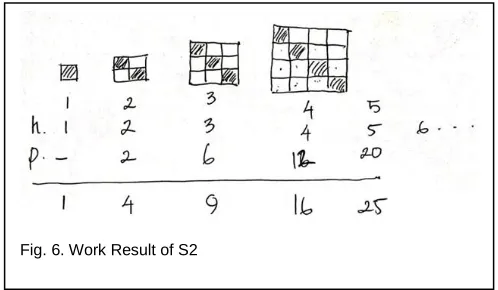
In solving the problem of paving blocks, the student S2 realized that the 1st picture, 2nd picture, and 3rd image formed a pattern. At the stage of observing the case, the student S2 observed and counted the number of paving separately between black and white. In the 1st figure, black 1; 2nd figure, black 2 and white 2; and in the 3rd image, black 3 white 6. Figure 7 presented work results of student S1 in observing a case
Based on the number of squares in Black (H) and White (P) in the 1st pattern, 2nd pattern, and 3rd pattern, student S1 organizes cases by sorting a number sequence pattern, namely the 1st pattern is H: 1 P: 0, the 2nd is H: 2 P: 2, the 3rd is H: 3 P6. Hence, the student searches for and predicts the 4th pattern by drawing the 4th pattern obtained by H (black Square): 4 P (White Square): 12 (see Figure 6). Then, the 5th pattern is H: 5 P: 4 × 5 = 20. The following are excerpts of the interview.
Researcher: How did you solve that problem?
Student S2: The 1st image is H:1P:0, the 2nd image is H:2P2,the 3rd image is H:3P:6,afterwards, I try to Fig. 3. Work Result of S1
Fig. 4. Work Result of S1
Fig. 5. Work Result of S1
make the 4th image obtained the H:4 P:12,the 5th image is H5: P:20.
Researcher: where the H: 5 and P: 20 come from?
Student S2: Look, according to me Sir. The black follows the next picture, for instance, the first image is 1, the second is 2, the third is 3 etc. Meanwhile, the second white is obtained from 1×2=2, the third white comes from 2×3=6, the fourth white is from 3×4=12 (while pointing his work result), so the fifth black is 5 coming from 4×5=20.
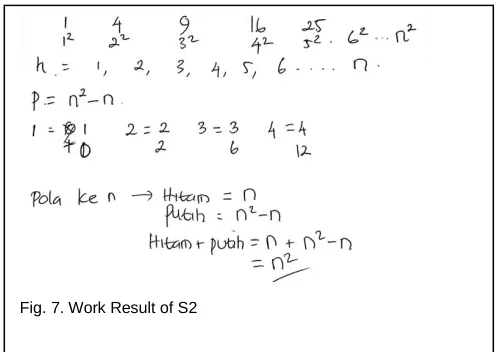
At the stage of formulating conjecturing, the student S2 sees a pattern formed by black paving 1, 2, 3, 4, 5 so that for the next n = n, whereas for the white one the student S2 sees that the number of black and white forms a pattern 1, 4, 9, 16, 25 so the n pattern = n2. From this conjecture, the student S2 formulates the general form for Black = n and white = n2-n so that for black and white = n + n2–n or n2. Then, the student S1 validates the conjecture by trying to apply the formula in the 1st, 2nd, 3rd, and 4th figure. After validating, the student S1 believes that the resulting formula is correct. The following are excerpts of interviews and the results of S1 work. It can be seen in Figure 7.
Researcher: How did you find the general formula?
Student S2: Look, sir, for the black one to follow the pattern, 1, 2, 3, 4, so the n = n, while the white one if added by black paving, the patterns 1, 4, 9, 16 become n2
Researcher: What is meant by this (while refers to the results of S2 work)
Student S2: white paving can be reduced from the number of all less the black, so n2-n. The end result is n + n2 –n or n2
Researcher: Are you sure about the formula? Student S2: Yes sir
Researcher: How can you be sure?
Student S2: the formula is tried for the 1st image is 1 × 1 = 1 correct, the 2nd image is 2 × 2 = 4 correct, the 3rd image is 3 × 3 = 9 correct, 4th image is 4 × 4 = 16, and the 5th image is 5 × 5 = 25 that must also be correct.
In addition to the thought process in building conjectures, one of the objectives to be achieved in this study is to determine students' responses towards the PBL. Students’
responses can be known from the percentage of students’ answers from each item questionnaire with Likert scale. The percentage of students’ responses can be seen in Table 6.
Based on the results of the questioner analysis presented in Table 6, the percentage of students’ interest of PBL is 90.8%, the students’ benefit after the implementation of PBL is 89.9, the students’ obstacles during the implementation of the PBL is 81.4%, and the students’ expectation and suggestion to PBL are 91.7%. These indicate that students' responses are positive towards PBL.
5 DISCUSSION
This study aims to investigate the effectiveness of Problem Based Learning (PBL) in improving students' conjecturing abilities in solving paving block problems compared to conventional learning. The results showed that the implementation of PBL was more effective than conventional learning. These results are in line with what Sutarto et al. (2018) state that the process of conjecturing is very important to resolve pictorial patterns.
The process of conjecturing carried out by students in solving the problem of Paving Block is the global process of conjecturing and the process of local conjecturing based on contrast (Sutarto, et al, 2016, 2018). The global process of conjecturing is done by observing the pattern of paving blocks as a whole without distinguishing black and white as a strategy in solving problems, whereas the process of contrast-based local conjecturing is done by observing paving block patterns separately between black and white in solving the problem.
In the PBL model, the formation of student groups that each group consists of high ability and low ability students is carried out heterogeneously. Each student in the experimental class is treated using PBL model where they have the opportunity to solve the paving block problem together, help each other collect data, share each other, and facilitate learning each other to solve the paving block problem. The findings of this study are consistent with results as reported by Barron & Hammond (2008) who say that heterogeneous abilities of students in a team facilitate the PBL model and encourage students to have individual responsibilities. In addition, Baiduri (2017) found that peer tutors increased student activity in learning mathematics.
TABLE6
STUDENTS’RESPONSE TOWARDS THE PBL MODEL
6
CONCLUSION
The research result proves that Problem Based Learning l is more effective in improving students' conjecturing abilities in solving paving block problems. Problem Based Learning also
contribute to the class such that the class is more active and creative and students think more critically than students taught using conventional learning. This is because providing a fun atmosphere for students can foster learning process becoming much more conducive.
Therefore, we need to propose the following suggestions for further researcher, determine whether the PBL can contribute effectively to the students higher order thinking skills in solving pattern problems in general.
ACKNOWLEDGMENT
My Deepest Thanks goes to the Directorate of Research and Community Service (DRPM) RISTEKDIKTI for the assistance provided in post-doctoral research grants.
REFERENCES
[1] Baiduri. (2017). Elementary school students’ spoken activities and their response in Math learning by peer-tutoring. International Journal of Instruction, 10/2, 145-160. Retrieved May, 2019 from https://doi.org/10.12973/iji.2017.10210a.
[2] Barron, B., & Hammond, L. D. (2008). Teaching for meaningful learning: A review on inquiry-based and cooperative learning.
Edutopia. Retrieved 15 June, 2019 from
http://www.edutopia.org/pdfs/edutopia-teaching-for-meaningful-learning.pdf.
[3] Brodie, Karin, 2010. Teaching Mathematical Reasoning in Secondary School Classrooms. Springer New York Dordrecht Heidelberg London
[4] Cañadas, M.C., Deulofeu, J. Figueiras, L., Reid, D., & Yevdokimov, O. 2007. The Conjecturing Process: Perspectives in Theory and Implications in Practice: Journal Of Teaching and Learning, 5 (1): 55-72.
[5] Chan, Z. C. Y. (2013). Exploring creativity and critical thinking in traditional and innovative problem-based learning groups. Journal of
Clinical Nursing, 22(15–16), 2298–2307.
https://doi.org/10.1111/jocn.12186
[6] Cheung, M. (2011). Creativity in advertising design education: An experimental study. Instructional Science, 39(6), 843–864. http://dx.doi.org/10.1007/s11251-010-9157-y
[7] Fischbein, E. (2002). Intuition in science and mathematics. An Educational Approach. NewYork: Kluwer Academic Publisher. [8] Harris, J. (2002). Activity design assessments: an uncharacteristic
consensus. Learning and Leading with Technology, 27(7), 42-50. [9] McGrath, D. (2002). Getting Started with Project-Based Learning.
Learning and Leading with Technology, 30 (3), 42-50.
[10] Nasional Council of Teacher of Mathematics. 2000. Principles and Standards For School Mathematics. Reston, VA: NCTM.
[11] Nusantara, T. (2016). Local conjecturing process in the solving of pattern generalization problem. Educational Research and Reviews, 11(8), 732-742.
[12] Nusantara, T. (2013). KARAKTERISASI KESALAHAN BERPIKIR SISWA DALAM MENGONSTRUKSI KONSEP MATEMATIKA. Jurnal Ilmu Pendidikan, 19(2).Nusantara, T. (2016). Local conjecturing process in the solving of pattern generalization problem. Educational Research and Reviews, 11(8), 732-742.
[13] Pardamean, B. (2012). Measuring change in critical thinking skills of dental students educated in a PBL curriculum. Journal of Dental Education,
[14] Savery, J. R. (2006). Overview of problem-based learning: Definitionsnd distinctions. The interdisciplinary Journal of Problem-based Learning, 1(1), 9-20.
[15] Solomon, G. (2003). ―Project-Based Learning: a Primer‖, Technology and Learning, 23(6), 20-30.
[16] Strobel, J. & van Barneveld, A. (2009). Is PBL eff ective? A meta-synthesis of meta-analyses comparing problem-based learning to conventional classroom learning. Interdisciplinary Journal of Problem Based Learning, 3(1), 44-58.
[17] Sutarto, N. T., Hastuti, S., & Dafik, I. (2016). Global conjecturing process in pattern generalization problem J. In Phys.: Conf. Ser(Vol. 1008, p. 012060).
[18] Sutarto, S., Pd, M., Syarifuddin, S. P., & Pd, M. (2013). Desain Pembelajaran Matematika. Yogyakarta: Samudra Biru.
[19] Sutarto Toto, N., & Subanji, S. (2015). Indicator of conjecturing process in a problem solving of the pattern generalization. In Proceding International Conference on Educational Research and Development (ICERD), UNESA Surabaya (pp. 32-45).
[20] Turnuklu, E.B. & Yesildere, S. 2007. The Pedagogical Content Knowledege in Mathematics: Pre Service Primary Mathematics Teacher’s Perspective in Turkey. Journal IUMPST. Vol 1. 1-13. [21] Westwood, P. (2006). Teaching and learning difficulties: