1535-9778/07/$08.00⫹0 doi:10.1128/EC.00401-06
Copyright © 2007, American Society for Microbiology. All Rights Reserved.
Development and Application of a Green Fluorescent Protein
Sentinel System for Identification of RNA Interference in
Blastomyces dermatitidis
Illuminates the Role of Septin in
Morphogenesis and Sporulation
䌤
†
T. Krajaejun,
1G. M. Gauthier,
3C. A. Rappleye,
5T. D. Sullivan,
2and B. S. Klein
1,2,3,4*
Departments of Medical Microbiology and Immunology,1Pediatrics,2and Internal Medicine3and Comprehensive Cancer Center,4
University of Wisconsin Medical School, University of Wisconsin Hospital and Clinics, Madison, Wisconsin 53792, and
Department of Microbiology, The Ohio State University, Columbus, Ohio5
Received 16 December 2006/Accepted 1 May 2007
A high-throughput strategy for testing gene function would accelerate progress in our understanding of disease pathogenesis for the dimorphic fungusBlastomyces dermatitidis, whose genome is being completed. We developed a green fluorescent protein (GFP) sentinel system of gene silencing to rapidly study genes of unknown function. Using Gateway technology to efficiently generate RNA interference plasmids, we cloned a target gene, “X,” next to GFPto create one hairpin to knock down the expression of both genes so that diminished GFP reports target gene expression. To test this approach inB. dermatitidis, we first usedLACZand the virulence geneBAD1as targets. The level of GFP reliably reported interference of their expression, leading to rapid detection of gene-silenced transformants. We next investigated a previously unstudied gene encoding septin and explored its possible role in morphogenesis and sporulation. A CDC11 septin homolog in B. dermatitidislocalized to the neck of budding yeast cells. CDC11-silenced transformants identified with the sentinel system grew slowly as flat or rough colonies on agar. Microscopically, they formed ballooned, distorted yeast cells that failed to bud, and they sporulated poorly as mold. Hence, this GFP sentinel system enables rapid detection of gene silencing and has revealed a pronounced role for septin in morphogenesis, budding, and sporulation ofB. dermatitidis.
The dimorphic fungi are a group of primary pathogens that are distributed worldwide and can infect both immunocompro-mised and immunocompetent individuals. They include organ-isms from various genera, such as Blastomyces dermatitidis,
Histoplasma capsulatum,Coccidioides immitis,Paracoccidioides
brasiliensis, Sporothrix schenkii, andPenicillium marneffei.
In-fections caused by these fungi are increasing in immunocom-promised hosts with AIDS, malignancy, autoimmune disor-ders, organ transplants, or immunosuppressive medication (29). An improved understanding of the biology and pathogen-esis of these fungi is needed for the development of additional preventive and therapeutic measures to combat these infec-tions.
B. dermatitidisis endemic to the Ohio-Mississippi river
val-leys and causes pneumonia, with or without dissemination, following the inhalation of conidia or hyphal fragments from the soil. Upon entry into the host, the fungus undergoes a temperature-dependent phase transition from the conidium form at environmental temperatures (22°C under laboratory conditions) to the pathogenic yeast form at body temperature (37°C). This transition is crucial for virulence and pathogenesis (25, 27). Only two genes ofB. dermatitidis—BAD1(B
lastomy-ces adhesin 1) (3–5, 13) and DRK1 (dimorphism-regulating
histidinekinase1) (21)—have been studied in detail for their roles in virulence or the phase transition of mold to yeast. Current efforts are directed toward identifying additional genes that contribute to virulence and morphogenesis of this and related dimorphic fungi.
The sequenced genome ofB. dermatitidisis nearly complete, paving the way for functional and comparative genomic studies of this pathogen and underscoring the need for reverse genetic approaches to studying biology and virulence. Homologous recombination in dimorphic fungi, includingB. dermatitidis(3, 21), occurs at a low frequency, can be time-consuming to achieve, and requires extensive knowledge of the sequence for the gene to be targeted. Recently, RNA interference (RNAi), one form of gene silencing, was discovered as a conserved mechanism among eukaryotes for disrupting gene expression (1, 18). RNAi offers advantages over homologous recombina-tion, since less target sequence information is needed, it may occur at a higher frequency, it can be effective in multinucleate or diploid organisms, and it requires shorter periods to gener-ate a silenced mutant. The RNAi strgener-ategy has been exploited successfully for reverse genetic analysis of many organisms, including fungi (1, 7, 8, 18, 22, 23, 28). A valuable refinement to these systems is the use of a reporter or sentinel gene to identify active RNAi lines among transformants (15, 17, 20).
Here we describe a sentinel RNAi system using a surrogate green fluorescent protein (GFP) signal to rapidly identify strains with alterations in the expression of a specific target in
B. dermatitidis. This kind of rapid screen is especially useful for
functional analysis of genes with unknown mutant phenotypes.
* Corresponding author. Mailing address: University of Wisconsin— Madison, 600 Highland Ave., K4/434, Madison, WI 53792. Phone: (608) 263-9217. Fax: (608) 263-6210. E-mail: [email protected].
† Supplemental material for this article may be found at http://ec .asm.org/.
䌤Published ahead of print on 11 May 2007.
1299
on September 8, 2020 by guest
http://ec.asm.org/
The system relies on RNAi technology and a GFP-expressing fungal strain as a reporter (17). A target gene, “X,” is fused to GFPand cloned as two inverted copies in an RNAi vector to generate one hairpin with both target sequences. We postu-lated that a strain with diminished expression of GFP would also have decreased expression of the target gene “X,” allow-ing us to quickly screen for phenotypes associated with altered gene expression. We initially used the well-characterized genes BAD1and LACZto test this concept. Once established, we exploited this GFP-tracking strategy for reverse genetic anal-ysis of a septin gene (CDC11) to better understand the genes that regulate the morphogenesis of dimorphic fungi. Using this technology, we uncovered a previously unidentified and pro-nounced role for theCDC11septin gene during morphogen-esis and sporulation ofB. dermatitidis.
MATERIALS AND METHODS
Strains and growth conditions.B. dermatitidisstrain 26199 is a patient isolate obtained from the American Type Culture Collection (Rockville, MD) (14) and is the strain whose genome is currently being sequenced (http://genome.wustl .edu/tools/BLAST/). Strain 14081 is a patient isolate that sporulates extensively at 25°C and was provided by the Wisconsin State Laboratory of Hygiene (Mad-ison, WI) (21, 30). Strain T5319 (21), originally derived from environmental isolate ER-3, is the spontaneous uracil auxotrophic strain ER-3ura5-s11(30) that was transformed with pPJ31, containingURA5and the -galactosidase reporterLACZdriven by theBAD1promoter. Yeast cells were grown at 37°C on
Histoplasmamacrophage medium (HMM) (33), Middlebrook 7H10 with oleic acid-albumin-dextrose-catalase enrichment (Becton Dickinson and Company, Franklin Lakes, NJ), or 3M medium (33). To quantify spore production, 1.5⫻ 107
yeast cells were incubated at 22°C on 3M medium supplemented with 100 M of hygromycin B for 14 days. Spores were harvested from mycelia by manual disruption and counted on a hemacytometer. The use and maintenance of
Agrobacterium tumefaciensstrain LBA1100 were done as previously reported (30).
RNA extraction and cDNA synthesis.B. dermatitidisyeast cells were grown in liquid HMM at 37°C for 1 to 2 days and then harvested. The yeast pellet was disrupted with mini glass beads, using a Mini-Beadbeater-8 (Biospec Products). Total RNA was extracted by using TriReagent RNA/DNA/protein reagents according to the manufacturer’s protocol (Molecular Research Center, Inc.). RNAs were further purified using an RNeasy Mini kit (QIAGEN), the concen-tration was measured using spectrophotometry (Nanodrop Technologies, Inc., Wilmington, DE), and the integrity was evaluated by agarose gel electrophoresis. To prepare cDNA, 1g of total RNA was reverse transcribed using TaqMan reverse transcription reagents and the manufacturer’s protocol (Roche Molec-ular Systems, Inc., Branchburg, NJ).
Molecular cloning and plasmid construction. GFP was amplified from pMAD686 (provided by Jon P. Woods, University of Wisconsin-Madison) and cloned downstream of theBAD1promoter in the binary vector pCTK4 (21), which contains theAspergillus nidulansglyceraldehyde-3-phosphate dehydroge-nase A (gpdA) promoter adjacent to the nourseothricin resistance gene. The resulting vector, pLR1-1, was used to expressGFPinB. dermatitidis.
To construct a sentinelGFP-RNAi vector, a 3.8-kb ClaI/PmeI fragment was excised from pCR186 (provided by William E. Goldman, Washington University in St. Louis), which contains aGFP-RNAi construct downstream of theH. capsulatum histone 2AB(H2AB) constitutive promoter. The blunt-ended frag-ment was inserted into a blunt-ended SalI/PmeI-digested 8.9-kb binary vector derived from pCTS463 (21), which contains theA. nidulans gpdApromoter upstream of the hygromycin phosphotransferase gene, to create theGFP-only RNAi vector (pH2AB-GFPi). Two copies of the Gateway cassette (the XhoI/ AscI 1.8-kb fragment from pCTS463) containing LR clonase-mediated recom-bination sites (attR1 andattR2) were cloned, in a convergent direction, into pH2AB-GFPi at SpeI and AscI/XhoI sites (Fig. 1). The resulting vector, pFANTAi4, served as the sentinelGFP-RNAi gateway destination vector in all RNAi experiments in this study.
An RNAi vector was constructed to simultaneously silenceGFPand a target gene (BAD1,CDC11homolog, orLACZ). The target was amplified fromB. dermatitidiscDNA (BAD1andCDC11) or pBPR1 (LACZ) (24), using target gene-specific primers with theattB1orattB2sequence at the 5⬘end (see Table S1 in the supplemental material) (forBAD1, primers Pr71 and Pr72; forLACZ,
primers Pr137 and Pr140 for the full-length gene, primers Pr137 and Pr138 for a 1.5-kb 5⬘end, primers Pr139 and Pr140 for a 1.6-kb 3⬘end, and primers Pr66 and Pr140 for a 0.9-kb 3⬘end; and forCDC11, primers Pr1 and Pr4 for an 810-bp fragment, primers Pr4 and Pr116 for a 500-bp 5⬘end, and primers Pr113 and Pr114 for an 850-bp 3⬘end). The PCR product of the target gene was direction-ally cloned into the donor vector pDONR207 (Invitrogen, Carlsbad, CA) to create an entry vector. This step required the BP clonase-mediated recombina-tion reacrecombina-tion (Invitrogen), where theattB1andattB2sites of the amplified target gene sequence and theattP1andattP2sites of the donor vector are recombined specifically by BP clonase to give the newattL1andattL2sites, respectively. The entry vector was then subjected to an LR clonase-mediated recombination re-action (Invitrogen) to clone two copies of the target gene into the destination vector pFANTAi4 to make aGFP-target gene RNAi expression vector. Similar to the BP clonase-mediated recombination reaction, this step required the LR clonase-mediated recombination reaction, where theattL1andattL2sites of the newly constructed entry vector (containing the target sequence) and theattR1
andattR2sites of the destination vector (pFANTAi4) are specifically recombined by LR clonase to give the newattB1andattB2sites, respectively. During these reactions, the Gateway cassette (Fig. 1) is replaced by the target gene sequence. If the Gateway sequence is not replaced with the target gene, the transformed
Escherichia colicells will be killed, since the product of theccdBgene (a part of the Gateway cassette) is toxic to cells.
To create an expression vector forB. dermatitidisCDC11-GFP chimeric pro-tein, the full-lengthB. dermatitidis CDC11mRNA was first identified by 5⬘and 3⬘rapid amplification of cDNA ends (RACE), using a First Choice RLM-RACE kit (Ambion, Inc.). The cDNA was fused withGFPby using “splicing by overlap extension PCR” (11), withattBsites added to the ends of the outside primers. This fusion was cloned into a modified version of pCTK4 (21), anAgrobacterium
binary vector harboring nourseothricin acyltransferase for selection and a single copy of the Gateway cassette, creating pJN-1819nat. The hybrid gene was se-quenced to verify in-frame translation.
Transformation ofB. dermatitidis.Agrobacterium-mediated gene transfer using previously described methods (30) was used in all transformations for gene expression and RNAi in this study. Transformants were selected on 3M medium FIG. 1. Map of the destination vector (pFANTAi4) demonstrating two copies ofGFP(⬃470 bp) that were cloned next to two copies of a Gateway cassette, in convergent orientation. The Gateway cassette will be replaced by anattB-flanked target gene PCR product to construct aGFP-target gene RNAi vector. Two enzymatic recombination steps (BP and LR clonase reactions) are required for RNAi vector construc-tion (see Materials and Methods for details). kanR, kanamycin resis-tance; hygR, hygromycin resisresis-tance; Term, terminator; LB and RB, left border and right border.
on September 8, 2020 by guest
http://ec.asm.org/
containing 25 to 100g/ml of hygromycin B (A.G. Scientific Inc., San Diego, CA) or 25g/ml nourseothricin (Werner BioAgents, Jena, Germany).
GFP localization withB. dermatitidisCdc11.B. dermatitidisstrains T5319 and ER-3 were transformed with pJN-1819nat. The transformants were patched onto agar at 37°C. Transformants were examined for Cdc11-GFP expression and localization by fluorescence microscopy (BX60; Olympus).
GFP reporter and RNAi inB. dermatitidis.To generateGFPreporters inB. dermatitidis, strains 26199, 14081, and T5319 were transformed with theGFP -expressing vector pLR1-1. Lines with highly expressed GFP, making up about 4% of transformants, were cloned and designated 26199-GFP, 14081-GFP, and T5319-GFP, respectively. Only the T5319-GFP reporter expresses bothGFPand
LACZ. For gene silencing experiments, the GFP reporter strains were trans-formed with control vectors (pH2AB-GFPi, containing aGFP-only RNAi ele-ment, and pBTS4, lacking the RNAi element) or withGFP-BAD1,GFP-LACZ, andGFP-CDC11RNAi vectors.
RNAi candidate transformants were randomly picked, patched onto 3M agar supplemented with 25 to 100g/ml of hygromycin B, incubated at 37°C, and screened for GFP by using a fluorescence detector (FluorImager SI; Vistra Fluorescence). Cells from selected colonies were further examined by bright-field and fluorescence microscopy (BX60; Olympus), and photographic images were obtained using a digital camera (DEI-750; Optronics Engineering).
Detection of BAD1 expression by colony immunoblotting and flow cytometry.
B. dermatitidisyeast cells were assayed for BAD1 by colony immunoblotting as previously described (21). Briefly, a small portion of a growing yeast colony was picked and spotted onto a 3M plate. The patched plate was incubated overnight at 37°C and then overlaid with a sterile nitrocellulose membrane (Millipore). The plates were further incubated for 2 days. The membrane was lifted from the plate, and excess cell material was washed off with Tris-buffered saline. The membrane was probed using the anti-BAD1 monoclonal antibody DD5-CB4 (34) in Tris-buffered saline plus 0.05% Tween. Goat anti-mouse immunoglobulin G (heavy plus light chains)–alkaline phosphatase conjugate (Promega, Madison, WI) was added as the secondary antibody. Blots were developed using 5-bromo-4-chloro-3-indolylphosphate/nitroblue tetrazolium (BCIP/NBT) substrate (Pro-mega).
For flow cytometry, yeast cells were stained with anti-BAD1 monoclonal antibody (1:50) at 37°C for 30 min and washed once with phosphate-buffered saline plus 1% bovine serum albumin. A goat anti-mouse antibody conjugated with phycoerythrin (1:50) was added to the yeast cells, incubated at room tem-perature for 30 min, and washed with phosphate-buffered saline plus 1% bovine serum albumin. Yeast cells were fixed with 2% paraformaldehyde for 30 min before measurements of GFP and BAD1 expression by flow cytometry.
Quantitation of-galactosidase activity.B. dermatitidisyeast cells were as-sayed for -galactosidase activity by an o-nitrophenyl--D-galactopyranoside (ONPG) assay as previously described (24). The yeast cells were cultured in liquid HMM for 3 days at 37°C. The cells were harvested, washed with 1 ml of ice-cold 0.1 M sodium phosphate buffer, pH 7.5, and beaten with mini glass beads (⬃0.5-mm diameter) using a Mini-Beadbeater-8 (Biospec Products, Bartlesville, OK). Cell extracts were spun down to collect the supernatant.-Galactosidase activity was normalized to the protein content, which was quantified using 10l of supernatant in the BCA plate assay (Pierce Chemical Co., Rockford, IL).
Northern blot analysis.RNAs were analyzed by Northern hybridization using standard protocols (6). Formaldehyde-agarose gels for Northern blot analysis were loaded with 15g total RNA per lane. A probe forB. dermatitidis GAPDH
was isolated as a 0.75-kb EcoRI fragment from pCR2.1-GAPDH#1 (provided by Laurens Smith, Idaho State University). A probe forGFPwas isolated as a 0.7-kb BsrGI fragment from pLR1-1 (theGFP-expressing vector used in this study). A 0.85-kb probe for theB. dermatitidis CDC11homolog was amplified by PCR from pFi-3AB2 (theGFP-CDC11RNAi vector used in this study), using primers Pr111 and Pr112 (see Table S1 in the supplemental material). Probes forB. dermatitidis CDC3(0.3 kb) andCDC10(0.5 kb) homologs were amplified by PCR fromB. dermatitidiscDNA, using primer pairs Pr97/Pr98 and Pr99/Pr100, re-spectively (see Table S1 in the supplemental material). Probes for hybridization were gel purified using a QIAquick gel extraction kit (QIAGEN) and were radiolabeled with [32
P]dCTP by using a Prime-a-gene probe labeling kit (Pro-mega). Radioactive signals from probed membranes were detected using a PhosphorImager (Storm860; Molecular Dynamics).
RESULTS
Feasibility of the concept of a surrogate GFP sentinel to detect RNAi inB. dermatitidis. Three differentB. dermatitidis strains (26199, 14081, and T5319) were engineered to express
GFP and designated 26199-GFP, 14081-GFP, and T5319-GFP, respectively. They are used as reporters throughout this study. To expedite the generation of target gene RNAi plasmids, Gateway technology (Invitrogen) was incorporated into the GFP sentinel RNAi vector. This technology relies on highly efficient, ligase-free in vitro recombination reactions to intro-duce target gene sequences and on negative selection, based on theccdBgene, against growth of the nonrecombined parental plasmid. Two copies of the ccdB gene-containing Gateway cassettes were inserted, in inverted orientation, next to in-verted copies ofGFP and downstream of theH. capsulatum H2ABpromoter in the RNAi destination vector (pFANTAi4) (Fig. 1).
To explore the feasibility of this sentinel approach, we first tested a known gene, the virulence factorBAD1, as the target (13). TheGFP-BAD1RNAi plasmid (pFi-BAD1) was created by cloning a 0.6-kb fragment ofBAD1in the divergent direc-tion into pFANTAi4 to simultaneously silenceGFPandBAD1 in GFP reporter strains of B. dermatitidis. Using Agrobacte-rium-mediated DNA transfer (30), the 26199-GFP reporter strain was transformed with the GFP-BAD1RNAi plasmid. Experimental control plasmids included “non-RNAi” (an
Agrobacterium binary plasmid without RNAi), “GFP-only
RNAi” (a binary plasmid with only theGFPinverted repeat), and “GFP-LACZ RNAi” (pFANTAi4 with target sequences forLACZ). Thirty clones ofGFP-BAD1RNAi transformants were randomly selected and surveyed for GFP expression by colony fluorescence (Fig. 2A; see Materials and Methods) and for BAD1 expression by colony immunoblotting (Fig. 2B; see Materials and Methods). SelectGFP-BAD1RNAi and control transformants with low GFP signals were confirmed by fluo-rescence microscopy (Fig. 2C). A majority of theGFP-BAD1 RNAi transformants showed sharply reduced GFP fluores-cence, which correlated with reduced BAD1 expression. Non-RNAi control transformants showed normal levels of GFP and BAD1, while the GFP-only RNAi control transformants showed only reduced GFP but normal expression of BAD1. The levels of GFP and BAD1 expression of selected transfor-mants were analyzed by flow cytometry (Fig. 2D). The
GFP-BAD1,GFP-LACZ, andGFP-only RNAi transformants had 1
to 2% residual GFP signals compared to those of non-RNAi controls. TheGFP-BAD1RNAi transformants demonstrated
⬍5% residual BAD1 expression relative to the non-RNAi con-trol. Similar results were observed with the T5319-GFP re-porter (data not shown).
We tested a second well-known gene,LACZ, to validate the GFP sentinel RNAi system. Different lengths of the LACZ sequence (0.9 kb and 1.6 kb of the 3⬘end, 1.5 kb of the 5⬘end, and 3 kb [full length]) were cloned into pFANTAi4 and trans-formed into the T5319-GFP reporter, which is a strain that expresses both GFP and LacZ. Sixteen randomly selected
GFP-LACZ RNAi transformants from each group were
as-sayed for a GFP signal to determine the efficiency of each
GFP-LACZRNAi plasmid (Fig. 3A). GFP expression from
each transformant silenced with 0.9-kb and 1.6-kb (3⬘ end) LACZsequences was consistently low (Fig. 3B). In contrast, GFP expression from transformants silenced with 1.5-kb (5⬘ end) and full-lengthLACZsequences was highly variable (Fig. 3B). The mean (⫾standard deviation) GFP fluorescence was as follows: non-RNAi, 9,466⫾82;GFP-only RNAi, 373⫾129;
on September 8, 2020 by guest
http://ec.asm.org/
GFP-LACZ(0.9 kb) RNAi, 935⫾320;GFP-LACZ(1.6 kb; 3⬘ end) RNAi, 1,628⫾530;GFP-LACZ(1.5 kb; 5⬘end) RNAi, 4,447 ⫾ 2,533; and GFP-LACZ (3 kb [full length]) RNAi, 5,540⫾2,980. To assess the correlation between GFP intensity and LacZ activity, three transformants (two with the lowest and one with the highest GFP intensity) from eachGFP-LACZ RNAi group were selected to quantify GFP signals by flow cytometry and LacZ activities by ONPG assay (Fig. 3C). In a similar fashion to the BAD1 results reported above, the non-RNAi transformants highly expressed both GFP and LacZ, while the GFP-only RNAi transformants had reduced GFP with normal LacZ activity. In theGFP-LACZRNAi mants, GFP intensity correlated with LacZ activity; transfor-mants with low GFP expression had relatively low LacZ activ-ities, while transformants with high GFP signals had relatively high LacZ activities (Fig. 3C). These results indicate that LacZ is also subject to interference but that the targeted sequence size, specific sequence, and position of the sequence in the gene may influence the efficiency of silencing. Silencing with the 0.9-kb (3⬘end) sequence ofLACZwas more effective than
that with the half-length (⬃1.6 kb; 3⬘ end) sequence, and silencing with the half-length sequence (3⬘or 5⬘end) was more effective than that with the full-length sequence (Fig. 3B and C). Silencing ofLACZwith a hairpin made from the 3⬘end was more effective than that with the 5⬘end.
Identification and characterization ofB. dermatitidisseptin homologs. Systemic dimorphic fungi must switch from the mold to yeast form to acquire pathogenicity, so the process of morphogenesis is integral to the pathogenesis of disease. Sep-tins form a protein family that is involved in morphogenesis and conserved in a broad range of living organisms, including fungi and animals, but not in plants and many protozoans (9, 16). InCandida albicansandSaccharomyces cerevisiae, septins are involved in cytokinesis, morphogenesis, and sporulation (9, 16, 31), but septins have not previously been identified and characterized forB. dermatitidisor other systemic dimorphic fungi. We postulated that septins would influence the morpho-genesis of B. dermatitidis. To identify B. dermatitidis septin homologs, septin amino acid sequences of Cdc3 (AspB), Cdc10 (AspD), Cdc11 (AspA), Cdc12 (AspC), and AspE from S.
FIG. 2. SilencingGFP-BAD1in GFP-expressing B. dermatitidis. (A) GFP signals of individual colonies of thebad1-null strain 55, control transformants (non-RNAi andGFP-only RNAi), and 30 randomly selectedGFP-BAD1 RNAi transformants. (B) Immunoblot assay showing secreted BAD1 of thebad1-null strain 55 and of control andGFP-BAD1RNAi transformants. (C) GFP signals and microscopic morphology of individual yeast cells of the control andGFP-BAD1RNAi transformants. (D) Flow cytometry analysis showing correlation between GFP signal and surface BAD1 for thebad1-null strain 55 and control and selectedGFP-BAD1RNAi transformants. For panels B and D, thebad1-null strain is a negative control for BAD1 expression; for panel A, it depicts background fluorescence in a non-GFP strain.
on September 8, 2020 by guest
http://ec.asm.org/
cerevisiae, C. albicans, A. nidulans, and Schizosaccharomyces
pombe(see Materials and Methods) were used to search, via
tBLASTn, theB. dermatitidisgenome database (http://genome .wustl.edu/tools/BLAST/). Homologs of each of these septins were found inB. dermatitidis contigs 1.54, 196.6, 43.8, 101.8, and 94.27 (Table 1). Conserved domains that are commonly present in septins of other organisms include the GTP-binding core domain, which is comprised of G1 [GXXXXG(K/R)(S/ T)], G3 (DTPG), and G4 (XKXD) motifs, and the coiled-coil domain at the C terminus (9, 12). The B. dermatitidisseptin homologs were analyzed for these domains. Among the B.
dermatitidis homologs identified, we found that only Cdc11
(amino acid sequence deduced from contig 94.27) contains all the GTP-binding motifs found in Cdc11 proteins of other fungi (G1, G3, and G4) and contains a 56-amino-acid coiled-coil domain, as analyzed by the MultiCoil program (32) (Fig. 4A and B).
We selected theB. dermatitidis CDC11homolog for further characterization and analysis to test its role in morphogenesis. Based on 5⬘- and 3⬘-RACE–PCR and sequence analysis, inB.
dermatitidisstrain 26199 theCDC11mRNA can be either 1,498
or 1,538 nucleotides in length, as two polyadenylation sites were identified (data not shown). The mRNA ofB. dermatitidis
CDC11is predicted to have a 1,155-nucleotide open reading
frame, which is translated into a 384-amino-acid protein. The 5⬘-untranslated region is 33 nucleotides long, while the 3⬘ -untranslated region is 304 or 350 nucleotides long. The gene has four introns of 65 to 79 nucleotides. The deduced full-length amino acid sequence of B. dermatitidis CDC11 was aligned with the Cdc11 amino acid sequences of other fungi, includingS. cerevisiae(GenBank accession number AAB50035),
C. albicans (AAM51626), A. nidulans (AAK21867),S. pombe
(AAB53691), C. immitis (AAK14772), and Neurospora crassa (XP_965058). The alignment demonstrates high degrees of iden-tity (41 to 92%) and similarity (64 to 95%) among these fungi (Fig. 4B). Phylogenetic analysis of selected fungal Cdc11 se-quences (Fig. 4B) revealed thatB. dermatitidisCdc11 was most closely related to the Cdc11 from another dimorphic fungus,C.
immitis(unpublished data) (26).
Septins ofS. cerevisiaeandC. albicansform a complex ring structure at the bud neck and facilitate cytokinesis (9, 10, 31). We investigated whether a similar structure forms inB.
der-matitidis Cdc11 by expressing a CDC11-GFP fusion gene in
strains T5319 and ER-3. Cells harboring the Cdc11-GFP fu-sion gene were grown at 25°C or 37°C. A septin ring appeared at the growing hyphal tip of mold grown at 25°C (Fig. 4C). At 37°C, septins were present in yeast and pseudohyphae, includ-ing hourglass (Fig. 4D) and rinclud-ing (Fig. 4E to G) forms. Septins appeared prior to septum formation at the mother-daughter bud neck (Fig. 4E), colocalized to mature septa (Fig. 4G), and eventually disappeared (Fig. 4D, arrowhead). Thus, the
CDC11homolog inB. dermatitidis has a similar distribution
and appearance to those found in other fungi, suggesting that it may share some of the same functions.
SilencingB. dermatitidis CDC11usingGFPsentinel RNAi.
We exploited the GFP sentinel RNAi tracking strategy to rapidly identify silenced strains and to study the function of
B. dermatitidis CDC11. To create an RNAi plasmid for
CDC11, we used an 810-bp fragment of the B. dermatitidis
CDC11 coding sequence from cDNA of strain 26199
FIG. 3. Silencing GFP-LACZ in B. dermatitidis. Various lengths of
LACZsequence (0.9 kb, 1.6 kb [both from the 3⬘end], 1.5 kb [5⬘end], and 3 kb [full length]) were used to createGFP-LACZRNAi vectors and trans-formed intoB. dermatitidisto cosilenceGFPandLACZin the reporter strain that expresses GFP and LacZ. (A) GFP signals of individual colonies. (B) Quantified GFP signals of individual colonies were compared between the wild-type strain ATCC 26199, the RNAi controls (non-RNAi andGFP -only RNAi), andGFP-LACZRNAi transformants (16 randomly selected clones from each group). (C) Correlation between LacZ activities (measured by-galactosidase ONPG assay) and GFP signals (measured by flow cytom-etry analysis) of the controls and theGFP-LACZRNAi transformants.
on September 8, 2020 by guest
http://ec.asm.org/
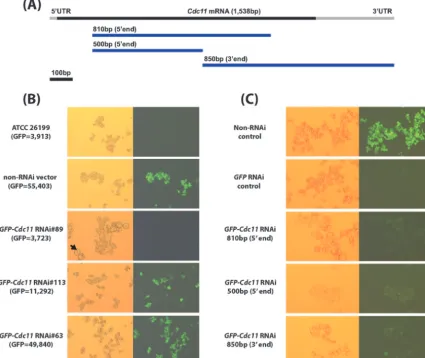
(Fig. 5A) to create the hairpin. This 810-bp sequence was checked for cross homology to the otherB. dermatitidisseptin homology regions (CDC3,CDC10,CDC12, andASPE, in con-tigs 1.54, 196.6, 43.8, and 101.8, respectively). Only a short stretch of 10 to 14 bp from each of these contigs matched the 810-bp CDC11 sequence, but the matches were outside the coding sequences of the putative septins.
The 810-bpCDC11sequence was cloned into theGFP sen-tinel RNAi vector pFANTAi4 to create the GFP-CDC11 RNAi vector (pFi-3AB2) and transformed into theB.
derma-titidis 26199-GFP reporter strain. As with GFP-BAD1- and
GFP-LACZ-silenced strains, we sought GFP-CDC11 RNAi
transformants with low GFP signals as a sentinel of reduced
CDC11 expression. Fifty-six clones of 26199-GFP
transfor-mants were randomly selected, and the GFP signals were quantified. The GFP-CDC11 RNAi transformants showed a wide range of GFP signals. Based on the non-RNAi control, which showed high fluorescence,⬃40% ofGFP-CDC11 trans-formants showed at least a fivefold reduction in GFP signal. We analyzed the low-GFP transformants for phenotypic alter-ations linked withCDC11silencing.
Phenotypic consequences of silencing septin inB. dermati-tidis. Microscopically, the control transformants (non-RNAi and GFP-only RNAi) and the GFP-CDC11 RNAi transfor-mants with high GFP signals showed a normal size, frequent budding, and a symmetrical round shape (Fig. 5B). The
GFP-CDC11RNAi transformants with low GFP signals exhibited
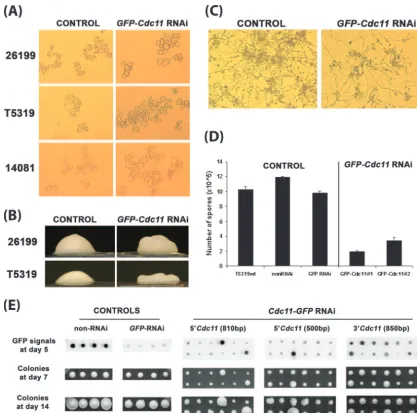
aberrant microscopic features. They had a ballooned, distorted appearance, with irregular shapes such as pseudohyphae, and many fewer budding yeast cells (Fig. 5B, middle panel). For strain 26199, of threeCDC11-silenced transformants analyzed, 35 to 50% of the yeast cells showed a ballooned, nonbudding phenotype microscopically, versus 3 to 5% of the unsilenced or GFP-silenced control transformants. Similar microscopic ab-normalities were observed in association with reduced GFP signals in the T5319-GFP and 14081-GFP reporter strains after transformation with theGFP-CDC11RNAi plasmid (Fig. 6A).
The CDC11-silenced colonies also looked macroscopically
abnormal. The controls (non-RNAi andGFP-only RNAi) and
theGFP-CDC11 RNAi transformants with high GFP signals
had smooth, dome-shaped colonies. In contrast, the
GFP-CDC11RNAi transformants with low GFP signals had rough
or pancake-like colonies (Fig. 6B).
Silencing of CDC11 impaired sporulation. Mycelia of the
GFP-CDC11 RNAi transformants with reduced GFP signals
produced fewer spores than the control strains, including the parental strain T5319, the non-RNAi control, and theGFP -only RNAi control (Fig. 6C and unpublished data). To quan-tify the defect, spore production was compared for an equal number of yeast cells (1.5 ⫻ 107) as the starting material. When the strains converted to mycelia after 2 weeks at 22°C, spores were collected and counted. The GFP-CDC11 RNAi transformants produced up to sixfold fewer spores than the controls (Fig. 6D).CDC11-silenced strains failed to “catch up” to controls in spore production, despite continued growth at 22°C for up to 6 weeks. Nevertheless, the spores harvested
fromCDC11-silenced strains showed viability rates similar to
those of the controls, and at 37°C, they germinated into mis-shapen yeast cells and formed pancake-like colonies (data not shown).
Silencing of Cdc11 sharply impaired B. dermatitidis yeast growth at 37°C. A defect in growth of the septin RNAi trans-formants was observed for all three GFP reporters tested. Based on the size of colonies during growth on agar over 2 weeks at 37°C, theGFP-CDC11(810-bp) RNAi transformants grew more slowly than the controls (Fig. 6E). This growth abnormality correlated with the intensity of the GFP signal, i.e., the lower the GFP signal, the slower the growth. Growth in more quantifiable liquid assays yielded similar findings for representative transformants tested over a 1-week period (data not shown). Cdc11-silenced strains grew up to 45% slower than the control strain by day 7.
Since RNAi typically targets a small sequence of 21 to 25 nucleotides (1), it is possible that off-target silencing by the hairpin of transcripts with homology to the gene of interest may confound interpretation of the results. As described above, we sought to guard against this possibility by ensuring that the hairpin sequences do not contain even short regions of sequence similarity to the other septins. To further minimize any possibility that our findings are due to off-target silencing, we created additional hairpins from two different regions of the gene that do not overlap, namely, a 500-bp sequence at the 5⬘ end and an 850-bp sequence at the 3⬘end (Fig. 5A), and cloned them into the GFP sentinel vector pFANTAi4 to make septin RNAi vectors pFi-511 and pFi-262, respectively. The pFi-511 and pFi-262 plasmids were used to silenceCDC11in 26199- and T5319-GFP reporters. The effects on microscopic appearance (Fig. 5C), colonial growth (Fig. 6E), and sporula-tion rates (data not shown) were similar to those found with the original 810-bp sequence used in pFi-3AB2. However, the
TABLE 1. Blastomyces dermatitidisseptin homologsa
Organism
BLAST result for septin class (B. dermatitidiscontig)
CDC3(aspB) (1.54) CDC10(aspD) (196.6) CDC11(aspA) (94.27) CDC12(aspC) (43.8) aspE(101.8) HS Probability HS Probability HS Probability HS Probability HS Probability
S. cerevisiae 147 4.0E⫺12 304 3.9E⫺63 588 8.7E⫺94 803 2.9E⫺92
S. pombe 182 3.9E⫺22 357 9.2E⫺85 679 8.0E⫺89 556 1.0E⫺104
C. albicans 149 1.2E⫺17 306 1.5E⫺84
A. nidulans 313 6.7E⫺46 515 5.1E⫺123 999 6.1E⫺174 823 4.1E⫺115 848 5.20E⫺137
aPredicted amino acid sequences forCDC3(aspB),CDC10(aspD),CDC11(aspA),CDC12(aspC), andaspEof several fungi (S. cerevisiae,C. albicans,A. nidulans,
andS. pombe) were searched by tBLASTn against the most currentB. dermatitidisgenome database (http://genome.wustl.edu/tools/BLAST/). The high score (HS) and probability for eachB. dermatitidis septinhomolog-containing contig are shown. In the case ofCDC3, only a portion of the gene is available for comparison on contig 1.54. Comparison of theCDC3sequence over this short stretch of nucleotides likely accounts for the lowerCDC3scores than those for the other septins.
on September 8, 2020 by guest
http://ec.asm.org/
degree of CDC11 silencing depended on the region of the
CDC11target chosen. In contrast to the results obtained with
LACZ, targeting the 5⬘ end (500 bp) of CDC11gave more severe GFP silencing and phenotypes than did targeting the 3⬘ end (850 bp) (Fig. 6E and unpublished data).
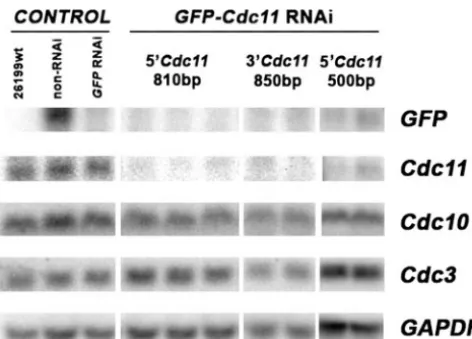
Confirmation ofGFPandseptinsilencing by Northern anal-ysis.To provide unambiguous evidence that the sentinel
re-porter and the phenotypic defects accurately signaledCDC11 silencing, we analyzed the transcript abundance in the strains. Representative transformants for wild-type 26199, the non-RNAi control, theGFP-only RNAi control, andGFP-CDC11 RNAi (in which various portions of CDC11 were targeted) were studied by Northern analysis. The blotted membrane was probed with GFP, CDC11, CDC10, CDC3, and GAPDH
FIG. 4. (A) Diagram showing two common domains for septins, i.e., a GTP-binding domain (comprised of three motifs, G1, G3, and G4) and a coiled-coil domain. (B) Alignment of the deduced amino acid sequence of the Cdc11 GTP-binding domain ofB. dermatitidis(Bd) with those of the following other fungi:S. cerevisiae(Sc; accession number AAB50035),C. albicans(Ca; AAM51626),A. nidulans(An; AAK21867),C. immitis
(Ci; AAK14772),N. crassa(Nc; XP_965058), andS. pombe(Sp; AAB53691). (C to G) Septin ring structures inB. dermatitidis. A Cdc11-GFP fusion was expressed inB. dermatitidisstrains T5319 and ER-3 and was found localized at the hyphal tip in mold, at the septum in a pseudohyphal form (note the hourglass shape; arrow), at various stages in budding yeast (E to G), and in a well-defined ring-like structure at the bud neck of the mother and daughter cells viewed from above (F). See the text for additional details.
on September 8, 2020 by guest
http://ec.asm.org/
probes (Fig. 7). The wild-type control had no detectableGFP transcript but had a strong signal forCDC11. The non-RNAi and GFP-only RNAi controls also had strong signals for
CDC11, but theGFPtranscript was abundant in the non-RNAi
control and diminished in theGFP-only RNAi control. Both
theGFPandCDC11transcripts were sharply reduced, to 5%
and 10%, respectively, in the GFP-CDC11 RNAi transfor-mants compared to those in the controls (Fig. 7). Levels of
GAPDH,CDC10, andCDC3transcripts appeared to be
equiv-alent in all the RNA extracts tested. Thus,GFP andCDC11 transcripts appeared to be reduced, as expected, in silenced strains, and there was no evidence of off-target silencing of the septin homologuesCDC3andCDC10.
DISCUSSION
The sequencing of theB. dermatitidisgenome is nearly com-plete. Efficient technologies for the functional analysis of this newly available genetic information will accelerate our under-standing of the biology and pathogenesis of this pathogen. Here we report the utility of RNAi for rapid functional analysis
of genes with unknown function inB. dermatitidisand illustrate its application for the investigation of septin. The technique involves a sentinel RNAi system using GFP as a surrogate marker. The effectiveness of a GFP-RNAi sentinel to monitor RNAi-based silencing was recently established withH.
capsu-latum(17). We reasoned that the development of such a
sys-tem would facilitate gene depletion studies withB. dermatitidis. Gateway recombination technology allowed us to quickly en-gineer a hybridGFP-target gene plasmid to silence bothGFP and the target gene simultaneously in B. dermatitidis GFP reporter strains. The level of GFP signal was used as initial indirect evidence of the degree of silencing of a target se-quence in an individual transformant. This type of sentinel system can be especially useful when the phenotype of a target gene mutation is unknown. To ensure that the RNAi target sequence is completely transcribed, we placed the copies of GFPsequence at the ends of the intended RNAi transcript. Thus, ifGFP is silenced, then RNAi is functioning, and it is likely that transcription has proceeded through the entire hair-pin sequence, target gene double-stranded RNA will be pro-duced, and target gene RNAi should also be functional.
FIG. 5. SilencingGFP-CDC11inB. dermatitidis.(A) Map showing theB. dermatitidis CDC11coding sequences and sequences designed to targetCDC11(5⬘end, 810 bp and 500 bp; and 3⬘ end, 850 bp). (B) Microscopic features showing a correlation between GFP signals and morphology (cell size and shape) of control transformants and selectedGFP-CDC11RNAi transformants. (C) Microscopic features of cells silenced with differentCDC11hairpin sequences. AllCDC11-silenced yeast cells had an abnormal shape and size compared to the controls.
on September 8, 2020 by guest
http://ec.asm.org/
The utility of this sentinel RNAi concept was initially estab-lished by using the well-known virulence geneBAD1as a test target. When the 0.6-kbBAD1sequence was used for RNAi, bothBAD1andGFPwere cosilenced as expected; for example, a transformant with relatively low GFP expression appeared to concomitantly express a low level of BAD1, and a transformant with a normal GFP signal expressed substantial BAD1. The utility of the sentinel approach was further confirmed with the use ofLACZas a target, wherein cotranscription of hairpins of GFP-LACZin the T5319-GFP reporter strain led to reduced expression of bothGFPandLACZ. These data gave us con-fidence that we could use GFP as a reliable sentinel to rapidly screen many candidate transformants to find those in which a target gene was efficiently silenced.
RNAi has been applied for functional genetic studies of many fungi (7, 8, 15, 20, 22, 23, 28), but little is known about
the factors that influence RNAi efficiency in these organisms. Rappleye et al. (22) showed for the dimorphic fungusH.
cap-sulatumthat two factors—loop size of the RNAi hairpin and
length of the target sequence—influence the degree of gene silencing. A greater silencing effect was observed with a shorter loop and a longer target gene sequence. We also explored a correlation between length of a target sequence and RNAi efficiency by using LACZ in B. dermatitidis. When several lengths ofLACZ(0.9 kb, 1.5 kb, and 3 kb [full length]) were used to create variousGFP-LACZhairpins, the shorterLACZ sequence (0.9 kb) was more effective at silencing than the longerLACZsequences. While these results agree with those of Rappleye et al. (22) in that the length of the targeting sequence is important, the decreased RNAi efficiency from increasing the length of the LACZ sequence indicates that there are quantitative differences in RNAi efficiency that may
FIG. 6. Abnormal phenotypes after silencing ofB. dermatitidis CDC11. (A)CDC11-silenced reporters (26199-GFP, T5319-GFP, and 14081-GFP) had big and aberrantly shaped cells compared to the control (GFP-only RNAi or non-RNAi). (B)CDC11-silenced transformant showing a rough or pancake-like colony and control transformant with a normal, smooth, dome-shaped colony. (C and D)CDC11-silencedB. dermatitidis
produced many fewer spores than the control. (E) Regardless of theCDC11sequence targeted (500 bp, 5⬘end; 810 bp, 5⬘end; and 850 bp, 3⬘end),
CDC11-silenced transformants had a growth defect compared to controls (non-RNAi andGFP-only RNAi).
on September 8, 2020 by guest
http://ec.asm.org/
be related to the specific target sequence and host organism, in addition to target length.
In agreement with this idea, we also found inGFP-LACZ RNAi studies that the specific sequence targeted greatly influ-enced the degree of silencing and the frequency of silinflu-enced transformants. When we targeted 1.5-kb regions ofLACZ rep-resenting either the 3⬘end or the 5⬘ end with hairpins, both regions promoted silencing, but the 3⬘ sequence was more efficient than the 5⬘sequence. Because of the empirical nature of these length and sequence effects on interference, for any gene of interest it would be useful to test different regions for targeting to find the most efficient target. In addition, to con-trol for possible off-target silencing, it is necessary to produce independent strains exhibiting silenced phenotypes by using nonoverlapping regions of the target gene. In the case of GFP-LACZRNAi, the same phenotype—loss of LacZ activity—was observed by using both regions, which confirmed that the phe-notype was a consequence of theLACZRNAi. Based on these initial RNAi studies targetingLACZandBAD1, the surrogate GFP sentinel system was gauged to be suitable for the study of a gene with an uncharacterized function inB. dermatitidis.
We exploited thisGFPsentinel RNAi system to investigate the role of septins in morphogenesis and sporulation in
B. dermatitidis. During cytokinesis of budding yeasts, septins
(Cdc3, Cdc10, Cdc11, and Cdc12) are recruited to the bud site, forming a ring-like structure postulated to function as a scaf-fold for localization of proteins involved in cell division and a barrier preventing back diffusion of intracellular contents from daughter to mother cell (9, 10, 16, 31). We identified five putative septin homologs (CDC3, CDC10, CDC11, CDC12, andASPEhomologs) by a tBLASTn search of theB.
derma-titidisgenome database. ACDC11homolog was selected for
functional study because it contains all the motifs (G1, G3, and G4) of the GTP-binding domain and the coiled-coil domain found in Cdc11 proteins of other fungi (Fig. 4A). A Cdc11-GFP hybrid protein localized to the bud neck ofB. dermatitidis in a well-defined ring structure, similar to that found in C.
albicansandS. cerevisiae(9, 10), implying thatB. dermatitidis
Cdc11 may share functional roles with these homologues.
CDC11in B. dermatitidiswas silenced using several target
region sequences (500 bp and 810 bp from the 5⬘end and 850 bp from the 3⬘end). Altered morphological phenotypes were consistently observed inGFP-silenced strains transformed with
all GFP-CDC11 RNAi constructs, suggesting a specificity of
theCDC11-silenced phenotypes. They included enlarged and
fewer budding yeast cells, rough or flat colonies, and growth and sporulation defects. These aberrant phenotypes were as-sociated with decreased CDC11 transcripts. In addition, the transcript analysis indicated that there was no cross-silencing of other septin genes. The phenotypes associated with the
CDC11-silenced strains ofB. dermatitidissupport the
hypoth-esis that Cdc11, which localized at the bud neck, is likely to serve a function in the budding event, similar to the case in other budding yeasts. These aberrant phenotypes could be due to an inability of the CDC11-silenced B. dermatitidisto con-strict and separate the mother and daughter compartments.
TheCDC11-silenced strains also had a striking growth defect,
similar to that reported for other fungi (10, 31). InUstilago
maydis, Boyce et al. (2) found that theCDC11homologsep3is
required for normal morphology and division of haploid cells, formation of hyphae during the filamentous growth response to lipids, and symptom development in maize. The growth defect of theCDC11-silenced yeast in our study made it un-feasible to study virulence in vivo. Although ourCDC11 -si-lenced strains were morphologically abnormal, they switched normally from mold to yeast in response to temperature, indi-cating thatCDC11does not control the phase transition inB.
dermatitidis.
In A. nidulans, ASPB (CDC3) and ASPC (CDC12)
tran-scripts are abundantly expressed in the conidiating mycelium, but their functional roles in conidiation are unclear (19). InS.
cerevisiae, CDC3, CDC10, CDC11, and SPR3 are highly
ex-pressed in sporulating cells (10). Deletion ofSPR3produces a threefold reduction in sporulation; deletion ofCDC3,CDC11,
andCDC12is lethal or produces a severe growth defect,
mak-ing an evaluation of the roles ofCDC3,CDC11, andCDC12in sporulation difficult (10).CDC11-silenced strains ofB.
derma-titidis showed a marked defect in sporulation. These strains
had up to sixfold fewer spores than controls, showing that
CDC11participates in control of sporulation in this dimorphic
fungus. This defect could not be explained by a growth delay of
CDC11-silenced strains, because continued incubation and
growth did not correct the defect and microscopic inspection showed persistent “barren” hyphae in the silenced strains even during extended growth.
That fact that deletion of CDC11 inS. cerevisiae severely impairs growth (10) foreshadowed the possibility thatB.
der-matitidis CDC11might be an essential gene. We were not able
to create acdc11-null strain ofB. dermatitidisdespite the use of different gene disruption and screening strategies (data not shown). The new surrogate GFP sentinel RNAi system re-ported here underscores the utility of gene silencing method-ologies such as this for studying the role of potentially essential genes.
In conclusion, we report a surrogate GFP sentinel RNAi system for facilitating reverse genetic analysis of the dimorphic fungusB. dermatitidis. With this system, gene silencing can be accomplished for three different genes,LACZ(a procaryotic transgene), BAD1 (a gene whose mutant phenotype was
FIG. 7. Northern blot analysis of transcript levels ofGFP,CDC11,
CDC10,CDC3, andGAPDHin the wild-type strain ATCC 26199, the control transformants (non-RNAi andGFP-only RNAi), and GFP-CDC11RNAi transformants.
on September 8, 2020 by guest
http://ec.asm.org/
known), andCDC11(a previously uncharacterized gene inB.
dermatitidis). An advantage of RNAi is that a partial target
sequence is adequate for gene silencing. However, the length and location of the target sequence should be optimized em-pirically for the maximal RNAi effect. To our knowledge, this study is the first characterization of a septin in the systemic dimorphic fungi. We found thatCDC11governs cell budding, growth, and sporulation but not phase transition. To fully de-fine the role of septins in morphogenesis of the dimorphic fungi, the sentinel RNAi system reported here could be ap-plied to the analysis of the other B. dermatitidis septin ho-mologs. The facility of the GFP sentinel RNAi system will accelerate reverse genetic analysis of these and other genes of unknown or suspected function in B. dermatitidis and other eukaryotic organisms.
ACKNOWLEDGMENTS
This work was supported by a postdoctoral fellowship from the Ellison Medical Foundation-International Nutritional Foundation (T.K.), a training grant from the Faculty of Medicine, Ramathibodi Hospital, Mahidol University (T.K.), a Pfizer fellowship in medical mycology from the IDSA (G.G.), and NIH grants from the USPHS (B.K. and G.G.). B.K. is a Hartwell Foundation Scholar.
We thank William Goldman for providing materials prior to publi-cation, Jon Woods for plasmid DNA, and Robert Gordon for assis-tance with graphics.
REFERENCES
1.Agrawal, N., P. V. N. Dasaradhi, A. Mohmmed, P. R. K. Bhatnagar, and S. K. Mukherjee.2003. RNA interference: biology, mechanism, and appli-cations. Microbiol. Mol. Biol. Rev.67:657–685.
2.Boyce, K. J., H. Chang, C. A. D’Souza, and J. W. Kronstad.2005. AnUstilago maydis septin is required for filamentous growth in culture and for full symptom development on maize. Eukaryot. Cell12:2044–2056.
3.Brandhorst, T., M. Wuthrich, T. Warner, and B. S. Klein.1999. Targeted gene disruption reveals an adhesin indispensable for pathogenicity of
Blastomyces dermatitidis. J. Exp. Med.189:1207–1216.
4.Brandhorst, T., and B. S. Klein.2000. Cell wall biogenesis ofBlastomyces dermatitidis. Evidence for a novel mechanism of cell surface localization of a virulence-associated adhesin via extracellular release and reassociation with cell wall chitin. J. Biol. Chem.275:7925–7934.
5.Brandhorst, T., M. Wuthrich, B. Finkel-Jimenez, and B. S. Klein.2003. A C-terminal EGF-like domain governs BAD1 localization to the yeast surface and fungal adherence to phagocytes, but is dispensable in immune modula-tion and pathogenicity ofBlastomyces dermatitidis. Mol. Microbiol.48:53–65. 6.Brown, T., and K. Mackey.1997. Analysis of RNA by Northern and slot blot hybridization, p. 4.9.1–4.9.16.InF. M. Ausubel, R. Brent, R. E. Kingston, D. D. Moore, J. G. Seidman, J. A. Smith, et al. (ed.), Current protocols in molecular biology. Wiley Interscience, Hoboken, NJ.
7.Cottrell, T. R., and T. L. Doering.2003. Silence of the strands: RNA inter-ference in eukaryotic pathogens. Trends Microbiol.11:37–43.
8.De Backer, M. D., M. Raponi, and G. M. Arndt.2002. RNA-mediated gene silencing in non-pathogenic and pathogenic fungi. Curr. Opin. Microbiol. 5:323–329.
9.Douglas, L. M., F. J. Alvarez, C. McCreary, and J. B. Konopka.2005. Septin function in yeast model systems and pathogenic fungi. Eukaryot. Cell 4:1503–1512.
10.Fares, H., L. Goetsch, and J. R. Pringle.1996. Identification of a develop-mentally regulated septin and involvement of the septins in spore formation inSaccharomyces cerevisiae. J. Cell Biol.132:399–411.
11.Horton, R. M., Z. Cai, S. N. Ho, and L. R. Pease.1990. Gene splicing by overlap extension: tailor-made genes using the polymerase chain reaction. BioTechniques8:528–535.
12.Kinoshita, M.2003. The septins. Genome Biol.4:236.1–236.9.
13.Klein, B. S.1997. Role of cell surface molecules ofBlastomyces dermatitidis
in the pathogenesis and immunobiology of blastomycosis. Semin. Respir. Infect.12:198–205.
14.Klein, B. S., and J. M. Jones.1990. Isolation, purification, and radiolabeling of a novel 120-kD surface protein onBlastomyces dermatitidisyeasts to detect antibody in infected patients. J. Clin. Investig.85:152–161.
15.Liu, H., T. R. Cottrell, L. M. Pierini, W. E. Goldman, and T. L. Doering. 2002. RNA interference in the pathogenic fungusCryptococcus neoformans. Genetics160:463–470.
16.Longtine, M. S., and E. Bi.2003. Regulation of septin organization and function in yeast. Trends Cell Biol.13:403–409.
17.Marion, C. L., C. A. Rappleye, J. T. Engle, and W. E. Goldman.2006. An ␣-(1,4)-amylase is essential for␣-(1,3)-glucan production and virulence in
Histoplasma capsulatum. Mol. Microbiol.62:970–983.
18.Mello, C. C., and D. Conte, Jr.2004. Revealing the world of RNA interfer-ence. Nature431:338–342.
19.Momany, M., J. Zhao, R. Lindsey, and P. J. Westfall.2001. Characterization of theAspergillus nidulansseptin (asp) gene family. Genetics157:969–977. 20.Mouyna, I., C. Henry, T. L. Doering, and J. P. Latge.2004. Gene silencing with
RNA interference in the human pathogenic fungusAspergillus fumigatus. FEMS Microbiol. Lett.237:317–324.
21.Nemecek, J. C., M. Wuthrich, and B. S. Klein.2006. Global control of dimorphism and virulence in fungi. Science312:583–588.
22.Rappleye, C. A., J. T. Engle, and W. E. Goldman.2004. RNA interference in
Histoplasma capsulatumdemonstrates a role for alpha-(1,3)-glucan in viru-lence. Mol. Microbiol.53:153–165.
23.Reese, A. J., and T. L. Doering.2003. Cell wall alpha-1,3-glucan is required to anchor theCryptococcus neoformanscapsule. Mol. Microbiol.50:1401– 1409.
24.Rooney, P. J., T. D. Sullivan, and B. S. Klein.2001. Selective expression of the virulence factor BAD1 upon morphogenesis to the pathogenic yeast form ofBlastomyces dermatitidis: evidence for transcriptional regulation by a con-served mechanism. Mol. Microbiol.39:875–889.
25.Rooney, P. J., and B. S. Klein.2002. Linking fungal morphogenesis with virulence. Cell. Microbiol.4:127–137.
26.Saitou, N., and M. Nei.1987. The neighbor-joining method: a new method for reconstructing phylogenetic trees. Mol. Biol. Evol.4:406–425. 27.San-Blas, G., and F. San-Blas.1984. Molecular aspects of fungal
dimor-phism. CRC Crit. Rev. Microbiol.11:101–127.
28.Sommer, U., H. Liu, and T. L. Doering.2003. An alpha-1,3-mannosyltrans-ferase ofCryptococcus neoformans. J. Biol. Chem.278:47724–47730. 29.Sternberg, S.1994. The emerging fungal threat. Science266:1632–1634. 30.Sullivan, T. D., P. J. Rooney, and B. S. Klein.2002.Agrobacterium
tumefa-ciensintegrates transfer DNA into single chromosomal sites of dimorphic fungi and yields homokaryotic progeny from multinucleate yeast. Eukaryot. Cell1:895–905.
31.Warenda, A. J., and J. B. Konopka.2002. Septin function inCandida albicans
morphogenesis. Mol. Biol. Cell13:2732–2746.
32.Wolf, E., P. S. Kim, and B. Berger.1997. MultiCoil: a program for predicting two- and three-stranded coiled coils. Protein Sci.6:1179–1189.
33.Worsham, P. L., and W. E. Goldman.1988. Quantitative plating ofHistoplasma capsulatumwithout addition of conditioned medium or siderophores. J. Med. Vet. Mycol.26:137–143.
34.Wuthrich, M., and B. S. Klein.2000. Investigation of anti-WI-1 adhesin antibody-mediated protection in experimental pulmonary blastomycosis. J. Infect. Dis.181:1720–1728.

![FIG. 3. Silencing GFP-LACZLACZkb [full length]) were used to createformed intothat expresses GFP and LacZ](https://thumb-us.123doks.com/thumbv2/123dok_us/8667902.1729981/5.594.64.259.71.622/fig-silencing-laczlaczkb-length-createformed-intothat-expresses-lacz.webp)