DIMENSION OF TRIBAL
DEVELOPMENT LEARNING PROCESS
AT GRASS ROOT LEVEL
G. P.PERUMAL,
Ph. D Research Scholar (F/T), Department of Economics, Thiruvalluvar University, Vellore – 632 115.
Dr. P. CHENNAKRISHNAN
Assistant Professor, Department of Economics, Thiruvalluvar University, Vellore – 632 115.
Abstract
The presence of tribal ad non-tribal reflect heterogeneous character of India economy of the Indian economy, while the tribal represent the traditional, conservation and isolated group of people living in mounting and terrains, the non-tribal represent the aspiration for faster change and modernization. The gap between these two groups of people has been expending ever since the development programmes have been implemented. The characteristics of the tribal economy are described as forest based. Family as a unit of production, consumption and patter of labour, periodical local market, and interdependence.
I. INTRODUCTION
In 1951, the government of India had started making efforts to raise the general standard of living of the weaker sections as well as tribal development in the form of National Extension Schemes, (NES) with the objective to intensify the, block level development activities. It was actually done to translate the spirit of the fundamental rights and Directive Principles of State Policy provided in Article 46, the State shall promote with special care the educational and economic interests of the weaker sections of the people, and in particular, of the Scheduled Caste and Scheduled Tribes, and shall protect them from social injustice and all forms of exploitation. In 1962 the block level programme became found to be a blockade to the
development of the weaker sections, the Tribal Development Block (TDB) was introduced later. Since desired goals could not be realized through these Programmes. The Tribal Integrated Development Project (ITDP) was started in 1972, and when it failed in practice another scheme, Tribal Sub-plan Scheme for Tribal Development (SSTD), was introduced in 1972 without defining the coverage area, and the objectives. Integrated Tribal Development Projects (ITDP) and Integrated Area Development Programme (IADP) were started functioning under this almost all states.
II. OBJECTIVE
1. To find out the constraints involved in availing the benefit of tribal development programmes and to suggest suitable policy measures. 2. To study the socio economic conditions of
tribal in Thiruvannamalai Taluk
3. To study the impact of tribal development programmes in Thiruvannamalai tribal area. Methodology
programmes, annual reports, tribal sub plans, implemented many development programmes in state and central governments. The researcher used on the period (2006-2016)study. The study period lack of problem in the tribal area and tribal blocks, the many programmes implemented of the Integrated Tribal Development programmes in the area. The researcher focus the education, drinking water and self help groups etc.
Review of Literature
Roy Burman B. K (2006), study examine have draft national tribal policyof 2006 creating concentration, the new draft tribal policy is a reworking of a similar document given shapes by the previous NDA government-however, rather than rectify the lacunae noticed in the earlier policy, the new draft has several regressive features. The proposal to renstate the single line administration, for instance would lead to concentration of power in the district official instead of festering actual at the grass root level.
Tankesh joshi and other (2007), women’s health and nutritional status is inextricably bound with social, cultural and economic factors the influence all aspects of their lives and it has consequence not only for the woman themselves but also for the well-being of their children. The functioning of the households and the distribution of resources of some communities there are many myths related to female menstruation cycle and other health practices. Our study reflects some of myths and practices related to this in bester. History of Indian Tribes
In Indian, there are 573 tribal community according for 8.90 percent of the total population. The tribal’s vary in socio-economic, cultural and linguistic features and are also widely dispersed all over the country in hilly, forest and plain areas. These tribal’s are said to be part of indigenous people, settled in different part of the Indian
sub-continent before the Aryans invasion. Wars between Indo-Aryans followed, in which, these earlier inhabitation with their inferior level of socio- economic strucuture were forced to the relatively inaccessible region of forest, hills and large mountain slops, which formed the cul-de-sac for them. The Aryans, with their superior socio-economic structure, occupied the fertile plains of Indus, and Ganga Yamuna in the Northern India and several areas of central India.
Tribal Development in Tamil Nadu
Out of the 36 Scheduled Tribes living in Tamil Nadu, six tribal communities i.e Toda, the Kota, the Panniyan, the Irula, the Kurumba, and the kattunayakan, who are residing in Nilgiris are only considered as Particularly Vulnerable Tribal Groups (PVTGs). A bulk of the Government’s funds earmarked for tribal development is directed for who are residing in other areas receiving less attention by the Government whereas; the NGOs are helping the tribal all over Tamil Nadu.
Tribal Welfare Programmes
Tribal Development Block Tribal Advisory Councils
Integrated Area Development Programmes Integrated Rural Development Programme Integrated Tribal Development Programme Hill Area Development programme Problems
education appears to be a luxury for them. In the case of those people who are engaged in agriculture, their minor children are also engaged in it. The illiterate parents do not consider it as their primary responsibility to give education to their children.
The Tribal Sub-Plan is financed Through the
Resource Drawn from
State plans
Special Central assistance of Ministry of Home Affairs (Ministry of Welfare)
Central and Centrally Sponsored programmes Institutional finance.
The Integrated Tribal Development Areas and the Modified Area Development Approach (MADA) continued further. During the Seventh Five Year plan clusters having a total population of were identified. The Seventh Plan period also witnessed the extension of TSP benefits to all the tribal’s beyond the ITDPs, MADA cluster groups of primitive Groups. During this period ITD pattern was allowed to continue. Better coordination was sought between various agencies and social services were accorded priority. Large Scale Agricultural Societies (LAMPS) in tribal areas were strengthened through widening the base.
Eight Plan began with the realization that the resource base and the socio-cultural heritage of ST is being eroded through a combination development intervention, commercial exploitation and ineffective legal and administrative system. The Eight Plan envisaged effective tackling of exploitative practices in the tribal area such as alienation of land, right to collection of forest products, ensuring full rehabilitation of tribal displaced due establishment of projects, special focus of programmes to deal with education and health needs of tribal women. Right from the inception of the Integrated Rural Development Programme in 1978-79, special emphasis was laid
on coverage of ST and SC families. Efforts have been made for wage employment expansion under various programmes, for example JRY. The guideline of Jawahar Gram Samridhi Yojana provides special safeguards for SCs and STs. Important techniques of sales promotion June 2012 Under JGSY 22.5%. of annual allocation is earmarked for SC/ST individual beneficiary scheme.
The Constitution of India provides for a number of safeguards for the ST a mainly to facilitate the implementation of the Directive principles contained in Article 46 of the X constitution. The important safeguards provided in the Constitution include Article 46 (Promotion of educational and economic interest of Scheduled Caste, Scheduled Tribes and other weaker sections) 330(Reservation of seats for SCs and STs in the House of People, 332 (Reservation of seats for SCs and STs in the legislative Assemblies of the states, 335 (claims of the SCs and Sts to service and posts etc. Programmes for which central assistance is given can be divided into three groups namely education, economic upliftment and health. The services provided to tribal under these programmes are free education, provision for educational equipment, Ashram school, scholarship etc. Increasing the welfare of the socially and economically disadvantaged groups, including the Scheduled caste, Scheduled Tribes, backward classes, handicapped and disabled, women and children.
Population Status of the SCs and STs
Table No.1: The literacy rate of Scheduled caste and Scheduled
Tribes in Tamil Nadu as per 2011 census is follows
(in Percentage)
Category Male Female Total
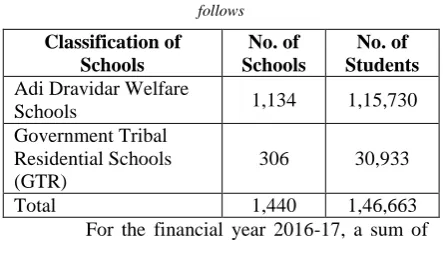
Table No.2: The number of schools functions under the Adi
Dravider and Tribal Welfare Department and students as
follows Classification of Schools No. of Schools No. of Students Adi Dravidar Welfare
Schools 1,134 1,15,730
Government Tribal Residential Schools (GTR)
306 30,933
Total 1,440 1,46,663
For the financial year 2016-17, a sum of Rs. 2971.19 crore has been provided in the out of which Rs. 2645. 89 crore (89.05%) has been allocated for education related schemes.
Table No.3: Schedule tribes Population in Thiruvannamalai
District as per 2011 Census
Taluk Area Population
2011
Population Density
Polur 819
km3 496,481 606 /km 2
Thiruvannamalai – Urban
102
km2 285,087 2,795 / km 2
Thiruvannamalai- sub urban
622
km2 387,578 623 / km 2
Thiruvannamalai –Rural
691
km2 390,880 566 / km 2
Arani 527
km2 299,900 569 / km 2
Cheyyar 634
km2 350,367 553 / km 2
Kalasapakkam 532
km2 312,013 549 / km 2
Jawadhu Malai 645
km2 178,897 277 / km 2
Vandhavasi 645
km2 381,174 591 / km 2
Chengam 682
km2 396,588 582 / km 2
Source: List of cities having population of one lakh ad above as
per 2011 Census
Table No. 4: Financial allocation to Adi Dravider and Tribal
Welfare Department during 2016-17
(Rs. in crore)
Particulars Revenue Capital Loan Total Secretariat 6.58 0.00 0.14 6.72
Adi Dravidar
Welfare
2474.61 221.21 0 2695.82 Tribal
Welfare 228.74 39.91 0 268.65 Total 2709.93 261.12 0.14 2971.19
Source: Minister for Adi Dravidar and Tribal Welfare
Department
Comprehensive Tribal Development
Programme
The Government has allocated a sum of Rs.50 crore for the Comprehensive Tribal Development Programme for the year 2016-17. Though this programme land development activities, improvement of Katcha houses, road work, improvement of GTR schools, provision of drinking water facilities, economic development schemes and training skills are implemented through TAHDCO for tribal development.
III. CONCLUSION
As part of the development programmes for the scheduled tribals, a strong emphasis should laid on the political process and social awareness of all section of the society needs to be raised rapidly. Obviously the deprived section of the society are getting more conscious of the denial of social justice to them and the use of ever-widening chasm between them and the elitist class. Amidst all these factors, it is evident from the socio-economic profile of this study that scheduled tribals have improved in terms of standard of living.
IV. REFERENCES
1) Hamumantha Rajappa (1993) Issue in Tribal Development, Journal of Rural Development, Vol.18, Issue no.2.
2) Meen Radhakrishana (2009), Starvation Among Primitive Tribal Groups, Economic Political Weekly, Vol.XLIV, No.18.
3) Nagada B.L (1998), Rajasthan – tribal Population and Development Scenario, Kurukshetra, Vol.39.
4) Nagaraju G.H. (2013), Soio – Economic Infrastructural Characteristic Sticks of Tribal Farmers in Karnataka a Case Study of Chamaraja, Southern Economis, Vol.No.51, No.18.
6) Roy Burman B.K, (2006) Draft National Tribal Policy of 2006 creating Consternation, Economic Political Weekly, Vol.Xl.34,p.36-45.
7) Sanjay Kumar Pradhan (2010), Problems of Tribal Development Education in India a Microscopic Analysis, Kurukshetra, Vol-58. 8) Tankesh Joshi and Muktesh Joshi, (2007)
Myths about tribal Women’s Health in Bastar, Kurukshetra, Vol-59,p-42.
9) Virginiasn xaxa (1999), Transformation Tribes in India Terms Discourse, Ecoomic Political Weekly, Vol. No.XXX, No.24.