a
Corresponding author: [email protected]
The LHCb Upgrade
Richard Jacobsson1,a on behalf of the LHCb Collaboration 1CERN, 1211 Geneva 23, Switzerland
Abstract.With the demonstration that LHCb can successfully perform forward precision measurements with event pileup, the operation and trigger strategy evolved significantly during the LHC Run 1 allowing LHCb to collect over 3fb-1 at centre-of-mass energies of 7TeV and 8TeV. Increased bandwidth opened the door for
LHCb to extend the physics program. The additional statistics and well managed systematic effects together with the stable trigger and data taking conditions have led to a very large number of world-class measurements and dominance in heavy flavour physics [1], in addition to a reputation of an excellent forward general purpose detector at the LHC. Long Shutdown (LS) 1 (2013-2014) will allow LHCb to fully explore the large statistics collected and prepare LHCb for Run 2 (2015 – 2017). However, even after an additional expected integrated luminosity of 5-6 fb-1 in Run 2, many of the LHCb precision measurements will remain limited by statistics,
and some exploratory physics modes will not even be accessible yet. With the need for reconstructing the event topology in order to efficiently trigger on the beauty and the charm hadrons decays, the current 1 MHz readout limit is the main bottle neck to run at higher luminosity and with higher trigger efficiencies. LHCb will therefore undergo a major upgrade in LS 2 (2018 – 2019) aimed at collecting an order of magnitude more data by 2028. The upgrade consists of a full readout at the LHC bunch crossing rate (40 MHz) with the ultimate flexibility of only a software trigger. In order to increase the instantaneous luminosity up to 2x1033cm-2s-1,
several sub-detector upgrades are also underway to cope with the higher occupancies and radiation dose.
1 Introduction
The LHC Run 1 left us with on the one hand the fundamental discovery of the existence of scalars in nature and a compatibility with a 126GeV/c2 Standard
Model (SM) Higgs boson. On the other hand, the absence of a non-SM signal in precision measurements has narrowed down the space for New Physics. In particular the results in the heavy flavour sector have explored New Physics with flavour related couplings up to a mass scale of many tens of TeV. While these results were clearly one of the very likely outcomes of Run 1, and they hint at an even more well-established Standard Model as low-energy effective theory, the unsolved fundamental questions such as the neutrino oscillations, the baryon asymmetry, the dark matter, dark energy etc, are still as much in need of New Physics. As it stands now, precision measurements are likely to have the largest discovery potential for new physics in the future. Clearly the nature of the newly found boson should be determined through precise measurements of the couplings to the vector bosons and the fermions, and its role in the electroweak symmetry breaking and mass generation need to be understood. However, the general purpose nature of flavour physics together with the fact that two of the most fundamental unexplained questions about the baryon
asymmetry and neutrino oscillations are of flavour nature shows that continued precision measurements on rare heavy flavour decays and CP violation are of equal importance in the search for New Physics. Of course, the direct searches for on-shell production of new particles will continue to play an important complementary role. If new particles are first discovered directly, flavour precision measurements will still be crucial to characterize the role of the new physics.
The main objective of LHCb is measuring indirect effects of New Physics in processes which are naturally strongly suppressed in the Standard Model, i.e. typically those which involve Flavour Changing Neutral Currents (FCNC) mediated by box and penguin diagrams. A key point in strong defense of the LHCb upgrade is that New Physics effect may enter differently in boxes and penguin contributions, which means that it is necessary to have access to as many modes as possible with sufficient precision to distinguish the contributions. The beauty and the charm sectors contain a very large repertoire of decays and topologies, and LHCb aims at exploring all the possible observables sensitive to new physics; time-dependent CP asymmetries to determine contributions to the phases from New physics, amplitude corrections by measuring branching ratios and oscillation frequencies, and a large number of angular analyses to discern © Owned by the authors, published by EDP Sciences, 2013
deviations from the helicity structures as they are predicted by the SM. Compared to direct searches, these observables are naturally inclusive and less model dependent. The theoretical understanding for many of these observables is very good within the framework of the SM, and LHCb aims at reaching experimental sensitivities which are comparable to the theoretical uncertainties. Experience with the detector operation and with the analysis of the data from Run 1 shows that systematics effects may be managed very well, and that the precisions in the measurements are not expected to be limited by systematics uncertainties. This also includes regular polarity switches of the LHCb spectrometer dipole which allows averaging out systematics from detector asymmetries. Consequently, the current measurements will remain limited by statistics even after an integrated luminosity of up to 10fb-1 in the current
experiment. A 10-fold increase in statistics will not only allow reaching the desired statistical power but would also allow opening the door to new physics modes both within the field of flavour physics but also in other physics topics for which the LHCb acceptance is particularly interesting. With the encouraging experience of working in an environment with event pileup during Run 1 [2], it can be achieved efficiently by operating the experiment at higher luminosity with an associated change to the LHCb trigger architecture to remove current limitations and increase the trigger efficiency, in particular for hadronic modes. Upgrades of some of the LHCb detectors are necessary as a consequence of the required radiation longevity. In addition, this provides an opportunity to re-optimize the experiment with upgraded technologies to cope more efficiently with the higher occupancies and further improvements to the physics capabilities.
2 Key features and upgrade foundation
Despite the challenge of precision flavour physics at the LHC in the forward region, LHCb can profit from a number of powerful key features. The cross-sections for bb-production is expected to be around 500b at √ = 14TeV implying a rate of about 200kHz of b-events at the LHCb interaction point at the target luminosity of 4x1032cm-2s-1 for Run 2. The production mechanism at
the LHC gives access to all the quasi-stable b-flavoured hadrons in a mixture of 40% of Bu, 40% of Bd , 10% of
Bs, and a small fraction of Bc, in addition to 10% of
b-baryons. The cross-sections for cc-production is approximately 20 times larger. In addition, the final states of the bb- and the cc-pairs appear in the same hemisphere and with a large boost. This allows on the one hand a very good proper time resolution for resolving for instance the Bs oscillations, but it also allows both same
side and opposite side flavour tagging with a single arm spectrometer. The detector acceptance spans the polar angles 15mrad to 300mrad in the horizontal bending plane of the spectrometer magnet and 250mrad in the vertical non-bending plane, equivalent to a pseudo-rapidity of about 2 < η < 5. While this corresponds to only 4% of the solid angle, it includes ~40% of the
bb-pair production cross-section. LHCb is unique in having a full detector coverage, including vertexing, tracking, particle identification and calorimetry, in the complete rapidity range between 2 and 5. On top of these features at the LHC, LHCb has also been pioneering several operational developments in Run 1 that allows maximizing the physics yield and reducing systematics. Firstly, a real-time luminosity control [4] allows LHCb to run at an optimized luminosity constantly throughout fills. This means that a single optimal trigger configuration and pre-scales may be used permanently. It also leads to a significantly more stable detector performance over time and easier calibrations, which in itself reduces systematics. In fact 95% of the total integrated luminosity in 2011 – 2012 was recorded within 3% of the optimal target luminosity. Secondly, LHCb invented a new concept to effectively increase the high level trigger (HLT) CPU capacity by more than 20% by deferring >20% of the events accepted at the first level trigger to local disks in the HLT farm and then processing these events through the HLT in the inter-fill time [2]. These operational features were largely at the heart of the physics results from Run 1 and they will continue to play the same role in the future.
On the whole, the current detector and trigger have been operated efficiently at four times the design pileup [2], and also well above this in the initial phase while the number of bunches was low. In addition, the physics output rate was stepped up from 2kHz in 2010 to 5kHz in 2012 to satisfy the extended physics program.
In these beyond-design conditions, the LHCb sub-detectors have demonstrated performance numbers which are either equivalent to design or better than design. The VELO has achieved an impact parameter resolution of 20m for tracks with high transverse momentum, and a proper time resolution of 45fs for Bs→J/and
Bs→DsdecaysThe momentum resolution ranges from
0.4% at 5GeV/c up to 0.6% at 100GeV/c. A mass resolution of 15MeV/c2 has been achieved for J/Ψ→μμ
decays and of 8MeV/c2 for B
s→J/decays using mass
constraints. The kaon identification is 95% with only 5% mis-identication of pions. Muons are identified with 97% efficiency with only 1-3% of mis-identifications. The energy resolution of the electromagnetic calorimeter has a sampling term of <10% with a 1% constant term.
In addition to routine operation at increasing luminosity beyond the design, LHCb has taken many occasions to explore the detector, trigger and reconstruction potentials at even higher pileup. At the end of 2012, LHCb also tested operating some of the critical detectors for the LHCb upgrade at a luminosity of 1033cm-2s-1. These studies are of course still carried out
For some other more inclusive channels, for example inclusive semi-leptonic decays such as B→DX, some degradation is observed.
All these performance numbers are clearly a demonstration of forward high precision tracking and high performance particle identification at pileup at the LHC and a demonstration of the concepts for the LHCb upgrade.
Figure 1: Signal to background ratio extracted from the invariant mass distribution of B → J/ψ μμ K candidates as a function of the number of primary vertices reconstructed
3
Current and future physics objectives
LHCb has already collected unprecedented samples of heavy flavoured hadrons and has surpassed the measurements made at previous B factories and hadron colliders in many channels in both measurements of CP violation and phases, and rare decays. The sensitivity is reaching the domain where deviations from the SM predictions may be observed. In many cases, this has been achieved with the data collected up to 2012 (~1fb-1)
and work is in progress to produce the final results including the large data set collected in 2012 (~2fb-1).
Below is a non-exhaustive list of examples of important target observables in the different areas which will also need to be pursued further with higher statistics to explore fully the New Physics potential.
In the area of CP violation in the beauty sector, the weak mixing phase s and the decay width difference
between the light (L) and heavy (H) Bs mass eigenstates,
∆Γ ≡ Γ Γ , in association with the b → ccs transition is explored simultaneously with the BsJ/and the
BsJ/f0 channels. There are many ways by which New
Physics could alter the amplitude of the B B box diagram leading to a modification of the phase. Combining the final states J/ and J/ yields a value of s = 0.01 ± 0.07(stat.) ± 0.01(syst.) rad and
∆Γ=0.106 ± 0.011(stat.) ± 0.007(syst.) ps-1 [6] which is
still consistent with the SM. A first measurement has also been done of the the effective mixing phase in the gluonic penguin b → sss transition with the purely hadronic final state of the Bs decay [7]. In this case the SM
expectation for s is zero because of cancellations
between the mixing and the decay weak phases. This channel will require significantly more statistics and higher hadronic trigger efficiency only made possible with the LHCb upgrade.
A powerful means of searching for New Physics is given by over-constraining the CKM matrix and checking the consistency of the angles of the unitarity triangle. The least well-determined of the angles is γ arg V V∗ /
V V∗ . In addition, a measurement of from tree-level processes which are expected to be dominated by Standard Model contributions as compared to measuring from box processes where New Physics may enter through virtual corrections provides an additional probe for New Physics. LHCb has recently presented the most precise measurement of from tree-level processes in which no penguin loop corrections are expected. A precision of 12o was obtained from a combination of
measurements of B± →DK± decays and including the
2012 data [8]. Preliminary studies have also been made of extracting from loops using a combined analysis of Bd→ and Bs→and assuming U-spin symmetry
[9]. The recent first observation and measurements of double charm decays B → DD [10] also opens another
Table 1: Expected statistical sensitivities after LHC Run 2 and after 50fb-1 with the LHCb Upgrade as
possibility for the determination of in the future. All decay modes which are used to extract are fully hadronic which means that these measurements will greatly benefit from the improved triggering on hadronic events in the upgrade.
Among rare decays, the importance of the B → μμ and B → μμ decays has been widely addressed in the last years as one of the most promising probes for new masses and couplings. LHCb recently published the first evidence for the Bs →μμ decay corresponding to a
branching ratio of 3.2 . . x 10 [11].This measurement together with the limits on B → μμ has imposed stringent limits on New Physics models.
Several channels in the categories of electroweak and radiative penguin decays allow probing for New Physics which affects the helicity structure of these decays as predicted by the SM. Multidimensional angular analysis of the electroweak bs di-lepton transition such as in B → K∗μμ , B → K∗ee and B → μμ allow extracting several observables which allow model-independent constraints on New Physics. LHCb has recently published the most precise result on the B → K∗μμ angular distributions [12] and a first angular analysis of the B → μμ decay [13]. In the bd electroweak penguin
→ μμ, LHCb has the potential to improve on the measurement of the ratio Vtd/Vts using penguin
topologies, but also to search for new scalars in the invariant mass distribution of the muons. Again, only the upgrade will produce sufficient statistics to fully assess all of the observables in the different channels.
LHCb has also developed an extensive physics program in the charm sector. LHCb published recently the first observation in a single measurement of mixing in the charm sector by measurement of the time-dependent ratio of D → K π to D → K π decay rates in D∗ -tagged events [14]. With increasing statistics LHCb is now well placed to investigate whether there is a CP violating contribution to the oscillations, in contrast to the SM expectation.
Last but not least to mention but a few others beyond the field of flavor physics, LHCb has the possibility with the unique rapidity range to measure production rates and asymmetries of electroweak gauge bosons which are important to constrain parton density functions, and should be able to determine sin θ from the forward-backward asymmetry of the leptons in Z0 decays.
Furthermore at √ = 14TeV and increasing statistics, LHCb may also be able to contribute to top physics by measuring precisely forward-central and charge asymmetries. LHCb may also come to reach the best sensitivity for lepton flavour violation in .
With the current 3.2fb-1 from Run 1 and the
expectation of another 5-6fb-1 up to 2018, Table 1 [15]
shows the expected statistical precision in 2018 for a number of representative physics modes, which can be compared with the current theoretical uncertainties on the right. For instance s we will still be an order of
magnitude away from the theoretical uncertainty, and while the decay Bs→μμ will be in good shape, the ratio
to Bd→μμ will only be explored with higher statistics.
It’s also clear from this table that hadronic modes like Bs →and the other gluonic penguins processes, as well as the measurement of will still have a lot of altitude. For CP violation in the charm sector the aim is to reach a precision of 10-4. In the case of B → K∗μμ, the theoretical precision in the crossing point S0 of the
forward-backward asymmetry will be reached, but instead there are a number of other angular observables which will only be fully assesed with higher statistics.
4 LHCb trigger and detector upgrade
The prerequisite for the necessary increase in instantaneous luminosity and trigger efficiencies for the LHCb upgrade is largely a redesign of the LHCb trigger scheme. Currently the LHCb trigger consists of a low-latency first level hardware trigger which uses simple transverse energy and momentum criteria on electrons, photons, hadrons and muons to reduce the readout rate to 1 MHz. . At a visible bunch crossing rate of 12MHz at 4x1032cm-2s-1, the thresholds are about 1GeV/c for muons
and 3-4GeV/c for electrons, photons and hadrons. In this configuration the 1 MHz bandwidth is shared between 150kHz of electron and photon triggers, 450kHz of hadron triggers and 400kHz of muon triggers. While LHCb is currently capable of a peak accept rate of 20MHz at the first level due to the implementation of a 16 event deep Front-End de-randomizing buffer, the strict limitation of a 1 MHz average first level accept rate is linked to the readout time of the de-randomizing buffer. The current high level trigger (HLT) has then access to the full detector information at 1 MHz and is built to perform mainly inclusive selections by triggering on partially reconstructed decays. Physics processes which require unbiased lifetime are selected by fully reconstructed decays together with mass requirements. The High-Level Trigger tasks run as ~30 000 independent copies of the executable on ~1600 CPU nodes. With an output physics rate of 5kHz at √ = 8TeV in 2012 and bandwidth sharing according to the physics priorities, this led to a combined efficiency of about 90% for selecting B decays to muons, about 30% for selecting B decays to hadrons, and about 10% for charm decays.
Hence, efficient trigger selection requires necessarily a reconstruction with information from the entire detector, and using impact parameter and track pT
information. This effectively means removing the L0 bottle neck.
The LHCb upgrade strategy therefore consists of reading out the entire detector at 40MHz, and performing solely the triggering in software on a CPU farm based on the full topology of the events [5]. Several of the sub-detectors should be improved to provide the appropriate granularity to allow a fast full reconstruction, and to allow operating the detector at a luminosity of up to 2x1033cm-2s-1. At a luminosity of 2x1033cm-2s-1, most B
events are accompanied by 3-5 other minimum bias events. Some sub-detector replacements are of course also needed as a result of the radiation effects up to 2018 and the higher integrated dose associated with the aim of collecting up to 100fb-1. In order to profit from the higher
luminosity and the higher trigger efficiency, the physics output rate will need to be about 20 kHz.
Figure 3: Selection efficiencies after the activity trigger in the
LHCb upgrade as a function of the limit on the output rate which is matching the processing capacity of the HLT farm.
The consequence of the 40 MHz readout is that all the sub-detector Front-End and Back-End electronics must be redone, whether the detector remains or not. Secondly the detector and the readout upgrade must be done in one single Technical Shutdown to allow benefitting from the upgrade. A single detector operating in the old configuration will force LHCb to continue operating with the current limitations until it is upgraded. However, to allow staging the HLT farm for the full software trigger,
a first level activity trigger will still be present in the system. It will allow tuning the software processing rate anywhere between the 1 – 40MHz. The upgrade aims at starting off at around 5 - 10MHz shortly after the initial commissioning. Figure 3 shows the trigger efficiencies at the output of the activity trigger as a function of the accept rate at 2x1033cm-2s-1, again separately for three
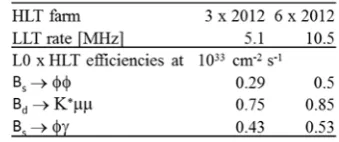
decay modes with muons, hadrons and photons in the final states [5]. The efficiencies reach the optimum very quickly for muons and photons just above 1 MHz, while the hadrons suffer the important fake rate which needs to be absorbed to get to high efficiency. Table 2 shows the combined efficiencies after the activity trigger and the HLT selection for the same modes and for farm sizes that would allow a 5MHz processing rate and a 10MHz processing rate. It shows that even with a relatively modest increase in the HLT farm CPU capacity as compared to the 2012 farm and using the current optimizations, there is a very important improvement in the signal efficiencies. The increase in CPU capacity will be based on both CPU technologies in six years and from a relative increase in the reconstruction speed with a re-optimized detector and software.
Table 2: Selection efficiencies with different farm sizes.
In terms of sub-detector upgrades [15], the aim is to achieve the same performance as now but at significantly higher pileup and occupancy. The detector re-optimization is currently on-going using four representative physics channels simulated in the upgrade conditions: Bs B → γ, D∗ → D K ππ π B →
K∗μμ
The biggest detector replacement concerns the tracking system from the VErtex Locator (VELO) up to the main tracking stations. The aim is to optimize the upgraded tracking detectors to allow faster tracking and vertexing. The VELO and the Trigger Tracker (TT) detector will be completely replaced. The VELO will be
Figure 2: The left plot shows the yield as a function of trigger rate for the decay B → Kπ at equivalent luminosity but in
based on pixel technology with micro-channel cooling, and will provide significantly higher granularity than now. The plan is to use planar silicon sensors 55x55 m2
incorporating 256x256 pixels. In order to improve the impact parameter resolution the sensor distance to the beam will be reduced by ~2mm such that the inner radius of the RF foil will be about 3.5mm from the beam instead of 5.5mm. In addition the aim is try to reduce the RF foil thickness.
Figure 4: The LHCb Detector.
For the TT the idea is to rebuild the detector with the same technology of silicon strips but with higher segmentation, improved sensor overlap, and closer to the beam pipe to improve the small-angle coverage. It should allow a fast VELO-TT momentum measurement and efficiently resolve fake tracks reconstructed between the VELO and the main tracking stations after the magnet.
In the case of the main tracking stations, the Inner Tracker (IT) will be entirely replaced, either with a somewhat larger detector based on the same silicon strip technology, or with a large scintillating fibre tracker. As a result, the Outer Tracker straw tube geometry can be reduced accordingly to remove problems with too high occupancy in the central region. Currently, the preferred option for the IT is the fibre tracker based on 250 m diameter scintillating fibres and read out via Silicon Photo-Multipliers (SiPMs). The expected spatial resolution is about 60 – 100 m.
The first muon detector layer (M1), and the scintillating pad detector (SPD) and preshowers used for e/γ separation with the calorimeter, will be entirely removed as they will not contribute with the very high occupancy. This is expected to improve the resolution of the electromagnetic calorimeter and ease the calibrations. For the e/γ separation, it will be done instead in the HLT with the full information available. In order to run at higher luminosity, the calorimeters will only reduce the gain on the photomultipliers and compensate with an increased electronics gain. The signal to noise has been demonstrated to be sufficient. As it stands currently, the muon detectors after the calorimeters will remain as is.
In the case of the two RICHes, the hybrid photo-multipliers (HPD) will be replaced for multi-anode photo multipliers. This is also necessary since the FE electronics is integrated in the HPDs. In addition the aerogel will be removed from RICH1 since it gives two few photons to actually allow reconstructing the rings in the higher multiplicities of the upgrade. The RICH1 optics will be re-optimized in order to allow operating at a luminosity of 2x1033cm-2s-1.
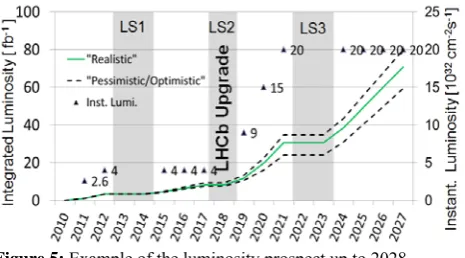
Figure 5: Example of the luminosity prospect up to 2028.
4 Upgrade schedule and prospect
Currently LHCb is in the phase of reviews and choosing technologies. The Technical Design Reports and the prototype validation should start coming in the second half of 2013. Finally the full installation of the detector and the 40MHz readout is scheduled for the Long Shutdown 2 in 2018 – 2019 with the requirement of an 18-month access to the cavern.
Taking together the best of knowledge from LHCb and LHC during Run 1, the strategy of the LHCb upgrade and the future schedule, Figure 5 shows an example of a luminosity projection up to 2028 with the LHCb upgrade in 2018. Assuming, the minimal aim of collecting at least 50fb-1 in this period, Table 1 also shows the expected
statistical precision for representative key physics channels. Generally speaking, all the key measurements should have reached precisions near the theoretical uncertainties.
5 Conclusions
The impressive performance of the LHC accelerator in the first three years of operation has enabled the LHCb experiment to pave the way for heavy flavour physics at an entirely new level of precision which will be pursued further in Run 2 into the territory where small deviations from the SM may be expected with another 5-6 fb-1.
Nevertheless, the ultimate precision and the access to many physics modes may only be achieved with a 10-fold increase in statistics. For this reason, LHCb will undergo one major upgrade between now and running up to 2028 to allow operating the experiment at a luminosity of up to 2x1033cm-2s-1. The detector upgrade is scheduled
for 2018 and consists of a complete redesign of the readout system and the trigger in order to read out the full detector at the bunch crossing rate and perform the triggering in only software to allow selecting efficiently the interesting flavour decay chain.
References
1. LHCb Collaboration, arXiv:1208.3355.
2. R. Jacobsson, “Performance of the LHCb detector during the LHC proton runs 2010 - 2012”, Proc. of the 2012 IEEE Nuclear Science Symposium, October 2012, California, USA.
3. LHCb Collaboration, arXiv:1304.4741.
4. R. Alemany-Fernandez, F. Follin, R. Jacobsson, “The LHCb online luminosity control and monitoring”, Proc. of the 4th Int. Particle Accelerator Conf., May 2013, Shanghai, China.
5. LHCb Collaboration, “Letter of Intent for the LHCb upgrade”, CERN-LHCC-2011-001.
6. LHCb Collaboration, arXiv:1304.2600. 7. LHCb Collaboration, arXiv:1303.7125. 8. LHCb Collaboration, arXiv:1305.2050. 9. LHCb Collaboration, LHCb-CONF-2012-007. 10. LHCb Collaboration, arXiv:1302.5854. 11. LHCb Collaboration, arXiv:1211.2674. 12. LHCb Collaboration, arXiv:1304.6325. 13. LHCb Collaboration, arXiv:1305.2168. 14. LHCb Collaboration, arXiv:1211.1230.
![Table 1: Expected statistical sensitivities after LHC Run 2 and after 50fb-1 with the LHCb Upgrade as compared to current theoretical uncertainties for a list of key observables [15]](https://thumb-us.123doks.com/thumbv2/123dok_us/8642548.1432256/3.595.101.240.411.529/expected-statistical-sensitivities-upgrade-compared-theoretical-uncertainties-observables.webp)