Contribution Of Universities Towards
Knowledge Of Millennium
Development Goals (MDGS):
A Study Of Uganda And Kenya
Robert Wamala, Makerere University, Uganda Jean Chamberlain, Uganda Christian University, Uganda Mary Sonko Nabachwa, Uganda Christian University, Uganda
ABSTRACT
This paper examines the contribution of universities towards students’ awareness of issues related to Millennium Development Goals (MDGs). The assessment is based on data of 1,920 students randomly selected from universities in Uganda and Kenya. Frequency distributions, the Chi-square test, and complementary log-log regression were used for analysis. About 74% (n = 1,100) of students aware of MDGs (n = 1,484) affirmed that they had acquired this information from universities where they were enrolled. In the multivariate assessment, modeled by a range of university and student characteristics, the reported contribution of universities in fostering knowledge of MDGs was more likely among students enrolled in master’s programs, those in the sciences, and among males. The findings suggest a high level of awareness of MDGs among university students but a shallow knowledge base of aspects related to the goals. Suggestions for enhancing knowledge of the goals centered on two aspects: i) incorporation of MDGs in curriculum content, particularly in the undergraduate and Arts programs, and ii) widening the dissemination platform of research findings among students.
Keywords: Millennium Development Goals, Role of Universities, Uganda and Kenya
INTRODUCTION
espite the notable progress made over the past decade on each individual Millennium Development Goal (MDG), achieving these goals remains a major challenge, particularly in developing countries. The success attained even in the poorest countries and in the most difficult circumstances demonstrates that the goals can be achieved (UNDP, 2010). That progress is uneven between and within regions and/or countries and often too slow to meet the 2015 deadline (UNDP, 2010) suggests that country-specific interventions are required to help achieve the development goals. This supports literature that suggests differentials by country and by goal for effective policies and interventions with regard to MDGs. However, consensus suggests that most of the goals are unlikely to be achieved by 2015 (CRS, 2010).
Further, the findings suggest that universities in the two countries are not promoting intellectual engagement on MDGs, resulting in huge capacity gaps and limited community outreach programs and action research on the subject matter (UMI & University of Botswana, 2011).
Although this may be the case, “...universities are uniquely positioned between the communities and the governments they serve. They are at the core of societies – and often in the rebuilding of broken ones as reflected by the MDGs” (New Straits Times, May 2, 2010). Thus, their role in knowledge building on MDGs cannot be underestimated. This study, therefore, sought to examine the contribution of universities in Uganda and Kenya in building knowledge of MDG-related issues among students enrolled in institutions in the two countries.
DATA AND METHODS
This study was conducted using a cross-section survey employing a quantitative approach to data and methods. The study population comprised final-year students enrolled in Ugandan and Kenyan universities by January 2011. A multi-stage stratification by countries, university foundation bodies (private vs. public), discipline (science vs. arts) and gender was adopted to obtain a representative sample of students. The sample of 1,920 students was obtained using Cochrane’s 1977 sample formulae based on a standard error of 3.2% and adjusted for a response rate of 83%. Primary data were obtained from students in selected universities and/or academic units using a questionnaire. Data in this work were analyzed at three stages. First, a descriptive summary of students’ characteristics (age, gender, program, country, and area of permanent residence) and status of the contribution of universities in fostering knowledge of MDGs were presented using frequency distributions. Second, associations between students and university characteristics by status of contribution towards knowledge of MDGs, the outcome variable, were examined using the Pearson Chi-square test and the probability value. The analysis at this stage helped examine independent associations between independent variables and status of contribution towards knowledge of the goals, the outcome variable. Potential predictors of the outcome variable, for consideration during the multivariate stage, were indentified. Third, the net-impact of student and university characteristics on reported contribution towards knowledge of MDGs was established using a binomial model with a complementary log-log function (Hilbe, 1996). Associations with the outcome variable were established at the 5% level, unless stated otherwise.
RESULTS OF THE STUDY
The students examined in this study are characterized as follows: predominantly undergraduate students (83.8%), and enrolled in private universities (72.5%); slightly more than half (51%) were from Kenyan universities and about four in every nine (44%) were females.
Contribution of Universities towards Knowledge of MDGs
Of the 1,920 students, 1,484 (77.3%) were aware of the MDGs. The results suggest a high level of awareness about MDGs among students enrolled in Ugandan and Kenyan universities. In light of other sources of knowledge on MDGs, the students were asked whether their universities had contributed towards their knowledge of the development goals. Table 1 presents a distribution summary of the students’ responses regarding the contribution of universities towards their knowledge of MDG-related issues.
Table 1: Students’ Responses to whether Universities Contributed Towards Knowledge of MDGs
Response Frequency Percentage
Yes 1,100 74.1
No 384 25.9
Total 1,484 100
Note: The analysis is based on students who were aware of MDGs (n = 1,484)
Differential in Contribution of Universities towards Knowledge of MDGs
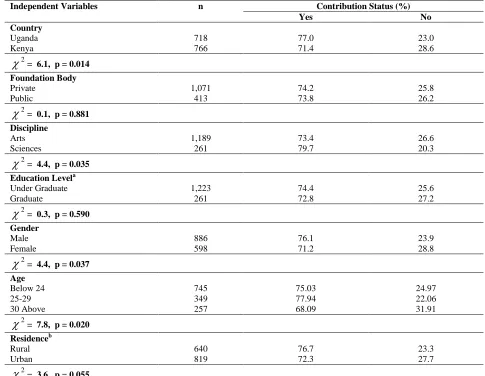
The association of student and university characteristics by status of contribution towards knowledge of MDGs was examined using the Chi-square test and the probability value; associations were established at 5% level. The relationships between the variables are presented using cross-tabular analysis in Table 2.
Table 2: Differentials in Reported Contribution of Universities towards Knowledge of MDGs
Independent Variables n Contribution Status (%)
Yes No
Country
Uganda 718 77.0 23.0
Kenya 766 71.4 28.6
2
= 6.1, p = 0.014 Foundation BodyPrivate 1,071 74.2 25.8
Public 413 73.8 26.2
2
= 0.1, p = 0.881 DisciplineArts 1,189 73.4 26.6
Sciences 261 79.7 20.3
2
= 4.4, p = 0.035 Education LevelaUnder Graduate 1,223 74.4 25.6
Graduate 261 72.8 27.2
2
= 0.3, p = 0.590 GenderMale 886 76.1 23.9
Female 598 71.2 28.8
2
= 4.4, p = 0.037 AgeBelow 24 745 75.03 24.97
25-29 349 77.94 22.06
30 Above 257 68.09 31.91
2
= 7.8, p = 0.020 ResidencebRural 640 76.7 23.3
Urban 819 72.3 27.7
2
= 3.6, p = 0.055a
Current program registered for at university
b
Area of permanent residence during university holidays
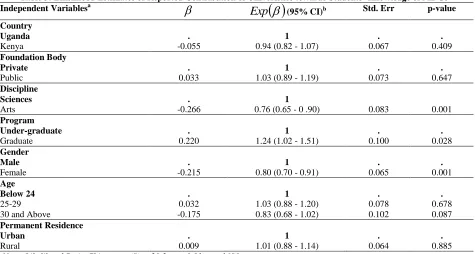
To this end, Table 3 presents regression estimates for the likelihood of affirming the contribution of universities towards students’ knowledge of MDG-related issues. The table comprises beta coefficients (
),exponentiated coefficients (
Exp
), the standard error of coefficients (Std. Err), and probability values (p-value). The findings are summarized in the subsequent sections.Table 3: Likelihood Estimates of Reported Contribution of Universities towards Students’ Knowledge of MDGs
Independent Variablesa
Exp
(95% CI)b Std. Err p-valueCountry
Uganda . 1 . .
Kenya -0.055 0.94 (0.82 - 1.07) 0.067 0.409
Foundation Body
Private . 1 . .
Public 0.033 1.03 (0.89 - 1.19) 0.073 0.647
Discipline
Sciences . 1
Arts -0.266 0.76 (0.65 - 0 .90) 0.083 0.001
Program
Under-graduate . 1 . .
Graduate 0.220 1.24 (1.02 - 1.51) 0.100 0.028
Gender
Male . 1 . .
Female -0.215 0.80 (0.70 - 0.91) 0.065 0.001
Age
Below 24 . 1 . .
25-29 0.032 1.03 (0.88 - 1.20) 0.078 0.678
30 and Above -0.175 0.83 (0.68 - 1.02) 0.102 0.087
Permanent Residence
Urban . 1 . .
Rural 0.009 1.01 (0.88 - 1.14) 0.064 0.885
Note: Likelihood Ratio Chi-square (8) = 29.2, p < 0.01, n = 1680
a
Bold variable items represent reference categories adopted
b
Exponentiated coefficients (Relative Risk) and their 95% Confidence Intervals
Regression Diagnostics
Specification errors of the link function adopted in the final model were examined using the link test. Three aspects were examined: i) Is the Complementary log-log transformation the correct functional form of the outcome variable? ii) Is a linear combination of student and university characteristics (independent variables) supported? iii) Is the complementary log-log function a linear combination of the independent variables?
Table 4: Specification Errors of Link Function
Complementary Log-log Function Coef. Std. Err p-value
_hata 0.894 0.217 0.000
_hatsqb 0.668 0.759 0.379
Cons. -0.017 0.038 0.648
Note: Specification Error test of model in Table 3
a
Hat Statistic, bHat-square Statistic
Summary of the Findings
According to Table 3, significant associations with reported contribution of universities towards students’ knowledge of MDG-related issues were observed for the gender, discipline of study, and graduate versus under-graduate type of registration variables (p < 0.05). These results are summarized as follows:
1. Students in the arts discipline were less likely to report contribution from their universities towards knowledge of MDG-related issues (Relative Risk = 0.76).
2. Female students were less likely to report contribution from their universities towards knowledge of MDG-related issues (Relative Risk = 0.80).
3. Students enrolled in master’s programs were more likely to report contribution from their universities towards knowledge of MDGs (Relative Risk = 1.24).
Non-significant association with the likelihood of a reported contribution by universities towards knowledge of MDG issues was observed for the student characteristics of country of residence, private-public variation in university foundation bodies, rural-urban residence, and age of the student (p > 0.05). In other words, students’ reporting of university contribution towards knowledge of MDG issues did not vary significantly with these variables.
DISCUSSION AND CONCLUSIONS
A high proportion of students (77.3%) were aware of MDGs. The figure represents students who reported having any knowledge of issues related to the development goals. The findings are contrary to the Cairo University MDG awareness study that reported that three-quarters (75%) of students were unaware of the development goals (Cairo University & UNDP, 2010). However, further analysis of students aware of MDGs in this study revealed that only 44.4% were able to mention the right number (8), while only 47.7% knew the correct deadline (2015) for the achievement of the goals. The proportion that was aware of both the right number and the target date for the achievement of the goals was 23.4%. This low figure suggests a shallow knowledge base of issues related to the goals despite the high level of awareness of MDGs. It also supports literature that suggested a dearth of concrete MDG-focused programs among Ugandan universities (MFPED, 2010; UMI & University of Botswana, 2011). The findings suggest that universities in Uganda and Kenya are not playing an optimal role in enhancing the knowledge of these development goals among their students. This work presents a sub-optimal contribution of universities in Uganda and Kenya towards knowledge of issues related to MDGs among under-graduates, students enrolled in the arts/humanities, and among females. In light of the fact that more males than females enroll for science courses (for example, NCHE, 2007; UNCST, 2010), this work indentifies a sub-optimal contribution of universities in fostering knowledge of these goals in mainly two sub-groups—undergraduates and students in arts-related disciplines.
On the other hand, the 2010 conference of the Association of Commonwealth Universities (ACU) attributes the inability of universities to effectively contribute to knowledge building on MDGs to the failure of governments and international donors to recognize higher education in current MDGs. In any case, the findings in this work demonstrate a sub-optimal contribution from Ugandan and Kenyan universities towards fostering knowledge of MDGs with regard to teaching, research, and dissemination of findings on MDG-related issues. These three main areas of contribution need to be strengthened to enhance awareness as well as create a good knowledge base of issues related to MDGs among students. Despite the fact that this study focused on students enrolled in Ugandan and Kenyan universities, the situation in other African institutions may not be very different. It is highly probable that students registered in other African universities have a similar level of knowledge of MDGs.
AUTHOR INFORMATION
Robert Wamala, Ph.D. Student, Institute of Statistics and Applied Economics, Makerere University, Uganda. E-mail: [email protected]. Corresponding author.
Dr. Jean Chamberlain, Uganda Christian University, Save the Mothers, Uganda. E-mail: [email protected]
Dr. Mary Sonko Nabachwa, Uganda Christian University, Department of Development Studies, Uganda. E-mail: [email protected]
REFERENCES
1. Association of Commonwealth Universities (April, 2010). Contribution of Universities to the Sustainable Achievement of the Millennium Development Goals. Proceedings of the ACU Conference of Executive Heads, South Africa.
2. Cairo University & UNDP (2010). MDGs Awareness Initiative in Cairo University. Research Document. Community and Environment Service Sector, Cairo University. Retrieved from
www.mdgs.cu.edu.eg/MDGs%20Awareness.pdf
3. CRS (December, 2010). The Millennium Development Goals: The September 2010 UN High-level Meeting. Status Report for Congress, Congregational Research Service.
4. Sergio, B. (2006). Achieving the Millennium Development Goals Is a Crucial Element in the Development of the Youth. MDG Global Watch Journal, 1(2).
5. Hilbe, J.M. (1996). Maximum-likelihood Complementary Log-log Regression. Stata Technical Bulletin 32: 19-20.
6. MFPED (2010). Millennium Development Goals Report for Uganda 2010: Accelerating Progress improving maternal health. Ministry of Finance Planning and Economic Development.
7. NCHE (2007). The State of Higher Education and Training in Uganda. A Summary Report on Higher Education Delivery and Institutions. National Council for Higher Education.
8. UCU (2011). The Enhancement of East African Universities’ Contribution towards the Attainment of Millennium Development Goal -5. Baseline report, Uganda Christian University.
9. UMI & University of Botswana (2011). Popularizing Millennium Development Goals in University Education. Policy Brief, Retrieved from www.umi.ac.ug/manage/newsletter/1328198608.pdf
10. UNCST (2010). Science, Technology and Innovation. Uganda’s Status Report 2008/2009. Uganda National Council for Science and Technology.
11. UDNDP (2010). The Path to Achieving the Millennium Development Goals: A Synthesis of Evidence from around the World. Status Report, United Nations Development Programme.