Original Research Article
A study on psychosocial problems among adolescents in urban
slums in Kolkata, West Bengal
Amal Kumar Sinha Roy
1, Manabendra Sau
2*, Kishore P. Madhwani
3,
Pausali Das
4, Jitendra Kumar Singh
5INTRODUCTION
Puberty is the unique stage of growth and development associated with the social and psychological changes referred to as adolescence. WHO defines adolescence both in terms of the age (spanning the ages between 10
and 19 years) and in terms of a phase of life marked by special attributes. These attributes include rapid physical growth and development; physical, social and psychological maturity, but not all at the same time; sexual maturity and the onset of sexual activity; experimentation; development of adult mental process
ABSTRACT
Background: Puberty is the unique stage of growth and development associated with the social and psychological changes referred to as adolescence. The adolescent psychosocial development is the process through which the dependent child becomes a self reliant adult. A large number of adolescents suffer from psychosocial problems and many of these problems are of transient in nature and are often not even noticed. The objective of the study was to find out the prevalence of psychosocial problems among adolescents.
Methods: A cross-sectional study was conducted in ward no 58 of Tangra area of Kolkata. The study group comprised of 420 adolescents, selected by multistage stratified random sampling. Data was collected on a pre-designed and pre-tested questionnaire by interviewing the adolescents and was subsequently analyzed by using suitable statistical package.
Results: Anxiety was maximum (34.76%) in adolescent boys whereas conduct disorder was found to be maximum (28.57%) in adolescent girls. Majority (35.62%) of late adolescent boys were attributed to substance abuse. Anxiety was found to be the commonest problem among adolescent males in all religions. Educational difficulties were maximum among Muslim adolescents. The problems per subject (with psycho-social problems) were more in adolescent boys (4.4) and girls (3.8) having joint family. None of the class I adolescent girls claimed to have any educational difficulties.
Conclusions: A holistic approach to underlying causes of psycho-social problems of adolescents should be undertaken. There is need of strengthening the existing “package” of services for adolescents in various initiatives and programmes.
Keywords: Psycho-social problems, Conduct disorders, Educational difficulties, Anxiety, Depression, Substance abuse
Department of Community Medicine, 1Medical College, Kolkata, 2Midnapore Medical College, 5KPC Medical College and Hospital, Kolkata, West Bengal, India
3
Occupational Health Consultant, Mumbai, Maharashtra, India
4
Psychologist and Special Educator, Kolkata, West Bengal, India
Received: 18 September 2018 Accepted: 08 October 2018
*Correspondence: Dr. Manabendra Sau,
E-mail: [email protected]
Copyright: © the author(s), publisher and licensee Medip Academy. This is an open-access article distributed under the terms of the Creative Commons Attribution Non-Commercial License, which permits unrestricted non-commercial use, distribution, and reproduction in any medium, provided the original work is properly cited.
and adult identity; transition from total socio-economic dependence to relative independence.1
We need to study the health problems of adolescents because they face significant problems and risk related to their healthy development. Adolescents have very special and distinct needs, which can no longer be overlooked. It is also essential to invest in adolescents, as they are the future of the country.
The adolescent psychosocial development is the process through which the dependent child becomes a self reliant adult.2 During the period of adolescence, a large number of children suffer from psychosocial problems at one time or the other during their development. Many of these problems are of transient in nature and are often not even noticed.3
Studies on children of school age have tended to focus on nutritional and other health problems related to communicable diseases. School-age children may also suffer a variety of physical disabilities and psychosocial problems (emotional and behavioural), as well as learning disorders.
The report on Work Force Need in India (2001) documented that throughout the 20th century, many reports addressed the magnitude of the emotional, behavioral and developmental problems in the nation’s children, adolescents and their families. All these psycho-social problems include conduct disorders, educational difficulties, depression, anxiety, substance abuse, psychosomatic disorders, delinquency, truancy, insomnia, fatigue, antisocial behaviours and low self esteem.4
As the psychosocial problems encompass a wide variety of disorders, prevalence of psychosocial problems also vary on the basis of the types of problems and screening tools used by the researchers.
METHODS
The present cross sectional study was conducted in ward no 58 of Tangra area of Kolkata, West Bengal comprised of adolescent girls and boys (10-19 years). The ward is having many slum areas. Total population of ward no 58 is 88465 as per 2011 census. Total male population is 46207 and female population is 42258. Worldwide more than 1.2 billion are adolescents, this indicates that roughly one in every six persons is an adolescent. About 21% of Indian population is adolescents (about 243 million). Thus the total population of adolescent in the ward 58 of Tangra are roughly 18,000.
The study was carried out for a period of one year (15th March 2017 to 14th March 2018). An adequate sample (210 adolescent boys and 210 adolescent girls) was drawn to carry out the present study. House to House survey was done and the requisite sample of 420 adolescents was drawn on the basis of proportionate
probability sampling technique (PPS). The sample of 420 adolescents was selected by the standard 30 cluster systematic random sampling technique (14 adolescents in each cluster). The instrument for data collection was self-administered questionnaire which was divided in two parts. Part I related to socio-demographic information, part II was the standard tool to measure psychosocial problem (paediatric symptom checklist – youth report). The tool was pretested among 20 adolescents who met the similar characteristics of study samples and they were not included in the main study. The respondents were given full authority to withdraw their participation without any fear or clarification at any time during the investigation. Confidentiality had maintained throughout the study. Obtained data was used for research purpose only. Time taken for data collection was 25-30 minutes from each respondents. The questions were clearly read out and explained by the researcher to make it clear and easy for the respondents as well as for the completeness.
For the active support and participation, it was imperative to explain the aim of the study to the head of the families and the targets and consent was taken for the same. For the purpose of this study detailed information was collected on a pre-designed and pre-tested questionnaire. All the data were tabulated in Microsoft Excel 2007 and analyzed by using Statistical Package for the Social Sciences (SPSS) version 20.0 software for proportions and chi-square tests as test of significance and binomial logistic regression analysis.
RESULTS
The study was conducted amongst the adolescents between 10-19 years of age in the Tangra area of Kolkata, West Bengal. A total of 420 adolescents (210 adolescent boys and 210 adolescent girls) were surveyed regarding their various psycho-social problems and the findings are as follows-
A total of 420 persons were interviewed and examined during the study period which revealed that majority (37.14%) belonged to 16-19 year age group. Majority were Hindus (76.90%) followed by Muslims (12.86%) and Christians (9.52%). Male and female were 50% each. Majority 42.86% were from lower middle followed by 20.71% from upper middle class according Modified Prasad socio-economic scale10 (based upon per capita monthly family income in Indian currency regularly updated as per consumer price index of India). 75% belonged to nuclear families and 25% from joint families (Table 1).
problems was found to be statistically significant. The overall problems per subject (with psycho-social
problems) were found to be 3.51 and were a bit high in males (3.66) as compared to females (3.32).
Table 1: Distribution of study sample according to socio-demographic factors.
Attributes Frequency
(N=420)
Percentage (%)
Age (in completed years)
10-13 110 26.19
14-15 154 36.67
16-19 156 37.14
Sex Male 210 50.00
Female 210 50.00
Literacy status
Illiterate 35 8.33
Up to primary 178 42.38
Secondary 165 39.29
Higher secondary and above 42 10.00
Social class
(modified Prasad scale)
VI (Below poverty line) 46 10.95
V (poor) 37 8.81
IV (lower middle) 180 42.86
III (upper middle) 87 20.71
II (upper) 53 12.62
I (upper high) 17 4.05
Type of family Nuclear 315 75.00
Joint 105 25.00
Religion
Hindu 323 76.90
Muslim 54 12.86
Christian 40 9.52
Others 3 0.71
Table 2: Distribution of adolescents according to their sex and psychosocial problems.
Psycho-social Problems *
Male (N=210)
Female (N=210)
Total (N=420)
No. (%) No. (%) No. (%)
No problem 138 65.71 152 72.38 290 69.05
Conduct disorder 54 25.71 108 51.43 162 38.57
Educational difficulties 41 19.52 32 15.24 73 17.38
Substance abuse 34 16.19 12 5.71 46 10.95
Depression 65 30.95 41 19.52 106 25.24
Anxiety 73 34.76 51 24.29 124 29.52
Total
Average problems/ subject 3.66 3.32 3.51
*Multiple problems; (2=4.94, df=1, p<0.05); significant.
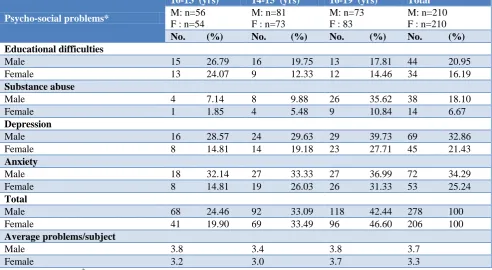
Table 3: Distribution of adolescents according to their sex, age group and psychosocial problems.
Psycho-social problems*
10-13 (yrs) 14-15 (yrs) 16-19 (yrs) Total
M: n=56 F : n=54
M: n=81 F : n=73
M: n=73 F : 83
M: n=210 F : n=210
No. (%) No. (%) No. (%) No. (%)
No problem
Male 39 69.64 54 66.67 45 61.64 138 65.71
Female 41 75.93 50 68.49 60 72.29 151 71.90 Conduct disorder
Male 15 26.79 17 20.99 23 31.51 55 26.19
Female 11 20.37 23 31.51 26 31.33 60 28.57
Psycho-social problems*
10-13 (yrs) 14-15 (yrs) 16-19 (yrs) Total
M: n=56 F : n=54
M: n=81 F : n=73
M: n=73 F : 83
M: n=210 F : n=210
No. (%) No. (%) No. (%) No. (%)
Educational difficulties
Male 15 26.79 16 19.75 13 17.81 44 20.95
Female 13 24.07 9 12.33 12 14.46 34 16.19
Substance abuse
Male 4 7.14 8 9.88 26 35.62 38 18.10
Female 1 1.85 4 5.48 9 10.84 14 6.67
Depression
Male 16 28.57 24 29.63 29 39.73 69 32.86
Female 8 14.81 14 19.18 23 27.71 45 21.43
Anxiety
Male 18 32.14 27 33.33 27 36.99 72 34.29
Female 8 14.81 19 26.03 26 31.33 53 25.24
Total
Male 68 24.46 92 33.09 118 42.44 278 100
Female 41 19.90 69 33.49 96 46.60 206 100 Average problems/subject
Male 3.8 3.4 3.8 3.7
Female 3.2 3.0 3.7 3.3
*Multiple problems, 2=6.18, df = 2, p<0.05 significant.
Table 3 depicts that maximum males and females who had no psycho-social problems were early teens (69.64 and 75.93% respectively). Conduct disorder was found to be maximum in late adolescent boys (31.51%) and mid adolescent girls (31.51%). Early adolescent boys and girls had more educational difficulties as compared to other groups (26.79 and 24.07% respectively). Majority (35.62% and 10.84%) of late adolescent boys and girls were attributed to substance abuse. Depression was found to be maximum in late adolescent boys (39.63%) and girls (27.71%). Anxiety was also maximum in late adolescent boys (36.99%) and girls (31.33%). The problems per subject (with psycho-social problems) were found to be lowest in mid adolescent boys (3.4) and girls (3.0). The difference between different age groups when compared with or without psycho-social problems was found to be statistically significant.
DISCUSSION
The present study revealed that out of 420 adolescents 30.95% had some or the other psychosocial problem. The problems were more in males (34.76%) as compared to females (51.43%). Anxiety was found to be maximum (34.76%) in adolescent boys whereas conduct disorder was found to be maximum (51.43%) in adolescent girls (Table 2). A lower prevalence of psycho-social problems in adolescents boys have been reported by Ahmad A, 2004 (17.9%), with prevalence of 25.5% in mid adolescents.5
Conduct disorder was found to be maximum in late adolescents i.e. 30.6% (Table 3). And it was commonest
among adolescent girls in all religions. According to National Mental Health association, India (2004), the conduct disorder is more common among boys than girls, with studies indicating that the rate among boys in the general population ranges from 6-16% while the rate among girls ranges from 2-9%.6
Depression, anxiety, educational difficulties and substance abuse were found to be higher in adolescent boys while conduct disorder were more in females. The difference between males and females with or without psycho-social problems was found to be statistically significant. The average problems per subject (with psycho-social problems) were found to be 3.51 (Table 2).
In the present study early adolescent boys and girls had more educational difficulties as compared to other groups (26.79 and 24.07% respectively) (Table 3). A lower prevalence of 18.7% of educational difficulties had been reported by Kumar from Meerut.7 A similar prevalence had been reported by Ahmad A (2004) in adolescent boys from Aligarh (17.9%). Educational difficulties were found to be maximum among Muslim adolescents.5
In the present study substance abuse was observed in 24.76% adolescent. The commonest one being tobacco chewing and smoking. A comparable finding had been reported by Kushwaha in 10-18 years adolescents (18.0%).11 Ahmad has also reported a prevalence of 20.9 percent in late adolescent boys of Aligarh.5
CONCLUSION
There are significant psychosocial problems amongst the adolescents. Thus it is recommended that a holistic approach to underlying causes of psycho-social problems of adolescents should be undertaken. There is need of strengthening the existing “package” of services for adolescents in various initiatives and programmes.
Funding: No funding sources Conflict of interest: None declared
Ethical approval: The study was approved by the Institutional Ethics Committee
REFERENCES
1. Bezbaruah S, Janeja MK. Adolescents in India: A Profile. Inter-Agency Working Group- Population & Development (IAWG – P&D); 2000: 1-5.
2. Hofmann AD. Adolescent growth and development. In: Adolescent Medicine. Donald E. Greydanus (Ed). Appleton and Large. 3rd Ed. Stanford Connecticnt Publishers; 2006: 11.
3. Rutter M, Graham P, Chadwick OFD, Yule W. Adolescent turmoil: Fact or Fiction. J Child Psychol Psychiatr. 1976;17:35-56.
4. Report of the AACAP Task Force on Work Force Needs; 2001: 1.
5. Ahmad A. study of physical and sexual development and prevalence of psychosocial problems in adolescent males (10-19 yrs) (dissertation). Aligarh: JNMCH. 2004.
6. National Mental Heath Association, India (2004). 7. Kumar D. A study of health status of adolescent
bogs in a rural area of different Meerut (dissertation). Meerut: LLRM; 2007.
8. Lewingdohn PM, Hops H, Roberts RE, Seeley JR, Andrews JA. Adolescent Psychopathology: I. Prevalence and Incidence of Depression and after DSM III R Disorder in high school students – J. Abnorm. Psychol. 1993;102:133-44.
9. Khurana S, Sharma N, Jena S, Sah R, Ingle GK. Mental health status of runway adolescent. Indian J. of pediatr 2004;71:29-34.
10. Nair MK, Paul MK, John R. Prevalence of depression among adolescents. Ind J Pediatr. 2004;71:(6):523-4.
11. Khushwaha KP, Singh YD, Rathi AK. Prevalence and abuse of psychoactive substances in children and adolescent. Ind J Pediatr. 1992;59:261-8.