Original Research Article
Knowledge, attitude and practices regarding emergency contraception
among married women in Ludhiana, Punjab, India
Shipra Saini, Deepshikha Kamra*, Shavinder Singh
INTRODUCTION
Emergency contraception is defined as the use of drugs or devices to prevent pregnancy within a few days of unprotected coitus. It is sometimes referred to as ‘morning after’ or post coital contraception.1
It can be used in situations when no contraceptive has been used, when there is a contraceptive failure or it is incorrectly used and in cases of sexual assault when the woman was not protected by an effective contraceptive method.2 Emergency contraception Pill is one of the 13 essential
commodities that are addressed by the UN Commission on Life-Saving Commodities for Women and Children (UNCoLSC).3 Emergency contraception is essentially female driven, so its use and success rests mainly on how women perceive and practice it.4 It offers women a last
chance to prevent pregnancy after unprotected
intercourse. Women deserve that last chance and barriers to the availability of emergency contraception should be eliminated.5 The ability of women to control their own fertility is absolutely fundamental to women’s empowerment and equality.6 Emergency contraception is financially, psychologically and physically less
burden-ABSTRACT
Background: An unwanted and unintended pregnancy is a major concern in a women’s life as it has its adverse social and health outcomes. Emergency contraception (EC) is safe and effective method that gives women a second chance to prevent unwanted pregnancy after unprotected intercourse.
Methods: This is a community based cross sectional study done in field practice area under the department of Community Medicine, Christian Medical College, Ludhiana, Punjab. A total of 400 respondents were selected by stratified random sampling from the list of eligible couples residing in the area. The interview was conducted using semi structured questionnaire, after obtaining their informed consent.
Results: The mean age of respondents was 31.44±5.67 years. 68.7% of respondents were using some kind of contraception. Majority (68%) of respondents had heard of emergency contraception and for majority (81.3%) source of information about EC was Media (TV). Out of 272 respondents who had heard of emergency contraception 146 (54.1%) had negative attitude towards emergency contraception and only 30 (8%) had used ECP. Practice of ECP was found to have statistically significant association with employment and history of unwanted pregnancy.
Conclusions: EC has a potential to curb the menace of unintended pregnancy thereby decreasing unsafe abortion and maternal mortality. In spite of reasonable awareness of emergency contraception, as found in present study there is wide gap for its usage. Hence behavioural change strategies should be considered to bring attitudinal change on use of emergency contraception.
Keywords: Emergency contraceptive pills, Knowledge, Attitude
Department of Community Medicine, Christian Medical College, Ludhiana, Punjab, India
Received: 15 May 2018
Revised: 25 June 2018
Accepted: 27 June 2018
*Correspondence:
Dr. Deepshikha Kamra,
E-mail: [email protected]
Copyright: © the author(s), publisher and licensee Medip Academy. This is an open-access article distributed under the terms of the Creative Commons Attribution Non-Commercial License, which permits unrestricted non-commercial use, distribution, and reproduction in any medium, provided the original work is properly cited.
some than abortion.1 Since the introduction of emergency contraception, the contribution of unsafe abortion to-wards maternal mortality has declined from 13 to 8 per cent.7 In India knowledge about various temporary and permanent methods among men and women ranges between 45-97 per cent, knowledge about EC is only 20 per cent in men and 11 per cent in women.7 The department of Ministry of Health and Family Welfare has introduced emergency contraceptive pills in 2002, despite its potential; use of EC is low in India. Emergency contraception is largely underutilized worldwide and has been referred to as one of the best kept secrets in Reproductive Health because, despite its unique potential for helping women prevent pregnancies and fulfil their reproductive intentions, rates of use and of counselling about the method are quite low.8 The potential of emergency contraception can be better utilized only when women are made aware of the method’s existence and its use within the short time frame of its efficacy. Such awareness is practically nonexistent in India at present.9 Hence a study was designed to evaluate the knowledge, attitude and practices regarding emergency oral contraception among married women of urban area of Ludhiana.
Aims and objectives
To assess the knowledge, attitudes and practices regarding emergency contraceptive in urban married women.
METHODS
This is a community based cross-sectional study conducted among women of reproductive age group (18- 45 years), residing in field practice area of urban health centre located in Field Ganj, Ludhiana, Punjab. The data was collected from 1st March 2016 to 29th February 2017.The total number married women in reproductive age; in the field practice area are 4157. The sample size was calculated as 371 taking prevalence of awareness of emergency contraception among women in urban areas as 18.8% (NFHS 3), taking an absolute precision of 3.8%. For an expected non response rate of 10% sample size was rounded off to 400. This was calculated using Openepi software.10 A list of 400 women was extracted from the departmental data base of married women in the reproductive age group residing in the field practice area, using systematic random sampling.
The women who were divorced, widowed, post-menopausal and with permanent sterilization were excluded. Ethical clearance was obtained from Ethical committee of Christian Medical College Ludhiana.
Study tool and data collection
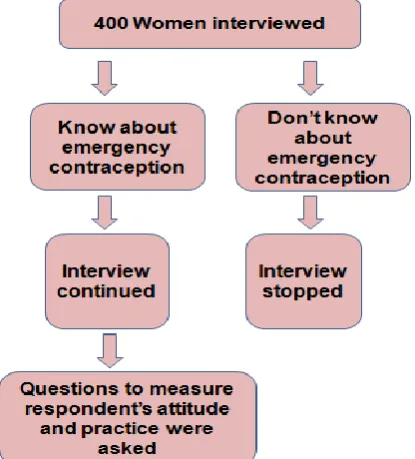
The information was collected on a pre-tested semi-structured questionnaire [Annexure 1] through personal interviews by house to house visits, from 400 married women in the reproductive age group. All the study
participants were informed about the purpose of the study, and their written and informed consent was obtained. The questionnaire includes variables on demo- graphic profile, knowledge, attitude and practice of emergency contraceptives. Questions of Attitude and Practice of emergency contraceptive pills were asked only from those respondents who knew about emergency contraception. Interviews were conducted in privacy, and confidentiality of the participants was assured. For Measurement of Attitude a performa adopted from Tilahun et al that was modified to measure the respondent’s attitude was used.11
The variables were measured with five point likert scale ranging from 1 (strongly disagree) to 5 (strongly agree). Mean scores for each construct was computed and dichotomized into positive and negative. Respondents who scored above the mean were labelled as having positive attitude and those who scored below the mean were labelled as having negative attitude. This scoring was subsequently reversed for negatively stated statement, so that the higher the score, the stronger the positive construct.
Data was entered using classical EpiData entry software. Data analysis was performed using Epidata Analysis Version 2.2.2 and EpiInfo 3.5.4 software.
Figure 1: Schematic presentation of data collection.
RESULTS
upper class followed by lower middle and upper middle (Table 1).
Table 1: Socio-demographic characteristics of respondents.
Number Percentage (%)
Age group (years)
18-25 79 19.8
26-35 229 57.3
36-45 92 23.0
Religion
Hindu 338 84.5
Sikh 62 15.5
Education status
Illiterate 19 4.75
Primary 98 24.50
Middle 99 24.75
High School 77 19.25
Intermediate 42 10.50
Graduate 57 14.25
Postgraduate 08 2.00
Employment
Unemployed 385 96.3
Employed 15 3.8
Socioeconomic status
Upper 09 2.25
Upper middle 69 17.25
Lower middle 138 34.50
Lower upper 164 41.00
Lower 20 5.00
Total 400 100.00
*As per Kuppuswamy scale.
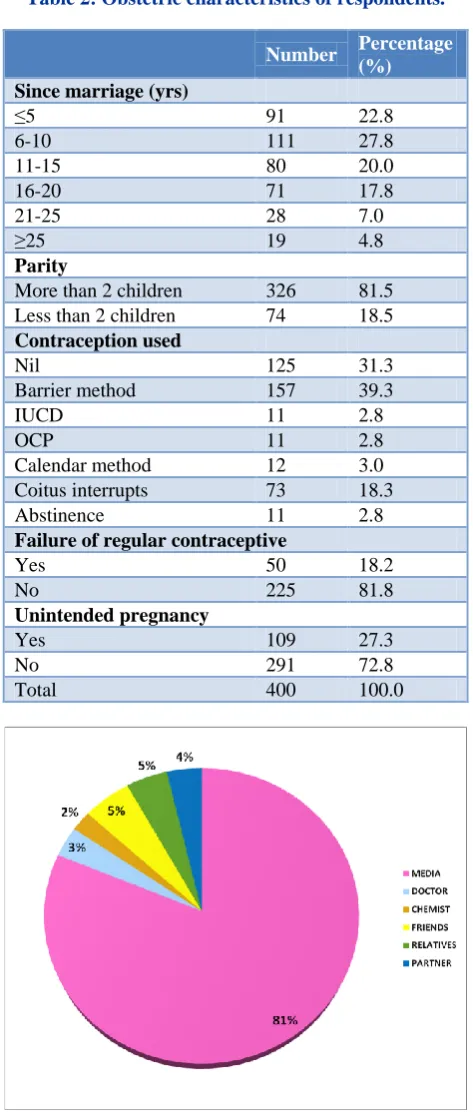
Most respondents (27.8%) who were interviewed were married for 6-10 years. 23.8% respondents were married for less than 5 years. Majority (81.5%) of respondents had more than 2 children. About one third (31.3%) of respondents were not using any contraception (Table 2).
Figure 2: Distribution of respondents according to contraception use.
More than half of those using any contraceptive were using barrier method as choice of contraception. About
one third (31.3%) of respondents were not using any (Figure 2).
Table 2: Obstetric characteristics of respondents.
Number Percentage (%)
Since marriage (yrs)
≤5 91 22.8
6-10 111 27.8
11-15 80 20.0
16-20 71 17.8
21-25 28 7.0
≥25 19 4.8
Parity
More than 2 children 326 81.5
Less than 2 children 74 18.5
Contraception used
Nil 125 31.3
Barrier method 157 39.3
IUCD 11 2.8
OCP 11 2.8
Calendar method 12 3.0
Coitus interrupts 73 18.3
Abstinence 11 2.8
Failure of regular contraceptive
Yes 50 18.2
No 225 81.8
Unintended pregnancy
Yes 109 27.3
No 291 72.8
Total 400 100.0
Figure 3: Distribution of respondents according to their source of information of emergency
contraception pill.
whether they ever experienced unwanted or unintended pregnancy, 109 (27.3%) respondents agreed they had experienced unwanted pregnancy. The study shows that majority (68%) of respondents had heard of emergency contraception. For majority (81.3%) of respondents source of information about EC was Media (TV), while only 9 (3.3%) got information from doctors (Figure 3).
Majority respondents agreed that ECP does not cause infertility, most respondents agreed that it is easily available in their nearby area but majority of respondents disagreed that if need arise they will take ECP. Out of 272 respondents who had heard of emergency contraception 146 (54.1%) had negative attitude towards emergency contraception. Out of 272 respondents who had heard of Emergency contraception, only 30 (8%) had
used ECP (Figure 4). Figure 4: Attitude of respondents towards emergency
contraception.
Table 3: Practice of ECP according to socio- demographic profile and obstetrics characteristics.
Characteristic Used ECP (%) Not Used ECP (%) Chi square test
Age
18-25 04 (8.5) 43 (91.5)
χ2=1.025 df(2); p=0.5991
26-35 20 (12.7) 138 (87.3)
36-45 06 (9.0) 61 (91.0)
Education
Illiterate 01 (11.1) 08 (88.9) χ2=0.000 df(1); p=0.9937
Literate 29 (11.0) 234 (89.0)
Occupation
Unemployed 25 (9.7) 233 (90.3) χ2=9.165 df(1); p=0.0025
Employed 05 (35.7) 09 (64.3)
Religion
Hindu 26 (11.5) 201 (88.5) χ2=0.252 df(1); p=0.6158
Sikh 04 (8.9) 41 (91.1)
Socioeconomic status
Upper 02 (22.2) 07 (77.8)
χ2=3.942 df(4); p=0.4140
Upper middle 08 (16.0) 42 (84.0)
Lower middle 09 (8.9) 92 (91.1)
Lower upper 11 (10.8) 91 (89.2)
Lower 0 10 (100.0)
Years of marriage
0-5 02 (3.8) 50 (96.2)
χ2=5.536 df(5); p=0.3541
6-10 10 (13.0) 67 (87.0)
11-15 09 (14.1) 55 (85.9)
16-20 07 (13.7) 44 (86.3)
21-25 02 (12.5) 14 (87.5)
26-30 0 12 (100.0)
Contraceptive usage
Yes 25 (12.8) 172 (87.2) χ2=2.129 df(1); p=0.1446
No 5 (6.6) 71 (93.4)
Parity
More than 2 25 (11.1) 200 (88.9) χ2=0.009 df(1); p=0.9250
Upto 2 05 (10.6) 42 (89.4)
Unwanted pregnancy
Yes 19 (23.8) 61 (76.3) χ2=21.575 df(2); p=0.0000
Table 4: Multivariate logistic regression analysis showing factors associated with practice of ECP.
Variables β Coefficient Odds Ratio 95% C.I. P value
Lower limit Upper limit
Age group -0.6243 0.5356 0.2195 1.3068 0.1701
Attitude -0.8743 0.4172 0.1737 1.0019 0.0505
Education 0.3848 1.4693 0.1465 14.7321 0.7435
Parity 0.7727 2.1656 0.6181 7.5877 0.2271
Religion -0.4142 0.6609 0.1878 2.3259 0.5188
Employment -1.5647 0.2091 0.0521 0.8404 0.0274
Years of marriage 0.3072 1.3596 0.3679 5.0241 0.6450
Socioeconomic status -0.2700 0.7634 0.4717 1.2354 0.2716
Contraceptive users -0.5079 0.6017 0.2065 1.7536 0.3520
Unwanted pregnancy -1.9026 0.1492 0.0599 0.3716 0.0000
On bivariate analysis association of knowledge of ECP with education, occupation, socio-economic status, years since marriage and contraceptive use was found to be statistically significant. On multivariate logistic regression analysis statistically significant association
was found between knowledge of ECP and
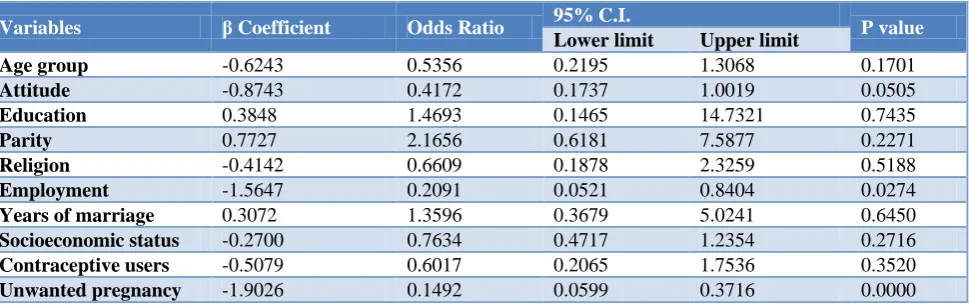
socioeconomic status. There was no statistically significant association of attitude with any socio-demographic or obstetric factor. On Multivariate analysis statistically significant association of attitude was found with socioeconomic status and practice of ECP. There was statistically significant association of Practice of ECP with occupation and history of unwanted pregnancy (Table 3).
The Table 4 shows, Multivariate analysis of practice of ECP with different variables, of these statistically significant association was found with Employment and history of unwanted pregnancy.
DISCUSSION
In the present study majority of respondents were housewives by occupation (96.3%), only 15 women were employed. This finding was found similar with study done by Kose et al where 95.2% of study subjects were housewives.12
Regular contraceptive usage
Out of total, 272 (69.75%) of subjects were using some kind of contraception, while a study from Delhi reported an contraceptive acceptance of 76.8%.13 NHFS 3 and Shendge et al from Cuttack reported contraceptive prevalence rate of 56 percent and 62.4% respectively.14,15 Out of total 400 respondents that were interviewed 50 (18.2%) subjects had experienced failure of their regular contraception. This high failure rate can be attributed to the usage of traditional method of contraception (23.8%).
Emergency contraceptive usage
In this study 272 (68%) respondents have heard about EC, which was found much higher than NFHS-III
(18.8%).14 The prevalence of awareness of emergency contraception varies from 2% in rural Uttar Pradesh to 12% in Karnataka, 12.2% in Rohtak, 14.3% in central India 33% in Nagpurand 40.6% in Sikkim respectively.
4-6,12,16,17
This vast difference in prevalence of awareness of
emergency contraception could be related to
were four times more likely to have used EC as compared to the study subjects who were not using any contraceptive method.13
In the present study out of 272 respondents who had heard of emergency contraception 146 (54.1%) had negative attitude towards emergency contraception. Majority of respondents 114 (41.9%) disagreed to the statement that if need arise they will take ECP. Most of the respondents 138 (50.7%) agreed to the statement that emergency contraception does not cause infertility in women. Majority of respondents 140 (51.4%) agreed to the statement that EC is easily available in their nearby area. 231 (84.9%) answered that it is not right to take emergency contraception and only 41 (15.1%) think it is right to take EC. Studies done in various parts of the country shows a positive attitude towards emergency
contraception among women.13,18 Differences in
methodology and beliefs of the community are the possible reasons for this variation.
Factor found to be associated with the positive attitude towards EC among the study subjects from multivariate logistic regression model was socio economic status. This finding was found similar to the study done by Verma et al.13 In the present study out of 272 respondents who knew about emergency contraception, 8% had ever used. Study done by Kose et al in rural Nagpur reports 5% women used it in the past.12 According to DLHS 4 ever use of Emergency Contraceptive Pills (ECP) in urban areas of Punjab is 1.3.22 As regards Practice of ECP, present study reveals that employed respondents and respondents with history of unwanted pregnancy had higher probability of using ECP as compared to unemployed respondents and respondents who never had unwanted pregnancy. Many studies show that knowledge regarding ECP was significantly associated with practice of ECP.12,13 However in the present study we could not prove it as we asked questions of practice of ECP to only those respondents who were aware of emergency contraception. There is need to educate women about the available methods of emergency contraception and correct timing of its use. Fear of side effects, myths and mis-understandings among the beneficiaries must be removed by proper counselling and awareness. For emergency contraception to become a true choice, women must have positive attitude towards ECP and access to the available option within the short timeframe permitted by the method. Reducing unintended pregnancies would improve educational and employment opportunities for young women, and, in turn, contribute to improvements in the status of women overall, greater family savings, reductions in poverty and increases in economic growth.
ACKNOWLEDGEMENTS
We are grateful to the Health workers of urban health and training center, in Field Ganj Ludhiana for their generous
help. Also, we are thankful to all women who had willingly shared their precious time in this study.
Funding: No funding sources Conflict of interest: None declared
Ethical approval: The study was approved by the Institutional Ethics Committee of Christian Medical College Ludhiana
REFERENCES
1. Haggai DNP. Emergency contraception: The
journey so far. BJOG. 2003;110:339–45.
2. WHO. Emergency contraception. WHO. 2016.
3. Blake S, Cody A, Kaur A, Liias N, Lindahl C, Bell E, et al. U. N. Commission on Life Saving Commodities for Women and Children : Country Case Studies Contributors and Acknowledgements. 2012.
4. Kaushal M, Laxmi Maru AD. Emergency
Contraceptive Knowledge, Attitudes and Practices in Women Presenting to Family Planning Outpatient Clinic in Central India. 2014;6:21–4.
5. Rahman H. Emergency Contraception - A last Chance to Prevent Unintended Pregnancy : What Everyone should know and what Sikkimese knows. 2014;139–52.
6. Lakkawar NJ, Magon S, Alaganandam P.
Assessment of attitude towards use of emergency contraceptives among antenatal women. Int J
Reprod Contraception, Obstet Gynecol.
2014;3(4):1067–72.
7. Mittal S. Emergency contraception - Potential for women â€TM s health. 2014;140(Suppl 1):45–52. 8. Abera H. Knowledge, Attitude, Utilization of
Emergency Contraceptive and Associated Factors among Female Students of Debre Markos Higher Institutions, Northwest Ethiopia, 2014. Fam Med Med Sci Res. 2014;3(4):4–11.
9. Duhan N. The untapped potential of emergency contraception in Table 1 : Sociodemographic characteristics of women in the study Socio
Demographic Characteristics of Women.
2012;2(2):239–43.
10. OpenEpi - Toolkit Shell for Developing New
Applications. 2009: 1–2. Available at:
papers3://publication/uuid/D1D82709-35D1-4B24-957E-475104C7E873. Accessed on 3 March 2018. 11. Tilahun D, Assefa T, Belachew T. Knowledge,
attitude and practice of emergency contraceptives among adama university female students. Ethiop J Health Sci. 2010;20(3):195–202.
12. Kose V, Joshi S. Knowledge of emergency
contraception among married women of
reproductive age in a rural-based teaching hospital of Nagpur, Maharashtra, India. J SAFOG. 2012;4(2):106–9.
13. Verma A, Singh SV, Gupta VK, Garg S, Meena JK.
Reproductive Age Group in Delhi. J Young Pharm. 2015;7(4):320-7.
14. International Institute for Population Sciences and Macro International. National Family Health Survey (NFHS-3): Health (San Francisco). 2007;1:56. 15. Shendge HB, Padhi M, Mishra K. Dynamics of
contraceptive use in women attending a tertiary care hospital. Indian J Res Reports Med Sci. 2012;2(4):2–5.
16. Nigam A, Maheshwari N, Prakash A. Knowledge of
emergency contraception and contraceptive
practices: representative study from rural uttar Pradesh. Indian J Community Med. 2010;35:449– 50.
17. Dahiya K, Mann S, Nanda S. Women’s Knowledge
and Opinions Regarding Emergency Contraception. J SAFOG with DVD. 2012;4:151–4.
18. Bhaumik A, Mankar M, Relwani N, Anjenaya S, Goel R. Knowledge, Attitude and Practice regarding Emergency Contraception among Engineering College Students of Thane City. Int J Curr Med Appl Sci. 2017;15(1):7-10.
19. Ibrahim ZM, Ahmed MR, Shaaban MM.
Knowledge, attitude and practice of emergency contraception among health care providers in Ismailia, Egypt. Middle East Fertil Soc J. 2013;18(4):246–52.
20. Rocca CH, Shankar M, Sreevathsa A, Krishnan S. Acceptability and use of emergency contraception among married women in Bangalore, India. Int J Gynaecol Obstet. 2013;121(1):64–8.
21. Raikar VR, Potdar PA, Potdar AB. Knowledge,
attitude and practice regarding emergency
contraceptives among married women of urban slum area. 2015;4(4):1008–11.
22. International Institute for Population Sciences. District Level Household and Facility Survey -4 State Fact Sheet Karnataka. 2014: 1–8.