Original Research Article
Assessment of awareness and attitude of rural women towards ill-effects
of indoor air pollution and their perception regarding alternate cooking
fuel usage in Mangalore
Prince Alex*, Kiran K. G., Sharon Baisil, Shameena A. U., Sanjeev Badiger
INTRODUCTION
The nature of air in indoors affects the quality of life and the welfare of the population in general. Exposure to various indoor pollutants results in an increased risk for developing various ailments mainly affecting the respiratory system. Currently, people spend majority of their time working inside buildings, be at home, workplace, or school where they can get affected depending upon the quality of the air present indoors.1
In our country, young women staying at home are in peril due to the fact that they are in constant exposure to the various indoor pollutants, especially the homemakers who are constantly occupied with their duties both in and out of the house. In the present phase, where there are more of nuclear families, the time spent by her in domestic for duties will be considerably more. With more work in the house, the young women involved in domestic work breathe more air indoors in proportion to other members of the house adults.
ABSTRACT
Background: Indoor air pollution is typically underreported and less regulated than its counterpart. So this study was to assess the awareness and attitude of the study population towards ill effects of indoor smoke exposure among the study population and to assess the users' perception about other alternative fuels to be used to reduce the ill effects. Objectives of the study were to assess the awareness and attitude of the study population towards ill effects of indoor smoke exposure among the study population and to assess the users' perception about other alternative fuels to be used to reduce the ill effects.
Methods: It was a cross- sectional study conducted in the rural field practice area of K.S Hegde Medical Academy among the household women who spend the majority time cooking in their house. The study included 400 household women. Data was collected using a pre-tested, semi-structured questionnaire, and entered into MS Excel and analysed.
Results: Most (80.8%) of them were aware that exposure to smoke affects the health of those exposed to it. Also, their perception regarding alternate fuels was good. In the study most of the study participants (92.1%) were willing to change over to a cleaner fuel.
Conclusions: By raising their awareness towards the harmful effects of firewood smoke and providing awareness regarding government programmes for using cleaner fuels, the ill-effects on health of those involved in cooking can be reduced in future.
Keywords: Awareness, Attitude, Perception, Ill-effects, Indoor air pollution
Department ofCommunity Medicine, K.S Hegde Medical Academy, NITTE University, Mangalore, Karnataka, India
Received: 18 June 2018 Accepted: 25 July 2018
*Correspondence: Dr. Prince Alex,
E-mail: [email protected]
Copyright: © the author(s), publisher and licensee Medip Academy. This is an open-access article distributed under the terms of the Creative Commons Attribution Non-Commercial License, which permits unrestricted non-commercial use, distribution, and reproduction in any medium, provided the original work is properly cited.
Fuel sources in the developed countries tend to be clean, using materials such as gas and electricity. Here, problems of indoor air pollution are mainly from compounds such as nitrogen dioxide, by-products from tobacco smoke, volatile organic compounds, and other chemical compounds. Furthermore, in order to conserve energy and to sustain a constant indoor temperature, the windows of the buildings are not opened. As a result, presently there is a trend to design buildings with good insulation.2 Hence, there wouldn’t be a renewal of the indoor air. Since the channelling of contaminated air by indoor sources to the outer area of the building is prevented, the collection of polluted air rises subsequently inside the house.
As per World Health Organization (WHO) records, around 300 crore people prepare food using open fires and stoves burning wood, animal dung, crop waste and coal. More than 40 lakh people die prematurely from illness related to the household air pollution from cooking with biomass fuels.3 There are lots of studies confirming that exposure to household air pollution can lead to a wide range of child and adult disease outcomes, including acute and chronic respiratory diseases such as pneumonia, chronic obstructive pulmonary disease, lung cancer, ischemic heart disease, stroke and cataract. There is also supporting evidence suggesting exposure to household air pollution is linked with adverse pregnancy outcomes, tuberculosis, cancers of the upper aero-digestive tract, cervical and other cancers.4
The importance of interventions to reduce exposure to indoor air pollution is reflected in the Millennium Development Goals (MDGs) in many ways which mention that: (i) Since the children under the age of five years are the most affected, there should be involvement of other methods of cooking to reduce child mortality (Goal 4). (ii) The process of aggregating fuel sources poses a major time burden on women and children and by removing this obstacle would contribute to promote gender equality and women empowerment (Goal 3). (iii) When the amount of time spent on fuel aggregation is reduced, people can spend more time for education and work thus increasing their income to eradicate poverty (Goal 1). (iv) The number of people depending on traditional fuels is one of the gauge to check their progress towards a future with clean energy solutions (Goal 7).5
While most media attention has focused on outdoor air pollution in the last few years, indoor air pollution (IAP) is typically underreported and less regulated than its counterpart. The association between indoor air pollution and various health consequences in children and grown-ups has been examined closely in the epidemiological and experimental literature. Many review articles have been published by national and international organizations as well as by experts within the field. Keeping the extent of ill effects of indoor smoke exposure in mind, this study was being conducted to find the extent of indoor smoke
problem among the rural population of Mangalore, as no such study has been carried out recently in this Medical Academy.
METHODS
This was a cross sectional study, which was conducted at two places namely Kuthar and Manjanady, that comes under the field practice area of K.S Hegde Medical Academy. After receiving approval from the institution’s ethical committee, the cross-sectional study was carried out. This study was conducted over a period of 2 years from December 2015 to July 2017.
The study population included women more than 18 years of age who spent majority of their time in cooking. A total of 400 households were included in the study. The list of households and details regarding population was obtained from the Gram Panchayaths of Kuthar and Manjanady that come under the field practice area of K.S Hegde Medical Academy. Proportional probability sampling method was used to determine the sample size in each village. Accordingly, 216 households were studied from Manjanady and 184 households were studied from Kuthar. Simple random sampling was done for the selection of households.
Data collection was done in Kuthar and Manjanady villages by door to door visit. One participant who was involved in cooking and fulfilled the inclusion criteria was selected from each household for the study. The data was collected by interview method using a pretested, prestructured questionnaire after obtaining informed written consent from the participants. Data was collected from the households till the required sample size was achieved. To meet the above-mentioned objectives, a questionnaire was developed and the questionnaire consisted of the following sections. The first section contained questions on basic demographic characteristics, section two on household socio- economic characteristics, third section was on housing details, section four was regarding the type of fuel used, its usage and priority of fuel used, section five about ill-effects of indoor smoke exposure, section six on health hazard awareness and lastly, section seven was regarding the user’s perception about alternative fuels
Statistical analysis
Data entry was done in MS Excel. The data sets were transferred into SPSS after data cleaning and recoding with data definitions. The data was analysed by Rates and Proportions.
RESULTS
less than 30 years of age (30.0%) followed by 41-50 years (28.5%) and 31-40 years of age (21.3%).
Figure 1: Showing the mean age distribution population.
Figure 2: Showing the educational status of the study population.
The majority of the study participants had primary school (61.5%), followed by pre-university (12.5%), and secondary school; 5.75% were illiterate as shown in Figure 2.
Most (70%) of the study participants were not working or employed, who were housewives. Around 4.75% of the study population were unskilled who were working as assistants in stationary and grocery shops. The semi-skilled women (17%) were the beedi workers and the skilled workers (3.75%) included tailors and ANMs; professionals (4.7%) were teachers, working in nearby schools.
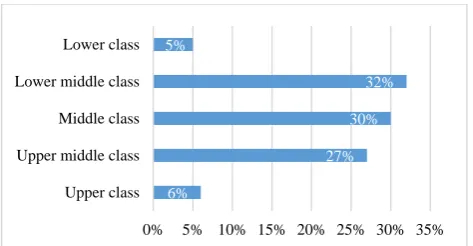
Majority of the participants belonged to lower middle class socioeconomic status (32.0%), followed by the middle class (30.0%). Only 5% of the study population belonged to the lower class, which were mainly the manual labourers and the elderly population living alone who depended on their monthly pensions as shown in Figure 3.
Figure 3: Showing the socio-economic classification of the study population (B.G. Prasad classification).
Figure 4: Showing the types of fuel used by the study population.
Among the types of fuels used for cooking by the participants, majority (41.3%) of the study participants relied on both firewood and LPG followed by individuals (34.3%) that depend only on firewood as shown in Figure 4. Due to high initial investment and lack of awareness, the number of LPG users (25%) are comparatively lower than the number of firewood users (Figure 4).
Figure 5: Showing the location of the cooking area in the households.
Considering the location of cooking by the study participants, majority of the cooking area was indoors (55.8%) followed by both indoor and outdoor cooking (37.5%) and outdoors only 6.7% as shown in Figure 5.
Considering the awareness of the study participants regarding indoor smoke, most (80.8%) of them was aware that exposure to smoke affects the health of those
30%
21.30% 28.50%
17.20% 3%
<30 31-40 41-50 51-60 >60
5.75%
61.50%
11.00% 12.50%
4.75% 4.50%
6%
27% 30%
32% 5%
0% 5% 10% 15% 20% 25% 30% 35% Upper class
Upper middle class Middle class Lower middle class Lower class
34%
25%
41% Firewood
LPG
Firewood and LPG
Indoor Outdoor Both
55.80% 6.70%
exposed to it as shown in Table 1. Majority (87.5%) the women were aware that burning of firewood and agricultural waste produces more smoke than LPG. Regarding awareness of smokeless chulhas, only 78% were aware (Table 1).
Table 1: Table showing awareness of study participants towards indoor smoke.
Awareness of study population
Number of study participants
Percentage (%)
Cooking smoke affects health of each person
-Yes 323 80.8
-No 77 19.2
Firewood and biomass fuels produce more smoke than LPG
-Yes 350 87.5
-No 90 12.5
Awareness of smokeless chulha
-Yes 312 78.0
-No 88 22.0
Table 2: Table showing attitude of study participants towards indoor smoke.
Attitude of study population
Number of study participants
Percentage (%)
Concern about effects of cooking smoke on self
- Yes 341 85.2
- No 59 14.8
Willingness to change to a cleaner fuel if present fuel is producing smoke
- Yes 367 91.7
- No 33 8.3
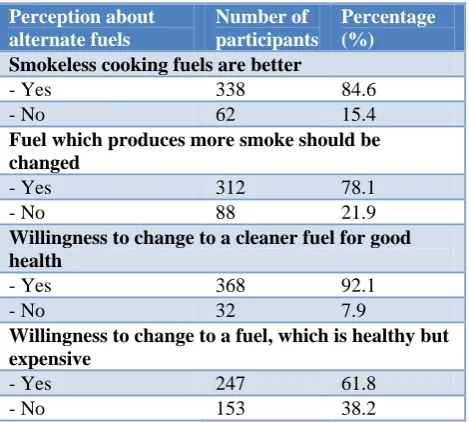
Table 3: Table showing user’s perception about alternate fuel usage.
Perception about alternate fuels
Number of participants
Percentage (%)
Smokeless cooking fuels are better
- Yes 338 84.6
- No 62 15.4
Fuel which produces more smoke should be changed
- Yes 312 78.1
- No 88 21.9
Willingness to change to a cleaner fuel for good health
- Yes 368 92.1
- No 32 7.9
Willingness to change to a fuel, which is healthy but expensive
- Yes 247 61.8
- No 153 38.2
On concern about the harmful effects of smoke on themselves, majority (85.2%) of the household women were concerned about its harmful effects as shown in Table 2. Among the study participants, majority (91.7%) were willing to change to a cleaner fuel that does not produce any smoke (Table 2).
Among the study participants, majority (84.6%) felt that smokeless fuels are better than the ones producing smoke as shown in Table 3. When asked about their perception regarding changing the fuel that produces more smoke, 78.1% of the household women, responded positively. In the study most of the study participants (92.1%) were willing to change over to a cleaner fuel. When asked the study participants were willing to change over to a fuel which is healthy, but expensive, only 61.8% were willing (Table 3).
DISCUSSION
The present study was a community based cross-sectional study. The study population consisted of 400 women in the age group of 18 to 65 years, permanently residing in the rural field practice area attached to K.S Hegde Medical Academy, Mangalore. The mean age of the study population was 37.68±11.2 years. Most of the participants were aged less than 30 years, followed by 41–50 year age group (28.5%) and 31-40 year age group (21.3%). This study finding is similar to the study conducted by Chhabi Lal Ranabhat et al in Nepal, where the age group was between 15 and 65 years.6 Also in the study, the most common age group was between the age of 21 and 30 years.
In this study, 61.5% had primary school education, 12.5% had pre-university education, 11% had secondary education, 4.75% were graduates and 4.5% were post-graduates. There were 4.2% illiterates in the study population. This was similar to the findings in the study conducted by S. Agrawal et al in Indian women where majority of the study participants had primary education (64%) followed by matriculation (15%), secondary education (10%) graduation (6%), post-graduation (2%) and 10% were illiterates.7 A study conducted in rural Pakistan by Naveed Z Janjua et al also showed similar results to our study where majority of the study participants attended only till primary school (70.8%), followed by 11% till 12th class, 15% till secondary school.8
study population were from the lower middle class (47%), followed by 26% from the middle class, 10% from the upper middle class, 14% from the lower class and 3% from the upper class.9 Also in a study conducted by Lakshmi P. V et al the study population consisted of 53% from the lower middle class, 29% from the middle class, 2% from the upper class, 6% from the upper middle class and the remaining 12% from the lower class.10 In this study, it was found that 34% of the study population were using firewood, 25% were on LPG, 41.3% were using both firewood and LPG for their cooking needs. In a study conducted by Po, J.Y.T et alin northeast India, the study population using firewood and charcoal were comparatively more (45%), LPG users were only 20% and people using both firewood and LPG were 35%.11 An initial high investment to procure the stove and cylinder could be the reason why most of the people, especially that in low socio-economic status still prefer firewood for their cooking purposes.
In our study, indoor cooking was practiced by 55.8% of the study population, outdoor cooking was done by 6.7% and 37.5% cooked both indoor and outdoor. Most of the study participants who cooked both indoor and outdoor, prepared rice and boiled water outdoors while other food items were cooked inside the house. Similar findings were seen in a study conducted by Balakrishnan K et al in southern India, where majority (67%) of the study population cooked indoors, 29% cooked both indoors and outdoors and the remaining 4% cooked outdoors.12 Also in another study conducted by Dutta et al. 13 among Indian women, 73% of the study population were cooking indoors, 24% cooked both indoors and outdoors and the remaining 3% cooked outdoors.
In our study, we have assessed the awareness and attitudes of the study participants regarding indoor smoke, and found that 80.8% of the study population were aware of the health risks posed by the smoke from burning firewood. Majority (87.5%) the women were aware of the increased smoke production from burning firewood. Regarding smokeless chulhas, only 78% of the study population were aware of it. 85.2% of the study population were concerned about the harmful effects of smoke on themselves. 91.7% were willing to change over to a clean fuel that doesn’t produce any smoke. In a study conducted by Bijoy Krishna Banik in rural Bangladesh, it was found that majority (85%) of the household women had good awareness and attitudes regarding the harmful effects of burning firewood.14 It was found that they were aware of the smoke production from firewood as compared to LPG. Most (76%) of the study participants were concerned about the health risks due to the burning of firewood and were willing to change over to a better fuel that produces less smoke. Rhodes et alconducted a study in Peru, Nepal and Kenya where it was seen that even though the study participants had good awareness and attitude, the practice was not possible due to the economic constraints.15 The study participants were
aware of the smoke production produced from burning of firewood. Only 60% were concerned of the health risks posed by exposure to the smoke.
In our study, majority (84.6%) of the study participants felt that smokeless fuels are better than the ones which produce smoke. Their perception about alternate fuel usage was good (78.1%). Most of the study participants (92.1%) were willing to change over to a clean fuel. Only 61.8% of the study participants were willing to change over to a cleaner fuel which is also expensive. In the study conducted by Jacqueline Hollada et alit was seen that most (89%) of the study participants were comfortable with smokeless fuels than firewood.16 Also majority of the women who were still using firewood were willing to change over to cleaner fuels. It was also found that 56% of the households were willing to change over to a healthy but expensive fuel for their daily cooking. In a similar study by Wickramasinghe in Sri Lanka, it was seen that majority (90%) of the study participants preferred smokeless fuels over firewood.17 Their perception about alternate fuels were good. Most of the study participants were willing to change over to a fuel that produces less smoke and 65% were willing to change over to a healthy and expensive fuel.
CONCLUSION
On assessing the awareness and attitudes of the study participants regarding indoor smoke, most (80.8%) of them were aware of its ill-effects. 91.7% were willing to change to a cleaner fuel, but only 61.8% of the participants were willing to change over to a fuel which is healthy and expensive. It was found that only 78% were aware about smokeless chulhas.
Limitations
Cigarette smoke also contributes to indoor air pollution which was not assessed in this study.
Funding: No funding sources Conflict of interest: None declared
Ethical approval: The study was approved by the Institutional Ethics Committee
REFERENCES
1. Fuentes-Leonarte V, Ballester F, Tenías J. Sources of Indoor Air Pollution and Respiratory Health in Preschool Children. J Environ Pub Health. 2009;2009:1-19.
2. Behera D. Health effects of indoor air pollution due to domestic cooking fuels. Indian J Chest Dis Allied Sci. 2001;43:27-31.
4. WHO. Health and Social Impacts of Household Energy. Who.int. 2017. Available at: http://www.who.int/indoorair/health_impacts/en. Assessed 21 May 2017.
5. WHO. Indoor air pollution and the Millennium Development Goals. Who.int. 2017. Available from: http://www.who.int/indoorair/mdg/en. Assessed 21 May 2017.
6. Ranabhat C, Kim C, Kim C, Jha N, Deepak K, Connel F. Consequence of Indoor Air Pollution in Rural Area of Nepal: A Simplified Measurement Approach. Frontiers in Public Health. 2015;3. 7. Agrawal S. Effect of Indoor air pollution from
biomass and solid fuel combustion on symptoms of preeclampsia/eclampsia in Indian women. Indoor Air. 2015;25:341–52.
8. Janjua NZ. Biomass fuel use and acute respiratory tract infection among under 5 children in rural areas of Pakistan. In Proceedings of APHA 136th Annual Meeting and Expo, San Diego, CA, USA, October 25-29, 2008.
9. Edelstein M, Pitchforth E, Asres G, Silverman M, Kulkarni N. Awareness of health effects of cooking smoke among women in the Gondar Region of Ethiopia: a pilot survey. BMC International Health and Human Rights. 2008;8(1):10.
10. Lakshmi PV, Virdi NK, Thakur JS, Smith KR, Bates MN, Kumar R. Biomass fuel and risk of tuberculosis: a case-control study from Northern India. J Epidemiol Community Health. 2012;66(5):457-61.
11. Po J, FitzGerald J, Carlsten C. Respiratory disease associated with solid biomass fuel exposure in rural women and children: systematic review and meta-analysis. Thorax. 2011;66(3):232-9.
12. Balakrishnan K, Sankar S, Parikh J, Padmavati R, Srividya K, Venugopal V, et al. Daily average
exposures to respirable particulate matter from combustion of biomass fuels in rural households of southern India. Environ Health Perspect. 2002;110(11):1069–75.
13. Dutta A, Ray RM, Banerjee A. Systematic inflammatory changes and increased oxidative stress in rural Indian women cooking with biomass fuels. Toxicol Appl Pharm. 2012;261:255–62.
14. Krishna Banik B. Female perceptions of health hazards associated with indoor air pollution in Bangladesh. Int J Sociol Anthropol. 2010;2(9):206-12.
15. Rhodes EL, Klasen DR, Naithani EM, Baliddawa N, Menya J, Khatry D, et al. Behavioral attitudes and preferences in cooking practices with traditional open-fire stoves in Peru, Nepal, and Kenya: Implications for improved cookstove interventions. Int J Environ Res. Public Health 2014;11:10310–26. 16. Hollada J, Williams K, Miele C, Danz D, Harvey S, Checkley W. Perceptions of Improved Biomass and Liquefied Petroleum Gas Stoves in Puno, Peru: Implications for Promoting Sustained and Exclusive Adoption of Clean Cooking Technologies. Int J Environ Res Pub Health. 2017;14(2):182.
17. Wickramasinghe A. Gendered Sights and Healthy Issues in the Paradigm of Bio-Fuel in Sri Lanka. Energia News. 2001;4:12-4.