Supported Decision-Making
for Persons with Mental Illness: A Review
Soumitra Pathare, MD,1,2
Laura S. Shields, MsC1,3
ABSTRACT
Persons with mental illness (PWMI) are often not afforded the same opportunity to make decisions on a par with others in society. Article 12 of the International Convention on the Rights of Persons with Disabilities (CRPD) states that persons with disabilities should have equal recognition before the law and the right to exercise their legal capacity. Exercising legal capacity can mean making decisions about employment, medical or psychosocial treatment, property, finances, family, and participation in community activities. The aim of this paper is to comprehensively review the evidence on supported decision making for PWMI, both in legislation and research globally, with a focus on low- and middle-income countries (LMICs). Results reveal only a few countries have provisions for supported decision-making for PWMI, with a particular shortage of such provisions in legislation in LMICs There is also a general paucity of research evidence for supported decision-making, with the majority of research focusing on shared decision-making for treatment decisions. This review highlights the need for additional research in this area to better guide models, which can be utilised in domestic legislation, particularly in LMICs, to better implement the ideals of Article 12 of the CRPD.
Key Words: Supported decision-making, mental illness, human rights, CRPD, legal capacity
Suggested Citation: Pathare S, Shields LS.Supported decision-making for persons with mental illness: a review. Public Health Reviews. 2012;34: epub ahead of print.
1 Centre for Mental Health Law and Policy, Indian Law Society, Pune, India. 2 Ruby Hall Clinic, Pune, India.
3 Athena Institute, VU University Amsterdam, Amsterdam, Netherlands.
Corresponding Author Contact Information: Dr. Soumitra Pathare at incarnapune@gmail.
INTRODUCTION
Making decisions is central to a person’s autonomy and the essence of what is regarded as personhood, and is a crucial component in enabling an individual to have control over their life and engage with society.1 Without
the ability to make decisions for ourselves, we are seen as non-persons before the law and our actions and decisions no longer have any legal force.1 In such circumstances, third parties often make decisions on behalf
of persons who are deemed to lack legal capacity and guardianship is often appointed, either informally (i.e., a relative) or formally (i.e., court appointed representative). People with disabilities are thus at risk of being stripped of their decision-making abilities and rights to self-determination by having others take on the authority to make decisions for them.2,3 In
particular, the presence of a mental illness is often equated with a lack of decision-making capacity.2,4-6 Society has historically restricted choice to
persons with mental illness (PWMI) due to an assumption of incapacity.7
As a result, institutions “took care” of many choices for PWMI, removing autonomy, responsibility, and self direction.7,8 For PWMI, having a
sub-stitute decision-making or guardianship system in place can abolish rights to self-determination and take away the opportunity to enter into transactions or contracts autonomously.
The Convention on the Rights of Persons with Disabilities (CRPD) came into force in 2008 and has created an impetus for change in disability laws (including mental health laws). The CRPD demands a paradigm shift in the disability sphere, moving from a substitute decision-making model to a supported decision-making model.4-6,9-14 Article 12 has been called the
core of the CRPD and states that all persons with disabilities (PWD) should have equal recognition before the law.14-16 It declares that PWD should have
both the recognition of their rights, legal capacity and the right to exercise this legal capacity.6,17,18 In practical terms, exercising legal capacity means
making decisions for oneself in all areas of life including medical treatment, housing, employment, relationships, finances, children, family planning, and property. The CRPD recognizes that there are times when PWD may require support in making decisions and that depending on the course of the disability or illness, varying levels of support may be needed.6,18 Accessing
support, regardless of its form, is central to the recognition of being equal and full citizens before the law.3 Countries are expected to take measures to
In most countries, mental health legislation does not include provisions for PWMI to exercise legal capacity. A number of laws still adopt a paternalistic approach with the stated purpose of protecting the individual and society from harm.5,20 This protection has been linked to the historical
view that PWMI are dangerous to others21 or violent,22 leading the state to
adopt a protective role. Early laws concerned with mental health were often penalizing and concerned with taking the individual away from society,21
frequently prescribing institutionalised treatment and guardianship as the solution and as a means of protection.5,6 Fortunately, mental health reform
in a number of countries has led to new mental health legislation that better promotes treatment in the community and inclusion of PWMI in society. Despite mental health reform, however, guardianship and substituted decision-making systems are still the prevailing norm in many countries and jurisdictions for PWMI.
Terminology used to describe decision-making capacity as it relates to mental illness differs substantially across jurisdictions, countries and even between disciplines of law and health. Decisions can be made in a number of ways in both law and health. Decisions can be made autonomously or by electing powers of attorney or writing advance directives, or by having court-appointed mentors or legal representatives or by having other supports (e.g., information aids, decision aids, peer support) or by having a substitute decision-maker. For the purposes of this review, we consider guardianship as a form of substituted decision-making where a decision maker is appointed to make decisions on behalf of a person believed to lack mental capacity.6 Guardianship can vary in its levels of decision-making power; for example, guardianship can be limited, partial or full (also known as plenary). While limited and partial guardianship are not ideal for realising legal capacity and autonomy, they allow an individual to retain some decision-making abilities in other areas of life, thus these levels of guardianship are preferred over full guardianship.6
The concepts of mental and legal capacity differ and hold different meanings. Legal capacity can be viewed as a person’s capacity to have rights and exercise these rights without discrimination.3,15,23 In contrast, mental capacity can be seen as the ability to understand incoming inform-ation, considering the harms and benefits of making or abstaining from a decision, and the ability to communicate the decision to others.23,24 The
correlation between the two definitions is that the cognitive requirements for mental capacity are also needed to exercise legal capacity.23 Frequently,
health or law professionals decide on both legal and mental capacity and it is often established prior to involvement from the legal system.24 However,
still have the right to retain full legal capacity, instead accessing support where necessary to be able to reach the same decision auto nomously.23
Research on decision-making for PWMI has been largely restricted to the medical domain, focusing primarily on treatment decisions. There is limited research outside this sphere, which test or evaluate supported decision-making models and assess legal outcomes as related to mental illness. Research has predominantly focused on shared decision-making. Shared decision-making has not been precisely defined in the literature,25,26
although it has been extensively researched27-34 (for review see26,34-41). In an
attempt to clarify the concept of shared decision-making, Makoul and colleagues42 posited that for a decision to be shared, it must involve at least
two participants, have shared information and the decision must be made and agreed upon by all parties. Montori and colleagues43 subsequently
added to this conceptual definition of shared decision-making by stating (specific to decision making in health care) that a decision is only shared if there is an ongoing partnership and collaboration between the health care worker and patient. Adams and colleagues44 emphasise the patient
par-ticipation angle of shared decision-making, highlighting that patients should have accessible information, enabling them to participate in an active and meaningful way.
Shared decision-making enables an individual to exercise partial auto-nomy over decisions and has been positioned as an intermediate option between paternalistic models and informed choice models35 and has been
associated with improvements in patient satisfaction, treatment adherence, and improved health outcomes (e.g., reduction of severity of symp-toms).34,45-48 Conversely, supported decision-making is broader, and can
consist of organisations, networks, provisions or agreements with the aim of supporting and assisting an individual with a mental illness to make and communicate decisions.6,23 In supported decision-making, the individual is
always the primary decision maker, but it is acknowledged that autonomy can be communicated in a number of ways, thus provision of support in different forms and intervals can assist in the expression of autonomous decisions. Supported decision-making enables the individual to retain legal capacity regardless of the level of support needed.3 Forms of supported
decision-making can therefore include advance directives, enduring powers of attorney, health care proxies, arrangements for financial decisions (e.g., payee regimes, banking systems), nominated representatives, and/or personal ombudsmen. These forms of support are more formal and offer less autonomy to PWMI on the support spectrum than less formal forms of support.6 Less formal but equally important forms of support can consist of
Research has extensively focused on advance directives which are defined as a supportive tool that specify a person’s wishes and preferences for treatment decisions for the future when he or she loses decision-making capacity.49-51 In advance directives, the wishes of the client are expressed
and based only on circumstances wherein the client loses decision-making capacity.49,51 Advance directives, while a valid support tool and a form of
supported decision-making, offer less autonomy and can transition into a form of substituted decision-making depending on the authority of the other person involved in the decision-making process. Furthermore, these tools are often not offered to persons with severe mental illness as they are seen by professionals to lack capacity.3
Despite the CRPD’s exhortation for supported decision-making, there has been resistance, primarily due to the assumption that PWMI are unable to make the right decision and are not aware of their best interests. This is based on the “outcomes” approach to legal capacity, which infers one’s capacity from the outcomes of decisions they make. This means that there are “right” and “wrong” decisions, and someone only has capacity if they can demonstrate that they can make “right” or reasonable decisions.2 The
bias in this approach lies in the fact that it assumes PWMI must make “right” and reasonable decisions to be considered to have capacity, and it does not afford PWMI the right to make mistakes or wrong decisions (and to subsequently learn from experience) like others in society.2 Furthermore,
persons without disabilities also solicit advice from family and professionals prior to making a decision—particularly health care decisions. In this sense, the concept of supported decision-making for people with disabilities only re-emphasises the norm of seeking advice and input when making an important decision.
As no countries have fully implemented Article 12 of the CRPD,1,52
METHODS
Study selection
As this review focuses on supported decision-making as it relates to mental illness and legal capacity, we review shared decision-making only briefly and synthesise the evidence in a way that might inform supported decision-making models. Studies in decision-decision-making are not always conducted as randomized controlled trials (RCTs), and restricting inclusion to a particular study design could substantially limit relevant data included in the evidence base. We therefore included RCTs, quasi-experimental studies, and qualitative studies. We also included grey literature (policy documents, legislation, unpublished presentations, reports) for the portion of the review identifying legislation for supported decision-making. We included all studies as long as at least 50 percent of the sample population had a mental illness and the intervention or research aim focused on decision-making for this population. We excluded studies if they focused on support tools which were not fully defined to be “supportive” (i.e., advance directives, nominated representatives, powers of attorney, health care proxies); populations with mental retardation, intellectual disabilities, Alzheimer’s, dementia or cog-nitive impairment, or focused on patients with health conditions other than mental health problems. There were no language restrictions for this review. Outcomes of interest for this review included patient satisfaction, health care outcomes (e.g., hospitalization rates post-intervention, severity of symptoms, medication adherence), effective supported decision-making models, legislation including provisions on supported decision-making (for grey literature). Relevant settings for the review of the research literature were community, primary, secondary, tertiary health care and social care settings (including inpatient psychiatric facilities).
Search Strategy
on other circumstances beyond medical decisions. For the legislative component of the review, we reviewed laws from any country regardless of its income level, as long as it incorporated provisions for supported decision-making for PWMI or included alternatives to guardianship and substituted decision-making systems. We searched in the following data-bases: PubMed, MEDLINE, PsycINFO, and Cochrane Library. References were searched from 1950 up until 2012. We also searched through reference lists of included studies to identify any additional references for potential inclusion that our searches might have missed. These additional references were searched in Google Scholar.
Data collection
From each study, we extracted the study design, setting, participant information, interventions (where appropriate), results, and limitations of the study. Both authors looked through the reference lists of included studies to identify any additional references that may have been missed by the searches. If relevant for inclusion, we obtained the abstract from the reference, and if relevant, obtained the full-text of the reference for review. Results
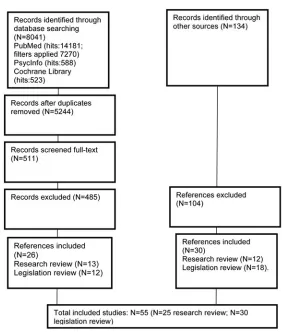
Fig. 1. Flow chart of study selection.
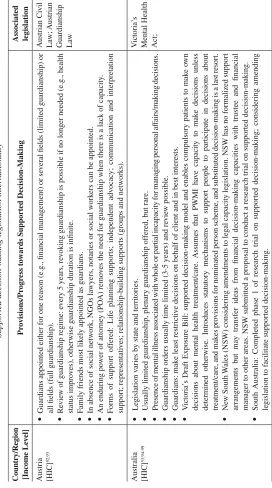
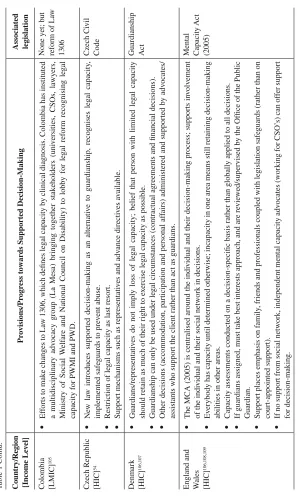
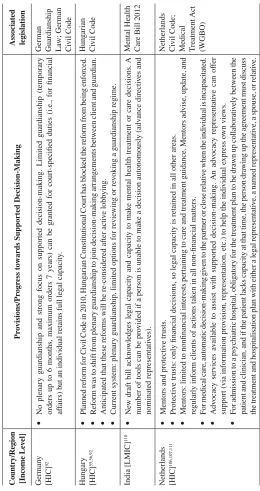
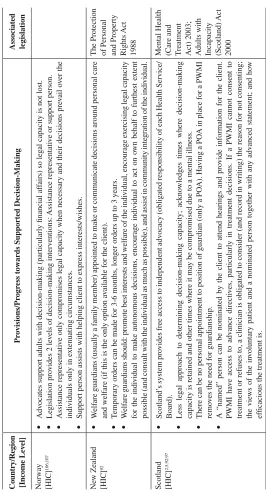
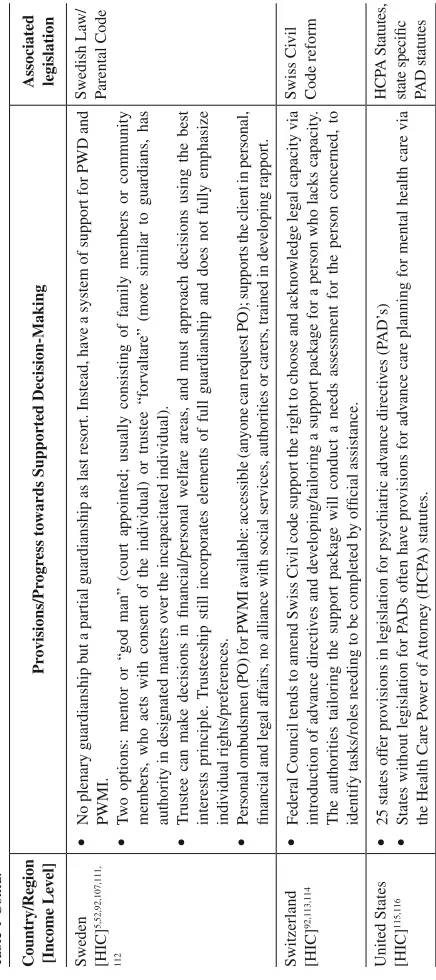
LEGISLATION REVIEW
T
able 1
Supported decision-making le
gislation internationally
Country/Region [Income Le
vel] Pr o visions/Pr ogr ess to
wards Supported Decision-Making
Associated legislation
Austria [HIC]
92,93
Guardians appointed either for one reason (e.g., financial management) or se
v
eral fields (limited guardian
ship) or
all fields (full guardianship).
Re
vie
w of guardianship re
gime: e
v
ery 5 years, re
v
oking guardianship is possible if no longer needed (e.g., health
status impro
v
es), otherwise guardianship duration is infinite.
F
amily friends most lik
ely appointed as guardians.
In absence of social netw
ork, NGOs la
wyers, notaries or social w
ork
ers can be appointed.
An enduring po
wer of attorne
y (PO
A) remo
v
es the need for guardianship when there is a lack of capacity
.
F
orms of support of
fered: Life planning supports; independent adv
ocac
y; communication and interpretation
support; representati
v
es; relationship-b
uilding supports (groups and netw
orks).
Austrian Ci
vil
La
w; Austrian
Guardianship La
w
Australia [HIC]
53,94-99
Le
gislation v
aries by state and territories.
Usually limited guardianship, plenary guardianship of
fered, b
ut rare.
Presence of mental illness associated with whole or partial incapacity for managing personal af
fairs/making decisions.
Guardianship orders usually time limited (3-5 years) and re
vie
w possible.
Guardians: mak
e least restricti
v
e decisions on behalf of client and in best interests.
V
ictoria’
s Draft Exposure Bill: supported decision-making model and enables compulsory patients to mak
e o
wn
decisions about mental health treatment/care.
Assumes that PWMI ha
ve capacity to mak
e decisions unless
determined otherwise. Introduces statutory mechanisms to support people to participate in decisions about treatment/care, and mak
es pro
visions for nominated person scheme, and substituted decision-making is a last resort.
Ne
w South
W
ales (NSW) considering amendments to le
gal capacity le
gislation. NSW has no formalized support
arrangements b
ut may transfer ideas from financial decision-making capacities with trustee and financial
manager to other areas. NSW submitted a proposal to conduct a research trial on supported decision-making.
South
Australia: Completed phase 1 of research trial on supported decision-making; considering amending
le
gislation to f
acilitate supported decision-making.
V
ictoria’
s
T able 1 Contd. Country/Region [Income Le
vel] Pr o visions/Pr ogr ess to
wards Supported Decision-Making
Associated legislation
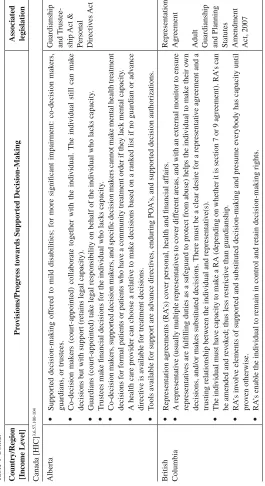
Canada [HIC]
3,6,57,100-104
Alberta
Supported decision-making of
fered to mild disabilities; for more significant impairment: co-decision mak
ers,
guardians, or trustees.
Co-decision mak
ers (court-appointed) collaborate together with the indi
vidual.
The indi
vidual still can mak
e
decisions b
ut with support (retains le
gal capacity).
Guardians (court-appointed) tak
e le
gal responsibility on behalf of the indi
vidual who lacks capacity
.
T
rustees mak
e financial decisions for the indi
vidual who lacks capacity
.
Co-decision mak
ers, supported decision mak
ers, and specific decision mak
ers cannot mak
e mental health treatment
decisions for formal patients or patients who ha
ve a community treatment order if the
y lack mental capacity
.
A health care pro
vider can choose a relati
v
e to mak
e decisions based on a rank
ed list if no guardian or adv
ance
directi
v
e is a
vailable for treatment decisions.
T
ools a
vailable for support are adv
ance directi
v
es, enduring PO
A
’s, and supported decision authorizations.
Guardianship and T
rustee-ship Act
&
Personal Directi
v
es Act
British Columbia
Representation agreements (RA
’s) co
v
er personal, health and financial af
fairs.
A representati
v
e (usually multiple representati
v
es to co
v
er dif
ferent areas, and with an e
xternal monitor to ensure
representati
v
es are fulfilling duties as a safe
guard to protect from ab
use) helps the indi
vidual to mak
e their o
wn
decisions, and/or mak
es substituted decisions.
There must be a clear desire for a representati
v
e agreement and a
trusting relationship between the indi
vidual and representati
v
e(s).
The indi
vidual must ha
v
e capacity to mak
e a RA (depending on whether it is section 7 or 9 agreement). RA
’s can
be amended and re
v
ok
ed; thus less restricti
v
e than guardianship.
RA
’s in
v
olv
e elements of supported and substituted decision-making and presume e
v
erybody has capacity until
pro
v
en otherwise.
RA
’s enable the indi
vidual to remain in control and retain decision-making rights.
T able 1 Contd. Country/Region [Income Le
vel] Pr o visions/Pr ogr ess to
wards Supported Decision-Making
Associated legislation
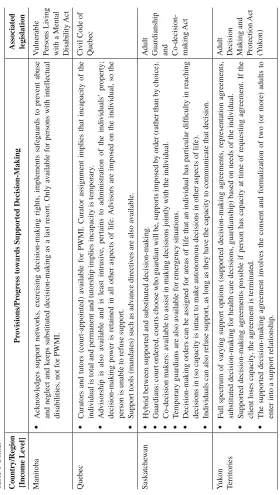
Manitoba
Ackno
wledges support netw
orks, e
x
ercising decision-making rights, implements safe
guards to pre
v
ent ab
use
and ne
glect and k
eeps substituted decision-making as a last resort. Only a
vailable for persons with intellectual
disabilities, not for PWMI.
V
ulnerable
Persons Li
ving
with a Mental Disability Act
Quebec
Curators and tutors (court-appointed) a
vailable for PWMI. Curator assignment implies that incapacity of the
indi
vidual is total and permanent and tutorship implies incapacity is temporary
.
Advisorship is also a
vailable and is least intrusi
v
e, pertains to administration of the indi
viduals’ property;
decision-making po
wer is retained in all other aspects of life.
Advisors are imposed on the indi
vidual, so the
person is unable to refuse support.
Support tools (mandates) such as adv
ance directi
v
es are also a
vailable.
Ci
vil Code of
Quebec
Saskatche
w
an
Hybrid between supported and substituted decision-making.
Guardians: court ordered, courts choose who guardian will be, supports imposed by order (rather than by choice).
Co-decision mak
ers: a
vailable to assist in making decisions jointly with the indi
vidual.
T
emporary guardians are also a
vailable for emer
genc
y situations.
Decision-making orders can be assigned for areas of life that an indi
vidual has particular difficulty in reaching
decisions in (so capacity is intact to mak
e autonomous decisions in other aspects of life).
Indi
viduals can also refuse support, as long as the
y ha
v
e the capacity to communicate that decision.
Adult Guardianship and Co-decision- making Act
Y uk on T erritories
Full spectrum of v
arying support options (supported decision-making agreements, representation agreements,
substituted decision-making for health care decisions, guardianship) based on needs of the indi
vidual.
Supported decision-making agreements possible if person has capacity at time of requesting agreement. If the client loses capacity
, the agreement is terminated.
The supported decision-making agreement in
v
olv
es the consent and formalization of tw
o (or more) adults to
enter into a support relationship.
Adult Decision Making and Protection Act (Yuk
T able 1 Contd. Country/Region [Income Le
vel] Pr o visions/Pr ogr ess to
wards Supported Decision-Making
Associated legislation
Colombia [LMIC]
105
Ef
forts to mak
e changes to La
w 1306, which defines le
gal capacity by clinical diagnosis. Colombia has instituted
a multidisciplinary adv
ocac
y group (La Mesa) bringing together stak
eholders (uni
v
ersities, CSOs, la
wyers,
Ministry of Social
W
elf
are and National Council on Disability) to lobby for le
gal reform recognising le
gal
capacity for PWMI and PWD.
None yet; b
ut
reform of La
w
1306
Czech Republic [HIC]
54
Ne
w la
w introduces supported decision-making as an alternati
v
e to guardianship, recognises le
gal capacity
,
implemented safe
guards to pre
v
ent ab
use.
Restriction of le
gal capacity as last resort.
Support mechanisms such as representati
v
es and adv
ance directi v es a vailable. Czech Ci vil Code
Denmark [HIC]
106,107
Guardians/representati
v
es do not imply loss of le
gal capacity; belief that person with limited le
gal capacity
should retain as much of their right to e
x
ercise le
gal capacity as possible.
Guardianship can only be used under le
gal circumstances (contractual agreements and financial decisions).
Other decisions (accommodation, participation and personal af
fairs) administered and supported by adv
ocates/
assistants who support the client rather than act as guardians.
Guardianship Act
England and Wales [HIC]
106,108,109
The MCA (2005) is centralised around the indi
vidual and their decision-making process; supports in
v
olv
ement
of the indi
vidual and their social netw
ork in decisions.
Ev
erybody has capacity until determined otherwise; incapacity in one area means still retaining decision-making
abilities in other areas.
Capacity assessments conducted on a decision-specific basis rather than globally applied to all decisions.
If guardians assigned, must tak
e best interests approach, and are re
vie
wed/supervised by the Office of the Public
Guardian.
Support places emphasis on f
amily
, friends and professionals coupled with le
gislation safe
guards (rather than on
court-appointed support).
If no support from social netw
ork, independent mental capacity adv
ocates (w
orking for CSO’
s) can of
fer support
for decision-making.
T able 1 Contd. Country/Region [Income Le
vel] Pr o visions/Pr ogr ess to
wards Supported Decision-Making
Associated legislation
German
y
[HIC]
92
No plenary guardianship and strong focus on supported decision-making. Limited guardianship (temporary orders up to 6 months, maximum orders 7 years) can be granted for court-specified duties (i.e., for financial affairs) b
ut an indi
vidual retains full le
gal capacity
.
German Guardianship La
w; German
Ci
vil Code
Hungary [HIC]
55,56,92
Planned reform for Ci
vil Code in 2010, Hungarian Constitutional Court has block
ed the reform from being enforced.
Reform w
as to shift from plenary guardianship to join decision-making arrangements between client and guardian.
Anticipated that these reforms will be re-considered after acti
v
e lobbying.
Current system: plenary guardianship, limited options for re
vie
wing or re
v
oking a guardianship re
gime.
Hungarian Civil Code
India [LMIC]
110
Ne
w draft bill ackno
wledges le
gal capacity and capacity to mak
e mental health treatment or care decisions.
A
number of tools can be pro
vided if a person is unable to mak
e a decision autonomously (adv
ance directi v es and nominated representati v es).
Mental Health Care Bill 2012
Netherlands [HIC]
106,107,111
Mentors and protecti
v
e trusts.
Protecti
v
e trusts: only financial decisions, so le
gal capacity is retained in all other areas.
Mentors: limited to nonfinancial interests pertaining to care and treatment guidance. Mentors advise, update, and regularly inform clients of actions tak
en in all non-financial matters.
F
or medical care, automatic decision-making gi
ven to the partner or close relati
ve when the indi
vidual is incapacitated.
Adv
ocac
y services a
vailable to assist with supported decision-making.
An adv
ocac
y representati
v
e can of
fer
support (via information pro
vision, representation, etc.) to help the indi
vidual e xpress o wn vie ws. F
or admission to a psychiatric hospital, obligatory for the treatment plan to be dra
wn up collaborati
vely between the
patient and clinician, and if the patient lacks capacity at that time, the person dra
wing up the agreement must discuss
the treatment and hospitalisation plan with either a le
gal representati
ve, a named representati
ve, a spouse, or relati
ve.
T able 1 Contd. Country/Region [Income Le
vel] Pr o visions/Pr ogr ess to
wards Supported Decision-Making
Associated legislation
Norw ay [HIC] 106,107 Adv
ocates support adults with decision-making (particularly financial af
fairs) so le
gal capacity is not lost.
Le
gislation pro
vides 2 le
v
els of decision-making interv
entions:
Assistance representati
v
e or support person.
Assistance representati
v
e only compromises le
gal capacity when necessary and their decisions pre
vail o
v
er the
indi
viduals only in e
xtenuating circumstances.
Support person assists with helping client to e
xpress interests/wishes. Ne w Zealand [HIC] 92 W elf
are guardians (usually a f
amily member) appointed to mak
e or communicate decisions around personal care
and welf
are (if this is the only option a
vailable for the client).
T
emporary orders can be made for 3-6 months, longer orders up to 3 years.
W
elf
are guardians should: promote best interests and welf
are of the indi
vidual, encourage e
xercising le
gal capacity
for the indi
vidual to mak
e autonomous decisions, encourage indi
vidual to act on o
wn behalf to furthest e
xtent
possible (and consult with the indi
vidual as much as possible), and assist in community inte
gration of the indi
vidual.
The Protection of Personal and Property Rights Act 1988
Scotland [HIC]
2,5,92,97
Scotland’
s system pro
vides free access to independent adv
ocac
y (obligated responsibility of each Health Service/
Board).
Less le
gal approach to determining decision-making capacity; ackno
wledges times where decision-making
capacity is retained and other times where it may be compromised due to a mental illness.
There can be no personal appointment to position of guardian (only a PO
A). Ha
ving a PO
A in place for a PWMI
remo
v
es the need for guardianship.
A “named” person can be nominated by the client to attend hearings and pro
vide information for the client.
PWMI ha
v
e access to adv
ance directi
v
es, particularly in treatment decisions. If a PWMI cannot consent to
treatment or refuses to, a clinician is obligated to consider (and record in writing) the reason for not consenting; the vie
ws of the in
v
oluntary patient and a nominated person together with an
y adv
anced statement; and ho
w
efficacious the treatment is.
T able 1 Contd. Country/Region [Income Le
vel] Pr o visions/Pr ogr ess to
wards Supported Decision-Making
Associated legislation
Sweden [HIC]
5,52,92,107,111,
112
No plenary guardianship b
ut a partial guardianship as last resort. Instead, ha
v
e a system of support for PWD and
PWMI.
T
w
o options: mentor or “god man” (court appointed; usually consisting of f
amily members or community
members, who acts with consent of the indi
vidual) or trustee “forv
altare” (more similar to guardians, has
authority in designated matters o
v
er the incapacitated indi
vidual).
T
rustee can mak
e decisions in financial/personal welf
are areas, and must approach decisions using the best
interests principle.
T
rusteeship still incorporates elements of full guardianship and does not fully emphasize
indi
vidual rights/preferences.
Personal omb
udsmen (PO) for PWMI a
vailable: accessible (an
yone can request PO); supports the client in personal,
financial and le
gal af
fairs, no alliance with social services, authorities or carers, trained in de
veloping rapport.
Swedish La
w/
P
arental Code
Switzerland [HIC]
92,113,114
Federal Council tends to amend Swiss Ci
vil code support the right to choose and ackno
wledge le
gal capacity via
introduction of adv
ance directi
v
es and de
v
eloping/tailoring a support package for a person who lacks capacity
.
The authorities tailoring the support package will conduct a needs assessment for the person concerned, to identify tasks/roles needing to be completed by official assistance.
Swiss Ci
vil
Code reform
United States [HIC]
115,116
25 states of
fer pro
visions in le
gislation for psychiatric adv
ance directi v es (P AD’ s)
States without le
gislation for P
ADs often ha
v
e pro
visions for adv
ance care planning for mental health care via
the Health Care Po
wer of Attorne y (HCP A) statutes. HCP A Statutes,
Alberta, Saskatchewan, Quebec and Manitoba) have legislation providing for varying forms of supported decision-making.6 Canada and Australia,
although having signed and ratified the CRPD and having provisions for varying forms of support for exercising legal capacity, have both entered a reservation on Article 12 of the CPRD, interpreting compulsory treatment and fully-supported or substituted decision-making as permissible under the CRPD, but only as a last resort.53 Scotland’s progressive Mental Health
Act and the United Kingdom’s Mental Capacity Act have both developed a Code of Practice to assist service users and carers on interpreting these Acts, which is particularly useful when it comes to outlining decision-making capabilities.2,5 In 2012, The Czech Republic enacted a new civil
code introducing supported decision-making and stating that restrictions of legal capacity are a last resort.6,54 Germany has also made use of supported
decision-making agreements in various forms for PWMI.6 The introduction
of a “friend” or “mentor” appointed by the court has become common in a number of European countries, such as Germany, Finland, Sweden and Austria. Friends/mentors are appointed to an individual after a capacity assessment finds the individual to lack capacity. The friend/mentor has authority to make substitute decisions, is expected to elicit the preferences of the client, and can also allow for the individual to make autonomous decisions in certain areas of life.52This arrangement has been viewed as a
middle ground between autonomous and substituted decision-making.3
ON THE WAY TO REFORM
Advocacy measures to implement Article 12 of the CRPD are strong, though legal reform has yet to take place.52 Guardianship law reform is
occurring in the Czech Republic, Hungary, France, Ireland, Portugal, Slovakia and Slovenia. Several South American countries like Colombia also offer either plenary guardianship or assistance to make decisions, where the individuals’ decision is taken into account along with a third party. The Hungarian Government, after plans in 2009 to abolish plenary guardianship and offer supported decision-making as an alternative, declined to enact the new reforms in 2010.55,56 Norway and Germany have
mixed systems, offering both support and substitution decision-making.57
RESEARCH REVIEW
Supported decision-making in high-income countries (HICs)
Few studies have assessed supported decision-making beyond treatment decisions, such as how supported decision-making impacts legal capacity and other life decisions. One study looked at having choice about housing and receiving support to autonomously decide about housing in the community. Srebnik et al. found that perceived autonomy to decide about housing had a substantial impact on psychological well-being.8 Other
authors have discussed financial capacity in persons with schizophrenia, recommending the use of advance directives to outline preferences and processes with regards to financial matters during periods of both capacity and incapacity.59 Another study in Australia60 looked at the impact of
supported decision-making. Results revealed that out of 22 adults, eight (36%) wanted to receive support in several areas of their life (e.g., choosing services, housing, medical procedures). Social exclusion was identified as a barrier to supported decision-making, as three of 22 participants had nobody they could nominate in their life as a supporter, though they were keen to have support.60,61 Participants believed that an advocate or multi disciplinary
team would be best to provide support for mental health care decisions, a solicitor for legal decisions, and a friend or relative for day-to-day matters. Another study conducted by Amnesty International in Ireland62,63 revealed
Shared decision making in mental health care
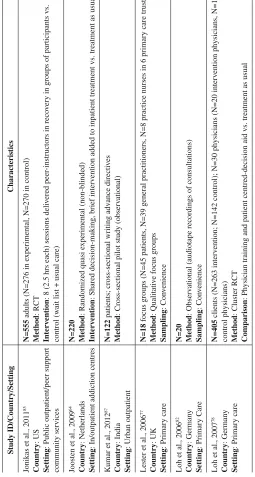
While a number of reviews have assessed shared decision-making we chose to review primary studies and not conduct a review of reviews. Despite the extensive research on shared decision-making, we were unable to identify any studies focusing on shared decision-making interventions in LMICs; therefore our review is limited to studies conducted in HICs (Table 2).
Shared decision-making interventions have shown mixed results. Some authors have found that shared decision-making interventions had some impact on reducing the severity of substance-related and/or psychiatric problems but did not impact quality of life.64,65 Another study found shared
decision-making to have a significant impact for clients with a mental illness even when deciding on secondary decisions like lifestyle behaviours.66
Mahone (2008) found that participation in shared decision-making was associated with better medication adherence rates,65,67 while a recent study
found that a computerized shared decision-making tool had no impact on medication adherence in community outpatient settings.68
Preferences in decision-making
Common across the majority of the studies is the finding that PWMI have a higher desire for treatment decision-making than other groups within general medicine.39,69-71 In addition, participants in a number of
studies declared that they had a clear desire for greater participation in decision regarding their psychiatric care compared to the current care they were receiving.39,65,67,70 To illustrate, in one study, 82 percent of participants
preferred a collaborative relationship with their health care provider, however only 70 percent experienced this collaboration.65 Interestingly,
participants articulated a clear idea of how and when to prioritise autonomy in decision-making and when to consult or defer the decision to health care professionals. One study72 interviewed participants who endorsed a
two-step process of decision-making; first prioritising autonomy and if auto-nomy was not possible, case managers were consulted to help make a decision.. The desired autonomy for decision-making varied by type of decision: for example, with medication choices, 77 percent prefer either autonomous or shared roles regarding their choices.44 Preferences for
decision-making also vary when it comes to who patients prefer to make health care decisions for them. Participants in one study70 wished for
T
able 2.
Supported and shar
ed decision-making included study c
har
acteristics
Study ID/Country/Setting
Characteristics
Amnesty International, 2009
62
McDaid and Delane
y, 2011
63
Country
: Ireland
Setting
: Public locations
N=8
clients with direct e
xperience of mental health in Ireland
Method
: Qualitati
v
e; semi-structured intervie
w
Sampling
: Sno
wballing
Campbell et al., 2007
75 Country : UK Setting : Home-based N=16 Method : Qualitati v e intervie ws Sampling : Purposi v e Dee gan, 2010 86 Country : US Method : Interv ention design/description
Hamann et al., 2007
83 Country : German y Setting : Inpatients N=107 Method
: Cluster RCT pilot study
Inter
v
ention
: Decision making interv
ention (decision aid, planning consultation) vs. usual care
Hamann et al., 2011
67 Country : German y Setting : Inpatients N=61
; Shared decision-making training (N=32) or cogniti
v
e training (N=29)
Method
: RCT
Inter
v
entions
: Shared decision-making training (interv
ention) or cogniti
v
e training (control)
Hamera et al., 2010
66
Country
: US
Setting
: Outpatient clinics
N=98 Method
: Secondary analysis of 98 audiotaped intervie
ws (between practitioners and patients)
Inter
v
ention
T
able 2 Contd.
Study ID/Country/Setting
Characteristics
Jonikas et al., 2011
85
Country
: US
Setting
: Public outpatient/peer support
community services
N=555
adults (N=276 in e
xperimental, N=270 in control)
Method
: RCT
Inter
v
ention
: 8 (2.5 hrs each) sessions deli
v
ered peer
-instructors in reco
v
ery in groups of participants vs.
control (w
ait list + usual care)
Joosten et al., 2009
64
Country
: Netherlands
Setting
: In/outpatient addiction centres
N=220 Method
: Randomized quasi e
xperimental (non-blinded)
Inter
v
ention
: Shared decision-making, brief interv
ention added to inpatient treatment vs. treatment as usual
K
umar et al., 2012
87
Country
: India
Setting
: Urban outpatient
N=122
patients; cross-sectional writing adv
ance directi
v
es
Method
: Cross-sectional pilot study (observ
ational)
Lester et al., 2006
77
Country
: UK
Setting
: Primary care
N=18
focus groups (N=45 patients, N=39 general practitioners, N=8 practice nurses in 6 primary care trusts)
Method
: Qualitati
v
e focus groups
Sampling
: Con
v
enience
Loh et al., 2006
82
Country
: German
y
Setting
: Primary Care
N=20 Method
: Observ
ational (audiotape recordings of consultations)
Sampling
: Con
v
enience
Loh et al., 2007
78
Country
: German
y
Setting
: Primary care
N=405
clients (N=263 interv
ention; N=142 control); N=30 physicians (N=20 interv
ention physicians, N=10
control physicians) Method
: Cluster RCT
Comparison
T
able 2 Contd.
Study ID/Country/Setting Characteristics Mahone, 2008 65 Country : US Setting
: Community MH centres
N=84
with serious mental illness
Method
: Cross sectional correlational study
Sampling
: Con
v
enience
Mahone et al., 2011
76
Country
: US
Setting
: Public outpatient MH
N=7
focus groups (consumers, f
amily members, prescribers, MH clinicians & rural pro
viders);
N=44
participants in 7 focus groups
Method
: Qualitati
v
e focus group
McMullen, 2012
80
Country
: Canada
Setting
: Primary care
N=11
physicians
Method
: Qualitati
v
e in-depth intervie
ws
Sampling
: Con
v
enience sample
O’Neal et al., 2008
70
Country
: US
Setting
: Outpatient; residential f
acility
N=65
(N=33 older adults o
v
er 50 (OD); N=32 younger adults (YD)
Method
: Cross-sectional pilot study (observ
ational)
Sampling
: Con
v
enience
Office of the Public
Adv ocate, 2010 60,61 Country : Australia Setting : Community N=22
referred to project, 8 had signed agreements
Method
: Ev
aluation study to test applicability of supported decision-making
Inter
v
ention/Pr
oject
: Supported decision-making for PWMI
P
atel and Bakk
en, 2010 71 Country : US Setting : Outpatient N=60 Method : Surv ey Sampling : Con v enience
Simon et al., 2006
74
Country
: German
y
Setting
: Inpatient, outpatient, self-help
N=40
patients with depression (45% se
v
ere)
Method
: Qualitati
v
e; Semi-structured intervie
ws
Sampling
: Con
v
T
able 2 Contd.
Study ID/Country/Setting
Characteristics
Srebnik et al.,1995
7
Country
: US
Setting
: Supported housing project
N=115 Method : Qualitati v e intervie ws; Quasi-e xperimental Inter v ention
: Program of
fering MH and community support services with obtaining/maintaining housing
Stace
y et al., 2008
73
Country
: Canada
Setting
: Outpatient and community
hospital
N=9 Method
: Semi-structured intervie
ws
Sampling
: Non-randomized con
v
enience sample
Stein et al., 2012
68
Country
: US
Setting
: Community mental health
clinics
N=1122 Method
: Non-randomized computer interv
ention
Inter
v
ention
: Computerized decision support program vs. treatment as usual
W oltmann and Whitle y 2010 72 Country : US Setting
: Public community MH
services
N=16
li
ving with se
v
ere mental illness
Method
: Qualitati
v
e, structured intervie
ws
Sampling
: Purposi
v
e; Sample tak
en from a pre
vious RCT comparing usual care vs. electronic decision
support program
W
oltmann et al., 2011
84
Country
: US
Setting
: Urban community MH services
Case mangers (EDSS, N=10) and control N=10; clients (EDSS N=40; control N=40) Method
: Cluster RCT
Comparisons
: Supported planning group vs. usual care planning group
Y
oung et al.,2008
81 Country : US Setting : Outpatient N=298
interactions between 18 “clients” and 152 physicians
Method
: Secondary analysis from an RCT
; Coded 287 audio recorded interactions between physicians +
patients assess shared decision-making beha
Similarly, Stacey and colleagues found that 52 percent of individuals with depression preferred to make treatment decisions alone, 38 percent collaboratively with the health practitioner, and eight percent wanted the practitioner to make the decision.73 In another study, the majority preferred
to make their treatment decision alone and have an active role in decision-making, followed by sharing the decision with their health care provider, and lastly, very few wanted someone to make a substituted decision on their behalf (even if the substitute decision maker was a family member).71,73
More difficult decisions will elicit a need for validation from health care professionals, like hospitalisation. Simon et al. found that participants noticed decision-making took longer when difficult topics arose and when clients were uncertain about the benefits of a decision exceeding the harms (e.g., with medication).74 In this particular study, 75 percent of patients
reported ambivalence towards decision-making, and judged that when symptoms became too great, decision-making should be placed in the hands of professionals. More difficult personal circumstances of the client (e.g., severity of symptoms at the moment, perceived self-competency, experiences with health care professionals) also play a role in determining whether a client relinquishes decision-making control to the health care professional.75
One factor potentially influencing results is treatment setting, that is, whether participants interviewed in these studies were formal or informal patients, outpatients or inpatients. This could influence the results as formal or inpatients may feel they have less options and less autonomy to make decisions, as well as perceived reduced decisional capacity compared to when they voluntarily seek treatment or when receiving care in the community.
The extent to which decision-making will be utilised by patients depends on a number of cognitive and affective factors such as individual preferences regarding involvement in the decision-making process.45 It is
not the case that all individuals want to make autonomous decisions, how-ever the central idea is that all individuals should have access to supported decision-making should they need and want it, and all individuals should have the opportunity to exercise their legal capacity.2
Barriers to decision-making
Barriers at the individual level
uncertain about their decisions regarding medication and treatment, and the uncertain group (compared to those displaying more certainty) felt less informed, less supported and less clear about how to value the benefits and risk of options.73 These participants required guidance in acquiring
inform-ation, clarifying values, and support to reach a decision. Second, some also expressed fear about their own level of competency and were reluctant to breach the topic of shared decision-making with their health providers often relating back to traumatic experiences from the past with health care providers.Another study identified that clients felt particularly uncertain about decision-making when they were perceived to not be competent due to their mental illness.76 Third, cultural factors in help-seeking behaviour
and decision-making also impact the willingness to share decision-making with health care providers. Patel and Bakken found that Hispanics preferred more passive decision-making in mental health care compared to non-Hispanics who preferred a more active decision-making role.71 Fourth,
social exclusion has also been cited as a barrier to decision-making.60 If
clients have someone to discuss decisions with (peers, families, community members) this often contributes to mobilising a large proportion of support needed to reach a decision.
Lastly, decisional conflict was cited as a barrier leading to increased treatment discontinuation and treatment refusal. Supported decision-making would contribute to addressing factors that influence decisional conflict such as being uninformed, having unclear values, feeling unsupported, and having low motivation. Another barrier to a more active role for PWMI in treatment decision-making is the fear and anxiety that they are “difficult” patients and challenging their health care provider and this will lead to reduced access to much needed care.67,77 Psychoeducation, having peer-staff
listen and inform clients, or providing information prior to consultations with health practitioners could alleviating some of this anxiety, fear and insecurity when considering participation in mental health care.
Barriers at the professional level
For health care workers, a number of barriers to employing a shared decision-making approach have been mentioned in the literature. In line with the patient perception of being perceived as difficult if engaging in shared making behaviours, a trial comparing a shared decision-making intervention and treatment as usual by Hamann and colleagues (2011)67 found that even at six months post-intervention, although patients
and decision-making), the treating psychiatrists perceived the shared decision-making group to be more difficult to treat (in terms of stress levels for the psychiatrist) compared to control group patients. Other barriers mentioned have been difficulty in ascertaining how to respond when it comes to mental health crises, lack of system support, and additional time required for shared decision-making.56,58 Although other studies, have found
that shared decision-making does not require additional time.78,79 McMullen
found that physicians she interviewed often did not make used of shared decision-making principles, but rather persuaded clients to decide on empirically supported treatments which physicians themselves had some control over (e.g., therapy in their office, pharmacotherapy as administered via their prescription pad).80 Two other studies found that most physicians
did not try to involve patients in shared decision-making and that physicians failed to fully participate in shared decision-making in consultations.81,82 Peer support and support systems
Two RCTs conducted in Germany revealed that shared decision-making interventions had a marginal increase in patient satisfaction and demonstrated some evidence that shared decision-making also increased doctor facilitation of patient involvement in decision-making, and did not increase doctor consultation time. Neither of the trials found any positive effect of shared decision-making on clinical outcomes, hospital readmission, or patient compliance with treatment.78,79,83 A more recent RCT found that an electronic
decision support system did not increase patient satisfaction, however clients became more involved in treatment plans and case managers became more aware of clients concerns and needs, potentially facilitating a more collaborative and supportive relationship in the future.84 Another study had
peer-educator led training for people with mental illness, which emphasised informed decision-making, wellbeing, and self-management.85 These
long-term training sessions resulted in a greater inclination to engage in self-advocacy behaviours and these effects continued after six months post-intervention as well as across settings and cultures. Advanced directives have also been seen as a way to support the client in reaching a decision and facilitate collaborative partnership between doctors and patients, particularly due to the fact that it takes into account that mental capacity may fluctuate over the course of mental illness. Deegan (2010) found that even within a short 15-minute consultation, peer support and technology could be utilised to enhance psychiatric medication visits and make them more efficient for both patients and clinicians.86 The drawback to this system is the cost of
Supported decision-making in LMICs
While the literature in HICs is limited, research in LMICs on supported decision-making is even sparser. Poor understanding of patient rights, limited education, and limited medical and legal resources have been reported as reasons for the lack of research.87 An opinion piece on advanced
directives points towards several implementation barriers in LMICs.50 The
authorstake the view that the service delivery context in a country like India make implementation of supported decision-making tools problematic, as such tools are designed to be implemented in a more accessible, equitable, and organized system.50 Another barrier is the limited resource availability
for monitoring and evaluating these legislative frame works leading to potential abuse of such progressive tools deisgned to aid in decision-making and promote autonomy.50 Lastly, limited resources means that dedicated
legal aid services are scarce, and make implementation of advanced directives in an affordable and accessible manner difficult.50 One study countering
these opinions was the first study on PADs in India which demonstrated that persons with a chronic mental illness (even with active symptoms) can make use of supportive tools in a resource-poor setting.87 While advance directives
are not a supportive tool allowing for full autonomous decision-making (although it does fall along the spectrum of support in a supported decision-making framework), this trial is a step in the right direction for shifting to more supportive decision-making models in India.
DISCUSSION
that choice and risk of making these choices is transparent in order to enable fair appraisal of the decision-making process.88
Our findings indicate a disconnect between international conventions (CRPD) and domestic legislation. We found very limited evidence on supported decision-making, and even less evidence on interventions assessing autonomy and decision-making outside treatment decisions. We found that the models of decision-making tested in the research arena are often very narrow and controlled and do not reflect the dynamic relations between health care professionals, legal professionals, clients, and carers that occur in practice. The findings from the research, predominantly on shared decision-making, indicated that common to the majority of PWMI, there is a desire for autonomy in decision-making and support for decisions involving complex life issues, particularly when the person is uncertain about the pros and cons of the decision, or uncertain about their competence.76
Some health care providers have expressed concerns about managing capacity and treatment decisions in crises, additional time, resources and infrastructure required, and difficulty in seeing clients as equals; all perceived as barriers to collaborating on decisions.56,58 However, supported
decision-making should not be seen as an impediment to accessing care, but rather a facilitator of better quality care. Supported decision-making as well as shared decision-making for treatment decisions both point towards a model of inclusion, wherein if a person has difficulty in expressing and communicating his or her wishes, the solution is not coercive and involuntary treatment or assignation of guardianship. Instead these methods allow a relationship to develop in ways that make it possible for an individual to communicate what he or she wants in certain aspects of their lives.52 It is also important to
recognise that there is no “ideal” for supported decision-making either at the professional, state, or national level; but rather a set of components, which, depending on the resources, training and cultural values of the country, can be utilised to promote legal capacity and autonomous decision-making.
From a legal point of view, countries that have ratified the CRPD have a particular impetus to modify or update their mental health legislation in light of the Convention, particularly when it comes to provisions enabling people to exercise their legal capacity. The CRPD requires mental health legislation to be framed in such a way that presumes all PWMI have legal capacity until proven otherwise, and even with a lack of decisional capacity, they should be offered supports and accommodations to reach an auto-nomous decision.
This provides further impetus to shift from a paternalistic way of viewing PWMI to a more inclusive and supportive system embracing decisions made by PWMI. There is an expectation from the CRPD that governments have a responsibility to change their existing legislation on substitute decision-making and supplant it with a more supportive model encouraging supported decision-making.89 Policies and programmes should accordingly
be designed to implement such legislation. This depends on how countries interpret Article 12 and interpret support for PWMI. Their interpretations and reaction to these interpretations ultimately shape practices and legislation.6 It is therefore important that research be conducted to inform
examples of how Article 12 of the CRPD can be implemented, and additionally, governments must liaise with user organisations, peer support networks, carers, and the social sector to ensure that support aids are used in practice when appropriate.89 From a practical legislation perspective,
instituting a law-based system of supported decision-making should focus on main decisions of legal relevance impacting PWMI, such as finances, who they live with, employment, medical decisions, community participation and choice of appropriate support services.11 The key for
legislation is to make provisions which enable support to individuals in a way that encourages them to utilise existing support networks and access support when they feel it is necessary to reach a decision.11
ADAPTING SUPPORT MODELS TO LMICs
Several countries discussed in this paper, such as the UK, Canada, Sweden and Australia, are leading the way towards inclusion of supported decision-making in their legislation and other countries could look to these examples to identify applicable components to their own context and legal systems. LMICs particularly need research and applicable models in supported decision-making. To illustrate, a review of shared decision-making training programs globally found no evidence of programs in LMICs to train health professionals in shared decision-making.90 The question remains as to how
supported decision-making models can be feasible for clinicians and clients, and adapted to suit the legal and medical context in LMICs.
supported decision-making efforts, as a person providing support may use their influence over the PWMI in a way that may not be in accordance with the best interests of the PWMI.70 In LMICs, there is limited availability of
monitoring systems in place to pose a safeguard against such abuse, however, non-profit organisations could perhaps enlist a guardian monitoring service. An additional consideration is, in resource-constrained settings (especially in LMICs) how and from whom can support be provided in the absence of family and friends? This is particularly the case, in both HICs and LMICs, for PWMI who have been institutionalised for a significant period of time in psychiatric hospitals and have limited community support. How can supported decision-making tools be extended to this population? The Australian supported decision-making study found that a number of people wanted support in making decisions but did not have the network to do so. Gordon discusses how community advocacy organisations have previously experimented with the development of support networks for people without family and friends who are willing or able to provide support and how the organizations can continue to do so. While this is a very positive initiative, Gordon expresses concern as to how sustainable it is to expect that non-profit organizations can handle large incoming caseloads of PWMI requiring support.57
The second issue when adapting models from HICs is the limited financial resources in LMICs. A personal ombudsman model like in Sweden may not be feasible in a LMIC due to the high implementation costs. Family support is crucial in LMICs and can provide a unique opportunity when con-sidering appropriate supported decision-making models. However, despite the limited financial resources, there are ways that LMICs can provide support for people to exercise their legal capacity. It is plausible that placing emphasis on the role of families and support networks in decision-making, similar to the UK, could be beneficial in LMICs, both from a cultural and financial standpoint. Involving independent advocates, where financially feasible (perhaps from voluntary organizations in LMICs) could potentially alleviate the barrier of social exclusion that limits support for PWMI who do not have a carer or support network. This is an effective model that works in the UK.88 It would also be necessary for the legal system or for an independent
body to monitor this informal support to ensure that the client is making autonomous decisions and that their human rights are respected.
Brayley proposes a model of supported decision-making based on a spectrum of increasing or decreasing state intervention and autonomy.57 The
of a state official as a guardian of last resort, whereas the step with the lowest state intervention is autonomous decision-making. Steps in between involve: a support team assisting with decision-making; single one-off decisions being made by a tribunal (wherein the client retains decision-making power for all other matters with the exception of this one-off decision); enduring guardianship, which the client sets out prior to losing capacity; guardianship by a family or friend with government support or overview. This is similar to a sliding scale of support, which would be beneficial in LMICs but also in HICs. Offering a number of support mechanisms on a spectrum based on need, and based on existing resources of the state or country and which build upon the values of the given society would be most effective to accommodate diverse needs of people with disabilities. In addition, particularly in LMICs, but not exclusively, people turn to informal support networks when they realise they need support.11 As a result, peers and social networks can be
invaluable in providing accommodations and support to those who would like to reach a decision while also utilising existing resources in a country and when the addition of legal advocates and representatives might be costly, particularly in resource-constrained settings. This could entail training people on the path to recovery from mental illness in peer-support training who can provide support or resources to those who require it to make decisions. This would indeed translate action to implementation of Article 12 of the CRPD by strengthening and extending informal networks rather than substituting them with professional legal and medical services.11