Issue 41
December 2008
Journal of the Ecclesiological Society
Ecclesiology
Today
Issue 41 for December 2008 published March 2009
ISSN: 1460–4213
The Ecclesiological Society 2009
All rights reserved
Society website: www.ecclsoc.org
Charity No: 210501
Journal of the
Ecclesiological Society
Articles
The medieval churches of Whittlewood Forest
by P. S. Barnwell 3
The English squarson
(or The black squires of England)
by Timothy Cockerill 29
St Mary the Virgin, Stratfield Mortimer: building a Victorian church in rural Berkshire
by J. R. L. Allen 47
VIEWPOINT: Reordering reoriented
by Paul Walker 63
Ten friends groups in Surrey
by Sue Filer 75
Recent enquiries 81
Regular Features
Chairman’s letter 2
Book reviews 87
Church Crawler 101
C
o n t e n t s
John Henman
After a long period of service to the Society as a member of Council, John Henman decided last summer to step down as Hon. Membership Secretary.
Many of you will know John, or will have had had dealings with him, as he has been on the Council for approaching thirty years, and for much of that time has looked after membership matters. In 1981, when I believe he took over the role, there were 138 people on the membership list. Now there are well on the way to seven times that number.
So his work has been the foundation on which the Society has built and grown. He has dealt, steadily and uncomplainingly, with the accompanying growth in administration, and has been the all-important human face of the Society to those joining, and to the many members who have had subsequent queries. The Society’s current good health owes a very great deal to his continued efforts, stretching over nearly three decades.
The Council in general, and I personally, am very grateful to John, and am sure that many members of the Society will want to join me in saying a hearty ‘thank you’. I know the Society is close to John’s heart, and we look forward to continued close contact, not least to seeing him at many of our future events.
We are fortunate that Dr Valerie Hitchman, whom some of you may know from her work administering the Society’s annual conference, has agreed to pick up the reins as Hon. Membership Secretary.
Ecclesiology Today
This is the delayed edition of Ecclesiology Today for the end of 2008. Although there is no particular theme, I think you will find that three questions are repeatedly touched upon – patronage and funding, the practicalities of building, and the use of space. I hope you find something that interests you.
As previously announced, the next issue will be dedicated to church seating. Sarah Brown and I are editors of that edition. We are pleased that a number of experts are writing articles especially for that issue, which we hope will be of permanent value in the debate over pews and church seating in general.
I am very pleased to be able to tell you that the following issue will be edited by Dr Geoff Brandwood, and will be dedicated to lesser-known Victorian church architects. I have had early sight of the plans for this edition, and it looks to be most interesting.
THE EIGHT SURVIVING CHURCHES of the royal Forest of Whittlewood, which straddled the border of Northamptonshire and Buckinghamshire from at least the Norman Conquest until 1853, are unspectacular, ordinary rural churches, even plain. Of the four medieval parochial churches which have been demolished, enough is known of two to indicate that they were no different.Yet, like all churches, these buildings, and the scanty pre-Reformation documents associated with them, contain evidence for the lives of the communities which built, maintained and worshipped within them. As a group the churches have no coherence apart from the fact that they all, at one time or another lay within the Forest (Fig. 1). The reason for studying them together is that the twelve medieval parishes which they served have recently been the focus of a major research project which examined the origins and varied types of medieval settlements found within them, some containing nucleated villages, others dispersed hamlets.1 As part of that project the churches were
investigated with a view to seeing what their evolution could contribute to understanding the ways in which the settlements as a whole developed.2The principal results of the project have been
published elsewhere, and include some discussion of the evidence
Paul Barnwell is a Fellow of Kellogg College, University of Oxford, where he teaches architectural history. He is working on a book on the medieval churches of Northamptonshire, contributed to the University of Leicester’s ‘Whittlewood Project’, and led the Society’s 2007 Focus Day to Whittlewood.
The medieval churches of Whittlewood Forest
P. S. Barnwell
Fig. 1: The parishes of Whittlewood Forest.The Forest lies some ten miles west of Milton Keynes.
of the churches;3the purpose of this paper is to focus more tightly
on the pre-Reformation church buildings, to consider how they evolved and the significance of the pattern of evolution.
Of an original twelve medieval parochial churches, those at Akeley, Silverstone and Wick Hamon have been demolished completely, and that at Wick Dive was so substantially rebuilt in the eighteenth century that little of the form of the medieval building can now be recovered. The fabric of the eight surviving churches (at Leckhampstead, Lillingstone Dayrell, Lillingstone Lovell and Stowe in Buckinghamshire; and at Furtho, Passenham, Potterspury and Whittlebury in Northamptonshire) has at various times been recorded and analysed, notably for the Buildings of
England series, the Royal Commission on the Historical
Monuments of England, and the Victoria County History,4but the
buildings have not previously been treated synthetically. Discussion starts with a summary of the history of settlement in Whittlewood, moves to the evolution of the church buildings, and concludes by assessing the significance of that evolution.
Medieval Whittlewood
Before the Norman Conquest Whittlewood seems to have provided woodland for a number of extensive estates with access to multiple landscape resources, the centres of which lay at some distance from the Forest.5In particular,Whittlebury was part of an
estate based at Green’s Norton four miles to the north, on which the church was dependent, and both Lillingstone Lovell and the manor of Boycott in Stowe parish were part of the royal manor of Kirtlington, twenty miles away in Oxfordshire. Although some of them were dependent, the settlements in the Forest were by no means unimportant: in c.930, for example, King Athelstan held a council at Whittlebury,6 the hunting-grounds of which may have
provided both game for feasting and an arena for entertainment. In the south east, Passenham may itself have been the centre of a large estate next to Watling Street,7 an important strategic route
through the Midlands, and was where Edward the Elder over-wintered in 921 while the defences of Towcester were put in order during his campaign against the Scandinavians.8 It is not
certain how early there were churches at Passenham,Whittlebury and Lillingstone Lovell, but there are hints, discussed later, that it may have been earlier than elsewhere.
Deanshanger (in Passenham) Dynne’s wooded slope. At the same time, and related to these developments, there were changes in the pattern of settlement as for the first time nucleated villages were formed, some representing expansions of earlier hamlets. The process was neither uniform nor complete, the parish of Leckhampstead in particular having retaining a scatter of small settlement foci as well as the main one at Church End.Also in the same period, and continuing into the thirteenth century, open fields were laid out and the proportion of arable land rose, though significant woodland remained. These developments were accompanied by a rise in population, that of Lillingstone Dayrell, for example, trebling from the 11 households recorded in Domesday Book to 33 in 1279, and the village increasing in size commensurately; Akeley followed a broadly similar trend, and the rate of growth at Leckhampstead was not much less.
The development of small estates and villages is reflected in the creation of local or manorial churches which, with the possible earlier churches, formed the basis of the later parochial system. In some instances there is positive evidence for the relative chronology of foundation. At Silverstone, for example, the chapel was dependent upon the church at its mother settlement of Whittlebury (which was, in turn, dependent on Green’s Norton), and a record that in the twelfth century Akeley paid an annual rent to Leckhampstead indicates a similarly subordinate relationship.9
In the later middle ages population fell following the famine of 1317–20 and the decline was hastened by the Black Death in 1348–9 while recovery was impeded by subsequent outbreaks of plague. At Lillingstone Lovell, for example, the 50 households of 1327 had been halved fifty years later, and at Whittlebury the population declined by a third between 1301 and 1524. In these places, as well as in Silverstone, the settled area contracted, but most settlements, even the smaller ones, seem to have survived through the fourteenth century. In the fifteenth century, however, some places were completely depopulated, usually because of the direct action of the lord of the manor in engrossing holdings to switch from arable to sheep farming. This was most notably the case at Lillingstone Dayrell, which shrank to about a quarter of its former size after 1350 but was effectively abandoned a century later when the engrossment of eight peasant holdings led to the displacement of 40 people who occupied seven messuages and four cottages.There was a similar process at the tiny settlement of Furtho, its entire parish a mere 700 acres, where only three tax payers remained in 1524.10In general, it was those smaller places
which had already been significantly weakened by population loss which suffered in this way, the larger and longer-established settlements remaining in existence even if shrunken.
Pre-Conquest Churches?
There is no certain evidence in the surviving church buildings of fabric dating from before the Norman Conquest. A case can, however, be made that there is part of an older building at Lillingstone Lovell, and much more tentative suggestions can be made that the forms of the churches at Whittlebury and Passenham contain artefacts of earlier buildings, though without invasive investigation, particularly excavation, neither case can be demonstrated.
Lillingstone Lovell
The plan of the church of the Assumption of the Blessed Virgin Mary at Lillingstone Lovell is unusual in several respects (Fig. 2). The nave is very narrow in relation to its width (and height), as reflected in the fact that the fourteenth-century chancel is wider than the nave (its shortness results from truncation in the eighteenth or nineteenth century).11In addition, the north chapel
is irregularly set out (Fig. 3), and the ‘responds’ at the east end of the nave are abnormally long, creating a sense of enclosure in front of the chancel arch. Combined with the way in which the west wall of the north chapel is aligned on the eastern pier of the nave arcade, these features suggest that the chapel represents a rebuilding on earlier foundations of a lateral compartment, cut
Fig. 2: Plan of the church of the Assumption of the Blessed Virgin Mary, Lillingstone Lovell. Notice the irregularly set out north chapel, and the long ‘responds’ at the east end of the nave. It is suggested that this represents the remains of a lateral compartment or pair of compartments, shown in the speculative reconstruction on the right. This and the other plans are discussed in the text.
into when the narrow nave aisle was built early in the thirteenth century. If the length of wall extending west from the chancel arch was complemented by one extending east from the former west wall of the compartment as represented by the pier, there would be space for a narrow doorway leading from the east end of the nave into the compartment in a manner characteristic of porticus in late Anglo-Saxon churches. The narrowness and height of the nave would be consistent with such a dating, and the clumsy construction of the tower arch may represent an altered pre-Conquest opening.12Without excavation of the floor in the aisle
it is not possible to ascertain whether the north porticus was mirrored on the south, and the shape and form of the early chancel is completely unknown, though it is likely to have been small, and may have served as a private compartment for the clergy, with the altar standing outside to the west.13 If these
suggestions are correct, they may indicate that Lillingstone Lovell, although a dependent settlement (above), was furnished with a church of some importance, probably with rights of baptism and burial since the west tower must have been built to house bells, before the Normal Conquest.
Fig. 3: Lillingstone Lovell, Assumption of the Blessed Virgin Mary, from the north-east, showing the north chapel, north aisle and tower.
© Copyright P S Barnwell.
Passenham and Whittlebury
Evidence for pre-Conquest churches at Passenham and Whittlebury is much more speculative, and would hardly be worth considering were it not known that the places were visited by kings in the early-tenth century. At Passenham, a straw in the wind is provided by the dedication to St Guthlac, a Fenland hermit who died in 714 and to whom only ten medieval churches in England were dedicated.14The only other possible hint of an
early church is that the nave is exceptionally wide, at 25 ft 3 in. (7.7 m.), perhaps suggesting that the present, thirteenth-century, walls encased an earlier, narrower or generally smaller, church. It is also just conceivable that the position of blocked north and south doorways almost in the middle of the nave, rather than in the more usual position towards the west end, is an artefact of a shorter nave with entrances on the same alignment.
At St Mary’s Whittlebury, the development of the church is more complicated (Figs. 4 & 5). Quoins on the west wall indicate that the nave was originally unaisled to the south; inside, the
Fig. 4: Plan of Whittlebury, St Mary. Notice the fact that the nave is offset to the tower. The dotted line of the wall labelled 'A' (to the immediate north of the current north arcade) marks an earlier nave wall, as discussed in the text.
capitals of the responds show that the arcade knocked through the formerly solid south wall was originally of c.1200. The way in which the nave is not aligned with the tower combined with the absence of similar quoins at the north suggests that the north arcade, perhaps slightly earlier than that on the south, was built one wall thickness inside an earlier wall and that the nave was therefore originally wider than now. The narrowing of a nave is relatively uncommon, but the reason may be that the nave was very wide – nearly as wide as that at Passenham; it still feels wide even in its slightly reduced form. This again opens the possibility that the present nave was constructed around something earlier.
Although the suggestion of earlier structures is speculative, both sites have a history which might suggest the presence of a church at some time in its past. At Passenham, King Edgar and his army leaders would have needed somewhere convenient to worship during the winter of 921, and the holding of an assembly at Whittlebury might well have required the construction of a place of worship if one did not already exist. Such buildings could have been temporary and might not have survived until the present churches were built, in which case their sites could nevertheless have been respected by the later permanent buildings; or, whether they were built of timber or stone, they might have survived until being demolished following encasement within the later buildings. These hypotheses could perhaps be tested by the use of ground-penetrating radar within the churches, though final interpretation would probably require internal excavation.
Saxon or Norman?
With one exception, the earliest stylistic evidence in the surviving churches, in the form of openings or mouldings, comes from the Norman period after 1120 or 1130. If this were to be interpreted as the time at which the present churches were first built it would
Fig. 5: Whittlebury, St Mary from the south-east.
© Copyright P S Barnwell.
imply either that the villages formed between the middle of the ninth century and 1100 did not have churches, or that the Anglo-Norman lords of the villages systematically completely replaced earlier buildings, perhaps including some of timber construction. Both interpretations are possible, but there is a third: namely, that Anglo-Saxon churches were so altered in the post-Conquest period that, although parts of their walls may remain, there are no stylistic details.15
The issue can be illustrated by the church of St Nicholas at Lillingstone Dayrell (Figs. 6 & 7), where the chancel arch is of eleventh-century character and could have been built before or after the Conquest. The nave is likely to retain the proportions, and perhaps some of the walling, of the building in which the chancel arch was first constructed, but the creation of arcades later in the middle ages has removed all evidence for windows which might have contained clues of date, as has the creation of a thirteenth-century tower arch in the west wall.16 Of the chancel
which the eleventh-century arch served nothing remains, though the smallness of the arch suggests that it was both narrower and lower than the present chancel. It is also possible that a change in alignment about half way along the thirteenth-century chancel was caused by the building of the western half of the south wall immediately outside that of a shorter eleventh-century structure, but it could also result from rebuilding in two stages as possibly indicated by the forms of the windows.17
Fig. 6: Plan of Lillingstone Dayrell, St Nicholas.The chancel arch is of eleventh-century character.
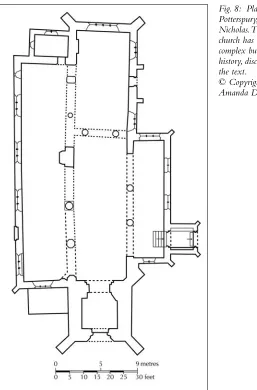
At St Nicholas, Potterspury (Figs. 8 & 9), the earliest stylistic evidence is the eastern pier of the north nave arcade, which has a round shaft and square abacus with some dog-tooth, probably of the later twelfth century (Figs. 10 & 11). This indicates the presence of a nave and north aisle by that date. It cannot be determined whether there was an earlier, unaisled, phase, though the irregular setting out of the north arcade suggests there was. There are no other stylistic features in the building earlier than the thirteenth century, all other older walls (whether twelfth-century or earlier) having been either taken away or pierced by large late-medieval arches which would have destroyed earlier windows and doorways. All that can be said with certainty is that by the end of the twelfth century Potterspury had a church with some kind of chancel and a two-bay nave with north aisle, which may have been built in one or more phases between perhaps the middle of the eleventh century and the end of the twelfth.
Both Potterspury and Lillingstone Dayrell are typical of the kind of church which would be expected in a modest manorial village. A church probably also existed in the tiny parish of St Bartholomew, Furtho (Figs. 12-14), where the only evidence for a twelfth-century origin is a re-set door head in the south wall of the chancel and the fact that the chancel is narrower than the nave, as it also is at The Assumption of the Blessed Virgin Mary, Stowe, and at St James, Akeley (demolished), the later form of which is known from nineteenth-century illustrations.18Whether
stone churches of these proportions represent the first churches at these small village sites is unclear. If they do not replace earlier structures, either of timber, or of stone as at Furnells, Raunds, in Northamptonshire, it would appear that the nascent villages of the late Anglo-Saxon period were not served by local churches. It is perhaps more likely that they are replacements or improvements
Fig. 7: Lillingstone Dayrell, St Nicholas, looking north-east to the small chancel arch, of eleventh-century character.
© Copyright P S Barnwell.
of earlier buildings, and that their present form could date from the achievement of full parish status: as was seen above,Akeley was originally dependent on Leckhampstead, and the parish of Lillingstone Dayrell was carved out of the larger territory of Lillingstone Lovell, suggesting that its church may have been subordinate to that of the mother settlement.
The earliest extant phase of the Church of the Assumption of the Virgin at Leckhampstead (Figs. 15 & 16) also seems to have been of similar form. Although the nave is now much longer, quoins above the south porch, associated with changes in masonry and a horizontal step-back in the western part of the wall, suggest that the nave shared with the other village churches the characteristic proportion of being roughly twice as long as it was wide. In addition, the fourteenth-century chancel is off-centre to the nave, suggesting that the west end of its south wall stands on
Fig. 8: Plan of Potterspury, St Nicholas.The church has a complex building history, discussed in the text.
the foundations of a twelfth-century or earlier predecessor, while the north wall was rebuilt outside the old one:19 such a sequence
would mean that the earlier chancel was probably the kind of small squarish compartment characteristic of the middle of the twelfth century at the latest.
An Age of Expansion
The two hundred years after the middle of the twelfth century saw the expansion of several of the Whittlewood churches. At Potterspury, as has been seen, either the church was built, or it was expanded by the addition of a north aisle. At Leckhampstead contemporary expansion was more radical. Perhaps in the third quarter of the twelfth century, the nave was extended to its present length. This may be related to the south doorway, which is more elaborate than anything else in the area and has a tympanum with entwined dragons (Fig. 17). The fact that the simpler north doorway is probably of the same date,20 combined with the
uniform nature of the north arcade (which consists of square chunks of wall (Fig. 18) left when the arches were knocked through), suggests that the north aisle or its predecessor was added as part of the same campaign.The tower may also have been built at that time, for the first-floor window in its west wall is flanked by shafts with capitals of late twelfth-century type and its
Fig. 9: Potterspury, St Nicholas from the west.
© Copyright English Heritage.NMR.
hoodmould, with lunettes cut in both upper and lower faces, is the same as that above the nave arcade. If this were the case, however, it would seem that the west doorway was inserted or replaced in the second quarter or middle of the thirteenth century as its mouldings have deep hollows and its shafts are lightly keeled.21
The addition of an aisle or aisles was one of the most frequent changes in the later twelfth and early-thirteenth century. It occurred on at least the north side of Lillingstone Lovell (Figs. 2 & 3) and on both sides at Whittlebury (Figs. 4 & 5), where the arcades (rebuilt at slightly different dates in the fourteenth century) were originally created c.1200 (above); at Lillingstone Dayrell, the responds of the early fourteenth-century arcades are also of thirteenth-century character (Fig. 6; the responds are just visible in Figure 7). Such early aisles, particularly that at Lillingstone Lovell, are very narrow – the latter little over 6ft (1.8 m.) wide. This is characteristic of the period, and was associated with low side walls under steep-pitched roofs.22 At
Leckhampstead, the aisle was rebuilt with taller walls and a
pitched roof in the first half of the fourteenth century (Figs. 15 & 16); it is possible that it was at the same time widened by a wall thickness, with the twelfth-century doorway re-set, because the outer wall is thinner than the Norman walls, and it was quite common for the new structure to be built outside the old one so that use of the church was disrupted as little as possible during building operations. At Whittlebury the aisles were also heightened during the first half of the fourteenth century, and provided with new, taller, arcades to let light from the enlarged windows into the nave. A similar pattern is found at Lillingstone Lovell, where the south aisle was widened (with the thirteenth-century doorway re-set) and new arcades supplied on both sides of the church; and although the detailed chronology is more difficult to understand, the development of Lillingstone Dayrell may not have been very different, since the arcades appear early fourteenth-century rather than contemporary with the capitals of their responds (above), as does the flowing tracery of the east window of the south aisle.23 At Stowe there is no evidence for
narrow aisles of the late-twelfth or early-thirteenth century: that on the north, which is of normal later-medieval proportions, was built in the mid- to late-thirteenth century; that on the south (Fig. 19) possibly as late as the middle to end of the fourteenth. Since arcades could be altered leaving no trace in the surviving fabric (particularly when plastered over), and the wider aisles were built outside older, narrow, ones, the possibility that there was an earlier generation of aisles cannot be completely dismissed at either Stowe or the south side of Potterspury (Fig. 8), where the south arcade and aisle date from around 1400 or a little later.
Aisles were not the only area of the church which saw expansion between the end of the twelfth century and the middle of the fourteenth.As already discussed, the nave of Leckhampstead was extended to the west where a new tower was built. At much the same time the present tower was erected at Whittlebury, while the early-thirteenth century saw the construction of that at Lillingstone Dayrell, and at Lillingstone Lovell the tower was either built or rebuilt. At Passenham, where the nave and chancel appear to have been built in their present form c.1230, the tower was added around seventy years later, and at Stowe (Fig. 19) the present tower dates from no earlier than 1330–40. While there is no visible evidence to suggest that it replaces anything earlier, heavy and intrusive post-medieval buttressing against its west face could open the possibility that an earlier structure had required replacement; on the other hand, it might, like Furtho, where the tower is early seventeenth-century (Figs. 12 & 13), have remained without a tower, bells perhaps hung in an open bell cote or simple timber structure on the roof.24That may also have been the case
Fig. 11: Potterspury, St Nicholas, early north arcade pier.This photograph was taken some years after Fig. 10, and the pews have been replaced by chairs, allowing the base of the pier to be seen. © Copyright P S Barnwell.
Fig. 13: Below. Furtho, St Bartholomew, from the south-east.The reset door into the chancel can be seen.
THE MEDIEVAL CHURCHES OF WHITTLEWOOD FOREST
at Potterspury, where the nave was extended to the west when the present tower was built at the end of the fourteenth or beginning of the fifteenth century (Fig. 9), probably as part of a refurbishment which saw the creation (or rebuilding) of the south aisle, and must have involved a reconstruction of the north aisle since it ran the full length of the enlarged nave.
The east ends of the churches were also subject to considerable alteration and expansion during this period.The earliest surviving example is at Lillingstone Dayrell, where the chancel was widened (to north and south) and lengthened, though whether in one or two phases is unclear (above). At Potterspury (Fig. 10) there were more certainly two stages of work in the late-thirteenth century: the chancel itself was lengthened and refurbished in about 1260, and its north wall was pierced by an arcade into a predecessor of the present north chapel thirty years later. The chancel itself was again refurbished in the first half of the fourteenth century, when all the other surviving medieval chancels apart from that at Passenham seem to have been enlarged: at Furtho rebuilding involved lengthening but not widening; at Leckhampstead it saw
Fig. 15: Plan of the church of the Assumption of the Virgin, Leckhampstead.The fourteenth-century chancel is off-centre to the nave, suggesting that the north wall of the present chancel may have been rebuilt outside an earlier wall.
lengthening and widening to the north; at Stowe lengthening and widening on both sides, as may also have been the case at Whittlebury where the nineteenth-century chancel is in a fourteenth-century style and may have re-used earlier foundations.25At Lillingstone Lovell, with its exceptionally narrow
nave, the chancel was made wider than the nave and lengthened, only to be truncated in the eighteenth or nineteenth century.26
Stagnation
In contrast to the preceding period, the two hundred years after the mid-fourteenth century saw very little significant building. At Stowe the south arcade, aisle and porch were built in the late-fourteenth century (above), a clerestory was added in the later fifteenth century and a moderately elaborate two-bay north chancel chapel early in the sixteenth; and at Potterspury, in addition to the radical transformation of the nave, aisles and tower in about 1400 (described above), the third quarter of the fifteenth century saw an unusual and complicated set of changes which involved moving the chancel arch half a bay to the east when the clerestory was constructed; later, in 1510,27 a series of bequests
indicates that the south porch was built or renewed, and perhaps in the 1530s or 1540s the north aisle was refenestrated in a campaign which may have been arrested by the Reformation since the label stops were left uncarved. Elsewhere, while Lillingstone Lovell was furnished with a clerestory, the aisled churches at Lillingstone Dayrell and Whittlebury were not, and the only other definite addition was the porch at Leckhampstead. Otherwise a rood loft was almost certainly created in all the churches, necessitating the replacement or alteration of an earlier screen, but only in Lillingstone Lovell and Potterspury did the creation of the stair require intervention in the fabric of the building.
THE MEDIEVAL CHURCHES OF WHITTLEWOOD FOREST
Discussion
After the initial construction phase, which has already been discussed, the broad overall chronological pattern of development seems to correspond well with that of settlement and population expansion between the twelfth and early- to mid-fourteenth century, and also with the contraction thereafter, marked in the churches by a lack of investment. The picture is not, however, as simple as that, for it needs to take account both of the separate evolution of devotional practice during the middle ages, and of the wealth contained within each community, which was not directly proportionate to its size.
The enlargement of chancels and provision of new towers in the thirteenth and early-fourteenth centuries has nothing to do with the expansion of population, as neither created more space for the laity. Both were connected with the development of liturgy and of the sacraments. After transubstantiation became a formal doctrine of the church in 1215, space around the altar, which had already begun to be placed at increased distance from the laity, was regularly made more elaborate, as befitted the place where Christ himself was present in the building, and larger, partly in order to enable the laity in the nave better to see the elevation of the host and partly to provide space for lights and for torch-bearers to enter the chancel to glorify Christ without blocking the view from the nave.28At the same time, increased ceremonial
surrounding the eucharist, and both baptism and burial, drove an increase in the number and size of bells which, in turn, led to the provision of new towers, replacing either earlier ones or small bell cotes.
It is partly against this background that the addition of nave aisles in the late-twelfth and early-thirteenth centuries must be
Fig. 17: Leckhampstead, Assumption of the Virgin, tympanum of south doorway with entwined dragons fighting over a small human figure.
seen. Although aisles have often been seen as providing accommodation for an expanded population, they did not provide space from which people could participate in the action of the liturgy through seeing it, particularly seeing the elevation of the host, the focus for the laity at Mass. Furthermore, aisles as narrow as that at Lillingstone Lovell (or even the present aisle at Leckhampstead) would have provided so little space that the benefit would have been slight, and there is little evidence that the churches actually needed significantly more space: at Lillingstone Dayrell, the 11 Domesday households were so spaciously treated in the eleventh-century nave that all the members of the 33 households of 1279 could just have squeezed in. At Leckhampstead, while the western extension of the nave could have supplied space for more people, the expansion occurred a hundred years before the late thirteenth-century peak of population; and at Potterspury the nave was probably not enlarged until around 1400, when the population was in decline.29
Rather than being related to the growth of population, it is more likely that the addition, and then expansion, of aisles was, like the alterations and additions to chancels and towers, driven by changes in liturgical or devotional practice. It is also important not simply to assume that the later widening of the early aisles was necessarily to provide extra space for the activity already accommodated in them, rather than being for a new function. This issue requires fuller exploration, but it is possible that the narrow aisles may have been intended to house saints’ images and their devotional objects, which became more important as lay access to the host was withdrawn, while the later, wider, aisles, were to accommodate the altars and burials required for the chantries and other forms of soul Mass once the impact of the doctrine of Purgatory (1274) was felt.30The fact the population
was expanding contemporaneously is probably coincidental rather than causative. In addition, the fact that the churches at Akeley, Furtho and Passenham were not furnished with aisles may be a reflection of their smallness and poverty, but does not mean that they failed to participate in liturgical evolution, for in the early-sixteenth century Passenham had a nave altar of St Mary31and a
resident chaplain as well as the rector’s curate.32
The lack of late-medieval or Perpendicular fabric is a sign of poverty and perhaps of the decline in population, but, while greater wealth might have led to rebuilding and improvement, it would probably not have led to further radical expansion, since there were no further doctrinal, liturgical or devotional changes which required new forms of space.The exception to the pattern in Whittlewood is Potterspury, perhaps significantly the settlement next to Watling Street, the most important long-distance route
THE MEDIEVAL CHURCHES OF WHITTLEWOOD FOREST
through the area, and the settlement with a significant industry (potting) which may have insulated it against the decline in agricultural wealth.
For the rest, the addition of clerestories and rood lofts shows that modest investment was made in the fittings required for changes in devotional fashion, particularly enhanced and affective piety towards the rood. Wills from the late-fifteenth and early-sixteenth centuries are rare, perhaps a reflection of the small number of parishioners and of a lack of wealth, and do not accurately reflect the number of small-scale bequests to lights and images or for single soul Masses, but there are hints that parishes were able to engage in the full range of devotional activities, even if in rather dated buildings. At the relatively prosperous Potterspury, there were, in addition to the high altar, altars to Our Lady, St Thomas and Jesus, and in 1526 there was a stipendiary priest as well as the vicar.33 Stowe has its early sixteenth-century
chancel chapel for soul masses; the nave piers contain evidence for the brackets to support elaborate images; and wills reveal that in addition to the high altar there were lights, and therefore images or altars, of Saints John the Baptist and Nicholas, and there is also mention of lights at the rood and sepulchre.34At Whittlebury, with
no evidence for fifteenth-century fabric, wills indicate that aisle altars to Saints Katherine and Thomas were still in use in the early-sixteenth century, as well as the high altar,35 while at Wick
Dive (on the site of the present church at Wicken), there were the high altar of St John the Baptist and also altars of Our Lady, at which there was a chantry and a fraternity, St Katherine and St Kenelm.36
Analysis of church development demonstrates that, despite its continued hold over the popular mind, the idea that churches mirror changes in settlement and population is too simple, notwithstanding the chronological coincidence with the age of
expansion, since churches evolved to address liturgical and devotional needs which changed irrespective of population levels. What may more reasonably be suggested is that church development provides a crude index of wealth in a community. None of the Whittlewood parishes was rich at any period, but there was sufficient wealth in the thirteenth and early-fourteenth century for all churches to be to some degree enlarged to accommodate elaborated liturgy and increased lay devotional activity.After the middle of the fourteenth century there were few developments in liturgy or devotion which required the expansion of the ground plan of parish churches. In prosperous parts of the country new chantry chapels might be added and aisles, towers and chancels were often renewed with larger, better, more ornate ones: they enhanced the setting of worship but did not provide for new forms of liturgy or devotion. In Whittlewood investment was made in the rood screens, clerestories, altars and images required for full participation in late-medieval worship, but in most of the parishes in the Forest there were not the means for ‘elective’ spending on opulent new works in the new Perpendicular style.
Afterword: The impact of the Reformation
At the Reformation most of the late-medieval fittings, furnishings and images were cast out, and along with them the altars and other paraphernalia for looking after souls in Purgatory. Shorn of images and the semi-living dead, and at a time when population was not rising markedly, most of the churches were larger than was needed even when fixed seating was introduced.This has left its mark in a number of ways. At Lillingstone Dayrell, where the chancel already contained monuments, including a tomb chest with brasses commemorating Paul Dayrell (d. 1491) and his wife,
Fig. 20: Lillingstone Dayrell, St Nicholas, chancel looking south-west, showing the somewhat obtrusive tomb of Paul Dayrell and his wife, erected shortly after 1571.
© Copyright P S Barnwell.
the centre of the chancel was effectively blocked shortly after 1571 with the large and elaborate tomb of another Paul Dayrell and his wife (Fig. 20). The proportions of this lavish monument render the chancel difficult to use for Communion, as it blocks access to the high altar, and it is perhaps likely that it marked the transformation of the chancel into a family chapel,37 and that a
table for the Lord’s Supper was set up west of the narrow chancel arch. Perhaps in the seventeenth century, the north aisle was taken down, probably on account of decay, and was only replaced in 1868.38 At Lillingstone Lovell, also, the chancel may have fallen
from use, since a visitation of 1530 reports it to have been ‘ruinous’39and its present severely truncated form dates from the
eighteenth or nineteenth century. At the modern village of Wicken the result was more drastic: the churches of the two parishes of Wick Dyve and Wick Hamon were only two hundred yards apart, and in 1587 the parishioners petitioned the Bishop of Peterborough that they might hold joint services alternately in the two churches;40 the result was a union of the parishes, and the
demolition of the church at Hamon.41 Practically nothing
remains, either, of the medieval church at Dyve, for the tower was replaced in the seventeenth century; and the rest was, in the years after 1753, designed by Thomas Prowse, lord of the manor, and built by Sanderson Miller in his favoured Gothick style, probably re-using the medieval foundations of the nave and aisles,42 but
with the chancel shortened.43
The picture between the Reformation and Civil War is not entirely one of decay, however, for the acts of individual patrons could have beneficial effects. The more striking example is at Passenham, where the population seems to have remained static, at about 19 households, from the early-fourteenth to the later seventeenth century.44 In 1624, the manor was bought by Sir
Robert Banastre, who had been Comptroller of the Household of James I and Court Victualler to Charles I.45He largely rebuilt the
manor house and supplied it with an enormous barn and stable block, and in 1626 refurbished the church, rebuilding the chancel, an act recorded by an inscription over its south doorway.This was clearly intended for his own use, and reflected his own Laudian sympathies: the chancel screen, later made into a west gallery, was an elaborate work with Ionic columns, while beyond lay a remarkable set of stalls with misericords, in which Gothic and classical detailing is freely mixed, below niches, perhaps once with statues, bearing the names of the apostles and evangelists (Figs. 21 & 22). Above, and carried round the east of the chancel, was a scheme of trompe l’œil paintings depicting the prophets, evangelists
Fig. 21: Passenham, St Guthlac, misericord of 1626.
and scenes from the burial of Christ. The artist is unknown, but inspiration may have come from the refurbishment of the chapel royal at Greenwich earlier in the 1620s.46
Without such patronage and refurbishment, it is likely that the church at Passenham would have decayed, and it might have succumbed to demolition during or before the nineteenth century, since already in the seventeenth century the main centre of population lay at Deanshanger, which acquired a chapel of ease in 1854. Today, although Deanshanger remains a chapel, it is the main focus for worship, and the site of the rectory.47
Banastre did not own the advowson of Passenham, but did at nearby Furtho, the manor of which he purchased in 1625.48
The village had been largely depopulated and demolished by 1524, while the road to Potterspury was blocked and enclosure completed by 1570,49
so that the church served little more than the manor household. It stood, however, beside the blocked road which now formed the drive to the manor house, and in 1620 Edward Furtho built the tower which straddles the medieval west wall, and reconstructed the south nave wall.50Here, final depopulation may, paradoxically,
have saved the church, creating circumstances in which it could be turned into an eye-catching garden feature on the way to the now very private residence of the lords of the manor.51
Acknowledgments
I have benefited greatly from the work of former investigators of the churches, even where I do not agree with their conclusions, and particularly from that of Hugh Richmond whose unpublished accounts of the Northamptonshire churches are available from the National Monuments Record in Swindon. I am also grateful to those with whom I have visited and discussed the
Fig. 22: Passenham, St Guthlac, south side of chancel with stalls and paintings of 1626.
© Copyright P S Barnwell.
churches, particularly Sarah Brown, Christopher Dyer, Richard Jones, Mark Page and Paul Woodfield. All the drawings have kindly been adapted from originals of varied quality by Amanda Daw; Fig. 1 is freely based upon R. Jones and M. Page, Medieval
Villages in an English Landscape: Beginnings and Ends (Macclesfield,
2006), 84, with the kind permission of Richard Jones. I am grateful to English Heritage for permission to reproduce Figs. 9, 10, 13 and 14.
Notes
1 The principal funding of the project,‘Medieval Settlements and Landscapes in the Whittlewood Area’, was provided by the Arts and Humanities Research Council between 2000 and 2005, supplemented by the grants and assistance of a large number of other bodies.The project was directed by Professor Christopher Dyer at Leicester University, assisted by Dr Mark Gardiner of The Queen’s University, Belfast, and Professor Stephen Rippon of Exeter University, and the research was principally conducted by Dr Richard Jones and Dr Mark Page, both of whom were based in Leicester.
2 The study of the churches was carried out by the present author, then of English Heritage, who also supervised an investigation funded by English Heritage of the vernacular houses of the area.The initial notes created by the investigation of the churches, ‘The Whittlewood Project: Notes on the Medieval Churches’, are deposited in the National Monuments Record. In so far as they consist of previously unpublished material, they are also available at http://ads.ahds.ac.uk/ catalogue/archive/whittlewood_ahrb_2006/.
3 R. Jones and M. Page, Medieval Villages in an English Landscape: Beginnings and Ends (Macclesfied, 2006), in which can be found full details of the project, its main results, and interim publications. The research material is available at the website given in n. 2 above.
4 For Buckinghamshire the accounts are in Royal Commission on Historic Monuments (England), Inventory of Historic Monuments in Buckinghamshire, 2 vols (London, 1912–13) vol. 2 (hereafter, RCHM, Buckinghamshire); Victoria History
of the Counties of England: Buckinghamshire, 4 vols (London, 1905–28), vol. 4 (ed.
W. Page) (hereafter, VCH, Buckinghamshire); N. Pevsner and E. Williamson, The
Buildings of England: Buckinghamshire, 2nd edn (London, 1994). For
Northamptonshire, the accounts are in N. Pevsner and B. Cherry, The Buildings of
England: Northamptonshire, 2nd edn (Harmondsworth, 1973), and in unpublished
notes for each church in the National Monuments Record (which also form part of the notes mentioned in n. 2).
5 This section is almost entirely derived from Jones and Page, Medieval Villages, to which reference should be made for more detail and discussion.
6 See Athelstan’s sixth law-code, ‘The Ordinance of the Bishops and Reeves of the London District’, cap. 12.1, translated in D.Whitelock, English Historical Documents
1: c.500–1042 (London, 1955), 389.
7 Victoria History of the Counties of England: Northamptonshire, 6 vols to date (London, 1902–), vol. 5 (ed. P. Riden) (hereafter,VCH, Northamptonshire), 234.
8 Anglo-Saxon Chronicle, MS A, s.a. 917 (recte 921), in The Anglo-Saxon Chronicle:
A Revised Translation, ed. by D. Whitelock, D.C. Douglas and S.I. Tucker, 2nd edn
(London, 1965), 66.
9 Newington Longeville Charters, ed. by H.E. Salter, Oxfordshire Record Society 3 (Oxford, 1931), no. 16.
10 VCH, Northamptonshire, 127. Stowe is the other settlement which is now abandoned, its church standing in curious isolation near the house, but that was a product of later enclosure, in 1637, when the village was bodily moved to Dadford. See Jones and Page, Medieval Villages, 215.
11 RCHM, Buckinghamshire, 170.
13 See the discussion in P.S. Barnwell,‘The laity, the clergy and the Divine Presence: the use of space in smaller churches of the eleventh and twelfth centuries’, Journal
of the British Archaeological Association, 157 (2004), 41–60.
14 F. Arnold-Foster, Studies in Church Dedications or England’s Patron Saints, 3 vols (London, 1899), vol. 2, 95–99; vol. 3, 365 with 353.
15 This possibility is discussed in relation to other Northamptonshire evidence in P.S. Barnwell, ‘Churches built for priests? The evolution of parish churches in Northamptonshire from the Gregorian Reform to the Fourth Lateran Council’,
Ecclesiology Today, 32 (2004), 8–15.
16 RCHM, Buckinghamshire, 167 and 168–69, is mistaken in thinking the tower arch is also eleventh-century.
17 RCHM, Buckinghamshire, 167 and 168 suggested two phases; the near-contemporary account in VCH, Buckinghamshire, 190, and the relatively recent one in Pevsner and Williamson, Buildings of England, 431, disagree. Those who participated in the Ecclesiological Society’s 2007 Focus Day were divided in their opinions.
18 The illustrations are reproduced in Akeley History Group, Akeley: Past Times (Akeley, 2001), 98, 103.The impression they create is supported by the very brief description in B.Willis, The History and Antiquities of the Town, Hundred and Deanery
of Buckingham (London, 1755), 129–30.
19 One-sided expansion is not common, but has been recognised at several churches in Northamptonshire, including All Saints, Pytchley. The phenomenon will be discussed in a forthcoming monograph on the medieval churches of Northamptonshire.
20 Pevsner and Williamson, Buildings of England, 429.
21 An alternative, suggested by RCHM, Buckinghamshire, 166, is that the tower is of the thirteenth century and that the window has been re-set.There is little sign of that, however, and the evidence of the hoodmould suggests otherwise. I am grateful to Sarah Brown for advice concerning this point.
22 P. Draper, The Formation of English Gothic:Architecture and Identity (New Haven and London, 2006), 175–76.
23 Nothing can be determined from the north aisle, since it was demolished in the eighteenth century and not replaced until the nineteenth. See Willis, History, 218; VCH, Buckinghamshire, 190.
24 An open bell cote remained at Akeley until the church was demolished in the nineteenth century and was shown in the illustrations mentioned in n. 18. For a simple enclosed structure, see the illustrated account of Glapthorn in RCHM, An
Inventory of Historical Monuments in the County of Northampton, VI: Architectural Monuments in North Northamptonshire (London, 1984), 77.
25 There were several phases of work in the nineteenth century.The chancel, which adheres to ecclesiological principles, was probably added in the 1870s: Northamptonshire Record Office [NRO], ML 595 Visitation Book 1872, and ML 598 Visitation Book 1878.
26 RCHM, Buckinghamshire, 170.
27 R.M. Serjeantson and H.I. Longden, ‘The parish churches and Religious Houses of Northamptonshire: their dedications, altars, images and lights’, Archaeological
Journal, 70 (1913), 394.
28 Cf. Barnwell, ‘The laity’, 56–57.
29 As implied by figures given in VCH, Northamptonshire, 290.
30 This will be discussed in my forthcoming monograph on the medieval churches of Northamptonshire.
31 Serjeantson and Longden,‘Parish churches’, 387; there is a squint at the south-east side of the nave which presumably stood behind the altar.
32 A Subsidy Collected in the Diocese of Lincoln in 1526, ed. by H. Salter, Oxford Historical Society 63 (London, 1909), 161.
33 Serjeantson and Longden, ‘Parish churches’, 393–94; Salter, Subsidy, 161, cf. Valor
Ecclesiasticus tempore Henrici VIII auctoritate regia instituta, ed. by J. Caley, 6 vols
(London, 1810–34), vol. 4, 239.
34 Buckinghamshire Record Office, DAWe vol. 2, f. 13v.–16r. (will of Richard Halley, 1524); vol. 3, f. 204r. (will of Joan Hillsden, 1539).
35 Serjeantson and Longden, ‘Parish churches’, 433.
36 Serjeantson and Longden, ‘Parish churches’, 439–41.
37 Monuments to the Dayrell family continued to be inserted into the chancel until the end of the seventeenth century. See RCHM, Buckinghamshire, 169.
38 Pevsner and Williamson, Buildings of England, 431.
39 Visitations in the Diocese of Lincoln, 1517–31, Lincoln Record Society 33, 35 and 37, 3 vols (1940–47), vol. 2, 32: it was at least not as bad as the rectory, which was reported in 1517–20 as in a similar state (vol. 1, 122–23) but by 1530 was ‘enormiter
dilapidata et quasi ad terram collapsa’ (‘greatly dilapidated and almost fallen to the
ground’).
40 Transcribed in Oxford, Bodleian MS Top Northants e.3, 146.
41 J. Bridges, The History and Antiquities of Northamptonshire, 2 vols (London, Oxford and Northampton, 1791), vol. 1, 330
42 H. Colvin, A Biographical Dictionary of British Architects 1600–1840, 3rd edn (New Haven and London, 1995), 787.
43 NRO, Wicken 362P/29.The chancel was lengthened in 1886 (NRO Faculties ML 1121).
44 VCH, Northamptonshire, 208. 45 VCH, Northamptonshire, 215.
46. K. Fincham and N. Tyacke, Altars Restored: The Changing Face of English Religious
Worship, 1547–c.1700 (Oxford, 2007), 259–60.
47 VCH, Northamptonshire, 236, 237. 48 VCH, Northamptonshire, 132. 49 VCH, Northamptonshire, 135. 50 Bridges, History, 297–98.
THE CHURCH OF ENGLAND has produced some unique characters, none more so than the squarson, or squire-parson, who was in his heyday during the reign of Queen Victoria.
Although the concept of the squire (or largest landowner in the village) doubling up as the parson was not a new one, it is perhaps significant that the term squarson did not come into general use until the 1850s, according to The Oxford English
Dictionary. The literary critic Raymond Mortimer thought that
the word had been invented, half in jest, by the clerical wit Sydney Smith or by that robust Victorian Bishop, Samuel Wilberforce.1
In any event squarsons, even if not so called, had been around since the Middle Ages. For example, in the fourteenth century, at Harpley in Norfolk, the chief landowner, Lord of the Manor, patron and incumbent was John de Gourney.2
Two hundred years later the dissolution of the monasteries by Henry VIII paved the way for a significant shift in land ownership. The Court of Augmentations sold large tracts of church lands to the laity, together with advowsons, giving the right to appoint a clergyman to a living as a rector or vicar.3As a result the new
squirearchy often became closely involved with church patronage and not infrequently nominated a member of their family to a vacancy.
The eighteenth century
By the middle of the eighteenth century the position in society of a minister of the Established Church could compare very favourably with the law or the armed services as a respectable profession. The legal profession was more lucrative and the navy or army, with their gorgeous uniforms, cut more of a dash, but the English country parson, charged with the saving of his parishioners’ souls, was second only to the squire in the local hierarchy. A fortunate Georgian squarson ruled supreme, combining as he did both rôles with nobody to gainsay him, enjoying ample leisure and a very comfortable way of life into the bargain. Although not a squarson himself, the famous Parson Woodforde, whose published diaries are so revealing, shows the lifestyle and outlook of a well-to-do country clergyman of the time.4
Some eighteenth-century squarsons were of an intellectual or antiquarian bent. Such a man was the Revd Sir John Cullum,
Timothy Cockerill is a retired solicitor and magistrate living near Cambridge.
The English squarson
(
or
The black squires of England)
6th Baronet, squire, Lord of the Manor, patron and Rector of Hawstead, near Bury St Edmunds in Suffolk (Fig. 1).5 Born in
1733 and descended from a family of landed gentry, he was a noted scientist, botanist and historian. He was a Fellow both of the Royal Society and the Society of Antiquaries of London, and was friendly with many of the leading figures of the day. Although he took his local duties of squire and parson seriously he still found time to write and publish a monumental history of the parishes of Hawstead and Hardwick, which remains the standard work today. Despite his many other interests and achievements he probably saw himself essentially as a local leader, lived amongst his parishioners and tenants and was both liked and admired by them. He died in 1785.
Quite a different and far less pleasant eighteenth-century squarson was the Revd Sir Henry Bate-Dudley (1745–1824) of Bradwell Lodge, Bradwell Juxta-Mare in Essex (Fig. 2).6 During
his eccentric and sometimes notorious career he played many parts including founding and editing The Morning Post, Master of Foxhounds and pugilist. He was the friend of David Garrick, William Hogarth and Mrs Siddons. Another friend, Thomas Gainsborough, painted him.
Bate-Dudley seems to have been equally at home in the London saloons or riding out with his hounds. One famous chase
ended up with the fox being killed on the roof of Creeksea Church, the Master having shinned up a drainpipe to witness the event. However he also did useful work at Bradwell, restoring both the church and his estate cottages and reclaiming 250 acres of marshland at a total cost to himself of almost £30,000.
Bate-Dudley’s clerical career can only be described as bumpy. In 1773 the newly ordained curate was walking with an actress in Vauxhall Gardens in London when she was insulted by a group of swells. A boxing match in lieu of a duel was arranged between Bate-Dudley and the swell’s nominee, who turned out to be a noted prize fighter. Nothing deterred, our parson entered the fray with enthusiasm and beat his opponent, thereafter often being referred to as ‘The Fighting Parson’. In 1782 he purchased the advowson of Bradwell for £1,500 but when the incumbent died in 1797 and Bate-Dudley appointed himself, the Bishop of London refused to institute him on the grounds of simony. Shortly afterwards he was sued for libel by the Duke of Richmond and sentenced to twelve months imprisonment in the King’s Bench prison. On his release he spent ten years of virtual banishment in Ireland before being rescued by Bishop Sparke of
Fig. 2: The Reverend Sir Henry Bate Dudley, Bart., Canon of Ely
Ely, who made him a Canon of Ely Cathedral. This strange appointment apparently came about due to pressure from Bate-Dudley’s patron, the Prince Regent, from whom he also obtained a totally unmerited baronetcy ‘in repayment of a long standing obligation’. At the time of the Littleport Riots near Ely in 1816 the Revd Canon Sir Henry Bate-Dudley, Bt., J.P., summoned the Militia from Bury St. Edmunds, rode at their head and, after reading the Riot Act, persuaded the rioters to surrender. Perhaps because of this he was given the job of preaching in Ely Cathedral before the Assize Judges sent to punish the offenders. His text, taken from the Book of Timothy, urged obedience to God’s laws and offered thanks ‘for deliverance from the terrors of devastation amidst which even this venerable temple was profanely marked to fall’. At the subsequent Assizes several of the rioters were condemned to death and others transported to Australia for life.
When Bate-Dudley died in 1824 his Bradwell parishioners and tenants must have had mixed feelings about their Fighting Parson, who was still as pugnacious as ever.
The nineteenth century
By the middle of the nineteenth century the power and influence of the squarson was at its zenith. The Anglican clergy held a respected place in the social hierarchy. The High Church or Oxford Movement and the moral tone of the Royal Family put religion centre stage although Darwin’s theory of evolution, the extension of the franchise, the great Chartist Rally in 1848 and the early murmurings of the trade union movement would have been seen as threats by the old time squarsons, who were for the most part all for the status quo.
The Victorian squarson was a powerful figure in his own area since he not only owned most of the land and employed a large section of the village on it, and was incumbent of the parish church, but was in addition often a magistrate and so the local upholder of the law.
his father’s opposition he insisted on taking Holy Orders and in due course succeeded his father as the squire, having appointed himself as the Rector.
A bird’s eye view of the landed Anglican clergy - many of whom were not, of course, squarsons - can be gleaned from The
Return of the Owners of Land 1873. Sometimes known as the
modern Doomsday Book, it listed all the landowners in Great Britain holding one acre or more. The landowners are listed alphabetically by county and in England there were 260 clergymen owning 1,000 acres, of which 15 held more than 5,000 acres (see appendix 2). On a random sample analysis of 100 of these landed parsons well over half of them were also squires or titled with entries in Burke’s Peerage or Burke’s Landed Gentry. However, of the 15 clergymen owning in excess of 5,000 acres only four were strictly landed clergy, the remainder being primarily squires who, although ordained, had no cure of souls.
The distribution of the landed clergy in the early 1870s is patchy and rather puzzling. It seems, however, that the size of the county and especially its whereabouts tended to govern the number of landed clergy living within it. For example, larger counties such as Yorkshire (the three Ridings), Shropshire and Norfolk had an above average number of county families and this is reflected in the number of landed gentry, most of whom were closely related to them. All three counties could muster a total of 45 landed clergy, whereas remote and poor counties like Cumberland and Westmorland could not field a single one.
The world of the squarson was closely linked to church patronage and the nineteenth century saw an increase in the sale of advowsons. The Clergy List 1880 shows that about 10% of private, as opposed to institutional, patrons were clergymen.
The personal column of The Times newspaper was one way of advertising the sale of an advowson, which could be bought and sold as a commercial transaction. Often the sporting and social potential of the district was stressed rather than the job itself. Sir W.S. Gilbert amusingly satirized such a situation in his Bab Ballads (1869). He introduces us to a worldly clergyman with the significant name of the Revd Simon Magus, who was offered a ‘rich advowson, highly prized’ by an unscrupulous agent.8For full
24 verses the wily agent tempts Magus, spelling out the advantages of the cure of Otium-cum-Digge, which was said to possess ‘the snuggest vicarage on earth’, no sort of clerical duties to speak of and £1,500 p.a. The parson, on complaining that there appeared to be no fashionable society in the area, ‘I mean, of course, no sinners there, whose souls will be my special care’, was hastily reassured that no less than four noblemen had their seats nearby, which immediately clinched the deal!
Squarson dynasties
Not only were there individual squarsons but there were also a number of squarson dynasties covering several generations, who were extremely influential over period of a century or more.
A fine example of a Cheshire dynasty of squarsons was provided by the Armitstead family.9 It all began with the Revd
John Armitstead (1764–1814) who came from a Yorkshire yeoman family and was not a university graduate. However, he was astute enough to marry into a local landed gentry family, whereupon he petitioned the College of Arms for a coat of arms for his own family. He managed to obtain such a grant in the name of his grandfather, thus, in his own eyes at least, making him a third generation gentleman. Later he purchased the advowson of Sandbach in Cheshire and the Cranage Hall estate of 1,600 acres, but died shortly afterward.
His son, the Revd John Armitstead II, was born in 1801, went to Oxford University and in 1828 was presented to the living of Sandbach by his father’s executors. Here he laboured for the next forty years, building three churches at his own expense, writing a pamphlet on Sabbath-day cheese making (he was against it) and, as a keen cricketer, once postponing the celebration of Ascension Day by a week because it clashed with an important cricket match.
His son, the third generation, was Canon John Richard Armitstead (1829–1919), Vicar of the family living of Sandbach from 1865 until 1919, who was also a Canon of Chester Cathedral, an Alderman on Cheshire County Council and a keen member of the Cheshire Hunt, until an unfortunate accident at a meet left him lame for life (Fig. 3). A low churchman he was always robed in a black gown by his butler before entering the pulpit. In 1877 he succeeded his cousin to the Cranage Hall estate.
The fourth generation of this remarkable squarson dynasty was Archdeacon John Hornby Armitstead (1868–1941). Launcelot Fleming, later Bishop of Norwich, spent a summer vacation in his parish between the Wars and was greatly impressed by him. He described Armitstead as one of the best of the old squarsons, an autocrat who ran the local town despite its Mayor, and a man whose whole life was selflessly devoted to the welfare of his parishioners, by whom he was greatly loved. He restored Sandbach church, was a Canon of Chester Cathedral like his father, was prominent on the Cheshire Education Committee and was later Archdeacon of Macclesfield. In 1928 he presented Sandbach church with electric light to mark the centenary of the Armitstead’s tenure of the living. He died during the Second World War.
Another lengthy squarson dynasty was provided by the Harrison family of Bugbrooke, near Northampton.10 In 1785,
Henry Bagshaw Harrison, a Daventry attorney, purchased the advowson and four years later presented his son to the living. By judicious marriages and thrift the Harrisons gradually established themselves as the leading landowners as well as the incumbents of Bugbrooke, building a substantial mansion (later known as Bugbrooke Hall) in a parkland setting in the early nineteenth century. By 1873 they owned 1,800 acres, were Lords of the Manor and patrons of Bugbrooke and on friendly terms with the leading county families, such as the Cartwrights of Aynho and the Drydens of Canons Ashby (Fig. 4). A nice story is told about one of the Harrison squarsons, probably the Revd James Harwood Harrison (1799–1890) who, as an elderly and infirm magistrate, dispensed justice through the open window of his library. On being confronted by a hapless local criminal he would shout the sentence ‘You will go to the House of Correction for 14 days’ so loudly that he could be heard from a great distance away.
Fig. 4:The Harrison family of Bugbrooke, Northants
The Harrisons continued to rule Bugbrooke as its squires and rectors until 1920, continued as its incumbents until 1974 and still retain the advowson and Lordship of the Manor.
The Cotswolds, always a much favoured area in which to live, have also provided their fair share of squarsons. One of the best documented, thanks to the skilful editing of his diaries, is the Revd Francis Edward Witts (1783–1854) of Upper Slaughter near Stow-on-the-Wold.11 He was descended from rich Oxfordshire
linen drapers and mercers who had purchased land and been accepted into the ranks of the landed gentry. Educated at Wadham College, Oxford he was appointed Rector of Upper Slaughter in 1808 and subsequently became the Lord of the Manor and owner of the advowson (Fig. 5). In 1814 he was appointed Vicar of Stanway by the Earl of Wemyss of Stanway House. As if this was not enough Witts also managed to obtain the incumbency of East Lulworth, Dorset, but was always non-resident there.
Apart from his clerical career Francis Witts was a Justice of the Peace, a Deputy Lieutenant for the county and was for many years prominent at Quarter Sessions. A high Tory of the old school, he was severe in his outlook towards the lower classes, something of a snob and a great diner out. He was also quite censorious of his clerical brethren and did not approve of them going out hunting. He lived in some style at Upper Slaughter Rectory (a large house now known as the Lords of the Manor Country House Hotel). Witts founded a three generation dynasty of Cotswold squarsons, his grandson reigning until 1913.
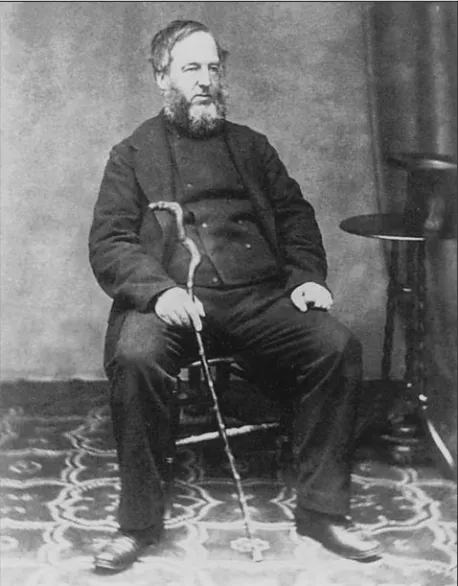
One further example of a squarson dynasty can be found in Berkshire. The Stevens family of Bradfield had purchased the advowson in 1751 and by 1800 had accumulated a landed estate of 4,300 acres. The Revd Thomas Stevens, a third generation squarson, was born in 1809 and educated at Oriel College, Oxford where he was a contemporary of John Keble and other early Tractarians (Fig. 6).12However, although Stevens always liked
what he called ‘a good musical service’ he was never a High Churchman himself, spending much of his undergraduate days studying natural history. In the vacations his practical bent showed itself by taking instruction from the village blacksmith.
As the second son, Thomas Stevens was probably always destined to be a clergyman but in 1830 his elder brother died and he found himself the heir to the family estate at Bradfield.To start with he helped his father run the estate but after the Poor Law Act 1835 he threw his boundless energies into becoming the rather over-vigorous Chairman of the Bradfield Union.As a result it became one of the most notorious Unions in England. Despite this, or perhaps in consequence of it, he was appointed an Assistant Poor Law Commissioner for England, establishing Unions in
Derbyshire, Leicestershire and parts of Staffordshire. He also became a close friend of the up-and-coming architect George Gilbert Scott, who was then designing workhouses.
Stevens was ordained in 1839 and, on his father’s death in 1842, he presented himself to the Bradfield living, worth £1,200 p.a. and one of the richest in Berkshire. Now he was both the squire and the parson and with enormous enthusiasm he threw himself into numerous local tasks and projects. He spent about £30,000 of his own money on restoring Bradfield Church and as a progressive landowner he was an early pioneer of steam ploughing. His greatest and most lasting achievement, however, was his founding of Bradfield College in 1850. Largely his own architect he erected a series of piecemeal buildings on a thirteen acre site around the old manor house. His new public school, the object of which was to instil religious learning into his young pupils, had the support of several prominent men including W. E. Gladstone.
Thomas Stevens, although full of energy and ideas, was also a notable eccentric. Whilst happy to spend large sums of his own money on Bradfield Church, estate improvements and his new college, his family did not fare quite so well. Their Rectory had become dingy and dilapidated and by the 1880s the dining room had not been redecorated for 40 years. Worst still, the passages
Fig. 6: The Reverend Thomas Stevens