Wilson et al. World Journal of Engineering Research and Technology
A DOCUMENT INTERCHANGE FRAMEWORK FOR TERTIARY
INSTITUTIONS
Wilson Nwankwo*1, Olanrewaju Babatunde2 and Olayinka Tosin 1
Ph. D., MCPN, PMP, RMP Department of Computer Science & Information Technology
Wellspring University Benin-City, Nigeria. 2
M. Sc, Department of Computer science & Information Technology Wellspring University
Benin-City, Nigeria.
3
M. Sc. Department of Computer science & Information Technology Wellspring University
Benin-City, Nigeria.
Article Received on 28/06/2017 Article Revised on 18/07/2017 Article Accepted on 08/08/2017
ABSTRACT
In this paper we evolve a document interchange framework for tertiary
institutions in Nigeria. This study follows an object-based qualitative
approach. We examined the various processes and formats adopted by
Nigeria’s Tertiary Institutions when verifying and validating academic
documents submitted to them by candidates enrolled in various
academic programmes and for which such verification or validation
lies with another tertiary institution. Analysis of the state of affairs
revealed several problems associated with the process such as: delays, high cost of
verification, student’s unlimited involvement in the process, etc. To eliminate these problems,
we proposed a uniform document interchange framework which could be adopted by the
appropriate regulatory authorities (Federal Ministry of Education, National Universities
Commission, National Board for Technical Education, National Council for Colleges of
Education). With the proposed FRAMEWORK, each Institution could implement its
Academic Information System in such a way that it will talk to or exchange requests and
verification information directly by way of controlled handshaking with a system owned by
another Institution through a coordinating message exchange service interface over a public
network such as the Internet.
World Journal of Engineering Research and Technology
WJERT
www.wjert.org
SJIF Impact Factor: 4.326*Corresponding Author
Wilson Nwankwo
Ph. D., MCPN, PMP, RMP
Department of Computer
Science & Information
Technology Wellspring
University Benin-City,
KEYWORDS: Document exchange, Interchange framework, XML, Academic data exchange, Document model
INTRODUCTION
Documents are central to the running of every organization whether or not profit-based
especially tertiary educational institutions where many vital decisions may be taken by a
party based on the presentation of the requisite document(s) by another party. What
constitutes a document is usually a matter of specification or the requesting party (authority).
These documents may come in different forms but must possess the very characteristics of a
document. The term document may be applied to any discrete representation of meaning, but
usually refers to something physical like one or more printed pages, or to a ―virtual‖
document in electronic (digital) format. A document is the main information medium in the
office and a key aid in the integration of office functions (Ananda, 1988). A document may
contain a structured amount of data that can be exchanged between the originator and the
recipient. A document consists of components, that is, the document profile, generic
structures (logical and layout object classes), specific structures (logical and layout objects),
styles (layout and presentation styles) and content portions.
Documents are sometimes classified as secret, private or public. They may also be described
as a draft or proof. When a document is copied, the source is called the original. There are
accepted standards for specific applications in various fields, such as:
Academia: thesis, dissertation, paper, journal
Business and accounting: invoice, quote, RFP, proposal, contract
Law and politics: summons, certificate, license, gazette
Government and industry: white paper
Media and marketing: brief, mock-up, script.
A document is, in some respects, a product according to the STEP definition (Cutting-Decelle
& Michel, 2003). It is a transitional and changing object defined within a precise stage of the
Project Life Cycle. In general, a document is related to other elaborated documents of the
Project Documentary Database. A Document has one or many authors. It is described by
general attributes such as a Code, an Index, a Designation, a date of creation and its
Author(s). A list of updated versions also keeps a record of any amendments made to the
Document Interchange
Interchange of documents is an essential part of corporate communication. Communication
involves the exchange of data, information or knowledge. Communication may be direct or
indirect communication (Gunther Krönert, 1990). Direct communication may include
discussions which allow a spatial distance between the parties but not a temporal one while
indirect communication allows both spatial and temporal distances. In theoretical
interpretation indirect communication may take the form of document exchange.
In many situations, documents are the main source for the interaction between personnel
users in this administrative system. A large amount of various kinds of forms and documents
need to be prepared as paper backup on the shelf in a real educational administration
environment (Tao and Mao, 2008).
However, exchanging information with another party especially in paper-based format is
susceptible to errors, easy distortion, and even time consuming. A typical example is where
some vital documents sent from one party to another are lost in transit. This could mean
substantial losses to the business of the affected party, and where such information is so
sensitive and highly confidential; it may pose serious security risks when it gets into the
hands of the wrong person.
In order to boost efficiency and simplify the workflow in educational administration,
electronic data exchange has shown enormous potentials in the last decade. Due to the
advancement in the direction of electronic document exchange, standards have been
developed over the years. For instance, the document interchange between open systems has
been standardized by office document architecture (ODA) and office document interchange
format (ODIF) (Gunther, 1990).
Data Interchange Principles
A data interchange framework may be designed based on the following principles and
architectures (Andreica et al., 2014)
1. Agent based system development, which is used for the communication between the
agents within the multi-agent system, in the form of FIPA-ACL (FIPA web) messages.
2. Agent-oriented methodologies such as Gaia (Wooldridge et al, 2000) used for MAS
3. Ontologies are used for achieving semantic interoperability in the multi-agent educational
system. They are powerful tools for sharing knowledge sources in a scalable, adaptable
and extensible manner and for reaching semantic interoperability among heterogeneous,
distributed systems.
4. Multi-agent architecture is used for designing the data exchange model proposal in order
to benefit from the advantages that agent based technology offers: decentralization,
extensibility, robustness, maintainability, flexibility (Weiss, 1999).
5. The knowledge layer is based on the Conceptual Knowledge Processing paradigm, which
makes use of concept lattices, that is, knowledge maps displaying concepts and their
hierarchies, with a clear semantic and a very high expressivity. They are based on Formal
Concept Analysis (Ganter et al, 2005) and the mathematical theory of concepts and their
hierarchies are widely accepted standard of knowledge processing and representation.
6. Open Internet of Things: the ―Utility/Application Plane‖ and ―Virtualized Plane‖ layers
provide a flexible framework for information communication and exchange including
cases of cloud hosted data (OpenIoT, 2013).
Office Document Architecture (ODA) Standard
The ODA standard describes an abstract view of an office document and a document
processing model as well as an interchange format of a document. The ODA standard defines
three kinds of document forms: a processable form with logical structures created after an
editing process; a formatted form with layout structures produced by a formatted process; and
formatted processable form with both logical and layout structures also produced by a
formatted process. An imaging process takes a formatted or formatted processable form and
produces a final document. ODA can specify the form of an encoded octet stream called the
Office Document Interchange Format (ODIF). Security features of ODA include
confidentiality, integrity, authenticity and non-repudiation of origin. A model is developed
which describes how the documents are structured. The standards refer to the model as ODA
while ODIF defines the coding for documents to be interchanged electronically, which can be
derived from the model developed. Both ODA and ODIF are standards under the ISO/IEC
8613-1:1994 (ISO, 2006).
Development of the ODA started in late 1989 and has reviewed up to 2006, and though
useful, however, it has been superseded by other technologies such as: Extended Mark-up
XML, etc. We shall restrict our discussion to XML and XSL as many other standards such as
Open document and Office open XL are based on XML and XSL.
Extended Mark-up Language (XML)
XML is the most popularly used format or language for data exchange and integration
between enterprise systems, web applications or services within organizations, and
accordingly, integration of XML data has become an important research problem.
XML’s development started with a group codenamed ―SGML Editorial Review Board‖ that
later became XML Working Group under the auspices of the World Wide Web Consortium
(W3C) in 1996. According to W3C, the design goals of XML as a specification are that.
It shall be straightforwardly usable over the Internet
It shall support a wide variety of applications.
It shall be compatible with SGML.
It shall be easy to write programs which process XML documents.
The number of optional features in XML is to be kept to the absolute minimum, ideally
zero.
XML documents should be human-legible and reasonably clear.
The XML design should be simple and concise to prepare.
Terseness in XML mark-up shall be of minimal importance.
As the technology continues to advance, studies have been undertaken to explore other areas
of application. Abiteboul et al.(2000) and Bourret (2000) both agreed that XML definitions
can be used to define databases and relevant algorithms. XML technology as the emerging
standard for exchanging and presentation of data over the Internet has become an important
business initiative in the 21st century (Opara & Srivastava, 2003). XML is important for achieving greater efficiencies and improving organization’s information exchange and
processing undertakings. Moreover, XML is important as a competitive technological tool in
global e-business. XML deployment strategies are expected to continue to grow in
complexity as e-transaction processing in the banking-financial services industry leans on IT
to ensure compliance and maintain an above average returns on investments (Dodds, 2000).
Integrating XML-based data systems
Data integration in XML involves reconciliation at different levels (Le et al, 2006). These
the same entity must be reconciled whereas at the instance level, more work is done to
ascertain whether or not the different objects from different sources represent the same
real-world object. XML is a key technology for enterprise system integration strategy that enables
integration of enterprise IT systems and sharing of business processes standards as it can be
implemented across the entire enterprise. XML implementation will lead to cost savings,
interoperability and new opportunities for businesses (Opara and Srivastava, 2003).
Extensible Stylesheet Language (XSL)
XSL is often regarded as a family of languages that are used to transform and render XML
documents. Initially developed by the XSL Working Group in W3C under a common name
XSL, the specification has three parts
XSL Transformation (XSLT) - an XML language used to transform XML documents;
XSL Formatting Objects (XSL-FO) - an XML language used to specify visual formatting
of an XML document;
XML Path Language (XPath) – this is a non-XML language associated with XSLT. It is
used for addressing specific parts of an XML document.
Accordingly, XSL may be used to represent: any of the species specified above; namespace
prefix for the XSLT namespace; and as suffix in file names of files containing XSLT
stylesheet modules. XSL is a widely used technology in document-oriented systems.
Other models and quai-standards
Aside XML and its derivatives, there are some other standards or quasi-standards that are
worthy of note. The Learning Objects Model (LOM) and the SCORM standard have
improved in various directions: personalized adaptive learning frameworks based on user
profiles (Arroyo et al, 2006); thus enhancing universal interoperability layer for educational
networks with Simple Query Interface (SQI). SCORM is an acronym for ―Sharable Content
Object Reference Model‖. ―Sharable Content Object‖ implies that SCORM is all about
creating material that can be shared across different systems. SCORM defines how to create
―sharable content objects‖ or ―SCOs‖ that can be reused in different systems and contexts. The ―Reference Model‖ reflects the fact that SCORM isn’t actually a standard but a reference
to existing standards that tells developers how to properly apply them.
The Systems Interoperability Framework (SIF) Association has also achieved relevant
Among major drivers of messaging standards are: Organization for the Advancement of
Structured Information Standards (OASIS), Internet engineering task force (IETF) that
developed the Application statement 2 (AS2) specifications, RosettaNet, etc.
OASIS is an international open standards consortium known for their popular specifications:
a. Service Component Architecture (SCA): a set of specifications that describe a model for building applications and systems using a Service-Oriented Architecture (SOA).
―SCA extends and complements prior approaches to implementing services, and SCA
builds on open standards such as Web services. SCA is based on the idea that business
function is provided as a series of services, which are assembled together to create
solutions that serve a particular business need. These composite applications can contain
both new services created specifically for the application and also business function from
existing systems and applications, reused as part of the composition. SCA provides a
model both for the composition of services and for the creation of service components,
including the reuse of existing application function within SCA compositions. SCA aims
to encompass a wide range of technologies for service components and for the access
methods which are used to connect them‖ (OASIS, 2015).
b. Service Data Objects (SDO): This is designed to simplify the way in which SOA applications handle data. With SDO, programmers can uniformly access and manipulate
data from heterogeneous data sources, including web services, relational databases, XML
data sources, enterprise information systems, etc.
Electronic Data Interchange (EDI)
Electronic Data Interchange (EDI) has remained an emerging concept over the last two
decades with evolving complexity in secure data delivery and data integrity. EDI is a
computer-to-computer exchange of documents in a standard electronic format. Simply put, It
is a step away from the conventional paper-based exchange of documents involving the
substitution of the conventional way of information sharing whereby one party sends
information directly or indirectly to another, with an electronic sharing medium. However,
EDI must be distinguished from other electronic means such as email, social media
platforms, workgroups, etc. Unlike many electronic information exchange platforms or
systems, EDI involves a more structured exchange between two or more electronic devices
and applications. The ―structure‖ in this aspect has to do with an agreed standard and format
there to be a successful handshaking. The merits of EDI include reduction in document
processing cost, increased processing speed, reduction in errors, low resource consumption,
enhanced relationships among the users to mention but a few. According to Adams et
al.(2002) , the EDI was proposed for standardizing business information exchange and has
various formats or species of it in use. The EDI uses different standards such as: ANSI X.12,
XML (cXML, xCBL, Open Trans, UBL). XML is a subset of the Standardize Generalized
Mark-up Language [SGXL].
Document Exchange in Nigerian tertiary institutions
It may be safely submitted that exchange of vital information across tertiary institutions in
Nigeria is next to zero as there is no formally established information sharing resource or
centre that interfaces or controls information exchange among tertiary institutions. On that
ground, it is often difficult to exchange vital information such as the verification and
validation of academic documents such as certificates, statement of results, etc. The odd
practice still remains that a student who seeks admission in one tertiary institution would be
required to initiate a process to have his previous academic profile or transcript processed by
his former institution and forwarded usually by post to the new institution to which he/she
seeks admission. For instance, a graduate of University of Lagos who wishes to undertake a
post-graduate study at the Federal University of Technology Owerri will be required to
initiate a process to have his transcript processed and sent by University of Lagos. This often
creates bottle necks as well as confidentiality issues. Since the student must pay for the
transcript, it subjects the entire process of validation and verification to manipulation. To this
end the very purpose of verification may be defeated. Having regard to the lapses in sharing
critical information, this study proposes a very cost-effective and light-weight framework that
could be used to overcome these challenges.
OBJECTIVES OF THIS STUDY
This paper is aimed at providing a document interchange structure (DIS) that will:
a. Provide a clear, structured, coordinated and uniform document interchange specification
that could be easily implemented across all tertiary institutions in Nigeria.
b. Define and flexible electronic document exchange cycle that would eliminate the
bottlenecks associated with the existing crude system.
c. Define various layers of a document interchange framework and how these layers will
d. Improve the credibility of academic document verification process by eliminating: the
usual costs on students, and restricting students’ involvement in the process;
e. Afford every tertiary institution a timely access to documents originating from another
institution irrespective of location whenever required in respect of a student’s academic
history;
f. Enthrone consistency, standardisation and predictability across all tertiary institutions in
the process of verification of academic documents;
g. Contribute to the quality assurance and continuous improvement drives of relevant
educational institutions and in Nigeria;
h. Assist the various regulators of educational institutions in enthroning conformity in vital
operations of Universities, Polytechnic’s, Colleges of Education and other regulated
institutions.
METHODOLOGY
An extended qualitative descriptive approach was adopted in this study. The extension to the
qualitative descriptive approach is drawn from the fact that it is possible to enhance or extend
the meaningfulness of the qualitative approach by infusing a light flavour of object-oriented
analysis. The reason behind this extended approach is due to the premium we placed on
simplicity and clarity on the component specifications to be defined. Prior to specifying the
component variables, observation and routine operational investigation were the major data
gathering methods employed. In addition, the residual knowledge of the authors in the
academic environment also played an important role. Employing the object-oriented analysis,
we identified the actors in the existing system.
Actors
Academic officer: this actor represents any authorized officer of the requesting University who may notify prospective students regarding their verifying documents/credentials.
Student: prospective student.
Certifying officer: Any authorized officer of the provisioning University who may receive or initiate the process of processing/verifying student’s academic profile/transcript.
Accordingly, a model of the existing system is presented in Figure 1. The diagram in Figure 1
credentials. First, the Requesting Institution (RI) through an authorized officer, notifies a
prospective student to make necessary arrangements that would crystallize into having his
academic transcript or previous academic profile sent to the RI. The student then makes
contact to the Verifying or Certifying Institution (CI) that is, his former Institution where he
must have undertaken a course of study. This contact often involves payment of requisite fees
for the processing and onward transmission to the RI. In some cases, the student may be
handed the verified document which he would personally send to the RI.
Figure 1: Use case diagram of the existing system. RESULT AND DISCUSSION
This section presents the following interrelated concepts or message specifications that
constitute the framework for the information exchange procedures. The framework is wholly
based on.
a. XML component specification, and/or
b. Extended Schema Definition (XSD) specification.
The XML component message specifications are captured in a tabular format for simplicity
and contain the following XML details:
a. Component field properties
c. Possible Error code(s)and Error message associated with each component field
d. Dynamic properties of the component field dependent on the given operation on the
field.
Categories of XML Component message specification This study has designed the following message specifications
1. Request for Information (RFI) message
2. Feedback on Request for Information (FRI) message
3. Cancel Request for Information (CRI) message
4. Delete Request for Information (DRI) message
5. Delete Confirmation Message (DCM)
6. Applicant Transcript Information(ATI) message
In each message specification, we adopted the dot notation commonly used in the XML
schema and field definitions. Each specification contains a set of fields and each field is
defined using one or more three-letter codes. The field specification is:
<PARENT FIELD>.<CHILD FIELD>[.<CHILD FIELDI>…<.SUBFIELDN>]
That is, where a field is a combination of more than one three-letter fields, the first field is the
parent field, the next is the child field and the next is the grand-child field…. For instance, in
RFI.PRG.NAM, ―RFI‖ is the parent field and represents the main message document; ―PRG‖
represents an academic programme specification and ―NAM‖ represents the programme
name field.
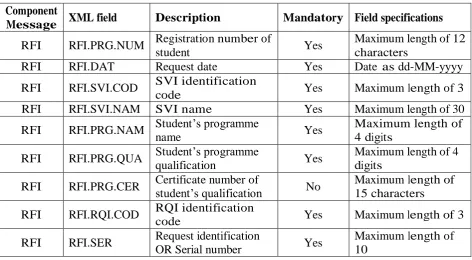
Request for Information message (RFI)
The RFI message specification provides an initial message generated by the requesting
institution (RQI) to the servicing institution (SVI). The content of the RFI is shown is Table I.
The Message contains basic details of the student (the subject of the message) and goes
through the DCI interface to the Tertiary Institution. The file is in the format:
<USER>_RFI_<REGISTRATION NUMBER>.XML
The <user> component represents the identity of the authorized user who is making the
request. The <user> for each tertiary must be an authorized personnel perhaps saddled with
REGISTRATION_NUMBER represents the applicant/student’s registration or matriculation
number as documented by the SVI.
Table I: Request for information (RFI) message. Component
Message XML field Description Mandatory Field specifications RFI RFI.PRG.NUM Registration number of
student Yes
Maximum length of 12 characters
RFI RFI.DAT Request date Yes Date as dd-MM-yyyy
RFI RFI.SVI.COD SVI identification
code Yes Maximum length of 3
RFI RFI.SVI.NAM SVI name Yes Maximum length of 30
RFI RFI.PRG.NAM Student’s programme
name Yes
Maximum length of 4 digits
RFI RFI.PRG.QUA Student’s programme
qualification Yes
Maximum length of 4 digits
RFI RFI.PRG.CER Certificate number of student’s qualification No Maximum length of 15 characters
RFI RFI.RQI.COD RQI identification
code Yes Maximum length of 3
RFI RFI.SER Request identification
OR Serial number Yes
Maximum length of 10
Feedback on Request for Information (FRI) message
This message specification is activated when the servicing institution receives a RFI message
from a RQI. The FRI message is a response message and may either indicate one of five
possibilities captured through the status (STA) field:
a. Request invalid (INV)
b. Request received and lodged (RRL)
c. Request under processing (RUP)
d. Requested information does not exist (RDE)
e. Request processed satisfactorily (RPS)
Table II shows the specification of the FRI. The feedback file pattern is in the format:
Table II: Feedback on Request for Information. Component
Message Field name Description Mandatory
Field
specifications
FRI RFI.PRG.NU
M
Registration number of
student Yes
Maximum length of 12 characters
FRI RFI.DAT Request date Yes Date as
dd-MM-yyyy
FRI RFI.SVI.COD SVI identification code Yes Maximum
length of 3
FRI FRI.DAT Feedback date Yes Date as
dd-MM-yyyy
FRI RFI.STA Request status Yes Maximum
length of 3
FRI RFI.SER Request identification OR
Serial number Yes
Maximum length of 10
FRI RFI.PRG.CER
Certificate number of student’s qualification(where student registration number does/does not exist)
No
Maximum length of 15 characters
FRI FRI.SER Feedback message serial
number Yes
Maximum length of 10
Cancel Request for Information (CRI) message
This message specification is only activated when there is a need to cancel an earlier request
sent from the RQI to the SVI. The CRI when delivered will automatically suspend the earlier
RFI. The CRI must be defined so as to match the earlier message to which it is meant to
nullify. Table III shows the various field included in the cancel request message specification.
The file name specification is
<USER>_CRI_<REQ.SER>.XML Table III: CRI specification.
Message Field name Description Mandatory Type CRI RFI.SER
Request
identification OR Serial number
Yes Maximum length of 10
CRI CRI.DAT Cancellation date Yes Date as dd-MM-yyyy
Delete Request for Information (DRI) message
The DRI is sent through the EDI controller from the RQI to the SVI to annul a message sent
sometime in the past. The effect is that if the message is approved the said request will be
flushed out of the system. There are two ways to this deletion. Where there is a central
controller in accordance with predefined rules. However, where there is no intermediate
controller the power to effect a deletion will reside at the side of the SVI. Table IV shows the
various field included in the DRY message specification. The file name specification is:
<USER>_DRI_<REQ.SER>.XML
Table IV: DRI specification. Message XML field
name Description Mandatory Type
DRI RFI.SER RFI identification OR
Serial number Yes
Maximum length of 10
DRI DRI.DAT Delete request date Yes Date as dd-MM-yyyy
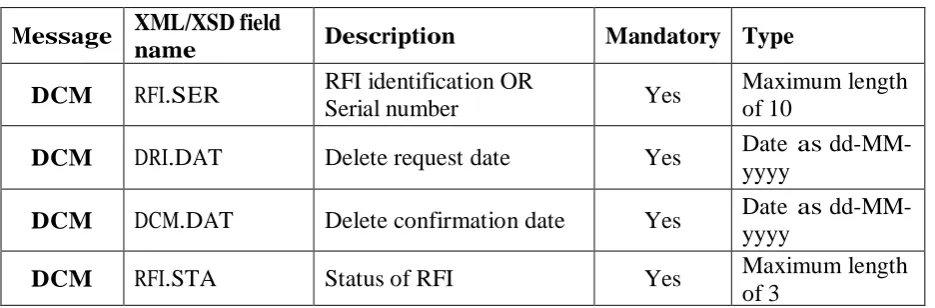
Delete Confirmation Message (DCM)
This Message is sent by SVI interface to the RQI as a feedback to an earlier DRI request from
the RQI. The DCM is a confirmatory response that informs the RQI that the deletion of its
RFI message is completed. The File name pattern is : <USER>_DCM_<REQ.SER>.xml
Table V shows the DCM message specification.
Table V: DCM message specification. Message XML/XSD field
name Description Mandatory Type
DCM RFI.SER RFI identification OR
Serial number Yes
Maximum length of 10
DCM DRI.DAT Delete request date Yes Date as
dd-MM-yyyy
DCM DCM.DAT Delete confirmation date Yes Date as
dd-MM-yyyy
DCM RFI.STA Status of RFI Yes Maximum length
of 3
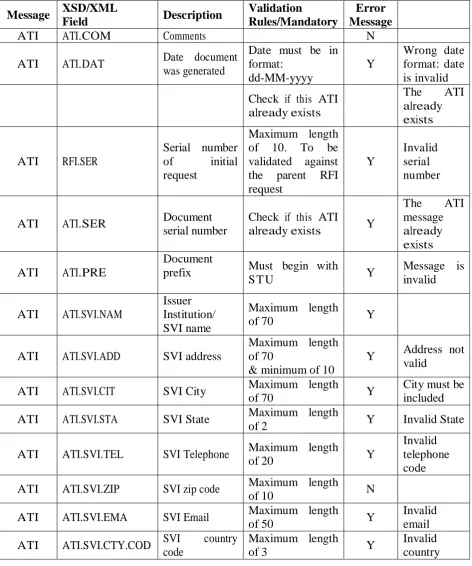
Applicant Transcript Information (ATI) message
This message has larger size than other message specifications owing to the fact that it
captures all atomic details about the academic history or profile of the applicant/student
against whom request is made during his/her studentship in the SVI. The ATI is generated at
the SVI system and sent to the RQI without any interaction with the applicant (student)
against whom it is issued. In other words, the ATI is expected as the output of a RFI message.
an updated status of RPS (Request Processed Successfully) for the original RFI message to
which the ATI message is associated. The file name format for ATI message is:
<USER>_ATI_<REGISTRATION NUMBER>.XML Table VI is a detailed specification of the ATI message.
Table VI: ATI message specification. Message XSD/XML
Field Description
Validation
Rules/Mandatory
Error Message
ATI ATI.COM Comments N
ATI ATI.DAT Date document
was generated
Date must be in format:
dd-MM-yyyy
Y
Wrong date format: date is invalid
Check if this ATI already exists
The ATI
already exists
ATI RFI.SER
Serial number of initial request
Maximum length of 10. To be validated against the parent RFI request
Y
Invalid serial number
ATI ATI.SER Document
serial number
Check if this ATI
already exists Y
The ATI
message already exists
ATI ATI.PRE
Document
prefix Must begin with
S T U Y
Message is invalid
ATI ATI.SVI.NAM
Issuer Institution/ SVI name
Maximum length
of 70 Y
ATI ATI.SVI.ADD SVI address
Maximum length of 70
& minimum of 10
Y Address not valid
ATI ATI.SVI.CIT SVI City Maximum length
of 70 Y
City must be included
ATI ATI.SVI.STA SVI State Maximum length
of 2 Y Invalid State
ATI ATI.SVI.TEL SVI Telephone Maximum length
of 20 Y
Invalid telephone code
ATI ATI.SVI.ZIP SVI zip code Maximum length
of 10 N
ATI ATI.SVI.EMA SVI Email Maximum length
of 50 Y
Invalid email
ATI ATI.SVI.CTY.COD SVI country code
Maximum length
of 3 Y
code
ATI ATI.SVI.END.DAT
Authorized endorsement date
Date must be in format:
dd-MM-yyyy
Y Invalid date
ATI ATI.SVI.END Authorized endorsement
Base 64 string that represents a signature
Y Invalid endorsement
ATI ATI.SVI.END.NA M
Name of
authorized endorsee
Maximum length
of 30 Y
Name cannot be empty
ATI ATI.SVI.END.RAN
Rank of the authorized person
endorsing the document
Date must be in format:
dd-MM-yyyy
Y
The rank cannot be empty
ATI APP.PRG.NAM
Applicant programme name
Maximum length
of 20 Y
Invalid programme name
ATI APP.PRG.DUR
Applicant programme duration
Maximum length
of 10 Y
Invalid period
ATI APP.PRG.DAT
Date of
commencement of programme
Must be in format
dd-mm-yyyy N
ATI APP.PRG.CPL Programme completion date
Must be in format
dd-mm-yyyy Y Invalid date
ATI APP.REG
Applicant registration number
Maximum length
of 12 Y
Applicant’s number is required
ATI APP.TIT Applicant title Maximum length
of 5 N
ATI APP.NAM Applicant full
name
Maximum length
of 80 Y
Applicant’s name cannot be empty
ATI APP.ADR
Applicant contact address
Maximum length
-120 Y
Address cannot be empty
ATI APP.STA
Applicant
state of
origin
Maximum length of 2
Check reference with STA.TAB
Applicant’s state of origin code incorrect ATI APP.CIT Applicant city Max length 20
ATI APP.BIR Applicant date
of birth
Must be in the format: dd-mm-yyyy
Y Invalid date of birth
of 12 semester value
ATI SEM.SES Academic
session
Maximum length of 9 and must be
in format:
dddd/dddd
Y Invalid session
ATI SEM.CRS.NAM Course name Maximum length
of 20 Y
ATI SEM.CRS.COD Course code Maximum length
of 7 Y
Invalid course code
ATI SEM.CRS.UNI Course unit Maximum length
of 1 Y
Invalid course unit
ATI SEM.CRS.GRD Grade obtained in a course
Maximum length of 1; must be a letter from set(A-F)
Y Invalid grade
ATI ATI.CUM
Cumulative Grade point average of student
Maximum length
of 3 Y
Invalid number
ATI ATI. CUM.CLS
Classification of applicant’s grade
Maximum length
of 15 N Invalid label
ATI ATI.REM General
remarks
Maximum length
of 200 N
Operational cycle message
The various specifications presented above are not employed or used simultaneously but are
seen to follow an operational cycle. This operational cycle may also be called a message
exchange cycle. The cycle begins with one institution (RQI) initiating a communication with
another institution (SVI) via a RFI message. This messages when received is acknowledged
by the SVI through a feedback response (FRI). A FRI message depicts one of many states of
affairs as earlier discussed. Following a FRI, a new message in the form of CRI or a DCM
may be initiated. Once conditions are satisfied, the SVI sends an ATI message to the RQI and
the message cycle is terminated.
CONCLUSION
This paper is the first part of a study geared towards implementing an electronic data
interchange framework and a model that support controlled exchange of structured
information between tertiary institutions in Nigeria especially in the domain of verification
and validation of students’ previous academic performance claims which are usually required
various document exchange formats and XML and/or its derivatives have remained the most
viable option. Having regard to the existing system of operation in verifying credentials we
have developed specifications that can easily be implemented regardless of the electronic or
computerized operating platform of any tertiary institution. The specifications are
lightweight, simple, and easy to implement. It is envisaged that controlled information
exchanged among tertiary institutions could be enhanced and extended further by adopting an
organized framework as we have shown in this paper.
REFERENCES
1. Abiteboul S, Buneman P and Suciu D Data on the Web: From Relations to
Semi-structured Data and XML, Morgan Kaufmann Publishers, 2000.
2. Adams S, Hardas D, Iossein, A and Kaiman C. BizTalk Unleashed, Sams Publishing
Indianapolis Indiana, 2002.
3. Ananda A L ―Document formatting for interchange between word processors‖. J
Department of Information Systems and Computer Science. National University of
Singapore, Kent Ridge, Singapore, 1988; 11(6).
4. Andreica A J, Czibulla G S, and Sacarea C ―Designing General Architecture for Data
Iterchange‖. International Conference on Web Information Systems and Technologies,
2014.
5. Bourret, R P ―XML Database Products [online]‖, Retrieved from
http://www.rpbourret.com/xml/, [Accessed 27 July 2017], 2000.
6. Cutting-Decelle, A F & Michel, J J ―ISO 15531 MANDATE: a standardised data model
for manufacturing management‖. International Journal of Computer Applications in
Technology archive, 2003; 18(1): 43-61.
7. Dodds, L ―Schema Round-up [online]‖, Retrieved from
http://www.xml.com/pub/200/09/06/deviant.html/ , [Accessed 27 July, 2017], 2000.
8. Ganter B, Stumme G and Wille R Formal Concept Analysis - Foundations and
Applications, Springer, 2005.
9. International Standards Organisation Revised Text of ISO 8613/DAD4, Information
Processing — Text and Office Systems. Office document Architecture (ODA) and
interchange format, 1994.
10.Krönert G ―Importance of the ISO standard 8613 for document interchange Basic
Communications. Elsevier Science Publishers B.V. (North-Holland), 1990; 61: 209-218
209.
11.Le, D X Rahayu J W and Pardede E ―Dynamic approach for integrating web data
warehouses‖, In Proceedings of International Conference on Computational Science and
Its Applications, 2006; 207–216.
12.OASIS ―Open CSA [online]‖, Retrieved from http://www.oasis-opencsa.org/sca/,
[Accessed 28 July 2017], 2015.
13.Opara E and Srivastava M ―Extensible Markup Language: An Enterprise Integration Web
Delivery System‖. Communications of the International Information Management
Association, 2003; 3(2).
14.OpenIOTOrg, ―Open Internet of Things architecture [online]‖, Retrieved from
https://github.com/OpenIotOrg/openiot/wiki/OpenIoTArchitecture, [Accessed 22 July
2017], 2013.
15.Sameshima Y and Kirstein P T Secure document interchange: a secure user agent.
Computer Networks and ISDN Systems, Elsevier Science B.V., 1996.
16.Tao L and Mao W Intelligent Document Technology in University Educational
Administration Management System. Proceedings of IEEE International Symposium on
IT in Medicine and Education, 2008.
17.Weiss G E Multi-agent Systems: A Modern Approach to Distributed Artificial
Intelligence, MIT Press, 1999.
18.Wooldridge M., Jennings N R and Kinny D ―The Gaia Methodology for Agent-Oriented
Analysis and Design‖. Journal of Autonomous Agents and Multi-Agent Systems, 2000;
3(3): 285-312.
19.W3C, ―XML [online]‖, Retrieved from http://www.w3.org/TR/xml11/#charsets,