Volume-7 Issue-2
International Journal of Intellectual Advancements
and Research in Engineering Computations
A study on mechanical properties of engineered cementitious composites
M.Kirubakar
1, K.Sampath Kumar
21
Post Graduate Student, Department of Civil Engineering, Kongu Engineering College, Erode,
Tamilnadu, India.
2
Assistant Professor, Department of Civil Engineering, Kongu Engineering College, Erode,
Tamilnadu, India.
ABSTRACT
Engineered Cementitious Composites (ECC) is a unique representative of High Performance Fibre Reinforced concrete, featuring extreme intrinsic tensile ductility and moderate fiber content. The tensile strain capacity of engineered cementitious composite is several hundred times that of normal concrete and the fracture toughness of engineered cementitious composite is similar to that of aluminum alloys. The scope of the project is to develop the strength with the mineral admixtures and chemical admixtures which replaced for the aggregate and putting it into practical application in the field of Construction. This micro cracking behavior leads to superior corrosion resistance as well as to selfhealing. In the presence of water unreacted cement particles recently exposed due to cracking hydrate and form a number of products that expand and fill in the crack. Engineered cementitious composite is to improve the safety, durability, and sustainability of infrastructure systems through the innovative materials. For a number of structural application, the use of Hybrid Fiber Composite is better able to meet the material performance requirements than the Mono Fiber composite. From this paper the compression strength test, direct tension test by using dog leg bone specimen, flexural strength test was carried out to characterize the mechanical behavior of conven tional concrete and engineered cementitious composite with various mix proportions.
Keywords:
Engineered Cementitious Composites, PVA Fiber, Steel Fiber
INTRODUCTION
Concrete is the mostly used construction material which has the high compressive strength capacity. Concrete is to consist of a graded range of stone aggregate particles bound together by a hardened cement paste. One major weakness of concrete is the brittle fracture behavior in tension, with low tensile strength and ductility. The lack of ductility is due to brittle nature of concrete in tension which may lead to structural integrity. The performance-based design concept allows a greater flexibility, e.g., in dimensioning and reinforcement detailing by structural engineers. The high performance of civil engineering materials with
added functions beyond their basic properties are highly desirable. [1-4]
In this project, in order to study the durability properties of ECC, the transition zone which exists between the cement paste and coarse aggregate was removed by replacing the coarse aggregates completely with steel fibers and PVA (Poly Vinyl Alcohol) fibers and their structural performances were studied separately. [5-10]
LITERATURE REVIEW
Aitcin (2015) has studied the mechanical properties of a new hybrid Fiber-reinforced engineered cementitious composite (ECC) material
reinforced with 1.75% polyvinyl alcohol (PVA) Fiber and 0.58% steel (SE) Fiber. The development of ECC aims to achieve the better impact resistance. A series of experiments carried out to determine compressive strength, Young’s modulus, modulus of rupture, and tensile characteristics of the new material. [11, 12]
Bassam et al (2014) have presented the reinforced concrete structures (RCS) show excellent performance in terms of durability and structural behavior except for the zones that are subjected to severe mechanical or cyclic loading and aggressive environmental conditions. This paper explaining and reviewing some of the most recent issues using UHPFC as a repair material. The results of findings will a be presented to prove that the UHPFC displays excellent repair and retrofit potentials in compressive and flexure strengthening and possesses high bonding strength and bonding durability as compared with other types concrete.
Hui Ma et al (2013) have presented the demand for repair and retrofit of aging concrete infrastructures increase over time. Normal concrete repair materials were much brittle and tend to crack, resulting in a lack of durability due to cycles of repair and retrofit. A Medium-Early-Strength Engineered Cementitious Composites (MES-ECC) was introduced and self-healing behavior was investigated in this paper. Autogenous healing of MES-ECC with different pre- damage levels and different pre-damage times was investigated.
The literature survey provides a concept regarding various techniques that are used for the Engineered Cementitious Composites.
ENGINEERED CEMENTITIOUS
COMPOSITES
Engineered Cementitious Composites (ECC) is a unique representative of HPFRCC, featuring the extreme intrinsic tensile ductility and to moderate the fiber content. ECC exhibit tensile strain hardening behavior similar to that of ductile metals. The tensile strain behaviouir of ECC is several hundred times that of normal concrete and the fracture toughness of ECC is similar to that of
the mechanical performance of reinforced ECC (R/ECC) structure by preventing the brittle failure and loss of structural integrity which is found in a traditional reinforced concrete (R/C) structure under excessive loading.
OBJECTIVES AND APPLICATIONS
OF ECC
Objectives
The scope of the project is to develop strength with the mineral admixtures and chemical admixtures replaced for the aggregate and putting it into practical application in the field of Construction. The main scope of the project is
To develop the New Hybrid Engineered Cementitious Concrete mix design (Hybrid ECC).
To exemplify the mechanical properties of different mixes.
To investigate the impact resistance of Hybrid ECC.
Applications
Engineered Cementitious Composites has been successively applied to dam repair, bridge deck overlays, coupling beams in high rise buildings and other structural elements and systems.
The high energy absorption and ability to deform under shear give it superior properties in seismic resistance applications when compared to normal concrete.
Engineered cementitious composites are being used in shear elements that are subjected to a cyclic loading, in the mechanical elements of the beam and column combination, and for general structural repairs.
RESEARCH METHODOLOGY
Cement
Cement OPC of 53 Grade locally available is used in this investigation. It is tested for the various properties as per the IS: 4031–1988 and found to be confirming to various specifications of IS: 12269–1987 having specific gravity 3.15 and it has a standard consistency of 32.5%.
Fly ash
The Ordinary Class F Fly Ash contains the Cementitious property collected from the nearer Thermal power plant of specific gravity 2.31 is taken. The quality parameters of Fly Ash for use in concrete confirming to IS 3812(part 1) has been used. The fineness of fly ash is about 3200cm2 / gm
Fine aggregate
Fine Aggregate locally available clean, well graded, natural river sand having fineness modulus of 2.89 conforming IS: 383 – 1970 was used as the fine Aggregate. The passing through size is 4.75mm, fineness modulus is about 3.27 and specific gravity is 2.67.
Polyvinyl alcohol fiber
It is an eco friendly cement reinforced material, which possesses alkali and weather resistance due to its unique molecular structure, taking on good affinity to cement, effectively prevent and resists the crack formation, improve bending strength, impact strength and crack strength, improve permeability, impact and seismic resistance of concrete. It can be used in industrial and civil buildings, walls, roofing, flooring and roads, bridges, tunnels, slope reinforcement. The fiber elongation is about 6% to 10%. The density is about 1.30g/cm3.
Steel fiber
Steel Fibers are filaments of wire, deformed and cut to lengths, for reinforcement of concrete, mortar and other composite materials. It is a circular cross-sectional shape and crimped in the longitudinal direction. When these are added to the mortar, Portland cement concrete or refractory
concrete, the flexural strength of the composite is increased from 25% to 100% - depending on the proportion of fibers added and the mix design. Steel fiber technology transforms a brittle material into a more ductile one. The proportions of Steel fibers in mix designs usually range from 0.2% to 2.0% (15 to 150 kg/m3) of the composite’s volume. The elongation of fiber is 3.5%. The specific gravity of fiber is about 7.8 g/cm3.
Water
Ordinary Portable Water available in the laboratory was used for the experimental investigation and for curing purpose. The water free from oils, acids and alkalis had a water soluble chloride content 140 mg/lit which is very much less than the permissible limit. The permissible limit for chloride is 500 mg/lit as per IS456-2000,
Superplasticizer
The superplasticizer (Conplast SP430 G8) is based on the Sulphonated Naphthalene Polymers and supplied as a brown liquid instantly dispersible in water. It gives high water reductions up to 25% without loss of workability or to produce high quality concrete of reduced permeability. It has a specific gravity of 1.22 and nil chloride content.
MIX PROPORTIONS
It shows the measurement of materials taken to prepare concrete of required strength relatively (with cement). From the grade M20 the letter M refers to the mix and the number to the specified 28 day cube strength of mix in N/mm2.
Conventional mix proportions
Table 1 Mix proportion of Conventional ECC
Cement Fine Aggregate Coarse Aggregate Water – cement Ratio
1 1.3 2.92 0.4
ECC mix proportions
The procedure of mixing ECC was adding cement, sand, mineral and chemical admixtures. Then slowly add the remaining quantity. Once the homogeneous mixture is formed then add fibers
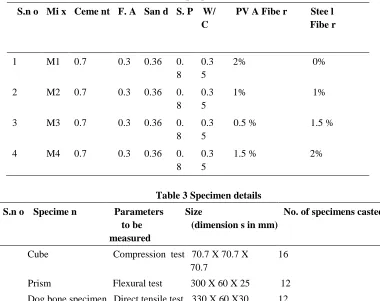
slowly. Mix all the constituents till the fibers are homogenously mixed in the matrix. The following Table 4.2 shows various mix proportions and Table 4.3 shows the various specimen details.
Table 2 Various mix proportions of ECC
S.n o Mi x Ceme nt F. A San d S. P W/ C
PV A Fibe r Stee l
Fibe r
1 M1 0.7 0.3 0.36 0. 8
0.3 5
2% 0%
2 M2 0.7 0.3 0.36 0. 8
0.3 5
1% 1%
3 M3 0.7 0.3 0.36 0. 8
0.3 5
0.5 % 1.5 %
4 M4 0.7 0.3 0.36 0. 8
0.3 5
1.5 % 2%
Table 3 Specimen details
S.n o Specime n Parameters to be measured
Size
(dimension s in mm)
No. of specimens casted
1 Cube Compression test 70.7 X 70.7 X 70.7
16
2 Prism Flexural test 300 X 60 X 25 12 3 Dog bone specimen Direct tensile test 330 X 60 X30 12
RESULTS AND DISCUSSION
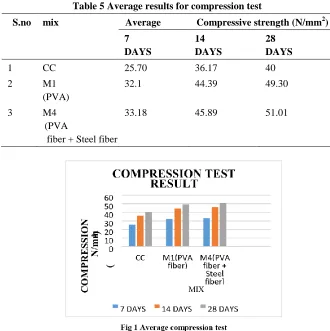
The results were obtained from various tests conducted on laboratory. The various strength test results were categorized and variations were shown by using charts. It helps in identifying the differences in results.
Compressive strength test
Table 4 Results for compression test
S.no mix Compressive strength
(N/mm2)
7 DAYS
14 DAYS
28 DAYS 1 M1 32.1 44.39 49.30 2 M2 32.7 45.22 50.26 3 M3 31.87 44.15 49.01 4 M4 33.18 45.89 51.01
Table 5 Average results for compression test
S.no mix Average Compressive strength (N/mm2) 7
DAYS
14 DAYS
28 DAYS
1 CC 25.70 36.17 40
2 M1 (PVA)
32.1 44.39 49.30
3 M4 (PVA
fiber + Steel fiber
33.18 45.89 51.01
Direct tensile test
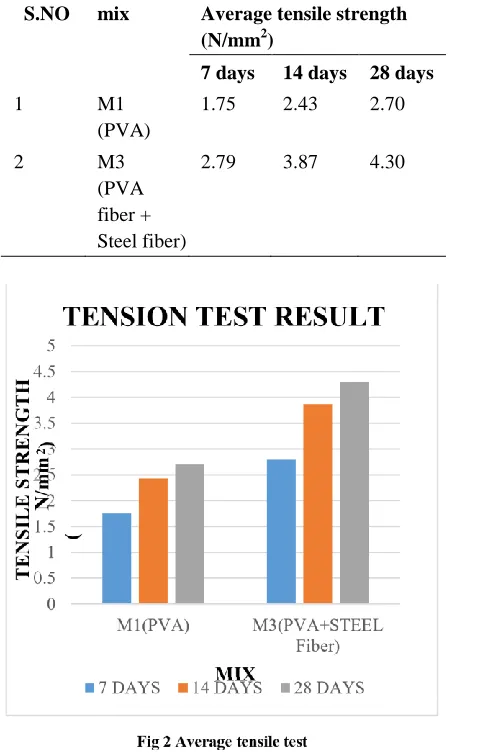
To verify the strain-hardening behavior of the cast ECC specimens, a series of direct tensile tests (three specimens for each ECC mix) were performed using an Instron 8506 load frame. The specimens were loaded with a constant cross head
Table 6 Results for Direct Tensile Test s.no mix Direct tensile strength test
(N/mm2)
7 days 14 days 28 days
1 M1 1.75 2.43 2.70 2 M2 2.27 3.15 3.50 3 M3 2.79 3.87 4.30 4 M4 1.90 2.71 3.00
Table 7 Results for average Direct Tensile Test
S.NO mix Average tensile strength (N/mm2)
7 days 14 days 28 days
1 M1
(PVA)
1.75 2.43 2.70
2 M3 (PVA fiber + Steel fiber)
2.79 3.87 4.30
Flexural test
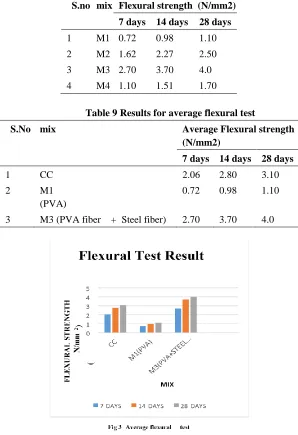
The main advantage of a four-point flexural test is the ease of the specimen preparation and testing.
Table 8 Results for Flexural Test
S.no mix Flexural strength (N/mm2) 7 days 14 days 28 days
1 M1 0.72 0.98 1.10 2 M2 1.62 2.27 2.50 3 M3 2.70 3.70 4.0 4 M4 1.10 1.51 1.70
Table 9 Results for average flexural test
S.No mix Average Flexural strength
(N/mm2)
7 days 14 days 28 days
1 CC 2.06 2.80 3.10
2 M1 (PVA)
0.72 0.98 1.10
3 M3 (PVA fiber + Steel fiber) 2.70 3.70 4.0
CONCLUSION
This study has explored experimentally the mechanical properties of a new fiber- reinforced Engineered Cementitious Composite (ECC) reinforced with Steel Fibers, PVA Fibers respectively. From compressive strength test, hybridization of fibers were not more effective. Thus the compressive strength of hybrid fiber mix is 3.4% higher than the PVA fiber mix. But, the tensile strength of hybrid mix gets 45.7% increase when compared to PVA fiber mix. From flexural
REFERENCE
[1]. Ahmed SFU, Maalej M, Tensile strain hardening behaviour of hybrid steel polyethylene fiber reinforced cementitious composites, Construction and Building Materials, 23, 2009, 96–106.
[2]. Bassam A. Tayeh, Baka and MegatJohari M. A. ‘Utilization of Ultra-High Performance Fiber Concrete (UHPFC) for Rehabilitation’, 54, 2015, 525-538.
[3]. Erdogan Ozbay, Okan Karahan, Mohamed Lachemi, Khandaker M.A. Hossain, Cengiz Duran Atis, Dual effectiveness of freezing–thawing and sulfate attack on high-volume slagincorporated ECC, Composites: Part B, 45, 2008, 1384-1390.
[4]. Haoliang Huang, Guang Ye, Denis Damidot, Effect of blast furnace slag on self- healing of microcracks in cementitious materials, Cement and Concrete Research, 60, 2008, 68-82
[5]. HuiMaa, Qian and Zhang ‘Effect of selfhealing on water permeability and mechanical property of Medium-EarlyStrength Engineered Cementitious Composites’, Construction and Building Materials, Vol. 68, 2015, 92–101.
[6]. Kamile, BurakFelekog, Ravi Ranade, and Victor C. ‘The role of flaw size and fiber distribution on tensile ductility of PVA-ECC’, Cement & Concrete Composites, 56(4), 2014, 536-545.
[7]. Khin T., Soe Y. X., Zhang L. and Zhang ‘Material properties of a new hybrid Fiberreinforced engineered cementitious composite’, Construction and Building Materials, 43(1), 2014, 399-407.
[8]. Khin T. Soe , Y.X. Zhang , L.C. Zhang, Impact resistance of hybrid-fiber engineered cementitious composite panels, Composite Structures 104, 2013, 320– 330.
[9]. Li-li Kan, Hui-sheng Shi, Investigation of self-healing behavior of Engineered Cementitious Composites (ECC) materials, 2012, 348-356.
[10].Mustafa Sahmaran, Ozbay, Yucel, Lachemic. and Victor C ‘Frost resistance and microstructure of Engineered Cementitious Composites: Influence of fly ash and micro poly-vinyl-alcohol fiber’, Cement & Concrete Composites, 34, 2012, 156-165.
[11].Mustafa Şahmaran, Victor C. ‘Durability properties of micro-cracked ECC containing high volumes fly ash’, Cement& Concrete Research, 39(2), 2009, 1033-1043.