Volume 22, 2010 109
PSYCHO-PHYSIOLOGICAL
PRECONDITIONS FOR THE
INDIVIDUALISATION OF TEACHING/
LEARNING PROCESS FOR LEFTHANDERS
Gunita Praulīte, Viktorija Perepjolkina, Juris Porozovs, Daina Voita
Riga Teacher Training and Educational Management Academy, Latvia E-mail: [email protected], [email protected], [email protected], [email protected]
Abstract
One of the basic principles in organising educational (teaching/learning) process is individualisation, in other words - ensuring opportunities and environment for successful learning considering individual students’ personal characteristics. Approximately 10% of our society is the so called left-handers - people with a dominant left hand. Obviously we encounter them at school, too. Left-handed children differ in the ways how they perceive information, analyse space and time, think and feel, i.e. in their psycho-physi-ological processes.
Our work deals with research results obtained by means of psycho-physiological testing: e.g. the compu-terised DT (Determination Test) S1 version and MLS (Motor performance series) test from Vienna Test System. The acquired results reveal that left-handers differ from right-handers in such psycho-physi-ological aspects as attention distribution and stability, information perception and processing, reaction
to conflict situations and reactive stress duration. The former also consume more oxygen while under
pressure than the latter.
The research results indicate that left-handers require an individual educational approach.
Key words: functional asymmetry of brain hemispheres, lefthanders, right-handers, attention, educa-tional (teaching/learning) process.
Introduction
one of the basic principles in organising educational (teaching/learning) process is indi-vidualisation,in other words - ensuring opportunities and environment for successful learning
considering individual students’ personal characteristics. Or, according to I. Beļickis (2000)
- ensure a pedagogical situation in which a “value-oriented atmosphere” prevails. humane-education (Gudjons, 1998) focuses on human as a whole, attempting to understand each indi-vidual’s actions and behaviour, and stresses student-centred education, with a child (student) in the centre of attention ( as opposed to the subject-centred approach). the 21st century education
is an approach demanding high pedagogical skill and knowledge of each student’s individual characteristics. I. Maslo (1995) speaks of educational individualisation in the historical aspect pointing out that even Jan Amos Komenský wrote about individual approach to educating in -dividual children.Approximately 10% of our society is the so called lefthanders - people with
a dominant left hand. obviously we encounter them at school, too. left-handed children pos-sess a different pre-programmed physical and mental potential which can be observed in their behaviour.
studies of brain function started in the 19th century (Paul Broca and Carl Wernicke) and
reached their peak in the late 20th century, and have proven that the specific behaviour of
left-handers is determined by the functional asymmetry and specialisation of brain hemispheres - functional differences in the right and left hemisphere. the left hemisphere ensures people’s
(right-handers’) logical, rational and theoretical skills, whereas the right one is responsible for creativity and intuition (Zigmond et al, 1999; Warner, 2000; Geake, 2009). The left-handers
may have it vice versa. the lateralisation of brain hemispheres develops along with the devel-opment of articulate speech. left-handed children’s psycho-physiological processes related to
perceiving information, analysing space and time, thinking and emotions are different. Several recently conducted researches (Warner, 2000; Pelša, 2004) have clarified the most distinct
left-handers’ characteristics that should be considered in education. left-handers are active and energetic, impetuous and very emotional, quite creative and highly imaginative. they use their energy resources economically, therefore at times seem to be tireless. such children prefer
di-versity in their work which demands for high levels of accuracy. Their impetuousness can fre
-quently lead to stress, just like their emotions and pressure may cause a stronger fear syndrome,
drastic change in mood and unstable attention.
even though the functional lateralisation of brain has been widely studied, children and adolescents’ psycho-physiological features related to the functional asymmetry of brain have
still been insufficiently investigated. Pedagogy, in particular, pays very little attention to this
problem. our aim was to detect the difference between children and adults with regard to indi-vidual psycho-physiological features related to the functional asymmetry of brain.
Methodology of Research
Our psycho-physiological research involved 62 participants: 22 junior form pupils (10-11 years old), 22 students of both genders (aged 20-21) and 18 adult male athletes (aged 20
-23); the latter were in excellent physical condition, according to harvard step-test indicators
(Auliks, 1985). All participants were questionnaired to detect their brain profile regarding the
lateralisation of sight, hearing and motor functions and later divided into two groups: Group i - with dominant left hemisphere (right-handers);
Group ii - with dominant right hemisphere (left-handers).
We tested school-children’s ability to distribute attention by means of numbers-arrange-ment test, and their capacities of information perception and processing (speed of processing
information, accuracy and productivity of work) by means of a proofreading test during which every participant, within a certain amount of time, has to look through 2000 printed characters and cross out one particular of them (Психологические тесты, 1999).
While testing the adult participants’ (students’) psycho-physiological indicators: quick
-ness and accuracy of reaction, as well as quick-ness and accuracy of hand movements we ap -plied the computerisedDT (Determination Test) S1 version (Neuwirth, Benesch, 2003) and MLS (Motor performance series) test (Neuwirth, Benesch, 2003) from Vienna Test System.
of education in the 21st century Volume 22, 2010 111
indirect method (Auliks, 1985), as the indicator of an individual’s physical and mental working
energy.
the results were statistically processed by means of the t-test: two- sample assuming
Unequal Variances tool in Excel.
Results of Research
the functional asymmetry of the large brain hemispheres, aside from being genetically predetermined, develops along with articulate speech. this functional specialisation of brain
forms gradually alongside the development of speech and abstract thinking up to the age of 14- 16 and reaches maximum during mature age (Pelša, 2004).
Young school-children’s lateralisation levels are still insufficient, consequently there are significant differences observed in how left- and right-handers of this age perceive and process information within a 3 minute interval (Table 1). Only in the 4th minute, possibly due to higher
determination, right-handers demonstrate an obviously higher rate of information processing
(3.09±0.67).
Table 1. Rates of information processing for students with differing “dominant” hemisphere.
Research
participants Information processing rates (bits per second)
1st min 2nd min 3rd min 4th min
Group I 3.48±0.71 2.49±0.54 2.78±0.62 3.09±0.67 *
Group II 2.90±1,49 2.62±0.51 3.04±1.26 2.71±0.66 *
* Significant difference (p=0.05)
Table 2. Accuracy for young school-children.
Research
participants Accuracy of work
1st min 2nd min 3rd min 4th min
Group I 0.94±0.04* 0.98±0.04* 0.88±0.01* 0.99±0.03
Group II 0.97±0.04* 0.91±0.03* 0.98±0.03* 0.99±0.01
* Significant difference (p=0.05)
The accuracy of intellectual work, detected by taking the number of accurately
crossed-out characters, dividing it by the total number of crossed-crossed-out characters and adding up the
number of mistakes (missed or incorrectly crossed-out characters), characterises an individual’s attention capacities. The results show that lefthanders and right-handers’ working accuracy sig
-nificantly differs in the 1st, 2nd and 3rd working minute. During the 1st and 3rd minute lefthanders
are more accurate, whereas right-handers accuracy is higher during the 2nd minute (table 2).
This testifies that left-handers’ emotions and impetuousness impede with their capacity to focus
attention. also the numbers-arrangement test (lasted fro 2 minutes) revealed that only 295 of
Research
participants Efficiency
1st min 2nd min 3rd min 4th min
Group I 369.95±72.38* 276.71±67.78* 308.50±72.20 343.80±76.71
Group II 320.00±146.14* 295.72±55.28* 343.60±130.50 312.78±82.17
* Significant difference (p=0.05)
Working efficiency of young school-children, which depends on working rates and at -tention stability, was calculated multiplying the number of scanned characters by the accuracy
indicator. The results revealed that efficiency is significantly different for left- and right-hand -ers during the 1st and 2nd minute: during the first minute it is higher fir right-handers, whereas
during the second minute - left-handers are more efficient (Table 3). Although during the 3rd
and 4th minute there are also evident differences, they are not statistically significant, and might
have occurred due to large data dispersion. Adult students display higher levels of efficiency and information processing rates, respectively: efficiency - 436.07 for left-handers and 536.41 for right-handers; information processing rate - 4.10 for right-handers and 4.69 for left-handers. Evidently adult left-handers work more intensively than their right-handed counterparts. This means also more intensive energy consumption; maximum oxygen consumption indicator (Vo2
max) is 64.82 for left-handers and 50.37 fro right-handers (a statistically significant difference).
Adults and children’s efficiency differs also dynamically. Children’s efficiency levels fluctuate within the four minutes (Table 3), while adult right-handers’ efficiency steadily in
-creases: first minute 414.58; second – 413.22; third – 462.54; fourth - 475.28. Adult left-hand
-ers’ efficiency levels fluctuate just like children’s: first minute 586.59; second minute – 493.13; third minute – 529.50; fourth minute – 481.17.
Table 4. Adult students’ reaction rates and efficiency levels.
Research
participants Reaction numbers Reaction rate (in seconds)
Right Wrong Missed
Group I 255.30±29.72 21.20±13.05 17.70±6.67 0.75±0.07
Group II 255.60±28.50 16.18±9.11 16.00±7.07 0.73±0.08
using the computerised dt (determination test), we detected students’ reaction to
vis-ual and acoustic stimuli. Working time limited - 4 minutes. Evaluating reaction rates along with right, wrong and missed reactions we can judge an individual’s abilities to work under pressure and take decisions in limited time. While learning or studying, individuals have to experience a certain optimal level of stress (Krauklis, 1981). For an educator it is essential to organise edu -cational process considering the psycho-physiological features of each particular age group. as
shown by Table 4 all participants’ reactions are within the norm: the norm for right answers is 175 - 278; for the wrong answers - 21-4 and for the missed ones - 20-4. Reaction numbers fro
right-handers and left-handers are not statistically different, however, right-handers have more
wrong reactions (21.20±13.05) than left-handers (16.18±9.11). Reaction rates also do not differ significantly.
the number of wrong and missed reactions indicates at attention stability. adult
left-handers and right-left-handers do not display significant differences as regards their reactions (Ta
of education in the 21st century Volume 22, 2010 113 1st, 2nd and 3rd minute (table 2). this proves certain instability in children’s brain hemisphere
lateralisation, which decreases in mature age.
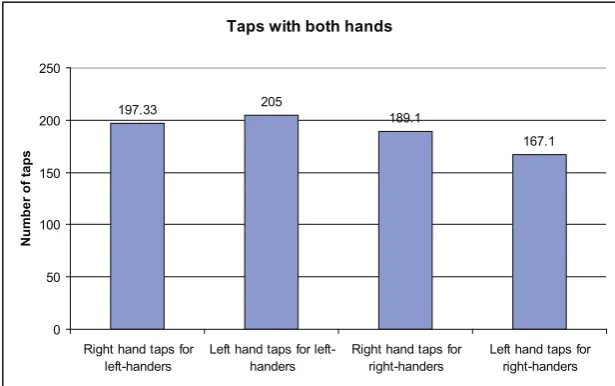
The MLS (Motor Performance Series) test reveals the specific characteristics of CNS
functions (figures 1 and 2). hand motor capacities are measured by the number of taps on the
working panel registered by computer. The test is carried out in two modes: working with one hand at a time and working with both hands simultaneously. While working with one hand sta
-tistically remarkable differences are observed in both right-handers (right hand - 203.10±12.40 taps; left hand -169.50±20.00 taps) and left-handers (left hand - 208.57±9.76 taps; right hand - 181.17±21.57 taps). Comparing right-handers and left-handers’ ability to work with the right hand we find no statistically remarkable differences (203.10±12.40 and 181.17±21,57), while, regarding their ability to work with the left hand, left-handers remarkably surpass right-handers (208.57±9.76 and 169.50±2000).
Taps with one hand
181.17
208.57 203.1
168.5
0 50 100 150 200 250
Right hand taps for
left-handers Left hand taps for left-handers Right hand taps forright-handers Left hand taps forright-handers
Number of taps
Figure 1. Motor performance of right and left hand in the one-hand working mode.
Taps with both hands
197.33 205 189.1
167.1
0 50 100 150 200 250
Right hand taps for
left-handers Left hand taps for left-handers Right hand taps forright-handers Left hand taps forright-handers
Number of taps
markable differences in the number of taps performed with each hand (left hand - 205, 00±11, 00; right hand - 197, 33±20, 73). Meanwhile right-handers demonstrate significant differences (right hand - 189, 10±22, 41; left hand - 167, 10±29, 86). This proves that right-handers’ func -tional brain asymmetry is more stable and the dominance of the left hemisphere is more explicit than the dominance of the right hemisphere in left-handers. similar conclusions are drawn also by other brain researchers. the group of young school-children could not be tested by means of mls test since it is designed for persons above the age of 15.
Discussion
a pedagogical process in which student-teacher interaction is organised to reach the target is the basis for the development of educated individuals. during continuous and produc-tive processes of cognition, interaction and personality development, each individual (also a
lefthander) acquires information, complements and consolidates knowledge, and develops new skills. Nowadays the problem of coordinating the manifold external influences, determined by
environment, and the internal psychological processes, traits and states for a growing child,
student and adult is still topical (Špona, 2001).
it is essential to organise the learning process so that children and youths could prove themselves and successfully apply their natural creative potential (talents, powers, will and
capabilities). According to the majority of authors (Warner, 2000; Špona, 2001; Pelša, 2004,
etc.), the 21st century educators make insufficient use of the latest discoveries in the filed of
neuro-psychology and psycho-physiology for the purpose of improving the quality of
teach-ing/learning process. This regards especially the latest research results in the field of functional
asymmetry and specialisation of human brain hemispheres. the authors of this article carried
out a poll among teachers which revealed that 31% primary school and 40% basic school teach -ers misbelieve that left-handedness is related to dominant left brain hemisphere.
Primary school teachers regularly encounter problems with lefthanders: difficulties in acquiring reading and writing, difficulty to understand the concepts “left” and “right”, inability to concentrate and focus on work. This explains the fact, revealed by the poll, that individual approach in work with lefthanders is more often used by primary school teachers (44%) and far less of then by basic school teachers (20%).
currently schools view the lefthanders problem mostly from ergonomic perspective. in-dividual shops offer products for lefthanders - stationery, computer mouses, etc. unfortunately too little attention is paid to the organisation of teaching /learning process and to the psycho-physiological processes ensuring a cognitive approach. this is particularly obvious in case of secondary school and university students - the group with stable brain hemisphere asymmetry
(as proven by our research results), consolidated cognition processes and stabilised thinking.
the authors would suggest that, alongside with conceptual pedagogical and psychological
ap-proaches, the ones based in psycho-physiology should be applied when working with these two
of education in the 21st century Volume 22, 2010 115 Conclusions
Research results prove that information processing rates, working efficiency and ac -curacy, as well as attention stability differs in children and adult students depending on their dominant brain hemisphere. children’s information processing rates are lower that those of
adults, however, at this age they do not remarkably differ for right-handers and left-handers.
accuracy rates, in turn, differ, mainly due to children’s unstable attention, and are more evident in left-handed children.
During the 4 minutes of proofreading a text working efficiency for children and adults differs. Both right-handed and left-handed children demonstrate fluctuating levels of efficiency. Right-handed adults’ efficiency grows by every minute, while left-handed adults’ efficiency fluctuates just like children’s. This proves the stability of brain hemisphere functional lateralisa -tion in adult right-handers and left-handers.
determination test results for adult students, evaluating reaction rates, as well as right,
wrong and missed reactions, prove that both right- and left-handers are capable of working under pressure posed by educational tasks.
MLS test results for students prove the specific characteristics of brain hemispheres in right- and left-handers. While working with one hand, both groups demonstrate statistically remarkable differences depending on whether they are working with the dominant or the pas
-sive hand. The capability to work with the right hand does not differ between the groups, while
the left-hand is obviously stronger for left-handers, which proves the functional dominance of
their right brain hemisphere. Test participants working with both hands, it becomes obvious that
right-handers’ left brain hemisphere is functionally dominant as compared to the dominant right hemisphere in left-handers.
References
Auliks, I. (1985). Sporta medicīna. Rīga: Zvaigzne, 170 p.
Brazdeikiene, L., Rugevičius, M., Mažeikaite-Gyliene, Ž. (2004). Left-handers Difficulties in Educa
-tion Process and Their Rela-tion with Peculiarities of Personality. Starptautiskās zinātniskās konferences „Teorija un prakse skolotāju izglītībā I” materiāli. Rīga: SIA Petrovskis un Ko. pp.407-412.
Geake, J.G. (2009). The Brain at School. Educational Neuroscience in the Classroom. open university
press. 229 p.
Gudjons, h. (1995). Pedagoģijas pamatatziņas [Pädagogisches Grundwissen]. Rīga: Zvaigzne ABC.
394 lpp.
Krauklis, A. (1981). Emocionālais STRESS un tā optimizācija. Rīga: Zvaigzne. 183 p.
maslo, i. (1995). Skolas Pedagoģiskā procesa diferenciācija un individualizācija. Rīga: RaKa. 172 p.
Neuwirth, W., Benesch, M. (2003). DT Determination Test. Manual. Release 31.00. mödling, austria,
copyright by dr.G. schuhfried Gmbh. 51 p.
Neuwirth, W., Benesch, M. (2003). MLS Motor Performance Series. Manual. Release 24.00. mödling,
Austria, Copyright by Dr.G. Schuhfried GmbH. p.37. Pelša, E. (2004). Varbūt arī tu esi kreilis? Rīga: Alis. 167 p.
Praulite, G., Spunde, A.Porozovs, J. (2003). Some Psycho-physiological Aspects of Mastering the
Warner, P. (2000). Preschooler plays and learns. Minnetonka, MN 55343: Meadowbrook Press. 159 p. Zigmond, m.J., bloom, f.e., landis, s.c., roberts, J.l., squire, l.r. (1999) Fundamental Neuroscience. San Diego et al.: Academic Press. 1024 p.
Психологические тесты. (1999). Москва: ВЛАДОС. 248 с.
Adviced by Vincentas Lamanauskas, University of Šiauliai, Lithuania
Gunita Praulīte
Dr. biol., Professor emeritus, Riga Teacher Training and Educational Management Acad-emy (RTTEMA), Imantas 7. linija 1, Riga, Latvia.
E-mail: [email protected] Website: http://www.rpiva.lv
Viktorija Perepjolkina
Researcher, Riga Teacher Training and Educational Management Academy (RTTEMA), Imantas 7. linija 1, Riga, Latvia.
E-mail: [email protected] Website: http://www.rpiva.lv
Juris Porozovs
Professor, Riga Teacher Training and Educational Management Academy (RTTEMA), Imantas 7. linija 1, Riga, Latvia.
E-mail: [email protected] Website: http://www.rpiva.lv
Daina Voita
Associated professor, Riga Teacher Training and Educational Management Academy, Latvia.