Volume-7 Issue-2
International Journal of Intellectual Advancements
and Research in Engineering Computations
An experimental study on behaviour of SIFCON with replacement of fine
aggregates by quarry Dust
S.Marappan
1, M.Mohammed Rashoo
lMohaideen
1, S.Senthil Murugan
1, U.Udaya
Sankar
1, P.Karthika
21
UG Student,
2Assistant Professor, Department of Civil Engineering, Engineering College,
Erode.
ABSTRACT
Concrete is a composite material which has wider application in construction industry because of strength and durability. The four components used in producing cement concrete generally are cement, water, sand and aggregate. But, natural sand is being depleted at present and also becoming costly, particularly in the rapidly developing countries like India. Hence, there is a necessity to develop a substitute for the fine sand for use in the concrete mixture, one of which is the manufactured sand developed fr om locally available quarry dust. Therefore, in this study, investigations are carried out to determine the mechanical properties of quarry dust and Slurry Infiltrated Fibrous concrete (SIFCON) made with the quarry dust. SIFCON possesses the high strength as well as large ductility because of its high tensile strength.SIFCON fibre content ranges from 4 -20% by volume. The specimen has partial replacement of fine aggregates by quarry dust as 15%, 30% and 45%
Keywords:
SIFCON, Cement, Quarry Dust, Steel fiber, Tensile Strength, Ductility, Stiffness.INTRODUCTION
Civil engineering practice and construction works in India depend to a very large extent on concrete. The most widely used structural material for construction is the concrete. Conventionally, concrete is fabricated from a few well defined components such as cement, water, fine aggregate, coarse aggregate and locally available natural sand from river beds, stream beds, etc. The availability of the natural sand resources is being depleted. Hence, as alternative, manufactured sand can replace the natural sand. The manufactured sand is usually obtained by crushing the stones from the stone quarry by crusher. The type of stone and its properties vary from place to place. In the present study, an attempt was made by completing replacing the natural sand with the manufactured sand to investigate the strength characteristics of SIFCON. SIFCON is a relatively new material which is considered as a new type of Fibre
seismic and explosive resistant structures, secure concrete applications such as safety vaults and strong rooms, refractory and military applications such as missile hangars, underground bunkers, and nuclear containment shielding. Sometimes, these application areas are exposed to high temperatures.
PROJECT WORK
Materials used and its Properties
Cement
The Cement used in this study was Ordinary Portland cement (OPC) which is the most important type of cement. OPC cement of 53grade of cement use in this experimental work. Conforming weight of each cement bag was 50kg.The property of cement is shown in Table 1[1].
Table 1: Properties of Cement
Physical Properties Value observed in investigation Specific gravity 2.8
Fineness of cement 3% Normal consistency 30% Initial setting time 150 min Final setting time 270 min
Fine Aggregate
M-sand was used as Fine aggregate with fineness modulus of 2.68 and it should passing through IS Sieve 4.75mm. It should have fineness
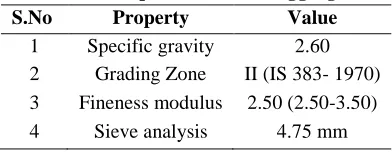
modulus 2.50- 3.50 and silt content should not be more than 4.The properties of Fine aggregate are shown below in Table 2 [2-7].
Table 2: Properties of Fine Aggregate
S.No. Property Value
1 Specific gravity 2.60 2 Grading Zone II (IS 383- 1970)
3 Fineness modulus 2.50 (2.50-3.50)
4 Sieve analysis 4.75 mm
Coarse Aggregate
The coarse aggregate are the blue granite stone of which particles greater than 4.75mm they should be hard, strong, dense, durable and clean. It
should be conical shape. Flaky pieces should be avoided. It creates much better bond between cement paste and the Aggregates. The properties of Coarse aggregate are shown below in Table 3.
Table 3: Properties of Coarse Aggregate
S.No. Property Value
1 Sieve analysis 4.75 mm 2 Specific gravity 2.53 3 Water absorption 2.71%
Fiber
This study uses a type of fibre made of steel with a unit weight of 7850 kg/m3. The steel fibre is of 1mm and cut into required lengths of 50 mm,
Figure 1: Steel Fibre
Table 4: Physical Properties of Fiber
S.No. Property Description
1 Diameter 0.33 mm
2 Length 25 mm
3 Young’s modulus 1 N/mm2
4 Aspect ratio(L/D) 75
5 Unit weight 7850 kg/m3
Admixture
The Plasticizer used to improve the workability of SIFCON is CONPLAST X421 It.The properties of conplast x421ic are shown below in Table 5
Table 5: Properties of CONPLAST X421 IC
S.No. Property Description
1 Color Dark brown
2 Specific gravity 1.09 at 200c
Mix proportions
This study adopts a fibre content of 8%, 10% and 12% by volume, water cement ratio of 0.5 and
super plasticizer about 0.6%. The slurry consists of cement and fine aggregates in the ratio of 1:1. The Mix proportions are shown below in Table 6 [7].
Table 6: Mix proportion of SIFCON
S.No Fiber W/C ratio Plasticizer content Mode of vibration
1 8% 0.5 0.6% Hand damping
2 10% 0.5 0.6% Hand damping
3 12% 0.5 0.6% Hand damping
RESULT AND DISCUSSION
Compressive Strength Test
Compression test is the most common test conducted on hardened concrete, partly because it
150mmx150mm, at an age of 7 and14 days. The mould and its base rigidly clamped together so as to reduce leakages during casting. The sides of the mould and base plates were oiled before casting to
prevent bonding between the mould and concrete. The cube was then stored for 24 hours undisturbed. The testing of cube under compression was shown in figure
Figure 2: Compressive Strength of Concrete
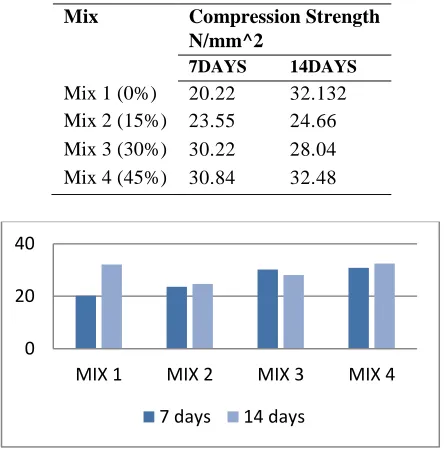
Table 7: Test results for Compression Strength
Mix Compression Strength
N/mm^2
7DAYS 14DAYS
Mix 1 (0%) 20.22 32.132 Mix 2 (15%) 23.55 24.66 Mix 3 (30%) 30.22 28.04 Mix 4 (45%) 30.84 32.48
Figure 3: Graphical Representation of Compression Strength Test
Split Tensile Strength Test
For tensile strength test, cylindrical specimens of dimension 150 mm diameter and 300 mm length were cast. In this test three cylinders were tested and their average value was reported. The split tension test was conducted by using digital compression machine having 2000 kN capacity [8].
Split tensile strength was calculated as follows: Spilt Tensile strength (MPa) = 2P / π DL Where, P = Failure Load (kN)
D = Diameter of Specimen (150 mm) L = Length of Specimen (300 mm)
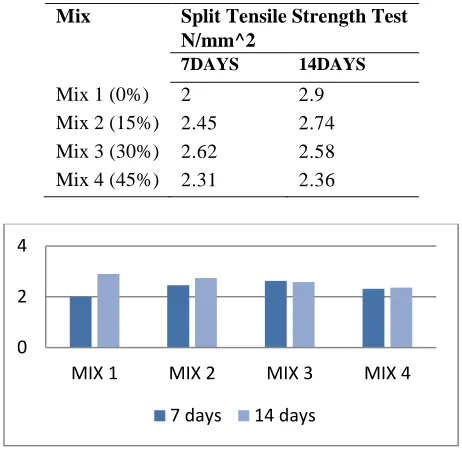
Test Results of splitting tensile strength for M60 grade of concrete shown in table 8
0 20 40
MIX 1 MIX 2 MIX 3 MIX 4
Three cylinder specimens were casted in each percentage, in order to find the average value of split tensile strength. These cylinder specimens
were left for 28days curing in a curing tank. After the course of curing, the specimens were ready for testing. All the cylinders were tested.
Figure 4: Split Tensile Strength of Concrete
Table 8: Test results for Split Tensile strength test
Mix Split Tensile Strength Test
N/mm^2
7DAYS 14DAYS
Mix 1 (0%) 2 2.9
Mix 2 (15%) 2.45 2.74 Mix 3 (30%) 2.62 2.58 Mix 4 (45%) 2.31 2.36
Figure 5: Graphical Representation of Split Tensile Strength of Concrete
CONCLUSIONS
In summary of the above investigations, the following conclusions are made from the experimental results indicated following:
Addition of steel fibres in concrete significantly increased the Compressive and Split tensile
SIFCON (with manufactured sand) made with 6% fibre fraction showed the optimum value in compressive and
0 2 4
MIX 1 MIX 2 MIX 3 MIX 4
Manufactured sand can be used as an alternative to the regular river sand in making SIFCON.
Manufactured sand can be successfully be used as an alternative to the natural sand where the natural sand availability does not meet the requirement.
REFERENCE
[1]. Parameswaran V.S., “Studies on Slurry Infiltrated Fibrous Concrete”, Transportation Research Record 1382, 1990.
[2]. Ahsanollah Beglarigale, “Flexural Performance of SIFCON Composites Subjected to High Temperature”, Construction and Building Materials, 104, 2016, 99-108.
[3]. Yogesh N Dhamak and Madhukar R Wakchaure, “Use of Precast SIFCON Laminates for Strengthening of RC Beams”, Int. Journal of Engineering and Computing, 4(9), 2015, ISSN: 2319-7242, 14261-14266. [4]. Kuldeep Dagar, “Slurry infiltrated fibrous concrete”, International Journal o f Applied Engineering and
Technology vol. 2 (2), 2012, ISSN: 2277-212X, 99-100.
[5]. Arun Aniyan Thomas and Jeena Mathews, “Strength and Behaviour of SIFCON with Different Types of Fibres”, International Journal of Civil Engineering and Technology (IJCIET) 5(12), 2014, 25-30.
[6]. Vinayaka N M, “An Experimental Investigation on SIFCON using Mono Fibres”, International Journal of Civil and Structural Engineering Research, 3(1), 2015, 267-272.
[7]. Subathra B and Pradeep T, “Experimental Study on Mechanical Properties of SIFCON, International Journal of Science and Engineering Research (IJOSER)”, 3(2), 2015.