Journal of Information Literacy
ISSN 1750-5968
Volume 4 Issue 2
December 2010
Article
Angello C. 2010. The awareness and use of electronic information sources among livestock researchers in Tanzania. Journal of information literacy, 4(2), pp 6-22 http://ojs.lboro.ac.uk/ojs/index.php/JIL/article/view/PRA-V4-I2-2010-1
Copyright for the article content resides with the authors, and copyright for
the publication layout resides with the Chartered Institute of Library and
Information Professionals, Information Literacy Group. These Copyright
holders have agreed that this article should be available on Open Access.
“By 'open access' to this literature, we mean its free availability on the public internet, permitting any users to read, download, copy, distribute, print, search, or link to the full texts of these articles, crawl them for indexing, pass them as data to software, or use them for any other lawful purpose, without financial, legal, or technical barriers other than those inseparable from gaining access to the internet itself. The only constraint on reproduction and distribution, and the only role for copyright in this domain, should be to give authors control over the integrity of their work and the right to be properly acknowledged and cited.”
The awareness and use of electronic information
sources among livestock researchers in Tanzania
Consolata Angello, Assistant Lecturer, Sokoine University of Agriculture, United Republic of Tanzania
Email: [email protected]
Abstract
This paper is the result of a study that was conducted to investigate the accessibility and use of electronic information resources by the livestock researchers in Tanzania. One of the main objectives of the study was to assess the information literacy skills of livestock researchers. The study was conducted in three livestock research institutes in Tanzania with an overall sample size of fifty respondents consisting of livestock researchers and information professionals. Detailed questionnaires, interviews and observations were the methods used for data collection while data was analysed by Statistical Package for Social Sciences (SPSS) and content analysis. One of the findings of the study was the lack of information literacy skills among most of the researchers and this was found to be limiting their access and use of e-resources. This paper discusses the level of information literacy that livestock researchers possess and its impact on these researchers’
awareness and use of e-resources.
Keywords
Information Literacy (IL), livestock researchers, E-resources, Information and Communication Technologies (ICTs), livestock information, developing countries, Tanzania
1. Introduction
Searching, managing and using information ethically are skills that every proficient researcher ought to have. Livestock researchers like all other researchers have to be able to access, retrieve and use information for the successful accomplishment of their research work. Murphy (2003) has emphasized that professional veterinarians must commit to a program of lifelong learning to maintain or upgrade their skills and remain competitive in their practice. The abilities to identify an information need, efficiently and effectively access information, critically evaluate information, and use information to develop accurate, creative solutions to real problems are required.Such skills identify an information literate individual. However, information literacy, like any skill, must be practiced to be maintained. Livestock research should therefore lay emphasis on the continuous use of both printed and electronic resources to gather information regarding particular cases that may be very useful for the research.
Pertti and Sanna (2006) have reported that the accessibility and availability of information has increased remarkably due to the digitisation of information. The growing supply of literature in libraries that is available in digital format facilitates effective searching for the material needed by scholars. This development has rapidly increased the scholars' exposure to a wider range of literature than would otherwise be available. There are some indications that scholars' ways of accessing literature for their work has changed in the electronic information environment (Tenopir 2003; Institute for the Future 2002). There are larger volumes of information than ever before, new ways of collecting information, new information containers and new tools for working for
However, in general, researchers in developing countries experience a number of barriers to accessing e-information. These include: a lack of skills required to access these resources and a lack of awareness of the wide range of electronic resources that are available. Another problem is the cost of appropriate hardware and software. The latter is a particularly serious problem for smaller institutions in developing countries (Galina and Russell, 1994).
This paper discusses the information literacy of livestock researchers in Tanzania and how it affects their awareness and use of e-resources. Recommendations on what livestock research institutes in Tanzania should do to enhance the use of e-resources by livestock researchers conclude this paper.
2. Scope of the study
This article focuses on the skills associated with searching and the usage of electronic information sources (e-resources) in livestock institutes in Tanzania. First, the article will look at the objectives and limitations of this research, followed by a literature review section outlining the sources of information required by livestock researchers as well as the role of research institutes in facilitating the access and use of e-resources. An account of the methodology employed in this study is also presented together with an analysis of the results generated by it. The article also provides a set of recommendations.
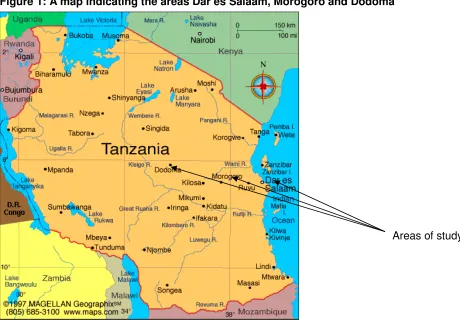
The map below shows the areas Dar es Salaam, Morogoro and Dodoma to illustrate the geographical areas where the study was conducted.
Figure 1: A map indicating the areas Dar es Salaam, Morogoro and Dodoma
3. Objectives
The aim of this study was to investigate the access and use of electronic information by livestock researchers in Tanzania, although this paper focuses on the following specific objectives:
1. Determining the information literacy skills of Tanzanian livestock researchers
2. Identifying the electronic sources of information accessed by the livestock researchers. 3. Investigating how the livestock research institutes could facilitate access and use of
e-resources.
4. Literature review
Sources of information for researchers
Information is a crucial asset for researchers. Without access to up-to-date information, they cannot do their job properly. Researchers need access to information within their institute and ideally from their offices. In addition, it is increasingly important that scientists know how to access information that is located outside of their own institution. Scientists need to consult handbooks and scientific journals, they need reliable statistical data, information from professional networks and internet resources (Kapange et al, 2003). A study by Kwok (1992) sampled a group of scientists and examined their use of materials such as CD-ROM databases, online databases, journals, monographs etc. to do research. The study listed five most useful resources: journals (print), personal contacts, conferences/meetings, online databases and research reports.
According to Rayand Day (1998) electronic sources of information have been found to be more useful compared to print sources of information. They argue that the advantages of using
electronic sources include the fact that these sources can be consulted faster than print indexes as they are more easily accessed through keyword searching and offer the opportunity of searching multiple sources at one time. In addition, electronic resources can be printed and searches saved to be repeated at a later date; they are also updated more often than printed sources. For livestock researchers, the above advantages play an important role in facilitating their work especially in remote centres outside major cities and towns.
Electronic information sources (e-resources) searching skills
The rapid development of the internet and the World Wide Web (WWW) has completely
transformed the production, storage and retrieval of information (Woodward and Pilling, 1993). A lot of information is now generated, converted and stored in electronic form and these resources require the users to acquire the necessary skills in order to effectively utilise them (Said, 2003).
Gleeson (2001) conducted research on the use of electronic journals and their influence on the information-seeking behaviour of scientists. The results of this study revealed that the majority of the scientists have integrated e-journals into their information-seeking strategies and considered them important resources, although the author also argued that many scientists were actually quite slow in adopting electronic sources, pointing to the fact that they were not taking full advantage of the internet.
people would search, with some academics only requiring papers published after 2000, while others used 60 years old sources.
IL training teaches researchers many skills which are important in creating awareness about e-resources, fostering effective access and ethical use of the e-resources. According to the literature Information Literacy training for researchers covers the following:
• Information search techniques
• Electronic resources available through the Programme for Enhancement of Research Information (PERI)
• Electronic library and information resources
• Effective internet searching
• Evaluation and quality of e-resources
• Copyright and licensing of e-resources
• Plagiarism (INASP, 2007)
Balas (1997) elaborates on the specific strategies that can be covered in IL training sessions for end users. These strategies are listed here because they are relevant to researchers as well:
• accessing electronic information resources on the World Wide Web
• using the Online Public Access Catalogue (OPAC)
• using specific CD-Rom databases
• using specific online search services
• accessing electronic journals and learning about document delivery services
• gaining general information skills or information literacy
Ray and Day (1998) state that searching skills are needed to maximise the potential of e-resources and minimise the impact of the lack of awareness, accessibility, information retrieval and
computing skills which inhibit effective access. Woodward and Pilling (1993) argue that searching for electronic information sources is both easier and more difficult than searching the print sources. It is easier because of the effective information retrieval systems employed to access catalogues and databases without having to physically go to information centres or libraries. It is difficult because the greater range of e-resources to search requires new skills in order to retrieve the relevant information.
Role of research institutes in facilitating the access and use of e-resources
There are two main factors that determine the adoption and use of new technologies, these are the individuals and organisation. In the case of the individuals, the use of new technology depends on the level of awareness, the skills possessed and an awareness of the benefits of using the
technology. On the other hand, an organisation/institution plays a major role in the adoption and subsequent use of new technologies by availing its members of the means of access and training them on the use of the technology. Livestock research institutions in Tanzania have particular responsibility to adopt new technologies, ensuring that the livestock researchers have the necessary skills to access and use the technologies in their work.
Research institutions play an important role in facilitating access and use of e-resources. Awareness can be raised through the use of in-house bulletins, brochures, posters, seminars, conferences and word of mouth (Kamau and Ouma, 2003). Other methods include the use of bookmarks with important URLs, websites and training sessions for users (Said, 2005), although Manda (2005) points out that training sessions on the access and the use of e-resources normally generates low attendance. Furthermore, institutions with or without a library can create awareness through user groups, meetings, staff intranets, conference packs, internal advertising, etc (Cole, 2006).
Addressing the research gap about the information needs of livestock researchers There have been a number of studies examining the use of ICTs by agricultural researchers in Tanzania, but none of these has focused on how livestock researchers in Tanzania access and use electronic resources and the role played by livestock research institutes in promoting access to these resources. Livestock researchers, like researchers in other disciplines, have specific
information needs which influence how they seek and access different forms of information. They also have their own attitudes about electronic sources of information and the perceived importance of these resources. This paper attempts to address such a lack of research on livestock
researchers in Tanzania and how they access the e-resources at their disposal, the skills they possess or need to access these resources and the role of their institutes in facilitating the researchers’ access to e-resources.
5. Research design used in the study
To meet the objectives of the study, a combination of quantitative (questionnaires) and qualitative (interviews and observations) research methods were used. Questionnaires were designed and distributed to a number of researchers in the selected research institutes. The purpose was to collect evidence concerning the use of electronic information resources and the patterns of
practices used by the researchers to retrieve the required information. Qualitative information was obtained from in-depth interviews of information professionals and livestock researchers working in the research institutes selected for this study. The interviews attempted to identify the factors that are likely to affect the accessibility and use of electronic information by livestock researchers, such as the availability of the resources in the institutions. Observations were also undertaken by the researcher during the interviews in order to capture any additional information that was not revealed by the questionnaires and the interviews. The use of questionnaires, interviews and observations provided the grounds for thorough and constant comparisons of the data and helped to ensure the validity and reliability of the findings. This paper examines the data obtained by using questionnaires, interviews and observations.
Study population
Table 1: Livestock Research Institutes and their respective numbers of researchers
No. Name of Research Institute/Center Location (Region)
No. of researchers National Institutions
1 National Livestock Research Institute (NLRI) Dodoma 22 2 Animal Diseases Research Institute (ADRI) Dar es Salaam 28
OtherInstitutions
3 Pastures Research Centre (PRC) Dodoma 1
4 Livestock Research Institute (LRI) Tanga 8 5 Livestock Research Institute Kilimanjaro 0 6 Tsetse and Trypanosomiasis Research
Institute (TTRI) Tanga 9
7 Livestock Research Institute Mwanza 4
8 Livestock Research Institute Mtwara 3
9 Livestock Research Institute Mbeya 9
10 Livestock Research Institute Tabora 4
11 Livestock Research Institute Arusha 6
Source: URT (2006)
Out of a total of 94 livestock researchers in all the livestock research institutes in Tanzania, 22 respondents were selected from NLRI and only 22 respondents out of the 28 researchers from ADRI agreed to participate in the study. ADRI and NLRI were selected because they are the National Livestock Research Institutes and offer a wide range of e-resources and have relatively large numbers of researchers compared to other livestock research institutes. The remaining 44 researchers listed under other institutions were not involved in the study because the limited time and resources available to conduct this research prevented access to these researchers who were scattered over a geographically wide area. Instead, 21 additional respondents were selected from Sokoine University of Agriculture (SUA) giving a total of 65 respondents from ADRI, NLRI and SUA consisting of 63 researchers and 2 information professionals (librarians). It should be noted that SUA is not included in the list above because it is a University and not a livestock research institute, although the independent livestock research institutes listed in Table 1 often work in collaboration with the University. SUA was included in this study because it also conducts research in livestock claiming the largest number of livestock researchers compared to all the other livestock research institutes in Tanzania and offering an automated library with many e-resources for
livestock researchers. In addition, ADRI, NLRI and SUA were selected because they all participated in the Programme for Enhancement of Research Information (PERI).
Sample size and sampling techniques
Three livestock research institutions were selected by non-probability sampling technique (purposive sampling). This is a deliberate selection of sample units that conforms to a
i. Sokoine University of Agriculture (SUA)- 21 respondents
ii. Animal Diseases Research Institute (ADRI), currently known as the Central Livestock Laboratory (CVL)- 22 respondents
iii. National Livestock Research Institute (NLRI)- 22 respondents
Data collection
As mentioned earlier, a combination of data collection instruments were used, namely
questionnaire, interview and observation. A total of 60 self-administered questionnaires were distributed among the livestock researchers as follows:
i. Animal Diseases Research Institute (ADRI) – 20 questionnaires ii. National Livestock Research Institute (NLRI) – 20 questionnaires iii. Sokoine University of Agriculture (SUA) – 20 questionnaires
Out of the 60 questionnaires distributed, 45 questionnaires were completed by the respondents. This is a response rate of 75%. The remaining 15 questionnaires were not answered because the researchers were away from their institutes at the time the data was being collected. The types of question that were asked in the questionnaire are indicated in Appendix 1.
The interviews enabled the researcher to follow-up the issues raised by the responses generated by the questionnaire. As the list below shows a total of five respondents were interviewed including two information professionals (Librarians) and three researchers:
i. Animal Diseases Research Institute (ADRI) – two researchers
ii. National Livestock Research Institute (NLRI) – one researcher and one librarian iii. Sokoine University of Agriculture (SUA) – one librarian
These respondents provided information on the availability of electronic resources for the livestock researchers in their institutes and the role played by their institutes in ensuring that electronic resources were easy to access by the livestock researchers. They also provided information about the level of importance they attributed to the e-resources for research work. In addition, they provided recommendations on possible ways of improving access to the e-resources. The interview schedule for information professionals and researchers are found in Appendix 2 and 3 respectively.
Observations were done by the researcher in order to capture any other additional information that was not revealed by the questionnaires and the interviews. The criteria used in the observation method are available in Appendix 4. The collected data was organised, coded and analysed. The Statistical Package for Social Sciences (SPSS) was used to analyse quantitative data collected through questionnaires and content analysis was used to analyse qualitative data from interviews and observations. The research findings presented in the next section are based on the results generated by questionnaires, interviews and observations.
6. Results from the three methods used
Competences in information literacy were ascertained through the survey by asking the
researchers whether they were able to search electronic sources. Almost all respondents (97.8%) claimed to have skills in electronic information searching, although the data also showed a
relatively low awareness by researchers (55.6%) of the e-resources available. The researchers with IL skills were aware and used a wide range of e-resources compared with the researchers who had no information literacy skills.
attended IL training in Dar es salaam [Tanzania Commission for Science and Technology
(COSTECH)], 15.6% attended the training in Morogoro [Sokoine University of Agriculture (SUA)], while a few (6.7%) had attended training outside the country. Analysis showed that the remaining 60% of the livestock researchers in Tanzania had not attended any information literacy training. During the interviews many researchers admitted that their institutions did not offer IL training because this type of training was not seen as a priority.
Source: Field data, 2007
The IL training received by the respondents covered a wide range of topics that enabled them to become familiar with various e-resources and how to access and use them. When asked about the outcome of the training, 16 of the researchers (35.6%) replied that they had learned how to apply information searching strategies, 14 researchers (31.11%) had learned how to use the e-resources effectively, 9 researchers had learned of the available e-resources (20.0%) while 7 researchers were taught Information Technology application skills (15.56%). Results from the interviews revealed that the respondents valued IL competences in research work: “IL training is required by the researchers” (Librarian, SUA) because it increases their “skills of searching for e-resources” (Researcher, NLRI). For this reason they argued that “IL training should be placed among the priorities of the institution”. (Researcher 1, ADRI) this type of training could take the form of “Short courses” (Documentalist, NLRI). The results showed that the 27 respondents (60%) had not attended any IL for the following reasons: 7 respondents claimed limited opportunity for IL training (15.6%) with 12 respondents (26.7%) claiming that their institutes did not provide any IL training opportunities, a further 3 respondents (6.7%) mentioned a lack of awareness of IL training
opportunities, while 2 respondents (4.4%) indicated lack of funding as the reason for not attending IL training. These obstacles to training were confirmed by the respondents during the interviews and clearly explain why many livestock researchers do not have the necessary searching skills or appropriate knowledge of e-resources which results in poor use of these e-resources.
Search strategies used by livestock researchers
Search strategies are important because they enable one to search and locate the most relevant e-resources quickly. IL training enables the searcher to apply complex searching strategies including keyword searching, phrase searching, field searching and Boolean searching. As the results in Table 2 show, the simpler strategies of keyword searching were used by the majority of
researchers, while fewer respondents employed Boolean and phrase searching. The interviews also revealed that respondents who had IL training were aware of most of the search strategies and used them to search and access e-resources.
Outside the country Dodoma
SUALibrary
Dar es Salaam Morogoro
Respondents' place of attendance for IL training 60 50 40 30 20 10 0 P e rc e n ta g e 2.22% 6.67% 15.56% 13.33% 2.22% Figure 2:
Table 2: Search strategies used by livestock researchers N = 45
Search strategy Frequency Percentage (%) Keyword searching 36 80
Field searching 34 75.6 Phrase searching 22 49.9 Boolean searching 16 35.6 Source: Field data, 2007
Type of sources used by livestock researchers
The results of the survey revealed that awareness of the different search engines depended on the level of information literacy of individual respondents. As shown in Table 3 the results indicate that researchers used a number of search engines to search for electronic sources, although Google was by far the most popular one.
Table 3: Search engines used by livestock researchers N = 45
Search engine Frequency Percentage (%)
Google 30 66.6
Yahoo 21 46.7
Google Scholar 11 24.4
Alta Vista 4 8.9
Ask.com 1 2.2
Source: Field data, 2007
Table 4: CD-ROMS used by livestock researchers N = 45
Type of CD-ROM Frequency Percentage (%)
TEEAL 19 42.2
CAB Abstracts 6 13.3
Agricola 1 2.2
Silverplatter 1 2.2 Source: Field data, 2007
The observations revealed that most livestock researchers were using the internet instead to search for information relevant for their research work. Data from the observations also revealed that the CD-ROMS listed below were available in Sokoine National Agricultural Library (SNAL), but most of the livestock researchers were not aware of these resources which would explain the lack of use.
- VETCD (Veterinary Compact Disc)
- Animal Health and Production Compendium (AHPC) - Tropical Forages
- Integrated principles of Zoology
- The livestock, Environment and Development Digital Library, - Anatomia canis
- British Society of Animal Science (BSAS): Proceedings of the annual BSAS meeting - Meat symposium
- Parasitology
- Renewable Natural Resources Strategy
Overall results indicated that, despite the reasonable number of e-resources for livestock
researchers, 20 of the respondents (44.4%) were not aware of any subject gateways, databases and directories in their fields of research. This is in contrast with the remaining scientists who claimed awareness of specific subject gateways and databases as shown in Table 5 below.
Table 5: Awareness of subject gateways and databases N = 45
Subject gateway Frequency of awareness Percentage (%)
AGORA 11 24.4
HINARI 5 11.1
Medline 2 4.4
Inform 3 6.7
Cochrane Library 0 0
INGENTA 1 2.2
OARE 3 6.7
Tanzania Development gateway 2 4.4
Tanzania Online 2 4.4
Health and wellness resource centre 0 0
Africa Journals Online 2 4.4
Results from table 5 show that a few researchers were aware of the e-resources. Only 11 researchers (24.4%) were aware of AGORA and 5 researchers (11.1%) were aware of HINARI databases. INFORM and OARE were known to 3 researchers (6.7%) respectively and each of the remaining databases were known by 2 researchers (4.4%) only. The following extracts from the interviews provide some insight as to why the researchers did not use a wider range of
e-resources. One respondent states that access is limited because “Our institute is not subscribed to international journals” (Documentalist, NLRI). This is confirmed by another respondent who
complained about lack of access to “international online databases because they require a user name and password to access them” (Researcher, NLRI). To compound this problem other respondents cited poor internet connection as the main obstacle to accessing the databases. Observations from the study revealed that all research institutes had internet connection although in most institutes this operated below the required speed and reliability. In addition, it was also observed that, not all computers in these research institutes were connected to the internet and this further hindered the researchers’ awareness of and access to the e-resources.
7. Limitations of the study
This study was limited by the allocated time frame and the limited funds, which could not allow the research to examine the practical impact of livestock researchers' ability to find reliable information after being information literate and how their research would affect the agricultural policy of
Tanzania. Another limitation was the unavailability of livestock researchers as the author of this paper who also conducted the research could only collect data from the livestock researchers who were available in their institutions at the time of the study. A few of the returned questionnaires had mistakes or errors (i.e. wrong answers) caused by lack of understanding of some of the questions, despite the pre-testing of the research instruments that was conducted prior to the data collection stage.
8. Conclusion and recommendations
Livestock researchers like researchers in other fields need to be informed of what is happening around the world and one of the most resourceful platforms where they can obtain and post their information is the Internet. Researchers who are information literate are aware of a wider range of e-resources and they are able to search and effectively use the e-resources. This ultimately
enables them to spend less time searching for relevant and up-to-date information that is useful for their research work. This study showed that, to a great extent, livestock researchers in Tanzania lacked the necessary information literacy skills to enable them to search and use the e-resources effectively. They lack the opportunity to attend information literacy training simply because their institutes do not offer training in this area, or because the researchers themselves are unaware of the benefits of attending such training. One of the recommendations that have emerged from this study is to raise awareness of IL training and its benefits among livestock researchers and also increase access to IL training by these researchers. Another recommendation is to make the e-resources available in livestock research institutes. Livestock researchers in Tanzania can only access and use e-resources if the resources are made available by their respective institutions. This can only be made possible if sufficient funds are set aside to increase the availability of the e-resources. E-resources should therefore be identified as priorities by research-based institutions since they are essential to ensure that informed research work is carried out by livestock
researchers. Following the above recommendations, livestock research institutes therefore need to subscribe to appropriate databases and this might be achieved through a cross-institutional
References
Balas J. 1997. Training the Internet Trainers. Computers in Libraries, 17(3), pp. 43-5
Chisenga J. 1999. Global information infrastructure and the question of African content [Online]. Available at http://www.ifla.org/IV/ifla65/papers/118-116e.htm (Accessed on 15t July 2007)
Cole L. 2006 Making the invisible visible: bringing e-resources to a wide audience. The journal for the Serials Community. Vol. 19 (1) 37 - 41.
http://serials.uksg.org/openurl.asp?genre=article&issn=09530460&volume=19&issue=1&spage=37
retrieved on 20 April, 2008
Galina C.S. and Russell J.M. 1994. Transfer of research findings in the tropics: how are researchers transferring information to livestock producers? [Online] Available at
http://www.fao.org/docrep/T4650T/t4650T04.htm (Accessed on 23 January, 2008)
Gleeson A. C. 2001. Information-Seeking Behavior of Scientists and Their Adaptation to Electronic Journals. A Master’s paper for the M.S. in L.S. degree. April, 2001. 38 pages. [Online] Available at http://ils.unc.edu/MSpapers/2672.pdf retrieved on 16th August 2007
INASP, 2007. INASP cascading workshop: Electronic Journals and Electronic Resources Library Management; PERI Resources [Online]. Available at
http://inasp.info/training/training-materials-copywright.html (Accessed on 20 August, 2007)
Institute for the Future. (2002). E-journal user study eJUST: research findings [Online]. Available at
http://ejust.stanford.edu/SR-786.ejustfinal.html (Accessed on 27 February, 2007)
Kaltan, G. 1983. Introduction to Survey Sampling, Beverly Hills, California: Sage Publications
Kamau, N. and Ouma, S. 2003. The impact of e-resources in the provision of health and medical information services in Kenya. [Online] Available at
http://www.icml9.org/program/track1/public/documents/Nancy%20Kamau115204.pdf (Accessed on
4 April, 2008)
Kapange, B.W et al. 2003. Information management: From old habits to new technologies. In: Managing research for agricultural development. Proceedings of the National Workshop on Client Oriented Research. 27-28 May 2003, Moshi, Tanzania.
Kwok, B. P. 1992. The information-seeking behavior of scientists and the role played by the library in the electronic era. Masters Dissertation. University of North Carolina – Chapel Hill, 1992.
[Online] Available at: http://ils.unc.edu/MSpapers/2672.pdf (Accessed on 16 August 2007)
Large, A., et al. 1999. Information seeking in the online age: Principles and practice. London: Bowker-Saur Publishing
Lwoga, E. 2006. Agricultural Research Online Systems: An approach to promote collaboration and sharing of agricultural research knowledge in Tanzania. Masters Dissertation, University of Dar es salaam.
Murphy S.A. 2003. Bridging the geographic divide: information access for remote livestock keepers a case study of outreach & engagement in Ohio [Online]. Available at
http://library.univet.hu/icahis/proc/kmurphy.pdf. (Accessed on 20 August 2009)
Pertti, V. and Sanna, T. 2006. Searching for electronic journal articles to support academic tasks. A case study of the use of the Finnish National Electronic Library (FinELib) [Online]. Available at
http://informationr.net/ir/12-1/paper285.html (Accessed on 20 August 2007)
Ray, K. and Day, J. 1998. Student attitudes towards electronic information resources. In:
Information Research, Vol. 4(2) [Online] Available at http://informationr.net/ir/4-2/paper54.html
(Accessed on 15 August 2007)
Said, A. 2005. Marketing e-resources to university staff and students in Pakistan. [Online] Available
at http://wsb-inasp.mantis.esw.zomo.co.uk/uploaded/documents/30-nov-05-INASPNews30.pdf
(Accessed on 4 April, 2008)
Said, A.S 2003. Information seeking in electronic environment: an investigation of forestry researchers in Tanzania. Masters Dissertation, University of Dar es Salaam
Tenopir, C. 2003. Use and users of electronic library resources: an overview and analysis of recent research studies. Washington, DC: Council on Library and Information Resources [Online].
Available at http://www.clir.org/pubs/abstract/pub120abst.html (Accessed on 20 August, 2007)
The United Republic of Tanzania (URT), 1997. Morogoro Region Socio-Economic profile. [Online] Available at http://www.tzonline.org/pdf/Morogoro.pdf (Accessed on 5November, 2007)
The United Republic of Tanzania (URT), 2006. Assistant Directorate – Livestock Research Coordination. [Online] Available at http://www.mifugo.go.tz/livestock_training/coordination.php
(Accessed on 23 August, 2007)
Thong, J.K L and Yap, C.S. 1995. CEO characteristics and information technology adoption in small business. OMEGA , International Journal of Management Science, 23(4), pp. 429-442
Tumsifu, E. 2002. Access and use of Information and Communication Technology (ICT) in selected Agricultural Research Institutes. Case of Ministry of Agriculture and Food Security in Tanzania. Masters Dissertation, University of Dar es salaam.
Tweve, J.T. 2000. An investigation of the availability and application of information technology in institutions of higher learning in Tanzania. Masters Dissertation, University of Dar es Salaam, Department of Information Studies
Walton, G. 2007. Loughborough University academics’ use of electronic search tools in the research process: a qualitative study [Online] Available at
www.lboro.ac.uk/library/about/PDFs/elecsurv.pdf (Accessed on 20 August, 2007)
Appendix 1: Questionnaire for livestock researchers Main purpose of the questionnaire:
To collect evidence concerning the accessibility and use of electronic information resources by livestock researchers.
RESEARCH TOPIC:
Access and use of electronic information by livestock researchers in selected livestock research institutes in Tanzania.
INSTRUCTIONS: Please circle the correct answer where applicable. PART 1: PERSONAL INFORMATION:
1. Name (Optional)………
2. Institution………
3. Sex ………..1) Male 2) Female
4. Age………1) 20-30 2) 31-40 3) 41-50 4) 51-60 5) 60-70 6) Above 70
5. Level of education……….1) Bachelor Degree 2) Masters Degree 3) PhD
6. For how long have you been doing research?...
PART 2
To find out the electronic sources of information accessed by the livestock researchers. 7. Which electronic sources of information do you have in your institution?
1) CD-ROMS (e.g. TEEAL, CAB abstracts)
2) International Online databases (e.g. EBSCO, AGORA)
3) Local online databases (e.g. Tanzania Online, Tanzania Development Gateway) 4) None
5) Others (please specify)………. ………. ………. 8. Please mention the CD-ROMS that you have in your institution
1) ……….. 2) ………. 3) ……….. 4) ……….
9. Mention any subject gateways, directories or databases related to your research that you know 1) ……….
2) ………. 3) ………. 4) ……….
10. Do you access the e- resources that are available in your institution? 1) Yes
2) No
11. If the answer to the above is “Yes”, what level of access do you get? 1) Full text
2) Abstract only
3) Bibliographic (title, author, place, year) information only
4) Others (please specify..………
……… ………
………
12. If the answer to Qn. 10 above is “No”, or options 2 and 3 in Qn. 11, what do you think are the reasons?
………. ………. ……….
13. Which among the electronic sources in your institution do you use most? Why? ………. ……….
14. Apart from electronic resources available in your institution, which other resources do you access elsewhere?
………. ……….
To identify the information literacy skills of Tanzanian livestock researchers. 15. Do you have any skills for searching for electronic information?
1) Yes 2) No
20. If the answer above is “Yes”, how do you search for electronic information? 1) Keyword searching
2) Phrase searching
3) Field searching (author, title, subject etc) 4) Boolean searching
21. Have you ever attended any training on Information Literacy? (NB: Information literacy means the ability to realize the need for information, ability to identify
sources of information, locate, search, access, analyze, evaluate and use information) 1) Yes
2) No
………. ………
23. What did you learn in those sessions?
……… ………. ………
23. If the answer to question 21 above is “No”, give reasons why you have not attended any training
………... ……… ………
24. If you have never attended any training on information literacy, which search engines do you use when searching for electronic information?
1) Google 2) Yahoo 3) Altavista
4) Google Scholar 5) Ask.com
6) Others (please specify)……….. ………. ……….
To determine the perceptions/attitudes of livestock researchers concerning the importance of electronic sources of information in research.
1. Do you think the electronic information resources are important for your research? 1) Yes
2) No
2. Give reasons for your answer above………... ………. ………. ………
To recommend on how to improve accessibility of electronic sources of information 3. What are your suggestions/ recommendations on improving the accessibility of electronic
Appendix 2: Interview guide for information professionals Main purpose of the interview guide
To collect information on the availability of electronic resources for the livestock researchers in their institutes and role played by their institutes in ensuring that electronic resources were available and accessed by the livestock researchers.
1. What e- resources are available for livestock researchers in your institution?
2. Are the e-resources in your library accessed by the livestock researchers? What levels of access do your users get? Give reasons for your answer.
3. What role does the institution play in creating the awareness of the researchers on the availability of the e-resources?
4. Do the livestock researchers have the necessary skills for searching for the e- resources in your library?
5. Have you ever conducted any training for the livestock researchers in order to give them the necessary skills for searching for the e- resources?
6. If there are no training sessions in your institution, what are the reasons?
7. Are there any problems associated with user training and awareness creation in your institution?
8. What do you recommend should be done to improve accessibility of electronic sources of information in your library/institution?
Appendix 3: Interview guide for livestock researchers Main purpose of the interview guide
To collect information on the availability, access and use of electronic resources by the livestock researchers and their level of skills in accessing and using the electronic resources.
1. Do you have any e-resources in your institution? Please mention them.
2. Do you access the resources in your institution? What is the level of access of the e-resources?
3. Do you have internet connectivity in your institution? Do you think it is fast and reliable? 4. What do you think are the obstacles of accessing and using e-resources in your institution? 5. Are there any IL training opportunities for livestock researchers in your institution?
6. Do you think IL training important for the researchers?
7. What are your recommendations on improving accessibility of e-resources in your institute?
Appendix 4: Observation checklist Main purpose of observations:
To capture any other additional information that was not revealed by the questionnaires and the interviews. The following components were used to guide the researcher in the observation.