aNd lEarNINg StratEgIES IN ScIENcE
EducatIoN: collaboratIVE work aNd
pEEr aSSESSmENt
Lúcia Pombo, Mário Talaia university of aveiro, aveiro, portugal E-mail: [email protected], [email protected]
Abstract
This paper presents the design of the curricular unit “Nature Integrated Sciences I”for the Course of Primary School Teachers of the 1st cycle of Higher Education at the University of Aveiro (Portugal). This curricular unit integrates a holistic approach to science based on the STS movement, where the activities promote collaborative work, such as study visits, field trips, laboratory classes, public presentations of works, discussion activities and self-and peer-assessment. It is intended to evaluate innovative teaching and learning strategies by hearing the students’ opinions about the proposed activities, their attitudes towards collaborative work and peer assessment. A questionnaire was applied online during the currilucar unit and the results show that most students felt that the teaching methodology was appropriate, group activities were relevant and assessment strategies contributed to the development of the targeted skills and building of knowledge.
Key words: collaborative work, peer assessment, science education.
Introduction
teaching at a higher education level intends to be a teacher’s act-centered and is not always the object of evaluation, particularly when it includes innovative practices (carvalho, 2006). the answer to this challenge involves the evaluation studies of teaching and learning in order to improve its quality. the organization of the training works of students follows diverse methodologies, following the science-technology-society (sts) line, promoting also the collaborative work. activities as study visits, field trips integrating different areas of science, public presentations of papers and discussion activities added by strategies of self and peer assessment were privileged. skills such as understanding the phenomena of natural and physical world, making judgments about socio-scientific issues, using properly the communication technologies, working collaboratively and peer reviewing are just some of the skills that students should develop along this subject.
Problem of Research
problems of education in the 21st century Volume 43, 2012 87
interpretation of the facts (rodrigues et al., 2006). it is required then an articulated vision of traditional knowledge belonging to different disciplines such as physics, chemistry, biology and Geology. on the other hand, the collaborative work is also behind, here understood as an opportunity for students of all levels to develop skills in team work, to negotiate, to discuss, and to find solutions to problems in a constructive and critical way (naismith, pilkington, lee & Weeden, 2007). the benefits of collaborative work have been pointed out by those who argue that learning is essentially a social activity that needs to be located in an authentic human activity (lave & Wenger, 1991; brown, collins & duigard, 1989). collaborative work will also be a facilitator of the reflection upon the developed product and its quality, and consequently, the effectiveness of the process leading to its construction. the opportunities for self and peer assessment, which also comes from the collaborative work, may also benefit the students’ learning (ozogul, olina & sullivan, 2008; Van den berg, admiraal & pilot, 2006).
recently, in addition to collaborative work, researchers and teachers have given importance to alternative methods of assessment, such as peer assessment (rourke, mendelssohn, coleman & allen, 2008). however, since the majority of teachers in higher education emphasize teaching methods based on traditional instruments (blin & munro, 2008; peng, 2008), evaluation is commonly limited mainly based on tests, involving only the teachers in the process. as peng (2008) suggests, these assessment methods are very limited because firstly, teachers should use a various range of assessment strategies, and secondly, students are not involved in the process. the literature (boud & falchikov, 2007; Joordens, shakinaz desa & paré, 2009; topping, 2008) states that students will enjoy great benefits by participating in the assessment (authentic assessment) as well as promoting autonomy in learning and also the collaboration. peer assessment can provide benefits at a cognitive level (the students’ performance related to the targeted learning objectives or to the general skills), at an affective level (students’ motivation to assess their peers) or at the students’ learning process, since the peer review can help students to reflect on what they have learned.
summarizing the literature (rourke, mendelssohn, coleman & allen, 2008), it can be noted that the peer assessment seems to promote critical thinking, communication, problem solving, feedback and communication between teachers and students, responsibility and motivation, seems also to support autonomous learning and facilitate the identification of effective individual contributions. however, the attitudes of students concerning the peer assessment are not always positive, since students may feel uncomfortable and insecure when they assess their peers, and sometimes they become resistant to this task. the literature also indicates that the peer assessment becomes time consuming as it requires training and preparation, so monitoring is also required (peng, 2008). on the other hand, it is important to be aware that it is a subjective act to which students are not yet accustomed, as it is a learning activity still little used even in higher education (peng, 2008).
the peer review may be more important when it includes feedback, being not only marking a final classification, as the feedback is surely considered essential in the learning process (pombo, abelha, caixinha, marques & costa, 2007), since it allows the development of students’ skills (writing and reflection, for example), thereby also contributing to the improvement of their learning.
Research Focus
in future editions.
the main research question of this study is: how collaborative work and peer assessment strategies used during the higher education course may develop students’specific competencies develop students’ specific competencies that will be widely necessary for the construction of knowledge as future teachers, specifically concerning science teaching in primary education?
Methodology of Research
General Background of Research
the curricular units nis i and ii are explored in the course of primary school teachers during two semesters, of 1st and 2nd year of course respectively. in both curricular units is
advocated a holistic approach of science where major themes of different sciences are articulated, like the sun, earth and life. in nis i the solar system (dynamics, structure and composition) is discussed, with the peculiarity of its light and optical phenomena. then, the themes about the atmosphere and hydrosphere are following, which focus on aspects such as the greenhouse effect, global warming, acid rain, etc. in nis ii aspects as lithosphere (the rocks’ cycle, its formation, plate tectonics ...) and biosphere (biodiversity and adaptations of organisms) are addressed. so, these curricular units count with the participation of a team of teachers from different scientific fields: physics and chemistry who teach in nis i and biology and Geology who teach in nis ii. the study here will be focused only in nis i, counting to the collaboration of higher education students attending the course of primary school teachers.
problems of education in the 21st century Volume 43, 2012 89
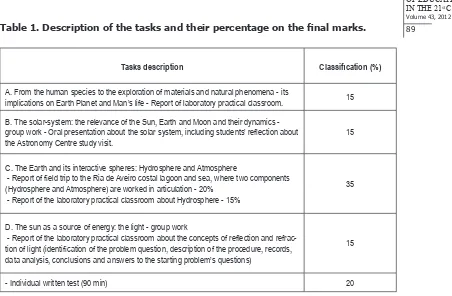
Table 1. Description of the tasks and their percentage on the final marks.
Tasks description Classification (%)
A. From the human species to the exploration of materials and natural phenomena - its
implications on Earth Planet and Man’s life - Report of laboratory practical classroom. 15 B. The solar-system: the relevance of the Sun, Earth and Moon and their dynamics -
group work - Oral presentation about the solar system, including students’ reflection about
the Astronomy Centre study visit. 15
C. The Earth and its interactive spheres: Hydrosphere and Atmosphere
- Report of field trip to the Ria de Aveiro costal lagoon and sea, where two components (Hydrosphere and Atmosphere) are worked in articulation - 20%
- Report of the laboratory practical classroom about Hydrosphere - 15%
35
D. The sun as a source of energy: the light - group work
- Report of the laboratory practical classroom about the concepts of reflection and refrac -tion of light (identifica-tion of the problem ques-tion, descrip-tion of the procedure, records, data analysis, conclusions and answers to the starting problem’s questions)
15
- Individual written test (90 min) 20
the tasks performed by each group of students were first assessed by teachers and the self and peer assessment made by each element of the group has also been considered. the final mark to be given to each student (of the same group) depends on a factor determined by an algorithm that enhances the self and peer assessment. the classification obtained by the self assessment has a weight of 30% and the average mark of the peer assessment has a weight of 70%. the score of each student is then divided by the highest score (assigned to the group elements). the final result is a dimensionless factor between 0 and 1 for each group member, which multiplies the scores given by the teachers. then, it is found the mark obtained by each group member accordingly.
Sample of Research
the empirical study involved the curricular unit “nature integrated sciences i” (nis i) for the course of primary school teachers of the 1st cycle of higher education at the university of aveiro, in the edition of 2010/11. from the 85 students enrolled in the curricular unit, a total of 65 (76.4%) responses were submitted and analyzed.
Instrument and Procedures
most questions were closed questions that were analyzed using quantitative techniques, namely descriptive statistics, and for that purpose microsoft excel was used. the content of the open questions was analyzed using nud*dist (non-numerical unstructured data indexing, searching and theorizing). this process was made by two different researchers in order to validate the chosen categories.
Results of Research
having in mind the main research question: how collaborative work and peer assessment strategies used during the higher education course may develop students’specific competencies develop students’ specific competencies that will be widely necessary for the construction of knowledge as future teachers, specifically concerning science teaching in primary education?, We will present the main results of the research.
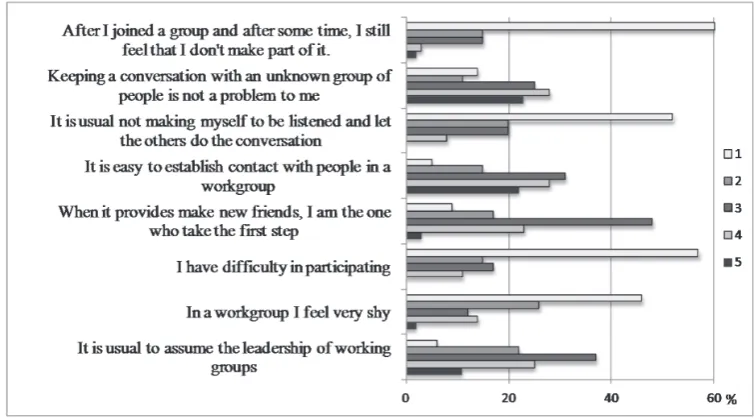
With regard to attitudes toward collaborative work (figure 1), the majority of students (between 46 and 60%) disagreed with the statements of the difficult integration into a workgroup, such as shyness, difficulty of participating, do not listen to a group, or feel that he/she is not part of the group, even after some time of him/her integration.
Figure 1: Students’ opinion (in percentage) about their attitudes towards the collaborative work, in a 1 to 5 scale of agreement (N=65).
about 52% stated high agreement about the fact of not having any problem in keeping a conversation with a group of people who do not know, or because they feel sure of themselves, making it easy to establish contact with people in a workgroup (50% gave high agreement), revealing that, when it provides make new friends, is him/herself who takes the first step. although the majority do not feel very shy in a group, and only 36% of students gave high agreement with the last sentence, revealing that it is usual to assume the leadership of working groups.
problems of education in the 21st century Volume 43, 2012 91
Figure 2: Students’ opinion (in percentage) about their attitudes towards the implemented assessment strategies, in a 1 to 5 scale of agreement (N=65).
most students also states do not feeling uncomfortable when knowing the peer assessment concerning their work colleagues (74% attributed the classification 1 or 2). the majority (60%) does not agree (score of 1 or 2) that collaborative work should be classified by assigning the same grade to all group members. they also refer considerably (69% showed high agreement) that collaborative work should be evaluated by teachers, students and their colleagues, and does not agree (66%, giving a rate of 1 or 2) that collaborative work should only be assessed by teachers.
on the other hand, 37% of students highly agreed that they feel uncomfortable when assessing their colleagues’ work. this discomfort may be related to their shyness and reserve, since the group members have a friendly relationship that could be affected by the classification that was assigned by their colleagues. furthermore 67% showed high agreement with the satisfaction regarding the peer assessment of their own workgroup.
it is also of a wide importance to understand what the main perspectives of students are, when they enroll in this course. it could be only to complete a course and get a degree, or more than that, they attend a course as an opportunity to research, to read, to collaborate where assessment is equally important for their professional life. furthermore, as stated by draper (2007), teachers of higher education tend to assume that their students have their well-defined choices. in this case, it is noted that this curricular unit is mandatory, not optional, and some students could not feel motivated by the proposed themes.
students (48) considers that the practical classrooms that involved field trips and study visits are very interesting, since it “allowed us to make contact with the real life” and “allowed us to put in practice what we have learned.” in addition, seven students indicated that the assessment method was a positive aspect because it allows to “evidence who have (or have not) actively participated in the works.”
Discussion
it is vital to promote the science teaching as it is also important to rethink the framework of teaching and learning. the development of a knowledge articulated vision, based on the connections between the various traditional disciplines, such as physics, chemistry, biology or geology, is other pertinent issue. it is important that formal science education occur in diverse it is important that formal science education occur in diverseit is important that formal science education occur in diverse learning environments (membiela, 2001), such as in the field, in museums, in the classroom, in the laboratory, among others. therefore, it is needed that teachers could be able to operate in these learning environments, and it is also needed to follow a holistic model that relate the outside classroom environment with the classroom context, as well as relate different learning environments.
Given that some students reported that self and peer assessment within groups should be sent only to teachers, without colleagues being aware of the classifications, it is worrying the poor evaluation culture evidenced among the community of students (as reported by pombo, loureiro & moreira, 2010), who will certainly continue in their future practice, as the students of this curricular unit will be education professionals in the future. these results are in accordance to the results reported in the previous peer assessment evaluation made in this curricular unit (pombo et al., 2009). as stated mellado & González (2000), it is known that teachers tend to teach the way they were taught, noting that past experiences influence the teachers’ conceptions which in turn influence the way they teach and what they teach. so, it is important that teachers experience a training course which includes assessment following a sts perspective so that they will include those in their future practices (carvalho & Gil-pérez, 1995).
What we intend to develop with this curricular unit is a scientific understanding of a wide range of issues of daily life that are supposed to be appealing to students. however, a contribution to the scientific interpretation requires the convergence of different aspects of knowledge that are not separately available in any specific area of science.
the implemented assessment strategies, allowing students to have an active role in the teaching and learning process, was also considered as a positive factor. suggestions for improvement are: to reduce the number of assessment tasks and to increase the time to do them, nevertheless students consider them very important for the development of their skills as future teachers in basic education.
problems of education in the 21st century Volume 43, 2012 93
Conclusions
in conclusion, we believe that it was extremely important to gather the students’ opinion about the curricular unit, particularly regarding their interest for the themes, their learning outcomes, the developed activities, the collaborative work and their assessment practices, since it allowed a formative evaluation of the course in order to improve it in future editions.
in short, we believe it is important to have the students’ feedback, to increase the quality of education, considering that teaching at higher education in portugal, traditionally, tends to be a teaching act-centered, not always under evaluation, especially when it includes innovative practices (carvalho, 2006).carvalho, 2006)., 2006).
in accordance with european guidelines (enQa-eu, 2005), it is expected that higher education will increase its standards of quality and efficiency in a sustained and growing way, as essential goals for the european area of education and training. the answer to this challenge is also supported by evaluation studies of teaching and learning which should occur regularly.
Acknowledgements
the authors would like to thank the students enrolled in the “nature integrated sciences i” (nis i) curricular unit, attending the course of primary school teachers of the 1st cycle of higher education at the university of aveiro, in the edition of 2010/11, who kindly participated in this study. We also would like to thank the research centre for didactics and technology in teacher education.
References
blin, f., & munro, m. (2008). Why hasn’t technology disrupted academics’ teaching practices? understanding resistance to change through the lens of activity theory. Computers & Education, 50, 475-490.
boud, d., & falchikov, n. (2007). Rethinking Assessment in Higher Education: Learning for the Longer Term, routledge, new york, ny.
brown, J. s., collins, a., & duigard, p. (1989). situated cognition and the culture of learning. Educational Researcher, 1, 32-41.
carvalho, a. m. p., & Gil-pérez, d. (1995). Formação de Professores de Ciências. são paulo: cortez editora.
carvalho, c. V. (2006). E-learning e formação avançada. Casos de sucesso no Ensino Superior da Europa e América Latina. porto: edições politema.
draper, s. W. (2007). a momentary review of assessment principles, reap conference – assessment design for learner responsibility, 9-31 may, 2007.
enQa-eu (european association for Quality assurance in higher education) (2005). standards and Guidelines for Quality assurance in the european higher education area. helsinki, 41p. Joordens, s., shakinaz desa, s., & paré, d. (2009). the pedagogical anatomy of peer-assessment:the pedagogical anatomy of peer-assessment:
dissecting a peerscholar assignment. Journal of Systemics, Cybernetics and Informatics, 7 (5), 11-15.
lave, J., & Wenger, e. (1991). Situated learning: Legitimate Peripheral Participation. cambridge:cambridge: cambridge university press.
martins, i. p. (2002). Educação e Educação em Ciências. aveiro: universidade de aveiro, departamento de didáctica e tecnologia educativa.
Formación científica para la ciudadanía. madrid: narcea s.a. ediciones.
naismith, l., pilkington, r., lee, b. h., & Weeden, p. (2007). ecoWiki- evaluating collaborative and constructive learning with Wikis, final report, university of birmingham. retrieved 9/05/2012, from http://portal.cetadl.bham.ac.uk/msprojects/lists/publication%20library_reviews/ secondary_school_review.pdf
ozogul, G., olina, Z., & sullivan, h. (2008). teacher, self and peer evaluation of lesson plans written byteacher, self and peer evaluation of lesson plans written by preservice teachers. Education Tech Research Dev, 56, 181-201.
peng, J. (2008). peer assessment in an efl context: attitudes and correlations. in: Proceedings of the Second Language Research Forum, pp. 89-107. cascadilla proceedings project, somerville, ma.
pombo, l., abelha, m., caixinha, h., marques, l., & costa, n. (2007). formação contínua de professores de ciências – de uma abordagem presencial para um contexto online. in Relatos de práticas: a voz dos actores da Educação em Ciência em Portugal, J.b. lopes & J.p. cravino (eds), minerva transmontana, Vila real, 98- 102p.
pombo, l., loureiro, m. J., & moreira, a. (2010). assessing collaborative work in a higher educationassessing collaborative work in a higher education blended learning context: strategies and students’ perceptions. Educational Multimedia International. 47(3), 217-229.
rodrigues, a. V., pombo, l; marques, l., santos, l., talaia, m., costa, J. a., & martins, i. p. (2006). uma abordagem integrada de ciências na formação de professores do 1º ciclo do ensino básico. in: Proceedings of “IV Seminario Ibérico de Ciencia Tecnologia Sociedad en la Educación Cientifica”, 3-5th July, málaga.
rourke, a. J., mendelssohn, J., coleman K., & allen, b. (2008). did i mention it’s anonymous? the triumphs and pitfalls of online peer review. in hello! Where are you in the landscape of educational technology? in: Proceedings Ascilite Melbourne 2008. http://www.ascilite.org.au/conferences/ melbourne08/procs/rourke.pdf
topping, K. J. (2008). peer assessment. Theory Into Practice, 48 (1), 20-27.
Van den berg, i., admiraal, W., & pilot, a. (2006). designing student peer assessment in higher education: analysis of written and oral peer feedback. Teaching in Higher Education, 11 (2), 135-147.
Advised by Laima Railiene, University of Siauliai, Lithuania
received: May �1, 2012�1, 2012, 2012 accepted: June 12, 2012 12, 201212, 2012, 2012
Lúcia Pombo PhD, Auxiliary Researcher, University of Aveiro, Campus Universitário de Santiago, 3810-193 Aveiro, Portugal.
E-mail: [email protected]
Website: http://www.ua.pt/de/PageText.aspx?id=13061
Mário Talaia PhD, Auxiliary Professor, University of Aveiro, Campus Universitário de Santiago, 3810-193 Aveiro, Portugal.
E-mail: [email protected]